Author: Dhruv Singh

  • Best Data Analytics Certification Guide for 2026

    Best Data Analytics Certification Guide for 2026

    A few years ago, becoming a Data Analyst usually required a formal degree in statistics, mathematics, or computer science. Today, the path has changed.

    However, with the rise of online learning platforms and industry certifications, many professionals are entering the data analytics field through certifications instead of traditional degrees.

    But here’s the catch. Not every certification teaches the same skills, and not every program is recognized by employers. Some certifications focus on foundational analytics concepts, while others specialise in tools like SQL, Python, Power BI, Tableau, or cloud analytics platforms.

    Choosing the wrong certification can mean spending months learning something that doesn’t actually help you move forward in your career.

    That’s why this blog is designed to help you make a smarter choice.

    In this Best Data Analytics Certification Blog for 2026, we’ll explore the top certifications available today, compare their cost and benefits, and help you identify which program aligns best with your career goals.


    Top Data Analytics Certifications to Consider in 2026

    According to the recent data and reports, Data Analytics has become one of the fastest-growing career fields in the world. Companies across industries, from finance and healthcare to e-commerce and marketing, are using data to make smarter decisions. Data Analytics Certifications have become a popular way for professionals to prove their skills and enter this field.  

    In 2026, there are dozens of certification programs available. Some are designed for complete beginners. However, others are meant for experienced analysts who want to specialize in tools like Python, SQL, Tableau, or Power BI.  

    The best Data Analytics Certification can help you: 

    • Learn practical Data Analysis skills 
    • Build a strong portfolio for job applications 
    • Increase your chances of landing a data analyst role 
    • Improve your salary potential 
    • Gain industry-recognized credentials 

    Below is a comparison of some of the certified Data Analyst Certifications in 2026. This includes their duration, cost, key skills covered, and industry recognition. 

    Certification Name Best For Duration Cost Key Skills Covered Exam Required Salary Impact Industry Recognition 
    Google Data Analytics Certificate Beginners 6 months $49/monthSQL, spreadsheets, data cleaning, data visualization No formal exam High for entry-level roles Very high 
    IBM Data Analyst Professional Certificate Beginners 3–6 months $49/month Python, SQL, Excel, visualization No Moderate to high High 
    Microsoft Power BI Data Analyst (PL-300) Intermediate 12 months $165 Power BI, data modeling, dashboards Yes High Very high 
    Tableau Desktop Specialist Intermediate2–3 months $200 Tableau dashboards, visual storytelling Yes Moderate High 
    AWS Certified Data Analytics – Specialty Advanced professionals 3–6 months $300 exam Big data, AWS analytics tools Yes Very high Very high 
    ComptiaIntermediate 2-4 months~$239 exam feeData concepts, visualization, data governanceYes Moderate High 
    Cloudera Certified Associate Data AnalystIntermediate professionals3-4 months ~$295 exam feeSQL analytics, big data tools, Hadoop ecosystemYes High High
    DASCA’s Data Analyst Certificate Beginners 2-3 months ~$585 exam feeData analytics fundamentals, statistics, and data interpretationYes Moderate Moderate to High 


    Top Entry-Level Data Analytics Certifications for Beginners 

    If you are completely new to Data Analytics, entry-level certifications are the best place to start. These programs are designed for people who do not have prior experience in data analysis, programming, or statistics. 

    Beginner certifications focus on teaching the core fundamentals of data analytics, such as: 

    • Understanding datasets 
    • Cleaning and organizing data 
    • Basic statistical concepts 
    • Using spreadsheets like Excel or Google Sheets 
    • Writing simple SQL queries 
    • Creating basic data visualizations 

    Here are two of the most popular beginner certifications in 2026:

    Google Data Analytics Professional Certificate

    This certification is one of the most beginner-friendly programs available. It covers the entire data analysis process. It teaches everything, from collecting data to presenting insights. Many people use it as their first step toward a career as a data analyst. 

    IBM Data Analyst Professional Certificate

    IBM’s certification focuses on practical tools such as Python, SQL, Excel, and data visualization platforms. It also includes hands-on projects, which help learners build a portfolio. Entry-level certifications usually take 3 to 6 months to complete. It depends on how much time you dedicate each week. 

    DASCA Associate Data Analyst Certification

    The DASCA Associate Data Analyst Certification is designed for beginners who want a strong foundation in analytics concepts. It focuses on data interpretation, statistical analysis, and data-driven decision making.

    This certification is useful for professionals who want to build core analytical thinking skills before moving to advanced data analytics tools.

    CompTIA Data+

    The CompTIA Data+ certification is another entry-level option that focuses on data analytics fundamentals. It covers data concepts, data mining, visualization techniques, and data governance.

    This certification is useful for beginners who want to understand how data is collected, analysed, and used in business decision-making.

    For people switching careers, from marketing, finance, HR, or operations, these certifications provide a structured path into the data analytics field. Some learners also combine certifications with practical bootcamp training to gain hands-on project experience.

    Advanced Data Analytics Certifications for Experienced Professionals 

    Once you have basic analytics skills, advanced certifications help you deepen your technical expertise and increase your career opportunities. 

    These certifications are typically designed for professionals who already understand: 

    • Data analysis concepts 
    • SQL queries 
    • Data visualization 
    • Basic statistics 

    Advanced certifications focus on more complex topics, including: 

    • Large-scale data processing 
    • Data modeling 
    • Machine learning concepts 
    • Cloud analytics platforms 
    • Advanced business intelligence tools 

    AWS Certified Data Analytics Certification 

    The AWS Certified Data Analytics Certification is designed for professionals who work with large-scale data in cloud environments. It focuses on using AWS tools to collect, process, store, and analyse big datasets. This certification validates skills in cloud-based data pipelines, data processing, and analytics solutions widely used by modern data-driven organizations. 

    Microsoft Power BI Data Analyst Certification 

    The Microsoft Power BI Data Analyst Certification (PL-300) focuses on turning raw data into meaningful business insights. It covers data modeling, report creation, and building interactive dashboards. Since Power BI is widely used in organizations for business intelligence, this certification helps professionals demonstrate their ability to analyze and present data effectively. 

    Cloudera Certified Associate (CCA) Data Analyst

    The Cloudera Certified Associate Data Analyst certification focuses on working with large datasets using SQL and big data platforms.

    It is particularly useful for professionals who want to work with big data environments, Hadoop ecosystems, and large-scale analytics systems used by many enterprise organizations.

    Specialized Certifications for Data Analytics Tools 

    In the data analytics industry, knowing specific tools can significantly increase your employability. Many companies hire analysts based on their expertise in popular analytics platforms and software. 

    This is where tool-based certifications become important. These certifications focus on mastering specific tools used by analysts every day. 

    Tableau Desktop Specialist Certification 

    The Tableau Desktop Specialist Certification validates your ability to work with data using Tableau. It focuses on connecting datasets, preparing data, and creating clear visualizations and dashboards. This certification is ideal for beginners who want to prove their data visualization skills and demonstrate the ability to present insights through interactive charts and reports. 

    Microsoft Power BI Data Analyst Certification 

    The Microsoft Power BI Data Analyst Certification (PL-300) proves your ability to transform raw data into meaningful business insights. It covers data preparation, data modeling, DAX calculations, and building interactive dashboards. This certification is widely valued because Power BI is a leading business intelligence tool used by organizations worldwide. 

    Learn SQL, Python, and dashboards in our practical Data Analytics Bootcamp.

    Do Certifications Alone Get You a Job?

    Certifications can definitely open doors, but they are rarely enough on their own to get you hired. Employers today want proof that you can actually work with data in real situations.

    A certification shows that you understand concepts like data cleaning, visualization, SQL, or Python. But what really makes a difference is how you apply those skills. Hiring managers often look for practical experience, such as projects, case studies, or portfolios where you’ve solved real business problems using data.

    For example, if you have a Google or IBM certification but no hands-on projects, you may still struggle in interviews. On the other hand, someone with fewer certifications but strong real-world projects can stand out more.

    To improve your chances of getting hired, you should:

    • Build a portfolio with 2–3 real data projects
    • Work on datasets from platforms like Kaggle
    • Create dashboards using Power BI or Tableau
    • Share your work on LinkedIn or GitHub

    Data Analytics Certification Cost, Salary Impact, and ROI in 2026 

    Before investing in a data analytics certification, it is important to understand the cost involved, the potential salary growth, and the return on investment (ROI). While certifications require time and money, they can significantly improve job opportunities and earning potential for professionals entering or advancing in the data analytics field. 

    Certification Cost Breakdown by Provider 

    Different providers offer data analytics certifications at different price points depending on course depth, platform, and exam requirements. Below is a comparison of some of the most recognized certifications in 2026. 

    Certification Provider Cost Structure Estimated Total Cost 
    Google Data Analytics Certificate Google / Coursera $49per month ~$150–$300 
    IBM Data Analyst Professional Certificate IBM / Coursera $49 per month subscription ~$150–$300 
    Microsoft Power BI Data Analyst (PL-300) Microsoft One-time exam fee ~$165 
    Tableau Desktop Specialist Tableau One-time exam fee ~$100 
    AWS Certified Data Analytics – Specialty Amazon Web Services One-time exam fee ~$300 
    CompTIA Data+CompTIAOne-time exam fee
    ~$239
    Cloudera Certified Associate (CCA) Data AnalystClouderaOne-time exam fee~$295
    DASCA Associate Data Analyst CertificationDASCSAOne-time exam fee~$585

    Average Salary Growth for Certified Data Analysts 

    Certifications can significantly improve career prospects by validating technical skills that employers look for in data professionals. Many certified analysts experience higher earning potential compared to non-certified professionals. 

    Experience Level         Average Salary Range 
    Impact of Certification
    Entry-Level Data Analyst $58,000 – $81,000 Certification helps secure the first analytics role
    Certified Entry-Level Analyst $47,000 – $81,000 10–20% salary increase potential
    Mid-Level Data Analyst $77,000 – $116,000 Higher growth with tool-based certifications 
    Specialized Analytics Roles $100,000+ Skills in Power BI, Tableau, Python, SQL increase value 
    Big Data Analytics Professionals $160,000 – $128,000+ Advanced certifications can significantly boost salary

    If you’re comparing analytics careers, you can also read up on Data Analyst vs Data Scientist Salary to understand how these roles differ in terms of compensation.

    How to Calculate the ROI of a Data Analytics Certification 

    Return on investment (ROI) helps to determine whether the time and money spent on a certification will provide meaningful career benefits. 

    1. Start by calculating the total cost of the certification, including course fees and exam fees. 
    2. Then, estimate the potential salary increase after gaining certification. 
    3. You need to compare the certification cost with the expected increase in annual income. 
    4. Lastly, consider additional benefits such as better job opportunities and career growth. 

    In many cases, professionals recover the certification cost within the first few months of employment or promotion. You can also consider the  Data Analyst Bootcamp with AI  to get ROI in a very short amount of time. 

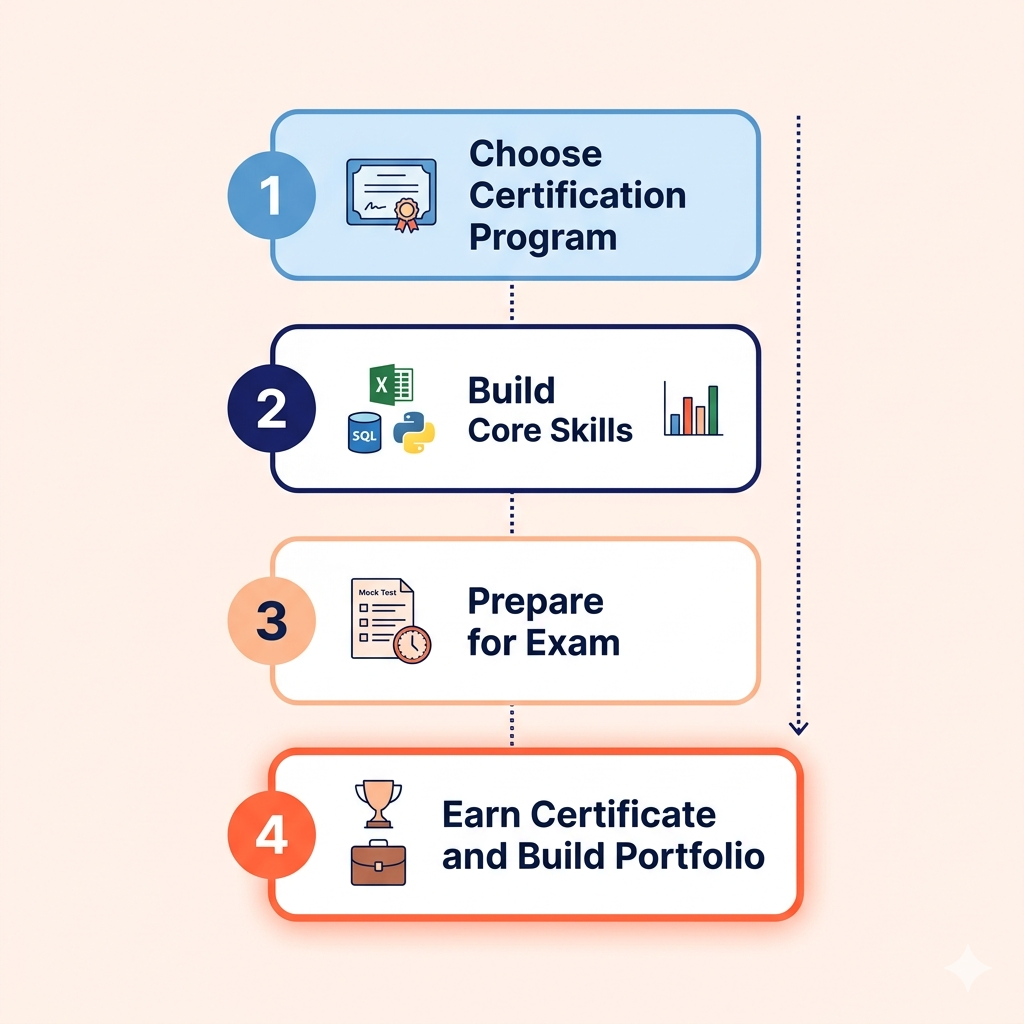
    Step-by-Step Guide to Becoming a Certified Data Analyst 

    Becoming a certified data analyst requires learning the right tools, gaining practical experience, and earning a recognised certification. 

    Following a structured approach can help you build the skills needed to enter the field of data analytics and demonstrate your expertise to potential employers.

    1. Choose the Right Certification Program 

    You need to start by selecting a certification that matches your current skill level and career goals. 

    Tip: Beginners can start with programs like the Google Data Analytics Certificate or IBM Data Analyst Professional Certificate to build foundational knowledge. 

    2. Build Core Skills  

    Strong data analysts are comfortable working with spreadsheets, databases, programming, and visualization tools. Learn skills in Excel, SQL, Python, and Data Visualization from a certified Data Analyst Bootcamp

    Example: Practice analyzing datasets in Excel or SQL, then create dashboards using Power BI or Tableau to present insights. 

    3. Prepare for the Certification Exam 

    Review the official exam syllabus and practice solving real data analysis problems before attempting the exam. 

    Tip: Use mock tests and sample datasets to understand how questions are structured and improve your confidence. 

    4. Complete the Certification and Build Your Portfolio 

    After earning your certification, showcase your skills by building projects and sharing them with employers. 

    Example: Create a dashboard using public datasets and publish it on GitHub or LinkedIn to demonstrate your practical analytics abilities. 

    Before choosing a certification, it’s helpful to understand the long-term career demand. A guide on Data Analyst Job Outlook explains how the role is growing across industries.

    gf 1 Best Data Analytics Certification Guide for 2026

    Should You Do a Bootcamp Before Getting Certified?

    If you’re starting from scratch, a Data Analytics Bootcamp can save you months of confusion. It gives you structure, real projects, and clarity on how things actually work in a real business environment. 

    Certifications validate your knowledge, but bootcamps build your ability to apply it. That’s why many learners struggle when they jump straight into certifications without hands-on practice.

    If you already have basic exposure, you can go directly for certification. But if not, starting with a practical program makes the journey much smoother and more job-focused.

    Many professionals begin with a structured  Data Analytics Bootcamp from Skillify Solutions, where they learn to manage teams, deliver projects, and work in Agile environments. This kind of practical exposure makes certifications easier and much more valuable later.

    A strong path most professionals follow today:

    Learn → Build Real Skills → Get Certified → Apply with Confidence

    Conclusion 

    It can be concluded that Data analytics is one of the most promising career paths today. However, getting started can feel overwhelming because there are so many certification options available.

    The best approach is simple. Start with a certification that matches your current skill level, learn the core tools, and gradually build your expertise.

    Working on projects, exploring datasets, and creating dashboards will help you stand out in the job market. Many learners also choose guided learning programs or bootcamps to accelerate their progress. For example, training platforms like Skillify Solutions help learners combine certifications with practical projects and real-world analytics skills. 

    Take the first step, stay consistent, and your journey into data analytics can begin sooner than you think.

    Become a job-ready data analyst through our structured Data Analytics Bootcamp.

    Frequently Asked Questions 

    1. Can I get a job with just a certification and no degree?

    Yes, you can get a data analytics job with a certification and no degree if you have skills. By showcasing real-world projects, you prove to employers that you can translate complex data into actionable business insights.

    2. How long does it take to get a data analytics certification?

    Most data analytics certifications take 2 to 6 months to complete, depending on the program and how many hours you study each week.

    3. Can I get a data analytics certification without a degree?

    Yes. Many certifications, like Skillify Solutions, Google Data Analytics, and IBM Data Analytics, are designed for beginners and do not require a college degree.

    4. Do data analytics certifications expire?

    Some certifications expire after 2–3 years, especially tool-based or cloud certifications like AWS or Microsoft. Others may remain valid without renewal.

    5. Is data analytics certification worth it for career changers?

    Yes. Certifications help career changers learn practical analytics skills, build a portfolio, and enter data-related roles faster.

  • Top Data Analytics Companies to Watch in 2026

    Top Data Analytics Companies to Watch in 2026

    A few years ago, companies relied mostly on instinct and experience to make business decisions.Today, the smartest companies rely on data.

    But having data alone isn’t enough. The real challenge is knowing how to analyze it, interpret it, and turn it into decisions that move the business forward.

    That’s where Top Data Analytics Companies play a critical role. They help businesses turn messy spreadsheets, customer behaviour data, and operational numbers into insights that actually guide decisions. These firms combine technology, AI, and analytics expertise to help organisations uncover patterns, predict trends, and make smarter strategic decisions.

    In this blog, we take a closer look at the top data analytics companies to watch in 2026 and how these organizations are helping businesses unlock the true value hidden inside their data.

    Top Data Analytics Companies Transforming Business Intelligence in 2026 

    Data analytics has become a critical capability for organizations looking to improve decision-making, optimize operations, and uncover new business opportunities. Leading analytics companies combine data engineering, artificial intelligence, machine learning, and business intelligence tools to help businesses turn raw data into actionable insights. 

    The companies listed below are widely recognized for delivering enterprise analytics solutions, data platforms, consulting services, and AI-driven insights across industries such as finance, healthcare, retail, and technology. 

    Selection Criteria 

    • The companies in this list were selected based on the following factors: 
    • Global reputation in data analytics and business intelligence services 
    • Strong enterprise client base and consulting capabilities 
    • Advanced analytics technologies, including AI, machine learning, and cloud data platforms 
    • Industry recognition from reports, analyst rankings, and enterprise adoption 

    Learn Data Analytics and unlock high-demand career opportunities today.

    Quick Comparison Table  

    Company Headquarters Core Expertise Key Strength 
    Accenture Ireland Data analytics consulting Large-scale enterprise transformation 
    Deloitte USA Analytics consulting and strategy Business intelligence and advisory 
    IBM USA AI, analytics platforms Watson AI and enterprise data solutions 
    Capgemini France Data engineering and analytics Cloud-based analytics transformation 
    PwC UK Business analytics consulting Data-driven business strategy 
    Teradata USA Data warehousing Enterprise-scale analytics platforms 
    SAS USA Advanced analytics software Statistical analytics and predictive modeling 
    Alteryx USA Data analytics automation Self-service analytics platform 
    MicroStrategy USA Business intelligence Enterprise analytics dashboards 
    Databricks USA Big data and AI platforms Lakehouse architecture for analytics 

    Leading Enterprise Data Analytics Companies in 2026 (Global Rankings #1–5) 

    1. Accenture 

    image 14 Top Data Analytics Companies to Watch in 2026

    Accenture is a global professional services company. It provides a wide range of data analytics, artificial intelligence, and digital transformation services to organizations across industries. 

    The company helps businesses modernize their data infrastructure, build data-driven strategies, and generate insights. All these help to improve decision-making and operational efficiency. Students from the certified Data Analyst Bootcamp get placed here due to a strong foundation and advanced techniques. 

    • Work: Offers AI, cloud, and data analytics solutions with a strong focus on data strategy, advanced analytics, and AI-driven automation. 
    • Scope: Helps enterprises transform raw data into actionable insights that drive innovation, efficiency, and business growth. 
    • Size: 700,000+ employees globally 

    2. Deloitte 

    deloite Top Data Analytics Companies to Watch in 2026

    Deloitte is one of the largest global consulting firms offering data analytics, business intelligence, and AI-powered advisory services. The company works with enterprises to build analytics capabilities that support strategic decision-making and digital transformation initiatives. 

    • Work: Provides data analytics consulting, AI implementation, and business intelligence solutions. 
    • Scope: Helps organizations leverage data for strategic planning, operational improvement, and risk management. 
    • Size: 450,000+ employees globally 

    3. IBM 

    image 15 Top Data Analytics Companies to Watch in 2026

    IBM is a technology leader known for its enterprise data analytics platforms and AI-powered solutions. Through technologies such as IBM Watson and hybrid cloud analytics platforms, the company helps organizations analyze large datasets and build predictive models. 

    • Work: Develops AI-driven analytics platforms, data management systems, and enterprise AI solutions. 
    • Scope: Supports businesses in building predictive analytics capabilities and data-driven decision systems. 
    • Size: 280,000+ employees globally 

    4. Capgemini 

    capgemini Top Data Analytics Companies to Watch in 2026

    Capgemini is a global consulting and technology services company specializing in data engineering, cloud analytics, and AI-driven business transformation. The company helps organizations modernize their data architecture and implement scalable analytics solutions. 

    • Work: Provides data engineering, big data analytics, and cloud-based analytics services. 
    • Scope: Enables organizations to adopt modern data platforms and advanced analytics strategies. 
    • Size: 350,000+ employees globally 

    5. PwC 

    pwc Top Data Analytics Companies to Watch in 2026

    PwC (PricewaterhouseCoopers) is a global professional services network offering data analytics consulting and business intelligence solutions. The firm focuses on helping organizations use data to improve risk management, compliance, and strategic decision-making. 

    • Work: Delivers analytics consulting, data strategy development, and business intelligence solutions. 
    • Scope: Helps enterprises transform data into insights that support financial planning and operational efficiency. 
    • Size: 360,000+ employees globally 

    Top Specialized Data Analytics Platforms and Technology Leaders in 2026 (Global Rankings #6–10) 

    6. Teradata 

    image 16 Top Data Analytics Companies to Watch in 2026

    Teradata is a leading provider of enterprise data warehousing and analytics platforms. Its solutions help organizations store, process, and analyze massive volumes of structured and unstructured data for business insights. 

    • Work: Provides cloud-based data warehousing, advanced analytics platforms, and big data processing tools. 
    • Scope: Enables organisations to analyze large-scale datasets and improve data-driven decision-making. 
    • Size: ~8,000 employees globally 

    7. SAS 

    image 17 Top Data Analytics Companies to Watch in 2026

    SAS is a well-established analytics software company specializing in advanced analytics, statistical modeling, and predictive analytics solutions. Its tools are widely used in industries that rely on complex data analysis. 

    • Work: Offers analytics software for predictive modeling, risk analysis, and data visualization. 
    • Scope: Helps businesses detect patterns, forecast trends, and improve strategic decision-making. 
    • Size: ~12,000 employees globally 

    8. Alteryx 

    image 12 Top Data Analytics Companies to Watch in 2026

    Alteryx provides a powerful self-service analytics platform that allows users to prepare, blend, and analyze data without extensive coding knowledge. It is widely used by organisations looking to automate data workflows and accelerate analytics processes. 

    • Work: Develops analytics automation platforms for data preparation and advanced analytics. 
    • Scope: Helps analysts quickly transform raw data into insights using automated workflows. 
    • Size: ~2,500 employees globally 

    9. MicroStrategy 

    image 12 Top Data Analytics Companies to Watch in 2026

    MicroStrategy is a business intelligence company known for its enterprise analytics and data visualization platforms. Its software enables organizations to build interactive dashboards and deliver real-time insights across the enterprise. 

    • Work: Provides BI tools, analytics dashboards, and enterprise reporting platforms. 
    • Scope: Enables organizations to monitor business performance through advanced data visualization. 
    • Size: ~2,000 employees globally 

    10. Databricks 

    image 13 Top Data Analytics Companies to Watch in 2026

    Databricks is a fast-growing data and AI company that offers a unified platform for data engineering, analytics, and machine learning. Its Lakehouse architecture combines the benefits of data lakes and data warehouses, enabling organizations to process massive datasets efficiently. 

    • Work: Provides unified data and AI platforms for analytics, machine learning, and big data processing. 
    • Scope: Helps enterprises build scalable analytics infrastructure and AI-driven applications. 
    • Size: ~6,000+ employees globally. 

    Key Services Offered by Leading Data Analytics Companies 

    Top data analytics companies offer a range of services that help organisations collect, process, analyse, and use data to make better business decisions. These services combine data engineering, analytics tools, and AI technologies to transform raw data into actionable insights. 

    • Data Strategy and Consulting: Data analytics firms help businesses create a clear data strategy and governance framework. This includes identifying data sources, building data architecture, and defining how data can support business goals. 
    • Business Intelligence and Visualization: Business intelligence services focus on turning complex datasets into interactive dashboards and reports. Tools like Power BI, Tableau, and MicroStrategy help organizations track performance and make faster decisions. Students can learn Business Intelligence from a certified Business Analyst Course within a very short timeline. 
    • Advanced Analytics and AI: Advanced analytics services use machine learning, predictive analytics, and AI models to uncover patterns in data. These insights help businesses forecast trends, automate decisions, and improve operational efficiency. 
    • Big Data Engineering: Big data engineering focuses on building systems that can store, process, and analyze massive datasets. Technologies such as Hadoop, Spark, and modern data platforms allow companies to handle large-scale data processing. 
    • Cloud Analytics Solutions: Cloud analytics platforms help businesses store and analyze data using cloud infrastructure like AWS, Azure, and Google Cloud. These solutions provide scalability, faster data processing, and reduced infrastructure costs. 
    • Industry-Specific Solutions: Many analytics companies develop industry-focused solutions for sectors like finance, healthcare, retail, and manufacturing. These solutions use domain-specific data models and analytics frameworks to solve industry challenges. 

    How to Choose the Right Data Analytics Company for Your Business 

    Before selecting a partner, businesses should evaluate several important factors to ensure the company can deliver reliable and scalable analytics solutions. 

    1. Industry expertise: A good analytics partner should have experience in your specific industry. Companies that understand industry challenges and data patterns can provide more relevant insights and practical solutions. 
    2. Technology compatibility: The analytics company should work with technologies that match your current systems. Compatibility with tools such as cloud platforms, data warehouses, and business intelligence software ensures smoother integration and faster implementation. 
    3. Pricing transparency: Clear and transparent pricing is essential. Businesses should look for partners that provide detailed cost structures, helping avoid hidden charges and allowing better budget planning. 
    4. Scalability factor: As data grows, analytics systems must scale accordingly. A reliable partner should provide solutions that can handle increasing data volumes and support future business expansion. 
    5. Security and compliance: Since analytics involve sensitive data, strong security practices are critical. The partner should follow industry standards for data protection and regulatory compliance. 
    6. Proven track record: Companies with successful projects, strong client portfolios, and positive industry recognition are more likely to deliver reliable analytics solutions and measurable business results. 

    Learn Python, SQL, and analytics skills employers are actively seeking from our Data Analytics Bootcamp today!

    ROI and Business Impact of Data Analytics Solutions 

    Data analytics help businesses improve decision-making, increase revenue, and reduce operational costs. The ROI of data analytics measures how much value a company gains from analytics compared to the cost of implementing analytics tools, infrastructure, and teams. Calculating ROI and operational efficiency will help you understand the Data Analyst Job Outlook in the future to make better decisions. 

    Basic ROI Formula 

    ROI (%) = (Net Benefit from Analytics − Analytics Investment Cost) ÷ Analytics Investment Cost × 100 

    Here is an example:

    Analytics investment: $100,000 Business value generated: $250,000 
    ROI = ($250,000 − $100,000) ÷ $100,000 × 100 = 150% ROI 
  • PySpark vs Pandas: A Comprehensive Guide

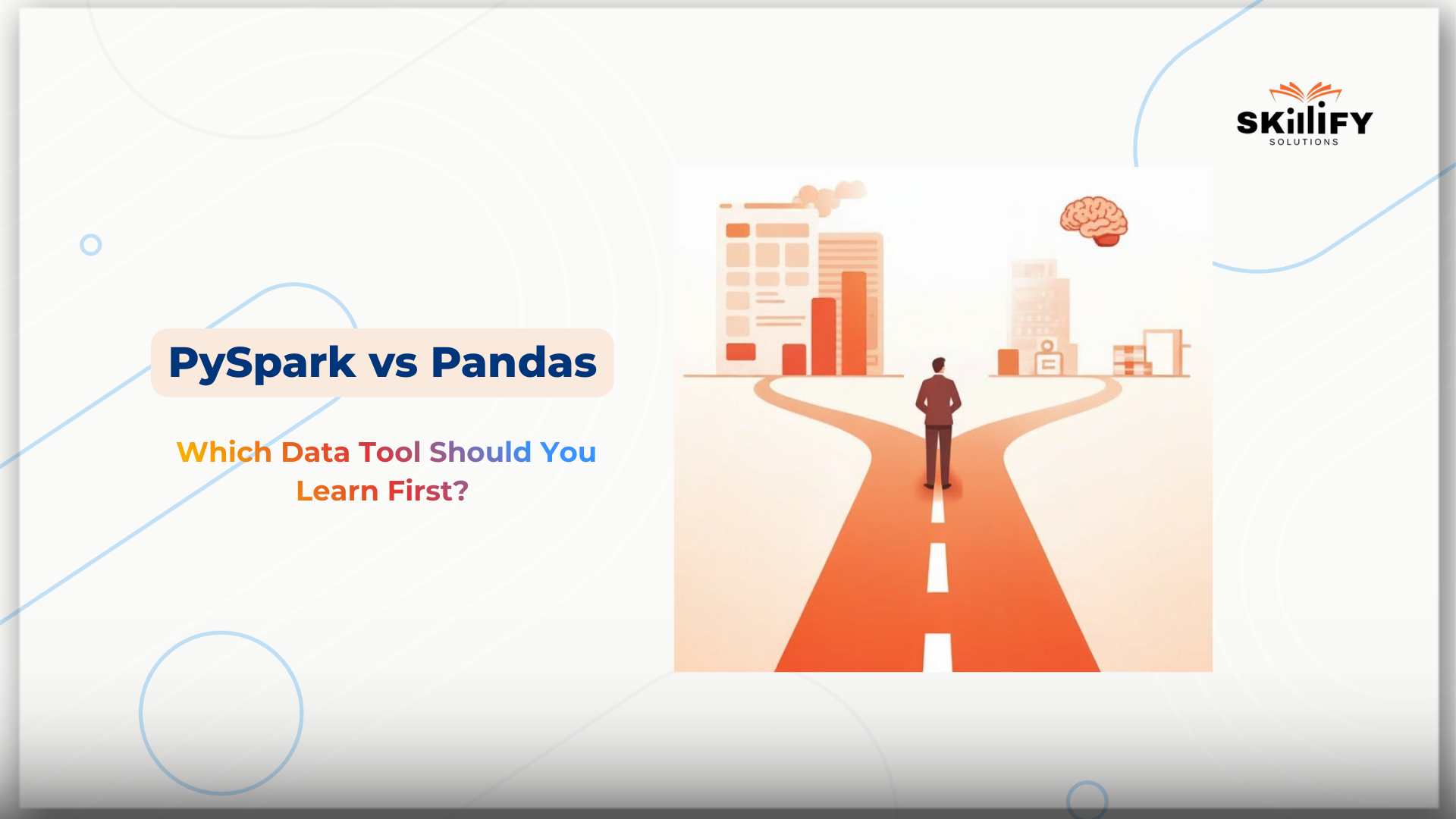
    PySpark vs Pandas: A Comprehensive Guide

    Introduction

    I still remember the first time I used Pandas, and it made me feel like a data wizard. A messy dataset, a few lines of Python, and suddenly everything made sense. Aggregations, joins, and filtering were the problems that once took hours in Excel, and now, it gets solved in minutes.

    But then I hit a wall. The dataset wasn’t 50 MB anymore. It was 20 GB.

    My notebook froze. Memory errors started appearing. And my laptop fan sounded like it was preparing for takeoff. That’s when someone suggested, “You should try PySpark.”

    At first, it felt intimidating. Distributed computing? Clusters? Spark jobs? But once I understood the concept, everything clicked. Pandas and PySpark aren’t competitors. They’re tools designed for different scales of data.

    In this blog, we’ll walk you through PySpark vs Pandas, break down how both work, where they shine, and how to decide which one is right for your data workflows. Read on to know more!

    PySpark vs Pandas: Complete Feature Comparison 

    When working with data in Python, two tools frequently come up in discussions: Pandas and PySpark. Both are powerful, but they are designed for very different scales of data processing. Pandas is widely used for data analysis on a single machine, while PySpark is built for distributed data processing across clusters. 

    Understanding the differences between them helps data professionals choose the right tool for the job. For example, analyzing a 50 MB CSV file for exploratory analysis is perfectly suited for Pandas. However, processing hundreds of gigabytes of log data from millions of users is where PySpark becomes essential. 

    The table below highlights the key differences between these two technologies across important features such as processing capability, scalability, learning curve, and cost. 

    Feature Pandas PySpark 
    Data Processing Single-machine, in-memory processing Distributed processing with a Spark cluster 
    Dataset Size Small to medium datasets (MB–GB) Very large datasets (GB–PB) 
    Processing Speed Faster for small data Faster for large data 
    Learning Curve Easy and beginner-friendly Moderate, requires Spark knowledge 
     Memory Management Uses single machine RAM Distributed memory across nodes 
    API Syntax Simple Pythonic syntax Spark DataFrame API 
    Integration Works with Python libraries (NumPy, Scikit-learn) Integrates with Hadoop, Hive, Databricks 
    Use Case Data analysis, exploration Big data processing, ETL pipelines 
    Cost Low runs on one machine Higher due to cluster/cloud resources 

    When to Use Pandas vs PySpark: Decision Framework 

    Choosing between Pandas and PySpark mainly depends on data size, infrastructure, and processing needs. Pandas work best for local data analysis, while PySpark is designed for large-scale distributed data processing. 

    When to Choose Pandas?  

    You can choose Pandas if the dataset is small to medium (MBs to a few GBs) 

    • Data can fit into single-machine RAM 
    • You need quick exploration, cleaning, or visualisation 
    • The workflow runs on a local laptop or workstation 

    You are using Python libraries like NumPy, Matplotlib, or Scikit-learn 

    For example, analyzing sales data with 100k–500k rows or cleaning a CSV file under 1 GB. If you are starting with Pandas and Python-based data analysis, the Data Science with AI Bootcamp is a strong foundation.

    When to choose PySpark? 

    Use PySpark when the dataset is large, like tens of GBs to TBs 

    • Data is stored in distributed systems like Hadoop, S3, or cloud storage 
    • You need parallel processing across multiple machines 
    • The workflow involves large ETL pipelines or big data analytics 

    For example, processing hundreds of GBs of user logs or transaction data. 

    The Break-Even Point Analysis 

    Here is a practical rule used by many data teams: 

    Data Size Recommended Tool 
    < 1–2 GB Pandas 
    2–10 GB Depends on RAM and workload 
    > 10–20 GB PySpark  

    In many real-world workflows, teams combine both tools. They recommend using PySpark for large data processing and Pandas for analysis and visualization of smaller outputs. 

    PySpark DataFrame vs Pandas DataFrame: Architecture Deep Dive 

    At a surface level, both tools work with rows, columns, filters, joins, and aggregations. The real difference is how they execute those operations. That architectural gap is what makes Pandas feel faster and simpler for local work, while PySpark becomes more practical as data size and pipeline complexity grow.  

    Pandas DataFrame Architecture 

    A Pandas DataFrame is a labelled tabular structure in Python and is the library’s core data object. It is designed to run on a single machine, and in most common workflows, the data being worked on lives in that machine’s memory. 

    That is why Pandas is so convenient for exploration, cleaning, ad hoc analysis, and model preparation on manageable datasets.  

    What this means in practice: 

    • Data is handled locally on one system 
    • Operations are typically executed immediately 
    • Performance is often excellent for small to medium datasets 
    • Scalability is limited by the machine’s RAM and CPU 

    This architecture is one reason Pandas are loved by analysts and data scientists. The syntax is compact, readable, and easy to test line by line. 

    But the trade-off is that once data becomes too large for local memory, performance drops sharply, or the workflow simply fails. That is the point where PySpark starts to make more sense. 

     If your goal is to work with business data, dashboards, and insights, the Data Analytics Programme helps you develop practical analytics skills.

    PySpark DataFrame Architecture 

    A PySpark DataFrame sits on top of Apache Spark, which Spark describes as a unified analytics engine for large-scale data processing. Spark SQL describes DataFrames as datasets organized into named columns, with richer optimizations under the hood. 

    In simple terms, PySpark DataFrames are built for distributed execution, not just local execution.  

    Instead of relying on one machine, Spark can split work across multiple executors or nodes. That gives PySpark a very different architecture: 

    • Data can be processed across a cluster 
    • Work can be split into parallel tasks 
    • Transformations are usually lazily evaluated 
    • Spark can optimize execution before running the job 

    This is the core reason PySpark is used in ETL pipelines, log processing, enterprise analytics, and cloud-scale data engineering. It is a distributed system designed to handle workloads that would be inefficient or impossible on one laptop.  

    Master Data Analysis Tools and launch your tech career today.

    Syntax Differences That Matter 

    The syntax difference is not only cosmetic. It reflects the architectural model underneath. 

    In Pandas, syntax is usually shorter and more direct because the operation is happening on one machine and is executed right away. In PySpark, syntax is a bit more explicit because Spark is building a distributed execution plan and optimizing it before running. Spark’s DataFrame API is intentionally SQL-like and designed to work with its optimization engine. 

    Let’s look at a practical way to understand it: 

    Area Pandas DataFrame PySpark DataFrame 
    Execution style Immediate in common workflows Lazy until an action triggers execution 
    Processing model Single-machine Distributed 
    Best for Analysis, cleaning, prototyping Big data pipelines, ETL, scalable processing 
    Syntax feel More Pythonic and compact More structured and Spark-oriented 

    So, when syntax feels heavier in PySpark, that is usually because Spark is doing more behind the scenes: planning, optimizing, and coordinating execution across distributed resources. That extra complexity is exactly what gives it scale. 

    Performance Benchmarks: Real-World Test Results 

    Performance differences between Pandas and PySpark become noticeable as the dataset size increases. Pandas performs very well for small datasets because it runs operations directly in memory on a single machine. Learning  Data Analytics gives you hands-on training in Python, data analysis, and real-world analytics projects.

    However, PySpark becomes more efficient when datasets grow larger because it can distribute processing across multiple machines and run tasks in parallel.  

    Another important factor is memory usage. Pandas typically load the entire dataset into memory, which can create limitations when the data grows large. PySpark, on the other hand, uses distributed processing and lazy evaluation, meaning data is retrieved and processed only when required, reducing memory pressure.  

    The following table summarizes typical benchmark patterns observed in real-world experiments. 

    Dataset Size Operation Pandas Time PySpark Time Winner 
    10 MB Filtering ~0.2 sec ~1.5 sec Pandas 
    100 MB GroupBy Aggregation ~1.8 sec ~4 sec Pandas 
    1 GB Join Operation ~30 sec ~20 sec PySpark 
    10 GB Aggregation ~9–10 min ~1–2 min PySpark 
    100 GB+ Large Join / ETL Not feasible on a single machine ~5–7 min (cluster) PySpark 

    Key Observations 

    • Small datasets (MB range): Pandas are faster because Spark has initialization overhead. 
    • Medium datasets (GB range): Performance starts to balance depending on hardware. 
    • Large datasets (10 GB and above): PySpark clearly performs better due to parallel computation and distributed processing. 

    Kickstart your Data Science Bootcamp with an AI journey with industry-ready courses.

    What are the Learning Path Recommendations? 

    If you are starting with data processing tools, the most effective path is to begin with Pandas and then move to PySpark. Pandas help you understand the fundamentals of working with data, such as filtering, grouping, joining, and transforming datasets. 

    Once those concepts are clear, learning PySpark becomes much easier because it follows a similar DataFrame concept but at a distributed scale. 

    According to practical industry workflows, Pandas is often used for local data exploration and analysis, while PySpark is adopted when teams start dealing with large-scale data pipelines and distributed systems. 

    Here is the recommended Learning Path:

    1. Start with Python fundamentals

    Learn core Python concepts such as lists, dictionaries, loops, and functions. Strong Python basics make it easier to work with data libraries. Learn Basic Python from a Data Science with AI Bootcamp to accelerate the learning process. 

    2. Learn Pandas for data manipulation

    Focus on DataFrame operations such as filtering rows, selecting columns, groupby aggregations, merges, and data cleaning. These are the building blocks of most data workflows. 

    3. Practice exploratory data analysis (EDA)

    Use Pandas with libraries like NumPy, Matplotlib, or Seaborn to explore datasets, identify patterns, and prepare data for modeling. You can start with a Data Analytics course to understand Data cleaning and transformation at a core level. 

    4. Master intermediate Pandas workflows

    Learn handling missing values, feature engineering, time-series analysis, and optimizing memory usage. These skills are essential for real-world projects. 

    5. Move to PySpark fundamentals

    Understand SparkSession, PySpark DataFrames, transformations, and actions. At this stage, you begin learning how distributed data processing works. 

    6. Understand distributed computing concepts

    Learn concepts like partitioning, lazy evaluation, and shuffling. These are critical for understanding how Spark processes large datasets efficiently. 

    7. Build real-world big data pipelines

    Work with Spark SQL, ETL pipelines, cloud storage systems, or platforms like Databricks. This is where PySpark becomes valuable for processing large-scale datasets. 

    Here is a practical Tip:

    A common workflow used by many data teams is to prototype analysis with Pandas on smaller datasets and then scale the same logic using PySpark. This is when the data becomes too large for a single machine. This combination allows teams to balance simplicity and scalability in modern data workflows. 

    Conclusion 

     If there’s one takeaway from this PySpark vs Pandas comparison, it’s this: data tools evolve as data grows.

    From this blog, it can be concluded that Pandas remains one of the most loved libraries in the Python ecosystem because it makes data manipulation incredibly simple. For small and medium datasets, it’s fast, intuitive, and extremely productive. 

    Instead of replacing Pandas, PySpark expands what you can do with data. It allows the same DataFrame-based workflows to operate across distributed systems and process datasets that would overwhelm a single machine. 

    The real advantage comes when you understand how and when to use both. Because in today’s data landscape, the professionals who thrive are the ones who can move seamlessly from local analysis to large-scale data engineering.

     Start your data career today with Skillify Solution’s industry-focused Data Analytics program!

    Frequently Asked Questions

    1. Is PySpark faster than Pandas for all datasets?

    No, PySpark is not faster for all datasets. Pandas usually performs better for small datasets because it runs directly in memory on a single machine without cluster overhead. PySpark becomes faster when datasets grow very large since it processes data in parallel across multiple machines.

    2. Can I use Pandas and PySpark together in the same project?

    Yes, Pandas and PySpark can be used together in the same project. Many data teams process large datasets using PySpark and then convert the results into Pandas for analysis, visualization, or machine learning tasks. This approach combines PySpark’s scalability with Pandas’ simplicity.

    3. What’s the minimum dataset size to justify using PySpark?

    There is no strict minimum size, but many teams consider PySpark when datasets grow beyond a few gigabytes or cannot fit comfortably in memory on a single machine. For smaller datasets, Pandas is usually simpler and faster, while PySpark becomes useful for large-scale data processing.

    4. Do I need to learn Scala to use PySpark?

    No, you do not need to learn Scala to use PySpark. PySpark allows developers to work with Apache Spark using Python. While Spark itself is written in Scala, PySpark provides a Python interface so users can write distributed data processing code using familiar Python syntax.

  • Data Science Bootcamp Cost in 2026

    Data Science Bootcamp Cost in 2026

    Introduction

    Are you thinking about enrolling in a data science bootcamp in 2026? Then you’re probably asking the real question: How much will the Data Science Bootcamp cost, and will it be worth it?  

    In 2026, bootcamp prices vary from $7,000 to $18,000, with premium programs going even higher. It is a serious investment. 

    Over the last few years, I’ve spoken with hundreds of aspiring data scientists, career switchers, fresh graduates, and engineers looking to pivot into AI. Almost all of them ask the same thing:
    “How fast will I recover my money?” 

    Here’s the reality: entry-level data roles in the US still start between $85,000 and $91,000, and many graduates break even within the first year. But not all bootcamps deliver the same outcomes. 

    In this blog, we’ll break down the real Data Science Bootcamp cost in 2026, compare it to degree programs, and help you calculate the Return on Investment (ROI), and how to decide if it’s the right move for you.  

    What is a Data Science Bootcamp?  

     A Data Science Bootcamp is an intensive, short-term training program designed to help learners gain job-ready skills. These include data analysis, machine learning, and AI within a few months. Unlike traditional degrees, bootcamps focus on practical learning, real-world projects, and career placement support rather than academic theory. 

    In 2026, bootcamps have evolved to include modern AI tools, cloud deployment, and production-level model building. They are especially popular among career switchers and professionals looking to transition into high-paying tech roles quickly. 

    Key Insights on Best Data Science Bootcamps 

    • Most bootcamps last 3-9 months and cost $7K-$18K  
    • Programs now include Generative AI, LLMs, and MLOps 
    • Employers value real projects and deployment skills over certificates. 
    • Many offer job guarantees, ISAs, or career coaching. 
    • Most graduates break even within the first year of employment. 

    How much does a Data Science Bootcamp cost: 2026 Price Comparison 

    In the global market, bootcamp prices range from under $1,000 for lean, live-online programs to over $16,000 for premium in-person immersive experiences.  

    Lower-cost programs often focus on live online instruction and mentorship. Whereas higher-priced bootcamps include extended curriculum depth, brand recognition, alumni networks, and structured career placement support. 

    Below is a clear comparison of leading Data Science bootcamps to help evaluate affordability, time investment, and career outcomes. 

    Bootcamp Cost Range Duration Level Format Payment Options Job Placement 
    Skillify Solutions $659.77 ~4 Months Beginner-Intermediate 100% Online  Upfront Yes 
    Springboard~$9,900 ~6 Months Beginner-Advanced Online Installments, Financing Job Guarantee Option 
    Flatiron School  ~$9,900 45 Weeks Beginner-Advanced Online / In-Person Financing Options Varies 
    Le Wagon Data Science and AI  ~$14,000 2 Months Intermediate Online Upfront / Financing No 
    4Geeks Academy Data Science and Machine learning  ~$9,899 3-6 Months Beginner-Intermediate Online / Hybrid Financing Available Yes 
    General Assembly Data Science Bootcamp  $16,450 12 Weeks Intermediate Online / In-Person Financing Options No 
    Data Science Dojo Bootcamp  ~$3,999+ ~16 Weeks Beginner-Intermediate Online / In-Person Upfront No 
    Techpro SMU AI and Data Science Bootcamp $9,900 15 Weeks Beginner-Intermediate 100% Online Installments No 
    Nashville Software School Data Science Bootcamp $13,125 9 Months Beginner Online Financing No 
    Tripleten Data Science Bootcamp  ~$9,700 9 Months Beginner-Intermediate Online Installments Yes (Money-back Guarantee) 

    Data Science Careers After Bootcamp: Salaries by Role 

    Completing a Data Science Bootcamp in 2026 opens multiple career paths beyond just Data Scientist. Many graduates enter roles such as Data Analyst, Machine Learning Engineer, or Data Engineer. It depends on their strengths and specialization.  

    Salaries vary by role, but most bootcamp graduates recover their investment within the first year if placed successfully. 

    Below is a practical Return on Investment (ROI) comparison of Data Science Careers After Bootcamp:  

    Career Paths and ROI Table 

    Role Starting Salary (US) Avg. Bootcamp Cost Break-Even Time 5-Year Earnings Potential 
    Data Analyst $58,000 – $81,000 ~$10,000 2-3 months $400,000 – $550,000 
    Data Scientist $63,000 – $86,000 ~$14,000 1-2 months $600,000 – $800,000 
    ML Engineer $105,000 – $137,000 ~$13,000 1-2 months $700,000 – $900,000 
    Data Engineer $71,000 – $141,000 ~$9,000 1-2 months $650,000 – $850,000 

    Career Progression Timeline and Long-Term ROI 

    A Data Science Bootcamp with AI is often just the starting point. In 2026, career growth in data science is strongly performance-driven, meaning salary increases are tied to skill upgrades, real-world impact, and specialization rather than just years of experience. 

    Career Stage Years of Experience Typical Role Avg. Salary Range (US) ROI Status 
    Entry-Level 0-1 Year Junior Data Scientist $63K – $86K Bootcamp cost recovered within 2-4 months 
    Early Mid-Level 2-3 Years Data Scientist$103K – $144K Strong positive ROI 
    Senior-Level 4-5 Years Senior Data Scientist $119K – $138K+ High ROI with accelerated growth 
    Lead / Specialist 5+ Years Lead Data Scientist $153K – $193K+ Exponential long-term ROI 

    The long-term ROI becomes significantly higher for professionals who continuously upgrade skills in Generative AI, cloud deployment, and MLOps. In short, the bootcamp is the entry ticket to sustained learning that drives exponential returns.  

    Start with the Data Science Bootcamp today and get the best career progression!

    How to Pay Less: Financing and Free Bootcamp Options 

    Data Science Bootcamps in the US typically cost between $7,000 and $18,000, but most programs now offer flexible financing options to reduce the upfront burden. Instead of paying the full amount at once, students can spread payments over several months or choose alternative funding models. 

    Income Share Agreements, Scholarships, and Payment Plans 

    Income Share Agreements (ISAs) allow students to defer tuition and repay a percentage of their salary after securing a job above a certain income threshold. While this lowers immediate risk, the total repayment can sometimes exceed the original tuition.  

    Many bootcamps also provide monthly instalment plans, employer sponsorship options, and merit-based or diversity scholarships, making programs more accessible without heavy savings. 

    Free Data Science Bootcamp with Certificate Programs 

    Free bootcamp-style programs are available through online platforms and nonprofit initiatives. These programs usually offer self-paced coursework, recorded lectures, and certificates of completion.  

    They can help build foundational skills in Python, SQL, and basic machine learning, but often lack structured mentorship and direct job placement assistance. 

    Data Science Bootcamp Free vs Paid: What’s the Difference? 

    The primary difference lies in structure, accountability, and career acceleration. Paid bootcamps typically provide live instruction, 1:1 mentorship, and portfolio projects. Data Science Bootcamp with AI also provide dedicated career coaching, which can significantly shorten the time for employment.  

    On the other hand, free Data Science Courses require greater self-discipline and independent networking efforts. While both paths can lead to opportunities, paid programs generally offer faster job placement and stronger long-term ROI due to guided support and hiring networks. 

     Let’s compare them to get a better understanding: 

    Feature Free Bootcamps Paid Bootcamps
    Mentorship Limited or community-based 1:1 mentorship and instructor access 
    Job Support Minimal Dedicated career coaching and hiring network 
    Completion Rate Lower (self-paced) Higher due to structured guidance 
    Time to Job 6-12+ months 3-6 months on average 
    Credential Value Certificate of completion Recognized brand and hiring partnerships 

    Is the Data Science Bootcamp Cost Worth It?  

    In 2026, the real question is not just how much a Data Science Bootcamp costs. But how quickly do you recover that investment? Compared to traditional degrees, bootcamps are shorter, less expensive, and designed to get students job-ready within months. However, long-term ROI depends on placement speed, salary level, and continuous skill upgrades. 

    For career switchers and professionals looking to enter tech quickly, bootcamps often provide the fastest financial return. Let’s compare the three major paths. 

    Bootcamp vs Degree vs Self-Learning 

    A Data Science Bootcamp is designed for fast-track career entry. It focuses on practical, job-ready skills such as Python, machine learning, SQL, and deployment tools. Bootcamps typically include mentorship, portfolio projects, and interview preparation, which can significantly reduce the time for employment. For career switchers, this is often the most time-efficient option. 

    A master’s degree offers deeper theoretical foundations in statistics, algorithms, and AI research. It may open doors to advanced roles in research, academia, or specialized AI domains. However, it requires a larger financial investment and a longer time before entering the workforce. You can check out the Best Data Science Master’s programs to understand the commitment and ROI. 

    Self-learning is the most affordable path and provides flexibility. However, it demands strong discipline, independent project building, and proactive networking. Without structured mentorship or job support, breaking into the industry may take longer compared to Bootcamps or degree programs. 

    Investment ROI Table 

    Education PathTotal CostsCommitment ROI Timeline Avg Salary 
    Bootcamp         $1K- $16K 6-8 MonthsMonths after the Job$90k – $140K
    Master’s Degree$32k – $129k2 years Years after graduation$122k – $142k
    Self Learning Free to $2k 8 Months 6-8 Months approx$74k – $86k

    How to Choose the Right Bootcamp for Your Budget and Career Goals? 

    A thoughtful selection process ensures you get the best return on your investment and avoids time and money spent on ineffective programs. Here’s a step-by-step checklist to pick up the right data science bootcamp without overspending or ending up in the wrong program. 

    • Assess your current level: Understand if you are a beginner or intermediate. Then pick a Data Science bootcamp that matches it. 
    • Define your target role: Analyze your target as a Data Analyst, Data Scientist or ML Engineer before you start shortlisting programs. 
    • Check out the curriculum coverage: Confirm if Python, SQL, stats, ML, and projects are widely taught or not and avoid theory-only courses. 
    • Prioritize hands-on projects: Choose projects and capstones that you can show in a portfolio. 
    • Verify instructor quality: Reconfirm course mentor and industry experience apart from the brand name. 
    • Choose the format you can finish: It can be online, self-paced or in-person. 
    • Compare total cost vs value: Do the comparison by checking what’s included, like mentorship, tools, and career support.  
    • Review career services: Look if they serve for resume, LinkedIn, interview prep, referrals and placement support. 
    • Validate outcomes: Do it via alumni reviews and transparent placement or salary reports where available. 
    • Pick the best ROI option: This will help you to find out which Data Science Bootcamp actually fits your budget, timeline, and job goals. 

    Before enrolling, review a full curriculum breakdown, project samples, and mentorship structure. You can explore the best structured online AI-focused Data Science Bootcamp to get a better understanding.  

    Conclusion 

    Choosing a Data Science Bootcamp is ultimately a personal and professional decision. One that should align with your goals, commitment level, and long-term vision. The right program can accelerate your transition, sharpen your skills, and open doors that once felt out of reach. A Data Science Bootcamp is not a shortcut to instant success. It is an accelerator, and accelerators only work if you keep driving. 

    If you are ready to commit to continuous learning, real-world projects, and strategic skill-building, the financial return can be significant. In many cases, the investment is recovered quickly, but the career upside lasts much longer. 

    If you approach the journey with clarity and discipline, the investment can become a turning point in your career. In the end, it’s not just about the cost, it’s about the direction you want your future to take.  

    Explore the Affordable Data Science Bootcamp now and secure your future!

    Frequently Asked Questions

    1. What’s the average salary after completing the best bootcamps for data science?

    The Data Science Bootcamp graduates typically earn $85,000-$91,000 annually at the entry level, depending on location and skills. With experience, salaries can exceed$140,000. Programs mostly focus on real-world projects to improve placement and earning potential.

    2. Are bootcamps better than a master’s degree for becoming a data scientist?

    Bootcamps are faster (3-9 months) and career-focused, while a master’s degree takes 1-2 years and is more academic. For quicker job entry and lower cost, many learners prefer bootcamps. The best choice depends on long-term career and research goals.

    3. How long does it take to complete the best bootcamps for data science?

    Most data science bootcamps take 12-24 weeks full-time or 6-9 months part-time. Intensive formats can be completed in about 3 months, while flexible schedules suit working professionals balancing jobs and study. The Data Science Bootcamp with AI by Skillify Solutions takes up to 6 months to complete. 

    4. What’s the difference between a data analyst and a data scientist bootcamp?

    A Data Analyst Bootcamp focuses on Excel, SQL, Tableau, and business reporting. A data scientist bootcamp covers Python, machine learning, statistics, and AI modelling. Data science programs are more technical and math-intensive, preparing students for predictive and ML roles.

  • Data Analyst Job Outlook 2026

    Data Analyst Job Outlook 2026

    I have some news that’s going to make your day. Imagine a career where you don’t have to climb the ladder for a decade just to get a decent raise. In the world of Data Analytics, 2026 is looking like a shortcut to the top. Whether you’re a fresh graduate or someone looking to excel in your career, this blog is for you. 

    We are talking about a field where entry-level roles are earning $68,892 to $81,000 with ease. Industries from Healthcare to E-commerce are adding millions of new roles this year. The good news is you don’t need a PhD to get in, but the right toolkit to enter a job-guaranteed field. 

    In this blog, we’re looking at the Data Analyst job outlook to secure a six-figure seat in the most lucrative job market. Let’s get into the raw truth of 2026. Read on!

    Data Analyst Job Outlook 2026: Market Growth & Demand Analysis 

    In 2026, the data analyst has moved past data janitors into the era of Insight Architects. To understand the Data Analyst Job Outlook 2026, it is crucial to look at the market. It will not be enough to just study the collection of job openings. This can be the fundamental shift in how businesses handle intelligence. 

    The Data Analyst of 2026 can be considered a high-level strategist who navigates a landscape defined by AI integration, real-time processing, and cross-industry demand. But are data analysts in demand?

    Based on the most recent 2026 market intelligence reports from Fortune Business Insights, here are some insights on the market growth and demand analysis of the Data Analyst career:  

    A Booming Market Valuation  

    The global data analytics market is projected to reach $104.39 billion by the end of 2026, growing at a massive annual rate of 21.5%. This is a global necessity as the world generates over 181 zettabytes of data this year. 

    Massive Opportunity Surge  

    It is projected to explode to $495.87 billion by 2034, growing at a staggering 21.5% CAGR. Industry forecasts suggest nearly 11.5 million new jobs in data science and analytics will be created by late 2026.  

    While AI is automating routine tasks, it is simultaneously creating a skills gap. It will drive a hiring surge for analysts who can translate raw numbers into business strategies. 

    Data Analyst Growth vs. Related Occupations (2026-2034) 

    If you are choosing a career in data for 2026, you are about to position yourself in the fastest-moving lane of the global economy. While Data Analyst remains the go-to entry point, the landscape is shifting toward specialized roles that command even higher premiums. 

    If you’re curious about how these roles will stack up by 2034, you can check out Top Degrees in Demand for the Future to get a better understanding. Below we have a table explaining the occupations and their growth rate to make it easy for you to choose the right one. 

    OccupationGrowth RateNew JobsAvg. SalaryEntry Requirements
    Data Analyst11%5.2 million $68,892Graduation
    Data Scientist16%82,500$129,294Graduation
    Operations Research Analyst21%24,100$69,331Graduation
    Market Research Analyst19%941,700$73,087Graduation 
    Business Intelligence Analyst21%284,100$94,944Graduation + Experience

    Industry-Specific Demand & Hiring Trends 

    • Sectors like Healthcare and Finance are now the leading employers. These industries are hungry for Insight Engineers who can navigate complex, real-time data streams. 
    • The Supply Chain Management industry is expected to hold a 26.5% market share in 2026. Analysts here are needed to solve the global “logistics puzzle” using real-time data. 
    • Healthcare is projected to be the fastest-growing vertical. The demand for analysts to handle genomic data and predictive patient outcomes is currently outstripping the supply of qualified talent. 
    • The Financial Risk and Fraud sector is growing as financial crimes become more sophisticated, requiring analysts who specialise in security-focused data mining. 

    Data Analyst Salary Outlook: 2026 Compensation Trends 

    Salary Table by Experience Level 

    Experience Level Average Salary Salary Range 
    Entry-Level (0-2 years) $68,892 $58,477 to $81,189 
    Mid-Level (2-4 years) $97,717 $77,980 to $116,636 
    Senior (5-7 years) $104,201 $83,568 to $123,305
    Principal/Lead (8+ years) $280.5 $21,000 – $46,200

    Kickstart your data career – Join our Data Analyst Bootcamp with AI Course Now!

    Regional Salary Variations & Cost of Living Impact

    When we talk about a paycheck in 2026, where you sit often matters as much as what you know. A high salary in a tech hub looks great on a LinkedIn offer letter. However, the real winner is the analyst who balances that income against the local cost of living (COL). 

    Below is a conversational breakdown of how geography and expenses are balanced out in the 2026 market. 

    Big-City Salaries and Their Impact on Net Take-Home Pay 

    In 2026, major technology hubs continue to have the highest advertised salaries. However, these figures often mask the significant cost burden associated with living in such cities. When housing, transportation, and daily expenses are considered, the apparent advantage of high pay can diminish quickly. 

    Salary Concentration in Leading Technology Markets 

    In the United States, San Francisco and New York remain at the top of the compensation spectrum, with salaries typically ranging from $58,477 to $81,189. In India, Bangalore continues to lead, with senior professionals earning between ₹9.3L/yr to ₹10.2L/yr annually. 

    Cost of Living and the Purchasing Power Gap 

    A salary in San Francisco may exceed the national average. But the cost of living can be 50% higher or more. Housing costs consume a large share of income. Thus, professionals in cities such as Hyderabad or Austin may retain higher disposable income, despite earning lower nominal salaries. 

    Remote Work Trends and the Evolution of Location-Based Compensation 

    By 2026, hybrid and remote work models have matured, but compensation structures have adapted accordingly. 

    Geographic Differentiation in Pay Structures 

    Many organisations now apply location-based compensation. The salaries are adjusted according to regional cost levels. Employees who relocate to lower-cost areas may experience salary problems, even when role scope and performance remain unchanged. 

    Compensation for On-Site Roles 

    At the same time, physical presence has regained measurable value. Approximately, most technology managers now offer higher compensation for fully on-site roles, with salary increases reaching up to some percentage points compared to fully remote positions. This reflects the continued importance of collaboration, immediacy, and in-person engagement. 

    Leveraging Salary-to-Cost Arbitrage 

    Cities such as Salt Lake City in the United States and Pune in India are emerging as strong alternatives. These locations often provide competitive, Tier 1 compensation levels while maintaining significantly lower living costs. 

    This combination enables higher savings rates, improved financial stability, and sustained career growth without the financial pressure associated with traditional metropolitan hubs. 

    Educational Requirements & Career Entry Pathways 

    In 2026, the path to becoming a Data Analyst has become more diverse. The expectations have never been higher. While a degree is still the gold standard, the industry is now prioritising demonstrable skills and portfolio quality over simple credentials. 

    Career LevelProficiencyCore Technical CompetenciesStrategic Focus
    Level 1BeginnerBasic SQL, Excel Proficiency, Fundamental Data VisualsLearn tools and accurate data entry.
    Level 2IntermediateAdvanced SQL, R/Python Scripting, Statistical AnalysisAutomate workflows and find trends.
    Level 3AdvancedPredictive Analytics, Data Modelling, Advanced BI ToolsForecast structured data architecture.
    Level 4ExpertBig Data Tech, Machine Learning Basics, Multi-Dimensional AnalysisSolve complex problems with scalable tech.
    Level 5LeaderAnalytics Team Leadership, Company-wide InitiativesDrive ROI and strategic business decisions.

    Essential Skills for 2026 Job Market Success 

    To succeed in 2026, you need to move beyond theory and master the tools that allow you to work on a scale. The market is currently good for analysts who can bridge the gap between raw data and AI-driven business strategy. 

    The Core Four Technical Stack  

    In 2026, SQL and advanced concepts like window functions and CTEs will be needed. You also need Python for automation, Advanced Excel, and at least one BI tool like Power BI or Tableau. If you don’t have these, your resume will be weak.  

    • Use AI assistants to generate boilerplate code and accelerate routine development tasks 
    • Know AI tools to streamline and speed up data cleaning and preparation 
    • Be familiar with AutoML platforms to build and evaluate models efficiently 
    • Review and audit AI-generated insights to ensure accuracy and business relevance 

    Learning Data Analyst Bootcamp with AI will be beneficial as it is designed to mirror a real-world environment, giving you the Core Four stack through project-based learning rather than just lectures.

    Data Storytelling & Business Acumen  

    Hiring managers in 2026 find people who code. However, they struggle to find people who can explain the results. Your ability to translate a complex statistical output into a clear and profitable business recommendation needs to be promoted to senior levels. 

    • Develop deep domain expertise in a specific industry such as Healthcare, Finance, or Retail 
    • Understand industry-specific data, metrics, regulations, and business challenges 
    • Apply analytical tools within real-world domain contexts other than solutions 
    • Analysts with strong domain knowledge can be up to 3× more valuable than tool-only specialists 

    AI’s Impact on Data Analyst Careers 

    Data Analyst Job Outlook

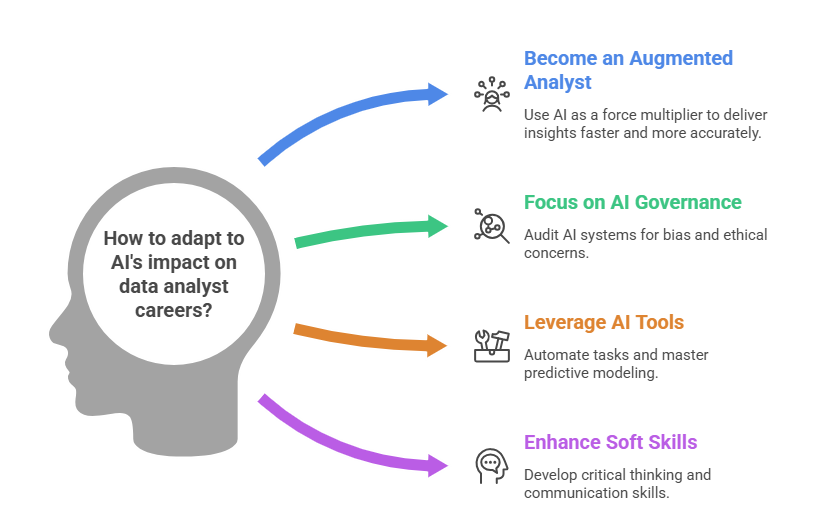
    In 2026, AI is a strategic partner for the Data Analyst associate degree job outlook. The skills that once made analysts indispensable are evolving, and new opportunities are emerging for those who can work alongside intelligent systems. 

    The Rise of the Augmented Analyst   

    Today, the most valuable analysts are Augmented Analysts. These are professionals who use AI as a force multiplier to deliver insights faster and more accurately. 

    Analyst’s New Role: 

    • Verify AI-generated insights for accuracy and relevance 
    • Translate findings into actionable business strategies 
    • Shift from data collection to strategic interpretation 

    Key Takeaways: 

    • Analysts are decision enablers 
    • Soft skills like communication and critical thinking have become central to success 

    The Trust but Verify Mandate   

    The AI models are increasingly complex; there’s a growing risk of false outputs that appear to be credible. 

    Emerging Needs in AI Governance: 

    • Professionals are now required to audit AI systems for bias, ethical concerns, and mathematical errors 
    • Roles like AI Trust Lead, AI System Trainer, and Data Product Manager are growing rapidly 

    Key Takeaways 

    • Understand data observability and governance frameworks 
    • Learn to validate AI outputs continuously 
    • Ensure AI insights align with business objectives and compliance standards 

    Leveraging AI Tools to Boost Your Analyst Career 

    Data Analysts must treat AI as a partner to excel in their careers.  Here are some strategies to stay ahead in the data analytics job market.  

    • Automate the 80% grind: Use AI copilots such as GitHub Copilot, Tableau Pulse for SQL scripts, dashboards and boilerplate coding. 
    • Master predictive modelling: Move from descriptive analytics to predictive analytics using AutoML platforms 
    • Focus on soft skills: Critical thinking, stakeholder communication, and data storytelling remain irreplaceable by machines.  

    Future Outlook Through 2032: Long-Term Career Viability 

    According to the U.S. Bureau of Labor Statistics (BLS), demand for data-centric roles is projected to grow by 23% to 35% by 2032. This is faster than the average for all occupations. 

    • Demand expected to outpace supply, with 11.5 million new data roles by late 2026 
    • About 108,400 new jobs for data analysts are projected over the next decade. 
    • Companies using data-driven insights are more likely to be profitable 
    • Routine SQL queries and dashboard creation are largely handled by AI 
    • Skills in causal inference and business context interpretation will remain critical 
    • Become AI Ethics Officer, Model Auditor, or Domain-Specific Strategy Analyst 

    Get a Data Analyst Bootcamp with AI Course from Skilify Solutions.

    Career Advancement & Specialization Opportunities 

    You can make a future jump from Junior to Leadership within a few years. For example, from Senior to Analytics Manager. However, in 2026, the jump to Senior requires Strategic Decision Support, where you act as a consultant to the C-suite.  

    By adding Machine Learning and advanced Python to your SQL foundation, you can transition into Data Science, which currently sees a 34% growth rate and average US salaries around $129,000. 

    High-Value Industry Specialisations 

    • Healthcare Analyst: Focuses on genomic data and patient outcomes. This sector is growing at 33.4% CAGR. 
    • Financial Risk Analyst: Specialises in security-focused data mining and fraud detection, as it is growing at 33.6%. 
    • Supply Chain: Solve ETA puzzles using real-time IoT data. This industry is currently holding a 26.5% market share. 

    Conclusion  

    It can be concluded that the Data Analyst Job Outlook 2026 is clear. Analysts who combine technical expertise, strategic thinking, and domain knowledge will lead to the next wave of data-driven decisions. AI may handle the routine, but human judgment and insight remain irreplaceable.  

    This is an industry that is growing ten times faster than the rest of the US economy. That’s the reality for Data Analytics in 2026, and you just need a well-designed Data Analyst Course to equip you with the skills that matter most. These can be data cleaning, predictive modelling, AI tools, and business storytelling. The future of analytics is here.  Best of luck for your future!

    Enroll to our Data Analyst Bootcamp with AI Course today and become one of tomorrow’s indispensable data leaders

    Frequently Asked Questions

    1. Can you get a data analyst job with an associate degree? 

    Yes, but it is competitive. While 65% of roles require a Bachelor’s, you can break in with an Associate degree by pairing it with professional certifications and a strong portfolio. 

    2. What is the job security for data analysts during economic downturns? 

    Data-driven firms are most likely to stay profitable. During recessions, companies lean on analysts to identify cost-saving efficiencies and protect cash flow. All these make the role of recession resistant. 

    3. How long does it take to become a job-ready data analyst? 

    You can expect 6–12 months of focused study. While basics take 3 months, mastering SQL, Python, and BI tools, plus building a real-world portfolio. It typically requires a year of consistent practice. 

    4. Is a data analyst a good career for career changers in their 30s or 40s? 

    Yes, the average age of a data analyst is 43. Companies value the domain expertise and soft skills that older professionals bring, which often outweigh pure technical coding speed. 

    5. What’s the typical work-life balance for data analysts, and does the job outlook include remote opportunities? 

    Balance is generally good, with 34% of roles offering remote or hybrid options in 2026. While “screen fatigue” is real, flexible schedules and the ability to work from anywhere remain a staple of the profession. 

  • Data Engineering vs Data Science: Career Guide 2026

    Data Engineering vs Data Science: Career Guide 2026

    Data Engineering and Data Science by the Skillify Solutions are two high-impact careers driving the Artificial Intelligence (AI) and analytics revolution. While one role focuses on crafting the robust infrastructure where data flows, the other specializes in transforming that data into next-generation predictive insights.

    In the digital era, the value lies not just in the data itself, but in the skilled professionals, the builders and the analysts, who bring it to life. This blog will help you understand Data Engineering vs Data Science, each career guideline so you can decide which side of the data lifecycle best suits your skills and career aspirations. Let’s begin.

    Data Engineering vs Data Science: Key Differences Explained 

    It is crucial to understand that both roles work with data but has different purposes. Data Engineers build the systems, while Data Scientists are responsible to analyze the data. Let’s break down Data Science vs Data Engineering in a tabular format to understand how they differ in 2026: 

    Feature Data Engineering Data Science 
    Objective Build and manage data pipelines and infrastructure. Analyze data to extract insights and build predictive models. 
    Responsibilities Design architectures, manage ETL/ELT, ensure data quality and scalability. Clean data, run analysis, create models, and present insights. 
    Skills & Tools SQL, Python, Spark, Hadoop, Kafka, Airflow, AWS, Snowflake. Python, R, TensorFlow, scikit-learn, Tableau, Power BI. 
    Deliverables Data pipelines, databases, and optimized infrastructure. ML models, dashboards, and actionable insights. 
    Education Computer Science or Engineering. Data Science, Statistics, or Mathematics. 
    Collaboration Works with data scientists and DevOps teams. Works with engineers and business teams. 
    Career Goal Data Architect / Lead Engineer. Senior Data Scientist / Head of Analytics. 
    Trends (2026) Data mesh, real-time streaming, automation. Generative AI, AutoML, decision intelligence. 

    Key Skills and Tools for Data Scientists and Data Engineers

    In today’s data driven world, both Data Scientists and Data Engineers need a solid technical foundation to excel in their fields. However, the question is Data Science and Data Engineering same. Their usage of tools and technologies will differ depending upon their focus and priorities. 

    image 3 Data Engineering vs Data Science: Career Guide 2026

    The Data Science and Data Engineering difference depends on whether you want to engineer the data pipeline or analyze the data to decide your career path. Skillify Solutions helps you understand the basic skill sets that are crucial for you to understand Data Science vs Data Engineering: 

    Unlock your future in data – Register today with Data Science with AI Course and become job-ready in 2026! 

    Data Engineer Tech Stack 

    Data Engineers are known as the foundation of any data-controlled organization. They have the responsibility of developing data systems that are scalable and punctual in availing clean data to scientists and analysts.  

    Here are the key skills and tools that define their role in 2026:  

    • Programming Languages: Candidates should be proficient in Python, Java, or Scala in order to create and automate data workflows 
    • Databases and Querying: He or she should have knowledge of NoSQL, SQL, and data modeling for both structured and unstructured storage. 
    • Big Data Technologies: An in-depth knowledge of Hadoop, Flink, Kafka, and Apache Spark will help you to handle large datasets. 
    • Cloud Platforms: You must be familiar with Azure, Google Cloud, or AWS to excel in your field. 
    • ETL and Data Integration: You must know to construct pipelines with Airflow in order to automate Data transformation.  
    • Infrastructure and DevOps: You need some knowledge of Terraform and Kubernetes for scalable data system deployment.  
    • Data Governance & Security: It is good to have knowledge of data quality and monitoring tools like Monte Carlo or Great Expectations. 

    Data Scientist Tool kit  

    Whereas Data Scientist helps to decode the information provided by engineers into business. Their mandate is to research on trends using forecasting models and report the findings to the stakeholder.  

    Here are the core skills and tools they must acquire as a basic tool kit:  

    • Programming and Scripting: Learn R or Python to create models and manipulate data. 
    • Mathematics and Statistical Ability: Proficiency in probability, hypothesis testing, regression and statistics can prove helpful.  
    • Machine Learning Frameworks: You need the knowledge of TensorFlow, PyTorch, scikit-learn, and XGBoost for predictive modeling. 
    • Data analysis and Visualization: You need to master tools like Tableau, Power BI, Seaborn, Matplotlib, NumPy, and Pandas for reporting.  
    • Data Wrangling: One must know the feature engineering, NumPy, and Pandas helps to prepare raw data. 
    • MLOps and Deployment: Knowledge of Docker, Git, and MLflow helps to deploy and track models during production. 
    • Communication and Storytelling: It will be useful in concise narratives and images to convert insights into business recommendations. 

    Roles & Responsibilities of Data Science and Data Engineering

    Both Data Engineers and Data Scientists are accustomed with data. Whereas their daily tasks look different in terms of approach. Engineers make sure that data flows seamlessly across systems. On the other hand, scientists work with the data to open insights and build predictive models. Let’s note how does their typical day look like for better understanding of Data Science vs Data Engineering

    Typical Day of a Data Engineer 

    The day in the life of a Data Engineer is filled with the tasks of guaranteeing the reliability of data, its ability to scale, and probability of access. They are the creators of the design, upkeep, and optimization of the data infrastructure that drives analytics and AI systems.  

    Their daily task include:  

    • Supervising and correcting unsuccessful ETL/ELT jobs.  
    • Constructing pipelines and warehouses.  
    • Automation of writing Python, SQL or Scala automation scripts.  
    • Working with teams to establish new data requirements.  
    • Ensuring data quality, security and documentation.  

    In short: They prepare data in an accessible, accurate and production ready format.  

    From beginner to pro – Your data career starts here with our Data Engineering course! 

    Typical Day of a Data Scientist 

    A Data Scientist is a profession that is centered around exploring, analyzing, and modeling data to provide answers to business inquiries and forecast business results. 

    Their daily task include:  

    • Treatment and analysis of new data.  
    • Creation and training of Machine Learning (ML). 
    • Tune parameter and model performance evaluation.  
    • Tableau, Power BI, or Python visualization of the findings.  
    • Delivering knowledge and suggestions to the stakeholders.  

    In short: They transform data into business value and informed decisions.   

    How They Collaborate? 

    Despite of the discussion around Data Science vs Data Engineering, it is prevalent that both of them work as a team. One is responsible for building the foundation whereas the other extracts insights. A typical workflow begins when Data Engineers create pipelines to deliver clean data. Data Scientists then use that data for exploration and reporting. 

    Continuous feedback between both roles ensures that data systems evolve to meet business needs and maintain analytical accuracy.  

    A Workflow Chart on how Data Engineers and Data Scientists Collaborate 

    [Raw Data]  

       ↓  

    (Data Engineer → ETL, Data Warehouse, Data Lake) 

       ↓  

    (Clean Structured Data) 

       ↓  

    (Data Scientist → Analysis, Modeling, Visualization) 

       ↓  

    [Business Insights & Actions] 

    +————–+

    |   [Raw Data] | (Unstructured Data Sources)

    +————–+

           ↓ (Ingestion Start)

    +—————————–+

    |    DATA ENGINEER (DE)       |  <– RESPONSIBILITY SHIFT –>

    |—————————–|

    |  1. ETL/ELT Pipeline Build  |

    |  2. Data Warehouse / Lake   |

    |  3. Data Quality & Cleansing|

    +—————————–+

           ↓ (Handoff: Clean Data)

    +—————————–+

    |  [Clean Structured Data]    |

    +—————————–+

           ↓ (Modeling Start)

    +—————————–+

    |    DATA SCIENTIST (DS)      |  <– RESPONSIBILITY SHIFT –>

    |—————————–|

    |  1. Feature Engineering     |

    |  2. Statistical Analysis    |

    |  3. Model Training & Testing|

    +—————————–+

           ↓ (Deployment Ready Model)

    +—————————–+

    |    DATA ENGINEER (DE)       |  <– DEPLOYMENT RESPONSIBILITY –>

    |—————————–|

    |  4. MLOps / Model Serving   |

    +—————————–+

           ↓ (Actionable Output)

    +—————————–+

    | [Business Insights & Actions]| (Strategy & Decision Making)

    +—————————–+

    Data Science vs Data Engineering: Job Opportunities & Salaries

    Data Science and Data Engineering jobs are reputed to have high-paying salaries, fast career advancement. Both of them has raised their demand all over the world. Knowing how these jobs develop and what they pay in 2026 can help you make a positive and long-term data career. 

    Career Progression 

    Data Engineering career path: Most professionals start as Junior or Associate Data Engineer, move into Data Engineer, then Senior Data Engineer, and ultimately to roles like Lead Data Engineer or Data Architect.  

    Data Science career path: A common path begins at Data Analyst or Associate Data Scientist, advances to Data Scientist, then Senior Data Scientist, and leads to Head of Analytics or ML/AI Director roles.  

    Data Engineering vs Data Science Difference in Career Progression Chart 

    Level Data Engineer Path Data Scientist Path Focus Area 
    Entry (0–2 yrs) Junior / Associate Data Engineer Junior / Associate Data Scientist Learn SQL, Python, ETL, and basic analytics. 
    Mid (2–5 yrs) Data Engineer Data Scientist Build pipelines, manage data, create ML models, analyze data. 
    Senior (5–8 yrs) Senior Data Engineer Senior Data Scientist Lead projects, design scalable systems, optimize models. 
    Leadership (8+ yrs) Data Architect / Head of Data Engineering Lead / Principal Data Scientist Set data strategy, manage teams, align business goals. 

    Salary Comparison: US & Global Markets  

    In 2026, both Data Engineering and Data Science continue to be among the most profitable tech careers in the U.S. market. Their salary depends on the experience, size of the company and industry. Their demand is higher because of the usage of cloud infrastructure and data-based decision-making. 

    Senior professionals with advanced technical and leadership skills can earn well. Sometimes these candidates earn above the national tech average. Here is a table showing Data Science vs Data Engineering salary and their approximate income:  

    Data Engineering vs Data Science Salary Comparison

    Role Approximate Average Salary (USD/year) 
    Data Engineer $99,466/ year
    Senior Data Engineer $134,350/ year
    Data Scientist $102,938/ year
    Senior Data Scientist $136,511/ year

    Job Growth Statistics & In-Demand Certifications 

    The demand for both Data Engineers and Data Scientists continues to increase as of the data of 2026. It is driven by cloud adoption, AI integration, and the increasing need for real-time analytics across industries. According to the U.S. Bureau of Labor Statistics both roles rank among the top 10 fastest-growing tech careers in the U.S. 

    Data Scientist roles are projected to grow by 34% from 2022 to 2032 and it exceeds the national average for all occupations. On the other hand, Data Engineer positions are expected to grow by 2030. It shows rapid expansion of cloud-based infrastructure, data warehouses, and analytics platforms.  

    Source Link

    High-demand certifications include:  

    • For Data Engineering: Cloud certifications (AWS Big Data, Azure Data Engineer), Apache Spark certification, data architecture credentials.  
    • For Data Science: Certified Data Scientist credentials, machine learning certifications (TensorFlow Developer, PyTorch), and statistics or applied mathematics specialisations.  

    Decode data. Predict the future. Become a Data Scientist today! 

    How to Start Your Career as Data Engineering & Data Scientist

    Starting a career in data is not a hard step. Both Data Engineering and Data Science offer exciting and high-growth paths. But you must figure out first which is better Data Science or Data Engineering? Here are the ways how you can get started and even switch between them if your interests evolve. 

    Path for Data Engineers  

    If you enjoy solving technical challenges, writing code, and building systems that move and process data, this path is for you. 

    • Step 1: Start with building a foundation in computer science, databases, and programming like Python and Java.  
    • Step 2: Then learn SQL as it is the backbone of data management and querying. 
    • Step 3: Start understanding Extract, Transform, Load (ETL) processes and data modeling. 
    • Step 4: Get hands-on experience with big data tools like Apache Spark, Hadoop, and Kafk 
    • Step 5: Learn cloud platforms and start working with AWS, Google Cloud, or Azure. 
    • Step 6: Build small projects like automating data pipelines or creating a mini data warehouse. 
    • Step 7: Apply for internships or entry-level roles like Junior Data Engineer or ETL Developer. 

    Pro Tip: You need to focus on data quality and scalability as good engineers think long-term about performance and reliability. 

    Path for Data Scientists  

    If you love finding patterns, predicting trends, and telling stories with numbers, Data Science might be your perfect fit. 

    • Step 1: Strengthen your basics in statistics, mathematics, and Python/R. 
    • Step 2: Learn to clean, explore, and visualize data using Pandas, NumPy, Matplotlib, and Seaborn. 
    • Step 3: Dive into machine learning and understand algorithms, model evaluation, and feature engineering. 
    • Step 4: Work on hands-on projects like Kaggle, GitHub, or personal datasets to showcase your skills. 
    • Step 5: Learn to use tools like Power BI or Tableau for data storytelling. 
    • Step 6: Gain domain knowledge and understand the business problem is as important as the model itself 
    • Step 7: Start as a Junior Data Scientist or Data Analyst and keep learning MLOps or advanced ML frameworks. 

    Pro Tip: Always connect your analysis to business impact as data alone doesn’t tell a story, you do. 

    Transition Guide  

    There are many professionals switch between Data Science and Data Engineering after they discover their actual strengths. After understanding the difference between Data Science and Data Engineering, here are the ways on how you can bridge the gap: 

    From Data Engineer to Data Scientist

    • Learn statistics, machine learning, and data visualization. 
    • Work with analytics or ML teams to understand their workflows. 
    • Build small ML projects using the data you already handle. 

    From Data Scientist to Data Engineer

    • Strengthen SQL and programming skills. 
    • Learn data architecture, ETL design, and cloud data tools. 
    • Contribute to pipeline automation or MLOps in your current role. 

    Pro Tip: The best professionals often blend both skill sets and are known as Data Science Engineers to be in huge demand. 

    Data Engineering vs Data Science: Which Career Path Should You Choose?

    Now the question arises which is better Data Science or Data Engineering. Both the career options are strong and well-paying in 2026, yet the choice of one or another career option is up to your interests. You can select Data Engineering in case you like creating systems, technical puzzles, and working at scale. It will suit best those who like to do backend work and power the analytics under the hood.  

    The discussion on What is Data Engineering vs Data Science states unlike choosing Data Science in case, you like analyzing data, discovering the patterns, and making business decisions based on the findings. It suits inquisitive thinkers who prefer experimenting, modeling, and telling of stories with information.

    Conclusion 

    It is to conclude, studying Data Engineering vs Data Science helps you in finding what fits you better. Data Engineers build the systems that make insights possible, while Data Scientists turn that data into smart decisions. 

    Both Data Science and Data Engineering careers are known to have a high salary, development, and influence. There are unlimited opportunities in the world of data in the upcoming years, so it is better to choose wisely.  

    Master Python, ML & AI – Launch your career in Data Science now 

    Frequently Asked Questions 

    1. Is data engineering harder than data science?

    It is not necessary as both are challenging in different ways. Data Engineering demands strong coding and system design skills, while Data Science focuses on math, ML, and analytics. Your strengths in coding and analysis decide which feels harder for you.

     2. Data engineering vs data science: Which offers better remote work opportunities? 

    Both Data Science and Data Engineering offer a remote flexibility. Data Science roles are often more remote-friendly due to analysis and modeling work, while Data Engineering may need closer collaboration for pipeline deployment and cloud management.

    3. Will AI replace data engineering and data science jobs?

    Artificial Intelligence (AI) can automate repetitive tasks but cannot replace these roles. Data Engineers will manage smarter systems, and Data Scientists will focus on strategy and ethics. AI enhances their efficiency, and it doesn’t eliminate the need for human expertise.

    4. Can you be a data scientist or data engineer without strong math skills?

    Yes, Data Engineers rely more on coding, databases, and cloud tools to some extent than heavy math. Data Scientists need a good grasp of statistics and logic. Whereas tools and libraries help to solve complex math.