Blog

  • 30 Must-Know Scrum Master Interview Questions and Answers

    30 Must-Know Scrum Master Interview Questions and Answers

    Key Highlights of scrum master interview questions and answers

    • This guide shares must-have Scrum Master interview questions and simple answers for every level of experience.
    • It explains the main ways the Agile methodology and the Scrum framework are not the same.
    • You can read answers for both behavior questions and ones about different situations.
    • The article gives specific questions to ask for senior jobs and for SAFe Agile settings.
    • Find easy tips to help get ready for interviews, focusing on how things work in real life.
    • See how to answer questions about sprint planning, the Scrum team, and project management in a good way.

    Introduction

    Getting a scrum master role takes more than a simple certification. Managers want to know if you can guide a team, get rid of blockers, and use the scrum process the right way. When you get ready for your scrum master interview, you have a chance to show what you know about agile methodology and show them you are a good pick for the job.

    This guide gives you the most asked scrum master interview questions and answers. You will find expert tips to help you talk about your skills, handle interview questions well, and get your next scrum master job. If you’re preparing seriously for interviews, enrolling in a Scrum Master Bootcamp with AI can help you gain hands-on experience with real-world Agile scenarios and mock interviews.

    Interview Questions and Answers for Scrum Master: Beginner Level

    Knowing the basics of the scrum master role is very important for anyone new in an Agile team. If you want to become a scrum master, some common interview questions might ask you to explain what the scrum master does. You may need to talk about the three main scrum artifacts, which are product backlog, sprint backlog, and increment. People might also ask you to define words like sprint and sprint goal.

    You should be ready to talk about what “Done” means for a task. You could also be asked to name and talk about the five scrum events. It’s a good idea to show that you have good, clear communication when working with people outside the team, like stakeholders. Being familiar with these interview questions shows you know the scrum framework well. It also helps you feel ready to work in a scrum team, because you can handle real problems that come up.

    1. What is Scrum and how does it differ from Agile?

    Agile is a way of thinking about development that focuses on making progress step by step. The idea is to work together, listen to customers, and adjust to change. Agile tells us what to value and why we make software in a certain way.

    Scrum is one way to use Agile. It gives rules, roles, and events to help teams get work done. In Scrum, teams break work into sprints, which last two or three weeks. A team in Scrum is made of people with different skills who organize their own work.

    The big difference between Agile and Scrum is this: Agile is a general idea, while Scrum is one way to practice it. Scrum helps teams change plans fast, so their work matches the main goals of Agile.

    2. Explain the role of a Scrum Master

    Helping with the scrum process is an important part of what a scrum master does. A scrum master acts as a leader who serves the team. The main goal is to be sure that the scrum team follows scrum values and works with best practices. A scrum master helps create a space where people feel free to work together.

    Some of the key jobs in this role are coaching people on agile principles. A scrum master also leads scrum ceremonies, like sprint planning and daily standups. They help manage the product backlog and try to keep out things that might stop the team from working well.

    When there is a problem or an argument, the scrum master steps in to help fix it. They also help the team choose what tasks or ideas will add the most business value. A big part of the role is getting the team to look for better ways to work, which helps with continuous improvement. This way, the scrum master works to boost team morale and make the whole team more productive.

    3. What are the three Scrum artifacts?

    The three main scrum artifacts are the product backlog, sprint backlog, and increment. The product backlog has a list of things that need to be added or fixed. It shows what work is most important. The sprint backlog has a list of jobs for one sprint. The increment is what has been finished at the end of each sprint.

    4. Define Sprint and Sprint Goal

    A key part of the Scrum framework is the sprint. A sprint will be between one to four weeks long. This set time lets a Scrum team work hard to deliver a product increment that can be shipped. During this sprint, the team picks backlog items and builds a sprint backlog. This backlog helps guide the work so the team can finish certain tasks.

    The sprint goal is short and clear. It says what the sprint is for. It helps everyone in the Scrum team stay on the same page and stay focused. This way, the team’s work all moves toward one job. When everyone understands the goal, teamwork gets better and each person knows what to do. This helps the development process and builds trust in the whole group.

    5. What is Definition of Done (DoD)?

    The Definition of Done, or DoD, is a simple list of steps that must be finished before a product increment is said to be ready. This helps everyone see what needs to be done and keeps the work to a high standard. It also makes sure the team agrees on what “done” means. With this, people feel responsible, and at the end of each sprint, the software works like it should.

    6. What are the five Scrum events?

    The five Scrum events are Sprint Planning, Daily Scrum, Sprint Review, Sprint Retrospective, and the Sprint itself. These events help teams work together, keep getting better, and make sure they keep moving forward. The events help everyone in the development process to stay focused and in line with their goals.

    7. Difference between Product Owner and Scrum Master

    While both the product owner and the scrum master play important roles in a scrum team, they each have different jobs. The product owner decides what the team needs to build. The product owner sets the order of tasks in the product backlog and speaks for what the customer wants. They help the team focus on the features that give the most value.

    The scrum master, on the other hand, looks after how the team works each day. The scrum master guides everyone in using scrum practices, leads meetings, and clears problems that may slow the team down. They work to improve teamwork, keep people productive, and support continuous improvement.

    RoleFocus
    Product OwnerMaximizing product value, managing the Product Backlog, prioritizing.
    Scrum MasterFacilitating Scrum process, coaching team, removing impediments.

    8. What is velocity in Scrum?

    Velocity in Scrum shows how much work the team can do in a Sprint. It is found by adding up the story points for all backlog items that are fully finished at the end of the Sprint. This helps teams and Product Owners plan and guess how many Sprints it will take to finish the product backlog. It is useful for release planning.

    But, velocity should not be used to compare teams. It should not be a measure to track how busy people are. Trying to get higher velocity can lead to poor work or team burnout. Teams should work to have a steady and predictable velocity. This makes it easier to deliver work in a good and healthy way, instead of always working to do more.

    9. Explain the three pillars of Scrum

    Scrum is built on the idea that you learn from what you have done before and make choices using the best facts you have right now. The method uses three main pillars. These pillars help teams to keep getting better with their work and what they create. These three are part of all Scrum events and pieces of work. They give simple ways for teams to see what is working and what is not. A team needs to follow these pillars if they want to use Scrum well.

    The three pillars of Scrum are:

    • Transparency: The main parts of the process are open to the people who have to get results. This helps everyone understand what is happening.
    • Inspection: There is a need to check the progress and items often, so it is easy to see problems early.
    • Adaptation: Fast changes are made if there are things that do not go as planned.

    10. What is timeboxing and why is it important?

    Timeboxing means you give a set amount of time to a task. In the Scrum framework, every event has a clear time limit. For example, a daily scrum should not be longer than 15 minutes. Timeboxing helps the team stay on top of their tasks and stops talks from dragging on. It also helps people make fast choices.

    When this limit is in place, teams spend less time on things that are not important. They work at a steady speed. This way of working is good for the development process. It also makes things easier to plan and know what will happen next. The team can keep giving value week after week by using timeboxing in the scrum framework.

    Scrum Master Behavioral Interview Questions and Answers

    Behavioral questions help interviewers see how you have dealt with different things at work before. They feel that what you did before can show them what you may do in the future. If you are going for a Scrum Master job, the questions will usually focus on servant leadership, conflict resolution, and coaching. The people asking want to hear real examples from your own life about these things.

    When you answer these questions, try to use a clear way like the STAR method. The STAR method means talking about the Situation, the Task, the Action, and the Result. This way, you can share a short and easy-to-follow story that shows your skills.

    Get a few good stories from your career where you handled team conflicts, helped remove a problem, and worked to boost team morale. Having examples ready will help you feel prepared and do well in your answer.

    11. How do you handle conflicts within the Scrum team?

    When there is a problem in the scrum team, I act fast to sort it out. This helps to keep everyone happy and working well. As a facilitator, I guide the team to fix the issue on their own. I feel that when handled right, some conflict can help people get creative and feel closer to each other. I start by watching and listening to what is going on so I know what everyone thinks. I ask the people to talk with each other in a calm and open way. If things do not get better, I will set up a meeting and help them find common ground.

    My conflict resolution process includes:

    • Meeting with people one-on-one to get their views.
    • Leading a group talk for a set time that looks at facts and what the group wants to reach.
    • Making team rules about what to do when they do not agree in the future.

    12. Describe a time when you had to challenge management

    In a job I had before, a top manager wanted to add a “critical” feature to our current sprint. At that time, the team had no extra room for new work. I set up a talk with the manager. At the meeting, I showed numbers about our workload and how the sprint burndown looked. I spoke clearly about Scrum principles, and pointed out why the sprint needed to be guarded and why pace had to be steady.

    I did not just say no. I helped the Product Owner join the talk. We looked at the option of swapping something out, to make room for the new work. In the end, we all decided this feature could be moved to the next sprint. This choice kept the team safe and showed the value of good agile practices to management.

    13. How do you build trust with your team?

    Building trust is key for a good scrum master. I do this by being steady, open, and reliable. I always try to match what I say with what I do. My main goal is to help the team, not to watch over everything they do. I try to make a safe place where people feel good about sharing their thoughts and even their mistakes. They know they do not need to worry. I ask for open talk, especially in Scrum meetings like Sprint Retrospectives. I also show the team that I can make mistakes and tell them when I do. I feel it is important to be real. To build trust, I:

    • Practice active listening so each person feels they are respected.
    • Honor commitments, mostly when you are working to remove blocks for the team.
    • Celebrate wins and help others learn from mistakes. This helps with continuous improvement.

    14. Share an example of when you failed as a Scrum Master

    Early in my time as a Scrum Master, I did not stop scope changes for my team. A stakeholder asked for a change during the sprint, saying it was “small.” I thought it would not cause big problems. But it made us switch focus, which slowed everyone down. We did not reach our sprint goal.

    During the sprint retrospective, I said I made a mistake. I talked about how this change hurt our team’s capacity and morale. It was tough, but I learned the importance of saying no and protecting the sprint. After that, we made a simple process for handling change requests.

    I now use what I learned from this to help Product Owners and stakeholders. Because of this, I am a better Scrum Master.

    15. How do you ensure effective team communication?

    Effective communication is a big part of how a Scrum team does well. As a scrum master, I help run Scrum events like the daily scrum. These meetings bring the team together and keep things clear for all. I also work to build a space where everyone feels safe to talk and be honest. I make sure that people respect each other and stay helpful in talks. When the team is not in one spot, I help pick the right ways or tools for us to talk.

    I help people talk to each other in a clear way by doing these things:

    • Make sure that, after sprint planning, the team has a clear sprint goal and everyone understands the backlog.
    • Run retrospectives in a way that gives people a safe space. This helps them feel okay to share honest thoughts about how the work and teamwork can be better.
    • Guide the team as they practice listening to each other and giving helpful feedback.

    Scrum Master Scenario Based Interview Questions and Answers

    Scenario questions help test if you can think quickly and use scrum principles in real situations. A person will give you a made-up problem and ask what you would do. These questions show how you solve problems, what you know as a scrum master, and how you deal with tough moments.

    There may not be just one correct answer. The interviewer wants to see how you think. They look for how you use scrum values and ways to work through the situation. Be ready to talk about why you would do something. Use ideas like sprint goals, team capacity, and conflict resolution when you explain your answer.

    16. How would you handle scope creep if the Product Owner adds new features in the middle of a sprint?

    If the product owner wants to put new features or backlog items in during a sprint, I start by reminding the team about the sprint goal. Scope changes can put this goal at risk. I speak with the product owner to see how urgent the new items are and ask if they think these can wait until the next sprint or if it is a real emergency. It is important for me to help the team stay focused and cut down on any distractions to make sure we reach our goal.

    If the new request is very important, I help start a talk between the product owner and development team.

    • The team looks at the new work and figures out how much there is.
    • The same amount of work needs to be taken out of the sprint backlog.
    • The Scrum team talks about the balance and agrees on it.

    17. What would you do if your Scrum team consistently fails to meet sprint commitments?

    If the team often misses what they plan to do in a sprint, I try to find the real reasons behind it. I do not blame anyone. I use the Sprint Retrospective to start an open talk with the team. We look at things like overcommitting during sprint planning, unclear user stories, or any problems that come from outside the team. It helps to get some data so we can make good choices. After we find out more, we make a plan to get better. This plan might include:

    • We use the team’s past speed, known as team velocity, to help us make better plans.
    • We work on making our list of tasks clearer and easier to follow. This helps us be sure each story is set and good to go.
    • We point out things that slow us down and fix them early. This helps us do better as a team all the time.

    18. How would you manage stakeholders who demand detailed daily status reports in a Scrum environment?

    Handling what stakeholders want can be hard, especially when they ask for detailed reports every day. The main thing is to use good and clear talk. A scrum master should make sure there is a set time for reports to be shared. This could be during daily standups or maybe as a short summary once a week. This helps everyone see what is happening and keeps things open.

    When you use things like team velocity and how far people are on user stories from the sprint backlog, you can answer questions stakeholders have. This keeps them in the loop without giving too much to the team.

    Letting people join in on sprint reviews gives them a way to see the current work. At the same time, this helps team morale stay steady. If you focus on business value in your reports, this will line up with what the company wants to see and reach its needs. This all shows how important effective communication is in scrum.

    19. How would you handle a team member who is disengaged or not contributing during sprint retrospectives?

    Dealing with a team member who does not take part in retrospectives can feel tough. To help, you need to make a safe space for your team. In this way, everyone can feel okay to talk about their thoughts and what they go through. It is good to start with clear communication. Speak with the person alone and try to find out why they are not joining in.

    Help them feel more ownership of their work. Talk about how important continuous improvement is for everyone who is part of the team. A team grows strong when people share and learn. You can try ideas like having people brainstorm ways to hit common goals or use user story mapping. This may bring the team member in and help them feel a part of what the group does.

    It is smart to show how coming to retrospectives can help. When the team joins in, there is often more team morale, better conflict resolution, and a sense that people work well together. In the end, just help your team member see that these talks can be good for everyone.

    20. Distributed team across US time zones struggling with communication?

    Effective communication is very important for distributed teams, especially when people are in different time zones in the U.S. A clear plan helps every team member stay on the same page and get the information they need. This helps keep misunderstandings low. Video calls and chat tools make it easy for people to talk in real time. Keeping records of talks and decisions helps things stay clear for everyone. It’s a good idea for teams to have working hours that can overlap. This makes it easy for team members to talk and work together.

    Regular standups also help, and everyone needs to join in. This lets the team feel more responsible for their work. A scrum master should build a safe space where people feel they can talk about their worries. When team members do this, the scrum master can solve problems with communication and help people of the scrum team work better together.

    21. What would you do if the Product Owner repeatedly changes priorities in the middle of a sprint?

    Dealing with a product owner who often changes priorities during a sprint can be hard for the scrum master. The key in this situation is clear communication. The scrum master can bring everyone together for a talk with the product owner. This helps the development team and product owner agree on the top priorities. It also lets them know how these changes can slow down the development team.

    Using tools like a sprint backlog session also helps. This way, everyone can see how new tasks or changes can change the project timeline. The development team needs to feel safe to share any worry they have. A safe space lets them take ownership of their work, feel good about it, and handle new changes better.

    Scrum Master Interview Questions and Answers for Experienced Professionals

    Moving into higher roles in Scrum takes more than just knowing the steps. You need to understand the people in your team and how they work together. A skilled scrum master often thinks about how to guide several teams at once. To do this, the teams must share the same product vision and there has to be clear communication between them.

    When people talk about how well the scrum master is doing, they often look at things like team velocity and what the team can get done. A big part of the scrum master’s job is to make sure the team is using the scrum framework in the right way and to push for continuous improvement.

    It also helps to show times when you have solved conflicts in the team or helped others learn. Doing this lets people see that you know what to do to help your team do their best work.

    22. How do you scale Scrum for multiple teams?

    Scaling Scrum for more than one team means using tools like SAFe or LeSS. These tools help teams work together, stay on the same page, and use effective communication. When you focus on teams working with each other and set up clear rules, it is easier to handle any work that connects different groups. This helps everyone move toward the same project goals as one team.

    23. How do you measure Scrum Master effectiveness?

    To measure how well a scrum master is doing, you need to look at how the team is working and what they get done. The main things to check are team velocity, how many sprints the team finishes, and if the people that have a stake in the work are happy. There is also value in asking the team for feedback in meetings after each sprint. This can help you see if the scrum master is helping the team feel good about their work and stay productive.

    24. How do you handle technical debt discussions?

    Talking about technical debt means having clear talks with the team about how it can hurt how fast you work and the quality of what you make. Make a list of the things you need to fix and give them an order. Write them down. Work with everyone to plan together, and make sure all important people understand why fixing technical debt should be part of upcoming sprints. Doing this helps make every project go well.

    25. Explain your approach to continuous improvement

    Keeping a focus on continuous improvement is important in the scrum framework. The scrum team uses regular feedback meetings, like sprint retrospectives, to talk about problems and think of ways to solve them. When you work in a place that values trying new things, the team can test out new practices and learn new technologies. This can lead to better work and more interest in what they do.

    When the team has ownership of their work, they feel more able to spot what needs to change and improve. Sharing useful facts, updates, and checking team velocity can show how the team grows and what steps to take next. This helps guide later sprints. In the end, it raises business value and helps the team follow agile principles. This way, the scrum team works well and the scrum environment gets better.

    Senior Scrum Master Interview Questions and Answers

    If you want to get a Senior Scrum Master job, you will have to answer questions about leading people, helping others learn, and how you help a company change for the better. The manager wants to know if you can do more than lead a single team. They look for proof that you can help many teams and support a major Agile change. Your skill in coaching teams and teaching new scrum masters will be important and will be looked at closely.

    These questions look at how you think and plan for the future. They also see what you feel a great Agile group should be like. Get ready to talk about times when you have dealt with tough problems in your team. Be ready to share how you stand up for agile principles with everyone in the company.

    26. How would you coach a struggling Scrum team to high performance?

    To help a struggling scrum team do better, it is good to work on how people talk with each other. Try to see what problems are stopping the team from moving ahead. The team should learn to work together and help each other. Ask everyone to share what they feel in meetings, and do this often. Set goals that the team can reach. Use the main ideas and steps from agile to give the team power to act. If you do these things, you can create a place where there is continuous improvement and everyone works to get better all the time.

    27. How do you drive Agile transformation across the organization?

    Driving agile transformation needs a clear plan, solid leadership, and teamwork across all groups. Help build a culture of continuous improvement by letting people feel confident, offering training, and using feedback from teams. Make changes based on this input, so the way of working matches what the company wants. At the same time, be sure everyone agrees and supports these changes.

    28. Describe your experience mentoring junior Scrum Masters

    Mentoring junior scrum masters means helping them understand the scrum framework and the values behind it. I share things I have learned from my own work to guide them through the scrum process. I make sure to talk a lot about servant leadership and the need for good, clear, and effective communication. We have practice sessions where they act out real-life cases. This gives them chances to practice leading scrum ceremonies like daily standups and sprint retrospectives.

    I also push them to take ownership of their work. I tell them to speak up when there are team conflicts. This helps them learn and feel strong in their jobs. Watching how they grow makes a friendly place where team morale goes up. This helps them feel ready to face problems and lead their teams well.

    SAFe Agile Scrum Master Interview Questions and Answers

    Having a strong understanding of the SAFe (Scaled Agile Framework) is important for any scrum master who works in big companies. Professionals looking to work in enterprise environments should explore structured SAFe certification courses to understand scaling Agile across multiple teams. In SAFe, the scrum master takes on more jobs. He works with release train engineers during PI (Program Increment) planning. The goal is to make sure all teams share the same goals.

    A big part of this job is to help with effective communication between several teams. This keeps everyone working together and helps the project run well. It is good to notice the differences in the role of the scrum master in SAFe when you compare it with scrum methodology in smaller teams. This can help you get a better idea of what the job involves.

    Good scrum masters also practice servant leadership and follow agile principles. They pay attention when several teams have to work together. When you do these things, it shows you understand what being a scrum master is all about.

    29. What is the Scrum Master’s role in PI Planning?

    The scrum master helps teams during PI planning. They make sure there is clear communication between the teams. The scrum master also helps the team set common goals. They guide everyone through each step of the process. If any problems come up, they work to solve them. The scrum master also helps everyone work together, so all teams agree on what is most important and what needs to be finished.

    30. How does SAFe differ from traditional Scrum?

    SAFe, or Scaled Agile Framework, takes scrum principles and uses them in big organizations. It helps teams in the company move in the same direction. This is different from how regular Scrum works, as that is for one team at a time. SAFe adds extra roles like the Release Train Engineer. It gives a clear way for people to follow agile practices across the whole business.

    How to Prepare for a Scrum Master Interview?
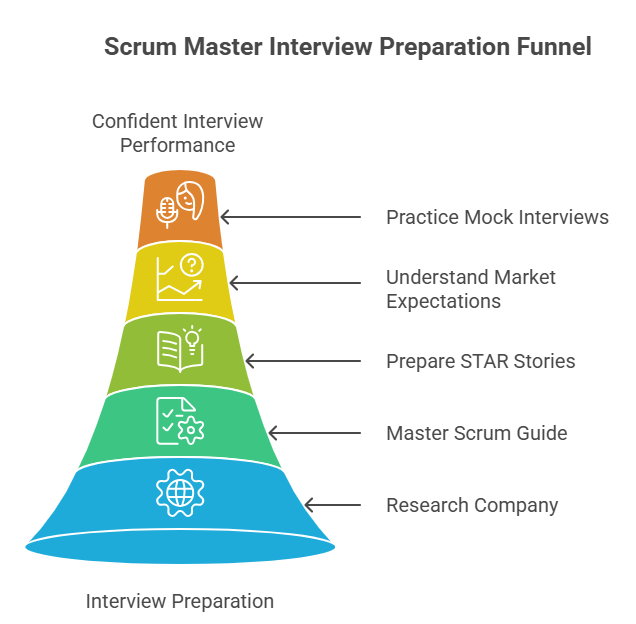
    Scrum Master Interview Questions and Answers

    Getting ready for a Scrum Master interview means you need to practice real-world skills and work on your effective communication. The people who hire Scrum Masters all over the world want to see that you can use agile principles to fix business problems. During the interview, talk about your own stories. Try to show how you worked out conflict and how you worked well with a product owner and your team. Use your experience to show them you can be a good scrum master.

    Check the company and learn about its industry before you go to the interview. This will help you give answers that fit what they want. Show that you have good servant leadership and that you can work well with others. At Skillify Solutions, we think people who can say what they bring to the team in a clear way do better in interviews. If you use these tips, you will be ready for a scrum master job anywhere in the world.

    If you want structured preparation, our Scrum Master Bootcamp offers practical training, mock interview sessions, and real Agile project simulations.

    Research Company Agile Maturity

    Before you go in for your interview, read the job description and look at the company website. Also, read any articles about their work style. Find out how the team uses Agile. If you see words like “Agile transformation” or “launching our first Scrum teams,” the company is new to this way of work. Then, you should talk about your coaching, training, and change-management skills when you meet them.

    If the company already uses Agile well, talk about your own work with things like scaling, metrics, and doing more releases without stopping. Give interview questions that show you know about these advanced parts. For example, you can ask how they measure success with Agile. This way, you show that you are ready, and you think in a smart way.

    Master the Scrum Guide

    The Scrum Guide is a must-have for Scrum Masters. You need to know it well if you are going for interviews. Be ready for questions about what things mean, what roles people have, what events happen, and what the main artifacts are. When you talk about these, give clear answers. Show you know why the rules are there in Scrum, like why there is a Daily Scrum or a Sprint Retrospective. This shows you really think about the work and understand it, not just remember the words. Learn the big ideas that are part of Scrum practices. Before your interview, practice so you feel sure you can talk about all of this confidently.

    • The three pillars of Scrum are transparency, inspection, and adaptation.
    • There are five Scrum values. These are commitment, courage, focus, openness, and respect.
    • The Scrum Master, Product Owner, and Development Team have different duties.

    This knowledge underpins all your answers.

    Prepare STAR Stories

    For behavioral questions, try using the STAR method. The steps are Situation, Task, Action, and Result. This way, you can share your answers in a clear and simple way. It helps you focus on what is important and leaves out things that do not matter. The STAR method lets you show how you solve problems and handle the situation in a good way.

    Think about some important times from your work as a Scrum Master. These can be times when you helped solve problems between people, or times when you coached team members. For each example, explain in a few words what happened, what you had to do, what steps you took to handle it (talk more about what you did), and what happened after. For results, mention clear things, like “better team velocity.” When you share real examples and numbers, your answers sound real and help you stand out to interviewers.

    Understand Market Expectations

    To understand market expectations, you need to know what companies and industries want in a scrum master. This means you should be aware of things like how well the team works, how fast they finish work, and how happy customers feel. When you focus on these things, you can help the team work better with business goals and be more useful to the company as a scrum master.

    Scrum Masters need to help everyone talk openly and share ideas. They should also keep up with the latest trends in the industry. Regular meetings, like sprint reviews, help set clear goals and make teamwork stronger. When Scrum Masters stay aware of best practices, they can give good support to their teams, no matter the place or time.

    Practice with Mock Interviews

    • Mock interviews give Scrum Master candidates a good way to practice their answers and feel more sure of themselves. Doing these practice sessions can show where you need to get better in talking with others and in your understanding of Scrum principles. Try using situational questions that make you think about real situations, like working with conflict resolution or guiding a team through sprint retrospectives.
    • It is also a good idea to get feedback from peers or mentors after each practice session. Working with others in this way helps make a safe space for helpful feedback, so you can work on your answers. This helps you to show you are ready and you know your stuff when you get to the actual interview.

    Conclusion

    To sum up, getting ready for a scrum master interview means you need to know the main ideas and common methods found in the scrum framework. It does not matter if you are just starting out or you have a lot of background in the role, it is key to understand scrum master interview questions. You should practice your answers and be ready to share clear thoughts during the interview. This will help people see you know what you are talking about. You need to know about servant leadership and be good at effective communication.

    These skills show you are ready to lead and support an agile team. Every moment in your scrum master interview gives you a chance to show you know the scrum practices and you can help your team get better over time with continuous improvement. If you want to learn even more and get more practice or details, you can check out Skillify Solutions for extra training and help. Good luck!

    Frequently Asked Questions

    1. What are the biggest red flags interviewers look for when hiring a Scrum Master?

    Interviewers want to see good communication from a candidate. They feel worried if you do not talk well, do not take feedback, or have little practice working in agile ways. Other things that can make them say no are not knowing how a team works, not helping talks in the group, and not caring about continuous improvement.

    2. Do I need certification to become a Scrum Master, or can I get hired with just experience?

    Having a certification can help you look more trusted as a scrum master. But, working in real-life jobs is just as important. A lot of companies want to see that you have worked with teams and can show results, not just a paper. In the end, having both a certificate and some working experience could make it easier for you to get a job as a scrum master.

    3. How do interviewers evaluate culture fit for Scrum Master roles, and what should I emphasize?

    Interviewers want to see if a scrum master will fit in with their team. They look at how you talk with others, how you work with your team, and how well you can adjust to change. Be ready to show the ways you match with the company’s values. Talk about how you help bring people together and what you do to build teamwork. It is also good to mention your experience working with different types of people. This helps show that you can help make the workplace strong and bring the team together.
  • Data Analyst vs Data Scientist Salary: Complete Breakdown

    Data Analyst vs Data Scientist Salary: Complete Breakdown

    Behind every business decision lies some data and behind that, two powerful roles. Yet when it comes to the Data Analyst vs Data Scientist Salary, the numbers reveal more than a job title. One role reports the past; the other engineers about the future.  

    In this comprehensive 2026 Data Analyst vs Data Scientist Salary blog by the Skillify Solutions, we compare salary trends across experience levels, locations, and industries. You’ll learn how education, technical expertise, and business impact translate into higher earnings and where each path leads after five years. Ready to see which data career truly pays off? Read on!

    Data Analyst vs Data Scientist Salary: 2026 Complete Breakdown 

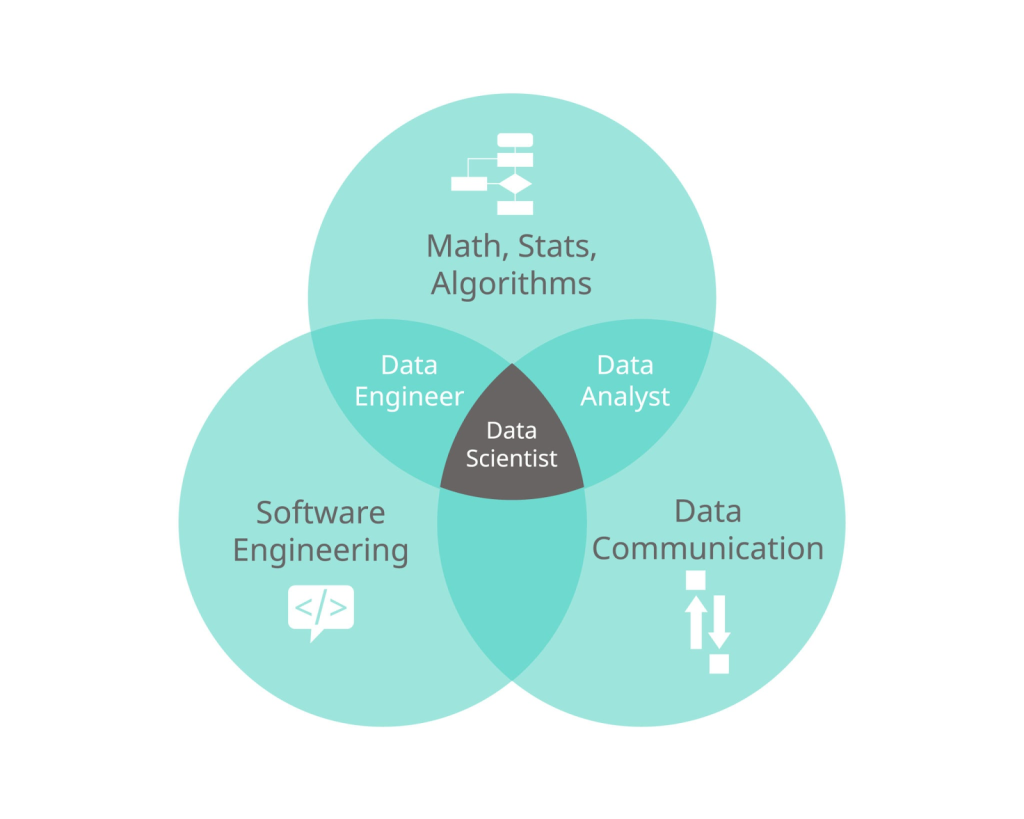
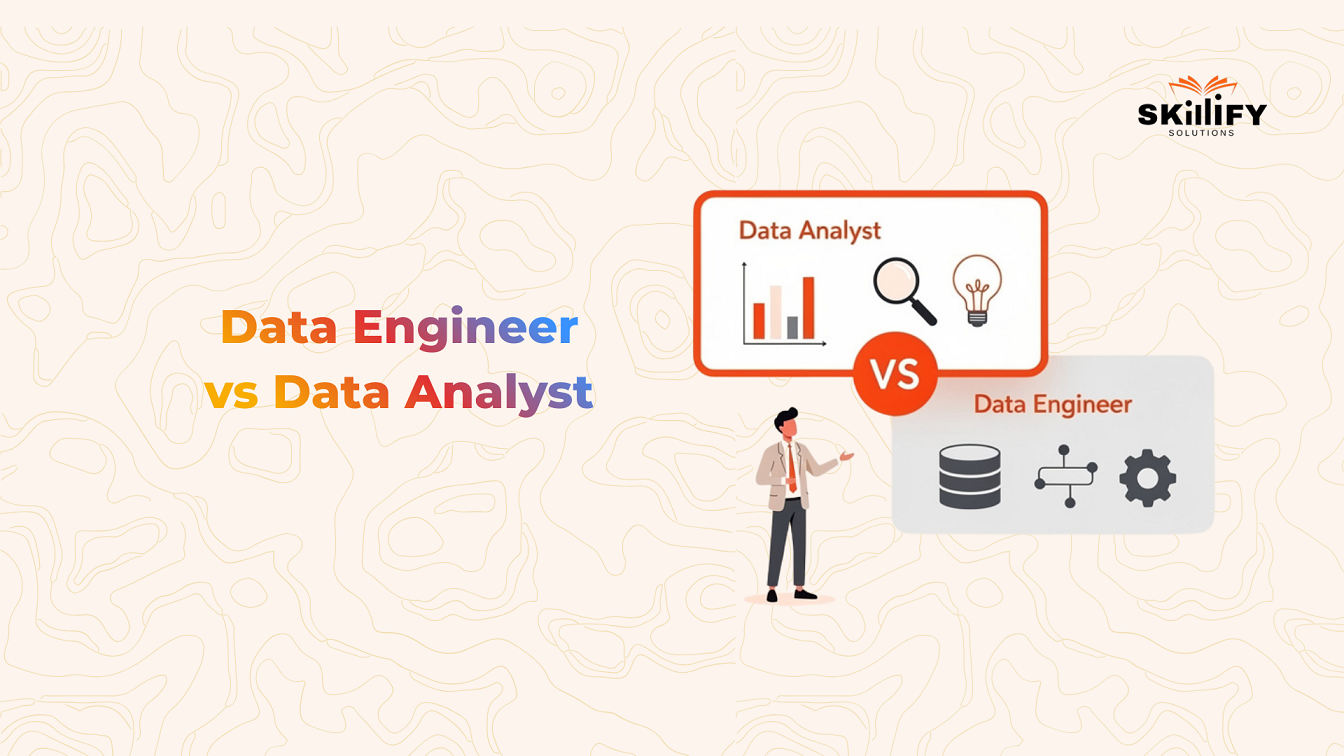
    Before talking about their pay slips, let’s understand what a Data Analyst and Scientist really do for a company. One person makes sense of the data and explains what’s happening, and the other uses it to predict what will happen next. That’s the key Salary Difference Between Data Analyst and Data Scientist.

    Here is a table comparing ranges for Data Scientist vs Data Analyst Salary at different experience levels. You can also look into their approximate salary gaps and percentage differences.  

    Data Analyst vs Data Scientist Salary Comparison

    Experience Level Data Analyst Salary Data Scientist Salary Salary Gap % Difference 
    Entry-Level (0-2 years) $68,893 ~$74537 ~$ 28,000 ~34% 
    Mid-Level (3-5 years) $70k$102,938 ~$ 58,000 ~63% 
    Senior-Level (6-10 years) $94,096 
    $136,511
    ~$ 100,000 ~77% 
    Lead/Principal (10+ years) $92,565  $151,963~$ 70k+ ~50%+ 

    Key Takeaways: 

    • Data Scientists draw higher salaries than Data Analysts at every level. 
    • The salary grows as one moves into more senior levels. 
    • It makes the difference cumulative over a career. 
    • This Salary Difference Between Data Analyst and Data Scientist can shape decisions about whether to aim for a Data Scientist or Analyst. 
    • For Data Analysts hoping to level up, understanding the jump in pay and competencies required is key. 

    Note: These are estimates based on recent data (2025), projected into 2026. 

    Why Data Scientists Earn More: The Salary Difference Explained 

    The Salary Difference Between Data Analyst and Data Scientist is not only because of their job titles but because of the level of skills and nature of problem solving. Both roles operate with data, although data scientists usually operate on a higher level, integrating analytics with programming, statistics, and machine learning to create predictive systems that can directly affect the strategy and growth of a company. Let’s consider the major motives of increased pay scale when it comes to Data Scientist vs Data Analyst Salary.

    Technical Skills Gap 

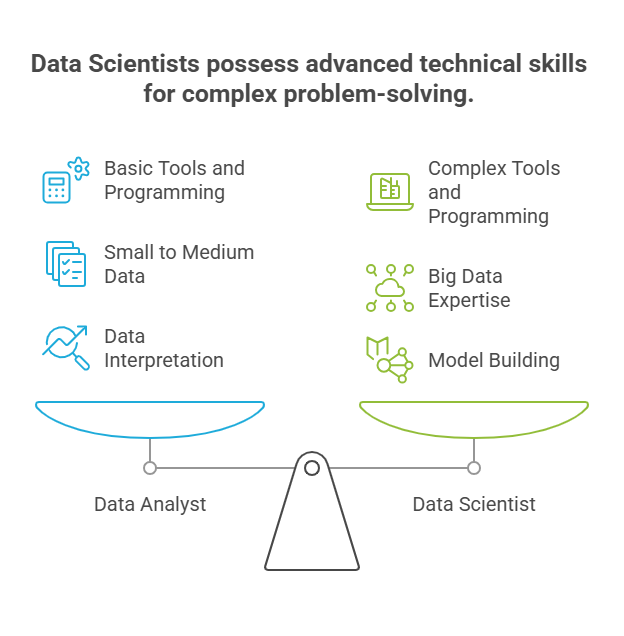
    Data scientists have a wider and more technical toolkit compared to data analysts. Here are some of them explained:  

    • Complex Tools and Programming: They work with such languages as Python, R, and SQL. They also have ideas about machine learning libraries such as TensorFlow or Scikit-learn.  
    • Big Data Expertise: They handle data of large scale on platforms such as Hadoop, Spark, and cloud tools (AWS, GCP, Azure).  
    • Model Building: Data scientists build predictive and prescriptive models to assist a business in forecasting trends. They are also responsible in automating decisions unlike analysts who are interested in interpreting the data.  

    Due to the high level of innovation and ability to solve complicated problems, data scientists receive higher pay. 

    Data Analyst vs Data Scientist Salary

    Educational Requirements 

    The academic journey of a data scientist may be more stringent and narrow.  

    • Increased Educational Requirements: Most jobs in the field of data science needs a Ph.D. or Master of Computer Science, statistics, mathematics, or data science.  
    • Good Theoretical Base: Data scientists must have a good grasp of algorithms, probability, calculus, and statistical inference to construct dependable models. 
    • Constant Upskilling: As the field of Artificial Intelligence (AI) and machine learning evolves fast, they must acquire new tools and techniques all the time.  

    Such an increased degree of education constrains the talent supply – it is more difficult to find and more costly to hire skilled data scientists. 

    Business Impact & Problem Complexity 

    Projects that have a more strategic impact on the organization tend to be handled by data scientists.  

    • Predictive and Strategic Focus: They affect fundamental business aspects such as demand forecasting, pricing, fraud detection and recommendation systems.  
    • High-Value Problem Solving: They solve complex, unstructured problems that involve experimentation, modeling, and optimization.  
    • ROI that is measurable: The results of their models can directly help raise revenues, cut costs or enhance efficiency – providing a definite financial worth to their work.  

    Data scientists are high impact contributors in a company because their solutions can influence key business metrics and are paid as such. 

    Data Analyst and Data Scientist Salary by Location & Industry 

    The place of employment can determine Salary Difference Between Data Analyst and Data Scientist.  The pay rates in U.S. cities differ depending upon the cost of living, availability of technologies, and the demand of data talents in this locality. Overall, highly technological cities or the headquarters of large companies are more likely to provide better pay to attract professional workers.  

    California cities such as San Francisco, New York, and Seattle lead Data Scientist vs Data Analyst Salary due to their abundance of technology companies and data-driven startups. In these areas, Data Scientists can earn more than $200K, and Data Analysts earn the equivalent of nearly $120K on average.  

    The new tech centers such as Austin, Atlanta, and Denver are also rapidly improving and have competitive salaries with reduced living expenses. The remoteness positions have also changed the scene, now the companies pay close to the national average, curbing the difference between the coast markets and the in-land markets. All in all, the location continues to be one of the largest considerations in determining Data Scientist vs Data Analyst Salary.

    Data Scientist vs Data Analyst Salary comparison Table 

    Title: Data Analyst and Data Scientist Salary Location Comparison 

    Top 10 US Cities Data Analyst Avg Data Scientist Avg Cost of Living 
    San Francisco, CA $87,390$131,325 ~$245 
    New York, NY $77,392$114,017 ~$187
    Seattle, WA $120,443 $76,693 ~$155
    Boston, MA $76,616 $109,422 ~$151
    Austin, TX $102,699$70,252 ~$97
    Denver, CO $71,001$98,206 ~$128
    Chicago, IL $70,780 $102,416 ~$117
    Atlanta, GA $69,433 $100,15 ~$96
    Dallas, TX $70,205 $96,574 ~$100
    Remote (US Avg) $76.5K $119K ~$100

    Industry Salary Table 

    The industry is a significant factor to identify the Salary Difference Between Data Analyst and Data Scientist. The financial rewards also vary depending on the time it takes for the data to grow and make decisions. Those companies approaching analytics in its most fundamental way are paying significantly higher rates than firms who use it as a support or reporting tool.  

    The industries that put data at the center of business strategy include technology, finance, e-commerce, algorithms, personalization, real-time decisions. That is why Data Scientists are in demand, and their salaries can be very high, over $150K. Data Analysts are also popular, only in lesser proportions as they receive good salaries due to their reporting and dashboarding skills.  

    Conversely, other industries, including healthcare, consulting, manufacturing, or energy still pose a good stabilizing factor. The Salary Difference Between Data Analyst and Data Scientist will decrease within the next few years as these traditional industries keep on being digitalized. 

    Data Scientist vs Data Analyst Salary Comparison

    Title: Data Scientist and Data Analyst Salary based on Industry

    Industry Data Analyst Range (Annual Base Salary) Data Scientist Range (Annual Base Salary) 
    Tech/Software (High Demand) $95,000 – $140,000+ $42,000 – $72,000
    Finance/Banking (Investment) $90,000 – $130,000 $140,000 – $200,000+ 
    Healthcare (Pharma/BioTech) $85,000 – $120,000 $135,000 – $185,000 
    E-commerce/Retail $80,000 – $115,000 $125,000 – $170,000 
    Consulting (Major Firms) $85,000 – $135,000 $145,000 – $190,000 
    Manufacturing $78,000 – $110,000 $115,000 – $160,000 

    Career Growth & Salary Progression: Which Path Pays Better Long-Term? 

    It is equally important to know how the salaries will increase with time along with studying the Salary Difference Between Data Analyst and Data Scientist. Although the pay of Data Analysts and Data Scientists initially comes at a competitive price, the growth patterns of the two professions are different.  

    In a couple of years, minor increments of annual pay, advancements, and job classification add up and create some differences. That is where the Data Scientist career begins to be seen as the clear winner.The next step will be visualizing how their earnings typically progress over five years with a Data Scientist and Data Analyst Salary Trajectory Graph Description: 

    5-Year Salary Trajectory Graph Description 

    Let us imagine a simple line chart showing two curves. One for a Data Analyst (DA) and another for a Data Scientist (DS). Two professionals are entering the market in 2026. As both careers progress, the gap between Data Analyst Salary vs Data Scientist Salary becomes more. While they may start somewhat close in the early years, the difference widens quickly as responsibilities, technical depth, and strategic impact increase.  

    Graphically, the slope of Scientist B’s salary line is steeper than Analyst A’s. It shows faster growth and higher long-term rewards. As both careers progress, the pay gap widens, and it reflects the added technical expertise and business impact that Data Scientists bring.  

    Here are the ways to read this graph: 

    • Step 1: On the X-axis, plot Years (1–5). 
    • Step 2: On the Y-axis, plot Salary (USD). 
    • Step 3: Draw two lines, blue for Data Analyst, green for Data Scientist. 
    • Step 4: Around Year 3, mark a “promotion jump.” This is where the Data Scientist’s curve accelerates faster. 
    • Step 5: By Year 5, the gap widens to about $60K per year, roughly a 48% difference in base pay. 

    If you shade the space between the Data Analyst Salary vs Data Scientist Salary, you’ll see how the salary gap compounds over time. This can be a visual reminder that steady, higher growth yields significant long-term rewards. 

    Key Takeaways from the graph: 

    • The salary of the Data Scientist increases faster than that of the Engineer with the same level of education even over a short period of time. 
    • Data Scientists advance through senior positions at 1525% rates compared to 812% among analysts. 
    • Within five years, Data Scientists can earn approximately 220K more than two years of analyst compensation extra. 
    • The Data Scientist curve in the industries and localities remains sharper and more rewarding. 

    Conclusion 

    The discussion of Data Analyst vs Data Scientist Salary about who makes more money is not simply that. It concerns the role of knowledge and innovation in shaping the value. Both jobs contribute to the data revolution, yet individuals who have high-level abilities and experience get the most increment. 

    Today, Data Scientists can be on the top of the payroll, but analysts who transform, innovate and are learning AI tools can also compete. We can conclude that in the future Data Scientist vs Data Analyst Salary, professions is clear and it is expressed in figures. 

    Frequently Asked Questions

    1. Can a data analyst salary match a data scientist salary with experience?

    A senior data analyst can approach a mid-level data scientist’s salary with enough experience, niche expertise, and leadership roles. Typically won’t surpass it due to the scientist’s deeper technical and modeling skills. 

    2. How quickly can you transition from data analyst to data scientist salary levels?

    Many professionals bridge the gap in 2 – 4 years if they try upskilling in programming, statistics, and machine learning. They can move into analytics engineering or junior data science roles within the same company. 

    3. Do certifications close the Data Analyst vs Data Scientist Salary gap? 

    Yes, certifications do help when done in Python, SQL, and machine learning. But alone they rarely close the Salary Difference Between Data Analyst and Data Scientist. Real project experience and advanced analytics skills carry more weight for data scientist-level salaries.

    4. Is the Data Analyst vs Data Scientist Salary difference smaller in non-tech industries? 

    Yes. In non-tech sectors like manufacturing or healthcare, the gap of Data Scientist vs Data Analyst Salary is smaller since data science applications are limited. But in tech, finance, or e-commerce, the difference is much wider due to higher data maturity and ROI impact.


  • Cognos vs Power BI: Which BI Tool Should Choose in 2026?

    Cognos vs Power BI: Which BI Tool Should Choose in 2026?

    Imagine a library where every book is leather-bound, perfectly indexed, and guarded by a master librarian. That’s Cognos. Now, imagine a high-speed digital newsroom where headlines update every second and anyone can grab a microphone. That’s Power BI. One offers the security of a fortress, the other the agility. The question isn’t which tool is better, it’s whether your data needs a vault or a megaphone to help you win this year.

    At Skillify Solutions, we don’t just compare tools but try to help you build a data-driven culture. This blog is your roadmap to answer your question on which tool is better. Let’s break down the Cognos vs Power BI clash and see which champion deserves a spot in your tech stack. Want to know more? Read on! 

    Cognos vs Power BI: Quick Comparison Table 

    Choosing the right Business Intelligence (BI) tool between Power BI vs Cognos in 2026 starts here. Power BI is the go-to for modern and fast-moving teams. On the other hand, IBM Cognos comes with a heavy-duty engine for massive and regulated organizations. 

    Below is a quick and up-to-date comparison table of Cognos vs Power BI:   

    Feature IBM Cognos Analytics Microsoft Power BI 
    Best For Large, high-governance enterprises like Banks, Government, and Healthcare.  Startups to Enterprises already using Microsoft 365. 
    Starting Price $11.25 USD   $14.00 USD 
    Ideal Users IT Professionals and Advanced Data Architects. Business Analysts and non-tech users  
    Learning Curve Steep  Gentle  
    Deployment Flexible: Hybrid, On-Premises, or Cloud. Cloud-native, best in Azure 
    Reporting Strength Essential for formal PDFs and financial statements. Best for clicking, filtering, and “playing” with data. 
    AI Features IBM Watson Integration AI Copilot 
    Data Connectors Robust for traditional databases Massive library (300+) 
    Main Advantage Rock-solid security and massive scalability for billions of rows. Speed of setup, low cost, and seamless connection to Excel/Teams. 
    Main Drawback Dated and complex. Performance can dip with extremely massive datasets 

    Feature Comparison: Cognos Analytics vs Power BI Capabilities 

    Choosing from Cognos vs Power BI is a big decision for any team. At Skillify Solutions, our students learn that the best tool is the one your team will enjoy using every day. Let’s compare the features to get a better understanding:  

    Data Visualization and Dashboard Design 

    IBM Cognos Analytics: You can imagine yourself as an architect building a skyscraper. Everything needs to be precise and down to the millimeter. Cognos is famous for its Pixel-Perfect reporting. If you need a formal 50-page financial report where every table and logo must stay in the exact spot when printed as a PDF, Cognos can be beneficial for you.  

    In 2026, it added Interactive Brushing, which means clicking a bar in a chart highlights related data across your other charts instantly. But the overall vibe remains professional and structured. 

    Best for: Large-scale and formal reporting as looking professional and staying consistent are non-negotiable there.  

    Microsoft Power BI: Now, imagine you’re playing a video game where you can move anything, change colors, and explore the world. Power BI is built for Interactive Discovery. It is very fast at making dashboards that feel “alive.” You can drag and drop visuals.  

    With the latest 2026 updates, you get some bubble charts and layouts that react instantly. It’s less about a static PDF and more about a screen you can play around with to find answers. 

    Best for: Fast-moving teams who need to see real-time trends and want to “click around” to understand their business. 

    AI and Advanced Analytics Features 

    IBM Cognos Analytics: Cognos depends heavily on IBM Watson. It is one of the smartest AI brains in history. It has an AI Assistant where you can type questions in plain English, like “Why did my sales drop in January?” and it will explain the “why” behind the trend.  

    This tool is excellent at forecasting by using complex math to predict where your business will be in six months with its techniques.  

    Best for: Identifying hidden patterns and getting automated explanations for complex business changes. 

    Microsoft Power BI: Power BI uses Microsoft Copilot. In 2026, it carries a dedicated data assistant sitting. You can literally say, “Create a report page for last week’s marketing ROI (Return on Investment) and Copilot will build the entire page from charts in seconds.  

    This low-code AI approach makes Power BI so popular with non-technical managers. 

    Best for: Speed. It’s for the person who wants the AI to build the reports for them. 

    Data Integration and Connectivity 

    IBM Cognos Analytics: Cognos is like a master key. It is legendary for connecting to Enterprise Data Warehouses such as Oracle, SAP, or IBM’s own DB2. It can handle billions of rows of data without error as it processes that data on a powerful server.  

    In 2026, it has even added connectivity to modern cloud systems and shows that it’s ready to play nicely with the new digital world.  

    Best for: Connecting Big Data and stable corporate systems that have been around for years.  

    Microsoft Power BI: Power BI is the social butterfly. It has over 300 connectors and can link to almost anything from an Excel sheet on your desktop to a Facebook ad account. It is because it lives in the Microsoft Fabric ecosystem.  

    It can be considered the easiest tool in the world if your company already uses Excel and SharePoint. It feels like a natural part of your office toolkit.  

    Best for: Businesses that use the Microsoft ecosystem and need to pull data from many different modern web apps. 

    Cognos vs Power BI Pricing: Plans, Tiers, and Value 

    Here is the comparison table to study the Plans, Tiers, and Value IBM Cognos vs Power BI.  

    Plan Type IBM Cognos Microsoft Power BI 
    Free Tier Freemium Plan  
    Basic Plan $11.25 USD   $14.00 USD 
    Enterprise $44.90 USD $24.00 USD 
    Capacity-based Variable  Variable 

    Microsoft Power BI: It is all about affordability and scale. It is often included in Microsoft 365 E5 licenses, and many businesses find they already own the basic version. It’s the best value for companies that want to get everyone on the team using data without a massive upfront cost. 

    IBM Cognos: While the entry price is competitive, the real value lies in its Enterprise level. It is built for heavy-duty reporting where data security and pixel-perfect accuracy are worth the premium. It is considered an investment in stability and centralized control. 

    Cognos vs Power BI: Use Cases by Industry and Team Size  

    Some businesses in 2026 need heavy-duty security. Whereas others need the speed of a startup. 

    Here is how Power BI vs Cognos fits into different business operations: 

    Use Cases of IBM Cognos   

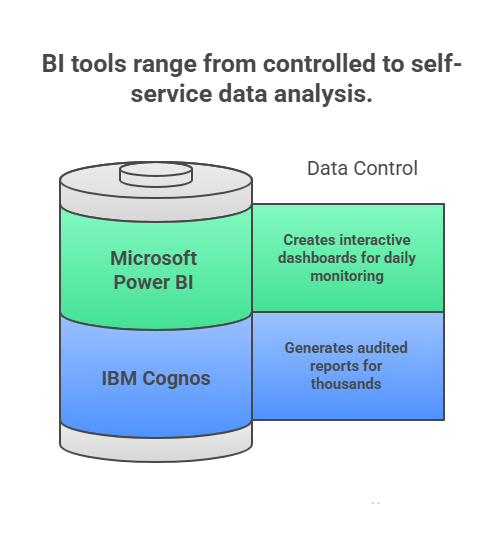
    Cognos is considered the go-to for structured excellence of the team. It is primarily used when a company needs data that is highly controlled and audited.  

    It is perfect for generating massive batches of reports that need to be sent to thousands of people simultaneously called Report Bursting.  

    Industry: Financial Services, Healthcare, Government, and Large-Scale Manufacturing. 

    Team Size: Large Enterprises with centralized IT departments and dedicated Data Architects. 

    Cognos is Best For: 

    • Generating perfect financial statements and legal documents. 
    • Distributing reports to thousands of users with high security. 
    • Handling massive data volumes from traditional, complex databases. 
    • Maintaining strict data governance and audit trails for compliance. 

    Use Cases of Microsoft Power BI   

    Power BI is used by teams that want to plug in their data and start seeing insights in minutes. It is the gold standard for “Self-Service BI,” where anyone in the company from HR to Sales can build their own dashboard to track daily performance. 

    Industry: Retail, E-commerce, Digital Marketing, Tech Startups, and Education. 

    Team Size: Small to Large Businesses that value decentralized, fast-paced decision making. 

    Power BI is Best For: 

    • Create interactive dashboards for daily monitoring. 
    • Connecting to modern web apps like Facebook Ads, Shopify, and Google Analytics. 
    • Sharing live data insights easily through Microsoft Teams and Excel. 
    • Low-cost entry for teams that need professional-grade AI tools. 
    Cognos vs Power BI

    Cognos vs Power BI: How to Choose the Right BI Tool in 2026 

    When it comes to picking the right tool from IBM Cognos vs Power BI, the “best” choice is the one that fits your team’s current skills and your company’s future goals. 

    Choose IBM Cognos Analytics if:   

    If your priority is precision and control, Cognos can be your solution. 

    • You work in Banks or Hospitals where data rules are very strict. 
    • You want IT experts to control all the numbers so nobody can change them by mistake. 
    • Your office already uses IBM systems and wants to stay with that family. 
    • You need to keep your data on private, physical servers for extra safety. 
    • You need formal PDF reports that look the same every single month.  

    Choose Microsoft Power BI if:   

    If your priority is speed and accessibility, Power BI is your modern engine. 

    • Your team already uses Excel, Teams, and Word every day. 
    • You want regular staff, not just tech experts, to create their own charts. 
    • You need a low-cost option that is easy on the wallet. 
    • You want to see live results today; not wait weeks for a report to be built. 
    • Your team is comfortable with Excel and wants a tool that feels similar. 

    Conclusion 

    The Cognos vs Power BI debate is not about which BI tool is superior, it’s about which one aligns with how your organization works in 2026.

    If your business depends on strict governance, audit-ready reporting, and pixel-perfect financial documents, IBM Cognos remains a powerful and reliable choice. If your teams need speed, self-service analytics, AI-assisted reporting, and seamless integration with Microsoft tools, Power BI clearly leads the way.

    Ultimately, the real advantage does not come from the platform alone, but from how confidently your team can use it to make decisions. The right BI tool, combined with the right skills, is what turns data into real business impact.

    At Skillify Solutions, we help professionals and teams master both Cognos and Power BI through practical, hands-on training so they can choose the right tool and actually use it to its full potential.

    Frequently Asked Questions  

    1. Is Cognos better than Power BI for large enterprises? 

    Power BI vs Cognos depends upon the daily needs of the businesses. Cognos is a powerhouse for massive companies that need strict IT control and formal, printed reports. However, Power BI is faster and easier for all employees to use daily.

    2. Can Power BI replace IBM Cognos Analytics? 

    Yes, but the style changes. Cognos is built for static PDF reports, while Power BI is made for interactive and clickable screens. In Skillify Solutions you can study both to make the right choice for your future. 

    3. Which BI tool has better AI capabilities: Cognos or Power BI? 

    It is a tie for this Power BI vs Cognos as Cognos uses IBM Watson to explain why data changed. Power BI uses Copilot to let you build entire reports just by typing a sentence.

    4. Can businesses transfer reports from Cognos to Power BI without data loss?

    Your data stays safe, but you must rebuild the reports. Since they use different languages, you can’t just copy-paste them.  You must clean up old data and build fresh, better-looking dashboards.


  • AI Engineer vs ML Engineer: Salary, Skills & Which Role Fits You Best

    AI Engineer vs ML Engineer: Salary, Skills & Which Role Fits You Best

    Some engineers live for the ‘Launch‘ button, however others live for the ‘Train‘ button. While they both work with intelligence, one builds the house and the other masters the bricks. This is the true divide between AI vs ML engineering.

    In 2026, the new tech world is divided into two specialties. AI Engineering is the new frontier for Full Stack creators. However,ML Engineering remains the preference for math lovers who live for algorithmic efficiency and MLOps. Both paths lead to the most influential roles in tech, but they require vastly different toolkits. 

    At Skillify Solutions, we’re here to help you navigate this crossroads with this blog on AI Engineer vs ML Engineer. We ensure you don’t just learn to code but learn to lead in the specific field that fits you. Ready to find your seat in the intelligence revolution? 

    Let’s break down which path is yours!

    AI Engineer vs ML Engineer: Salary, Skills & Career Path Comparison 

    In 2026, the tech world is no longer just talking about data. It talks about agents, automation, and real-time intelligence. While AI and ML are often used, their career paths have differences that are significant. 

    Let’s break down  

    Category AI Engineer ML Engineer 
    Core Focus They build an end-to-end intelligent system that mimics human thinking and reasoning.  Design and optimize algorithms that learn from data and make predictions.  
    Responsibilities Develop chatbots and integrate AI into existing software. Model training and build data pipelines. 
    Skills NLP, Deep Learning, Robotics, Computer Vision, Software Architecture. Statistical Modeling, Linear Algebra, Feature Engineering, Big Data Processing. 
    Tools TensorFlow, PyTorch, OpenAI API, LangChain, OpenCV, ROS. Scikit-Learn, Keras, Hadoop, Spark, MLflow, Databricks. 
    Salary (USA) $87k – 1lakh $87k – $167k  
    Employers Tech Giants like Google, Meta, Robotics firms, Healthcare and Smart Device makers. Fintech, E-commerce like Amazon, Netflix, Ad-tech and SaaS platforms. 
    Career Path AI Architect, Chief AI Officer, Robotics Specialist. Senior ML Engineer, Data Scientist, MLOps Lead. 
    Best Fit Aspirants who enjoy problem-solving and building smart user-facing products. Professionals who love math, statistics, and want to learn data patterns.   
    Certifications Microsoft Azure AI Engineer, IBM AI Professional. Google Professional ML Engineer, AWS ML Specialty. 
    Projects Voice Assistants, Self-driving car logic, GenAI apps. Recommendation engines, Fraud detection, Demand forecasting. 

    What Does an AI Engineer Do? 

    The job of an AI Engineer is to take human-like intelligence such as speech, vision, or reasoning. Then they weave it into a functional product. In 2026, this role is heavily focused on Agentic workflows and Generative AI integration. 

    Let’s study the core responsibilities and the tools that are essential:  

    Core Responsibilities of an AI Engineer 

    An AI Engineer must take an active approach to build intelligent systems: 

    1. Integrate Systems: Wire Large Language Models (LLMs) like GPT-4 or Claude into existing applications using robust APIs. 
    2. Develop Agents: Build AI Agents that autonomously execute tasks like booking travel or filing taxes. 
    3. Engineer Prompts & RAG: Design advanced prompt strategies and Retrieval-Augmented Generation (RAG) systems so the AI securely accesses and uses your company’s private data. 
    4. Deploy Ethics & Guardrails: Implement active safety layers and monitoring to prevent hallucinations and ensure data privacy. 

    Common Tools & Frameworks 

    1. Orchestration: LangChain, LlamaIndex, Haystack. 
    2. Models/APIs: OpenAI, Anthropic, Hugging Face. 
    3. Vector Databases: Pinecone, Weaviate, Milvus 
    4. Vision/Speech: OpenCV, Whisper, ElevenLabs. 

    AI Engineer Salary by Region 

    Let’s study ML Engineer VS AI Engineer based on their Salary: 

    Region Entry-Level (0-2 Years) Mid-Senior (5+ Years) Market Trend 
    USA $87k – 1lakh  $227k+ Rising  
    UK  £31k – £83k £93k+ Stable  
    India ₹17.1- ₹18.9 Lakhs ₹18.9 Lakhs+ Explosive  

    What Does an ML Engineer Do? 

    An ML Engineer is the specialist who builds the brain of the AI. They focus on the math, data, and training needed to make a model smarter and more accurate. To understand it better, if the AI Engineer builds the car, the ML Engineer is the specialist who designs the high-performance engine. They mainly focus on math, training, and the raw performance of models. 

    Let’s study the core responsibilities and the tools that are essential: 

    Core Responsibilities of an ML Engineer 

    1. Train & Tune Models: Take raw data and train custom models from scratch or fine-tune existing ones for specific tasks. 
    2. Engineer Data Pipelines: Build and maintain the “pipes” that clean and move massive datasets into the model. 
    3. Manage MLOps: Oversee the model lifecycle, deploying, monitoring for “drift,” and retraining as needed. 
    4. Optimize Performance: Ensure models run fast and remain cost-effective in cloud environments. 

    Tools & Libraries Used 

    1. Frameworks: PyTorch (the 2026 industry favorite), TensorFlow, JAX. 
    2. Data Processing: Apache Spark, Databricks, SQL. 
    3. Monitoring: MLflow, Weights & Biases, Kubeflow. 

    ML Engineer Salary by Region 

    Below we will study ML Engineer VS AI Engineer based on their Salary:

    Region Entry-Level (0-2 Years) Mid-Senior (5+ Years) Market Trend 
    USA $87k – $167k $205k+ Strong
    UK  £27k – £61k £140k+ Stable  
    India ₹8.3- ₹9.2 LPA ₹23.8 LPA+ Rising 

    AI Engineer vs ML Engineer: Which Career Path Fits You Best? 

    AI Engineer vs ML Engineer

    Based on Educational Background 

    The AI Engineer Path 

    1. Best for: Computer Science graduates or Software Engineers. 
    2. The Logic: If you’re comfortable with Full-Stack development and APIs, you will find AI Engineering aligning. 
    3. Key Skill: You need to be a Master of System Architecture. 

    The ML Engineer Path 

    1. Best for: Statistics, Mathematics, or Physics majors. 
    2. The Logic: If you enjoy working with algorithms and ML Engineer Path is for you.  
    3. Key Skill: You need a deep comfort level with Linear Algebra and Calculus. 

    Based on Career Goals 

    You can choose AI Engineering if your passion lies in building functional and user-facing products. You might aim to create an autonomous coding assistant or a smart application. 

    Your daily satisfaction comes from seeing people interact with your smart features. In this role, you actively prioritize user experience and seamless functionality over the complex math of the model architecture. 

    Choose ML Engineering if you prefer solving foundational data puzzles and optimizing the engine itself. You might focus on reducing AI bias or making models 10x smaller for mobile devices. This path is for those who prioritize scalability and mathematical optimization above all else. 

    Based on Industry Preference 

    Let’s study AI Engineer vs ML Engineer  based on their industry preference: 

    IndustryAI Engineering FocusML Engineering Focus
    SaaS & CreativeBuild GenAI tools for designers and writers.Optimize massive recommendation engines.
    Finance & CXAutomate real-time customer support agents.Engineer millisecond-fast fraud detection.
    Health & RoboticsDesign vision for drones and home bots.Train high-accuracy like tumor detection models.

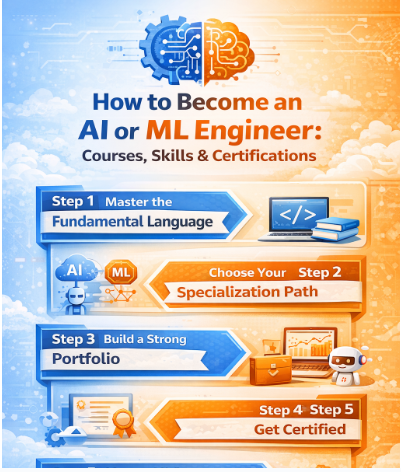
    How to Become an AI or ML Engineer: Courses, Skills & Certifications 

    You need a tactical roadmap to Start your career in the AI or ML fields in 2026. At Skillify Solutions, we’ve mapped out the most direct route to help you focus on the high-impact skills the industry demands. 

    Here is your step-by-step path on how to Become an AI or ML Engineer:  

    AI Engineer vs ML Engineer

    Step 1: Master the Fundamental Language  

    Start with Advanced Python, SQL for data retrieval, and the basics of Git for version control. You can try our Python for Data Science and AI course to master the syntax. Try libraries like NumPy and Pandas that serve as your foundation. 

    Step 2: Choose Your Specialization Path   

    First you have to decide whether you want to be an architect or an engine specialist. For AI Engineers, focus on API integration, Prompt Engineering, and Vector Databases. For ML Engineers, learn about Statistics, Calculus, and Linear Algebra. 

    Explore the Skillify Solutions AI & Machine Learning Bootcamp, which offers specialized tracks for both career paths, ensuring you don’t waste time on irrelevant modules. 

    Step 3: Build a Strong Portfolio  

    Recruiters care more about your practical experience than what’s on your degree in 2026. You need projects that solve real-world problems. Build a Retrieval-Augmented Generation (RAG) chatbot that can read a company’s entire legal database.  

    For ML, you have to develop a predictive model that identifies potential equipment failure in a manufacturing plant using sensor data. 

    Step 4: Get Certified  

    Certifications prove that you know how to use the cloud infrastructure that powers AI. Here are the Top 2026 Certifications: 

    1. Microsoft Certified: Azure AI Engineer Associate. 
    2. AWS Certified: Machine Learning, Specialty. 
    3. Google Professional Machine Learning Engineer. 

    Pro Tip: At Skillify Solutions, we align our curriculum with these global certifications, providing you with mock exams and prep material to ensure you pass on your first attempt. 

    Step 5: Master MLOps and Deployment   

    Learn Docker, Kubernetes, and MLflow. You need to understand how to deploy your AI agents or ML models so they can handle thousands of users. 

    Ready to claim your spot in the AI revolution? Explore all Skillify Solutions Courses here and take the first step toward your new career today. 

    Conclusion 

    In 2026, the market rewards specialists who don’t just know the theory. They can deliver results that drive business value.  If you are trying to choose between an AI Engineer vs ML Engineer career path in 2026, the most important step is to understand which one matches your strengths and career goals.  

    The choice you make today will define your future in the global tech economy. At Skillify Solutions, we provide specialized training, real-world projects, and expert mentorship to help you master a discipline.  Start your journey today and lead the future of technology. 

    Frequency Asked Questions

    1. What’s the difference between AI and ML engineering in startups vs big tech?

    In startups, an AI Engineer often handles everything from prompt design to deployment. In big tech, roles are specialized. ML Engineers focus on massive scale and reliability. Whereas AI Engineers build specific product features

    2. Is AI engineering harder than ML engineering? 

    It is not harder, just different. ML Engineering is math-intensive and requires deep knowledge of statistics and algorithms. AI Engineering focuses on system architecture and product integration

    3. Can an ML engineer transition into an AI role? 

    Definitely. Since Machine Learning is a subset of AI, ML engineers already have foundational logic. To switch, you’ll just need to master Generative AI tools like LLMs and RAG systems. At Skillify Solutions, our bridge courses help you learn quickly by adding the latest 2026 AI skills to your existing ML toolkit.

    4. What’s the future of AI engineer vs ML engineer roles?

    In the future, AI Engineers will build autonomous agents that do work, while ML Engineers will create specialized models that power them. Join our courses at Skillify Solutions to master your skills for this evolving landscape. 

  • Top Degrees in Demand for the Future: 2026 & Beyond

    Top Degrees in Demand for the Future: 2026 & Beyond

    Imagine telling your parents that you don’t want to become a doctor, engineer, or Chartered Accountant (CA) and instead, you want to study Artificial Intelligence, Behavioural Psychology, or Renewable Energy. Ten years ago, they would have laughed. But today? These top degrees in demand for the future are getting graduates hired faster than traditional fields. 

    The degrees that mattered in 2010 aren’t the degrees that will matter in 2026. Hiring is shifting nowadays as industries are reinventing.  And the biggest surprise? The most in-demand degrees for the future come from researching the industry standards. In this blog by Skillify Solutions, we break down the top degrees in demand for the future, backed by real-world examples, salary trends, and industry reports. Let’s dive in! 

    Understanding Top Degrees in Demand for the Future 2026

    Picking top 10 best degrees for the future 2026 feels like betting on your future in a world that is rapidly changing. In the digital transformation era, AI is reshaping jobs, and climate tech is booming like anything. Look at Sundar Pichai, who studied Metallurgical Engineering, a field nowhere close to tech leadership. But his curiosity for product design and strategy led him to Google’s top seat. 

    Understanding the top future-proof degrees in 2026 can equip you with skills that can match the market demands in the upcoming years. It can also ensure steady jobs and growth to build a rewarding and resilient career.  

    What Makes a Degree “Future-Proof” in 2026

    When you are looking for a future proof degree, you’re not just chasing a job, but building a career that lasts through global shifts and digital waves.  Degrees become future proof when they align with recent trends like AI adoption, green energy pushes, and healthcare advancements.  

    These fields are expected to grow in Science, Technology, Engineering, and Mathematics (STEM) and healthcare by 2030. Employers look for fresh graduates who can blend tech savvy approaches with human skills like analytical thinking and adaptability. These advancements can keep you ahead even if the recent job roles do not exist in the future market.  

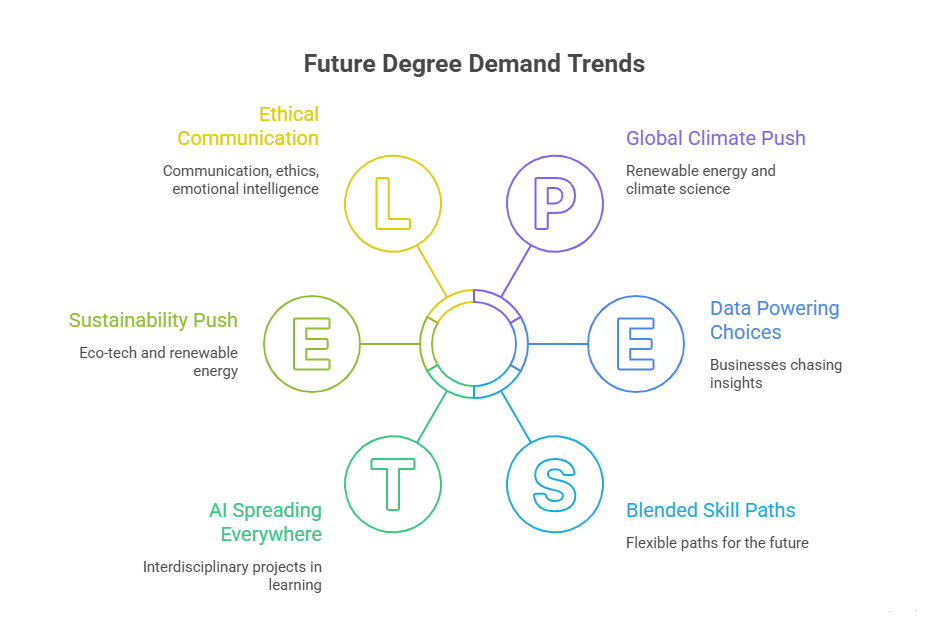
    5 Key Trends Driving Future Degree Demand 

    The branching of Artificial Intelligence (AI), automation, and digitalization is reshaping job roles across every sector in 2026. This rapid change points out that the importance of degree and education is being measured by the upcoming opportunities and challenges in the future market.  

    Here’s the real talk on the five key trends fueling future degree demand, accumulated from the latest job reports. 

    1. AI Spreading Everywhere: Previously, AI was only used by coders but now, it’s weaving into education, art, business, and healthcare. It boosts interdisciplinary projects in learning outcomes and problem-solving. Imagine using AI tools to blend creative writing with data analysis, this way you can master in any field.  
    2. Data Powering Choices: Every field today or in the future will require data intelligence from journalism to psychology. You can assume that Python and SQL are turning raw information into smart calls. These approaches are a must-have as businesses in 2026 chase insights.  
    3. Sustainability and Climate Push: Renewable energy and climate science are growing at a faster pace with thousands of roles in solar, wind, and eco-tech. It is fueled by global pushes for a cooler planet where it can be considered as a future proof career option.  
    4. Blended Skill Paths: One of the common problems for most fresh graduates is that they go for multiple skill paths and try to explore them. Like they will try business plus computer science to beat competition and create flexible paths for the future.  
    5. Learning Soft Skills: Communication, ethics, and emotional intelligence are considered gold in this digital era. Employers want humans who can connect, not just code for driving the need for human intelligence.  
    top degrees in demand for the future

    Explore Skillify’s game-changing bootcamps with 90% placement magic – Join Data Science Bootcamp with AI course today! 

    Top 15 Degrees in Demand for the Future 

    If you are worried about the future aspects in this tech Savvy world, there is a study of 15 degrees for the future that you must do. One good news is that 2026 jobs are tilted towards technology, health, and sustainability. The STEM and healthcare roles are about to rapidly increase by 17-30% by 2030.  

    Below, there are top 15 career paths, roles, salaries, and tips to visualize your future. 

    1. Computer Science & Artificial Intelligence 

    Between 2019 and 2029, the U.S. Bureau of Labor Statistics (BLS) anticipates a 13% rise in employment for computer and information technology occupations. The answer to why is that these graduates can mix algorithms with everyday magic. They can fuel self-driving cars and factories 30% quicker. You can see this career path in recommendation systems, voice assistants, self-driving cars, smart home devices, and even in the way businesses operate. 

    Career opportunities include 

    • Software Developer or Full-Stack Engineer 
    • AI or ML Engineer 
    • Robotics Programmer or Automation Engineer 
    • Big Data or Backend Systems Developer 
    • Cloud or DevOps Engineer 

    Salary Expectations: $120k/ year median salary range while US freshers huge in tech hubs. 

    Why it’s future-proof: Most industries are replacing manual tasks with automation. But they still need humans with technical skills to guide, train, and optimize these systems. 

    2. Data Science & Analytics 

    Data Science can be considered as the engine behind modern decision-making. Every click, purchase, and swipe produces data, and companies need experts who can find patterns, predict trends, and turn information into strategy. All the future proof career options like AI, healthcare, and technology need Data experts to run their business.  

    Career Opportunities 

    • Data Analyst 
    • Data Scientist 
    • Machine Learning Engineer 
    • Data Engineer 
    • Business Intelligence Analyst 
    • Quantitative Analyst 

    Salary ExpectationsUSA Median can range from $102,938/year. Freshers in Data Science and Analytics can expect $73k – $143k varying with the sector.  

    Why It’s Future-Proof: Organizations are becoming data dependent. Every industry wants to predict its future, and that makes data professionals irreplaceable. 

    3. Nursing & Advanced Practice Nursing 

    With the increasing world’s population, advanced nursing needs rapid rise. Nurse Practitioners (NPs) are becoming the backbone of global health. They can diagnose, prescribe, and manage treatments.  

    Career Opportunities 

    • Registered Nurse (RN) 
    • Nurse Practitioner (NP) 
    • Clinical Nurse Specialist 
    • Acute Care Nurse 
    • Pediatric Nurse Practitioner 
    • Telehealth Nursing Specialist 

    Salary Expectations: A nurse practitioner can earn up to $93,969/year and for senior level it can go upto $113k. 

    Why It’s Future-proof: Healthcare demand is rising, and telehealth is expanding. In this, the NPs are filling essential care gaps across hospitals and clinics. 

    4. Cybersecurity & Information Security 

    Cyberattacks are increasing with a rate of 300% year over year. Organizations urgently need defenders who can secure systems, protect data, and prevent breaches for protecting their data.  

    You’ll learn: 

    Ethical hacking, digital forensics, penetration testing, threat analysis, network security protocols, firewalls, cryptography, and cloud security defense. 

    Career Opportunities 

    • Cybersecurity Analyst 
    • Ethical Hacker / Pen Tester 
    • Information Security Manager 
    • Cloud Security Specialist 
    • Cyber Forensics Investigator 

    Salary Expectations: You can expect $102k/ year on average. The Ethical Hackers often earn more than $123k at senior levels 

    Why It’s Future-proof: Today, companies digitize everything, so cybersecurity is becoming a non-negotiable requirement.  

    5. Physician Assistant 

    PAs diagnose illnesses, prescribe medication, and offer advanced patient care. They are responsible for reducing the pressure on healthcare systems. 

    You’ll learn: 

    Clinical diagnostics, surgical assistance, pharmacology, patient management, emergency care, and primary care procedures. 

    Career Opportunities: 

    • Surgical PA 
    • Emergency Medicine PA 
    • Primary Care PA 
    • Orthopedic PA 
    • Pediatric PA 

    Salary Expectations: Median: $112,902/year

    Why it’s future-proof: Growing patient demand and physician shortages increase reliance on PAs. 

    30-40% salary boost awaits with our Data Analytics Bootcamp with AI Course– Join today! 

    6. Healthcare Administration 

    Behind every hospital is a team helping it run smoothly. Healthcare administrators manage operations, finances, and patient experience. 

    You’ll learn: 

    Healthcare operations, policy, HR management, finance, quality control, telehealth systems, and healthcare leadership. 

    Career Opportunities: 

    • Hospital Administrator 
    • Healthcare Operations Manager 
    • Clinical Coordinator 
    • Medical Office Manager 
    • Health Services Manager 

    Salary Expectations: Median: $86k/ year

    Why it’s future-proof: Healthcare is expanding and needs skilled leaders to manage large, complex systems. 

    7. Biomedical Engineering 

    Biomedical engineers design life-saving technologies from prosthetics to surgical robots. 

    You’ll learn: 

    Biomechanics, biomaterials, imaging systems, medical device design, electronics, tissue engineering, and regulatory standards. 

    Career Opportunities: 

    • Medical Device Engineer 
    • Clinical Engineer 
    • Biomechanics Engineer 
    • Surgical Robotics Engineer 
    • Medical Imaging Engineer 

    Salary Expectations: Median: $81,127/year

    Why it’s future-proof: Medical technology is expanding rapidly, so industries require engineers who understand both medicine and innovation. 

    8. Financial Technology (FinTech) 

    FinTech is transforming how we pay, invest, borrow, and save. This field blends finance + coding + cryptography. 

    You’ll learn: 

    Blockchain fundamentals, smart contracts, financial modelling, risk analytics, fraud detection, Python, and cybersecurity for banking. 

    Career Opportunities: 

    • Blockchain Developer 
    • Algorithmic Trading Engineer 
    • Fraud Detection Engineer 
    • FinTech Software Architect 
    • Crypto Analyst 

    Salary Expectations: Median: $114k/ year

    Why it’s future-proof: Money is becoming digital and financial institutions are evolving into tech companies. 

    9. Renewable Energy Engineering 

    As countries transition to sustainability, green energy engineers are in high demand. 

    You’ll learn: Solar & wind systems, energy storage, smart grids, electrical systems, sustainability modelling, and environmental impact analysis. 

    Career Opportunities: 

    • Solar Energy Engineer 
    • Wind Turbine Systems Engineer 
    • Smart Grid Engineer 
    • Energy Storage Engineer 
    • Sustainability Consultant 

    Salary Expectations: Median: $90,000/year

    Why it’s future-proof: Climate goals, green policies, and renewable energy investments guarantee long-term growth. 

    10. Physical Therapy (DPT) 

    Physical therapists help people recover movement, strength, and independence after injuries or surgeries. 

    You’ll learn: Human anatomy, rehabilitation techniques, movement science, therapeutic exercise, neuromuscular therapy, and clinical assessment. 

    Career Opportunities: 

    • Orthopedic PT 
    • Sports Rehab Therapist 
    • Pediatric PT 
    • Neurological PT 
    • Home Health PT 

    Salary Expectations: Median: $79k/ year

    Why it’s future-proof: An aging population + lifestyle injuries = permanent demand for rehabilitation specialists. 

    11. Systems & Business Analytics 

    This degree blends business and technology, helping companies make faster, smarter, and more efficient decisions. 

    You’ll learn: 

    Systems modelling, analytics tools, SQL, dashboarding, business strategy, automation workflows, and process optimization. 

    Career Opportunities: 

    • Business Analyst 
    • Systems Analyst 
    • Operations Analyst 
    • Digital Transformation Specialist 
    • BI Analyst 

    Salary Expectations: Median $82k/ year

    Why it’s future-proof: Businesses rely on data and automation and need analysts to guide strategy. 

    12. Information Technology Management 

    IT managers keep digital infrastructure running from cybersecurity to cloud systems. 

    You’ll learn: 

    Network management, cybersecurity basics, cloud computing, IT project management, enterprise software, and digital governance. 

    Career Opportunities: 

    • IT Manager 
    • Network Architect 
    • Systems Administrator 
    • Cybersecurity Manager 
    • Cloud Infrastructure Manager 

    Salary Expectations: Median: $98k/ year

    Why it’s future-proof: Every organization needs strong digital foundations, making IT leadership essential. 

    13. Occupational Therapy 

    OTs help people rebuild physical and cognitive skills needed for daily life. 

    You’ll learn: Therapeutic techniques, motor skills training, cognitive rehab, sensory integration, mental health support, and patient-centered care. 

    Career Opportunities: 

    • Occupational Therapist 
    • Pediatric OT 
    • Geriatric OT 
    • Hand Therapist 
    • Rehab Consultant 

    Salary Expectations: Median: $96,864

    Why it’s future-proof: Demand for rehabilitation and independent-living support continues to grow. 

    14. Supply Chain & Logistics 

    Supply chains keep the world moving from warehouses to global shipping networks. 

    You’ll learn: Logistics management, procurement, operations planning, inventory control, analytics, and supply chain technologies (ERP, WMS). 

    Career Opportunities: 

    • Supply Chain Manager 
    • Logistics Coordinator 
    • Procurement Specialist 
    • Demand Planning Analyst 
    • Global Operations Manager 

    Salary Expectations: Median: $81k/ year

    Why it’s future-proof: E-commerce and global trade rely on efficient, tech-enabled supply chains. 

    15. Mental Health Counseling 

    Mental health professionals are critical as awareness and emotional health needs rise. 

    You’ll learn: Psychotherapy techniques, counseling skills, mental health assessment, crisis intervention, behavioral therapy, and ethics. 

    Career Opportunities: 

    • Mental Health Counselor 
    • Clinical Psychotherapist 
    • School Counselor 
    • Trauma Specialist 
    • Behavioral Health Consultant 

    Salary Expectations: Median: $53,139

    Why it’s future-proof: Mental health services are expanding across schools, workplaces, hospitals, and communities. 

    How to Choose Your Future-Proof Degree: 5-Step Framework 

    Choosing a degree used to be simple previously as poaching a good job offer with a degree and skills was pretty easy. Pick a degree that is safe and in demand, get a job, and stay in that field for decades. But today, industries are evolving faster than your university syllabuses. Most of the job roles appear and disappear within years and students often find themselves asking the same question: How to Choose Your Future-Proof Degree? The answer to this question is choosing the right degree.
    Then, you’ll learn how to turn that degree into a job-ready portfolio with this 5-stage career-building roadmap. 

    Step 1: Assess Your Core Interests and Strengths 

    Candidates nowadays are chasing certificates like Pokémon cards, which is a big no when it comes to selecting your future proof career. You must choose one real-world skill and learn it thoroughly. Whether it’s coding or creative writing, it is crucial to understand your core strengths and talent.  

    Many students do this wrong as they aim to learn six tools at 20% depth instead of one tool at 80%. This is to understand that the world hires creators, not collectors who have a bunch of incomplete skills.  

    Ask yourself: 

    • What subjects excite me enough to study for three or four years? 
    • What skills feel interesting – analytical thinking, creativity, empathy, problem-solving? 
    • When do I feel most engaged or curious? 

    Step 2: Analyze Market Demand and Job Growth 

    It is important to understand that a degree can only be considered future proof if it leads the market for a decade. If a field shows consistent demand across multiple reports, there are several chances that they are going to grow.   

    What to research: 

    • Industry trends like AI, cybersecurity, healthcare, green energy, fintech 
    • Hiring patterns in LinkedIn job insights 
    • BLS growth forecasts 
    • Skill reports like Google and others  

    Step 3: Calculate ROI and Career Potential 

    A degree is an investment, so compare what you will spend and what you can earn and grow in future. The best degree is the one that keeps creating opportunities long after you graduate and helps you get Return on Investment (ROI). You can also equip you with transferable skills like data, coding, analysis, and healthcare expertise.  

    Things you should consider 

    • Tuition and living costs 
    • Time to complete 
    • Starting salary 
    • Upward mobility 
    • Skill versatility 

    Step 4: Evaluate Program Quality and Reputation 

    It is evident that choosing the right discipline is half the battle won for you.  Choosing the right program is the other half to choose top degrees in demand for the future in the world. You can explore opportunities like updated curriculum, industry projects, internship opportunities and university–industry partnerships 

    Ask these questions: 

    • Are they teaching what companies use? 
    • Do graduates from this program get hired into good roles? 

    Step 5: Plan for Flexibility and Lifelong Learning 

    Now, this is the final and the most important step when you are just hoping that someone will hire you. Employers love candidates who do not entertain guesswork, so you should take care of projects and visibility. As a perfect candidate, you have to negotiate your strength along with the proof of capability.  

    Things that are needed 

    • Real projects 
    • Public proof 
    • Demonstrated consistency 
    • Confidence with your work 

    Conclusion 

    Choosing the right degree today is less about “what everyone studies” and more about what the future needs. The key to figuring out top business degrees in demand for the future is choosing that opens doors, sparks curiosity, and stays relevant long after 2026. 

    This blog by the Skillify Solutions concludes the top degrees along with expectations and average salary. The jobs of tomorrow won’t wait, and your future self will thank you for choosing a path that challenges you, excites you, and prepares you to grow in a world that’s changing faster than ever.

    Frequently Asked Questions 

    1. Which fields offer the best opportunities for remote work among the top degrees in demand for the future? 

    The top 10 best degrees for the future 2030 can be CS/AI, Data Science by Skillify Solutions, Cybersecurity, FinTech, IT Management, Business Analytics shine for remote work. Code from home, analyze data anywhere; secure systems virtually acquire more than 40%. Healthcare admin & counseling offer hybrid flexibility. 

    2. Which top degrees in demand for the future have the highest global career opportunities?

    The most heated question is which degree has the highest demand in the future? Degrees like CS, AI, Cybersecurity, FinTech, Renewable Energy, and Biomedical Engineering open doors globally.  These top degrees in demand for the future 2026 across oceans and cultures are in high demand.

    3. What soft skills complement the top degrees in demand for the future to stay competitive? 

    The top business degrees in demand for the future will need clear communication, curiosity, problem-solving, and the ability to adapt fast. Being a team player and knowing how to solve tricky puzzles can help you get hired and promoted.

    4. Can certifications enhance the value of the top degrees in demand for the future? 

    Yes. Certifications like AWS cloud, CompTIA Security+, or PMP from the Skillify Solutions can help you chase the top ten degrees in demand for the future. They can boost your pay, open doors quicker, and prove your skills beyond a degree.

    5. Which top degrees in demand for the future offer the highest ROI in terms of salary vs tuition?

    Computer Science and AI often lead when it comes to return on Investment (ROI) from the top degrees in demand for the future in the world. Data Science from Skillify Solutions, Cybersecurity, and Nursing also pack great ROI punches.


  • Data Engineering vs Data Science: Career Guide 2026

    Data Engineering vs Data Science: Career Guide 2026

    Data Engineering and Data Science by the Skillify Solutions are two high-impact careers driving the Artificial Intelligence (AI) and analytics revolution. While one role focuses on crafting the robust infrastructure where data flows, the other specializes in transforming that data into next-generation predictive insights.

    In the digital era, the value lies not just in the data itself, but in the skilled professionals, the builders and the analysts, who bring it to life. This blog will help you understand Data Engineering vs Data Science, each career guideline so you can decide which side of the data lifecycle best suits your skills and career aspirations. Let’s begin.

    Data Engineering vs Data Science: Key Differences Explained 

    It is crucial to understand that both roles work with data but has different purposes. Data Engineers build the systems, while Data Scientists are responsible to analyze the data. Let’s break down Data Science vs Data Engineering in a tabular format to understand how they differ in 2026: 

    Feature Data Engineering Data Science 
    Objective Build and manage data pipelines and infrastructure. Analyze data to extract insights and build predictive models. 
    Responsibilities Design architectures, manage ETL/ELT, ensure data quality and scalability. Clean data, run analysis, create models, and present insights. 
    Skills & Tools SQL, Python, Spark, Hadoop, Kafka, Airflow, AWS, Snowflake. Python, R, TensorFlow, scikit-learn, Tableau, Power BI. 
    Deliverables Data pipelines, databases, and optimized infrastructure. ML models, dashboards, and actionable insights. 
    Education Computer Science or Engineering. Data Science, Statistics, or Mathematics. 
    Collaboration Works with data scientists and DevOps teams. Works with engineers and business teams. 
    Career Goal Data Architect / Lead Engineer. Senior Data Scientist / Head of Analytics. 
    Trends (2026) Data mesh, real-time streaming, automation. Generative AI, AutoML, decision intelligence. 

    Key Skills and Tools for Data Scientists and Data Engineers

    In today’s data driven world, both Data Scientists and Data Engineers need a solid technical foundation to excel in their fields. However, the question is Data Science and Data Engineering same. Their usage of tools and technologies will differ depending upon their focus and priorities. 

    image 3 Data Engineering vs Data Science: Career Guide 2026

    The Data Science and Data Engineering difference depends on whether you want to engineer the data pipeline or analyze the data to decide your career path. Skillify Solutions helps you understand the basic skill sets that are crucial for you to understand Data Science vs Data Engineering: 

    Unlock your future in data – Register today with Data Science with AI Course and become job-ready in 2026! 

    Data Engineer Tech Stack 

    Data Engineers are known as the foundation of any data-controlled organization. They have the responsibility of developing data systems that are scalable and punctual in availing clean data to scientists and analysts.  

    Here are the key skills and tools that define their role in 2026:  

    • Programming Languages: Candidates should be proficient in Python, Java, or Scala in order to create and automate data workflows 
    • Databases and Querying: He or she should have knowledge of NoSQL, SQL, and data modeling for both structured and unstructured storage. 
    • Big Data Technologies: An in-depth knowledge of Hadoop, Flink, Kafka, and Apache Spark will help you to handle large datasets. 
    • Cloud Platforms: You must be familiar with Azure, Google Cloud, or AWS to excel in your field. 
    • ETL and Data Integration: You must know to construct pipelines with Airflow in order to automate Data transformation.  
    • Infrastructure and DevOps: You need some knowledge of Terraform and Kubernetes for scalable data system deployment.  
    • Data Governance & Security: It is good to have knowledge of data quality and monitoring tools like Monte Carlo or Great Expectations. 

    Data Scientist Tool kit  

    Whereas Data Scientist helps to decode the information provided by engineers into business. Their mandate is to research on trends using forecasting models and report the findings to the stakeholder.  

    Here are the core skills and tools they must acquire as a basic tool kit:  

    • Programming and Scripting: Learn R or Python to create models and manipulate data. 
    • Mathematics and Statistical Ability: Proficiency in probability, hypothesis testing, regression and statistics can prove helpful.  
    • Machine Learning Frameworks: You need the knowledge of TensorFlow, PyTorch, scikit-learn, and XGBoost for predictive modeling. 
    • Data analysis and Visualization: You need to master tools like Tableau, Power BI, Seaborn, Matplotlib, NumPy, and Pandas for reporting.  
    • Data Wrangling: One must know the feature engineering, NumPy, and Pandas helps to prepare raw data. 
    • MLOps and Deployment: Knowledge of Docker, Git, and MLflow helps to deploy and track models during production. 
    • Communication and Storytelling: It will be useful in concise narratives and images to convert insights into business recommendations. 

    Roles & Responsibilities of Data Science and Data Engineering

    Both Data Engineers and Data Scientists are accustomed with data. Whereas their daily tasks look different in terms of approach. Engineers make sure that data flows seamlessly across systems. On the other hand, scientists work with the data to open insights and build predictive models. Let’s note how does their typical day look like for better understanding of Data Science vs Data Engineering

    Typical Day of a Data Engineer 

    The day in the life of a Data Engineer is filled with the tasks of guaranteeing the reliability of data, its ability to scale, and probability of access. They are the creators of the design, upkeep, and optimization of the data infrastructure that drives analytics and AI systems.  

    Their daily task include:  

    • Supervising and correcting unsuccessful ETL/ELT jobs.  
    • Constructing pipelines and warehouses.  
    • Automation of writing Python, SQL or Scala automation scripts.  
    • Working with teams to establish new data requirements.  
    • Ensuring data quality, security and documentation.  

    In short: They prepare data in an accessible, accurate and production ready format.  

    From beginner to pro – Your data career starts here with our Data Engineering course! 

    Typical Day of a Data Scientist 

    A Data Scientist is a profession that is centered around exploring, analyzing, and modeling data to provide answers to business inquiries and forecast business results. 

    Their daily task include:  

    • Treatment and analysis of new data.  
    • Creation and training of Machine Learning (ML). 
    • Tune parameter and model performance evaluation.  
    • Tableau, Power BI, or Python visualization of the findings.  
    • Delivering knowledge and suggestions to the stakeholders.  

    In short: They transform data into business value and informed decisions.   

    How They Collaborate? 

    Despite of the discussion around Data Science vs Data Engineering, it is prevalent that both of them work as a team. One is responsible for building the foundation whereas the other extracts insights. A typical workflow begins when Data Engineers create pipelines to deliver clean data. Data Scientists then use that data for exploration and reporting. 

    Continuous feedback between both roles ensures that data systems evolve to meet business needs and maintain analytical accuracy.  

    A Workflow Chart on how Data Engineers and Data Scientists Collaborate 

    [Raw Data]  

       ↓  

    (Data Engineer → ETL, Data Warehouse, Data Lake) 

       ↓  

    (Clean Structured Data) 

       ↓  

    (Data Scientist → Analysis, Modeling, Visualization) 

       ↓  

    [Business Insights & Actions] 

    +————–+

    |   [Raw Data] | (Unstructured Data Sources)

    +————–+

           ↓ (Ingestion Start)

    +—————————–+

    |    DATA ENGINEER (DE)       |  <– RESPONSIBILITY SHIFT –>

    |—————————–|

    |  1. ETL/ELT Pipeline Build  |

    |  2. Data Warehouse / Lake   |

    |  3. Data Quality & Cleansing|

    +—————————–+

           ↓ (Handoff: Clean Data)

    +—————————–+

    |  [Clean Structured Data]    |

    +—————————–+

           ↓ (Modeling Start)

    +—————————–+

    |    DATA SCIENTIST (DS)      |  <– RESPONSIBILITY SHIFT –>

    |—————————–|

    |  1. Feature Engineering     |

    |  2. Statistical Analysis    |

    |  3. Model Training & Testing|

    +—————————–+

           ↓ (Deployment Ready Model)

    +—————————–+

    |    DATA ENGINEER (DE)       |  <– DEPLOYMENT RESPONSIBILITY –>

    |—————————–|

    |  4. MLOps / Model Serving   |

    +—————————–+

           ↓ (Actionable Output)

    +—————————–+

    | [Business Insights & Actions]| (Strategy & Decision Making)

    +—————————–+

    Data Science vs Data Engineering: Job Opportunities & Salaries

    Data Science and Data Engineering jobs are reputed to have high-paying salaries, fast career advancement. Both of them has raised their demand all over the world. Knowing how these jobs develop and what they pay in 2026 can help you make a positive and long-term data career. 

    Career Progression 

    Data Engineering career path: Most professionals start as Junior or Associate Data Engineer, move into Data Engineer, then Senior Data Engineer, and ultimately to roles like Lead Data Engineer or Data Architect.  

    Data Science career path: A common path begins at Data Analyst or Associate Data Scientist, advances to Data Scientist, then Senior Data Scientist, and leads to Head of Analytics or ML/AI Director roles.  

    Data Engineering vs Data Science Difference in Career Progression Chart 

    Level Data Engineer Path Data Scientist Path Focus Area 
    Entry (0–2 yrs) Junior / Associate Data Engineer Junior / Associate Data Scientist Learn SQL, Python, ETL, and basic analytics. 
    Mid (2–5 yrs) Data Engineer Data Scientist Build pipelines, manage data, create ML models, analyze data. 
    Senior (5–8 yrs) Senior Data Engineer Senior Data Scientist Lead projects, design scalable systems, optimize models. 
    Leadership (8+ yrs) Data Architect / Head of Data Engineering Lead / Principal Data Scientist Set data strategy, manage teams, align business goals. 

    Salary Comparison: US & Global Markets  

    In 2026, both Data Engineering and Data Science continue to be among the most profitable tech careers in the U.S. market. Their salary depends on the experience, size of the company and industry. Their demand is higher because of the usage of cloud infrastructure and data-based decision-making. 

    Senior professionals with advanced technical and leadership skills can earn well. Sometimes these candidates earn above the national tech average. Here is a table showing Data Science vs Data Engineering salary and their approximate income:  

    Data Engineering vs Data Science Salary Comparison

    Role Approximate Average Salary (USD/year) 
    Data Engineer $99,466/ year
    Senior Data Engineer $134,350/ year
    Data Scientist $102,938/ year
    Senior Data Scientist $136,511/ year

    Job Growth Statistics & In-Demand Certifications 

    The demand for both Data Engineers and Data Scientists continues to increase as of the data of 2026. It is driven by cloud adoption, AI integration, and the increasing need for real-time analytics across industries. According to the U.S. Bureau of Labor Statistics both roles rank among the top 10 fastest-growing tech careers in the U.S. 

    Data Scientist roles are projected to grow by 34% from 2022 to 2032 and it exceeds the national average for all occupations. On the other hand, Data Engineer positions are expected to grow by 2030. It shows rapid expansion of cloud-based infrastructure, data warehouses, and analytics platforms.  

    Source Link

    High-demand certifications include:  

    • For Data Engineering: Cloud certifications (AWS Big Data, Azure Data Engineer), Apache Spark certification, data architecture credentials.  
    • For Data Science: Certified Data Scientist credentials, machine learning certifications (TensorFlow Developer, PyTorch), and statistics or applied mathematics specialisations.  

    Decode data. Predict the future. Become a Data Scientist today! 

    How to Start Your Career as Data Engineering & Data Scientist

    Starting a career in data is not a hard step. Both Data Engineering and Data Science offer exciting and high-growth paths. But you must figure out first which is better Data Science or Data Engineering? Here are the ways how you can get started and even switch between them if your interests evolve. 

    Path for Data Engineers  

    If you enjoy solving technical challenges, writing code, and building systems that move and process data, this path is for you. 

    • Step 1: Start with building a foundation in computer science, databases, and programming like Python and Java.  
    • Step 2: Then learn SQL as it is the backbone of data management and querying. 
    • Step 3: Start understanding Extract, Transform, Load (ETL) processes and data modeling. 
    • Step 4: Get hands-on experience with big data tools like Apache Spark, Hadoop, and Kafk 
    • Step 5: Learn cloud platforms and start working with AWS, Google Cloud, or Azure. 
    • Step 6: Build small projects like automating data pipelines or creating a mini data warehouse. 
    • Step 7: Apply for internships or entry-level roles like Junior Data Engineer or ETL Developer. 

    Pro Tip: You need to focus on data quality and scalability as good engineers think long-term about performance and reliability. 

    Path for Data Scientists  

    If you love finding patterns, predicting trends, and telling stories with numbers, Data Science might be your perfect fit. 

    • Step 1: Strengthen your basics in statistics, mathematics, and Python/R. 
    • Step 2: Learn to clean, explore, and visualize data using Pandas, NumPy, Matplotlib, and Seaborn. 
    • Step 3: Dive into machine learning and understand algorithms, model evaluation, and feature engineering. 
    • Step 4: Work on hands-on projects like Kaggle, GitHub, or personal datasets to showcase your skills. 
    • Step 5: Learn to use tools like Power BI or Tableau for data storytelling. 
    • Step 6: Gain domain knowledge and understand the business problem is as important as the model itself 
    • Step 7: Start as a Junior Data Scientist or Data Analyst and keep learning MLOps or advanced ML frameworks. 

    Pro Tip: Always connect your analysis to business impact as data alone doesn’t tell a story, you do. 

    Transition Guide  

    There are many professionals switch between Data Science and Data Engineering after they discover their actual strengths. After understanding the difference between Data Science and Data Engineering, here are the ways on how you can bridge the gap: 

    From Data Engineer to Data Scientist

    • Learn statistics, machine learning, and data visualization. 
    • Work with analytics or ML teams to understand their workflows. 
    • Build small ML projects using the data you already handle. 

    From Data Scientist to Data Engineer

    • Strengthen SQL and programming skills. 
    • Learn data architecture, ETL design, and cloud data tools. 
    • Contribute to pipeline automation or MLOps in your current role. 

    Pro Tip: The best professionals often blend both skill sets and are known as Data Science Engineers to be in huge demand. 

    Data Engineering vs Data Science: Which Career Path Should You Choose?

    Now the question arises which is better Data Science or Data Engineering. Both the career options are strong and well-paying in 2026, yet the choice of one or another career option is up to your interests. You can select Data Engineering in case you like creating systems, technical puzzles, and working at scale. It will suit best those who like to do backend work and power the analytics under the hood.  

    The discussion on What is Data Engineering vs Data Science states unlike choosing Data Science in case, you like analyzing data, discovering the patterns, and making business decisions based on the findings. It suits inquisitive thinkers who prefer experimenting, modeling, and telling of stories with information.

    Conclusion 

    It is to conclude, studying Data Engineering vs Data Science helps you in finding what fits you better. Data Engineers build the systems that make insights possible, while Data Scientists turn that data into smart decisions. 

    Both Data Science and Data Engineering careers are known to have a high salary, development, and influence. There are unlimited opportunities in the world of data in the upcoming years, so it is better to choose wisely.  

    Master Python, ML & AI – Launch your career in Data Science now 

    Frequently Asked Questions 

    1. Is data engineering harder than data science?

    It is not necessary as both are challenging in different ways. Data Engineering demands strong coding and system design skills, while Data Science focuses on math, ML, and analytics. Your strengths in coding and analysis decide which feels harder for you.

     2. Data engineering vs data science: Which offers better remote work opportunities? 

    Both Data Science and Data Engineering offer a remote flexibility. Data Science roles are often more remote-friendly due to analysis and modeling work, while Data Engineering may need closer collaboration for pipeline deployment and cloud management.

    3. Will AI replace data engineering and data science jobs?

    Artificial Intelligence (AI) can automate repetitive tasks but cannot replace these roles. Data Engineers will manage smarter systems, and Data Scientists will focus on strategy and ethics. AI enhances their efficiency, and it doesn’t eliminate the need for human expertise.

    4. Can you be a data scientist or data engineer without strong math skills?

    Yes, Data Engineers rely more on coding, databases, and cloud tools to some extent than heavy math. Data Scientists need a good grasp of statistics and logic. Whereas tools and libraries help to solve complex math.

  • Data Engineer vs Data Analyst in 2026

    Data Engineer vs Data Analyst in 2026

    Data Engineer vs Data Analyst in 2026 depends on whether you prefer Python and Spark or R and statistics. Data generation by global systems is increasing thus, both roles are in high demand. Yet they require fundamentally distinct skill sets and daily approaches to problem-solving.

    In terms of future opportunity, the Data Engineering role is projected to maintain its high salary premium because their infrastructure expertise directly addresses scaling challenges. While Analysts are the business navigators, Engineers are the builders ensuring the data systems do not crash under load. The Engineer’s focus is system robustness whereas, the Analyst’s focus is strategic modeling and reporting.

    In this blog, we will cover:

    Key difference between Data Analyst and Data Engineer

    • Daily tasks along with hands-on abilities
    • Which is better Data Engineer or Data Analyst
    • Data engineer vs data analyst salary in 2026
    • Finding a job that matches what you enjoy doing
    • Future outlook, including AI impact and trends

    Data Engineer vs Data Analyst: Key Differences

    AspectData EngineerData Analyst
    Primary FocusSet up systems, move info smoothly, also keep it ready to use when neededILook at numbers, make charts, get useful info for decisions
    Core ResponsibilityCreate data setups, build transfer workflows while keeping databases running smoothlyData wrangling, statistical analysis, dashboards, reporting
    Daily TasksSetting up flow systems, keeping an eye on info accuracy, handling tech upkeepCleaning data, then digging into patterns, while building reports plus visual displays
    Technical DepthHigh: programming, system design, big data platformsModerate: SQL, Python/R for analytics, visualization tools
    Key ToolsPython/Java/Scala, SQL, Spark/Hadoop, AWS/Azure, AirflowSQL, Excel, Power BI/Tableau, Python/R
    Data StageFrom messy info to usable detailsNeat, ready-to-use info to spot trends
    Data VolumeHuge amounts of messy data, sometimes kind of organized, sometimes notOrganized data sets, usually cleaned beforehand
    CollaborationTeams up with analysts, works alongside scientists, delivers practical data they can actually useTeams up with key people, uses info to spark real steps forward
    Avg US Salary (2026)$5-10 LakhSource$4-9 Lakh Source
    Entry BarrierMore tech skills needed; involves lots of codingModerate; analytics-focused
    Career PathJunior Engineer → Senior Engineer → Data Architect / Platform LeadJunior Analyst → Senior Analyst → Analytics Lead / Strategy
    Best ForLoves writing code, also into creating full setups, plus figuring out tech hiccups along the wayLoves digging into data – finds joy in spotting patterns. Numbers? They speak volumes when shared right. Teams up with others to get things done

    What is a Data Analyst?

    A data analyst checks numbers, then turns them into clear pictures or charts so we get useful answers. For instance: What’s changing? Why does it matter? What happened? What caused it? So what’s probably coming up now?

    Core Responsibilities:

    • Data handling, fixing mistakes, also turning it into useful format
    • Exploratory Data Analysis (EDA)
    • Making dashboards or summaries for team leads
    • Collaborating with business teams to translate insights

    Background:

    Bachelor’s degree in Stats, Math, or Business Analysis – similar areas work too. Most times, data analysts aren’t expected to know much about databases or how they’re built.

    Real-World Example / Day-in-the-Life

    • Start with data cleaning in Excel or SQL
    • Conduct exploratory analysis using Python/R
    • Prepare dashboards in Tableau/Power BI
    • Show findings during team chats at work
    • Work alongside data engineers so datasets stay on point

    What is a Data Engineer?

    A Data Engineer sets up systems so information moves smoothly from where it’s gathered to where it’s studied. Instead of just storing data, they keep things running properly over time while improving speed when needed. 

    Their work guarantees accuracy, so reports and models actually make sense later on. Without messy or broken inputs, teams can trust what they’re working with daily. Data engineering career path is to handle heavy loads of info safely through smart setups others rely on heavily.

    Data Engineer vs Data Analyst

    Key Responsibilities:

    • TL/ELT Workflows: Extract, Transform, Load / Extract, Load, Transform pipelines from multiple sources to central repos; optimize for speed.
    • Scalable Storage: Systems for structured, semi-structured, unstructured data that scale with needs.
    • Big Data Tools: Apache Hadoop (distributed storage/processing), Apache Spark (fast analytics), Apache Hive (data warehousing), Apache Kafka (streaming platform) for massive datasets.
    • Data Reliability: Early error checks, monitoring, fast fixes, alerts for accuracy and scalability.
    • Cloud and Databases: Amazon Web Services (AWS), Microsoft Azure, Google Cloud Platform (GCP); SQL: PostgreSQL, MySQL; NoSQL: MongoDB, Apache Cassandra.
    • Storage Optimization: Boost read/write speeds, data movement for real-time analytics under load.
    • Stakeholder Collaboration: Align with data analysts, scientists, business units for practical tools.
    • Security and Compliance: Role-based access control (RBAC), encryption, standards to protect data.

    Technical Focus:

    Data engineers must know how to code well – languages such as Python, Java, or Scala. On top of that, they should understand how to design data systems and set up solid structures. When it comes to working with large datasets, getting hands-on with cloud services is a must. 

    Instead of just local setups, modern solutions often rely on platforms built for heavy loads. Besides this, handling workflows smoothly means using tools similar to Apache Airflow. Another key part? Running applications efficiently through containers, powered by Docker or Kubernetes.

    Data Engineer Example Project

    • Build a pipeline to process streaming sales data
    • Turn messy info into neat collections
    • Set up automatic data collection, while keeping it safely stored
    • Give analysts tools they can use right away instead of waiting around

    Problem-Solving Approach

    Engineers tackle tough problems tied to systems and structures. Instead, they build data flows, handle massive storage setups, keep operations running smoothly, or fix performance hiccups when things slow down. 

    Say a data channel crashes during heavy load, someone in this role pins down the issue, gets it working again, then adjusts things so it won’t break under pressure later.

    Analysts tackle company issues by digging into numbers. Using info from records, they spot patterns that matter. Reports come next, showing what the data means clearly. Instead of just listing facts, they suggest real steps to fix things. 

    Say sales drop in one area – they might push new ads or tweak pricing to help.

    Code Complexity

    Engineers need strong coding skills. They build scripts that run data workflows automatically, keep data transfer tasks running smoothly, while linking different platforms together. 

    Knowing Python, Java, or Scala matters a lot also hands-on work with tools like Spark and Hadoop counts just as much. Being comfortable with both SQL and NoSQL databases isn’t optional either.

    Analysts tweak code a bit. Mostly they run SQL to pull data, while leaning on Python or R to dig deeper. Visuals come next, scripts handle that part. Their real job? Turning tidy datasets into clear takeaways instead of crafting the tools behind them.

    Stakeholder Interaction

    Engineers usually stick to their own squads, like coders or data folks. They’re focused on keeping systems running smooth instead of guessing how it affects sales or strategy. Not really common. Their main job’s about solid pipelines, not boardroom talk. Stability matters more than storytelling here.

    Analysts talk closely with company leaders, managers, along with different departments. They turn messy numbers into clear takeaways, using charts or summaries that help shape smart moves.

    Team Interaction

    Engineers team up with data scientists, helping keep information correct, easy to reach, plus able to grow when needed. They might fix broken workflows or tweak how data’s set up so analysis runs smoother.

    Analysts team up with business units, using info to spot trends while guiding decisions alongside leaders. When special data’s needed, they loop in engineers for help shaping or updating files.

    Error Consequence

    Engineers know mistakes can cause big problems,  like a failed pipeline or weak design that stop data from flowing, which messes up other tools and teams relying on it. So they usually set up tracking tools that warn them early, helping avoid crashes before they happen.

    Analysts say mistakes mess up choices. Wrong reports, confusing patterns, or broken visuals push companies toward bad moves – yet rarely shake the data systems underneath.

    Automation Impact (2026)

    Engineers who design systems say automation really matters when things need to grow. They create flow setups, automatic data intake, or live handling methods, so big amounts of info move smoothly. Tools powered by artificial intelligence? More often they’re used to fine-tune flows or spot odd patterns.

    Analysts say machines help with charts and reports, think smart dashboards or forecast tools. Still, people are needed to explain what it all means, spot deeper trends, while guiding real-world decisions.

    Core Skills & Tools You Need

    Core Technical & Soft Skills

    Data Engineer:

    Data engineers set up, create, or keep running the setups that move data smoothly from one place to another. Key abilities they need involve:

    • Programming: Use Python, Java, or Scala for automation, workflows, and system integration.
    • Databases and Querying: Manage structured (SQL) and unstructured (NoSQL) data efficiently.
    • Cloud Platforms: Utilize AWS, Azure, or GCP for system deployment and scaling.
    • Big Data: Work with Spark, Hadoop, Kafka, and Hive to handle and process large, fast datasets at scale.
    • Architecture: Design solid data paths and storage locations for reliable access and analysis.
    • Problem-Solving: Quickly identify and fix issues (hiccups, glitches) in systems and workflows.
    • Data Integrity: Ensure data accuracy, consistency, and dependability in complex setups.

    Data Analyst:

    • Data Extraction & Preparation: Use SQL to query and retrieve data, then Python or R for cleaning, manipulation, and initial exploratory analysis.
    • Visualization & Reporting: Create clear, interactive dashboards and reports using tools like Power BI or Tableau to present findings effectively.
    • Foundational Tools: Employ Spreadsheets (e.g., Excel) for quick calculations and preliminary data checks.
    • Statistical Analysis: Apply statistical techniques to identify significant trends, patterns, and relationships within the data.
    • Critical Thinking & Business Acumen: Ask insightful questions, interpret numerical results accurately, and connect data findings directly to business impact and decision-making.
    • Communication: Translate complex data insights into simple, actionable recommendations for stakeholders and decision-makers.
    • Data Quality Focus: Maintain meticulous attention to detail to ensure the accuracy and reliability of all data used and reported.
    • Collaboration: Work effectively with Data Engineers and Business Units.

    Must-Know Tools & Platforms

    Data Engineer:

    • Data engineers use different tools and platforms to create, handle, or improve data setups. Main ones are:
    • Big Data Platforms: Spark, Hadoop – for processing and managing massive datasets efficiently.
    • Workflow tools like Airflow or Luigi help set up, run, and check data processes over time using triggers instead of manual steps.
    • Cloud tools like AWS, also Azure plus GCP – used to set up flexible data systems or handle online storage.
    • Databases: SQL like MySQL or PostgreSQL, also NoSQL such as MongoDB, Cassandra – used to store organized info plus messy, free-form data.
    • Talend, Informatica, or dbt help pull data out, clean it up, then load it into storage spots made for analysis.

    Data Analyst:

    • Data analysts use software to check numbers, make charts, or share what they find. Key ones are:
    • Data Visualization: Tableau, Power BI helps build dashboards along with eye-catching reports.
    • Spreadsheets plus tools: Excel  used at first to check numbers or share results.
    • Python, R used to clean data, run stats plus handle report tasks automatically.
    • Databases & Querying: SQL used to pull, sort, or tweak info from structured storage setups.
    • BI tools like Looker or Google Data Studio help teams use data in daily work. These platforms link info straight to real tasks people do every day.

    Tip:Getting good with these tools could boost how fast you work – and make you more valuable by 2026 – since machines and smart software are playing bigger parts in most jobs now.

    Career Growth & Role Transition

    Data Analyst: Junior → Senior → Analytics Lead → Business Intelligence / Domain Specialist

    Data Engineer: Junior → Senior → Data Architect → Chief Data Officer (CDO)

    Switching paths: data analysts might shift into engineering by picking up coding, pipeline tools, plus system design abilities.

    Data Engineer vs Data Analyst Salary Comparison 2026

    Average Salary by Experience Level (INR)

    RoleFresher (0-1 yrs)Early Career (1-3 yrs)Mid-Career (3-6 yrs)Senior (6+ yrs)
    Data Analyst₹3–5 LPA₹4–7 LPA₹6–12 LPA₹15+ LPA
    Data Engineer₹4–8 LPA₹5–11 LPA₹7–15 LPA₹20+ LPA

    Source

    Salary by Location (USA Focus)

    RoleAverage Salary (USD)Range
    Data Analyst₹6L/yr₹4L – ₹10L/yr Source
    Data Engineer₹7L/yr₹5L – ₹10.0L/yrSource

    Industry-Specific Salary Variations

    • Tech: Higher for engineers
    • Money jobs: Experts who know both numbers plus companies earn more cash
    • Medical field: Experts who handle data insights plus dashboards are getting more attention lately

    Data Engineer vs Data Analyst: Which Role is Right for You?

    Choose Data Analyst if:

    • You excel at translating complex data into compelling business narratives.
    • You prioritize visualizing data and statistical analysis to uncover actionable insights.
    • You thrive on direct collaboration with business stakeholders and decision-makers.

    Choose Data Engineer if:

    • You possess strong production-level coding skills and an aptitude for system design.
    • You enjoy solving high-level technical challenges related to data infrastructure and scalability.
    • You prefer setting up automated ETL/ELT workflows and optimizing large-scale data storage.

    Future Outlook: AI Impact & 2026 – 2030 Trends

    The period from 2026 to 2030 will be defined by AI’s shift from a simple tool to an autonomous collaborator and a core enterprise operating system. This era, often termed the “Agentic Future.

    Modern data engineering is transforming from manual processing to advanced automation, enabling teams to skip routine data checks and focus on high-value strategy. Engineers are rapidly adopting real-time data streams and distributed network architectures like data meshes to facilitate seamless, cross-team data sharing.

    Data scientists leverage this robust infrastructure, using smart technology for quick insights, trend spotting, and predictive analytics. To maintain authority and competence, continuous learning is essential. Skillify Solutions provides the cutting-edge expertise required to master these evolving technologies and lead the industry’s digital transformation.

    Conclusion

    Choosing between these paths, the analytical depth of a Data Analyst or the systemic architecture of a Data Engineer is a difficult task. It should align with your individual strengths and long-term career aspirations in the data domain. 

    At Skillify Solutions, we emphasize that optimal organizational success is achieved when these two functions operate in seamless integration. This collaborative synergy is key to driving data-driven decisions and realizing full organizational potential in 2026 and beyond.Start your journey with the Skillify Solutions Bootcamp Courses and get hands-on experience for your future. 

    Start your journey with our Data Science Bootcamp and get hands-on experience to excel as a Data Analyst or Data Engineer.

    Frequently Asked Questions

    1.Do Data Engineers and Data Analysts require certifications to advance in 2026?

    Yes, certifications do matter though hands-on skills carry just as much weight. Cloud or data credentials like AWS, Azure boost engineers’ opportunities. Whereas analysts gain more from specialized analytics or field-specific training. 

    2.Can a Data Analyst become a Data Engineer?

    Yeah, if you pick up some extra skills like coding, data workflows, or system design.

    3.Can a Data Analyst transition into a Data Engineer role without a computer science degree?

    Yeah, crash courses or web classes  along with real practice  might help close the gap.
    Transitioning from Data Analyst to Data Engineer is highly achievable without a Computer Science degree. By mastering the modern data stack, you shift from interpreting data to building its architecture.

    How do the learning curves differ between Data Engineers and Data Analysts?

    Engineers must understand code and systems inside out – analysts spend more time studying data, showing results clearly while talking regularly with team members who rely on those insights.

  • Best Online Data Science Masters Programs

    Best Online Data Science Masters Programs

    Choosing the right Master’s program is the biggest career decision you’ll make this year. The fear of enrolling in a degree that delivers outdated skills or a weak network is valid, and it’s stopping you from moving forward. You don’t need another generic list of Best Online Data Science Masters, you need a reliable, objective selection method.

    This blog is designed to give you that method. We cut through the university marketing fluff and the aggressive sales pitches to provide a proven, objective selection framework. Whether you’re aiming for a top research role or a fast-track industry position, this blog from Skillify Solutions break down the five critical factors that guarantee your online degree becomes the asset it should be.

    Best Online Data Science Masters Programs 2026

    It is quite challenging to choose the best data science masters online. There are different universities, different costs and different formats. To make your decision easier, we’ve created a clear and updated list of the best data science masters programs online in 2026.

    Each program in the table below is industry-relevant, and designed for working professionals or aspiring data scientists looking for a flexible path to upgrade their skills. Compare key details like cost, duration, accreditation, GRE requirements, and specializations and find the program that matches your goals.

     Best Online Data Science Masters Programs 2026

    Program Name & University Total Cost (USD) Program Duration GRE Requirement Accreditation Status Graduation Rate Key Specializations 
    Data Science, Master of Science, John Hopkins University $66,670 annually / $33,335 per semester 3 to 4 full time semesters (1.5 to 2 years) No GRE required Accredited (JHU Engineering, ranked #13 US News 2026) Not specified Data science core areas, machine learning, capstone research, AI applications 
    Master of Information and Data Science, UC Berkeley School of Information $69,471 total (27 units, $2,573/unit) 12-32 months No GRE required WASC-accredited (#1 ranked MIDS program) Not specified ML/Deep Learning, Generative AI/LLMs, NLP, Data Engineering, AI Ethics 
    Master of Data Science Online, University of California San Diego Around $83,000 total (18 months full-time) 18 months (5 quarters) GRE not required Accredited (UCSD, recognized globally) Not specified Data foundations, core DS, electives, 10-week real-world capstone project 
    Master of Science in Data Science, University of Arizon~$34,860 first year / ~$52,290 total (18 months) 18 months Optional GRE Accredited (University of Arizona) Not specified Data collection/exploration, ML/NLP, data visualization, algorithmic thinking, ethics 
    MS in Data Science, Eastern University $9,900 total (30 credits) 10 months (self-paced) No GRE required Accredited Not specified Python, R, SQL, Tableau, AWS, machine learning, statistics, coding from scratch 
    MS in Data Science, Tufts University $53,970 (30 credits,  $1,799/credit) 12-24 months Not specified Accredited (Tufts University) Not specified Statistics, machine learning, data visualization, optimization 
    Georgia Institute of Technology – Master of Science in Analytics ~$10,692 total 1-2 years Not Required Accredited Not specified Analytics, machine learning, data engineering, visualization 
    Purdue University – MS in Data Science ~$14,000 annually 1.5-2 years Not Required Accredited, ranked High graduation rate Big data, data mining, ML, statistical analysis 
    MS in Data Science, University of North Dakota ~$39,240 total (2 years) 2 years Not specified Accredited (UND) Not specified Big data research, AI, cybersecurity, scientific visualization, autonomous systems 
    Master of Science in Applied Data Science – Syracuse University (Online)   ~$51,000 total 18 months Not Required MSCHE Accredited Not Publicly Reported Data Mining, ML, AI, Cyber Analytics, Cloud Data Systems  
    Online MSc in Data Science – University of London (Goldsmiths)   ~$14,000–$17,000 total  24–60 months (flexible) No GRE University of London Accredited Not Publicly Reported Data Science Foundations, ML, Advanced Analytics 
    Master of Science in Data Science – University of Colorado Boulder (Online) $15,000–$20,000 total 1–3 years (flexible) No GRE Higher Learning Commission Accredited Not Publicly Reported Statistical ML, NLP, Computer Vision, Big Data Systems 

    How to Choose the Best Online Data Science Masters Program 

    With hundreds of options available in the market, it is crucial to focus on accreditation, curriculum depth, Return on Investment (ROI), and flexibility to match your goals. The Skillify Solutions will help you to explore the metrics that are essential before choosing the best online data science masters from top places.  

    According to the U.S Bureau of Labour Statistics,  34% growth of Data Scientists (2022-2032), and median salaries of the Data Scientist are hitting approximate $112,590 per year. Therefore, choosing the best online data science master programs can help you unlock six-figure careers.  

    best online data science masters

    Accreditation and Program Reputation 

    It is evident that a well-accredited best online masters in data science program increases your chances of employer recognition and smooth transitions into global roles. 

    • You must ensure the programs have recognized regional accreditation. These can be WASC, HLC, and MSCHE to help you with quality education and employer recognition. 
    • It is essential to check university rankings on US News, Forbes, or Tech Guide for understanding the program reputation. 
    • You can research alumni outcomes such as job placement rates, salary growth, and employer expectations from a Data Scientist.  
    • It will be helpful to prefer programs with industry endorsements or certifications like DASCA or ABET accreditation. 

    Curriculum and Specializations 

    A strong curriculum teaches not just theory but real-world application. The best online masters in data science balance fundamentals with emerging technologies. 

    • You must ensure the core coverage like Python, SQL, statistics, machine learning, and visualization. 
    • It is crucial to explore specializations like AI, NLP, big data, and business analytics. 
    • Look for hands-on projects, capstones, internships, and portfolio building in the best data science masters online. 
    • Include ethics and communication skills in the curriculum so that you can show your Data Science specialization.  

    Cost vs. ROI Analysis 

    A Data Science master’s degree can be considered an investment. Thus, you should evaluate the return by comparing the learning costs with potential outcomes: 

    • Start comparing total tuition costs and hidden fees and consider financial aid availability. 
    • You can estimate ROI by analyzing alumni salary data, program cost, and duration. 
    • Consider the opportunity cost of full-time if you have a part-time study or earning potential. 
    • Look for best online masters in data science with strong career support services to maximize placement success. 

    Flexibility and Program Format 

    • Understand flexibility such as live online classes, hybrid options, and length of program. 
    • You can evaluate self-paced options or classified models based on your learning style. 
    • Then confirm technical support availability, access to resources, and mobile compatibility. 
    • You must check for stackable credentials or certificates for further skill development. 
    • It is needed to review GRE requirements and admission flexibility for career switchers. 

    Online Data Science Masters Admission Requirements 

    If you are applying for a best online masters data science there are various prerequisites and materials that are commonly required by US universities. When applying for an online Master’s in Data Science program, universities look for a solid academic foundation and applications to evaluate the candidates better. Let us study some of them:  

    Prerequisites and Background 

    • You must have a bachelor’s degree in computer science, mathematics, statistics, engineering, or related STEM fields. 
    • Your graduation must be with a minimum GPA of 3.0.  
    • Foundational coursework in calculus, linear algebra, probability, and programming (Python or R) is expected by some of the best data science masters programs online.  
    • Some programs accept non-STEM degrees with additional foundational courses or certificates.  
    • Data science coursework heavily involves programming and algorithms. Therefore, Coding experience is highly recommended. 
    • English proficiency test scores like TOEFL, IELTS, or Duolingo with minimum percentages are required for international students. 

    Application Materials 

    • It is crucial that you submit the online application form within the university deadlines.  
    • Transcripts from previous academic institutions will be helpful in speeding up the process.  
    • Some universities ask for statements of purpose explaining your motivations and goals for pursuing data science.  
    • You can build and show a resume or CV with detailed education, work, and experience.  
    • Letters of recommendation from academic or professionals will be highly recommended as application materials.  
    • GRE scores may be required depending on the program. Some Data science online universities leave the GRE for strong experienced candidates. 

    Career Outcomes and Salary Expectations 

    Graduates of online Master’s in Data Science programs have strong career opportunities with competitive salaries. These will grow with experience and time thus it is considered as one of the best career options for the youth. 

    Data science jobs focus on industries like tech, finance, healthcare, and government and offer diverse roles and high demand. 

    USA v1 1 1 Best Online Data Science Masters Programs

    Job Titles and Roles 

    Online Data Science Master’s graduates can apply for various high-demand roles across tech, finance, healthcare, and consulting. This is clear progression from entry-level candidates to leadership positions. 

    Job Title Key Responsibilities Typical Industries 
    Data Scientist Build predictive models, statistical analysis, data visualization   Tech, Finance, Healthcare 
    Machine Learning Engineer Deploy ML models, optimize algorithms, productionize AI   Tech, Automotive, AI Startups 
    Data Engineer Design ETL pipelines, manage databases, ensure data quality   All sectors using big data 
    Business Intelligence Analyst Create dashboards, business insights, KPI reporting   Finance, Retail, Consulting 
    Senior Data Scientist Lead projects, mentor juniors, strategic model selection   Tech Giants, Enterprise 
    Data Science Manager Team leadership, project prioritization, stakeholder communication   Corporate, Consulting 

    Salary Ranges by Experience Level 

    You can expect a huge salary growth after completing the best online data science masters programs. From entry-level roles to senior positions the expected salary can be up to $200K in high-cost areas like San Francisco 

    Experience Level Median Salary (USD) Salary Range (USD) Key Factors 
    Entry-Level (0-2 years) $74,537$$63,706 to $86,893Location, portfolio strength 
    Mid-Level (3-6 years) $118,401 $99,849 to $137,383ML specialization, certifications 
    Senior-Level (7+ years) $119,308$100,620 to $138,456Leadership, industry (tech/finance) 
    Executive (Director/VP) $180,000 – $215,000 Varies by company Equity, bonuses in Big Tech 

    Source

    Top Hiring Companies 

    If you are thinking of your data science career, you must research the top companies actively hiring data scientists today. You’ll find opportunities in various exciting sectors, each with unique cultures and challenges. 

    Tech giants like Google, Amazon, Meta, Microsoft, Apple, and IBM are perfect if you are looking for fast-paced and cutting-edge AI-driven environments. They mostly invest in innovation and offer competitive salaries and benefits.  

    If you lean toward finance or consulting, firms like JPMorgan Chase, Goldman Sachs, and Deloitte are using massive datasets to optimize investment decisions and customer insights. In healthcare and biotech, companies such as Genentech, Pfizer, and UnitedHealth Group are transforming patient outcomes and drug development through data analytics and machine learning. 

    Finally, don’t overlook emerging startups and AI firms where you get to work on new projects with agility and creativity. Along with that, you can explore internships or networking with employees to find the culture and challenge that fits you best. 

    Online vs. On-Campus Data Science Masters 

    You have to choose between online and on-campus Master’s in Data Science depending on your lifestyle, career stage, and learning preferences. It can be said that both formats deliver top quality curriculum from top universities. However, best data science masters programs online prioritize flexibility for working professionals while on-campus needs your physical presence, networking and resources.  

    Aspect Online Programs On-campus Programs 
    Flexibility High as it is self-paced, study anywhere while working full-time   Limited as it has fixed schedules and full-time commitment 
    Cost Lower with no relocation   Higher with housing and living expenses 
    Networking Virtual classes, alumni platforms, optional events, strong for remote students In-person events, career fairs, professor access, peer study groups 
    Curriculum & Faculty Identical to on-campus, same capstones, electives Same content with lab access and guest speakers 
    Student Profile Working professionals or career switchers  Recent graduates and international students on visas 
    Career Outcomes Equivalent placement rates (90%+) or portfolio-focused   Dependent on traditional recruiting from campus networks 
    Best For Busy adults balancing work and family   Full-time students seeking physical learning 

    Conclusion 

    Choosing the right Master’s program is the biggest career decision you’ll make this year. It’s a massive investment, in time, tuition, and opportunity cost. The best online data science Master’s degrees typically take 12 to 24 months to complete, depending on the chosen format: accelerated, standard, or flexible self-paced options. 

    This blog can remove the fear of enrolling in a degree that delivers outdated skills or a weak network is valid, and it’s stopping you from moving forward. 

     Frequently Asked Questions

    1.Is an online data science masters worth it? 

    Yes, the best data science masters programs online boost careers with 36% job growth, $130K+ salaries, and advanced ML skills. It is definitely worth it as there are 94% placement rates from top programs like Georgia Tech that proves ROI. 

    2.How long does it take to complete an online data science masters?

    To complete the best online data science masters degrees it mostly takes 12-24 months. It can be accelerated, standard, and self-paced, flexible, deciding the duration of the course.  

    3.Can I work while pursuing an online data science degree?

    Absolutely, the best online masters for data science are designed for advantages like asynchronous classes, self-paced and no relocation. So , you can work as 90% of students work full-time per program reviews.

  • 10 Best Data Science Courses in 2026

    10 Best Data Science Courses in 2026

    From predicting customer behaviour to building AI-powered products, Data Science has become the backbone of modern innovation. Thousands of learners are hunting for the Best Data Science Courses in order to upskill their careers. 

    The job growth has been projected to be 34% by the US Bureau of Labor Statistics. Therefore, mastering the right skills has become essential. Amid 1000+ courses flooding in the market, how do you pick up the best data science online program with placement that deliver skills, and six-figure salaries? In this blog we will study the 10 Best Data Science Courses in 2026 that deliver results. Read on! 

    Top 10 Best Data Science Courses in 2026: Detailed Comparison

    US data science jobs are growing more than 34% with 23K+ openings yearly at $150K+ salaries. Choosing the right course is critical. This comparison table breaks down the 10 Best Data Science Courses by duration, level, features, and ideal learners. Here is the breakdown of each of them with their duration, level, and core features.  

    Course Duration Level Key Features Ideal For 
    Data Science Bootcamp with AI by Skillify Solutions4 monthsBeginnerMaster Python, SQL, Machine Learning, and AI with dedicated career coaching Perfect for first time learners who want to build a foundation and support business decisions. 
    IBM Data Science Professional Certificate by Coursera.  4 Months  Beginner  Structured 9–10 course sequence, Python, SQL, visualization, basic ML, cloud tools, job‑ready projects, industry certificate   Newcomers who want an industry-branded, beginner-friendly path into data science with flexible pacing. 
    Data Science Specialization by Johns Hopkins, Coursera.  6-9 months  Intermediate R-based, strong statistics focus, EDA, regression, reproducible research, basic ML, GitHub-centric projects.   Learners comfortable with some coding who want rigorous statistical foundations and prefer R. 
    Applied Data Science with Python by University of Michigan, Coursera4-6 months  Intermediate Python libraries (pandas, matplotlib, scikit-learn). Inferential stats, ML, text mining
    – Social network analysis, hands-on projects   
    Beginners with basic Python looking for practical data science, ML, and visualization skills. 
    MicroMasters in Statistics and Data Science by edX, MIT.  9-18 months Intermediate to Advance Structured 5-course sequence, probability & statistics, data analysis, machine learning, computation (Python/R theory), mathematical depth Serious learners seeking rigorous graduate-level theory and academic credentials for master’s pathways. 
    UC San Diego Data Science MicroMasters by edX, UCSD.  6-9 months  Intermediate Analyze big data using Python, Jupyter notebooks, and Apache Spark, and mastering concepts in machine learning, probability, and statistics. Learners wanting scalable big data systems and ML depth beyond single courses. 
    Professional Certificate in Data Science by edX, Harvard.  4-6 months Beginner and Intermediate Learning data wrangling with the tidyverse, data visualization with ggplot2, and implementing machine learning algorithms through case studies. R enthusiasts seeking structured stats-focused programs from top universities. 
    Data Scientist Nanodegree by Udacity. 6-12 months Intermediate  Project-based learning approach, end-to-end data science workflow and practical skills. Job transitioners valuing hands-on projects, mentorship, and portfolio building. 
    Data Scientist in Python Certificate Program by DataQuest. 11 months  Beginner and Intermediate  Python stats on large datasets, SQL queries & web scraping, Insightful data visualizations, Automated ML & predictive modeling Self-directed learners who want interactive coding and portfolio projects. 
    Career Track 365 Data Science. 6-12+ months Beginner and Intermediate  Video curriculum Python/R/SQL, Math, stats, ML, AI foundations, Analytics to decision-making skills   Beginners looking for structured video paths with AI/data science career prep. 
    Python Data Science by FreeCodeCamp  300+ hours Beginner and Intermediate  Free Python, NumPy, Pandas, Matplotlib
    Jupyter Notebooks, hands-on projects
    Full codebase 
    Beginners looking for free, comprehensive Python data science practice. 

    Factors to Consider When Choosing the Best Data Science Courses 

    Beyond the name and popularity of the course, applicants should understand which course will provide value for their time and money. There are some key factors that will help you determine which Data Science Course will be the best fit for you. Let them understand one by one before you make any decisions for your future.  

    Accreditation and Recognition 

    Accreditation and recognition can be considered as the signal strength of how the employer will take your course. Here are some key points to check accreditation and recognition: 

    Who stands behind the course 

    • Accredited university such as MIT, Harvard, UC San Diego. 
    • Recognized industry bodies like the Data Science Council of America, Association of Data Scientists.  
    • Well-known platform with verified certificates such as the Skillify Solutions will be definitely fruitful.

    Type of credential 

    • It can be a degree, MicroMasters or university certificate. 
    • Professional credentials like exam-based DASCA certifications. 
    • A simple “Certificate of Completion” recognition will also work. 

    How to use this 

    If you are aiming for roles in large multinational companies, then go for university or industry-accredited credentials. On the other hand, if you already have a strong degree and just need skills, online program recognition certifications can also help.  

    Curriculum Relevance and Depth 

    A certificate will be useless if the data science syllabus is outdated, and you get to learn nothing. Here are the areas you should focus on while looking at the syllabus depth and relevancy. 

    Core building blocks 

    • Programming Languages: The curriculum must include Python, R, and SQL.  
    • Math and Statistic: It must include probability, hypothesis testing, and regression.  
    • Data Skills: Data Science Includes cleaning, wrangling, visualization. 
    • Machine Learning: Here, you should focus on supervised and unsupervised basics. 

    Depth and Breadth  

    • Beginner Courses: Must include broad overview of simple models and small projects. 
    • Advanced Courses: Check whether topics like deep learning, NLP, MLOps, and Big Data tools are there. 

    Industry Alignment 

    • Usage of current tools: Must include pandas, scikit-learn, TensorFlow or cloud platforms. 
    • Includes Business Context: You must learn problem framing, metrics, and communication.  

    How to use this 

    You can create a checklist of skills required for your Data Scientist target role from job descriptions, then see how many things are aligned with the course.  

    Tip: Avoid courses that only offer basic Excel or BI skills as “Data Science.” 

    Flexibility and Learning Format 

    It is important to note that even the best institute for data science certification is useless if it does not fit your life and learning style. Here are some crucial dimensions to consider: 

    Schedule: 

    • Self-paced: It will be good for working professionals as learners can decide the timings.  
    • Fixed cohorts: Good for accountability as it offers weekly live sessions and deadlines  

    Time Demand 

    • Light: 3–5 hours/week. 
    • Moderate: 8–10 hours/week. 
    • Intensive: 15+ hours/week  

    Format 

    • Video only with quizzes. 
    • Interactive coding in the browser. 
    • Live classes with Q&A and group projects. 

    How to use this 

    It can prove helpful if you write down your real weekly hours and preferred style if you are choosing self-paced learning mode.  Immediately rule out any course whose time or format clashes with your reality for real-time results.  

    Support and Career Services 

    Finally, this is to understand how much help you get during and after the best online courses for data science for beginners. These are the types of support you can look out for:  

    Academic and Learning Support:  

    Discussion forums, teaching assistants, or mentors to answer technical questions. Code reviews or feedback on projects.  

    Career support 

    Resume and LinkedIn reviews. Mock interviews, career coaching, and job search strategy sessions. Employer partnerships or job boards.  

    Community: Active learner or alumni community (Slack/Discord/LinkedIn) for networking and peer support. 

    How to use this

    Minimal career and community support would be enough if you are self-disciplined and already in tech. On the other hand, if you are switching careers or new to tech, you should prioritize best certification courses for data science with mentor access, structured projects and verifiable success stories. 

    Career Growth Opportunities After Completing Data Science Courses 

    Completing a data science course in 2026, such as those offered by Skillify Solutions, can opens many career doors in this rapidly growing and data backed world. Below are the points on the career growth, demand, and salary outlook for data science professionals in 2026: 

    Industry Demand for Data Science Professionals 

    According to the U.S. Bureau of Labor Statistics, an average of 34% growth in data science jobs is expected between 2023 and 2033. This growth is much faster than the average for all occupations in 2026.  

    The demand for data scientists is expected to create approximately 23,400 new job openings annually in the US alone. According to a report by McKinsey & Company, organizations using analytics increased their performance and profits by up to 126%. This itself is creating a surge in demand for skilled data scientists. 

    Source

    Potential Career Paths and Roles

    The best part of having a best institute for data science certification is that you can opt for various career options according to your interest. You can aim for roles like Data Scientist, Data Analyst, Machine Learning Engineer, Data Engineer, or Business Intelligence Analyst.  

    For example, Data Scientist is ranked as the four best technology jobs in the US. Along with that, you can expect a 36% job growth prospect over the next decade.  

    Salary Expectations and Job Outlook 

    Salary expectations in any industry depend on the amount of knowledge and experience you have. Most of the Data Science online program help you with hands-on experience with real-world data, and you will learn about the latest tools and techniques used by professionals.  

    The minimum salary range for the Best data science courses with placement starts from $63,650. The median annual wage was reported as $112,590 per year in May 2024, which is expected to increase in upcoming years. Skills like Big Data and Data Pipeline skills now appear in over 10% of job listings, which indicates high earning potential in 2026.  

    Tips to Maximize Your Data Science Learning

    There are a few key things that you as an aspiring data scientist should keep in mind to be successful in the field. Let’s learn each battle-tested tip in detail to experience exponential growth from the best online data science courses 

    1. Test your skills through competitions: Take part in Kaggle competitions and hackathons to tackle real-world datasets and benchmark against top talent. Get instant feedback from your peers. These can build problem-solving skills and expand your ideas.  
    2. Master your business goals: 85% of projects fail without this link, so you should always tie your models to company objectives. Ask questions like “How does this boost revenue or efficiency?” to turn data work into the business value.  
    3. Stay calm with messy data: Plan 1 to 2 days of buffers for scattered sources as data is rarely clean or complete. This realistic approach will help you meet deadlines and impress stakeholders.  
    4. Build strong fundamentals: Solidify math, statistics, Python/R, and SQL basics and unlock advanced models. This will let you interpret complex results confidently.  
    5. Prioritize projects over perfection: Work on real-world projects via GitHub or Kaggle to practice end-to-end workflows. Build a portfolio showing your measurable impacts, like backed up data to show your efficiency.  
    6. Skip model obsession: A simple dashboard or rules-based system often delivers faster. Therefore, you should focus on solving the problem effectively without algorithms.  
    7. Collaborate across teams: Optimize tools for smooth teamwork and learn interpersonal skills.  You can collaborate across teams and colleagues to secure access to hidden datasets. 
    8. Stay ahead of evolving tools: Spend some time weekly to learn trends like AutoML, new PyTorch releases, or cloud platforms. Evaluate tech carefully and adapt without trying to learn everything available.  
    9. Communicate properly: Translate insights into simple stories for non-tech audiences. Strong communication makes your analysis actionable and builds stakeholder trust.  
    10. Boost with bootcamps and courses: Learn with bootcamps courses for hands-on projects and mentorship. They bridge the theory of job-ready skills faster than self-study alone.  
    11. Network at events and communities: Attend conferences, workshops, and meetups to learn trends, build connections, and gain fresh perspectives. You can explore Platforms like Observable to increase collaboration.  
    12. Brainstorm critical thinking and curiosity: Work on question assumptions, dig for hidden patterns, and stay inquisitive. Pair the with a growth mindset to except failure as well.  
    13. Start small and win big: Deliver quick and simple successes to earn executive trust and then start to scale up. Sell Return on Investment (ROI) clearly for example; A saves $X or grows Y% to increase data understanding.  
    14. Prove your fit with passion: Tailor skills to your target role like ML engineer vs. analyst, quantify impacts in applications, and follow genuine interests. 94% of skilled grads land jobs between 150,000+ US openings. 

    Conclusion 

    Choosing the best paid data science courses can be the defining step of your career in 2026. Whether you prefer a premium international program or hands-on, industry-ready course, this blog will clarify your doubts. The future belongs to those who can understand, analyse, and predict data, and the Best Data Science Courses listed above give you everything you need to get there. So go ahead, pick a course, commit to the journey, and watch how your skills transform into opportunities. Want to excel in the Data Science Field with real-time learning?

    Join our Data Science Bootcamp with AI Course today!

    Frequently Asked Questions

    1. Are online data science courses as effective as in-person programs?

    Yes, online courses match in-person effectiveness with flexibility, hands-on projects, and real-world labs. In-person offers networking whereas online data science courses save time and cost. Students can choose the best online data science courses based on their schedule.

    2. Can I get a job in data science without prior coding experience?

    Most of the skilled graduates of land jobs focus on fundamentals and practice for getting a job as a Data Scientist. No prior code needed for best certification courses for data science.

    3. How do I stay updated after completing a data science course?

    You must gather updates on Data Science, KDnuggets; join Kaggle or Reddit, attend NeurIPS/meetups and contribute to GitHub or open source. Dedicate 2-4 hours per week to new tools like AutoML or PyTorch and start networking via LinkedIn. 

    4. Where should I learn Data Science as a beginner?

    Start with fundamental Skills like Data Science Bootcamp with AI by the Skillify Solutions. This is the best institute for data science programs to start with the fundamentals before. Hands-on, self-paced, project-focused courses can help build a portfolio fast.