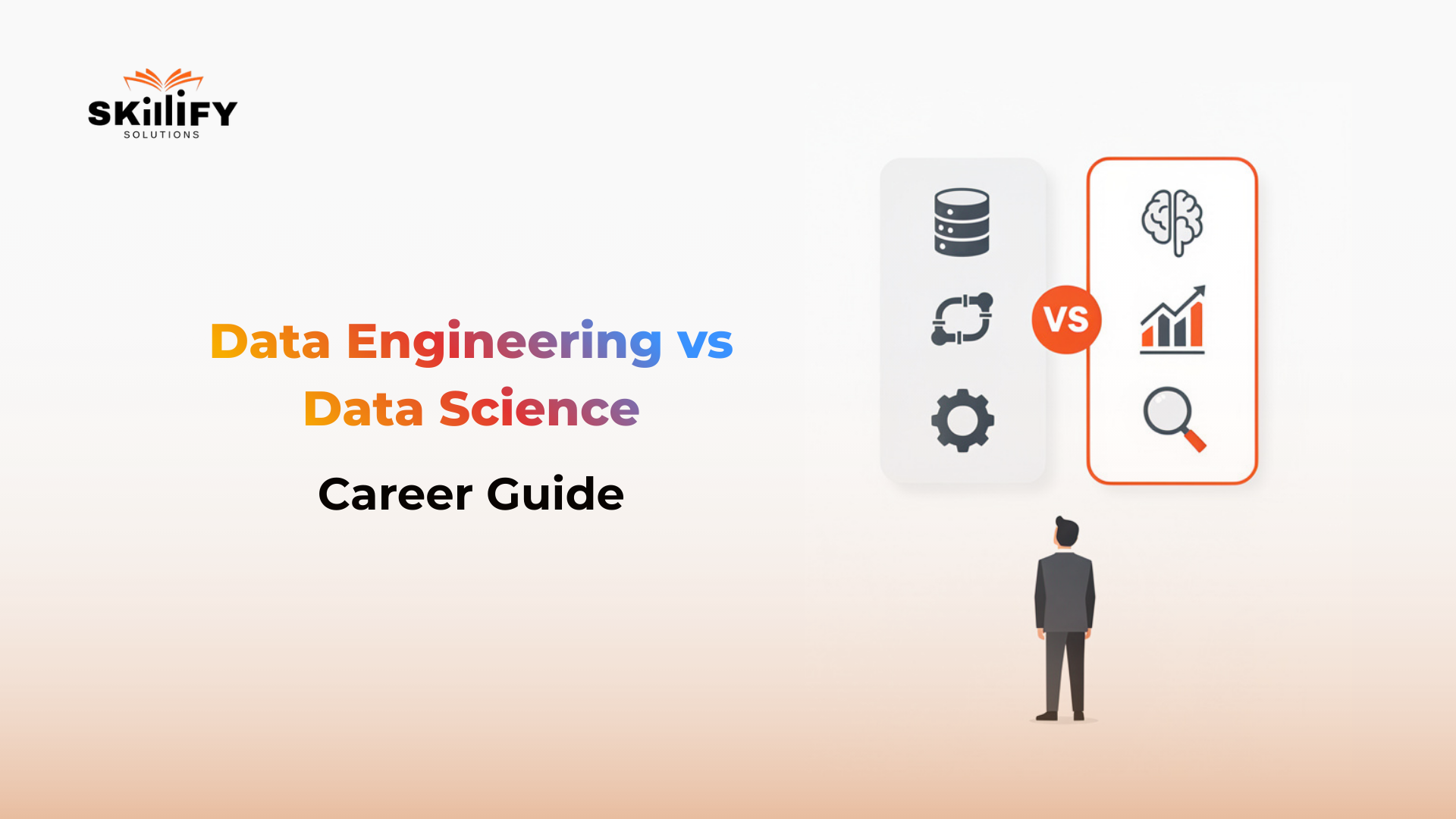
Data Engineering and Data Science by the Skillify Solutions are two high-impact careers driving the Artificial Intelligence (AI) and analytics revolution. While one role focuses on crafting the robust infrastructure where data flows, the other specializes in transforming that data into next-generation predictive insights.
In the digital era, the value lies not just in the data itself, but in the skilled professionals, the builders and the analysts, who bring it to life. This blog will help you understand Data Engineering vs Data Science, each career guideline so you can decide which side of the data lifecycle best suits your skills and career aspirations. Let’s begin.
Data Engineering vs Data Science: Key Differences Explained
It is crucial to understand that both roles work with data but has different purposes. Data Engineers build the systems, while Data Scientists are responsible to analyze the data. Let’s break down Data Science vs Data Engineering in a tabular format to understand how they differ in 2026:
| Feature | Data Engineering | Data Science |
| Objective | Build and manage data pipelines and infrastructure. | Analyze data to extract insights and build predictive models. |
| Responsibilities | Design architectures, manage ETL/ELT, ensure data quality and scalability. | Clean data, run analysis, create models, and present insights. |
| Skills & Tools | SQL, Python, Spark, Hadoop, Kafka, Airflow, AWS, Snowflake. | Python, R, TensorFlow, scikit-learn, Tableau, Power BI. |
| Deliverables | Data pipelines, databases, and optimized infrastructure. | ML models, dashboards, and actionable insights. |
| Education | Computer Science or Engineering. | Data Science, Statistics, or Mathematics. |
| Collaboration | Works with data scientists and DevOps teams. | Works with engineers and business teams. |
| Career Goal | Data Architect / Lead Engineer. | Senior Data Scientist / Head of Analytics. |
| Trends (2026) | Data mesh, real-time streaming, automation. | Generative AI, AutoML, decision intelligence. |
Key Skills and Tools for Data Scientists and Data Engineers
In today’s data driven world, both Data Scientists and Data Engineers need a solid technical foundation to excel in their fields. However, the question is Data Science and Data Engineering same. Their usage of tools and technologies will differ depending upon their focus and priorities.
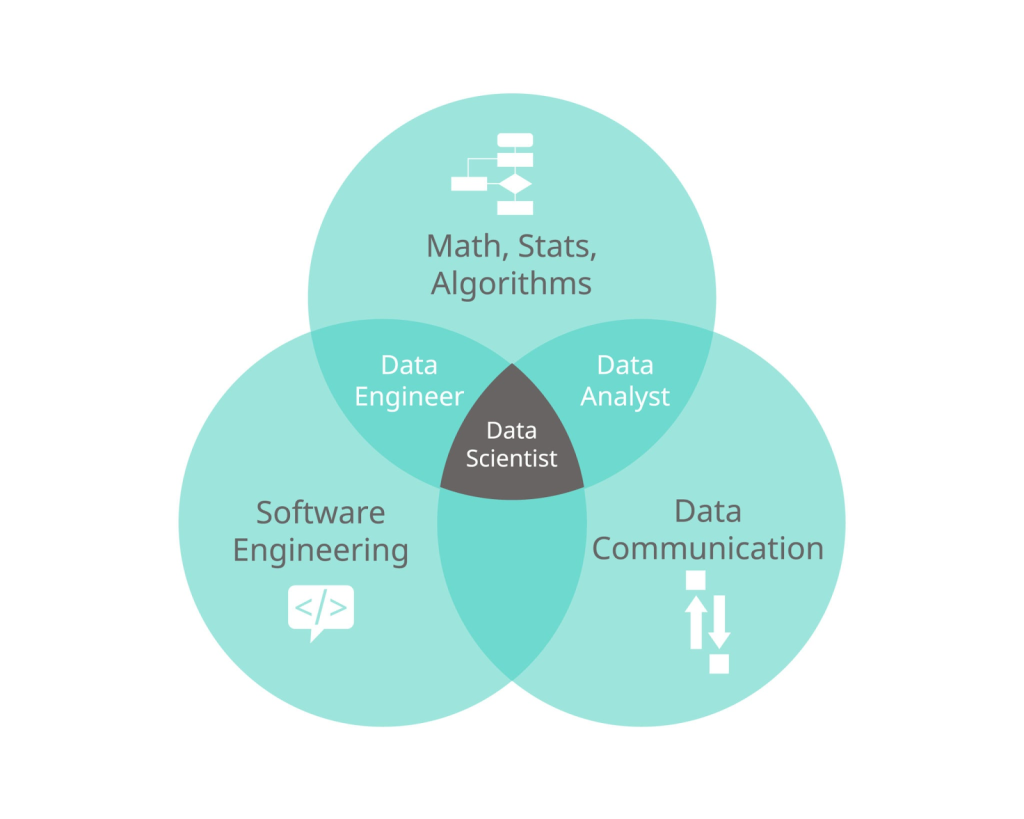
The Data Science and Data Engineering difference depends on whether you want to engineer the data pipeline or analyze the data to decide your career path. Skillify Solutions helps you understand the basic skill sets that are crucial for you to understand Data Science vs Data Engineering:
Unlock your future in data – Register today with Data Science with AI Course and become job-ready in 2026!
Data Engineer Tech Stack
Data Engineers are known as the foundation of any data-controlled organization. They have the responsibility of developing data systems that are scalable and punctual in availing clean data to scientists and analysts.
Here are the key skills and tools that define their role in 2026:
- Programming Languages: Candidates should be proficient in Python, Java, or Scala in order to create and automate data workflows
- Databases and Querying: He or she should have knowledge of NoSQL, SQL, and data modeling for both structured and unstructured storage.
- Big Data Technologies: An in-depth knowledge of Hadoop, Flink, Kafka, and Apache Spark will help you to handle large datasets.
- Cloud Platforms: You must be familiar with Azure, Google Cloud, or AWS to excel in your field.
- ETL and Data Integration: You must know to construct pipelines with Airflow in order to automate Data transformation.
- Infrastructure and DevOps: You need some knowledge of Terraform and Kubernetes for scalable data system deployment.
- Data Governance & Security: It is good to have knowledge of data quality and monitoring tools like Monte Carlo or Great Expectations.
Data Scientist Tool kit
Whereas Data Scientist helps to decode the information provided by engineers into business. Their mandate is to research on trends using forecasting models and report the findings to the stakeholder.
Here are the core skills and tools they must acquire as a basic tool kit:
- Programming and Scripting: Learn R or Python to create models and manipulate data.
- Mathematics and Statistical Ability: Proficiency in probability, hypothesis testing, regression and statistics can prove helpful.
- Machine Learning Frameworks: You need the knowledge of TensorFlow, PyTorch, scikit-learn, and XGBoost for predictive modeling.
- Data analysis and Visualization: You need to master tools like Tableau, Power BI, Seaborn, Matplotlib, NumPy, and Pandas for reporting.
- Data Wrangling: One must know the feature engineering, NumPy, and Pandas helps to prepare raw data.
- MLOps and Deployment: Knowledge of Docker, Git, and MLflow helps to deploy and track models during production.
- Communication and Storytelling: It will be useful in concise narratives and images to convert insights into business recommendations.
Roles & Responsibilities of Data Science and Data Engineering
Both Data Engineers and Data Scientists are accustomed with data. Whereas their daily tasks look different in terms of approach. Engineers make sure that data flows seamlessly across systems. On the other hand, scientists work with the data to open insights and build predictive models. Let’s note how does their typical day look like for better understanding of Data Science vs Data Engineering
Typical Day of a Data Engineer
The day in the life of a Data Engineer is filled with the tasks of guaranteeing the reliability of data, its ability to scale, and probability of access. They are the creators of the design, upkeep, and optimization of the data infrastructure that drives analytics and AI systems.
Their daily task include:
- Supervising and correcting unsuccessful ETL/ELT jobs.
- Constructing pipelines and warehouses.
- Automation of writing Python, SQL or Scala automation scripts.
- Working with teams to establish new data requirements.
- Ensuring data quality, security and documentation.
In short: They prepare data in an accessible, accurate and production ready format.
From beginner to pro – Your data career starts here with our Data Engineering course!
Typical Day of a Data Scientist
A Data Scientist is a profession that is centered around exploring, analyzing, and modeling data to provide answers to business inquiries and forecast business results.
Their daily task include:
- Treatment and analysis of new data.
- Creation and training of Machine Learning (ML).
- Tune parameter and model performance evaluation.
- Tableau, Power BI, or Python visualization of the findings.
- Delivering knowledge and suggestions to the stakeholders.
In short: They transform data into business value and informed decisions.
How They Collaborate?
Despite of the discussion around Data Science vs Data Engineering, it is prevalent that both of them work as a team. One is responsible for building the foundation whereas the other extracts insights. A typical workflow begins when Data Engineers create pipelines to deliver clean data. Data Scientists then use that data for exploration and reporting.
Continuous feedback between both roles ensures that data systems evolve to meet business needs and maintain analytical accuracy.
A Workflow Chart on how Data Engineers and Data Scientists Collaborate
[Raw Data]
↓
(Data Engineer → ETL, Data Warehouse, Data Lake)
↓
(Clean Structured Data)
↓
(Data Scientist → Analysis, Modeling, Visualization)
↓
[Business Insights & Actions]
+————–+
| [Raw Data] | (Unstructured Data Sources)
+————–+
↓ (Ingestion Start)
+—————————–+
| DATA ENGINEER (DE) | <– RESPONSIBILITY SHIFT –>
|—————————–|
| 1. ETL/ELT Pipeline Build |
| 2. Data Warehouse / Lake |
| 3. Data Quality & Cleansing|
+—————————–+
↓ (Handoff: Clean Data)
+—————————–+
| [Clean Structured Data] |
+—————————–+
↓ (Modeling Start)
+—————————–+
| DATA SCIENTIST (DS) | <– RESPONSIBILITY SHIFT –>
|—————————–|
| 1. Feature Engineering |
| 2. Statistical Analysis |
| 3. Model Training & Testing|
+—————————–+
↓ (Deployment Ready Model)
+—————————–+
| DATA ENGINEER (DE) | <– DEPLOYMENT RESPONSIBILITY –>
|—————————–|
| 4. MLOps / Model Serving |
+—————————–+
↓ (Actionable Output)
+—————————–+
| [Business Insights & Actions]| (Strategy & Decision Making)
+—————————–+
Data Science vs Data Engineering: Job Opportunities & Salaries
Data Science and Data Engineering jobs are reputed to have high-paying salaries, fast career advancement. Both of them has raised their demand all over the world. Knowing how these jobs develop and what they pay in 2026 can help you make a positive and long-term data career.
Career Progression
Data Engineering career path: Most professionals start as Junior or Associate Data Engineer, move into Data Engineer, then Senior Data Engineer, and ultimately to roles like Lead Data Engineer or Data Architect.
Data Science career path: A common path begins at Data Analyst or Associate Data Scientist, advances to Data Scientist, then Senior Data Scientist, and leads to Head of Analytics or ML/AI Director roles.
Data Engineering vs Data Science Difference in Career Progression Chart
| Level | Data Engineer Path | Data Scientist Path | Focus Area |
| Entry (0–2 yrs) | Junior / Associate Data Engineer | Junior / Associate Data Scientist | Learn SQL, Python, ETL, and basic analytics. |
| Mid (2–5 yrs) | Data Engineer | Data Scientist | Build pipelines, manage data, create ML models, analyze data. |
| Senior (5–8 yrs) | Senior Data Engineer | Senior Data Scientist | Lead projects, design scalable systems, optimize models. |
| Leadership (8+ yrs) | Data Architect / Head of Data Engineering | Lead / Principal Data Scientist | Set data strategy, manage teams, align business goals. |
Salary Comparison: US & Global Markets
In 2026, both Data Engineering and Data Science continue to be among the most profitable tech careers in the U.S. market. Their salary depends on the experience, size of the company and industry. Their demand is higher because of the usage of cloud infrastructure and data-based decision-making.
Senior professionals with advanced technical and leadership skills can earn well. Sometimes these candidates earn above the national tech average. Here is a table showing Data Science vs Data Engineering salary and their approximate income:
Data Engineering vs Data Science Salary Comparison
| Role | Approximate Average Salary (USD/year) |
| Data Engineer | $99,466/ year |
| Senior Data Engineer | $134,350/ year |
| Data Scientist | $102,938/ year |
| Senior Data Scientist | $136,511/ year |
Job Growth Statistics & In-Demand Certifications
The demand for both Data Engineers and Data Scientists continues to increase as of the data of 2026. It is driven by cloud adoption, AI integration, and the increasing need for real-time analytics across industries. According to the U.S. Bureau of Labor Statistics both roles rank among the top 10 fastest-growing tech careers in the U.S.
Data Scientist roles are projected to grow by 34% from 2022 to 2032 and it exceeds the national average for all occupations. On the other hand, Data Engineer positions are expected to grow by 2030. It shows rapid expansion of cloud-based infrastructure, data warehouses, and analytics platforms.
High-demand certifications include:
- For Data Engineering: Cloud certifications (AWS Big Data, Azure Data Engineer), Apache Spark certification, data architecture credentials.
- For Data Science: Certified Data Scientist credentials, machine learning certifications (TensorFlow Developer, PyTorch), and statistics or applied mathematics specialisations.
Decode data. Predict the future. Become a Data Scientist today!
How to Start Your Career as Data Engineering & Data Scientist
Starting a career in data is not a hard step. Both Data Engineering and Data Science offer exciting and high-growth paths. But you must figure out first which is better Data Science or Data Engineering? Here are the ways how you can get started and even switch between them if your interests evolve.
Path for Data Engineers
If you enjoy solving technical challenges, writing code, and building systems that move and process data, this path is for you.
- Step 1: Start with building a foundation in computer science, databases, and programming like Python and Java.
- Step 2: Then learn SQL as it is the backbone of data management and querying.
- Step 3: Start understanding Extract, Transform, Load (ETL) processes and data modeling.
- Step 4: Get hands-on experience with big data tools like Apache Spark, Hadoop, and Kafk
- Step 5: Learn cloud platforms and start working with AWS, Google Cloud, or Azure.
- Step 6: Build small projects like automating data pipelines or creating a mini data warehouse.
- Step 7: Apply for internships or entry-level roles like Junior Data Engineer or ETL Developer.
Pro Tip: You need to focus on data quality and scalability as good engineers think long-term about performance and reliability.
Path for Data Scientists
If you love finding patterns, predicting trends, and telling stories with numbers, Data Science might be your perfect fit.
- Step 1: Strengthen your basics in statistics, mathematics, and Python/R.
- Step 2: Learn to clean, explore, and visualize data using Pandas, NumPy, Matplotlib, and Seaborn.
- Step 3: Dive into machine learning and understand algorithms, model evaluation, and feature engineering.
- Step 4: Work on hands-on projects like Kaggle, GitHub, or personal datasets to showcase your skills.
- Step 5: Learn to use tools like Power BI or Tableau for data storytelling.
- Step 6: Gain domain knowledge and understand the business problem is as important as the model itself
- Step 7: Start as a Junior Data Scientist or Data Analyst and keep learning MLOps or advanced ML frameworks.
Pro Tip: Always connect your analysis to business impact as data alone doesn’t tell a story, you do.
Transition Guide
There are many professionals switch between Data Science and Data Engineering after they discover their actual strengths. After understanding the difference between Data Science and Data Engineering, here are the ways on how you can bridge the gap:
From Data Engineer to Data Scientist:
- Learn statistics, machine learning, and data visualization.
- Work with analytics or ML teams to understand their workflows.
- Build small ML projects using the data you already handle.
From Data Scientist to Data Engineer:
- Strengthen SQL and programming skills.
- Learn data architecture, ETL design, and cloud data tools.
- Contribute to pipeline automation or MLOps in your current role.
Pro Tip: The best professionals often blend both skill sets and are known as Data Science Engineers to be in huge demand.
Data Engineering vs Data Science: Which Career Path Should You Choose?
Now the question arises which is better Data Science or Data Engineering. Both the career options are strong and well-paying in 2026, yet the choice of one or another career option is up to your interests. You can select Data Engineering in case you like creating systems, technical puzzles, and working at scale. It will suit best those who like to do backend work and power the analytics under the hood.
The discussion on What is Data Engineering vs Data Science states unlike choosing Data Science in case, you like analyzing data, discovering the patterns, and making business decisions based on the findings. It suits inquisitive thinkers who prefer experimenting, modeling, and telling of stories with information.
Conclusion
It is to conclude, studying Data Engineering vs Data Science helps you in finding what fits you better. Data Engineers build the systems that make insights possible, while Data Scientists turn that data into smart decisions.
Both Data Science and Data Engineering careers are known to have a high salary, development, and influence. There are unlimited opportunities in the world of data in the upcoming years, so it is better to choose wisely.
Master Python, ML & AI – Launch your career in Data Science now
Frequently Asked Questions
1. Is data engineering harder than data science?
It is not necessary as both are challenging in different ways. Data Engineering demands strong coding and system design skills, while Data Science focuses on math, ML, and analytics. Your strengths in coding and analysis decide which feels harder for you.
2. Data engineering vs data science: Which offers better remote work opportunities?
Both Data Science and Data Engineering offer a remote flexibility. Data Science roles are often more remote-friendly due to analysis and modeling work, while Data Engineering may need closer collaboration for pipeline deployment and cloud management.
3. Will AI replace data engineering and data science jobs?
Artificial Intelligence (AI) can automate repetitive tasks but cannot replace these roles. Data Engineers will manage smarter systems, and Data Scientists will focus on strategy and ethics. AI enhances their efficiency, and it doesn’t eliminate the need for human expertise.
4. Can you be a data scientist or data engineer without strong math skills?
Yes, Data Engineers rely more on coding, databases, and cloud tools to some extent than heavy math. Data Scientists need a good grasp of statistics and logic. Whereas tools and libraries help to solve complex math.