Behind every business decision lies some data and behind that, two powerful roles. Yet when it comes to the Data Analyst vs Data Scientist Salary, the numbers reveal more than a job title. One role reports the past; the other engineers about the future.
In this comprehensive 2026 Data Analyst vs Data Scientist Salary blog by the Skillify Solutions, we compare salary trends across experience levels, locations, and industries. You’ll learn how education, technical expertise, and business impact translate into higher earnings and where each path leads after five years. Ready to see which data career truly pays off? Read on!
Table of Contents
- Data Analyst vs Data Scientist Salary: 2026 Complete Breakdown
- Why Data Scientists Earn More: The Salary Difference Explained
- Data Analyst and Data Scientist Salary by Location & Industry
- Career Growth & Salary Progression: Which Path Pays Better Long-Term?
- Conclusion
- FAQs
Data Analyst vs Data Scientist Salary: 2026 Complete Breakdown
Before talking about their pay slips, let’s understand what a Data Analyst and Scientist really do for a company. One person makes sense of the data and explains what’s happening, and the other uses it to predict what will happen next. That’s the key Salary Difference Between Data Analyst and Data Scientist.
Here is a table comparing ranges for Data Scientist vs Data Analyst Salary at different experience levels. You can also look into their approximate salary gaps and percentage differences.
Data Analyst vs Data Scientist Salary Comparison
Title: Data Analyst vs Data Scientist Salary Comparison
| Experience Level | Data Analyst Salary | Data Scientist Salary | Salary Gap | % Difference |
| Entry-Level (0-2 years) | $68,893 | ~$74537 | ~$ 28,000 | ~34% |
| Mid-Level (3-5 years) | $70k | $102,938 | ~$ 58,000 | ~63% |
| Senior-Level (6-10 years) | $94,096 | $136,511 | ~$ 100,000 | ~77% |
| Lead/Principal (10+ years) | $92,565 | $151,963 | ~$ 70k+ | ~50%+ |
Key Takeaways:
- Data Scientists draw higher salaries than Data Analysts at every level.
- The salary grows as one moves into more senior levels.
- It makes the difference cumulative over a career.
- This Salary Difference Between Data Analyst and Data Scientist can shape decisions about whether to aim for a Data Scientist or Analyst.
- For Data Analysts hoping to level up, understanding the jump in pay and competencies required is key.
Note: These are estimates based on recent data (2025), projected into 2026.
Why Data Scientists Earn More: The Salary Difference Explained
The Salary Difference Between Data Analyst and Data Scientist is not only because of their job titles but because of the level of skills and nature of problem solving. Both roles operate with data, although data scientists usually operate on a higher level, integrating analytics with programming, statistics, and machine learning to create predictive systems that can directly affect the strategy and growth of a company. Let’s consider the major motives of increased pay scale when it comes to Data Scientist vs Data Analyst Salary.
Technical Skills Gap
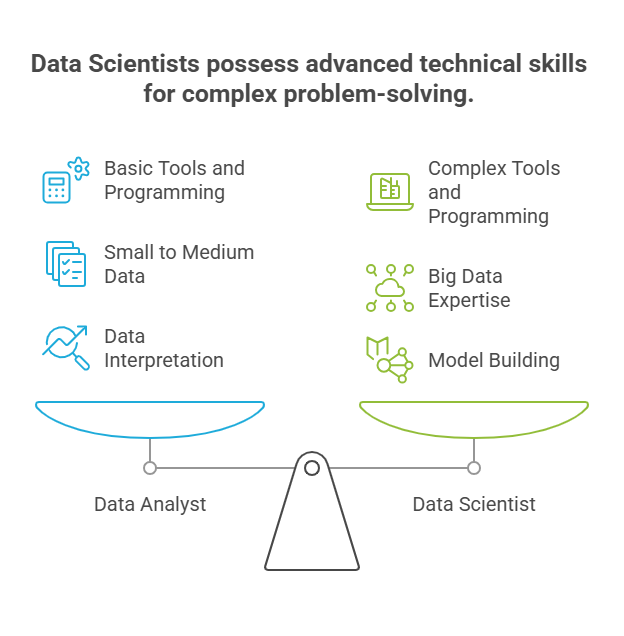
Data scientists have a wider and more technical toolkit compared to data analysts. Here are some of them explained:
- Complex Tools and Programming: They work with such languages as Python, R, and SQL. They also have ideas about machine learning libraries such as TensorFlow or Scikit-learn.
- Big Data Expertise: They handle data of large scale on platforms such as Hadoop, Spark, and cloud tools (AWS, GCP, Azure).
- Model Building: Data scientists build predictive and prescriptive models to assist a business in forecasting trends. They are also responsible in automating decisions unlike analysts who are interested in interpreting the data.
Due to the high level of innovation and ability to solve complicated problems, data scientists receive higher pay.
Educational Requirements
The academic journey of a data scientist may be more stringent and narrow.
- Increased Educational Requirements: Most jobs in the field of data science needs a Ph.D. or Master of Computer Science, statistics, mathematics, or data science.
- Good Theoretical Base: Data scientists must have a good grasp of algorithms, probability, calculus, and statistical inference to construct dependable models.
- Constant Upskilling: As the field of Artificial Intelligence (AI) and machine learning evolves fast, they must acquire new tools and techniques all the time.
Such an increased degree of education constrains the talent supply – it is more difficult to find and more costly to hire skilled data scientists.
Business Impact & Problem Complexity
Projects that have a more strategic impact on the organization tend to be handled by data scientists.
- Predictive and Strategic Focus: They affect fundamental business aspects such as demand forecasting, pricing, fraud detection and recommendation systems.
- High-Value Problem Solving: They solve complex, unstructured problems that involve experimentation, modeling, and optimization.
- ROI that is measurable: The results of their models can directly help raise revenues, cut costs or enhance efficiency – providing a definite financial worth to their work.
Data scientists are high impact contributors in a company because their solutions can influence key business metrics and are paid as such.
Data Analyst and Data Scientist Salary by Location & Industry
The place of employment can determine Salary Difference Between Data Analyst and Data Scientist. The pay rates in U.S. cities differ depending upon the cost of living, availability of technologies, and the demand of data talents in this locality. Overall, highly technological cities or the headquarters of large companies are more likely to provide better pay to attract professional workers.
California cities such as San Francisco, New York, and Seattle lead Data Scientist vs Data Analyst Salary due to their abundance of technology companies and data-driven startups. In these areas, Data Scientists can earn more than $200K, and Data Analysts earn the equivalent of nearly $120K on average.
The new tech centers such as Austin, Atlanta, and Denver are also rapidly improving and have competitive salaries with reduced living expenses. The remoteness positions have also changed the scene, now the companies pay close to the national average, curbing the difference between the coast markets and the in-land markets. All in all, the location continues to be one of the largest considerations in determining Data Scientist vs Data Analyst Salary.
Data Scientist vs Data Analyst Salary comparison Table
Title: Data Analyst and Data Scientist Salary Location Comparison
| Top 10 US Cities | Data Analyst Avg | Data Scientist Avg | Cost of Living |
| San Francisco, CA | $87,390 | $131,325 | ~$245 |
| New York, NY | $77,392 | $114,017 | ~$187 |
| Seattle, WA | $120,443 | $76,693 | ~$155 |
| Boston, MA | $76,616 | $109,422 | ~$151 |
| Austin, TX | $102,699 | $70,252 | ~$97 |
| Denver, CO | $71,001 | $98,206 | ~$128 |
| Chicago, IL | $70,780 | $102,416 | ~$117 |
| Atlanta, GA | $69,433 | $100,15 | ~$96 |
| Dallas, TX | $70,205 | $96,574 | ~$100 |
| Remote (US Avg) | $76.5K | $119K | ~$100 |
Industry Salary Table
The industry is a significant factor to identify the Salary Difference Between Data Analyst and Data Scientist. The financial rewards also vary depending on the time it takes for the data to grow and make decisions. Those companies approaching analytics in its most fundamental way are paying significantly higher rates than firms who use it as a support or reporting tool.
The industries that put data at the center of business strategy include technology, finance, e-commerce, algorithms, personalization, real-time decisions. That is why Data Scientists are in demand, and their salaries can be very high, over $150K. Data Analysts are also popular, only in lesser proportions as they receive good salaries due to their reporting and dashboarding skills.
Conversely, other industries, including healthcare, consulting, manufacturing, or energy still pose a good stabilizing factor. The Salary Difference Between Data Analyst and Data Scientist will decrease within the next few years as these traditional industries keep on being digitalized.
Data Scientist vs Data Analyst Salary Comparison
Title: Data Scientist and Data Analyst Salary based on Industry
| Industry | Data Analyst Range (Annual Base Salary) | Data Scientist Range (Annual Base Salary) |
| Tech/Software (High Demand) | $95,000 – $140,000+ | $42,000 – $72,000 |
| Finance/Banking (Investment) | $90,000 – $130,000 | $140,000 – $200,000+ |
| Healthcare (Pharma/BioTech) | $85,000 – $120,000 | $135,000 – $185,000 |
| E-commerce/Retail | $80,000 – $115,000 | $125,000 – $170,000 |
| Consulting (Major Firms) | $85,000 – $135,000 | $145,000 – $190,000 |
| Manufacturing | $78,000 – $110,000 | $115,000 – $160,000 |
Career Growth & Salary Progression: Which Path Pays Better Long-Term?
It is equally important to know how the salaries will increase with time along with studying the Salary Difference Between Data Analyst and Data Scientist. Although the pay of Data Analysts and Data Scientists initially comes at a competitive price, the growth patterns of the two professions are different.
In a couple of years, minor increments of annual pay, advancements, and job classification add up and create some differences. That is where the Data Scientist career begins to be seen as the clear winner.The next step will be visualizing how their earnings typically progress over five years with a Data Scientist and Data Analyst Salary Trajectory Graph Description:
5-Year Salary Trajectory Graph Description
Let us imagine a simple line chart showing two curves. One for a Data Analyst (DA) and another for a Data Scientist (DS). Two professionals are entering the market in 2026. As both careers progress, the gap between Data Analyst Salary vs Data Scientist Salary becomes more. While they may start somewhat close in the early years, the difference widens quickly as responsibilities, technical depth, and strategic impact increase.
Graphically, the slope of Scientist B’s salary line is steeper than Analyst A’s. It shows faster growth and higher long-term rewards. As both careers progress, the pay gap widens, and it reflects the added technical expertise and business impact that Data Scientists bring.
Here are the ways to read this graph:
- Step 1: On the X-axis, plot Years (1–5).
- Step 2: On the Y-axis, plot Salary (USD).
- Step 3: Draw two lines, blue for Data Analyst, green for Data Scientist.
- Step 4: Around Year 3, mark a “promotion jump.” This is where the Data Scientist’s curve accelerates faster.
- Step 5: By Year 5, the gap widens to about $60K per year, roughly a 48% difference in base pay.
If you shade the space between the Data Analyst Salary vs Data Scientist Salary, you’ll see how the salary gap compounds over time. This can be a visual reminder that steady, higher growth yields significant long-term rewards.
Key Takeaways from the graph:
- The salary of the Data Scientist increases faster than that of the Engineer with the same level of education even over a short period of time.
- Data Scientists advance through senior positions at 1525% rates compared to 812% among analysts.
- Within five years, Data Scientists can earn approximately 220K more than two years of analyst compensation extra.
- The Data Scientist curve in the industries and localities remains sharper and more rewarding.
Conclusion
The discussion of Data Analyst vs Data Scientist Salary about who makes more money is not simply that. It concerns the role of knowledge and innovation in shaping the value. Both jobs contribute to the data revolution, yet individuals who have high-level abilities and experience get the most increment.
Today, Data Scientists can be on the top of the payroll, but analysts who transform, innovate and are learning AI tools can also compete. We can conclude that in the future Data Scientist vs Data Analyst Salary, professions is clear and it is expressed in figures.
Frequently Asked Questions
1. Can a data analyst salary match a data scientist salary with experience?
A senior data analyst can approach a mid-level data scientist’s salary with enough experience, niche expertise, and leadership roles. Typically won’t surpass it due to the scientist’s deeper technical and modeling skills.
2. How quickly can you transition from data analyst to data scientist salary levels?
Many professionals bridge the gap in 2 – 4 years if they try upskilling in programming, statistics, and machine learning. They can move into analytics engineering or junior data science roles within the same company.
3. Do certifications close the Data Analyst vs Data Scientist Salary gap?
Yes, certifications do help when done in Python, SQL, and machine learning. But alone they rarely close the Salary Difference Between Data Analyst and Data Scientist. Real project experience and advanced analytics skills carry more weight for data scientist-level salaries.
4. Is the Data Analyst vs Data Scientist Salary difference smaller in non-tech industries?
Yes. In non-tech sectors like manufacturing or healthcare, the gap of Data Scientist vs Data Analyst Salary is smaller since data science applications are limited. But in tech, finance, or e-commerce, the difference is much wider due to higher data maturity and ROI impact.