 Skip to content
When people hear the word IT career, they immediately think of coding, programming, and complex technical skills. But here’s the truth. Some of the fastest-growing and highest-paying careers today are non-technical jobs in IT. Yes, you read it right.
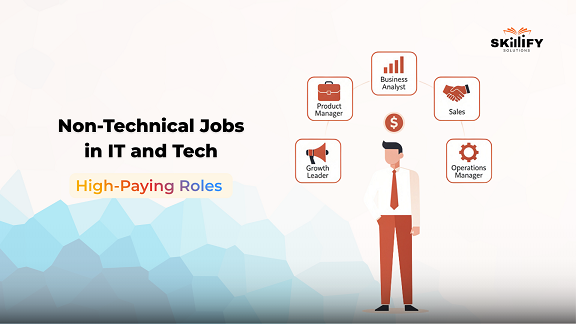
In 2026, Tech companies are not just hiring developers. They are hiring Product Managers, Growth Leaders, Business Analysts, Sales Experts, and Operations Managers who drive revenue, strategy, and customer experience. The average salary ranges from $50,000–$150,000/year. Companies now pay premium salaries to professionals who can solve business problems without touching code.
If you are a fresher or an engineer avoiding coding, or looking for a career switcher, 2026 offers more opportunities than ever. This blog gives you clarity, career direction, and real salary insights and also shows you the best roles for freshers and experienced professionals alike. Scroll down to know more!
What Are Non-Technical Jobs in IT and Tech Industry?
Non-technical jobs in IT (Information Technology) are roles that support, grow, and manage tech businesses without coding skills. Instead of building software, these professionals focus on business strategy, sales, marketing, operations, hiring, customer relationships, and execution. In simple terms, they make sure the tech product succeeds in the market.
For example, developers build the product, but non-technical teams help it sell, scale, and sustain.
Here are some common examples of Non-Technical Jobs
- Product Manager
- Business Analyst
- HR / Tech Recruiter
- Digital Marketing Executive
- Customer Success Manager
- Sales and Growth Manager
- Operations Manager
Let’s understand the logic of Services vs Product Companies
IT Services companies, like consulting or outsourcing firms, need roles focused on client management, project coordination, delivery, and account growth. However, product companies focus more on product strategy, user research, growth marketing, and customer retention.
Reasons why Demand Is Rising in 2026
- SaaS and startup growth
- AI automating coding tasks
- Global expansion of tech firms
- Strong focus on revenue and customer experience
Best Non-Technical Jobs in IT Companies with No Coding Requirements
Many IT companies hire non-technical professionals to manage product strategy, operations, hiring, sales, marketing, and customer relationships. For getting hired, you do not need coding skills for these roles.
You will be rewarded for your knowledge and decision-making skills. What you need is business understanding, communication ability, analytical thinking, and leadership potential.
Below are the best non-technical jobs in IT companies in 2026.
1. Product Manager
A Product Manager decides what features should be built, why they matter to customers, and how the product should grow in the market. They work closely with developers and designers but focus mainly on strategy, user needs, and business impact rather than coding.
Core Competencies
- Product strategy
- User research
- Road mapping
- Data-driven decision-making
- Stakeholder management
Industry Demand
Product Managers have a very high interest in SaaS startups, fintech, edtech, AI companies, and global product-based firms. This is because innovation and customer experience are priorities in these fields.
$159,221 to $226,914 per year
Career Growth
Professionals usually start from Product Manager and progress to Senior Product Manager. If you have a Product Management certificate, the next step can be becoming the Director of Product, which can eventually lead to becoming a Chief Product Officer.
2. Business Analyst
A Business Analyst studies business processes, identifies gaps, and recommends improvements. They translate business needs into structured requirements that technical teams can execute. Their role is essential in ensuring that technology solutions align with business objectives.
Core Competencies
- Data analysis
- Requirement gathering
- Excel and BI tools
- Problem solving
- Documentation
Industry Demand
High demand remains strong in IT services companies, consulting firms, banks, and enterprise technology organizations. In these fields, structured decision-making is important so you can start learning with a Business Analyst Certification and meet the industry standards.
$98047 to $131,558 per year
Career Growth
Professionals often move from Business Analyst to Senior Analyst, then to Lead Analyst or Strategy roles, and can eventually transition into consulting or product leadership.
3. Data Analyst
A Data Analyst interprets business data and converts numbers into actionable insights. They help leadership teams understand trends, performance gaps, and growth opportunities. Heavy programming is not mandatory in many roles, especially at entry and mid-levels.
Core Competencies
- Excel
- SQL basics
- Data visualization
- Critical thinking
- Reporting
Industry Demand
Data Analysts are in strong demand across SaaS, e-commerce, fintech, healthcare tech, and AI-driven organizations where data plays a key role in decision-making. You can study the Data Analyst Job Outlook 2026, to understand how companies are prioritizing data driven decision making and hiring the right talent.
$80,000 to $120,000 per year
Career Growth
Professionals often move from Data Analyst to Senior Analyst, then to Analytics Manager, and eventually to Head of Analytics or Data Strategy roles.
Start Your Tech Career Without Coding Today with our Data Analytics Bootcamp with AI Certifications.
4. Scrum Master
A Scrum Master ensures Agile teams function smoothly and deliver projects efficiently. They remove obstacles, manage workflows, and improve team productivity. Their role focuses on process excellence rather than technical coding.
Core Competencies
- Agile methodology
- Team coordination
- Communication
- Conflict resolution
- Process improvement
Industry Demand
Scrum Masters are highly valued in product companies and IT services firms that follow agile frameworks to deliver faster and more efficiently. You can also go through the 30 Must-Know Scrum Master Interview Questions and Answers to prepare in a better way.
$74,000 to $143,000 per year
Career Growth
Professionals grow from Scrum Master to Senior Scrum Master. With professional courses like Certified Scrum Master, they can also become an Agile Coach. The final career growth will be Program Management or Delivery Leadership roles.
5. IT Project Manager
An IT Project Manager plans, coordinates, and delivers technology projects within defined timelines and budgets. They manage teams, risks, and stakeholders to ensure successful project execution.
Core Competencies
- Project planning
- Risk management
- Budget control
- Client communication
- Leadership
Industry Demand
IT Project Managers are in steady demand in IT services companies, consulting firms, enterprise tech organizations, and global outsourcing firms.
$42,000 to $111,000 per year
Career Growth
Professionals move from Project Manager to Senior Project Manager, then Program Manager, and eventually into Delivery Head or Operations leadership roles.
6. Technical Recruiter
A Technical Recruiter identifies, evaluates, and hires skilled technology professionals. They understand technical roles but focus mainly on sourcing talent, interviewing, and hiring strategies.
Core Competencies
- Talent sourcing
- Interview evaluation
- Communication
- Negotiation
- Employer branding
- Hiring strategy
Industry Demand
Demand for technical recruiters is high in startups, IT services firms, and global technology companies that constantly hire tech talent.
$49,000 to $122,000 per year
Career Growth
Professionals can move from Recruiter to Talent Acquisition Lead, then HR Manager, and eventually HR Director.
7. Customer Success Manager
A Customer Success Manager ensures clients get value from the product and continue using it in the long term. They focus on retention, renewals, and relationship management.
Core Competencies
- Account management
- Communication
- Problem resolution
- Upselling
- Relationship building
- Customer analytics
Industry Demand
Customer Success Managers are highly demanded in SaaS and subscription-based tech companies where recurring revenue depends on retention.
$52,000 to $89,000 per year
Career Growth
Customer Success Managers often progress from Customer Success Manager to Senior CSM, then Account Director, and eventually Revenue or Growth leadership roles.
8. Pre Sales or Tech Sales Consultant
A Pre Sales or Tech Sales Consultant explains technical products to potential clients and supports the sales team in closing deals. They combine product understanding with persuasive communication skills.
Core Competencies
- Product presentation
- Client handling
- Negotiation
- Solution consulting
- Market understanding
- Communication
Industry Demand
These professionals are in high demand in SaaS, cybersecurity, cloud services, and enterprise software companies where complex solutions require explanation.
$66,000 to $149,000 per year including incentives
Career Growth
Pre-Sales or Tech Sales Consultant usually moves from Sales Consultant to Sales Manager, then Regional Head, and eventually Vice President of Sales.
9. Digital Marketing Manager
A Digital Marketing Manager drives online growth through paid ads, SEO, content, and performance campaigns for tech products. Their main role is to focus on content marketing and performance campaigns.
Core Competencies
- Performance marketing
- SEO strategy
- Campaign optimization
- Analytics
- Brand positioning
- Lead generation
Industry Demand
Digital Marketing Managers in 2026 have a very high demand in SaaS startups and product companies that rely heavily on digital acquisition.
$50,000 to $97,000 per year
Career Growth
Digital Marketing Managers can move from Marketing Manager to Growth Head, then Marketing Director, and eventually Chief Marketing Officer.
10. Operations and Delivery Manager
An Operations and Delivery Manager ensures that services are delivered efficiently and business processes run smoothly.
Core Competencies
- Process optimization
- KPI tracking
- Team leadership
- Client coordination
- Performance monitoring
- Efficiency improvement
Industry Demand
Operations and Delivery Manager have a strong background in IT services companies, BPOs, SaaS firms, and enterprise tech organizations.
$53,000 to $117,000 per year
Career Growth
Operations and Delivery Manager typically progress from Operations Manager to Senior Operations Manager, then Delivery Head, and eventually Chief Operating Officer.
Highest Paying Non-Technical Jobs in Tech (2026)
In 2026, roles tied to revenue, product ownership, and large-scale execution continue to dominate the highest-paying non-technical tech careers.
Product Leadership, Program Management, and Tech sales roles are among the highest-paying non-technical jobs in the tech industry. These positions have a direct impact on revenue, strategy, and company growth. That is why compensation levels are significantly higher compared to entry and mid-level roles.
Here we will discuss a simplified salary table for quick comparison:
| Role | Experience | Average Salary |
| Product Manager | 5 to 10 years | $217,434 |
| Program Manager | 8 plus years | $140,000 |
| Growth Manager | 4 to 7 years | $136,000 |
| Tech Sales Director | 10 Years Above | $160,000 |
Non-Technical Jobs in IT Companies for Freshers
Freshers can enter IT companies through entry-level non-technical roles very easily in 2026. They will require communication, coordination, analytical thinking, and eagerness to learn, rather than coding skills. These roles help you build a strong foundation in tech industry workflows while you grow over time.
1. HR / IT Recruiter
An HR or IT Recruiter helps tech companies find and hire the right talent. They screen resumes, schedule interviews, coordinate with hiring managers, and ensure a smooth candidate experience. Here, candidates don’t need coding expertise. They need an understanding of tech roles and strong communication skills.
Educational Requirements: Bachelor’s degree in HR, Business Administration, Psychology, or any graduation. MBA in HR is a plus but not mandatory.
Average Salary: $44,000 to $59,000 per year
Growth Path: Recruiter → Senior Recruiter → Talent Acquisition Lead → HR Manager
2. Business Development Executive
A Business Development Executive focuses on generating new leads, building client relationships, and supporting sales growth. They reach out to potential customers, present solutions, and assist in deal closure without needing technical coding skills.
Educational Requirements: Bachelor’s degree in business, Marketing, Commerce, or Management.
Average Salary: $39,500 to $89,500 per year
Growth Path: QA Analyst → Senior QA → Test Lead → QA Manager
3. QA Analyst
A QA Analyst in manual testing checks software products for errors, bugs, and usability issues before release. They use test cases and checklists to validate features. This role is ideal for detail-oriented freshers without any coding knowledge.
Educational Requirements: Bachelor’s degree in computer applications, IT, Engineering, or any technical graduation.
Average Salary: $50,000 to $69,000 per year
Operations Executive
An Operations Executive supports business processes, tracks performance, prepares reports, coordinates tasks, and ensures teams meet goals. This role is great for freshers who are organized and enjoy working cross-functionally.
Educational Requirements: Bachelor’s degree in business administration, Commerce, Management, or any graduation.
Average Salary: $57,000 to $87,000 per year
Growth Path: Operations Executive → Operations Manager → Operations Head
Customer Support
Customer Support professionals help product users resolve issues, navigate features, and get value from tech platforms. These roles combine problem-solving with empathy and strong communication, that too without coding knowledge.
Educational Requirements: Bachelor’s degree in any field. Good English communication skills are important.
Average Salary: $37,000 to $66,000 per year
Growth Path: Support Executive → Senior Support → Team Lead → Customer Success Manager
Best Non-Technical Jobs in Tech for Entry-Level Candidates
Entry-level non-technical jobs allow candidates to start their careers in the technology industry without coding. They offer structured learning and clear promotion paths.
- Junior Business Analyst works on data reporting and process improvement using tools like Excel and basic BI dashboards.
- A Sales Development Representative generates leads and supports revenue growth using CRM tools and outreach platforms. Career growth typically leads to Account Executive and Sales Manager roles.
- A Customer Support Associate resolves user queries using CRM and support tools. Over time, this role can progress into Customer Success or Team Lead positions.
- An Operations Analyst manages reporting, KPIs, and internal coordination using Excel and project management tools. Growth can lead to Operations Manager roles.
- A Digital Marketing Executive handles online campaigns and analytics using advertising and SEO tools. Career progression can lead to Growth Manager or Marketing Director positions.
Build a Future-Proof Career in Tech Today with our Business Analytics Bootcamp with AI– Start today!
Non-Technical Jobs for Engineers
Product Owner
A Product Owner works closely with development teams. They focus on defining product requirements, prioritizing features, and ensuring the final output matches business goals. Engineers moving into this role benefit from their technical background while shifting toward decision-making and customer value creation.
Why It Fits Engineers?
- Strong understanding of software workflows
- Ability to communicate with developers clearly
- Logical thinking and system design knowledge
Solutions Consultant
A Solutions Consultant explains technical products to clients and helps customize solutions based on business needs. This is a client-facing role that combines technical knowledge with presentation and sales skills.
Why It Fits Engineers?
- Comfortable explaining technical concepts
- Ability to design practical solutions
- Strong analytical mindset
Program Coordinator
A Program Coordinator manages multiple projects, tracks progress, and ensures teams meet deadlines. The role focuses on coordination, reporting, and execution rather than coding.
Why It Fits Engineers?
- Understanding of technical timelines
- Structured thinking
- Process management ability
Corporate Tech Trainer
A Corporate Tech Trainer teaches employees or clients about software tools, systems, or technologies. This role shifts from building technology to educating others about it.
Why It Fits Engineers?
- Strong technical foundation
- Ability to simplify complex concepts
- Communication skills
Non-Technical Roles in the IT Industry vs Tech Companies
IT (Information Technology) services companies focus more on delivery, client management, and operations. However, tech product companies emphasize product development, growth, and customer experience roles.
In simple words, IT (Information Technology) services companies work for clients and execute projects. Product tech companies build their own products and scale them globally. Because of this difference, non-technical roles also vary in focus and growth direction.
| Comparison Factor | IT Services Companies | Product Tech Companies |
| Focus | Client project delivery | Product building and scaling |
| Non-Technical Role Focus | Project management, operations, and delivery coordination | Product management, growth, marketing, customer success |
| Revenue Model | Service contracts from clients | Product sales and subscriptions |
| Skills needed | Reporting, coordination, and stakeholder management | Strategy, experimentation, analytics |
| Career Growth | Delivery Head, Account Director | Product Director, Growth Head, Revenue Leader |
Skills Required for High-Paying Non-Technical Jobs in Tech
In 2026, companies tend to pay higher salaries to professionals who can connect business goals with execution. Skills like influencing stakeholders and using data-driven tools effectively also count as an extra advantage. However, strong communication, business understanding, and tool proficiency are essential for non-technical tech roles. Here are the key skills that separate average performers from high-earning professionals.
1. Communication and Stakeholder Management
You must clearly communicate ideas, align cross-functional teams, manage clients, and handle conflicts. The ability to influence decisions and coordinate between departments directly affects leadership growth.
2. Business Analysis and Domain Knowledge
You must understand the revenue models, customer behaviour, and market trends that make you more valuable. High earners know how their product or service drives business results.
3. Tool Proficiency
Comfort with tools like Jira for project tracking, CRM (Customer Relationship Management) platforms for sales management, Excel for reporting, and analytics tools like Power BI or Google Analytics is critical.
4. Leadership and Decision Making
High-paying roles require ownership, prioritization, risk management, and strategic thinking. Decision-making ability often matters more than execution skills at senior levels.
If you want to build these skills in a structured way, practical learning programs can make the transition faster. For example, a Product Management Course can help you master roadmap planning, stakeholder management, and case studies.
Similarly, a Business Analyst Bootcamp or Data Analyst Bootcamp can train you in Excel, SQL basics, dashboards, and real-world data projects.
Who Should Choose Non-Technical Jobs in IT & Tech?
Non-technical job roles focus on business growth, operations, strategy, customer management, and execution. If you enjoy working with people, analyzing problems, and driving results, these careers can offer high income potential and long-term stability. These roles are a great fit for the following:
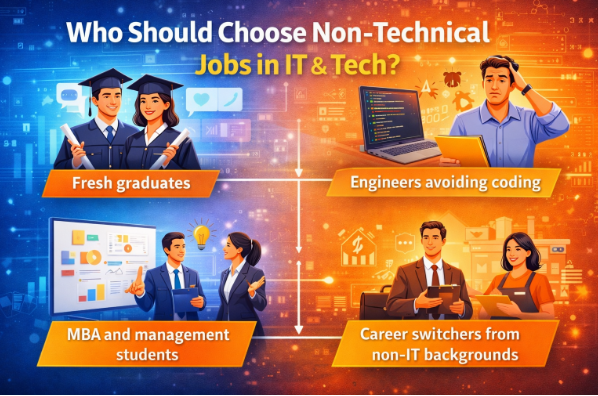
1. Fresh graduates
Graduates who have good communication skills, logical thinking, and basic knowledge. Entry-level roles in operations, sales, support, and analytics provide structured learning and clear promotion paths.
2. Engineers avoiding coding
Engineers who want to avoid daily coding still use their technical understanding. Roles like Product Owner, Solutions Consultant, and Program Manager allow them to shift toward strategy and leadership.
3. MBA and management students
Students who understand marketing, finance, HR, or operations. Tech companies value business professionals who can drive revenue, scale products, and manage teams.
4. Career switchers from non-IT backgrounds
Candidates who want to switch their career from technical jobs, such as banking, retail, consulting, or education. With basic training in tools and domain knowledge, transitioning into tech is realistic and achievable. It is better to understand the Top Degrees in Demand for the Future to make a correct choice on which degrees align best with tech industry growth.
How to Get a High-Paying Non-Technical Job in IT & Tech
Strategic upskilling and role-focused preparation can significantly improve your chances of landing a high-paying non-technical job. You need a clear plan and focused step-by-step effort to get the highest-paying non-technical jobs in tech. Below are the key steps you can follow:
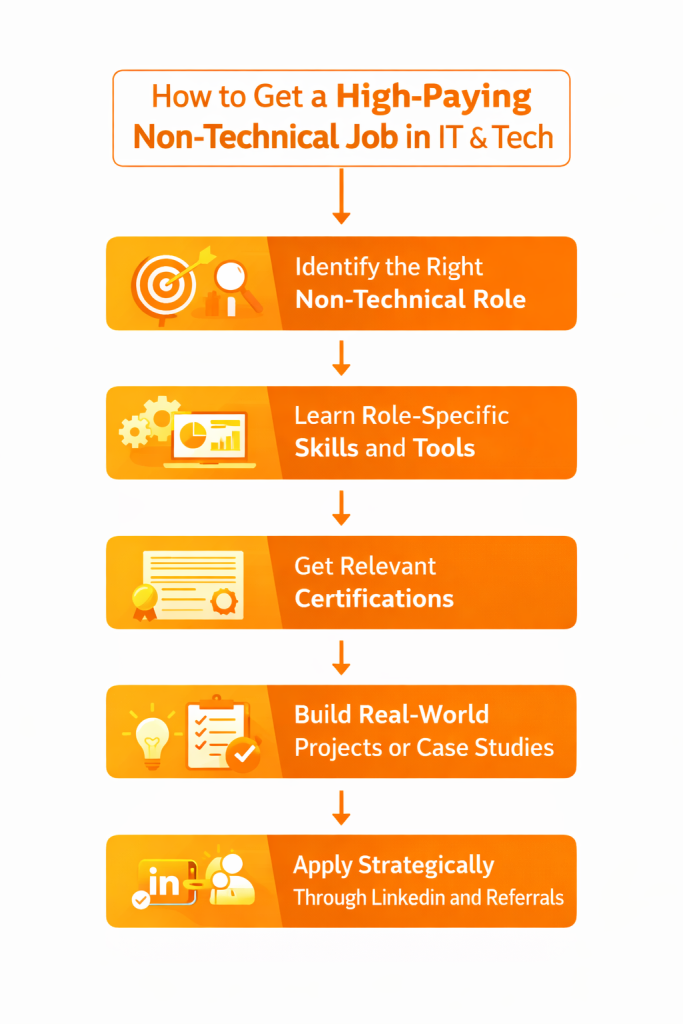
Step 1: Identify the Right Non-Technical Role
Start by choosing a role that matches your strengths and background. For example, if you enjoy analysis, consider a Business Analyst. If you like communication and persuasion, Sales or Customer Success may suit you better.
Step 2: Learn Role-Specific Skills and Tools
Each role requires specific skills and tools. These are some of the examples:
- Product roles require strategy thinking and tools like Jira.
- Business roles require Excel, reporting, and analytics tools.
- Sales roles require CRM platforms and outreach tools.
- Focus on practical learning rather than theory.
Step 3: Get Relevant Certifications
You must choose the right certification depending on the role you want to target. You can try the Product Management Certification for aspiring Product Managers.
Business Analysis Certifications for analyst roles are also helpful. Agile or Scrum Certification for project and program roles can prove beneficial.
Step 4: Build Real-World Projects or Case Studies
Create small projects, mock case studies, dashboards, sales pitch decks, or product analysis reports. This demonstrates applied knowledge and increases credibility during interviews.
Step 5: Apply Strategically Through LinkedIn and Referrals
Use LinkedIn actively by optimizing your profile, connecting with recruiters, and engaging with industry posts. Referrals significantly increase hiring chances. Also, apply through trusted career portals and company websites.
Conclusion
From the above discussion, we can conclude that the tech industry in 2026 is no longer just about coding. It is about building products, driving revenue, managing customers, analysing data, and leading teams. With the right skills, tools, and mindset, freshers and professionals alike can build high-paying, stable, and future-proof careers in non-technical jobs in IT.
Major roles include Product Owners shaping vision, Growth Managers scaling revenue, Customer Success leaders building loyalty, and Program Managers driving execution. If you are serious about entering or switching into tech, you are at the right place. Structured certifications aligned with industry demand can shorten your learning curve and help you transition with confidence.
Get Job-Ready for Non-Technical Tech Roles – Start with our Product Management Certifications today!
FAQs
Are non-technical jobs in IT high-paying?
Yes. Many non-technical jobs in IT, such as Product Manager, Program Manager, Tech Sales Director, and Data Analyst, offer salaries between $50,000 and $200,000+ per year. It depends on experience. With structured training from Skillify Solutions in Product or Analytics, earning potential increases significantly.
Can freshers get non-technical jobs in tech companies?
Freshers can enter roles like Business Analyst, HR Recruiter, Customer Support, or Operations Executive without coding. Building skills through Data Analytics for Freshers can help with placement chances and career growth.
Which non-technical job pays the most in tech?
Product leadership, Program Management, and Tech Sales Director roles typically pay the highest, often exceeding $150,000 annually. Upskilling through aProduct Management Course from Skillify Solutions can help professionals move toward these high-earning positions.
Are non-coding tech jobs future-proof?
As companies focus on data-driven decisions, product growth, and customer retention, non-coding roles remain highly relevant. According to industry trends, analytics and product roles are expanding rapidly. Skillify Solutions certifications in Data Analytics and Product Management help future-proof your career.


