 Skip to content
If your goal is a higher salary, broader impact, and leadership at scale, Release Train Engineer (RTE) is the better choice. If you prefer team-level coaching and hands-on Agile execution, Scrum Master is the right fit.
But the real question is which is right for you. I’ve seen many Scrum Masters try to move into RTE roles, assuming it’s a natural next step. It’s not. It’s a shift from managing one team’s delivery to owning outcomes across multiple teams, timelines, and stakeholders. And that changes everything, how you think, how you communicate, and how you’re evaluated.
At the Scrum Master level, success is about improving team velocity, removing blockers, and ensuring smooth sprint execution. At the RTE level, success is about aligning multiple teams, managing dependencies, and delivering business outcomes without chaos. The problems get bigger, the stakes get higher, and the visibility increases.
This blog goes beyond definitions. It breaks down roles, responsibilities, salary, and real-world expectations so you can make a clear, informed career decision.
Release Train Engineer vs Scrum Master
At first glance, RTEs and Scrum Masters may seem similar. They both enable Agile teams. But the difference is scale. Scrum Masters focus on a single team, while RTEs align multiple teams at a program level. This table highlights the key differences in scope, responsibilities, and salary.
| Area | Scrum Master | Release Train Engineer (RTE) |
| Level | Team-level | Program-level |
| Scope | Manages a single Scrum team | Aligns multiple Agile teams (ART) |
| Focus | Sprint execution and Agile process | Program delivery and alignment |
| Responsibilities | Facilitates ceremonies, removes blockers | Manages dependencies and execution |
| Stakeholders | Team and Product Owner | Leadership, product, and teams |
| Impact | Tactical | Strategic |
| Framework | Scrum or SAFe | SAFe |
| Certifications | Scrum Master Bootcamp | SAFe Advanced Scrum Master |
| Certification Cost | ~$480-$500 | ~$900-$930 |
| Salary Range | $120K-$145K | $120K-$120K+ |
| Career Growth | Senior SM to Agile Coach | SPC to Agile Coach to Program Leader |
Start your Agile journey with industry-recognized SAFe Advanced Scrum Master certification today!
What Is a Release Train Engineer? Role, Scope, and Daily Responsibilities
A Release Train Engineer (RTE) is a program-level Agile leader in the Scaled Agile Framework. The main aim is to ensure multiple teams work together smoothly to deliver value.
You can think of the RTE as the Scrum Master for the entire Agile Release Train (ART). They align teams, remove cross-team blockers, and drive execution at scale.
To understand this better, most professionals begin with formal SAFe Training Programs that cover ART structure and program execution.
Five core responsibilities in a SAFe ART
An RTE is responsible for driving execution across multiple teams while ensuring alignment and delivery timelines. Their role goes beyond facilitation to actively managing dependencies and program flow.
| Responsibility | What It Means |
| Program Execution | Ensures all teams deliver on time across the ART |
| Dependency Management | Aligns teams and resolves cross-team blockers |
| Facilitation | Runs key events like PI Planning and sync meetings |
| Continuous Improvement | Drives retrospectives at the program level |
| Stakeholder Alignment | Connects teams with leadership and product management |
Role in PI Planning, Iteration Reviews, and System Demos
RTEs play a key role in orchestrating major Agile events, ensuring they are structured and outcome-driven. They connect team-level work with overall program goals through these events.
- PI Planning (Program Increment Planning): RTEs facilitate planning across all teams, ensuring that goals, timelines, and dependencies are clearly aligned. This helps every team start with a shared direction and coordinated plan.
- Iteration Reviews: RTEs track progress across teams, identify risks early, and ensure continuous alignment. This keeps delivery on track and prevents issues from escalating.
- System Demos: RTEs ensure integrated output from all teams and present overall progress to stakeholders. This showcases real, end-to-end value delivered across the program.
Skills Beyond Scrum Mastery
RTEs require program-level thinking, stakeholder management, and strategic communication skills. Unlike Scrum Masters, they operate across teams and influence larger business outcomes.
- Program-level thinking to manage multiple teams together
- Stakeholder management with leadership
- Dependency handling to resolve cross-team issues
- Strategic communication to align business and tech
- SAFe expertise with a deep understanding of scaled Agile
What is a Scrum Master?
A Scrum Master is a team-level Agile facilitator who ensures the Scrum framework is followed and the team delivers efficiently. They act as servant leaders, helping remove blockers, improving team processes, and enabling continuous delivery.
The Scrum Master’s role is focused on team performance, process adherence, and Agile maturity, unlike RTEs, who operate at a program level.
If you’re new to this role, understanding What is a Scrum Master can help you understand their day-to-day can give you better clarity on responsibilities.
Four core duties in a SAFe or standalone Scrum team
A Scrum Master’s responsibilities revolve around enabling team efficiency and maintaining Agile discipline.
- Facilitates Scrum ceremonies
- Removes blockers that impact team progress
- Coaches the team on Agile best practices
- Protects the team from external disruptions
In SAFe environments, many professionals start with a SAFe Scrum Master certification to understand how Scrum fits into scaled Agile systems.
Scrum ceremonies the SM owns vs facilitates
Scrum Masters are responsible for ensuring ceremonies happen effectively, but they don’t always “own” them.
| Ceremony | Role of Scrum Master |
| Sprint Planning | Facilitates |
| Daily Standup | Facilitates |
| Sprint Review | Facilitates |
| Sprint Retrospective | Facilitates |
| Backlog Grooming | Supports Product Owner |
Limits of the Scrum Master Role
While Scrum Masters play a critical role, their scope is limited to a single team.
- No direct control over multiple teams or programs
- Limited influence on strategic decisions
- Growth may plateau without moving to roles like RTE or Agile Coach
Build strong Agile foundations and transition into high-impact roles with structured Certified Leading SAFe now!
RTE vs Scrum Master Salary in the USA
RTE and Scrum Master salaries differ mainly due to scope and impact. Scrum Masters operate at a team level. However, RTEs manage program-level delivery across multiple teams, resulting in higher compensation and faster salary growth for RTEs.
Release Train Engineer salary by experience and area
Release Train Engineer salaries increase significantly with experience and are higher in major metro areas. On average, RTEs in the US earn around $130K–$180K+.
The top performers in cities like New York and California are crossing $190K–$200K+. Experience plays a major role, with salaries rising sharply as professionals move into senior and principal roles.
| Experience Level | Salary Range |
| Entry-Level RTE | $100K–$116K |
| Mid-Level RTE | $120K–$145K |
| Senior RTE | $125K–$149K+ |
Scrum Master salary range by certification level and industry
Scrum Master salaries are more stable and depend on certification level and industry demand. On average, Scrum Masters earn around $100K–$130K. The certified professionals and those in high-paying industries like finance and consulting are reaching $135K–$150K+.
| Level | Salary Range |
| Entry-Level Scrum Master | $95K–$111K |
| Certified Scrum Master | $110K–$125K |
| Senior Scrum Master | $120K–$125K+ |
Industry also plays a major role in Scrum Master salaries. Sectors like finance, consulting, and technology usually offer the highest compensation. This is because they rely heavily on Agile delivery and large-scale digital transformation programs. In these industries, experienced Scrum Masters can earn well above the average salary range.
Healthcare, government, and defense sectors typically offer more stable mid-range salaries with strong job security and long-term projects. Overall, certifications like SAFe 6.0 Advanced Scrum Master improve credibility, but roles like SAFe RTE unlock higher salary brackets due to larger responsibilities.
Salary growth trajectory
The career progression from Scrum Master to RTE brings the most significant salary jump, as the role shifts from team-level facilitation to program-level leadership.
While Scrum Masters see steady growth, moving into an RTE role can increase compensation by 30–50% or more, especially in large organizations and tech-driven industries.
| Career Stage | Salary Range |
| Scrum Master | $111K–$128K |
| Senior Scrum Master | $120K–$125K |
| Release Train Engineer | $116K–$133K |
| Agile Coach or SPC | $122K–$130K+ |
This is why many professionals actively explore Scrum Master job opportunities and career paths before transitioning into RTE roles.
Can a Scrum Master Become a Release Train Engineer?
Yes, many RTEs start their careers as Scrum Masters. The transition is natural because both roles share a foundation in Agile, but moving to RTE requires scaling from team-level execution to program-level leadership.
Skills gap between SM and RTE
Moving from Scrum Master to RTE requires shifting from team-level facilitation to program-level leadership. It’s less about new tools and more about handling scale, complexity, and business alignment.
- Scope expansion: From one team to multiple teams (ART)
- Dependency management: Handling cross-team blockers, not just team issues
- Stakeholder alignment: Working with leadership, product, and business teams
- Program execution: Driving timelines and delivery at scale
For professionals aiming to move into this role, a SAFe RTE certification becomes a key milestone.
Certifications that accelerate the SM-to-RTE transition
Certifications help formalize your transition and signal readiness for larger Agile responsibilities. They build the foundation first, then move you toward program-level expertise.
| Certification | Purpose | Impact on Career |
| SAFe Scrum Master (SSM) | Team-level Agile foundation | Entry point into SAFe |
| Leading SAFe (SA) | Understanding SAFe at scale | Prepares for program roles |
| SAFe Advanced Scrum Master | Core RTE certification | Unlocks RTE opportunities |
| SAFe® 6.0 Agile Product Manager | Advanced transformation role | Leads enterprise Agile |
Transform your career with the in-demand Scrum Master Bootcamp with AI, better roles, and higher salaries!
Timeline and realistic steps to become an RTE from an SM background
The transition typically takes 1–3 years. It depends on exposure to scaled Agile environments and willingness to take on larger responsibilities.
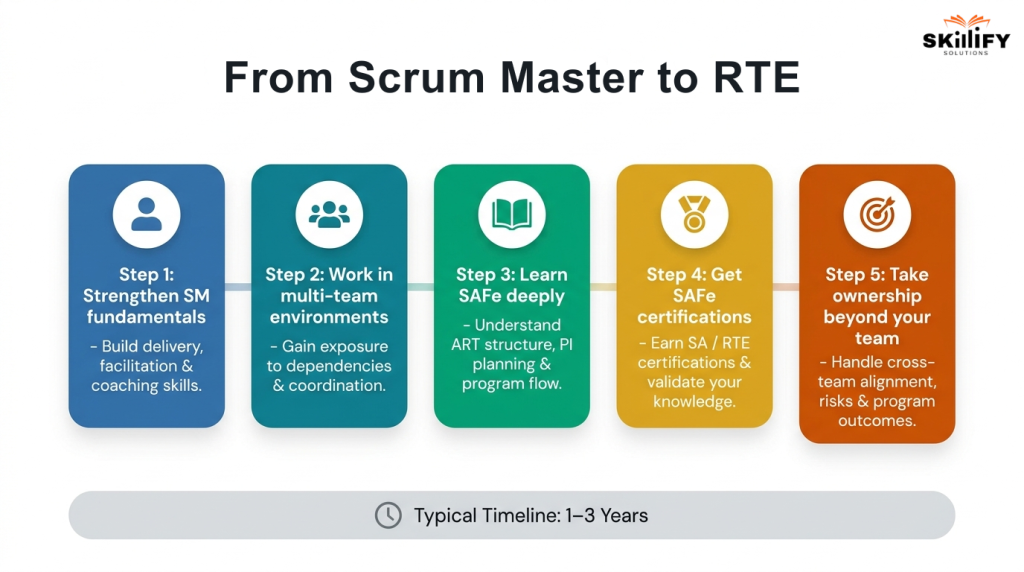
Step 1: Strengthen Scrum Master fundamentals and build strong delivery, facilitation, and Agile coaching skills
Step 2: Work in multi-team environments and gain exposure to dependencies and coordination across teams
Step 3: Learn the SAFe framework deeply to understand ART structure, PI planning, and program flow
Step 4: Get SAFe certifications (SA / RTE) and validate program-level knowledge
Step 5: Take ownership beyond your team and start handling cross-team alignment and risks
In real-world scenarios, this success is often measured using Agile Metrics for Scrum Master. They track team performance and delivery efficiency.
Which Role Should You Pursue: A Decision Framework Based on Your Career Goals
Choosing between a Scrum Master and an RTE depends on where you want your career to go, deep team focus or broader program leadership. Both roles are valuable, but they differ in scale, responsibility, and long-term growth.
| Focus areas | Choose Scrum Master | Choose RTE |
| Scope | Working closely with one team | Managing multiple teams (ART) |
| Work Style | Hands-on facilitation and coaching | Strategic coordination and leadership |
| Focus | Process improvement and team efficiency | Delivery, alignment, and business outcomes |
| Stakeholders | Team and Product Owner | Leadership, product, and multiple teams |
| Career Path | Agile Coach to Senior SM | Program Leader to SPC and Agile Coach |
| Salary Goal | Stable growth | Higher earning potential |
If you’re still at the starting stage, a Scrum Master bootcamp is the best entry point. If you’re aiming for scale, SAFe courses will help you move faster.
Conclusion
It can be concluded that both Scrum Master and Release Train Engineer play critical roles in Agile environments. However, they represent different stages of growth. Scrum Master builds your foundation. They are Agile mindset, team facilitation, and process excellence. RTE builds on that foundation and expands it into program-level leadership and execution.
As organizations scale Agile, the demand for RTEs continues to grow, along with higher salary opportunities and leadership exposure. However, stepping into this role requires readiness to handle complexity, cross-team coordination, and business alignment.
If you’re early in your career, mastering Scrum is essential. If you’re looking to move up, RTE offers the next level of impact.
Learn, practice, and get SAFe 6.0 Teams certified to accelerate your Agile career with proven SAFe courses!
Frequently Asked Questions
1. Is RTE higher than Scrum Master?
Yes, an RTE is considered a higher-level role. Scrum Masters work at a team level. While RTEs operate at a program level, managing multiple teams and broader delivery outcomes.
2. Can one person be both RTE and Scrum Master?
In smaller organizations, one person may handle both roles. However, in scaled Agile setups, they are usually separate due to the difference in scope and responsibilities.
3. What certification do I need to become an RTE?
The most relevant certification is SAFe Release Train Engineer (RTE). Many professionals go for Leading SAFe (SA) or SAFe Scrum Master (SSM) from Skillify Solutions as a foundation.
4. How many teams does an RTE manage?
An RTE typically works with 5 to 12 Agile teams within an Agile Release Train (ART), depending on the organization’s size and structure.
5. Does Scrum Master experience count for RTE roles?
Yes, Scrum Master experience is highly relevant. It builds the foundation in Agile practices, which is essential before moving into program-level RTE responsibilities.
6. What tools does an RTE use vs. a Scrum Master?
Both use tools like Jira and Confluence, but RTEs use them at a program level, like tracking multiple teams. However, Scrum Masters use them for team-level sprint planning and execution.


