Author: Kazi Hoque

  • SAFe® Methodology Explained: Principles, Values, and Competencies Guide

    SAFe® Methodology Explained: Principles, Values, and Competencies Guide

    Agile works well until you try to scale it. That’s where most organizations struggle. More teams mean more dependencies, misalignment, and slower delivery. I’ve seen teams follow Agile perfectly at a small level, but completely break down when things expand.

    That’s exactly the gap SAFe® methodology is designed to solve. It’s not just another framework, but a system that connects strategy, teams, and execution across the entire organization.

    But here’s the problem: most people find SAFe® confusing because they focus on terminology instead of understanding its core foundation.

    In this blog, I’ll break it down into principles, values, and competencies, so you can finally understand how SAFe® actually works in real-world scenarios.

    What is the SAFe® Methodology and Why Does  it Matters for Enterprises 

    The Scaled Agile Framework (SAFe®) is a structured approach that combines workflows, organizational practices, and guiding principles to help large organizations implement Agile effectively. It provides a clear system that defines roles, responsibilities, and ways of working. It ensures that teams can operate in alignment even on a large scale. 

    SAFe® is designed for organizations that manage complex projects across multiple levels. It includes teams, programs, and portfolios. Instead of isolated Agile efforts, it creates a unified structure where all parts of the business move in the same direction. 

    The major strength lies in offering a well-defined, yet practical framework. This helps enterprises bring consistency, visibility, and coordination into their operations. This structured approach is one of the key reasons why SAFe® is widely adopted by large organizations.  

    According to the 12th Annual State of Agile Report, nearly 29% of organizations use SAFe® as their primary approach to scaling Agile. This analytics makes it one of the most widely followed frameworks in enterprise environments.

     If you’re new to SAFe®, starting with a structured SAFe® certification course from Skillify Solutions can help you understand these concepts in a practical way.

    How SAFe® Differs from Traditional Agile Frameworks 

    Traditional Agile frameworks like Scrum and Kanban are designed to help small teams work efficiently. They focus on quick iterations, flexibility, and team-level collaboration. 

    However, when organizations grow and multiple teams start working on the same product, basic Agile often falls short. This is where SAFe® helps. It extends Agile to handle large-scale coordination, planning, and alignment. 

    Instead of just improving how one team works, SAFe® ensures that all teams in an organization move in the same direction. The table below shows the key differences between SAFe® and Agile frameworks at a glance:  

    Aspect Traditional Agile (Scrum/Kanban) SAFe® (Scaled Agile Framework) 
    Scope Single team Multiple teams + entire organization 
    Scale Small projects Large, complex projects 
    Structure Flexible, minimal roles Defined roles and hierarchy 
    Team Size 5-10 members 50-150+ members 
    Planning Team-level planning Cross-team, program-level planning 
    Collaboration Within one team Across teams and departments 
    Alignment Limited to team goals Aligned with business strategy 
    Use Case Startups, small teams Enterprises, large organizations 

    This is also why many professionals choose to pursue SAFe® certification to understand how Agile works at scale. You can go through What is SAFe® Certification to get a better understanding and choose the best for your future. 

    Understanding the Four Levels of the SAFe® Framework 

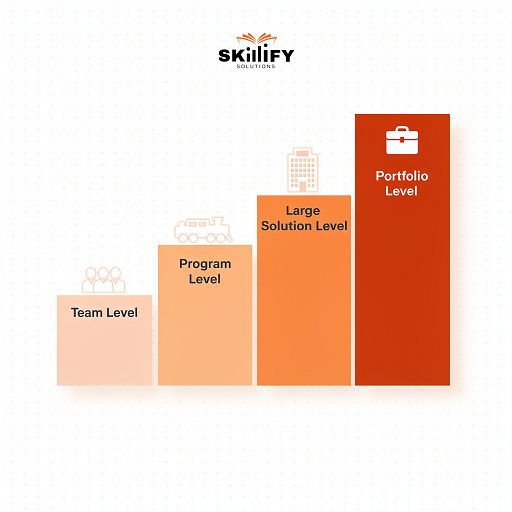
    SAFe® is divided into four levels to manage large-scale work effectively. Each level focuses on a different layer of the organization. It takes care that all of them, from daily tasks to long-term strategy, are connected. 

    You can think of it as a system where teams execute, programs coordinate, and leadership guides direction. Here are the four levels of the SAFe® Framework:  

    4 level SAFe® Methodology Explained: Principles, Values, and Competencies Guide
    1. Team Level: This is where the actual work happens. Agile teams use Scrum or Kanban to deliver features in small iterations. The focus is on execution and delivery at this level of the SAFe® framework.  
    2. Program Level: Here, multiple teams come together and align their work. They follow a shared plan and deliver value in fixed cycles. These are called Program Increments, and the key focus comes with coordination across teams 
    3. Large Solution Level: This level is mostly used when projects are very complex and involve multiple programs. It helps manage large systems that require high-level coordination. Here is the key focus: handling complex and multi-program solutions.  
    4. Portfolio Level: This is the top level where business decisions are made. It ensures that all work aligns with the company’s strategy and investment priorities. The core focus includes strategy, funding, and governance 

    Together, these levels create a connected system in which strategy flows down, and execution flows up, ensuring clarity, alignment, and better results across the organization. To understand how these levels work in real-world scenarios, many professionals start with the Leading SAFe® Certification, which covers the full framework end-to-end. 

    Lean-Agile Principles That Power SAFe® 

    SAFe® is built on a set of Lean-Agile principles that guide how teams plan, work, and deliver value at scale. These principles focus on efficiency, alignment, and decision-making across the organization. Instead of just following processes, SAFe® encourages a mindset of continuous improvement and value delivery. 

    Let’s look at the key Principles  

    1. Focus on Value: Delivering maximum business value with minimum waste 
    2. Think in Systems: Helps to optimize the entire workflow, not just individual teams 
    3. Work in Small Batches: This is to deliver faster and get quick feedback 
    4. Stay Flexible: Keeping options open and adapting them as needed 
    5. Continuous Learning: Improve through regular feedback and iteration 
    6. Limit Work in Progress: Avoiding overload and improving efficiency 
    7. Empower Teams: This principle helps to enable faster decision-making at the team level 
    8. Organize Around Value: Structuring the work based on outcomes.  

    Advance your skills with SAFe® 6.0 Agile Product Manager and get hired today!

    Connecting SAFe® with the Agile Manifesto 

    SAFe® builds on the core values of the Agile Manifesto. These are collaboration, working solutions, customer focus, and adaptability, and extend them beyond individual teams. While Agile was originally designed for small teams, SAFe® applies the same thinking across multiple teams and business units. 

    In simple terms, SAFe® keeps the flexibility and speed of Agile, but adds the structure needed for large organizations to stay aligned. This ensures that teams can adapt to change while still delivering consistent value at a scale. 

    SAFe® Core Values: The Foundation of Alignment and Execution 

    SAFe® is built on a set of core values that guide how teams collaborate, make decisions, and deliver work at scale. These values ensure that even in large organizations, everyone stays aligned, transparent, and focused on outcomes. 

    According to the official SAFe® framework, the core values include alignment, transparency, respect for people, and continuous improvement, which act as the foundation for successful implementation.  

    Below are the key SAFe® Core Values 

    1. Alignment: Ensures all teams work toward a common business goal 
    2. Transparency: Builds trust through open communication and visibility 
    3. Respect for People: Empowers teams and encourages collaboration 
    4. Relentless Improvement: Focus on continuous learning and growth 

    In simple terms, these values create a system where teams are connected, trusted, and constantly improving, leading to better execution at scale. To understand how to get certified and choose the right path, you can read our complete guide on SAFe®Certification for 2026. 

    SAFe® Core Competencies: Enabling Enterprise Agility 

    While values define the mindset, SAFe® core competencies define what organizations need to do well to achieve true business agility. These competencies act as key capability areas that help enterprises scale Agile successfully. 

    SAFe® uses these competencies to measure and improve how effectively an organization delivers value, adapts to change, and aligns teams with strategy. Below are the key SAFe® Core Competencies.

    1. Lean-Agile Leadership: Leaders drive culture and transformation 
    2. Team and Technical Agility: Teams deliver high-quality work consistently 
    3. Agile Product Delivery: Focus on customer value and fast delivery 
    4. Enterprise Solution Delivery: Manage large and complex systems 
    5. Lean Portfolio Management: Align strategy with execution and funding 
    6. Continuous Learning Culture: Encourage innovation and improvement 
    7. Organizational Agility: Enable the entire business to respond to change 

    Key Competencies That Drive Large-Scale Organizations 

    In large organizations, not all competencies carry equal weight. Some are more critical because they directly impact alignment, delivery speed, and business outcomes. These key competencies help enterprises manage complexity while staying agile. 

    Most Important Competencies 

    1. Lean-Agile Leadership: Strong leadership is essential to drive transformation and decision-making 
    2. Team and Technical Agility: Ensures teams can consistently deliver high-quality work 
    3. Agile Product Delivery: Keeps focus on customer value and faster releases 
    4. Lean Portfolio Management: Aligns business strategy with execution and funding 

    Learn to become a Certified SAFe® 6.0 Scrum Master (SSM) to manage teams and deliver today!

    The SAFe® House of Lean: Building a Culture of Continuous Improvement 

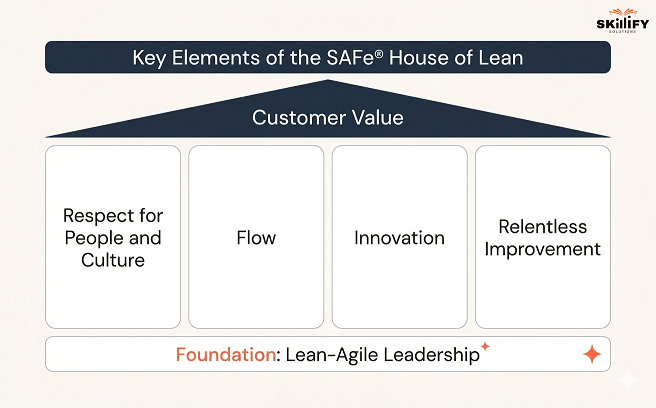
    The SAFe® House of Lean is a visual model that explains how organizations can build a system focused on continuous improvement and value delivery. It shows that success doesn’t come from tools alone, but from a strong foundation of leadership, culture, and working principles. 

    The house here represents how different elements come together. At the top is the goal, delivering value to customers quickly and consistently. 

    This is supported by key pillars like respect for people, smooth workflow, innovation, and continuous improvement. At the base is Lean-Agile leadership, which ensures that the right mindset and direction are in place. 

    Key Elements of the SAFe® House of Lean 

    key element SAFe® Methodology Explained: Principles, Values, and Competencies Guide

    Foundation: Lean-Agile Leadership 

    Leaders play a critical role in setting the vision and building the right environment for Agile to succeed. They encourage open communication, learning, and innovation, while also supporting teams during change. Strong leadership ensures that Agile is not just implemented but sustained and continuously improved over time. 

    Pillar 1: Respect for People and Culture 

    This pillar focuses on creating a workplace where people feel valued, trusted, and empowered. When teams are respected, they take ownership of their work, collaborate better, and contribute more effectively. A strong culture of respect leads to higher motivation, better teamwork, and improved outcomes. 

    Pillar 2: Flow  

    Flow is about ensuring that work moves smoothly from start to finish without unnecessary delays. By reducing bottlenecks and managing workload properly, organizations can deliver faster and more predictably. Good flow also helps teams focus on completing tasks instead of constantly switching between them. 

    Pillar 3: Innovation 

    Innovation encourages teams to think beyond routine work and explore new ideas, better solutions, and improved ways of working. Organizations that support experimentation and learning can adapt quickly to changes and stay competitive in the market. 

    Pillar 4: Relentless Improvement 

    Continuous improvement is a key part of SAFe®. Teams regularly reflect on their work through feedback sessions and retrospectives, identifying what can be improved. Small, consistent improvements over time lead to better efficiency, quality, and performance. 

    SAFe® Adoption in 2026: Enterprise Use Cases and Trends 

    In 2026, enterprises are adopting SAFe® to manage large-scale operations with better alignment and faster delivery. It is widely used across industries like IT, BFSI, telecom, and manufacturing, where multiple teams need to work together on complex projects. Organizations use SAFe® to connect business goals with execution, reduce delays, and improve coordination across departments. 

    At the same time, SAFe® adoption is evolving beyond IT. Companies are applying it across functions like operations, strategy, and product management, focusing more on continuous value delivery instead of one-time projects.

     In simple terms, SAFe® is helping enterprises become more agile, aligned, and efficient at scale. This growing adoption is also increasing demand for professionals with SAFe® for Teams (6.0) Certification and hands-on understanding of the framework. 

    Conclusion 

     SAFe® methodology helps organizations move from isolated Agile teams to a fully aligned, enterprise-wide system. By combining principles, values, and competencies, it creates a structure where teams can deliver faster while staying connected to business goals.

    For professionals, understanding SAFe® is not just about learning a framework; it’s about understanding how large organizations actually operate and scale Agile effectively.

    It can be concluded from the above blog that SAFe® helps you move from doing Agile in teams to driving Agile across the organization. If you’re looking to apply these concepts in real-world scenarios, you can explore SAFe® certification courses here by Skillify Solutions.  

    Frequently Asked Questions

    1. What is SAFe® in Agile?

    SAFe® (Scaled Agile Framework) is a framework that helps organizations apply Agile practices across multiple teams and at an enterprise level. It combines Agile, Lean, and DevOps to improve coordination and delivery.

    2. How is SAFe® different from Scrum?

    Scrum focuses on single teams and small projects, while SAFe® is designed for multiple teams and large organizations. SAFe® adds structure, roles, and planning across teams to ensure alignment.

    3. Is SAFe® suitable for large enterprises?

    Yes, SAFe® is specifically designed for large enterprises. It helps manage complex projects, align teams with business goals, and scale Agile across the organization.

  • SAFe Certification List Explained (2026)

    SAFe Certification List Explained (2026)

    Introduction

    The SAFe® certification list includes more than a dozen credentials issued by Scaled Agile, Inc., organized by role, experience level, and function within a SAFe® enterprise. The right credential depends on your current role, your organization’s transformation stage, and your career objectives. This guide breaks down every SAFe® certification available in 2026, explains who each one is designed for, and helps you identify the most logical path forward.

    Whether you are a Scrum Master stepping into a release train, a product leader managing a portfolio, or an executive sponsoring a large-scale agile transformation, there is a SAFe® credential designed for your context. For a full breakdown of available courses and enrollment options, visit Skillify Solutions’ SAFe® certification training page.

    The Complete SAFe Certifications List (2026)

    Scaled Agile, Inc. organizes its credentials into tiers: foundational certifications for practitioners and leaders new to SAFe®, advanced credentials for experienced coaches and specialists, and the expert-level SAFe Program Consultant designation. The table below covers all active SAFe® certifications, with corrected renewal fees and updated credential names reflecting the current 2025–2026 catalog.

    CertificationCredentialLevelDurationAnnual RenewalBest For
    SAFe PractitionerSPFoundational1 day$195/yrAll ART team members
    SAFe Scrum MasterSSMFoundational2 days$195/yrScrum Masters, Kanban practitioners
    Leading SAFe (SAFe Agilist)SAFoundational2 days$195/yrLeaders, managers, executives
    SAFe POPMPOPMFoundational2 days$195/yrProduct Owners, Product Managers
    Advanced Scrum MasterASMAdvanced2 days$295/yrExperienced Scrum Masters
    SAFe DevOps PractitionerSDPFoundational2 days$195/yrDev and Ops delivery teams
    SAFe Release Train EngineerRTEAdvanced3 days$295/yrAdvanced Scrum Masters, ART professionals
    SAFe Lean Portfolio ManagementLPMAdvanced2 days$295/yrPortfolio managers, business owners
    SAFe Government PractitionerSGPFoundational2 days$195/yrGovernment and public sector teams
    SAFe Program ConsultantSPCExpert4 days$995/yrTransformation leaders, coaches

    Certification names link to relevant Skillify Solutions training pages. Renewal fees are tiered by SAFe Studio membership level, not a flat rate. For current SAFe certification cost details by provider and region, confirm directly with Skillify or Scaled Agile before enrolling.

    Note: The “SASM” credential listed in older resources has been officially renamed to Advanced Scrum Master (ASM) in the 2025–2026 Scaled Agile catalog. The credential content is substantially the same; the abbreviation is what changed.

    Foundational SAFe® Certifications

    SAFe Practitioner (SP): The SP introduces team members to SAFe® principles and practices, covering how agile teams operate within a scaled environment. This credential suits developers, testers, business analysts, and others who participate on Agile Release Trains (ARTs) without formal coaching responsibilities.

    SAFe Scrum Master (SSM): The SSM prepares Scrum Masters to facilitate agile team events within a SAFe® environment, including PI Planning, Iteration Planning, and retrospectives. It is the recommended first credential for practitioners moving from single-team Scrum into a multi-team ART context.

    Leading SAFe® (SA): This is the most widely held SAFe® credential globally. It targets managers, directors, executives, and change agents who need to understand and lead SAFe® implementations. Leading SAFe® serves as the foundation course for the entire framework and is typically the first certification organizations deploy across leadership teams during a transformation.

    SAFe Product Owner / Product Manager (POPM): The POPM credential covers the dual role of Product Owner and Product Manager within SAFe®. It addresses backlog management, feature definition, roadmap planning, and customer-centric delivery. This is the go-to credential for product professionals working inside an ART.

    SAFe DevOps Practitioner (SDP): The SDP focuses on the Continuous Delivery Pipeline within SAFe®: continuous exploration, continuous integration, continuous deployment, and release on demand. It is designed for development and operations professionals working to improve flow and deployment frequency.

    SAFe Government Practitioner (SGP): This specialty credential adapts SAFe® principles to public sector environments, addressing compliance, procurement, and contracting constraints unique to government agencies. It is particularly relevant for federal and state IT modernization programs.

    Advanced SAFe® Certifications

    Advanced Scrum Master (ASM): Formerly listed as SASM, this credential is designed for experienced Scrum Masters who want to deepen their coaching capability. ASM covers conflict resolution, team dynamics, and supporting RTEs at the program level. It bridges the gap between individual team facilitation and enterprise coaching.

    SAFe Release Train Engineer (RTE): The RTE is the servant leader and chief coach of the Agile Release Train. This is one of the most demanding credentials in the SAFe® ecosystem, requiring a strong foundation in SAFe® principles, facilitation skills, and the ability to manage cross-team dependencies at scale. In our experience working with enterprise teams, organizations that invest in certified RTEs see measurably faster PI execution and fewer impediment escalations.

    SAFe Lean Portfolio Management (LPM): LPM addresses strategy alignment, Lean budgeting, and portfolio governance within SAFe®. This credential suits portfolio managers, business owners, and enterprise architects responsible for connecting strategy to execution across multiple ARTs.

    Expert Level: SAFe Program Consultant (SPC)

    The SPC is the highest-level SAFe® credential and the only one that qualifies holders to train and certify others. SPCs lead SAFe® implementations at the enterprise level, coach ARTs, train teams, and guide organizational transformation. The SPC course runs four days and is a prerequisite for becoming an authorized SAFe® trainer (SPCT). To explore this path, visit Skillify Solutions and choose the right SAFe® course for your transformation goals.

    How to Choose the Right SAFe® Certification Path

    Selecting the right SAFe® credential is not just about passing an exam. It is about matching the credential to your current responsibilities and your organization’s maturity with SAFe®. Here is a practical framework for choosing:

    1. Start with your role. Are you a team-level practitioner, a coach, a product leader, or an executive? SAFe® maps credentials directly to roles within the framework.

    2. Assess your organization’s SAFe® maturity. Teams early in a transformation benefit more from Leading SAFe® (SA) than from advanced credentials. Organizations deeper into their journey may need SPC or RTE investment.

    3. Consider prerequisites. Some credentials, like ASM, assume prior SSM certification. Others, like SPC, require demonstrated SAFe® experience and typically SA certification first.

    4. Factor in your budget. Exam fees and annual renewals differ by tier. The SP and SSM are cost-effective starting points. For deeper investment, talk through the options with an advisor who can help you evaluatewhich SAFe® certification is best for your role and ROI.

    5. Plan for renewal. All SAFe® credentials require annual renewal through SAFe Studio. Foundational credentials renew at $195/yr, Advanced at $295/yr, and SPC at $995/yr.

    Skillify Solutions works with professionals and enterprise L&D teams to map certification paths to business outcomes. Their advisors take a role-based approach rather than pushing the most expensive credential, which is a distinction worth noting when evaluating which SAFe® certification is best for your situation.

    SAFe® Credential Levels, Renewal, and Exam Structure

    Exam Format

    Most SAFe® exams consist of 45 multiple-choice questions. Candidates have 90 minutes to complete the exam and must score at least 73% to pass. The exam attempt is bundled with course enrollment for most credentials. Additional retakes cost $50 for standard courses and $250 for the SPC.

    Annual Renewal Requirements

    SAFe® credentials expire annually. Renewal requires either completing continuing education units (CEUs) through Scaled Agile-approved activities or passing the exam again. Renewal fees are tiered by SAFe Studio membership level: $195/yr for Foundational credentials, $295/yr for Advanced credentials, and $995/yr for the SPC. Professionals holding multiple credentials at the same tier pay a single combined renewal fee for that tier.

    PDUs and Continuing Education

    Many SAFe® courses qualify for Project Management Professional (PMP) PDUs through PMI. Agile practice education qualifies under technical project management PDU categories, making SAFe® courses an efficient way to satisfy both SAFe® renewal and PMP maintenance requirements simultaneously.

    SAFe® Certification Trends and Market Context for 2026–2027

    AI Integration in SAFe® Practices

    Scaled Agile has begun integrating guidance on AI-augmented delivery into its framework content. The SAFe® 6.0 release introduced explicit guidance on AI-assisted team practices, value stream management, and intelligent backlog refinement. Professionals holding current SAFe® credentials gain access to updated course materials reflecting these additions at no additional cost, a meaningful benefit of maintaining active certification status.

    Growing Demand for RTE and SPC Credentials

    In our experience working with enterprise teams, the roles that consistently face the most acute talent shortage are Release Train Engineers and SAFe Program Consultants. As more organizations advance past the initial SAFe® launch phase, demand for experienced coaches who can sustain and mature the implementation has outpaced supply. Professionals holding RTE or SPC credentials are commanding premium salaries, particularly in regulated industries like financial services, defense, and healthcare technology.

    Government and Public Sector Expansion

    Federal and state agencies are accelerating digital modernization programs, and many are standardizing on SAFe® as their delivery framework. The SAFe Government Practitioner (SGP) credential has seen increased uptake as agencies seek to adapt commercial agile practices to compliance-heavy environments.

    Enterprise Learning and Development Investment

    Large enterprises are increasingly treating SAFe® certification as a core component of their L&D strategy rather than an individual employee benefit. Organizations that deploy cohort-based training, where entire ART teams get certified together, report faster time to PI Planning competency and fewer early-stage facilitation failures.

     Find Your SAFe® Certification Path

    Skillify’s advisors help you pick the right SAFe® credential for your career goals.

    Talk to a SAFe® Advisor

    Bringing It Together: Choosing Your SAFe® Certification in 2026

    The SAFe® certification list covers a wide spectrum of roles and experience levels, from the foundational SP for team practitioners to the expert-level SPC for enterprise coaches. The right credential is the one that aligns with where you are in your career, the role you play in your organization’s SAFe® implementation, and the outcomes you want to achieve in the next twelve to twenty-four months.

    For most professionals entering the SAFe® ecosystem, Leading SAFe® (SA) provides the most versatile foundation. For those already working inside an ART, the POPM, SSM, or ASM credentials provide targeted depth. And for practitioners ready to lead transformation at scale, the RTE and SPC credentials represent the highest-value investment available in the scaled agile credential market.

    The SAFe® framework will continue to evolve with the enterprise landscape, particularly as AI-augmented delivery practices become standard. Professionals who maintain current certifications and actively apply the framework will find themselves well-positioned regardless of how organizational structures shift.

    Frequently Asked Questions

    1. What is the best SAFe® certification for beginners?

    For most professionals new to SAFe®, Leading SAFe® (SA) is the most practical starting point. It provides a comprehensive overview of the framework and qualifies holders to participate meaningfully in SAFe® transformations at the program level. Team-level practitioners who want a lighter introduction can start with the SAFe Practitioner (SP) credential instead.

    2. How much does SAFe® certification cost?

    SAFe certification cost varies by credential and provider. Course and first-exam bundles range from approximately $500 for foundational credentials to $2,495–$3,500 for the SPC, depending on the training partner. All credentials also carry tiered annual renewal fees of $195, $295, or $995 per year. Organizations enrolling teams in bulk through authorized partners like Skillify Solutions can often negotiate volume pricing.

    3. Which SAFe® certification is best for product managers?

    The SAFe Product Owner / Product Manager (POPM) credential is the primary choice for product professionals. For those managing across multiple teams or an entire portfolio, adding the Lean Portfolio Management (LPM) certification provides additional depth in strategic planning and Lean budgeting practices.

    4. How long does it take to get SAFe® certified?

    Most SAFe® certification courses run two days, followed by an online exam that candidates typically complete within the same week. The SPC program is the exception at four days. From enrollment to certification, most professionals complete the process within two to three weeks depending on exam scheduling availability.

    5. Do SAFe® certifications expire?

    Yes. All SAFe® credentials require annual renewal. Professionals must earn the required continuing education units or retake the exam each year. Scaled Agile sends renewal reminders before the expiration date. Missing the renewal window results in a lapsed credential that requires full reinstatement.

    6. Is SAFe® certification worth it in 2026?

    SAFe® remains the most widely adopted scaled agile framework in enterprise environments. More than 20,000 organizations across 120 countries use SAFe®. LinkedIn job data consistently shows SAFe®-related skills appearing in enterprise agile role postings at higher rates than competing frameworks. For professionals working in or targeting large enterprise environments, SAFe® credentials deliver real career leverage.

  • 30 Must-Know Scrum Master Interview Questions and Answers

    30 Must-Know Scrum Master Interview Questions and Answers

    Key Highlights of scrum master interview questions and answers

    • This guide shares must-have Scrum Master interview questions and simple answers for every level of experience.
    • It explains the main ways the Agile methodology and the Scrum framework are not the same.
    • You can read answers for both behavior questions and ones about different situations.
    • The article gives specific questions to ask for senior jobs and for SAFe Agile settings.
    • Find easy tips to help get ready for interviews, focusing on how things work in real life.
    • See how to answer questions about sprint planning, the Scrum team, and project management in a good way.

    Introduction

    Getting a scrum master role takes more than a simple certification. Managers want to know if you can guide a team, get rid of blockers, and use the scrum process the right way. When you get ready for your scrum master interview, you have a chance to show what you know about agile methodology and show them you are a good pick for the job.

    This guide gives you the most asked scrum master interview questions and answers. You will find expert tips to help you talk about your skills, handle interview questions well, and get your next scrum master job. If you’re preparing seriously for interviews, enrolling in a Scrum Master Bootcamp with AI can help you gain hands-on experience with real-world Agile scenarios and mock interviews.

    Interview Questions and Answers for Scrum Master: Beginner Level

    Knowing the basics of the scrum master role is very important for anyone new in an Agile team. If you want to become a scrum master, some common interview questions might ask you to explain what the scrum master does. You may need to talk about the three main scrum artifacts, which are product backlog, sprint backlog, and increment. People might also ask you to define words like sprint and sprint goal.

    You should be ready to talk about what “Done” means for a task. You could also be asked to name and talk about the five scrum events. It’s a good idea to show that you have good, clear communication when working with people outside the team, like stakeholders. Being familiar with these interview questions shows you know the scrum framework well. It also helps you feel ready to work in a scrum team, because you can handle real problems that come up.

    1. What is Scrum and how does it differ from Agile?

    Agile is a way of thinking about development that focuses on making progress step by step. The idea is to work together, listen to customers, and adjust to change. Agile tells us what to value and why we make software in a certain way.

    Scrum is one way to use Agile. It gives rules, roles, and events to help teams get work done. In Scrum, teams break work into sprints, which last two or three weeks. A team in Scrum is made of people with different skills who organize their own work.

    The big difference between Agile and Scrum is this: Agile is a general idea, while Scrum is one way to practice it. Scrum helps teams change plans fast, so their work matches the main goals of Agile.

    2. Explain the role of a Scrum Master

    Helping with the scrum process is an important part of what a scrum master does. A scrum master acts as a leader who serves the team. The main goal is to be sure that the scrum team follows scrum values and works with best practices. A scrum master helps create a space where people feel free to work together.

    Some of the key jobs in this role are coaching people on agile principles. A scrum master also leads scrum ceremonies, like sprint planning and daily standups. They help manage the product backlog and try to keep out things that might stop the team from working well.

    When there is a problem or an argument, the scrum master steps in to help fix it. They also help the team choose what tasks or ideas will add the most business value. A big part of the role is getting the team to look for better ways to work, which helps with continuous improvement. This way, the scrum master works to boost team morale and make the whole team more productive.

    3. What are the three Scrum artifacts?

    The three main scrum artifacts are the product backlog, sprint backlog, and increment. The product backlog has a list of things that need to be added or fixed. It shows what work is most important. The sprint backlog has a list of jobs for one sprint. The increment is what has been finished at the end of each sprint.

    4. Define Sprint and Sprint Goal

    A key part of the Scrum framework is the sprint. A sprint will be between one to four weeks long. This set time lets a Scrum team work hard to deliver a product increment that can be shipped. During this sprint, the team picks backlog items and builds a sprint backlog. This backlog helps guide the work so the team can finish certain tasks.

    The sprint goal is short and clear. It says what the sprint is for. It helps everyone in the Scrum team stay on the same page and stay focused. This way, the team’s work all moves toward one job. When everyone understands the goal, teamwork gets better and each person knows what to do. This helps the development process and builds trust in the whole group.

    5. What is Definition of Done (DoD)?

    The Definition of Done, or DoD, is a simple list of steps that must be finished before a product increment is said to be ready. This helps everyone see what needs to be done and keeps the work to a high standard. It also makes sure the team agrees on what “done” means. With this, people feel responsible, and at the end of each sprint, the software works like it should.

    6. What are the five Scrum events?

    The five Scrum events are Sprint Planning, Daily Scrum, Sprint Review, Sprint Retrospective, and the Sprint itself. These events help teams work together, keep getting better, and make sure they keep moving forward. The events help everyone in the development process to stay focused and in line with their goals.

    7. Difference between Product Owner and Scrum Master

    While both the product owner and the scrum master play important roles in a scrum team, they each have different jobs. The product owner decides what the team needs to build. The product owner sets the order of tasks in the product backlog and speaks for what the customer wants. They help the team focus on the features that give the most value.

    The scrum master, on the other hand, looks after how the team works each day. The scrum master guides everyone in using scrum practices, leads meetings, and clears problems that may slow the team down. They work to improve teamwork, keep people productive, and support continuous improvement.

    RoleFocus
    Product OwnerMaximizing product value, managing the Product Backlog, prioritizing.
    Scrum MasterFacilitating Scrum process, coaching team, removing impediments.

    8. What is velocity in Scrum?

    Velocity in Scrum shows how much work the team can do in a Sprint. It is found by adding up the story points for all backlog items that are fully finished at the end of the Sprint. This helps teams and Product Owners plan and guess how many Sprints it will take to finish the product backlog. It is useful for release planning.

    But, velocity should not be used to compare teams. It should not be a measure to track how busy people are. Trying to get higher velocity can lead to poor work or team burnout. Teams should work to have a steady and predictable velocity. This makes it easier to deliver work in a good and healthy way, instead of always working to do more.

    9. Explain the three pillars of Scrum

    Scrum is built on the idea that you learn from what you have done before and make choices using the best facts you have right now. The method uses three main pillars. These pillars help teams to keep getting better with their work and what they create. These three are part of all Scrum events and pieces of work. They give simple ways for teams to see what is working and what is not. A team needs to follow these pillars if they want to use Scrum well.

    The three pillars of Scrum are:

    • Transparency: The main parts of the process are open to the people who have to get results. This helps everyone understand what is happening.
    • Inspection: There is a need to check the progress and items often, so it is easy to see problems early.
    • Adaptation: Fast changes are made if there are things that do not go as planned.

    10. What is timeboxing and why is it important?

    Timeboxing means you give a set amount of time to a task. In the Scrum framework, every event has a clear time limit. For example, a daily scrum should not be longer than 15 minutes. Timeboxing helps the team stay on top of their tasks and stops talks from dragging on. It also helps people make fast choices.

    When this limit is in place, teams spend less time on things that are not important. They work at a steady speed. This way of working is good for the development process. It also makes things easier to plan and know what will happen next. The team can keep giving value week after week by using timeboxing in the scrum framework.

    Scrum Master Behavioral Interview Questions and Answers

    Behavioral questions help interviewers see how you have dealt with different things at work before. They feel that what you did before can show them what you may do in the future. If you are going for a Scrum Master job, the questions will usually focus on servant leadership, conflict resolution, and coaching. The people asking want to hear real examples from your own life about these things.

    When you answer these questions, try to use a clear way like the STAR method. The STAR method means talking about the Situation, the Task, the Action, and the Result. This way, you can share a short and easy-to-follow story that shows your skills.

    Get a few good stories from your career where you handled team conflicts, helped remove a problem, and worked to boost team morale. Having examples ready will help you feel prepared and do well in your answer.

    11. How do you handle conflicts within the Scrum team?

    When there is a problem in the scrum team, I act fast to sort it out. This helps to keep everyone happy and working well. As a facilitator, I guide the team to fix the issue on their own. I feel that when handled right, some conflict can help people get creative and feel closer to each other. I start by watching and listening to what is going on so I know what everyone thinks. I ask the people to talk with each other in a calm and open way. If things do not get better, I will set up a meeting and help them find common ground.

    My conflict resolution process includes:

    • Meeting with people one-on-one to get their views.
    • Leading a group talk for a set time that looks at facts and what the group wants to reach.
    • Making team rules about what to do when they do not agree in the future.

    12. Describe a time when you had to challenge management

    In a job I had before, a top manager wanted to add a “critical” feature to our current sprint. At that time, the team had no extra room for new work. I set up a talk with the manager. At the meeting, I showed numbers about our workload and how the sprint burndown looked. I spoke clearly about Scrum principles, and pointed out why the sprint needed to be guarded and why pace had to be steady.

    I did not just say no. I helped the Product Owner join the talk. We looked at the option of swapping something out, to make room for the new work. In the end, we all decided this feature could be moved to the next sprint. This choice kept the team safe and showed the value of good agile practices to management.

    13. How do you build trust with your team?

    Building trust is key for a good scrum master. I do this by being steady, open, and reliable. I always try to match what I say with what I do. My main goal is to help the team, not to watch over everything they do. I try to make a safe place where people feel good about sharing their thoughts and even their mistakes. They know they do not need to worry. I ask for open talk, especially in Scrum meetings like Sprint Retrospectives. I also show the team that I can make mistakes and tell them when I do. I feel it is important to be real. To build trust, I:

    • Practice active listening so each person feels they are respected.
    • Honor commitments, mostly when you are working to remove blocks for the team.
    • Celebrate wins and help others learn from mistakes. This helps with continuous improvement.

    14. Share an example of when you failed as a Scrum Master

    Early in my time as a Scrum Master, I did not stop scope changes for my team. A stakeholder asked for a change during the sprint, saying it was “small.” I thought it would not cause big problems. But it made us switch focus, which slowed everyone down. We did not reach our sprint goal.

    During the sprint retrospective, I said I made a mistake. I talked about how this change hurt our team’s capacity and morale. It was tough, but I learned the importance of saying no and protecting the sprint. After that, we made a simple process for handling change requests.

    I now use what I learned from this to help Product Owners and stakeholders. Because of this, I am a better Scrum Master.

    15. How do you ensure effective team communication?

    Effective communication is a big part of how a Scrum team does well. As a scrum master, I help run Scrum events like the daily scrum. These meetings bring the team together and keep things clear for all. I also work to build a space where everyone feels safe to talk and be honest. I make sure that people respect each other and stay helpful in talks. When the team is not in one spot, I help pick the right ways or tools for us to talk.

    I help people talk to each other in a clear way by doing these things:

    • Make sure that, after sprint planning, the team has a clear sprint goal and everyone understands the backlog.
    • Run retrospectives in a way that gives people a safe space. This helps them feel okay to share honest thoughts about how the work and teamwork can be better.
    • Guide the team as they practice listening to each other and giving helpful feedback.

    Scrum Master Scenario Based Interview Questions and Answers

    Scenario questions help test if you can think quickly and use scrum principles in real situations. A person will give you a made-up problem and ask what you would do. These questions show how you solve problems, what you know as a scrum master, and how you deal with tough moments.

    There may not be just one correct answer. The interviewer wants to see how you think. They look for how you use scrum values and ways to work through the situation. Be ready to talk about why you would do something. Use ideas like sprint goals, team capacity, and conflict resolution when you explain your answer.

    16. How would you handle scope creep if the Product Owner adds new features in the middle of a sprint?

    If the product owner wants to put new features or backlog items in during a sprint, I start by reminding the team about the sprint goal. Scope changes can put this goal at risk. I speak with the product owner to see how urgent the new items are and ask if they think these can wait until the next sprint or if it is a real emergency. It is important for me to help the team stay focused and cut down on any distractions to make sure we reach our goal.

    If the new request is very important, I help start a talk between the product owner and development team.

    • The team looks at the new work and figures out how much there is.
    • The same amount of work needs to be taken out of the sprint backlog.
    • The Scrum team talks about the balance and agrees on it.

    17. What would you do if your Scrum team consistently fails to meet sprint commitments?

    If the team often misses what they plan to do in a sprint, I try to find the real reasons behind it. I do not blame anyone. I use the Sprint Retrospective to start an open talk with the team. We look at things like overcommitting during sprint planning, unclear user stories, or any problems that come from outside the team. It helps to get some data so we can make good choices. After we find out more, we make a plan to get better. This plan might include:

    • We use the team’s past speed, known as team velocity, to help us make better plans.
    • We work on making our list of tasks clearer and easier to follow. This helps us be sure each story is set and good to go.
    • We point out things that slow us down and fix them early. This helps us do better as a team all the time.

    18. How would you manage stakeholders who demand detailed daily status reports in a Scrum environment?

    Handling what stakeholders want can be hard, especially when they ask for detailed reports every day. The main thing is to use good and clear talk. A scrum master should make sure there is a set time for reports to be shared. This could be during daily standups or maybe as a short summary once a week. This helps everyone see what is happening and keeps things open.

    When you use things like team velocity and how far people are on user stories from the sprint backlog, you can answer questions stakeholders have. This keeps them in the loop without giving too much to the team.

    Letting people join in on sprint reviews gives them a way to see the current work. At the same time, this helps team morale stay steady. If you focus on business value in your reports, this will line up with what the company wants to see and reach its needs. This all shows how important effective communication is in scrum.

    19. How would you handle a team member who is disengaged or not contributing during sprint retrospectives?

    Dealing with a team member who does not take part in retrospectives can feel tough. To help, you need to make a safe space for your team. In this way, everyone can feel okay to talk about their thoughts and what they go through. It is good to start with clear communication. Speak with the person alone and try to find out why they are not joining in.

    Help them feel more ownership of their work. Talk about how important continuous improvement is for everyone who is part of the team. A team grows strong when people share and learn. You can try ideas like having people brainstorm ways to hit common goals or use user story mapping. This may bring the team member in and help them feel a part of what the group does.

    It is smart to show how coming to retrospectives can help. When the team joins in, there is often more team morale, better conflict resolution, and a sense that people work well together. In the end, just help your team member see that these talks can be good for everyone.

    20. Distributed team across US time zones struggling with communication?

    Effective communication is very important for distributed teams, especially when people are in different time zones in the U.S. A clear plan helps every team member stay on the same page and get the information they need. This helps keep misunderstandings low. Video calls and chat tools make it easy for people to talk in real time. Keeping records of talks and decisions helps things stay clear for everyone. It’s a good idea for teams to have working hours that can overlap. This makes it easy for team members to talk and work together.

    Regular standups also help, and everyone needs to join in. This lets the team feel more responsible for their work. A scrum master should build a safe space where people feel they can talk about their worries. When team members do this, the scrum master can solve problems with communication and help people of the scrum team work better together.

    21. What would you do if the Product Owner repeatedly changes priorities in the middle of a sprint?

    Dealing with a product owner who often changes priorities during a sprint can be hard for the scrum master. The key in this situation is clear communication. The scrum master can bring everyone together for a talk with the product owner. This helps the development team and product owner agree on the top priorities. It also lets them know how these changes can slow down the development team.

    Using tools like a sprint backlog session also helps. This way, everyone can see how new tasks or changes can change the project timeline. The development team needs to feel safe to share any worry they have. A safe space lets them take ownership of their work, feel good about it, and handle new changes better.

    Scrum Master Interview Questions and Answers for Experienced Professionals

    Moving into higher roles in Scrum takes more than just knowing the steps. You need to understand the people in your team and how they work together. A skilled scrum master often thinks about how to guide several teams at once. To do this, the teams must share the same product vision and there has to be clear communication between them.

    When people talk about how well the scrum master is doing, they often look at things like team velocity and what the team can get done. A big part of the scrum master’s job is to make sure the team is using the scrum framework in the right way and to push for continuous improvement.

    It also helps to show times when you have solved conflicts in the team or helped others learn. Doing this lets people see that you know what to do to help your team do their best work.

    22. How do you scale Scrum for multiple teams?

    Scaling Scrum for more than one team means using tools like SAFe or LeSS. These tools help teams work together, stay on the same page, and use effective communication. When you focus on teams working with each other and set up clear rules, it is easier to handle any work that connects different groups. This helps everyone move toward the same project goals as one team.

    23. How do you measure Scrum Master effectiveness?

    To measure how well a scrum master is doing, you need to look at how the team is working and what they get done. The main things to check are team velocity, how many sprints the team finishes, and if the people that have a stake in the work are happy. There is also value in asking the team for feedback in meetings after each sprint. This can help you see if the scrum master is helping the team feel good about their work and stay productive.

    24. How do you handle technical debt discussions?

    Talking about technical debt means having clear talks with the team about how it can hurt how fast you work and the quality of what you make. Make a list of the things you need to fix and give them an order. Write them down. Work with everyone to plan together, and make sure all important people understand why fixing technical debt should be part of upcoming sprints. Doing this helps make every project go well.

    25. Explain your approach to continuous improvement

    Keeping a focus on continuous improvement is important in the scrum framework. The scrum team uses regular feedback meetings, like sprint retrospectives, to talk about problems and think of ways to solve them. When you work in a place that values trying new things, the team can test out new practices and learn new technologies. This can lead to better work and more interest in what they do.

    When the team has ownership of their work, they feel more able to spot what needs to change and improve. Sharing useful facts, updates, and checking team velocity can show how the team grows and what steps to take next. This helps guide later sprints. In the end, it raises business value and helps the team follow agile principles. This way, the scrum team works well and the scrum environment gets better.

    Senior Scrum Master Interview Questions and Answers

    If you want to get a Senior Scrum Master job, you will have to answer questions about leading people, helping others learn, and how you help a company change for the better. The manager wants to know if you can do more than lead a single team. They look for proof that you can help many teams and support a major Agile change. Your skill in coaching teams and teaching new scrum masters will be important and will be looked at closely.

    These questions look at how you think and plan for the future. They also see what you feel a great Agile group should be like. Get ready to talk about times when you have dealt with tough problems in your team. Be ready to share how you stand up for agile principles with everyone in the company.

    26. How would you coach a struggling Scrum team to high performance?

    To help a struggling scrum team do better, it is good to work on how people talk with each other. Try to see what problems are stopping the team from moving ahead. The team should learn to work together and help each other. Ask everyone to share what they feel in meetings, and do this often. Set goals that the team can reach. Use the main ideas and steps from agile to give the team power to act. If you do these things, you can create a place where there is continuous improvement and everyone works to get better all the time.

    27. How do you drive Agile transformation across the organization?

    Driving agile transformation needs a clear plan, solid leadership, and teamwork across all groups. Help build a culture of continuous improvement by letting people feel confident, offering training, and using feedback from teams. Make changes based on this input, so the way of working matches what the company wants. At the same time, be sure everyone agrees and supports these changes.

    28. Describe your experience mentoring junior Scrum Masters

    Mentoring junior scrum masters means helping them understand the scrum framework and the values behind it. I share things I have learned from my own work to guide them through the scrum process. I make sure to talk a lot about servant leadership and the need for good, clear, and effective communication. We have practice sessions where they act out real-life cases. This gives them chances to practice leading scrum ceremonies like daily standups and sprint retrospectives.

    I also push them to take ownership of their work. I tell them to speak up when there are team conflicts. This helps them learn and feel strong in their jobs. Watching how they grow makes a friendly place where team morale goes up. This helps them feel ready to face problems and lead their teams well.

    SAFe Agile Scrum Master Interview Questions and Answers

    Having a strong understanding of the SAFe (Scaled Agile Framework) is important for any scrum master who works in big companies. Professionals looking to work in enterprise environments should explore structured SAFe certification courses to understand scaling Agile across multiple teams. In SAFe, the scrum master takes on more jobs. He works with release train engineers during PI (Program Increment) planning. The goal is to make sure all teams share the same goals.

    A big part of this job is to help with effective communication between several teams. This keeps everyone working together and helps the project run well. It is good to notice the differences in the role of the scrum master in SAFe when you compare it with scrum methodology in smaller teams. This can help you get a better idea of what the job involves.

    Good scrum masters also practice servant leadership and follow agile principles. They pay attention when several teams have to work together. When you do these things, it shows you understand what being a scrum master is all about.

    29. What is the Scrum Master’s role in PI Planning?

    The scrum master helps teams during PI planning. They make sure there is clear communication between the teams. The scrum master also helps the team set common goals. They guide everyone through each step of the process. If any problems come up, they work to solve them. The scrum master also helps everyone work together, so all teams agree on what is most important and what needs to be finished.

    30. How does SAFe differ from traditional Scrum?

    SAFe, or Scaled Agile Framework, takes scrum principles and uses them in big organizations. It helps teams in the company move in the same direction. This is different from how regular Scrum works, as that is for one team at a time. SAFe adds extra roles like the Release Train Engineer. It gives a clear way for people to follow agile practices across the whole business.

    How to Prepare for a Scrum Master Interview?

    Scrum Master Interview Questions and Answers

    Getting ready for a Scrum Master interview means you need to practice real-world skills and work on your effective communication. The people who hire Scrum Masters all over the world want to see that you can use agile principles to fix business problems. During the interview, talk about your own stories. Try to show how you worked out conflict and how you worked well with a product owner and your team. Use your experience to show them you can be a good scrum master.

    Check the company and learn about its industry before you go to the interview. This will help you give answers that fit what they want. Show that you have good servant leadership and that you can work well with others. At Skillify Solutions, we think people who can say what they bring to the team in a clear way do better in interviews. If you use these tips, you will be ready for a scrum master job anywhere in the world.

    If you want structured preparation, our Scrum Master Bootcamp offers practical training, mock interview sessions, and real Agile project simulations.

    Research Company Agile Maturity

    Before you go in for your interview, read the job description and look at the company website. Also, read any articles about their work style. Find out how the team uses Agile. If you see words like “Agile transformation” or “launching our first Scrum teams,” the company is new to this way of work. Then, you should talk about your coaching, training, and change-management skills when you meet them.

    If the company already uses Agile well, talk about your own work with things like scaling, metrics, and doing more releases without stopping. Give interview questions that show you know about these advanced parts. For example, you can ask how they measure success with Agile. This way, you show that you are ready, and you think in a smart way.

    Master the Scrum Guide

    The Scrum Guide is a must-have for Scrum Masters. You need to know it well if you are going for interviews. Be ready for questions about what things mean, what roles people have, what events happen, and what the main artifacts are. When you talk about these, give clear answers. Show you know why the rules are there in Scrum, like why there is a Daily Scrum or a Sprint Retrospective. This shows you really think about the work and understand it, not just remember the words. Learn the big ideas that are part of Scrum practices. Before your interview, practice so you feel sure you can talk about all of this confidently.

    • The three pillars of Scrum are transparency, inspection, and adaptation.
    • There are five Scrum values. These are commitment, courage, focus, openness, and respect.
    • The Scrum Master, Product Owner, and Development Team have different duties.

    This knowledge underpins all your answers.

    Prepare STAR Stories

    For behavioral questions, try using the STAR method. The steps are Situation, Task, Action, and Result. This way, you can share your answers in a clear and simple way. It helps you focus on what is important and leaves out things that do not matter. The STAR method lets you show how you solve problems and handle the situation in a good way.

    Think about some important times from your work as a Scrum Master. These can be times when you helped solve problems between people, or times when you coached team members. For each example, explain in a few words what happened, what you had to do, what steps you took to handle it (talk more about what you did), and what happened after. For results, mention clear things, like “better team velocity.” When you share real examples and numbers, your answers sound real and help you stand out to interviewers.

    Understand Market Expectations

    To understand market expectations, you need to know what companies and industries want in a scrum master. This means you should be aware of things like how well the team works, how fast they finish work, and how happy customers feel. When you focus on these things, you can help the team work better with business goals and be more useful to the company as a scrum master.

    Scrum Masters need to help everyone talk openly and share ideas. They should also keep up with the latest trends in the industry. Regular meetings, like sprint reviews, help set clear goals and make teamwork stronger. When Scrum Masters stay aware of best practices, they can give good support to their teams, no matter the place or time.

    Practice with Mock Interviews

    • Mock interviews give Scrum Master candidates a good way to practice their answers and feel more sure of themselves. Doing these practice sessions can show where you need to get better in talking with others and in your understanding of Scrum principles. Try using situational questions that make you think about real situations, like working with conflict resolution or guiding a team through sprint retrospectives.
    • It is also a good idea to get feedback from peers or mentors after each practice session. Working with others in this way helps make a safe space for helpful feedback, so you can work on your answers. This helps you to show you are ready and you know your stuff when you get to the actual interview.

    Conclusion

    To sum up, getting ready for a scrum master interview means you need to know the main ideas and common methods found in the scrum framework. It does not matter if you are just starting out or you have a lot of background in the role, it is key to understand scrum master interview questions. You should practice your answers and be ready to share clear thoughts during the interview. This will help people see you know what you are talking about. You need to know about servant leadership and be good at effective communication.

    These skills show you are ready to lead and support an agile team. Every moment in your scrum master interview gives you a chance to show you know the scrum practices and you can help your team get better over time with continuous improvement. If you want to learn even more and get more practice or details, you can check out Skillify Solutions for extra training and help. Good luck!

    Frequently Asked Questions

    1. What are the biggest red flags interviewers look for when hiring a Scrum Master?

    Interviewers want to see good communication from a candidate. They feel worried if you do not talk well, do not take feedback, or have little practice working in agile ways. Other things that can make them say no are not knowing how a team works, not helping talks in the group, and not caring about continuous improvement.

    2. Do I need certification to become a Scrum Master, or can I get hired with just experience?

    Having a certification can help you look more trusted as a scrum master. But, working in real-life jobs is just as important. A lot of companies want to see that you have worked with teams and can show results, not just a paper. In the end, having both a certificate and some working experience could make it easier for you to get a job as a scrum master.

    3. How do interviewers evaluate culture fit for Scrum Master roles, and what should I emphasize?

    Interviewers want to see if a scrum master will fit in with their team. They look at how you talk with others, how you work with your team, and how well you can adjust to change. Be ready to show the ways you match with the company’s values. Talk about how you help bring people together and what you do to build teamwork. It is also good to mention your experience working with different types of people. This helps show that you can help make the workplace strong and bring the team together.