 Skip to content
Agile estimation techniques help teams plan work realistically, handle uncertainty, and deliver predictable outcomes. Instead of relying on fixed timelines, they focus on relative effort, complexity, and risk, giving teams a more practical way to commit to work.
The problem? Most teams still estimate as if it’s a traditional project, with quick guesses, hour-based thinking, and minimal discussion. That’s where sprint failures begin. Deadlines slip, velocity becomes inconsistent, and planning turns reactive instead of reliable.
From experience, the shift happens when teams stop chasing accurate time estimates and start building consistent estimation systems. Agile is about improving predictability over time.
In this blog, we’ll break down 10 proven Agile estimation techniques that bring structure, clarity, and confidence to sprint planning. Read on!
What Are Agile Estimation Techniques?
Agile estimation techniques are methods used by teams to estimate the effort, complexity, and scope of work required to complete tasks in a sprint. Instead of predicting exact hours or fixed timelines, Agile focuses on relative estimation. It compares tasks with each other to understand which ones are bigger, more complex, or riskier.
Teams typically use units like story points, T-shirt sizes, or ideal days to size work. The goal is not perfect accuracy, but to create a consistent and reliable system that supports better sprint planning, realistic commitments, and predictable delivery over time.
IT is important to build a strong foundation in estimation and sprint planning. Programs like a Scrum Master Bootcamp help teams understand how estimation actually works in real-world environments.
10 Agile Estimation Techniques
Agile teams use different estimation techniques depending on team size, backlog volume, and complexity of work. Below are the 10 most widely used methods, along with when and why to use them.
1. Planning Poker
Planning Poker is a consensus-based estimation technique where team members assign story points using cards. These are usually Fibonacci numbers. Everyone reveals estimates simultaneously to avoid bias.
- Best for: Scrum teams, collaborative estimation
- Pros: Reduces bias, encourages discussion
- When to use: During sprint planning or backlog refinement
This technique is a core part of Scrum practices and is deeply covered in hands-on programs, such as SAFe 6.0 Scrum Master Certification. Here you can learn where teams learn how to run estimation sessions effectively.
2. T-Shirt Sizing
Tasks are categorized into sizes like S, M, L, XL based on relative effort. It’s a fast way to estimate without deep discussion.
- Best for: Early-stage backlog sizing
- Pros: Fast, simple, no numbers needed
- When to use: Initial product backlog creation
Upgrade your Agile skills with hands-on SAFe® 6.0 Scrum Master Certification today!
3. Story Points and Fibonacci
Story points measure effort, complexity, and uncertainty using a Fibonacci scale like 1, 2, 3, 5, 8, and more. Larger gaps reflect increasing uncertainty.
- Best for: Most Agile teams
- Pros: Flexible, accounts for risk
- When to use: Sprint planning and ongoing estimation
Story points become more powerful when paired with the right tracking approach. Many Scrum teams also rely on key Agile Metrics for Scrum Master to improve estimation accuracy over time.
4. Affinity Estimation
Teams group user stories based on relative size by comparing them quickly with each other. It avoids deep discussion and speeds up estimation.
- Best for: Large backlogs
- Pros: Very fast, scalable for many tasks
- When to use: Bulk estimation sessions
5. Bucket System
Stories are placed into predefined buckets like story point ranges. This comes with multiple team members simultaneously, making it efficient for large datasets.
- Best for: Large teams, distributed teams
- Pros: Saves time, parallel estimation
- When to use: It is 50+ backlog items
6. PERT Estimation
Uses three values. These are optimistic, pessimistic, and most likely, to calculate a weighted average estimate. Helps account for uncertainty and risk.
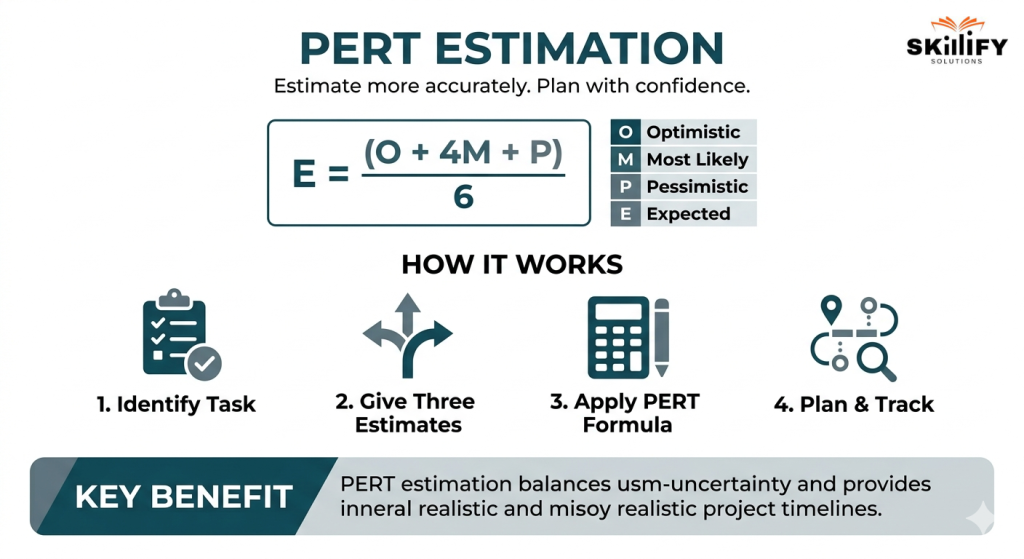
- Best for: Complex, uncertain tasks
- Pros: More realistic, risk-aware estimation
- When to use: New or high-risk features
7. Ideal Days Estimation
Estimates how long a task would take under ideal conditions with no interruptions. Focuses purely on effort, not delays.
- Best for: Teams new to Agile
- Pros: Easy to understand, simple transition from hours
- When to use: Early Agile adoption phase
8. Wideband Delphi
Experts estimate independently, discuss differences, and repeat until consensus is reached. A structured and iterative approach.
- Best for: Complex, high-impact features
- Pros: High accuracy, structured decision-making
- When to use: Strategic or critical work
9. Analogous Estimation
Estimates are made by comparing tasks with similar past work. Relies on historical data and team experience.
- Best for: Experienced teams
- Pros: Fast, data-driven
- When to use: When past sprint data is available
10. Velocity Forecasting
Uses past sprint velocity to predict how much work a team can complete in future sprints. Focuses on delivery predictability.
- Best for: Mature Agile teams
- Pros: Improves planning accuracy, realistic commitments
- When to use: Sprint planning, release forecasting
Gain practical Agile skills with hands-on training in SAFe 6.0 Advanced Scrum Master Certification now!
Agile vs Traditional Estimation: Key Differences
Agile estimation is fundamentally different because it focuses on adaptability, iteration, and team-driven planning, whereas traditional estimation follows a fixed, linear, and predictive approach.
Agile assumes that requirements will evolve, so estimates are flexible and continuously refined. In contrast, traditional methods try to define everything up front and stick to the plan.
If you want a deeper understanding of this evolution, Agile Methodology in Project Management explains how planning, execution, and estimation change in Agile environments.
Bottom-Up vs Top-Down Estimation
Agile teams estimate at the task level and refine continuously, while traditional models estimate once at the beginning and try to follow that plan strictly
| Aspect | Agile Estimation (Bottom-Up) | Traditional Estimation (Top-Down) |
| Approach | Starts from small tasks/user stories and builds upward | Starts from the overall project scope and breaks downward |
| Planning style | Iterative and incremental | Linear and sequential |
| Ownership | Team-driven, self-organizing | Manager-driven, centralized |
| Flexibility | High – adapts every sprint | Low – fixed upfront plan |
| Accuracy over time | Improves with each sprint | Often reduces as assumptions fail |
| Handling change | Welcomes change at any stage | Change is costly and discouraged |
This shift from traditional to Agile estimation often requires structured learning. Many professionals transition through SAFe Agilist certifications. It will explain how estimation evolves at both the team and enterprise levels.
Why Story Points Beat Hour-Based Estimation
Agile uses story points because they capture complexity and uncertainty, not just time. Research and industry practices, including PMI guidance, highlight that hour-based estimation often fails due to unpredictability, while relative estimation improves consistency over time.
| Aspect | Story Points (Agile) | Hours-Based Estimation (Traditional) |
| What it measures | Effort, complexity, uncertainty | Time only |
| Accuracy | Relative and more consistent | Often inaccurate due to unknowns |
| Team alignment | Shared understanding across the team | Individual assumptions vary |
| Impact of uncertainty | Built into estimation | Often ignored or underestimated |
| Sprint predictability | Improves with velocity tracking | Hard to maintain consistency |
| Focus | Value delivery and effort | Time tracking and deadlines |
Agile Estimation Techniques Comparison
Different Agile estimation techniques serve different purposes. Some are fast but less accurate, while others are slower but more precise. Choosing the right method depends on your team size, backlog volume, and complexity of work.
| Technique | Speed | Accuracy | Best Team Size | Best Fit Use Case |
| Planning Poker | Medium | High | Small–Medium | Sprint planning, team discussions |
| T-Shirt Sizing | Very Fast | Low–Medium | Any | Early backlog, rough sizing |
| Story Points (Fibonacci) | Medium | High | Small–Medium | Standard Agile estimation |
| Affinity Estimation | Very Fast | Medium | Medium–Large | Large backlog grouping |
| Bucket System | Fast | Medium | Large | Bulk estimation |
| PERT Estimation | Slow | Very High | Small | Complex, high-risk tasks |
| Ideal Days | Fast | Medium | Small | Teams new to Agile |
| Wideband Delphi | Slow | Very High | Small–Medium | Critical or complex features |
| Analogous Estimation | Very Fast | Medium | Experienced teams | Using past data |
| Velocity Forecasting | Fast | High | Stable teams | Sprint and release planning |
Build strong Agile foundations with Scrum Master Bootcamptoday and learn Agile Estimation Techniques!
Common Agile Estimation Mistakes
Even strong Agile teams face estimation issues when they skip process discipline or fall back to traditional thinking. These mistakes directly impact velocity, sprint planning, and delivery predictability.
Estimating in Hours Instead of Story Points
Estimating hours creates false precision and ignores complexity and uncertainty. This leads to inconsistent velocity and poor sprint commitments.
Here is the Fix:
- Use story points for relative estimation
- Compare tasks instead of predicting time
- Track velocity over multiple sprints
While AI tools can support estimation, having a strong foundation in Agile principles is still essential. Courses in SAFe® frameworks ensure teams use these tools effectively rather than relying on them blindly.
Anchoring Bias in Planning Poker
When one estimate influences others, teams lose independent thinking. This results in biased and inaccurate estimates.
Here is the Fix:
- Use simultaneous card reveal
- Let everyone estimate independently first
- Discuss only when there’s a large variation
Estimating Without Proper Backlog Refinement
Estimating unclear or incomplete stories leads to wrong assumptions and rework later.
Here is the Fix:
- Do backlog refinement before estimation
- Ensure stories are clear and well-defined
- Align the team on the scope before assigning points
Agile Estimation in SAFe®
In SAFe, estimation moves beyond individual teams to ART (Agile Release Train) and Solution Train levels. Teams estimate features and epics to align multiple teams on a shared delivery plan. The focus shifts to coordination, capacity, and predictability at scale.
To understand the foundation behind this approach, SAFe Lean Agile Principles explain how teams balance speed, quality, and alignment across large programs.
Estimating Features and Epics in PI Planning
During PI Planning, teams estimate features (ART level) and epics (portfolio level) using relative methods like story points or T-shirt sizing. This helps prioritize work and ensures all teams are aligned with what can be delivered in the increment.
If you’re serious about improving sprint planning and estimation accuracy, investing in the right learning path can accelerate your growth. Advanced SAFe certifications and structured training help turn these techniques into real execution capability.
How RTE Uses Capacity & Load for Planning
The Release Train Engineer (RTE) uses data like team velocity, capacity, and workload to balance estimates across teams. This ensures no team is overcommitted, and the plan remains realistic and achievable.
AI-Assisted Agile Estimation Tools in 2026
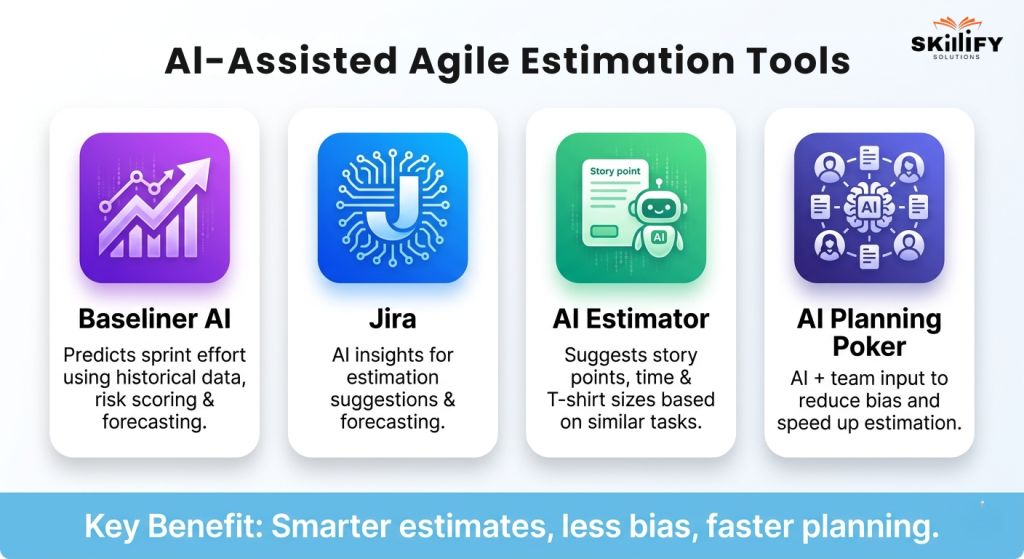
AI tools help Agile teams move from guesswork to data-driven estimation by analyzing past sprint data, velocity patterns, and task complexity. They don’t replace team discussions but provide smarter starting points and predictions for better planning.
Popular AI Estimation Tools in 2026
- Baseliner AI: Predicts sprint effort using historical data, risk scoring, and forecasting models
- Jira (AI integrations and plugins): Uses past sprint data for estimation suggestions and forecasting
- AI Estimator (Jira app): Suggests story points, time, and T-shirt sizes based on similar past tasks
- AI Planning Poker tools: Combine team input with AI suggestions to reduce bias and speed up estimation
AI-assisted estimation improves accuracy by using historical sprint data, reduces bias, and speeds up planning, but it depends heavily on data quality, cannot replace team judgment and context, and over-reliance may lead to missed risks or incorrect assumptions.
To explore this role further, understanding the Release Train Engineer Salary and career path can give you a clearer picture of its importance.
Conclusion
Agile estimation is about building a system your team can trust. When done well, it brings clarity to planning, confidence to commitments, and consistency to delivery.
The techniques we covered are not one-size-fits-all. Some are fast and simple, others are detailed and accurate. The key is to choose what fits your team, your backlog, and your stage of Agile maturity.
From experience, teams that improve estimation don’t just plan better, they execute better. Their sprints become more predictable, their workload more balanced, and their outcomes more reliable.
Start small. Pick one or two techniques, apply them consistently, and refine over time. Because in Agile, better estimation improves everything that follows.
Take your Agile career forward with the industry-recognized SAFe 6.0 Agile Product Management certification today!
Frequently Asked Questions
1. What is story point estimation in Agile?
Story point estimation is a method used to measure the effort, complexity, and uncertainty of a task instead of time. It helps teams estimate work relatively using scales like Fibonacci.
2. Is Planning Poker the best method?
Planning Poker is one of the most popular methods because it reduces bias and encourages team discussion. However, the best method depends on team size, experience, and use case.
3. How do distributed teams estimate?
Distributed teams use online tools like digital Planning Poker or estimation apps to collaborate remotely. They rely on structured discussions and shared visibility.
4. What does velocity mean in Agile?
Velocity is the amount of work a team completes in a sprint, usually measured in story points. It helps predict how much work can be done in future sprints.
5. Can AI estimate stories accurately?
AI can improve estimation by using historical data and patterns, but it cannot fully replace team judgment and context.
6. What is T-shirt sizing in Agile?
T-shirt sizing is a simple estimation method where tasks are categorized as S, M, L, and XL based on effort and complexity instead of numbers.


