 Skip to content
SAFe Value Stream Mapping helps you identify where value slows down and how to improve flow from idea to delivery. It gives you complete visibility into how work moves across teams, systems, and processes.
In most organizations, only 20–30% of the total time is spent on actual work. The remaining time is lost in approvals, handoffs, dependencies, and waiting between steps.
If you feel your team is working fast but delivery is still slow, this is likely your problem. This problem is not because of inefficiency in execution, but because no one had visibility into how work was flowing across the system.
That’s exactly what SAFe® Value Stream Mapping solves. It helps you see where time is actually going, where value is getting stuck, and how to fix it.
In this blog, you’ll learn how to map value streams, measure flow, and improve delivery speed using SAFe® practices in 2026. Because once you see the delay, you can fix it.
What is SAFe Value Stream Mapping?
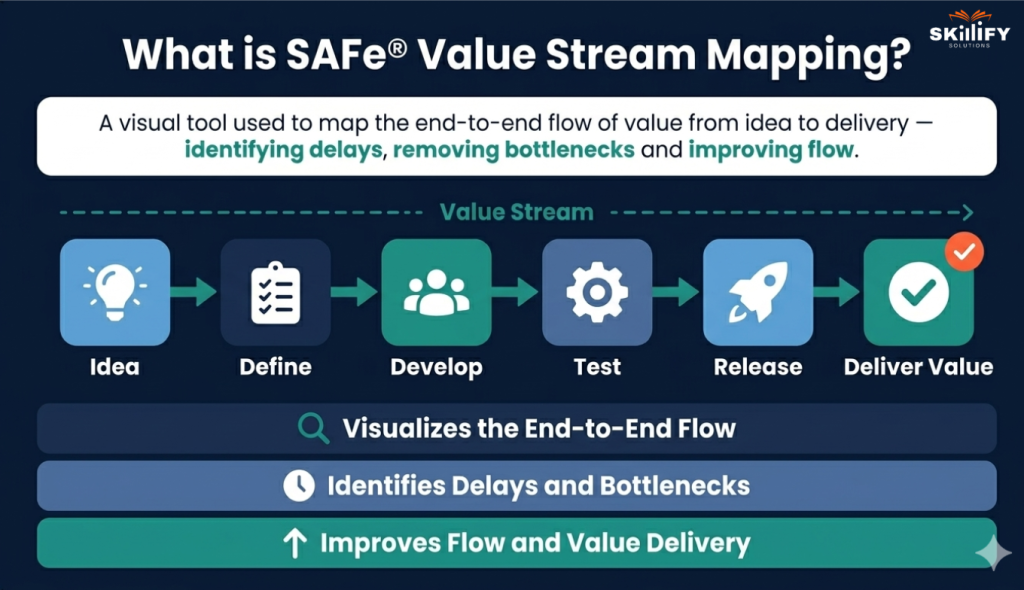
SAFe® Value Stream Mapping (VSM) is a structured method used to visualize how value flows from idea to customer delivery across an organization. The Scaled Agile Framework (SAFe® 6.0), it helps enterprises identify delays, bottlenecks, handoffs, and inefficiencies in their processes.
At its core, VSM answers one simple question: how fast and smoothly does value move through your system?
Instead of focusing only on teams, SAFe® VSM looks at the entire system level, from the delivery request. This makes it critical for large enterprises running multiple teams and Agile Release Trains (ARTs).
If you’re new to SAFe, starting with foundational courses like Leading SAFe® can help you understand how value streams connect with overall business agility and delivery systems.
Value Stream Definition in SAFe® 6.0
In SAFe® 6.0, a value stream is defined as the series of steps an organization uses to deliver value to the customer, from concept to cash.
There are a few important characteristics:
- Starts with a trigger like a customer request, an idea, or a market demand
- Ends with a customer outcome like a product, service, or feature delivered
- Includes both value-adding steps and delays
- Cuts across teams, departments, and systems
This concept is rooted in core SAFe Lean Agile Principles, which focus on improving flow, reducing waste, and delivering value faster across the system.
Types of Value Streams: Operational vs Development
Here’s a clear, practical comparison to understand how both value streams function in SAFe:
| Aspect | Operational Value Stream | Development Value Stream |
| Focus | Deliver value to customers | Build and improve solutions |
| Trigger | Customer request/order | Idea/feature requirement |
| Outcome | Service/product delivered | Working solution/release |
| Teams | Sales, ops, support | Product, engineering, QA |
| Goal | Smooth customer delivery | Faster, continuous delivery |
| Metrics | Delivery time, customer satisfaction | Cycle time, throughput |
Role of Value Streams in Lean Portfolio Management (LPM)
In SAFe Lean Portfolio Management, decisions are made at the business and investment level, not just at the team level. Value Stream Mapping (VSM) helps leaders see how value actually flows across the organization.
Why it matters:
- Improves flow: Finds delays, bottlenecks, and reduces cycle time
- Better investment decisions: Funds high-value streams, not assumptions
- Aligns strategy to execution: Connects business goals with delivery
- Enables faster outcomes: Speeds up idea to customer delivery
Why SAFe® Value Stream Mapping Matters
SAFe® Value Stream Mapping (VSM) is about improving how fast and efficiently value reaches the customer. In large organizations using the Scaled Agile Framework, delays are often hidden across teams, approvals, and systems. VSM makes these gaps visible and actionable.
Why it matters:
- Reveals bottlenecks: Identifies delays, handoffs, and where work gets stuck
- Improves flow speed: Reduces cycle time and enables faster, consistent delivery
- Drives better decisions: Uses real data to prioritize high-impact improvements
- Aligns teams and business goals: Connects strategy with execution
- Boosts productivity: Eliminates waste and improves overall system performance
Deliver customer value faster by mastering prioritization with the SAFe Product Owner Product Manager certification now!
How to Do SAFe® Value Stream Mapping
Value Stream Mapping in the Scaled Agile Framework helps visualize how work flows from idea to delivery, uncovering delays and inefficiencies to improve speed and value delivery.
Step 1: Identify Trigger and Customer Value
Identify what starts the process with the trigger and what value is delivered to the customer (outcome). This ensures clarity on purpose and aligns everyone on the end goal. Always define value from the customer’s perspective, not internal activities.
Step 2: Map Workflow, Delays, and Handoffs
Map all steps involved, including work, delays, and handoffs between teams. This gives a complete view of the flow and highlights inefficiencies. Most delays occur in the waiting time between steps, not the work itself.
Step 3: Measure Flow Metrics
Measure key metrics like cycle time, throughput, and work in progress (WIP) to understand performance. These help uncover inefficiencies and delays. Focus on improving end-to-end flow time, not just individual tasks.
Step 4: Identify Bottlenecks and Improve Flow
Analyze the flow to find where work slows down or gets stuck. These bottlenecks reduce efficiency and speed. Fix the biggest constraint first to create maximum improvement in flow.
Step 5: Align with Agile Release Train (ART)
Ensure teams are aligned through Agile Release Trains for smooth and continuous delivery. Proper alignment reduces delays and improves coordination, leading to faster and more predictable outcomes.
Lead Agile Release Trains effectively and align multiple teams with SAFe RTE certification training now!
SAFe® Value Stream Mapping Example and Template
Understanding Value Stream Mapping becomes easier when you see it in action. In the Scaled Agile Framework, both examples and templates help teams visualize flow, identify delays, and standardize improvements across projects.
Development Value Stream Example
A development value stream shows how a feature moves from idea to delivery, helping teams identify delays and improve flow. Typically, the actual work takes less time than the total cycle, with most delays happening between steps.
| Stage | Activity | Time Taken |
| Idea | Requirement defined | 1 day |
| Backlog | Prioritization | 1 day |
| Development | Coding | 3 days |
| Testing | QA validation | 2 days |
| Deployment | Release | 1 day |
| Wait Time | Between steps | 4-5 days |
Reusable VSM Template for Teams
A reusable template standardizes how teams map value streams, making it easier to compare processes, spot inefficiencies, and track improvements over time.
It ensures everyone follows the same structure, reducing confusion and saving time. This consistency helps teams quickly identify delays, bottlenecks, and opportunities for optimizing flow.
| Element | Description |
| Trigger | What starts the process |
| Steps | Activities involved |
| Wait Time | Delays between steps |
| Handoffs | Team transitions |
| Metrics | Cycle time, throughput, WIP |
| Outcome | Final value delivered |
To go beyond templates and apply this in real-world scenarios, professionals often combine this knowledge with courses like SAFe DevOps Practitioner. This focuses on execution and flow optimization across teams.
SAFe® Value Stream Mapping Tools (2026)
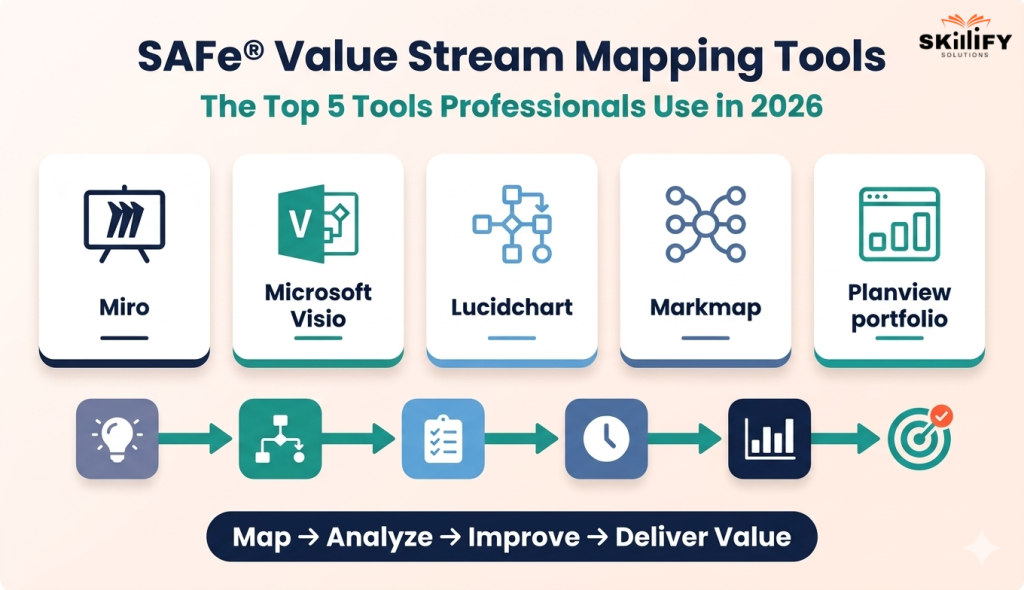
In 2026, organizations use a mix of mapping and management tools to gain clarity, collaborate better, and track performance in real time. These tools help teams identify delays, streamline workflows, and deliver value faster across the system.
1. Miro
Miro is a visual collaboration tool used to create and share value stream maps in real time. It is widely used for remote workshops and brainstorming to visualize workflows.
Key Features
- Drag-and-drop VSM boards
- Real-time collaboration
- Ready-made templates
- Integrations with Jira, Slack
Pricing: Free plan available, with paid team and enterprise plans
2. Lucidchart
Lucidchart is a diagramming tool that helps teams visualize workflows and map value streams clearly. It focuses on process design and collaboration rather than full VSM management.
Key Features
- Interactive value stream maps
- Real-time collaboration
- Easy sharing and presentation
- Integrations with G Suite, Slack
Pricing: Free version available with paid individual and team plans
3. Microsoft Visio
Microsoft Visio is a structured diagramming tool used to create detailed process maps and value stream diagrams. It is ideal for organizations using Microsoft ecosystems.
Key Features
- Professional VSM diagrams
- Pre-built templates
- Microsoft 365 integration
- Data linking capabilities
Pricing: Paid tool and Enterprise licensing available
You can explore the Scaled Agile Framework Tools in detail to help organizations choose the right systems to manage and optimize value streams effectively.
4. Jira Align
Jira Align is an enterprise SAFe® tool that helps organizations track and optimize value flow across teams and portfolios. It goes beyond mapping by providing real-time insights and alignment.
Key Features
- End-to-end value stream visibility
- Real-time flow metrics
- ART alignment
- Deep Jira integration
Pricing: Custom enterprise pricing
5. Asana
Asana is a work management tool that helps teams track workflows and monitor progress across tasks. It can support value stream mapping by visualizing stages and delays.
Key Features
- Task and workflow tracking
- Timeline and board views
- Team collaboration
- Integrations with Slack, Google tools
Pricing: Free plan available with paid premium plans
Value Stream Mapping vs Value Stream Management in SAFe®
In the Scaled Agile Framework, Value Stream Mapping (VSM) and Value Stream Management are closely related but serve different purposes.
Mapping focuses on visualizing the current workflow, while management focuses on continuously improving and optimizing that flow using data and tools. Both are essential for achieving faster and more efficient value delivery.
| Aspect | Value Stream Mapping (VSM) | Value Stream Management |
| Purpose | Visualize and understand workflow | Monitor and optimize flow continuously |
| Focus | Current state process | Ongoing performance improvement |
| Approach | One-time or periodic activity | Continuous, data-driven process |
| Output | Visual map of steps and delays | Insights, metrics, and improvements |
| Tools | Miro, Lucidchart, Visio | Jira Align, VSM platforms |
| Data Usage | Limited, mostly manual | Real-time data and analytics |
| Goal | Identify bottlenecks | Improve flow efficiency over time |
SAFe® Certification for Value Stream Mapping
In the Scaled Agile Framework, Value Stream expertise is closely tied to Lean Portfolio Management (LPM). LPM focuses on aligning strategy, funding, and execution around value streams, making it essential for leaders who want to improve flow and business outcomes at scale.
SAFe® Lean Portfolio Management (LPM)
The SAFe 6.0 Lean Portfolio Manager (LPM) certification equips professionals with the skills to connect business strategy with delivery execution. It teaches how to identify value streams, allocate funding effectively, and measure performance using flow-based metrics.
What you learn:
- Identifying and organizing value streams
- Funding products instead of projects
- Measuring flow like cycle time, throughput
- Aligning teams with business goals
These decisions are guided by Lean thinking, which is why a deeper understanding of SAFe Lean Agile Principles becomes critical for leaders working at the portfolio level.
Leading SAFe® (SAFe® Agilist Certification)
The Leading SAFe Certification is a foundational course that helps professionals understand how to implement SAFe, align teams, and improve value flow across the organization. It is ideal for leaders driving Agile transformation and working with value streams.
What you learn:
- Lean-Agile principles and leadership mindset
- Aligning teams and Agile Release Trains (ARTs)
- Value delivery from strategy to execution
- Lean Portfolio Management and flow optimization
Lead Agile transformation confidently and scale delivery across teams with Leading SAFe Certification!
Conclusion
From the above blog, we can conclude that SAFe® Value Stream Mapping is a practical approach to solving one of the biggest challenges in organizations. It is a slow and inefficient delivery. In this blog, we covered how to map value streams, measure performance, identify bottlenecks, and use the right tools to improve flow.
The key takeaway is that most inefficiencies are hidden in plain sight, within delays, handoffs, and disconnected processes. By making these visible, teams can take focused action and improve continuously.
Certifications and structured frameworks like SAFe® further help in scaling these improvements across the organization. As businesses grow more complex in 2026, the ability to deliver value quickly and consistently becomes a major advantage. Value Stream Mapping is the first step toward achieving that.
Frequently Asked Questions
Q1: Is Value Stream Mapping the same as process mapping?
No. Value Stream Mapping focuses on end-to-end value flow, including delays and wait time, while process mapping mainly shows steps and the sequence of tasks without a deep focus on flow efficiency.
Q2: How often should value streams be reviewed in SAFe?
Value streams should be reviewed regularly, typically every Program Increment (PI) or when there are major changes. Continuous review helps identify new bottlenecks and improve flow.
Q3: What is flow time in SAFe® value stream metrics?
Flow time is the total time taken for work to move from start to finish, including both active work and waiting time. It helps measure how fast value is delivered.
Q4: Can value stream mapping work for non-IT organizations?
Yes. Value Stream Mapping applies to any industry, including manufacturing, healthcare, and services. It helps improve flow and efficiency wherever work moves through a process.
Q5: What SAFe® role is responsible for value stream management?
Value stream management is primarily handled by Lean Portfolio Management (LPM) leaders, along with roles like Business Owners and Release Train Engineers. They ensure alignment, funding, and flow optimization across value streams.


