Skip to content
Key Highlights of SAFe RTE Interview Questions and Answers
- SAFe RTE interview questions covering essential role and ART responsibilities
- Release Train Engineer interview questions and answers with practical scenarios
- SAFe RTE interview questions 2026 covering emerging AI-focused topics
- RTE behavioral interview questions using practical STAR-based answers
- RTE interview questions PI planning focused on real-world challenges
- SAFe RTE scenario interview questions covering complex ART situations
Passing an RTE Certification and succeeding in an RTE interview are two different challenges. Certification can test whether you understand SAFe concepts. An interview can ask what you would do when those concepts collide with reality.
Imagine an ART where teams consistently overcommit, Product Management changes priorities mid-PI, dependencies keep returning, and leadership wants faster delivery. There is rarely one textbook answer. The interviewer is watching how you assess the situation, facilitate alignment, involve the right people, and drive improvement.
That is the mindset behind these 50+ SAFe RTE interview questions and answers for 2026. We cover role responsibilities, PI Planning, dependencies, ROAM, Flow Metrics, PI Predictability, servant leadership, stakeholder and executive management, case studies, and AI-enabled RTE scenarios. Use this blog to sharpen not just what you answer, but how you think through an RTE problem.
What Interviewers Look for in an RTE
RTE interviews test more than SAFe knowledge. Interviewers assess how well you facilitate ART events, manage dependencies, resolve impediments, align stakeholders, and support continuous improvement in real-world situations.
5 Core RTE Competencies Interviewers Assess
- ART Facilitation: Effectively facilitate PI Planning and ART events.
- Servant Leadership: Coach teams and stakeholders without taking away autonomy.
- Dependency Management: Resolve cross-team dependencies and impediments.
- Metrics and Improvement: Use flow and predictability of metrics to improve ART performance.
- Stakeholder Alignment: Build alignment across Product Management, teams, Business Owners, and leadership.
Why Practical SAFe Knowledge Matters
RTE interviews focus on practical applications. Instead of simply defining PI Planning, ROAM, or ART events, explain how you would handle conflicts, dependencies, risks, changing priorities, and stakeholder challenges.
What Makes a Strong RTE Interview Answer?
A strong answer is specific, practical, and aligned with the RTE’s servant-leader role. Identify the problem, explain your facilitation approach, involve the right stakeholders, and show the expected outcome.
RTE Role and Responsibilities Interview Questions
If you’re building a stronger foundation in enterprise-level SAFe practices, the Leading SAFe 6.0 course can help connect ARTs, teams, and business objectives.
1. What does a Release Train Engineer do, and how is the RTE different from a Scrum Master?
Expert Answer: An RTE is a servant leader who facilitates an Agile Release Train, coordinates teams, manages dependencies and impediments, and supports value delivery. A Scrum Master primarily serves one Agile team, while an RTE works across the ART to improve alignment, flow, and collaboration.
What the interviewer is testing: Your understanding of the RTE’s scope, responsibilities, and servant-leadership role. If you’re comparing these two career paths in more detail, our guide on Release Train Engineer vs Scrum Master explains their responsibilities, scope, and career differences.
2. How do you prioritize your time when multiple ART teams need your help?
Expert Answer: I prioritize issues based on their impact on the ART, business value, dependencies, and urgency. I first address blockers affecting multiple teams or critical objectives, then support team-level concerns through coaching and delegation. I also encourage teams and Scrum Masters to resolve issues independently whenever possible rather than making the ART dependent on me.
What the interviewer is testing: Prioritization, delegation, facilitation, and servant leadership.
3. Describe your experience with PI Planning and your responsibilities as an RTE.
Expert Answer: I prepare the ART for PI Planning by coordinating logistics, stakeholders, priorities, and readiness. During planning, I facilitate collaboration, manage dependencies and risks, support alignment around PI Objectives, and keep discussions focused.
Afterward, I help track commitments, address impediments, and ensure outcomes from planning translate into effective PI execution. The SAFe Product Owner/Product Manager 6.0 course can strengthen your understanding of the product side of the ART.”
What the interviewer is testing: Your practical understanding of PI Planning and RTE responsibilities before, during, and after the event.
4. What is the difference between an RTE and an SPC?
Expert Answer: An RTE focuses primarily on facilitating and coordinating an ART, supporting teams, managing flow, and driving execution. An SPC, or SAFe Practice Consultant, has a broader role in enabling and coaching organizations through SAFe adoption and transformation. An RTE operates at the ART level, while an SPC can work across organizational transformation initiatives.
What the interviewer is testing: Your understanding of SAFe roles and their different organizational scopes. If you’re new to SAFe credentials, understanding What is SAFe Certification can help you see how different certifications fit into your career path.
5. What are the key ART events, and what role does the RTE play in each?
Expert Answer: Key ART events include PI Planning, Scrum of Scrums, PO Sync, System Demo, and Inspect & Adapt. I facilitate these events, create alignment, surface dependencies and impediments, encourage collaboration, and ensure follow-up actions are owned. My role is to enable the ART to continuously inspect progress, adapt plans, and improve value delivery.
What the interviewer is testing: Your knowledge of ART events and ability to facilitate them effectively.
Ready to lead high-performing ARTs? Build practical SAFe expertise with Leading SAFe 6.0 training and certification.
PI Planning Interview Questions and Scenarios
6. What would you do if PI Planning is running behind schedule?
Expert Answer: I would identify what is causing the delay, refocus discussions on critical priorities, and timebox remaining activities. I would avoid rushing important decisions and ensure dependencies, risks, and PI Objectives are addressed. If necessary, I would facilitate smaller discussions while keeping the overall ART aligned.
What the interviewer is testing: Facilitation, time management, and decision-making under pressure.
7. How would you handle a key Business Owner who does not attend PI Planning?
Expert Answer: I would first understand the reason for their absence and ensure another authorized stakeholder can provide business context and guidance. I would document decisions requiring their input and arrange follow-up as quickly as possible. I would also address the participation issue before the next PI Planning event.
What the interviewer is testing: Stakeholder management, escalation, and maintaining business alignment.
8. What would you do if teams overcommit during PI Planning?
Expert Answer: I would facilitate a discussion around actual capacity, historical performance, dependencies, and priorities. Rather than deciding what teams should remove, I would help teams and Product Management negotiate scope and sequencing. The goal is to establish realistic commitments while preserving the most valuable outcomes.
What the interviewer is testing: Facilitation, capacity awareness, and ability to challenge unrealistic commitments.
9. How would you resolve an unresolved dependency between two teams during PI Planning?
Expert Answer: I would make the dependency visible, bring the affected teams and relevant Product Owners together, and clarify ownership, timing, and impact. I would facilitate an agreement on sequencing or an alternative solution. If it cannot be resolved within the ART, I would escalate it through the appropriate channel.
What the interviewer is testing: Dependency management, collaboration, ownership, and escalation judgment.
10. What would you do if Product Management did not provide a clear vision before PI Planning?
Expert Answer: I would raise the gap before planning and work with Product Management, Business Owners, and relevant stakeholders to clarify priorities, business outcomes, and context. If some uncertainty remains, I will help teams identify assumptions and risks rather than allowing planning to proceed on unclear priorities.
What the interviewer is testing: Readiness assessment, stakeholder alignment, and facilitation judgment.
RTE Dependency, Risk, and Impediment Management Questions
11. How do you identify and manage cross-team dependencies?
Expert Answer: I identify dependencies during PI Planning and make them visible on the Program Board. I clarify ownership, timing, and impact, then track them throughout the PI and escalate blockers when necessary.
The SAFe Big Picture can also help you visualize how teams, ART roles, and coordination points connect across the framework.
What the interviewer is testing: Dependency management and ownership.
12. What would you do when a dependency involves a team outside your ART?
Expert Answer: I would connect the teams, clarify the dependency and delivery expectations, and establish ownership. If the dependency threatens PI Objectives and cannot be resolved directly, I will involve the appropriate stakeholders and escalate it.
What the interviewer is testing: Cross-team collaboration and escalation judgment.
13. How do you use ROAM to manage PI risks?
Expert Answer: I use ROAM to make risks visible and assign appropriate responses:
| ROAM | Response |
| Resolved | Risk is eliminated |
| Owned | Someone accepts responsibility |
| Accepted | Risk is acknowledged |
| Mitigated | Actions reduce its impact or probability |
What the interviewer is testing: Practical risk management knowledge.
14. What would you do if a PI risk becomes a major impediment mid-PI?
Expert Answer: I would assess its impact, bring the right stakeholders together, establish ownership, and agree on immediate actions. If the ART cannot resolve it internally, I would escalate it through the appropriate channel.
What the interviewer is testing: Impediment management and escalation.
15. How do you prevent recurring dependency problems across multiple PIs?
Expert Answer: I would analyze recurring dependency patterns to identify their systemic causes. During Inspect and Adapt, I would turn findings into improvement actions, assign ownership, and track whether the changes reduce dependency issues in future PIs.
What the interviewer is testing: Systemic problem-solving and continuous improvement.
RTE Behavioral and Servant Leadership Interview Questions
16. Tell me about a time you coached a resistant Scrum Master.
Expert Answer: I would first understand the Scrum Master’s concerns rather than imposing a solution. I would use coaching questions, explain the impact of the behavior, and agree on a small improvement to try. I would then follow up and provide feedback based on observed results.
If your RTE path involves deeper coaching and facilitation skills, consider the SAFe Advanced Scrum Master 6.0 course for advanced Scrum and team-coaching capabilities.
What the interviewer is testing: Coaching, empathy, and servant leadership.
17. Describe a situation where you had to give difficult feedback to a Business Owner.
Expert Answer: I would keep the conversation factual and focused on business impact rather than personal behavior. I would explain the situation, listen to their perspective, and agree on specific actions. My goal would be to maintain the relationship while addressing the issue affecting ART alignment or delivery.
What the interviewer is testing: Communication, courage, and stakeholder management.
18. Tell me about a time when an ART failed to meet its PI Objectives. What did you do?
Expert Answer: I would avoid assigning blame and facilitate an objective review of what happened. I would examine dependencies, capacity, priorities, risks, and execution issues, then identify improvement actions with the teams and stakeholders.
What the interviewer is testing: Accountability, facilitation, and continuous improvement.
19. How did you rebuild trust after repeated PI performance problems?
Expert Answer: I would rebuild trust through transparency, consistent communication, and measurable improvements. I would identify the underlying problems with the ART, agree on realistic actions, and regularly communicate progress. Delivering a few visible improvements consistently can help restore stakeholder confidence.
What the interviewer is testing: Leadership, transparency, and relationship building.
20. Describe a conflict between Product Management and Architecture that you had to facilitate.
Expert Answer: I would bring both sides together to clarify business outcomes, technical constraints, and the impact of each option. Rather than choosing a side, I would facilitate evidence-based discussion and help the stakeholders reach an aligned decision.
What the interviewer is testing: Conflict resolution and facilitation.
21. Tell me about a time you helped an underperforming team without taking away its autonomy.
Expert Answer: I would first help the team identify the underlying issue instead of prescribing the solution. I would use coaching, metrics, and targeted support while allowing the team to own its improvement plan. I would then monitor progress and adjust support based on results.
What the interviewer is testing: Servant leadership, coaching, and empowerment.
22. Describe a situation where you influenced stakeholders without having direct authority.
Expert Answer: I would build influence through relationships, transparency, data, and shared objectives. I would understand each stakeholder’s concerns, connect the issue to business outcomes, and facilitate agreement rather than relying on positional authority.
What the interviewer is testing: Influence, communication, and stakeholder management.
Behavioral Answer Structure
Use the STAR and Lesson approach:
| Element | What to Cover |
| Situation | Set the context |
| Task | Explain your responsibility |
| Action | Describe what you personally did |
| Result | Show the measurable outcome |
| Lesson | Explain what you learned |
Prepare for complex ART challenges and strengthen facilitation skills through SAFe Advanced Scrum Master 6.0 training.
RTE Metrics, Flow, and Continuous Improvement Questions
23. Which metrics do you track as an RTE, and how often do you review them?
Expert Answer: I Track flow, predictability, quality, and delivery metrics to understand ART health. I review key indicators regularly during PI execution and use deeper analysis during Inspect & Adapt. I focus on trends rather than isolated numbers.
What the interviewer is testing: Your ability to use metrics for informed ART decisions.
24. What would you do if Flow Efficiency suddenly declined?
Expert Answer: I would investigate where work is spending more time waiting rather than immediately assuming team productivity has declined. I would examine bottlenecks, dependencies, handoffs, approvals, and WIP.
Then I will work with teams to identify the root cause and remove systemic constraints. Improving flow becomes easier when you understand how these practices fit into the wider SAFe Methodology.
What the interviewer is testing: Flow thinking and systemic problem-solving.
25. How do you use PI Predictability to improve future planning?
Expert Answer: I compare planned and actual business value to understand how reliably the ART delivers against its objectives. If predictability is consistently low, I investigate factors such as overcommitment, dependencies, changing priorities, and capacity before improving future planning assumptions.
What the interviewer is testing: Metrics interpretation and realistic planning.
26. How do you turn Inspect and Adapt findings into measurable improvements?
Expert Answer: I convert findings into specific improvement actions with clear ownership and measurable outcomes. I prioritize systemic issues, agree on actions with the ART, and track progress in the following PI to determine whether the changes actually improved performance.
What the interviewer is testing: Continuous improvement and accountability.
27. Which SAFe flow metrics are most useful for evaluating ART health?
Expert Answer: I look at the six SAFe Flow Metrics together: Flow Velocity, Flow Time, Flow Load, Flow Efficiency, Flow Distribution, and Flow Predictability. Together, they show how much work is moving, how long it takes, where capacity is going, and how predictably value is delivered.
What the interviewer is testing: Understanding of SAFe Flow Metrics and ART performance.
28. How would you use DORA metrics alongside SAFe flow metrics?
Expert Answer: I would use SAFe Flow Metrics to understand ART-level value flow and DORA metrics to evaluate software delivery performance. Looking at both helps identify whether improvements in planning and flow are translating into faster, more stable software delivery.
What the interviewer is testing: Ability to connect ART flow with engineering outcomes.
AI and AI-Empowered RTE Interview Questions for 2026
AI-related RTE questions are an emerging 2026 interview area. Focus on how AI can support ART planning, decision-making, and delivery while keeping human judgment and accountability central.
29. How could AI assist an RTE during PI Planning?
Expert Answer: AI can help analyze historical data, identify dependencies, summarize priorities, and flag capacity concerns. I would use these insights to support planning discussions, while teams and stakeholders validate recommendations before making commitments.
What the interviewer is testing: Practical AI adoption and judgment.
30. How would you validate an AI-generated dependency map?
Expert Answer: I would treat the map as a starting point and validate it with the affected teams and Product Owners. I would check whether the underlying data is current and confirm:
- Dependency ownership
- Required timing
- Delivery impact
- Team capacity
What the interviewer is testing: AI validation and collaboration.
31. What would you do if AI-generated recommendations conflict with team capacity?
Expert Answer: I would prioritize actual team capacity and delivery constraints over an AI recommendation. I would review the assumptions behind the recommendation with the team and adjust the plan based on evidence.
| AI Recommendation | RTE Response |
| Matches capacity | Validate and consider |
| Exceeds capacity | Reassess scope |
| Conflicts with constraints | Investigate assumptions |
What the interviewer is testing: Human judgment and responsible AI use.
32. How should an RTE evaluate AI-generated PI objectives or planning recommendations?
Expert Answer: I would check whether they align with business priorities, capacity, dependencies, technical constraints, and measurable outcomes. Relevant stakeholders should validate the recommendations before they become ART commitments.
What the interviewer is testing: Critical evaluation and governance. RTEs working closely with product strategy can also benefit from SAFe Agile Product Management 6.0 to better connect customer needs, product decisions, and value delivery.
33. What role should human judgment play when AI is used in ART planning?
Expert Answer: Human judgment should remain central. AI can identify patterns and provide recommendations, but RTEs and stakeholders understand organizational context, team dynamics, business priorities, and risks that AI may miss.
What the interviewer is testing: Responsible AI leadership.
34. How would you explain AI governance to nontechnical Business Owners?
Expert Answer: I would explain AI governance in practical terms: ensuring AI is used responsibly, transparently, and within agreed boundaries. I would focus on:
- Data privacy
- Accuracy
- Bias
- Accountability
- Human oversight
35. What risks should RTEs consider when using AI for ART-level decision-making?
Expert Answer: I would consider inaccurate outputs, biased recommendations, outdated data, privacy concerns, and overreliance on automation. Important ART decisions should have appropriate human review and clear accountability.
What the interviewer is testing: AI risk awareness.
36. Which RTE responsibilities should AI augment rather than replace?
Expert Answer: AI can augment reporting, data analysis, dependency discovery, risk identification, and planning insights. It should not replace facilitation, coaching, conflict resolution, stakeholder relationships, or decisions requiring human context and accountability.
What the interviewer is testing: Understanding of AI’s appropriate role in RTE work.
RTE Stakeholder and Executive Management Interview Questions
37. How would you explain ART health to a CTO focused primarily on feature delivery?
Expert Answer: I would connect ART health to business outcomes rather than feature counts alone. I would use flow, predictability, quality, dependencies, and delivery trends to explain how effectively the ART is delivering sustainable value.
What the interviewer is testing: Executive communication and outcome-focused thinking.
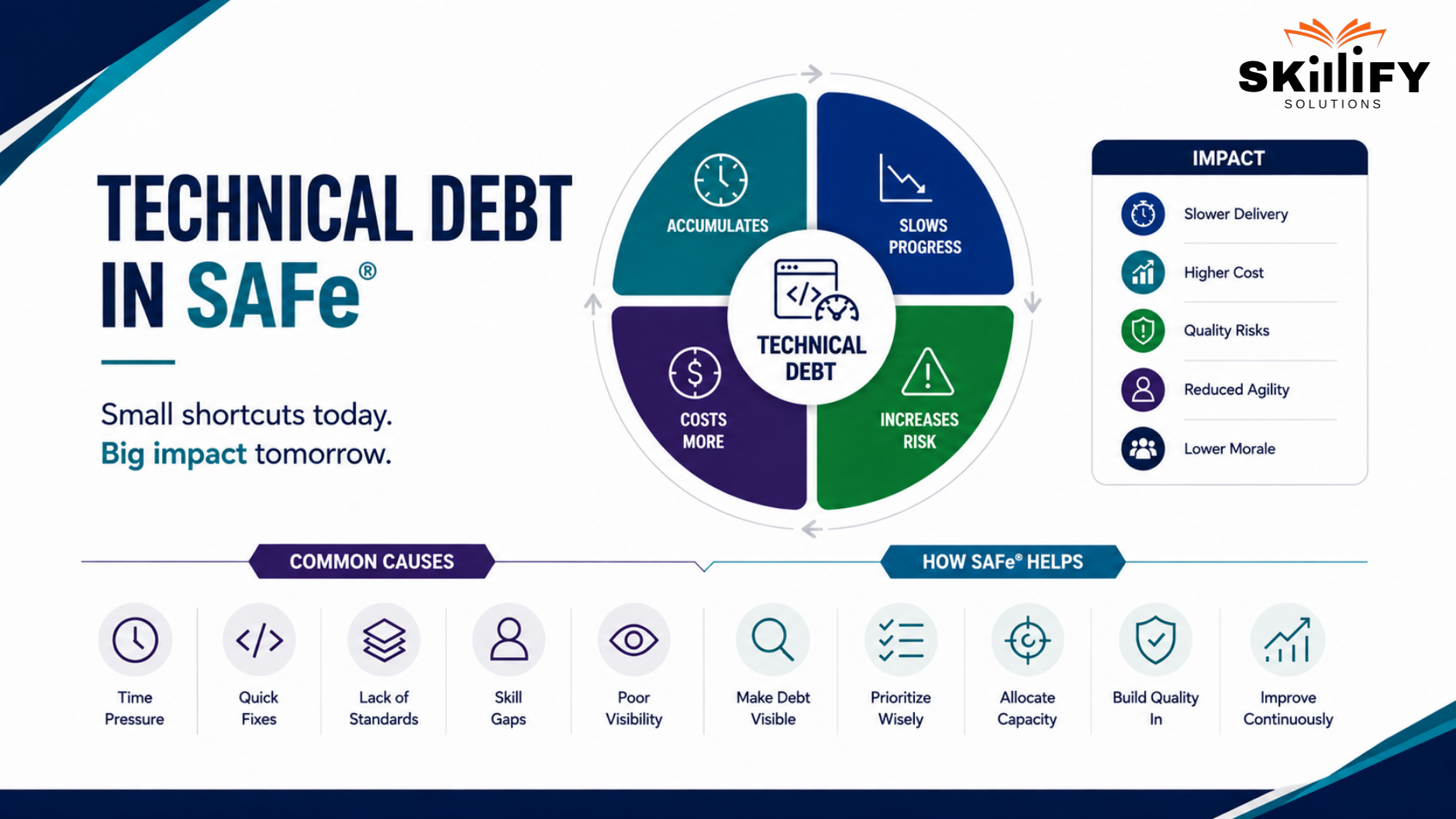
38. How would you justify technical debt capacity to a CPO who wants more features?
Expert Answer: I would explain technical debt through its business impact, such as slower delivery, increased defects, or reduced future capacity. I would use evidence to show why addressing critical technical debt supports sustainable feature delivery.
What the interviewer is testing: Business communication and prioritization.
39. What would you do if a portfolio leader wanted to add another team to the ART mid-PI?
Expert Answer: I would first understand the business’s need and assess its impact on capacity, dependencies, priorities, and existing PI Objectives. I would facilitate a discussion with relevant stakeholders before making any changes.
For RTEs working with portfolio leaders and executives, SAFe Lean Portfolio Management 6.0 provides a useful foundation for connecting strategy, investment decisions, and execution.
What the interviewer is testing: Change management and systems thinking.
40. How would you handle an executive who bypasses ART priorities?
Expert Answer: I understand the urgency, make the impact on existing priorities visible, and involve the appropriate Product Management and Business Owners. I would facilitate transparent trade-offs rather than simply rejecting the request.
What the interviewer is testing: Stakeholder management and influence.
41. How do you communicate an ART’s poor performance to senior leadership?
Expert Answer: I would be transparent and use relevant metrics to explain the situation, business impact, underlying causes, and improvement actions. I would focus on facts and solutions rather than assigning blame.
What the interviewer is testing: Executive communication and accountability.
42. What would you do if Product Management and Engineering disagree on priorities?
Expert Answer: I would facilitate a discussion around business value, technical constraints, risks, and customer outcomes. I would help the appropriate decision makers reach alignment rather than choosing a side myself.
This type of cross-functional facilitation also highlights an important distinction between the RTE and Scrum Master roles covered in Release Train Engineer vs Scrum Master.
What the interviewer is testing: Conflict resolution and facilitation.
43. How do you handle stakeholders who repeatedly introduce unplanned work?
Expert Answer: I would make the impact on capacity and flow visible and discuss the pattern with relevant stakeholders. I would establish clearer prioritization and intake practices while ensuring urgent work involves transparent trade-offs.
What the interviewer is testing: Flow management and stakeholder influence.
44. How would you build trust with executives who are skeptical of SAFe?
Expert Answer: I would listen to their concerns and avoid defending SAFe through theory alone. Instead, I would use ART data, demonstrate measurable improvements, communicate challenges honestly, and connect SAFe practices to business outcomes.
What the interviewer is testing: Credibility and executive relationship management.
45. What would you do after inheriting an ART that has missed PI Objectives for three consecutive PIs?
Expert Answer: I would assess priorities, capacity, dependencies, flow, risks, and stakeholder alignment to identify systemic causes. I would then prioritize improvement actions, assign ownership, and measure progress across future PIs.
If you’re evaluating RTE as a career option, exploring Release Train Engineer Salary can give you a better idea of the role’s earning potential.
What the interviewer is testing: Diagnosis, leadership, and continuous improvement.
RTE Case Study and Situational Interview Questions
46. Your ART enters PI Planning with unclear priorities, missing Business Owners, and unresolved dependencies. What do you do?
Expert Answer: I would identify which gaps are blocking effective planning, engage available decision-makers, clarify critical priorities, and make dependencies visible. I would facilitate focused discussions and escalate decisions that cannot be resolved within the planning window.
What the interviewer is testing: Facilitation under pressure and stakeholder management.
47. Your ART has missed its PI Objectives for three consecutive PIs. How would you diagnose the underlying problem?
Expert Answer: I would analyze trends across capacity, predictability, flow, dependencies, priorities, and risks. I would involve teams and stakeholders to validate the findings, identify systemic causes, and turn them into measurable improvement actions.
What the interviewer is testing: Root-cause analysis and continuous improvement.
48. Two teams blame each other for a critical dependency failure. How would you facilitate resolution?
Expert Answer: I would bring both teams together, establish the facts, clarify ownership, and focus the discussion on resolution rather than blame. I would agree on immediate actions and then address the underlying process issue.
What the interviewer is testing: Conflict resolution and servant leadership. For candidates interested in connecting ART flow with delivery practices, SAFe DevOps 6.0 provides a relevant next step
49. A senior executive asks a team to prioritize urgent work that was not included in the PI. How would you respond?
Expert Answer: I acknowledge the urgency and make the impact on existing PI priorities and capacity visible. I would involve Product Management and relevant Business Owners to evaluate the trade-off and communicate any priority change transparently.
What the interviewer is testing: Executive communication and prioritization.
50. Teams are meeting sprint commitments, but ART-level outcomes and predictability are declining. What would you investigate?
Expert Answer: I would investigate whether teams are optimizing local commitments while broader outcomes suffer. I would examine dependencies, changing priorities, scope, flow, PI Objectives, and predictability to identify the gap between team-level and ART-level performance.
What the interviewer is testing: Systems thinking and metric interpretation.
How to Structure Your Answer to an RTE Case Study
Use a simple four-step approach:
| Step | Focus |
| Situation | Identify the core problem |
| Assessment | Analyze causes, impact, and stakeholders |
| Action | Explain what you would facilitate or change |
| Result | Show the expected business or ART outcome |
As AI becomes part of enterprise delivery, the Leading SAFe 6.0 course offers a natural learning path for understanding AI-enabled SAFe practices alongside broader business agility.
How to Structure Your Answer to an RTE Case Study
Use a simple structure to keep case-study answers focused:
- Identify the core ART challenge.
- Assess impact, stakeholders, dependencies, and risks.
- Explain the actions you would facilitate as an RTE.
- End with the expected business or ART outcome.
How to Answer RTE Behavioral Questions Using STAR
- Situation: Briefly describe the ART, team, or stakeholder challenge you faced.
- Task: Explain your responsibility and what you need to achieve.
- Action: Describe the specific steps you took as an RTE, including coaching, facilitation, communication, or escalation.
- Result: Highlight the outcome, preferably with measurable improvements.
- Lesson: Share what you learned and how it influenced your future approach.
How to Prepare for a SAFe RTE Interview
If structured learning is part of your preparation plan, comparing SAFe RTE Training Providers can help you find training suited to your experience and career goals.
- Review core SAFe principles and RTE responsibilities.
- Practice PI Planning and ART event scenarios.
- Prepare examples involving conflict, risks, dependencies, and impediments.
- Revise SAFe Flow Metrics and PI Predictability.
- Practice behavioral answers using STAR.
- Prepare for emerging AI-related RTE scenarios.
Questions to Ask the Interviewer About the ART
- What is the current maturity level of ART?
- How many teams and stakeholders participate in the ART?
- What are the ART’s biggest current challenges?
- How does the organization measure ART success?
- How are dependencies and impediments currently managed?
- What would you expect the RTE to accomplish in the first 90 days?
SAFe RTE Interview Preparation Checklist
| Area | Prepare |
| RTE Role | Responsibilities and servant leadership |
| PI Planning | Facilitation, dependencies, and objectives |
| ART Events | Key events and RTE responsibilities |
| Risks | ROAM, impediments, and escalation |
| Metrics | Flow Metrics and PI Predictability |
| Behavioral | STAR-based examples |
| AI | AI-assisted planning and governance |
| Case Studies | Real-world ART scenarios |
| Stakeholders | Executive communication and conflict resolution |
| Final Review | Organization and role research |
Conclusion
A strong SAFe RTE interview requires more than knowing SAFe terminology. You need to demonstrate practical judgment, facilitation skills, servant leadership, and the ability to manage dependencies, risks, metrics, and stakeholders.
The 50+ questions in this guide cover key RTE responsibilities, PI Planning, ART events, Flow Metrics, behavioral situations and more. Use STAR for behavioral questions and focus on real-world problem-solving for scenarios.
With consistent practice and a clear understanding of the RTE role, you can approach your interview with greater confidence and demonstrate that you are ready to lead and support an ART effectively.
Connect strategy with execution and strengthen enterprise decision-making through SAFe Lean Portfolio Management 6.0 training.