 Skip to content

Agile Software Development is what happens when companies stop treating software like a factory assembly line. Instead of planning everything up front and hoping nothing changes, Agile helps teams adapt continuously while building products faster and more efficiently.
And honestly, that adaptability matters more in 2026 than ever before. Today, products evolve weekly. AI tools change workflows overnight. Customer expectations shift constantly.
In this environment, traditional development methods often become too slow. That’s why companies, from startups to enterprises, rely heavily on Agile frameworks like Scrum, Kanban, and SAFe.
For Agile teams, the biggest advantage isn’t just speed. It’s visibility. Everyone knows what’s being built, what’s delayed, and what needs improvement. That level of transparency changes how teams collaborate entirely.
In this blog, we’ll break down Agile software development step-by-step. You will learn the Agile Manifesto, Scrum, Kanban, SAFe, sprint cycles, certifications, and how Agile works inside real software teams today. Read below to learn more!
What is Agile Software Development?
Agile software development is a flexible and iterative approach to building software. Instead of delivering a product all at once, Agile teams develop software in smaller cycles called sprints. It allows faster releases, continuous feedback, and regular improvements.
Agile was created to solve the problems of traditional software development methods like Waterfall, where teams often spent months or years building software before users could even test it. In many cases, changing customer requirements, delayed feedback, and long development cycles caused projects to fail or exceed budgets.
The origins of Agile date back to 2001, when 17 software developers met in Snowbird, Utah, to discuss better ways of developing software. This meeting led to the creation of the Agile Manifesto, which introduced a new mindset for software development focused on adaptability, people, and working software instead of rigid processes and documentation.
Today, Agile is used by startups, product companies, SaaS businesses, and large enterprises worldwide. As Agile adoption continues growing across industries, professionals are also upgrading their Agile skills through Leading SAFe certifications. They are focused on modern Agile and enterprise workflows.
The Agile Manifesto
The Agile Manifesto is the foundation of Agile software development. It was published in 2001 by a group of software experts who wanted a more efficient and human-centered way to build software.
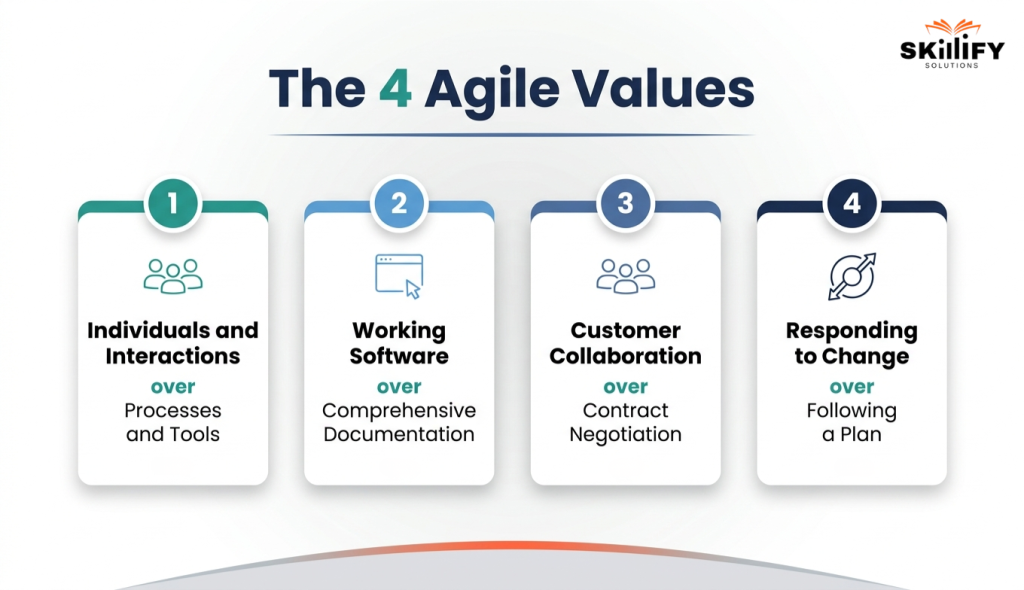
The manifesto introduced four core values:
- Individuals and interactions over processes and tools
- Working software over comprehensive documentation
- Customer collaboration over contract negotiation
- Responding to change by following a plan
These values shifted the focus from rigid planning and heavy documentation to teamwork, customer feedback, and continuous improvement. The manifesto also defined 12 Agile principles that guide Agile teams even today. These principles emphasize:
- Early and continuous software delivery
- Welcoming changing requirements
- Frequent collaboration between developers and business teams
- Sustainable development pace
- Continuous technical improvement
- Simplicity and adaptability
These principles later evolved into what many organizations now call the Lean Agile Mindset. Here teams focus on adaptability, collaboration, customer value, and continuous learning.
Agile vs Waterfall: Key Differences Explained
Here’s a quick comparison between Agile and Waterfall to understand how both software development approaches differ. The table below highlights their key differences in process, flexibility, delivery, and customer involvement.
| Feature | Agile | Waterfall |
| Approach | Iterative and flexible | Sequential and fixed |
| Delivery | Frequent releases | One final release |
| Customer Feedback | Continuous | Mostly at the end |
| Handling Changes | Easy to adapt | Difficult to change |
| Best For | Dynamic projects | Fixed-scope projects |
Master real-world Agile workflows with practical and leading SAFe certification programs now!
How Agile Software Development Works
Agile software development works through short development cycles called sprints. Each sprint usually lasts one to four weeks and focuses on delivering a small, working part of the product.
This cycle helps teams release software faster, collect feedback continuously, and improve with every iteration.
The Agile Sprint Cycle Explained
Each Agile sprint includes a few important activities that keep the team aligned and productive. These meetings help Agile teams stay collaborative, transparent, and focused on continuous improvement.
| Agile Activity | Purpose |
| Sprint Planning | Decide what work will be completed in the sprint |
| Daily Standup | Short daily meeting to track progress and blockers |
| Sprint Review | Demonstrate completed work and collect feedback |
| Sprint Retrospective | Discuss what went well and what can be improved |
Key Agile Roles
Agile teams have clearly defined roles that help manage delivery and collaboration. Together, these roles help teams deliver software efficiently within each sprint.
| Role | Responsibility |
| Product Owner | Manages product goals and prioritizes tasks |
| Scrum Master | Ensures Agile processes are followed and removes blockers |
| Development Team | Designs, develops, and tests the software |
Professionals looking to move into Scrum Master roles often start with structured training programs like the Scrum Master Bootcamp with AI. It covers sprint planning, standups, retrospectives, and AI-powered Agile workflows used in modern teams.
Product Backlog vs Sprint Backlog
Agile teams use two important task lists to manage work during development. The product backlog is continuously updated based on business needs and customer feedback, while the sprint backlog focuses only on the work planned for the current sprint.
| Backlog Type | Purpose |
| Product Backlog | Master list of all product features, fixes, and requirements |
| Sprint Backlog | Tasks selected from the product backlog for the current sprint |
This continuous prioritization process plays a major role in Agile Product Management. Here product teams align sprint goals with customer and business requirements.
Top Agile Frameworks Compared
Different Agile frameworks are designed for different types of teams and projects. Some focus on sprint-based delivery, while others prioritize workflow management, technical practices, or enterprise-scale coordination.
| Framework | Best For | Key Focus | Working Style |
| Scrum | Product and software teams | Sprint-based delivery | Iterative sprints |
| Kanban | Opeerations and support teams | Continuous workflow | Visual task flow |
| SAFe® | Large enterprises | Scaling Agile across teams | Multi-team coordination |
| XP | Development teams | Code Quality and engineering practices | Continuous improvement |
1. Scrum
Scrum is the most widely used Agile framework for software and product development teams. It works through short sprints, usually lasting 1–4 weeks, where teams deliver small parts of the product continuously.
Scrum focuses heavily on teamwork, sprint planning, reviews, and regular feedback. For beginners entering Agile teams, certifications like SAFe 6.0 Scrum Master help build practical Scrum knowledge through real sprint simulations and Agile project workflows.
2. Kanban
Kanban is an Agile framework focused on continuous task flow instead of fixed sprints. Teams use visual boards to track work across different stages like “To Do,” “In Progress,” and “Done.” Kanban is commonly used by support, operations, and maintenance teams that handle ongoing tasks.
3. SAFe®
Scaled Agile Framework (SaFe) helps large organizations apply Agile practices across multiple teams and departments. It introduces structured planning, coordination, and alignment between business and technical teams, making it suitable for enterprise-scale projects.
Enterprise Agile environments commonly rely on leading SAFe® certifications from Skillify Solutions. This is to train leaders and Agile teams working across multiple departments.
4. Extreme Programming (XP)
Extreme Programming (XP) is an Agile framework focused on improving software quality and development practices. It emphasizes continuous testing, pair programming, frequent releases, and close collaboration between developers and customers. XP is mainly used by highly technical development teams.
Upskill faster with our SAFe 6.0 Advanced Scrum Master certifications designed for real enterprise environments today!
Agile Software Development in Practice
Agile works differently depending on the size of the organization. Small teams usually follow simple sprint-based workflows, while large enterprises use scaled Agile frameworks to coordinate multiple teams working together.
Agile at Team Level
At the team level, Agile usually involves a single Scrum team working on one product through short sprints. The team plans tasks, develops features, tests software, and collects feedback within each sprint cycle.
| Team-Level Agile Components | Purpose |
| Scrum Team | Small cross-functional development team |
| Sprint | Short development cycle (1–4 weeks) |
| Daily Standup | Tracks progress and blockers |
| Sprint Review | Demonstrates completed work |
| Retrospective | Improves future sprint performance |
Agile at Enterprise Scale
Large organizations use enterprise Agile frameworks like SAFe® to coordinate multiple Agile teams working on larger products and systems. Teams are grouped into Agile Release Trains (ARTs), which align planning and delivery across departments.
| Enterprise Agile Components | Purpose |
| Agile Release Train (ART) | Multiple Agile teams working together |
| Program Increment (PI) | Large planning cycle across teams |
| SAFe® Framework | Scales Agile practices organization-wide |
| Cross-Team Planning | Aligns business and development goals |
Professionals managing enterprise Agile transformation often pursue certifications like SAFe POPM to better handle large-scale Agile delivery and AI-driven product workflows.
Benefits of Agile Software Development
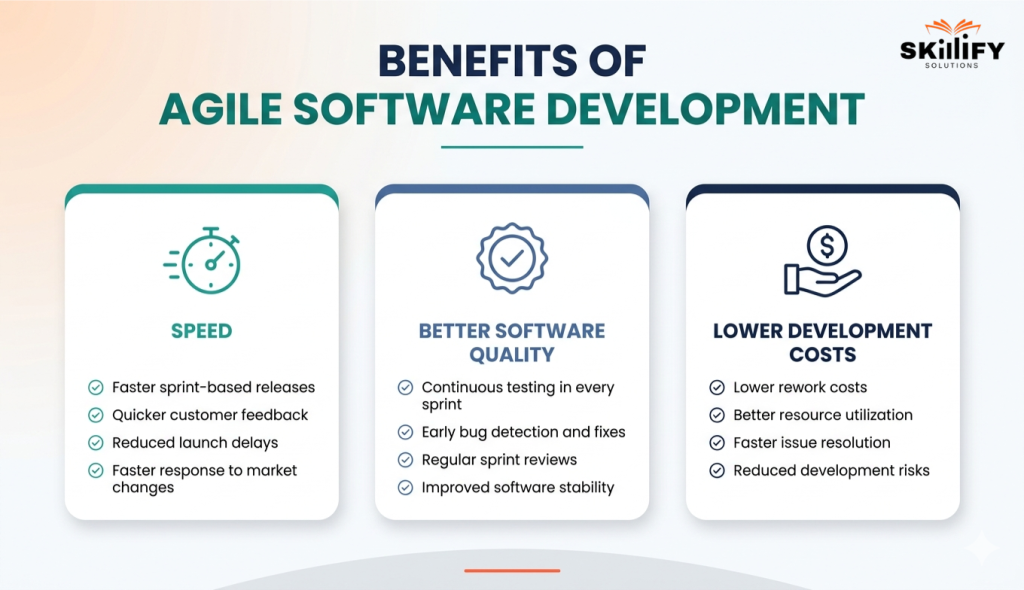
Agile software development helps businesses deliver software faster, improve product quality, and reduce development costs. Its iterative and feedback-driven approach allows teams to adapt quickly to changing customer and market requirements.
Speed
According to McKinsey, Agile teams can achieve up to 40% faster time-to-market compared to traditional development approaches. Short sprint cycles and continuous releases help businesses launch products and updates more quickly.
- Faster sprint-based releases
- Quicker customer feedback
- Reduced launch delays
- Faster response to market changes
Better Software Quality
Agile improves software quality through continuous testing, sprint reviews, and regular feedback cycles. By identifying issues early in development, teams can significantly reduce defects before release.
- Continuous testing in every sprint
- Early bug detection and fixes
- Regular sprint reviews
- Improved software stability
Agile teams also rely heavily on Agile Test Automation to speed up testing, reduce manual effort, and maintain software quality across continuous releases.
Lower Development Costs
Agile reduces rework costs by collecting customer feedback throughout development instead of after final delivery. Continuous improvements help teams avoid expensive late-stage changes and wasted development efforts.
- Lower rework costs
- Better resource utilization
- Faster issue resolution
- Reduced development risks
Learn how modern Agile teams deliver software faster using Scrum frameworks with our Scrum Master Bootcamp now!
Agile Careers and Certifications in 2026
Agile professionals continue to be in high demand across software, product, operations, and enterprise transformation roles. Certifications help validate Agile knowledge, improve career opportunities, and increase earning potential at the team level as well as in enterprise Agile environments.
| Certification | Best For | Focus Area |
| Scrum Master Bootcamp with AI | Beginners and Agile professionals | Scrum fundamentals with AI-powered Agile tools |
| AI-Empowered SAFe® Scrum Master | Scrum Masters | AI-driven Scrum facilitation and Agile delivery |
| Leading SAFe® 6.0 | Managers and enterprise leaders | Scaling Agile across large organizations |
| SAFe® Advanced Scrum Master (SSM) | Experienced Scrum Masters | Advanced Scrum coaching and team optimization |
| AI-Empowered SAFe® Product Owner/Product Manager | Product Owners and PMs | AI-assisted product strategy and backlog management |
| SAFe® Lean Portfolio Management | Enterprise portfolio leaders | Lean governance and Agile portfolio strategy |
These certifications are designed for professionals working in modern Agile environments. Here, AI, enterprise collaboration, and continuous delivery are becoming core parts of software development and product management.
For a detailed breakdown of certification benefits, eligibility, career scope, and salary potential, read the complete guide on Top Agile Certifications in 2026. Here, you can also learn which certification is best suited for beginners, Scrum professionals, product managers, and enterprise Agile leaders.
Conclusion
From the above discussion, the reason Agile became the preferred software development approach is simple and simple. It helps teams adapt faster in a constantly changing world. Agile improves collaboration, speeds up delivery, reduces development risks, and keeps customer feedback at the center of the process.
Throughout this blog, we explored how Agile works, the most popular frameworks, Agile team structures, and the certifications shaping Agile careers in 2026. Whether you want to build software, manage products, or lead teams, learning Agile can help you stay relevant in the modern technology industry.
Upgrade your Agile expertise with our SAFe Certification Courses for Agile Leaders and Enterprise now!
Frequently Asked Questions
1. What is the difference between Agile and Scrum?
Agile is a software development approach focused on flexibility and continuous improvement. Scrum is one of the most popular Agile frameworks used to implement Agile practices through sprints, standups, and defined team roles.
2. Is Agile only for software development?
No. Agile is widely used in product management, marketing, operations, HR, and project management because its flexible and collaborative approach works across many industries.
3. What does an Agile team look like?
An Agile team is usually a small cross-functional group that includes developers, testers, designers, product owners, and Scrum Masters working together in short sprint cycles.
4. Which Agile framework should I start with?
Scrum is the best Agile framework for beginners because it is simple to understand, widely adopted, and suitable for most software and product development teams.


