 Skip to content

The Test Pyramid in Agile is one of the simplest yet most misunderstood concepts in software testing. Most teams know about unit tests, integration tests, and UI tests, but very few know how to balance them correctly.
We all learned this the hard way while working with automation-heavy Agile projects where hundreds of UI tests looked impressive on dashboards but failed constantly in CI/CD pipelines. Releases slowed down, debugging became painful, and teams lost trust in automation itself.
That’s where the Test Pyramid changes everything. It gives Agile teams a practical structure for building faster, stable, and scalable test automation without drowning in maintenance effort.
In this blog, you’ll learn how the 3-layer testing model works, why the 70/20/10 rule matters, common anti-patterns that silently break Agile projects, and how modern teams are adapting the pyramid for 2026 software development. Read on!
What is the Agile Testing Pyramid?
The Test Pyramid in Agile is a software testing strategy that helps teams create faster, stable, and cost-effective automated test suites. Agile expert Mike Cohn introduced the concept in his 2009 book Succeeding with Agile.
He created the Test Pyramid to solve a common problem in software testing that teams were relying too heavily on slow and expensive UI tests while ignoring faster unit tests.
It explains how different types of automated tests should be distributed across an application to improve software quality while maintaining fast delivery cycles. The model divides testing into three layers:
- Unit tests
- Integration tests
- UI or end-to-end tests
The idea is simple: teams should have faster and lower-cost tests at the bottom and fewer slow tests at the top. This approach improves software quality while keeping testing efficient in Agile projects.
The Test Pyramid is widely used in Agile and CI/CD environments because it supports continuous testing, faster releases, and early bug detection. Professionals often start with the Scrum Master Bootcamp with AI to build practical Agile execution and testing knowledge.
Why the Pyramid Shape Matters in Agile Testing
The pyramid shape represents the balance between test speed, cost, and reliability. Tests at the bottom are faster and cheaper, while tests at the top are slower and more expensive to maintain.
Why this structure works:
- Unit tests run quickly and catch bugs early
- Integration tests verify APIs and service communication
- UI tests validate critical user journeys
- Fewer UI tests reduce maintenance effort
- Faster feedback improves Agile sprint delivery
If teams rely too much on end-to-end testing, test execution becomes slow and unstable. The Test Pyramid prevents this by encouraging more low-level automated tests and fewer complex UI tests.
This structure helps Agile teams deliver stable software faster with better feedback loops throughout the development cycle. This balanced testing approach is one of the key foundations of successful Agile Software Development, where quick feedback loops and rapid releases are critical for product stability.
The 3 Layers of the Agile Test Pyramid
The Agile Test Pyramid is divided into three layers based on test speed, complexity, and maintenance cost. This structure helps Agile teams achieve better automation efficiency, faster feedback loops, and stable software releases.
Large enterprises implementing layered Agile testing strategies commonly use the Leading SAFe 6.0 Certification to standardise Agile delivery and testing practices across teams. Let’s find out each of the layers with details:
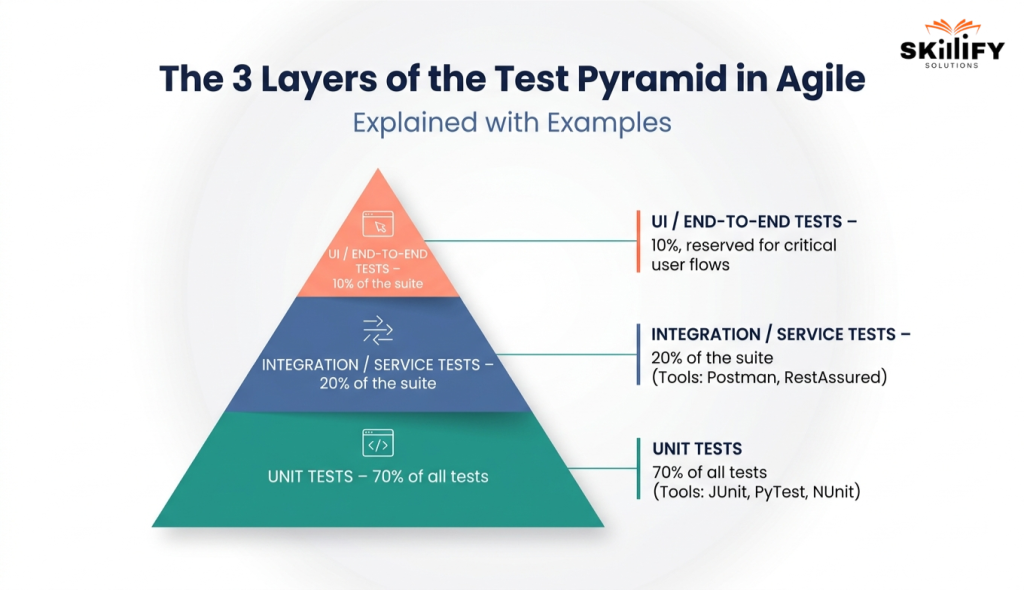
Unit Tests: The Foundation
Unit tests form the foundation of the Test Pyramid and usually make up nearly 70% of the entire test suite. These tests check small pieces of code, such as functions, methods, or classes, in isolation. Since they run very quickly and are easy to maintain, they help developers detect bugs early in the development cycle.
Tools like JUnit, PyTest, and NUnit are commonly used for unit testing. A simple example is testing whether a login function correctly validates a username and password.
Many Agile teams also combine testing strategies with proper Agile Estimation Techniques to better plan sprint workloads, automation effort, and testing timelines.
Integration Tests: Middle Layer
Integration or service tests usually make up around 20% of the Test Pyramid. These tests verify whether different modules, APIs, services, or databases work correctly together. They are slower than unit tests, but are important for validating communication between different application components.
Tools such as Postman and RestAssured are widely used for integration testing. An example would be testing whether a payment API correctly sends and receives data from the database.
Build scalable Agile testing and leadership skills through Leading SAFe 6.0 Agilist Certification today!
UI or End-to-end Tests: The Apex
UI or end-to-end tests sit at the top of the Test Pyramid and generally make up only 10% of the test suite. These tests simulate real user actions and validate complete business workflows from start to finish. Since they require a full application environment, they are slower, more expensive, and harder to maintain.
These tests are usually reserved for critical user flows such as login, checkout, or payment processing. A common example is testing the entire checkout process of an e-commerce application to ensure all system components work together correctly.
The 70/20/10 Rule: How to Apply the Right Ratio to Your Agile Team
The 70/20/10 rule is a common guideline used in the Agile Test Pyramid. It suggests that around 70% of tests should be unit tests, 20% should be integration or service tests, and 10% should be UI or end-to-end tests.
This structure helps Agile teams maintain faster feedback loops, lower testing costs, and stable CI/CD pipelines. Since unit tests are fast and easy to maintain, they form the largest part of the testing suite, while slower UI tests are kept limited to critical workflows.
Why There is no Universal ratio, and How to Calibrate Yours
The 70/20/10 ratio is not fixed for every project. Different applications require different testing strategies based on complexity, architecture, and business needs.
For example, microservice applications may require more integration tests, while UI-heavy applications may need additional end-to-end testing. The main goal is to maintain fast, reliable, and balanced test automation.
Teams can calibrate the ratio by monitoring:
- Test execution speed
- Maintenance effort
- Flaky test frequency
- CI/CD pipeline performance
- Release stability
- Signs Your Pyramid Ratio Is Off and How
Understanding how to balance testing, sprint planning, and Agile collaboration becomes easier through programs like SAFe 6.0 Advanced Scrum Master, focused on practical Agile team workflows.
Signs Your Pyramid Ratio Is Off and How to Rebalance it
An unbalanced Test Pyramid can slow down releases and increase maintenance effort. One common issue is having too many UI tests and too few unit tests, which makes automation slower and more unstable.
Another issue is missing integration tests, where APIs and services fail even when unit tests pass successfully.
Teams can rebalance the pyramid by:
- Increasing unit test coverage
- Reducing unnecessary UI tests
- Adding more API and integration tests
- Removing flaky automation tests
- Running fast tests earlier in CI/CD pipelines
Monitoring flaky tests, release stability, and automation speed is an important part of using Agile Metrics for Scrum Master to improve sprint delivery and team efficiency.
Common Test Pyramid Anti-Patterns to Avoid
Test Pyramid anti-patterns happen when Agile teams create an unbalanced testing strategy. This usually leads to slow test execution, unstable automation, higher maintenance costs, and delayed releases.
The Ice Cream Cone Anti-Pattern
The Ice Cream Cone anti-pattern occurs when teams rely heavily on UI or end-to-end tests while having very few unit tests and integration tests. This creates slow, fragile, and difficult-to-maintain test suites.
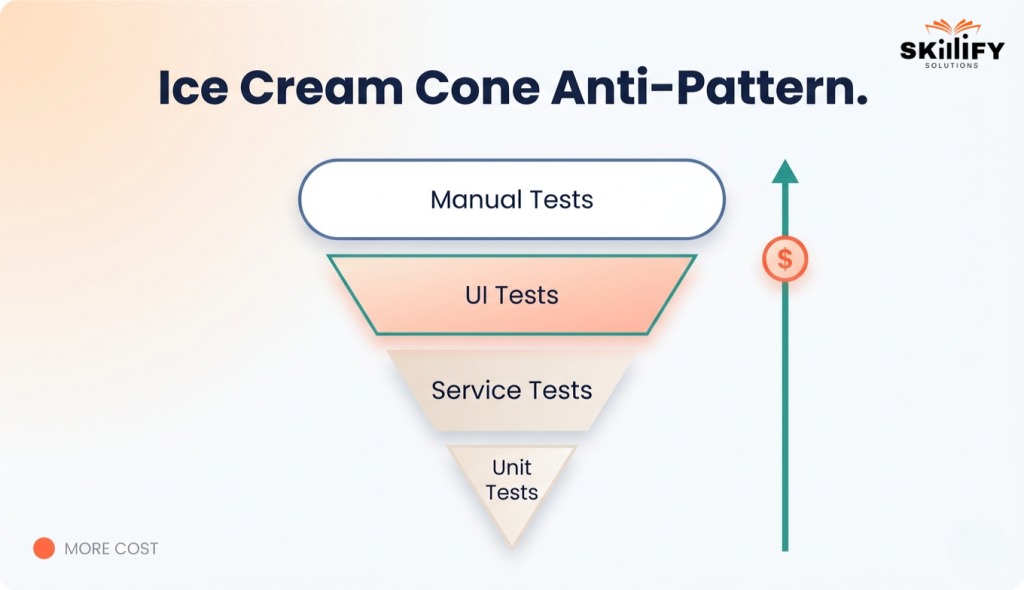
Since UI tests require full application environments, they take longer to run and often fail due to small UI changes, timing issues, or environment instability. As the application grows, release cycles become slower, and debugging becomes more difficult.
Teams can avoid this anti-pattern by increasing unit test coverage, reducing unnecessary UI tests, and testing business logic at lower levels of the pyramid.
Strengthen Agile product delivery and roadmap planning with SAFe Agile Product Management Certification now!
The Hourglass Anti-Pattern
The Hourglass anti-pattern appears when teams have many unit tests and many end-to-end tests, but very few integration tests in the middle layer. In this situation, APIs, services, and modules are not tested properly together.
This often causes end-to-end tests to fail because integration issues are detected too late in the testing cycle. Missing integration tests also make debugging slower and reduce confidence in the automation suite.
Teams can rebalance the pyramid by adding more API and service-level tests that validate communication between system components earlier in the CI/CD pipeline.
Flaky Automated Tests and Their Impact
Flaky tests are automated tests that sometimes pass and sometimes fail without any code changes. These unreliable tests reduce trust in automation and waste developer time during debugging.
Flaky tests are commonly caused by timing issues, unstable environments, shared test data, network dependency, or poor test isolation. In Agile and CI/CD environments, flaky automation can slow deployments and create false failure alerts.
Teams can reduce flaky tests by improving test stability, isolating test environments, removing duplicate automation, and keeping tests independent from each other. The Test Pyramid also aligns strongly with SAFe Lean Agile Principles, where continuous improvement, fast feedback, and built-in quality are core Agile delivery principles.
How to Build a Test Pyramid for an Agile Project
Building a Test Pyramid early in an Agile project helps teams create faster feedback loops, stable automation, and reliable CI/CD pipelines. The main goal is to maintain more fast-running tests at the lower levels and fewer slow tests at the top layer.
Steps to Build a Test Pyramid
- Build strong unit test coverage for core business logic before adding higher testing layers.
- Add integration tests to validate APIs, databases, and service communication between modules.
- Keep UI and end-to-end tests limited to critical user journeys and business workflows.
- Automate testing early to support continuous testing and faster Agile sprint delivery.
- Configure CI/CD pipelines to run unit tests first for faster developer feedback loops.
- Remove duplicate and flaky tests regularly to improve automation stability and reliability.
- Monitor test execution time to maintain a balanced and efficient Test Pyramid structure.
- Use shift-left testing to detect defects earlier and reduce production-level software issues.
Teams scaling Agile testing across multiple teams often adopt frameworks covered in the SAFe 6.0 for Teams (SP) Certification to improve collaboration, automation, and sprint execution.
Test Pyramid in Agile Sprints and CI/CD Pipelines
The Test Pyramid helps Agile teams run faster, stable, and efficient testing during sprint cycles and CI/CD pipelines. Different testing layers run at different stages based on speed and complexity. This structure improves continuous testing, faster feedback, and release stability.
When Each Test Layer Runs in Agile Sprints
Unit tests run first during development because they are fast and help developers catch bugs immediately after code changes.
Integration and service tests run after unit testing to verify communication between APIs, databases, and application modules. UI or end-to-end tests run later in the sprint cycle or before deployment because they are slower and validate critical user workflows.
Shift-Left Testing and Faster Feedback Loops
Shift-left testing means identifying defects earlier in the development process instead of waiting until the final testing stage.
The Test Pyramid supports shift-left testing by focusing more on fast unit tests and integration tests. This helps Agile teams reduce debugging effort, improve CI/CD speed, and release stable software more frequently.
Become industry-ready in Agile, Scrum, and modern delivery workflows with Scrum Master Bootcamp with AI today!
Is the Test Pyramid Still Relevant in 2026
Yes, the Test Pyramid is still relevant in 2026, but modern Agile teams no longer follow it as a strict rule. The core idea of maintaining more fast-running tests and fewer slow UI tests is still widely used in Agile, DevOps, and CI/CD environments.
However, modern software architectures like microservices, cloud-native applications, and AI-driven systems have changed how teams approach testing. Today, teams focus more on risk-based testing, API testing, contract testing, and continuous quality engineering instead of relying only on the traditional pyramid structure.
The Test Pyramid is now treated more as a testing guideline than a fixed framework. Agile teams adapt the ratio based on application complexity, release frequency, and business requirements.
Modern Alternatives to the Test Pyramid
Continuous testing strategies are now a major part of advanced Agile Test Automation approaches used in modern CI/CD pipelines. Several modern testing models have evolved from the traditional Test Pyramid to better support modern software development practices.
Here are the modern alternatives to the Test Pyramid
- Testing Trophy
- Honeycomb Testing Model
- Risk-Based Testing
- Continuous Testing
- Contract Testing for Microservices
Test Pyramid in SAFe: How it Scales Across Agile Release Trains
In the Scaled Agile Framework (SaFe), the Test Pyramid helps multiple Agile teams maintain faster, stable, and scalable test automation across Agile Release Trains (ARTs).
Unit tests validate individual components during development; integration tests verify communication between systems and services, and UI tests are limited to critical business workflows.
This approach helps SAFe teams improve CI/CD pipeline efficiency, detect defects earlier during Program Increments (PIs), reduce slow and expensive UI testing, maintain faster feedback across teams, and deliver stable software consistently at scale.
Many enterprise Agile teams use leading SAFe Training to manage Agile Release Trains (ARTs), improve cross-team coordination, and scale testing practices effectively.
Conclusion
It can be concluded that the Test Pyramid remains one of the most effective testing strategies for Agile teams because it creates a balance between speed, quality, and automation stability.
By focusing more on unit tests, maintaining a healthy integration layer, and limiting UI tests to critical workflows, teams can achieve faster feedback loops and more reliable CI/CD pipelines.
Throughout this blog, we explored the three layers of the Test Pyramid, the 70/20/10 rule, common anti-patterns, CI/CD implementation, SAFe scaling, and modern testing alternatives used in 2026. A balanced testing strategy ultimately helps Agile teams release software faster with greater confidence and fewer production issues.
Improve enterprise Agile execution and continuous delivery with SAFe 6.0 Advanced Scrum Master certification today!
Frequently Asked Questions
1. Who created the testing pyramid?
Agile expert Mike Cohn created the testing pyramid in his 2009 book Succeeding with Agile. He introduced the model to help teams build faster and more balanced automated testing strategies.
2. Does Playwright change the traditional test pyramid?
Playwright does not replace the traditional Test Pyramid, but it improves UI and end-to-end testing speed and reliability. This allows modern teams to run more E2E tests without significantly slowing down CI/CD pipelines.
3. What is the ice cream cone anti-pattern?
The Ice Cream Cone anti-pattern occurs when teams rely mostly on UI or end-to-end tests while ignoring unit tests. This creates slow, expensive, and difficult-to-maintain automation suites.
4. Why do some teams replace the test pyramid with the test trophy?
Some teams prefer the Testing Trophy because it focuses more on integration testing rather than large numbers of unit tests. It is commonly used in modern frontend and JavaScript-heavy applications.
5. What is the difference between the test pyramid and shift-left testing?
The Test Pyramid is a framework that organises different testing layers, while shift-left testing is the practice of testing earlier in the development lifecycle. Both approaches help teams detect defects faster and improve software quality.


