 Skip to content
Key Takeaways
- It focuses on customer needs and continuous value delivery
- Work in small iterations with quick feedback loops
- Balance business, UX, and technology decisions
- Adapt quickly to changing market and user needs
- Prioritize features based on impact and value
- Build efficiently while reducing waste and rework
Agile Product Management is one thing, building the right product, not just building fast. Teams ship features quickly, follow every Agile ritual, and still miss what users actually need.
The problem wasn’t speed, it was direction. When decisions are driven by assumptions instead of real insights, even the fastest teams can end up building the wrong things.
Agile Product Management fixes this by combining customer insights, business goals, and continuous delivery. Instead of guessing upfront, teams validate ideas early, take feedback regularly, and refine the product with every iteration.
This reduces risk, improves product-market fit, and ensures that every release actually adds value. In this blog, you’ll learn how Agile Product Managers think, how effective roadmaps are built, and how prioritization really works.
We’ll also explore tools, frameworks, and career opportunities in 2026, so you can apply Agile Product Management in a way that is practical, structured, and results-driven. Read on to learn more!
What is Agile Product Management?
Agile Product Management is a flexible approach to building and managing products where decisions are driven by customer feedback, data, and continuous learning.
Instead of planning everything up front, product teams work in small iterations, test ideas quickly, and improve based on real user insights. The focus is simple. To deliver value continuously, adapt quickly, and build what customers actually need.
Agile Product Management is built on three core ideas:
- Customer-driven: Product decisions are based on real user feedback, not assumptions
- Iterative: Work is delivered in small cycles, like sprints, and improved continuously
- Value-focused: Priority is given to features that deliver maximum business and user value
Understanding these principles is easier with hands-on learning, which is why many professionals begin with programs like the Scrum Master Bootcamp to build a strong Agile foundation.
Agile vs Traditional Product Management: Key Differences
It is important to understand how Agile differs from traditional product management in terms of planning, execution, and flexibility. Here’s a simple comparison:
| Factor | Agile Product Management | Traditional Product Management |
| Approach | Flexible and iterative | Fixed and plan-driven |
| Planning | Continuous and adaptive | Detailed upfront planning |
| Customer Involvement | High | Limited |
| Delivery | Frequent, small releases | Large, infrequent releases |
| Change Handling | Easily adaptable | Difficult to change |
| Focus | Value and outcomes | Scope and deadlines |
Step into product leadership with a hands-on SAFe 6.0 Agile Product Management learning experience!
Benefits of Agile Product Management for Modern Teams
Agile Product Management helps teams work faster, smarter, and more aligned with customer needs. By focusing on iterative development, continuous feedback, and adaptability, teams can deliver better products while reducing risks and inefficiencies.
1. Faster Delivery with Continuous Customer Feedback
Agile enables teams to deliver products in small, frequent releases, which significantly improves time-to-market. Instead of waiting months, teams release updates quickly and gather real user feedback at every stage.
2. Better Prioritization and Reduced Product Waste
Agile focuses on building only what delivers the highest value to users and the business. Teams prioritize tasks based on impact, ensuring that time and resources are not wasted on unnecessary features.
Agile Product Manager Roles and Responsibilities
An Agile Product Manager is responsible for building the right product by aligning customer needs, business goals, and team execution. They ensure that teams work on the most valuable features while continuously adapting to feedback and changing market conditions.
Defining Product Vision and Strategy
The Agile Product Manager defines a clear product vision and roadmap that outlines where the product is heading and why. Key focus areas:
- Set a clear long-term product direction
- Align roadmap with business goals
- Continuously refine based on feedback
For example, a fintech product team may start with a vision to “simplify digital payments,” but over time, shift focus to UPI features based on user demand.
Backlog Prioritization and Cross-Functional Collaboration
Managing and prioritizing the product backlog is a key responsibility. The Product Manager ensures that teams focus on features that deliver the highest value based on customer needs and business impact.
What they do daily:
- Prioritize features based on value and urgency
- Align teams like engineering, design, and marketing
- Remove confusion and keep everyone focused
Tip: Always prioritize features that directly impact user experience or revenue first, instead of low-impact enhancements.
Customer Insights and Data-Driven Decisions
Agile Product Managers rely heavily on customer feedback, user data, and market insights to make decisions. Instead of assumptions, they use real data to understand user behavior and improve the product continuously.
To improve decision-making further, many product managers are now exploring AI Tools for product managers to analyze user behavior and identify opportunities faster.
How they use data:
- Analyze user behavior and product usage
- Collect feedback through reviews and testing
- Use insights to improve features continuously
For example, if analytics show users drop off at checkout, the team can prioritize improving the payment flow instead of adding new features.
To apply these benefits in real projects, practical exposure through programs like the Product Management Bootcamp can make a significant difference.
Agile Product Management with Scrum and SAFe®
Agile Product Management connects product strategy with execution, and frameworks like Scrum and SAFe® help teams implement this in real scenarios. While Scrum works best for small teams, SAFe® is used to scale Agile across large organizations.
Role of Product Manager in Scrum Teams
In Scrum, the Agile Product Manager works closely with the Product Owner and development team to ensure the right product is being built. Scrum breaks work into short cycles called sprints (2–4 weeks), where teams deliver small, usable outputs.
Key responsibilities in Scrum:
- Define product strategy and align it with business goals
- Guide the Product Owner on backlog priorities
- Ensure teams build features that deliver real value
- Continuously adjust priorities based on feedback
Build smarter products faster with structured Agile Product Management training programs now!
Product Manager vs Product Owner in SAFe®
In SAFe® (Scaled Agile Framework), the roles are clearly divided to handle large-scale product development across multiple teams.
| Role | Product Manager (SAFe) | Product Owner (SAFe) |
| Focus | Strategy and roadmap | Execution and delivery |
| Scope | Works across multiple teams | Works with a single team |
| Responsibility | Defines vision, features, and priorities | Manages backlog and sprint tasks |
| Stakeholders | Works with business leaders and customers | Works with developers and teams |
| Time Horizon | Long-term product direction | Short-term sprint execution |
These skills are often developed faster through guided learning, such as theAI-Powered SAFe POPM Certification Training, which focuses on real-world product decision-making.
How to Build an Agile Product Roadmap
An Agile product roadmap is a flexible plan that shows what to build and why. It keeps evolving based on customer feedback, business goals, and team progress.
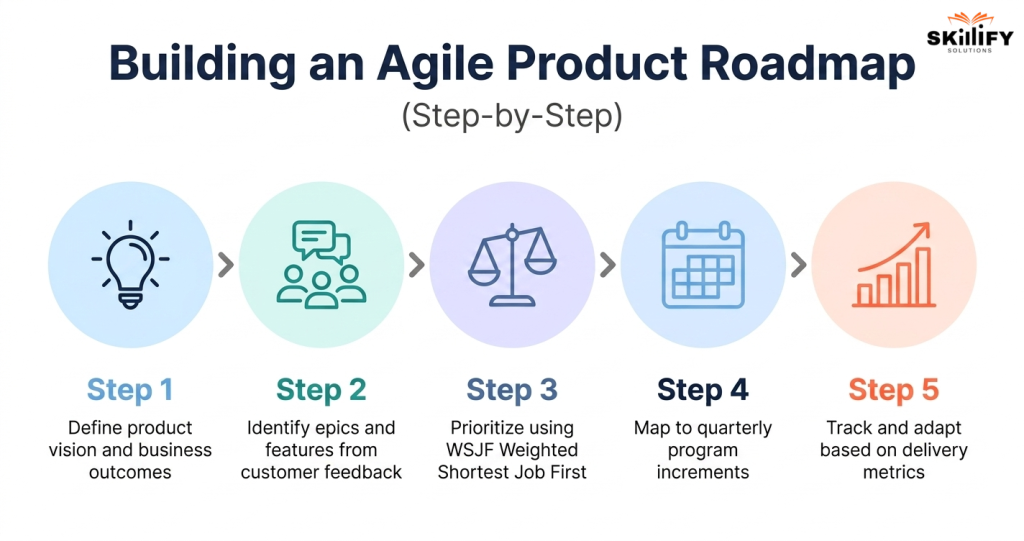
Step 1: Define Product Vision and Business Goals
Start with a clear product vision and what you want to achieve. This gives direction to the team and helps everyone align. Improve user retention or increase revenue from a feature.
Step 2: Identify Epics and Features from Customer Feedback
Break the vision into epics like big goals and smaller features based on real user needs and feedback. You must focus on solving actual customer problems, not assumptions.
Step 3: Prioritize Using WSJF
Use Weighted Shortest Job First (WSJF) to decide what to build first by comparing value vs effort. High-value, low-effort tasks get priority. You can build what delivers maximum impact quickly. Prioritization techniques like WSJF are best understood in practice, which is why many teams rely on structured training like the SAFe Agile Product Management Certification.
Step 4: Plan Across Program Increments
Plan your work into timeframes, like quarters or program increments, to keep delivery structured and predictable. It helps teams stay aligned and track progress easily.
Step 5: Track Progress and Adapt Using Metrics
Measure progress using metrics like velocity, delivery speed, and user feedback, and update the roadmap accordingly. You can keep improving instead of sticking to a fixed plan.
To understand these metrics better in real scenarios, you can explore Agile Metrics for Scrum Master, which explains how teams track performance effectively.
Agile Product Management Tools for Prioritization and Collaboration
Agile Product Managers rely on a set of tools to plan, prioritize, collaborate, and track product development efficiently. These tools help teams stay aligned, manage backlogs, visualize workflows, and make data-driven decisions throughout the product lifecycle.
1. Jira
Tools like Jira are widely used for managing backlogs, sprint planning, and task tracking. They support Scrum and Kanban workflows, helping teams prioritize and execute work effectively.
2. Confluence
Confluence helps teams document product requirements, share ideas, and collaborate in real time. It acts as a central hub for all product-related information.
3. Miro
Miro is used for brainstorming, road mapping, and visual planning. It helps teams collaborate visually, especially in remote environments.
4. Figma
Figma allows teams to design, prototype, and collaborate on product interfaces in real time. It ensures alignment between product, design, and development teams.
5. Product Analytics Tools
Tools like Mixpanel help product managers track user behavior, analyze data, and make informed decisions.
6. Road Mapping Tools
This tool helps teams create and manage product roadmaps, aligning strategy with execution.
SAFe® Agile Product Management Certification and Career Path (2026)
SAFe Agile Product Management certification helps professionals learn how to build products at scale, align strategy with execution, and manage multiple Agile teams. It is widely recognized in large enterprises and is especially valuable for roles like Product Manager, Product Owner, and Agile Coach.
What SAFe® Agile Product Management Certification Covers
The SAFe® Agile Product Management Certification focuses on how to build and manage products at scale by aligning customer needs with business goals. It teaches how to define product strategy, create roadmaps, and prioritize features using methods like WSJF to deliver maximum value.
It also covers working with multiple Agile teams, managing large backlogs, and ensuring smooth collaboration across departments. Overall, it helps professionals move from execution-focused roles to strategic product decision-making in enterprise environments.
Salary Trends and Career Growth in 2026
SAFe-certified professionals are in high demand, especially in industries like tech, finance, and healthcare, with strong salary growth and leadership opportunities.
| Role | Average Salary (US) | Salary Range |
| SAFe® Product Owner / Product Manager | ~$102K | $93K – $118K+ |
| SAFe® Scrum Master | $124K | $109K – $139K+ |
| SAFe® Agile Coach / Consultant | $113K+ | $113K – $130K+ |
If you’re planning to enter this field, understanding What Hiring Managers Want in Agile Roles can give you a clear edge during interviews.
Conclusion
At the end of the day, Agile Product Management is about making better product decisions. From defining vision to prioritizing features and adapting based on feedback, every step is focused on delivering value.
We’ve walked through how Agile works, the role of a Product Manager, roadmap building, and where this career is heading in 2026. What matters most is how you apply it. Stay close to your users, focus on impact, and keep improving with every release. That’s where Agile truly works.
Upgrade your career with the in-demand SAFe® 6.0 Agile Product Manager Certification today!
Frequently Asked Questions
Q1: Is a Product Owner the same as an Agile Product Manager?
No, a Product Owner focuses on backlog and team execution, while an Agile Product Manager handles strategy, vision, and roadmap.
Q2: Do I need a technical background to be an Agile product manager?
No, a technical background is not mandatory, but a basic understanding of technology helps in better collaboration with development teams.
Q3: What is WSJF, and how is it used in Agile product management?
WSJF (Weighted Shortest Job First) is a method used to prioritize tasks based on value, urgency, and effort to deliver maximum impact quickly.
Q4: How long does the SAFe® APM certification take to complete?
The SAFe® Agile Product Management certification by Skillify Solutions typically takes 2–3 days of training, followed by an exam.
Q5: Can I work as an Agile product manager without SAFe® certification?
Yes, certification is not mandatory, but it helps in gaining structured knowledge and better job opportunities.
Q6: What is the Agile product management salary in the US in 2026?
Agile Product Managers in the US earn around $110K–$150K on average, depending on experience and company.


