 Skip to content
PERT and CPM are two of the most widely used project management techniques to plan timelines, reduce delays, and bring control to execution. If you’ve ever struggled with projects going off track despite careful planning, the issue is usually not effort; it’s estimation.
From practical experience, most teams either overestimate speed or underestimate risk, which leads to unrealistic timelines. This is exactly where PERT and CPM make a difference.
PERT helps you deal with uncertainty using multiple time estimates, while CPM helps you identify the critical path and manage execution with precision.
In this blog, we’ll break down PERT vs CPM with formulas, real-world examples, and clear use cases, so you can move from guesswork to structured, reliable project planning. Read on to know more!
Difference Between PERT and CPM
In project management, PERT and CPM are two essential scheduling techniques used to plan, track, and manage projects efficiently. While both help identify timelines and dependencies, they differ in how they handle time estimation, uncertainty, and cost control.
The table below gives a quick and clear comparison to understand the core differences between PERT and CPM.
| Aspect | PERT | CPM |
| Abbreviation | Program Evaluation and Review Technique | Critical Path Method |
| Time Model | Probabilistic | Deterministic |
| Orientation | Event-oriented | Activity-oriented |
| Best For | Uncertain projects like R&D and innovation | Predictable projects like construction, manufacturing, and others |
| Cost Trade-off | Not focused on cost | Includes time–cost trade-off |
| Uncertainty | High uncertainty handled | Assumes low uncertainty |
| Network Focus | Focus on events/milestones | Focus on activities or tasks |
What is PERT in Project Management
Program Evaluation and Review Technique (PERT) is a project scheduling method used to plan tasks when time estimates are uncertain. It helps managers break a project into activities, estimate durations, and identify the sequence of tasks required to complete the project.
PERT is mainly used in projects where outcomes are not fixed, such as research, product development, or innovation-driven work. Instead of relying on a single time estimate, it uses multiple estimates to handle uncertainty more effectively.
In modern teams, learning PERT is often complemented with Agile and Scrum frameworks. You can learn it from Scrum Master Bootcamp, which focuses on iterative planning and faster execution.
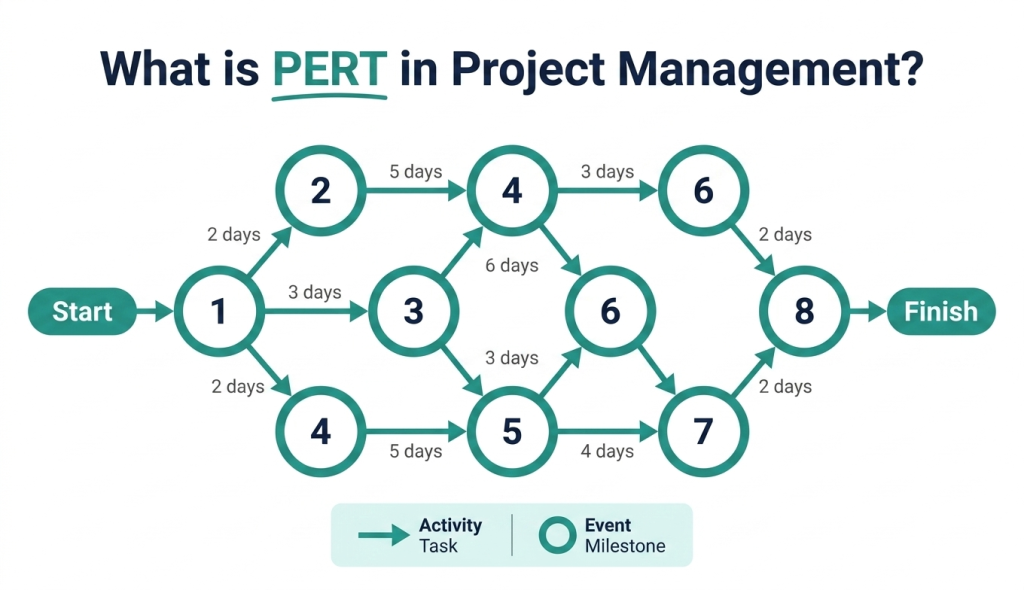
Probabilistic Estimation Technique
PERT is called a probabilistic technique because it considers uncertainty in task durations. Instead of one fixed time, it uses three estimates:
- Optimistic time (O): Minimum possible time
- Most likely time (M): Realistic estimate
- Pessimistic time (P): Maximum possible time
This approach gives a more balanced and practical timeline, especially in complex or unpredictable projects.
PERT Formula with Example
Imagine you are managing a factory machine installation project. In the best case, the work can be completed in 5 days, under normal conditions it takes around 7 days, and in case of delays it may take up to 13 days.
Instead of relying on a single estimate, you use the PERT formula to calculate a more realistic timeline.
Using the formula Te = (O + 4M + P) / 6, we get:
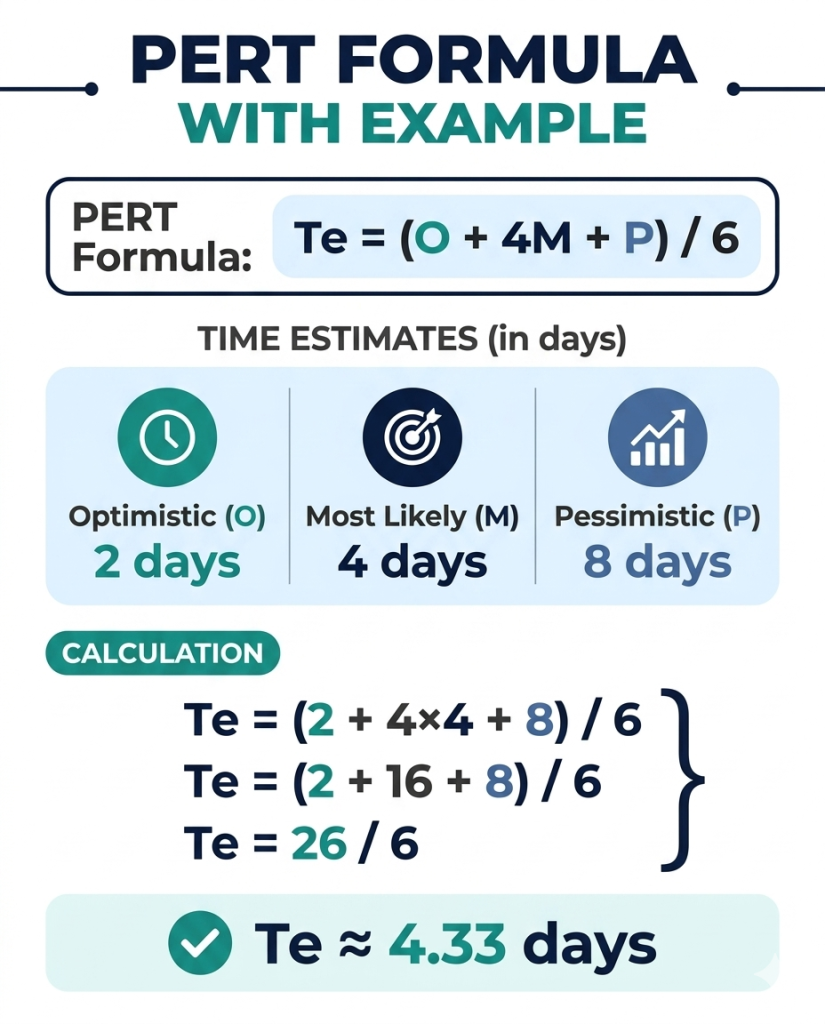
This means the expected project duration is around 7.7 days, giving a balanced estimate that accounts for uncertainty and possible delays.
While PERT focuses on estimation in uncertain projects, modern teams often combine it with Agile Methodology in Project Management to adapt faster during execution.
What is CPM?
Critical Path Method (CPM) is a project scheduling technique used to plan and control tasks with fixed and known durations. It helps identify the longest sequence of dependent activities (critical path) that determines the minimum time required to complete a project.
CPM is widely used in projects where activities are predictable, such as construction, manufacturing, and infrastructure projects. It focuses on time optimization and cost control, making it useful for managing deadlines efficiently.
Deterministic Scheduling Method
CPM is called a deterministic method because it assumes that activity durations are known and fixed. This makes CPM suitable for projects where tasks are repetitive and timelines are well defined.
- Each task has a single time estimate
- No uncertainty is considered
- Focus is on accurate planning and scheduling
Ready to stop guessing timelines? Master project planning techniques that actually work with our Scrum Master Bootcamp!
Forward Pass and Backward Pass in CPM
These are two key calculations used to determine the project schedule:
Forward Pass: Calculates the earliest start (ES) and earliest finish (EF) for each activity. It moves from the start to the end of the project.
Backward Pass: Calculates the latest start (LS) and latest finish (LF) without delaying the project. It moves from the end to the beginning.
Float (Slack) in CPM with Example
Float (or slack) is the amount of time a task can be delayed without affecting the overall project timeline.
Formula: Float = LS – ES (or LF – EF)
Example:
| Task A: ES = 2 days, LS = 4 days Float = 4 – 2 = 2 days |
This means Task A can be delayed by 2 days without delaying the project. Tasks with zero float form the critical path, and any delay in these tasks will delay the entire project.
Concepts like critical path and float are key parts of SAFe® 6.0 Scrum Master (SSM) programs. These are widely used in industries like construction and operations.
When to Use PERT vs CPM: A Decision Guide
If the project involves uncertainty and evolving timelines, PERT is more suitable. If tasks and durations are clearly defined, CPM works better for planning and control.
Use cases of PERT
PERT is ideal when you need multiple time estimates, like optimistic, most likely, and pessimistic, to handle uncertainty. Use PERT when the project has uncertain timelines and high variability:
- Research and Development (R&D) projects
- New product development or innovation projects
- Complex, non-repetitive projects
- Projects where the task duration is not clearly known
- Large-scale planning where estimation is required
Use cases of CPM
CPM works best when activity durations are known, and a deterministic (fixed) approach can be applied. Use CPM when the project has fixed timelines and predictable tasks:
- Construction and infrastructure projects
- Manufacturing and production processes
- Routine or repetitive projects
- Projects with clearly defined activities and durations
- Projects where cost optimization and scheduling efficiency are important.
In practice, many teams don’t strictly choose one method; they combine structured planning with Agile execution models, often led by roles like a Scrum Master. If you’re exploring this role, here’s a simple breakdown of What is a Scrum Master.
Hybrid use in Modern Project Management
Modern project management combines both techniques because they are complementary tools for planning, scheduling, and control. In real-world projects, PERT and CPM are often used together:
- PERT is used during the planning phase to estimate uncertain timelines
- CPM is used during the execution phase to track progress and control cost
- Both help identify the critical path and task dependencies
Many organizations follow a hybrid approach, structured planning with PERT/CPM, and execution through Scrum frameworks led by Certified Scrum Masters (CSM).
Real-World Examples of PERT and CPM
PERT and CPM are applied in very different real-world scenarios based on how predictable the project is. PERT is used when activities are uncertain and exploratory, while CPM is used when tasks are clearly defined and sequential. This makes PERT more common in innovation-driven environments and CPM more relevant in execution-heavy industries.
Over time, project management has evolved. While PERT and CPM still play a role in planning and scheduling, modern software projects have shifted towards Agile methods, which focus more on flexibility and continuous delivery rather than fixed timelines.
PERT Example
PERT is widely used in projects where task durations are uncertain and cannot be predicted accurately in advance. It was originally developed for the U.S. Navy’s Polaris missile program and later applied in aerospace and research-driven projects, including NASA missions.
These projects involve multiple complex activities where timelines vary, making probabilistic estimation essential.
- Developed for the Polaris missile program of the U.S. Navy
- Used in aerospace and NASA projects
- Suitable for R&D and innovation-driven projects
- Handles uncertain and variable task durations
- Uses optimistic, most likely, and pessimistic estimates
- Example: space missions, experimental product development
Build job-ready project management skills and take control of timelines and execution with our SAFe 6.0 Lean Portfolio Manager (LPM) certification!
CPM Example
CPM is widely used in projects where activities are well-defined and timelines are predictable. It is especially effective in construction and infrastructure projects, where tasks follow a fixed sequence and delays can directly impact the overall completion time.
CPM helps identify the critical path, ensuring that key activities are completed on schedule while optimizing time and cost.
- Used in construction and civil engineering projects
- Suitable for projects with fixed and known timelines
- Identifies the critical path, the longest sequence of tasks
- Helps in time and cost optimization, like crashing
- Activities follow a clear sequence, like foundation to structure and finishing)
- Example: building construction, highways, plant setup
Why Agile Is Replacing PERT/CPM in Software Projects
Traditional methods like PERT and CPM rely on fixed planning and predefined timelines, which work well in stable environments. However, software projects are highly dynamic, where requirements change frequently, and new updates are introduced continuously. This makes rigid scheduling methods less effective.
This shift has also increased demand for Agile roles across industries. It is important to understand the evolving Project Manager Job Market and how these skills impact career growth.
Agile replaced these approaches by focusing on flexibility, iteration, and continuous improvement. Instead of planning everything up front, Agile breaks work into small cycles (sprints), allowing teams to adapt quickly and deliver faster.
- Handles changing requirements easily
- Uses short development cycles (sprints)
- Focuses on continuous feedback and improvement
- Prioritizes working software over fixed plans
- Better suited for fast-moving, evolving projects
This shift has made roles like Scrum Master and Product Owner more important. It has also driven demand for certifications like Product Management with AI Bootcamp lately.
Limitations of PERT and CPM
While PERT and CPM are powerful scheduling tools, they have limitations depending on the project environment. PERT struggles with estimation accuracy in uncertain scenarios, while CPM becomes less effective when projects are dynamic and frequently changing.
Challenges of probabilistic estimation in PERT
PERT is useful for handling uncertainty, but its biggest limitation is that it depends heavily on estimated values. The optimistic, most likely, and pessimistic times are based on assumptions and expert judgment, which may not always be accurate.
The three-time estimates are often based on judgment, which can be biased or inaccurate. This makes the final timeline unreliable if the inputs are wrong. Also, in large projects, creating and managing multiple estimates for every activity becomes complex, time-consuming, and difficult to maintain.
Limitations of CPM in dynamic environments
CPM’s major limitation is its lack of flexibility in changing environments. CPM, on the other hand, works best when task durations are fixed, but this becomes a limitation in dynamic projects. It assumes stable conditions and does not handle changes well during execution.
If delays or changes occur, the entire schedule needs to be recalculated. This makes CPM less suitable for projects where requirements evolve frequently or timelines are uncertain.
Learn from a Certified SAFe 6.0 Teams Practitioner on how top teams manage uncertainty and deliver projects faster and more efficiently!
PERT vs CPM vs Agile: Which is Better in 2026?
In 2026, there is no single best method; the right choice depends on the type of project. PERT is useful when timelines are uncertain, CPM works best for structured and predictable execution, while Agile dominates in environments where speed, flexibility, and continuous change are critical.
The table below gives a clear comparison.
| Aspect | PERT | CPM | Agile |
| Approach | Probabilistic (estimation-based) | Deterministic (fixed planning) | Iterative and adaptive |
| Best For | R&D, innovation projects | Construction, manufacturing | Software, startups, dynamic projects |
| Flexibility | Medium | Low | High |
| Time Estimation | Uses 3 estimates (O, M, P) | Single fixed estimate | No fixed estimate, evolves over time |
| Change Handling | Limited | Very limited | Excellent |
| Focus | Planning under uncertainty | Time and cost optimization | Continuous delivery & improvement |
| Project Type | Complex, uncertain | Structured, predictable | Fast-changing, evolving |
| Modern Relevance | Used in planning-heavy projects | Used in execution-heavy industries | Widely used in modern tech projects |
Unlike traditional methods, Agile project management focuses on continuous delivery and adaptability. Learning from the SAFe 6.0 Agile Product Manager Certification makes it highly relevant in modern software and startup environments.
Conclusion
PERT and CPM are powerful tools that help bring clarity to project planning. The key difference is simple. PERT is used when timelines are uncertain, while CPM works best when tasks and durations are clearly defined.
In real-world scenarios, both techniques can complement each other. PERT for planning and estimation, CPM for execution and control. And for dynamic environments like software, Agile adds the flexibility that traditional methods lack.
The goal is not to follow one method blindly, but to use the right approach at the right stage. When used correctly, these techniques can help you plan better, reduce delays, and deliver projects more efficiently.
Master both traditional and Agile methods to handle any project with confidence with our Product Management Bootcamp!
Frequently Asked Questions
1. Which is more accurate for time estimation: PERT or CPM?
PERT is more accurate when there is uncertainty, as it uses three time estimates. CPM is accurate only when task durations are fixed and predictable.
2. Can PERT and CPM be used in Agile project management?
Yes, but in a limited way. PERT can help in early estimation, and CPM can support planning, but Agile mainly relies on iterative and flexible scheduling.
3. How does float differ in PERT and CPM usage?
Float is mainly used in CPM to measure task flexibility. In PERT, the focus is more on time estimation rather than detailed float calculation.
4. Why is CPM preferred in construction projects over PERT?
CPM is preferred because construction projects have fixed tasks and timelines. It helps in managing schedules and controlling costs effectively.


