 Skip to content
The best agentic AI tool in 2026 depends on one simple question: do you want to build agents, manage agents, or use agents without coding?
A developer building custom AI workflows may prefer LangGraph or CrewAI because they offer flexibility and deep orchestration control. A business operations team may lean toward Microsoft Copilot Studio or Gumloop because they can automate workflows without heavy coding.
Enterprises already running large CRM or automation systems may find more value in Salesforce Agentforce, UiPath, or IBM watsonx Orchestrate.
Agentic AI is also much bigger than chatbots now. These systems can plan tasks, reason through workflows, use external tools, access business data, trigger actions, and complete multi-step operations with minimal human input.
This blog compares 12 of the best agentic AI tools in 2026 so your team can choose faster, avoid costly trial-and-error, and understand which platform truly fits your use case. Read on to know more!
The Best Agentic AI Tools Compared in 2026
Agentic AI tools help teams automate tasks, plan workflows, and get work done faster with less manual effort. If you are new to this concept, understanding What is Agentic AI can help clarify how AI agents differ from traditional AI assistants.
Let’s compare the best ones in 2026 for a better understanding.
| Tool | Best For | Type | Learning Curve | Pricing |
| LangGraph | Complex AI workflows | Framework | High | Free and Paid |
| CrewAI | Multi-agent collaboration | Framework | Medium | Free and Paid |
| Microsoft AutoGen | Conversational AI agents | Framework | High | Free |
| Claude SDK | Safe agentic systems | SDK | Medium | Paid and API-based |
| LlamaIndex | Data-heavy AI agents | Data framework | Medium | Free and Paid |
| IBM watsonx Orchestrate | Enterprise automation | AI platform | Medium | Paid |
| Salesforce Agentforce | CRM AI agents | AI platform | Medium | Paid |
| Microsoft Copilot Studio | Low-code AI agents | Low-code platform | Low | Paid |
| UiPath Agent Platform | Workflow automation | AI + RPA platform | Medium | Paid |
| Gumloop | No-code AI workflows | No-code platform | Low | Free and Paid |
| AgentGPT | Simple autonomous agents | Browser agent tool | Low | Free and Paid |
| Kore.ai | Customer support agents | Enterprise AI platform | Medium | Paid |
12 Best Agentic AI Tools in 2026
1. LangGraph
LangGraph is an open-source framework for building stateful, multi-step AI agents. It is useful when teams need agents that can plan, use tools, remember context, pause for human approval, and continue long-running workflows without starting again.
Strengths:
- Supports long-running and stateful AI workflows
- Built for multi-agent and tool-based orchestration
- Human-in-the-loop support for review and approvals
- Durable execution helps workflows resume after delays or failures
- Strong developer ecosystem from LangChain
Best for: Developer teams building complex AI agents, internal copilots, automation workflows, or multi-step enterprise AI systems. Teams exploring orchestration frameworks like LangGraph often combine them with practical AI workflow training through the Full Stack Development Bootcamp with AI Certification.
2. CrewAI
CrewAI is an open-source framework for building teams of AI agents that work together on a shared goal. Each agent can have a specific role, task, and tool access, making it useful for workflows like research, content creation, lead analysis, and business automation.
Strengths:
- Built for role-based multi-agent teamwork
- Supports both simple and advanced agent workflows
- Can connect agents with business tools and custom APIs
- Good for automating repeatable team-based tasks
- Flexible for developers who want control over agent behavior
Best for: Teams that want multiple AI agents to collaborate like a small digital team across research, planning, writing, sales, or operations.
Learn real-world automation with the Product Management with AI Bootcamp. Start your AI journey today.
3. Microsoft AutoGen
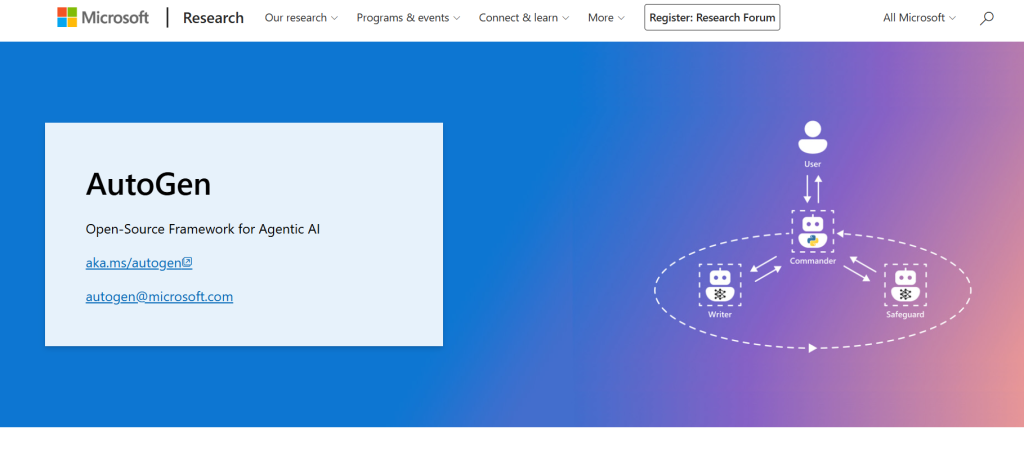
Microsoft AutoGen is an open-source framework for building conversational AI agents and multi-agent systems. It helps agents communicate with each other, use tools, and work with humans to complete complex tasks.
Strengths:
- Strong for multi-agent conversations
- Supports human-in-the-loop workflows
- Useful for research and prototyping
- Backed by Microsoft’s agentic AI ecosystem
Best for: Developers and research teams building conversational agent systems.
4. Claude SDK
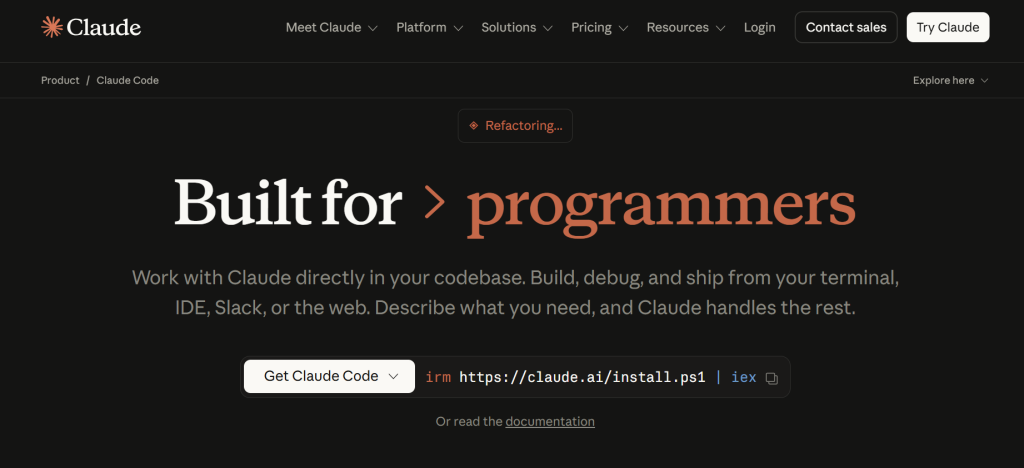
Claude SDK helps developers build AI agents with Claude’s reasoning, tool use, and safety-focused design. It is useful for coding agents, internal assistants, and workflows where reliability and controlled execution matter.
Strengths:
- Strong reasoning and instruction-following capability
- Supports tool use and agent workflows
- Good for coding and knowledge-heavy tasks
- Built with safety and control as a core focus
Best for: Teams building AI agents where safety, accuracy, and controlled actions are important.
5. LlamaIndex
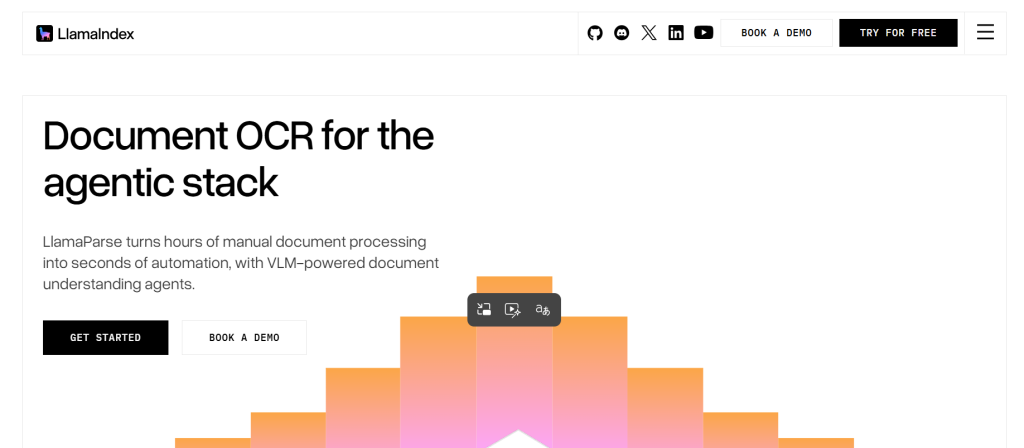
LlamaIndex is an open-source data framework for building AI agents that work with private, structured, and unstructured data. It is especially useful for RAG systems, document workflows, and enterprise knowledge assistants.
Strengths:
- Strong for connecting LLMs with business data
- Supports RAG, indexing, retrieval, and document processing
- Useful for data-heavy and knowledge-heavy use cases
- Works with Python and TypeScript
Best for: Teams building AI agents that need to search, understand, and act on large internal datasets. Since LlamaIndex rely heavily on retrieval, indexing, and analytics pipelines, many professionals also learn these skills through the Data Analytics Bootcamp with AI.
6. IBM watsonx Orchestrate
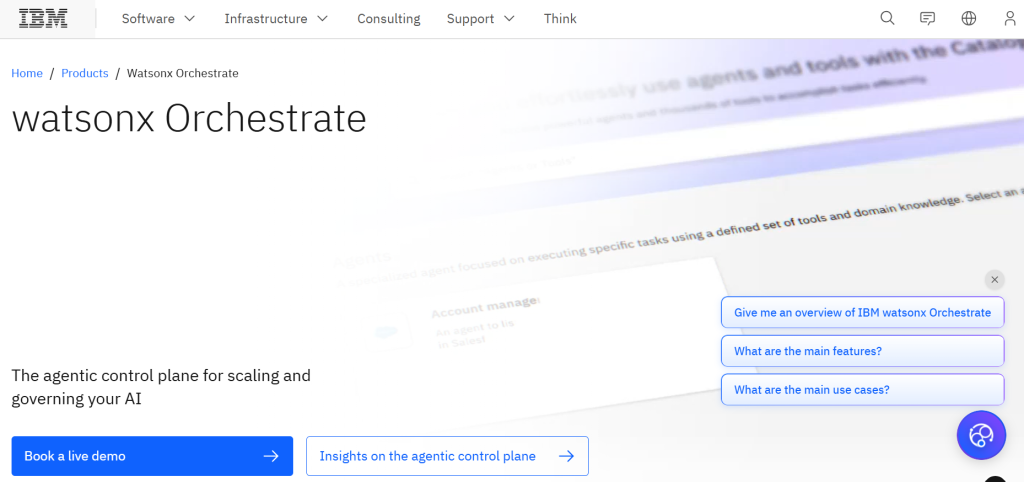
IBM watsonx Orchestrate helps enterprises build and manage AI agents for business workflows. It is designed for companies that need secure automation across HR, sales, operations, and other enterprise functions.
Strengths:
- Built for enterprise AI and automation
- Supports AI agents and assistants for complex workflows
- Strong fit for hybrid cloud and governed environments
- Useful for large companies with compliance needs
Best for: Enterprises that need secure, scalable AI agents for internal business operations.
7. Salesforce Agentforce
Salesforce Agentforce helps businesses build and deploy autonomous AI agents across sales, service, marketing, and commerce. Since it connects directly with Salesforce data, it is useful for customer-facing and CRM-heavy workflows.
Strengths:
Built for Salesforce CRM workflows
- Can act across sales, service, marketing, and commerce
- Supports low-code and pro-code agent building
- Strong fit for customer support and revenue teams
Best for: Salesforce users who want AI agents inside their CRM and customer workflows.
Microsoft Copilot Studio
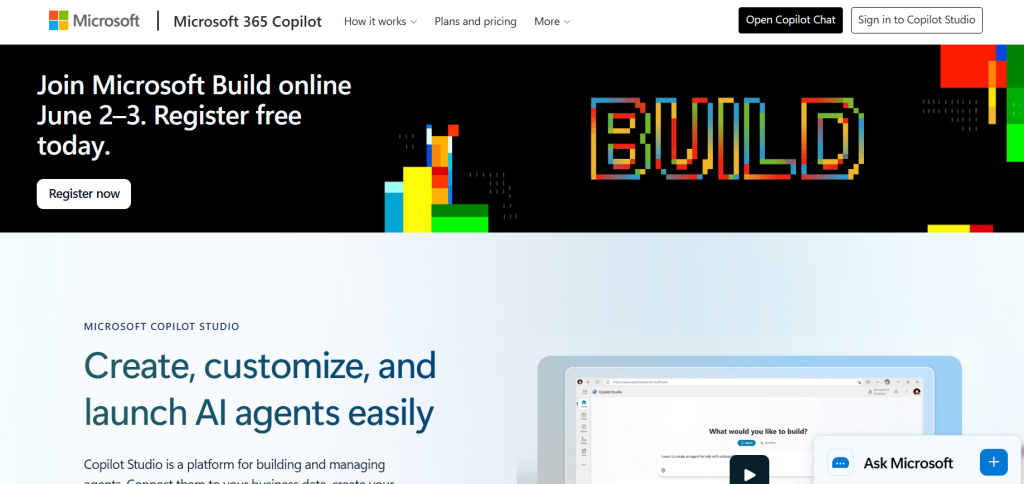
Microsoft Copilot Studio is a low-code platform for building AI agents and agent flows. It is especially useful for teams already using Microsoft 365, Teams, Power Platform, and other Microsoft business tools.
Strengths:
- Low-code interface for building agents
- Connects with Microsoft and external data sources
- Useful for internal support, HR, IT, and workflow automation
- Good for business teams with limited coding skills
Best for: Microsoft-based teams that want to create AI agents without heavy development work. Non-technical professionals entering AI automation often start with structured learning paths like the Data Analytics Bootcamp with AI for better platform expertise.
UiPath Agent Platform
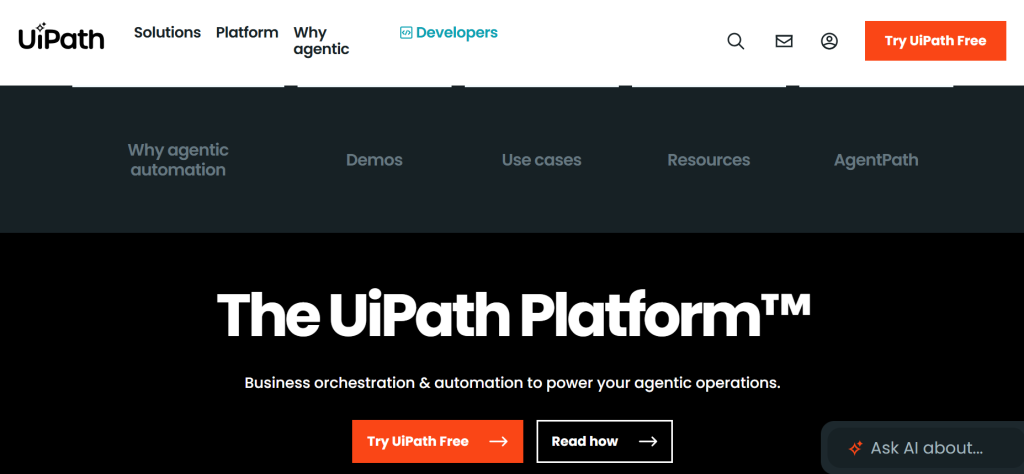
UiPath Agent Platform combines AI agents, robots, tools, and humans to automate complex business processes. It is useful for companies already using RPA and looking to move toward agentic automation.
Strengths:
- Strong in RPA and enterprise automation
- Supports end-to-end process orchestration
- Useful for document-heavy and operations-heavy workflows
- Combines AI agents with human review and software robots
Best for: Enterprises automating finance, operations, support, and back-office workflows.
Start building practical AI automation skills with the our leading Business Analytics Bootcamp with AI today.
Gumloop
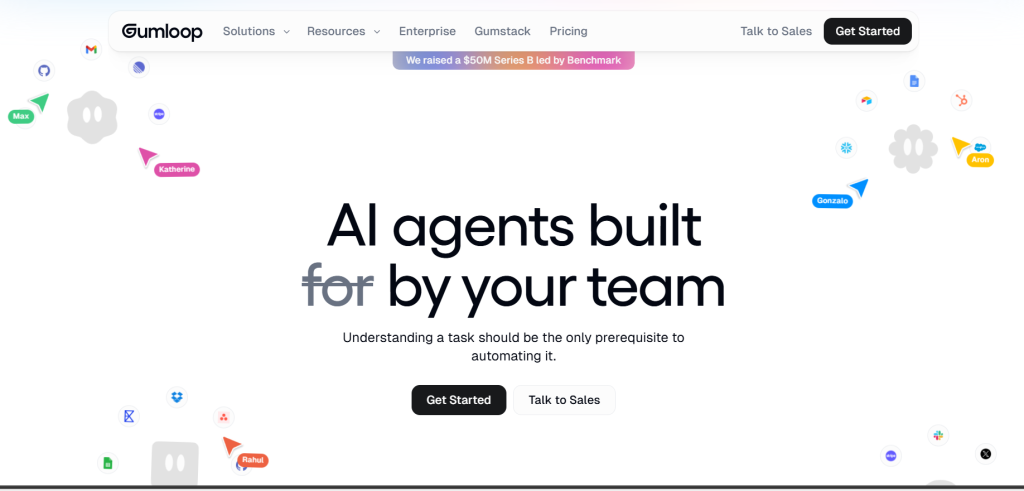
Gumloop is a no-code AI automation platform that helps teams build AI-powered workflows without writing code. It can connect AI models with business tools, making it useful for marketing, sales, operations, and research automation.
Strengths:
- No-code workflow builder
- Connects AI models with business apps
- Useful for fast automation experiments
- Good for non-technical teams
Best for: Teams that want to build AI workflows quickly without depending fully on developers. Teams using no-code AI automation tools also often look into the best data analytics bootcamp to better understand workflow data, reporting, and AI-driven decision-making.
AgentGPT
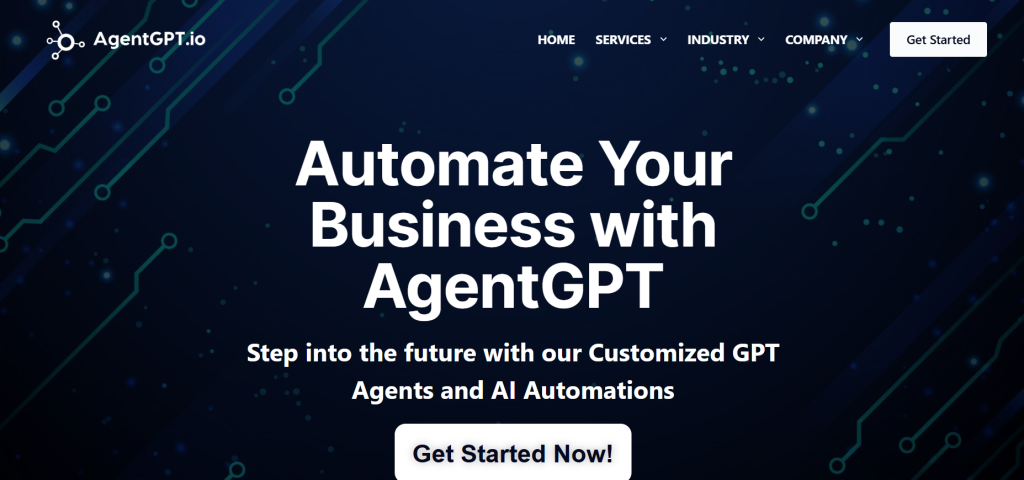
AgentGPT is a browser-based tool that lets users create and deploy autonomous AI agents by giving them a goal. The agent breaks the goal into tasks, executes them, and learns the results.
Strengths:
- Easy to use in the browser
- Good for experimenting with autonomous agents
- Useful for simple research and planning tasks
- Open-source and beginner-friendly
Best for: Beginners and small teams exploring autonomous AI agents for simple tasks.
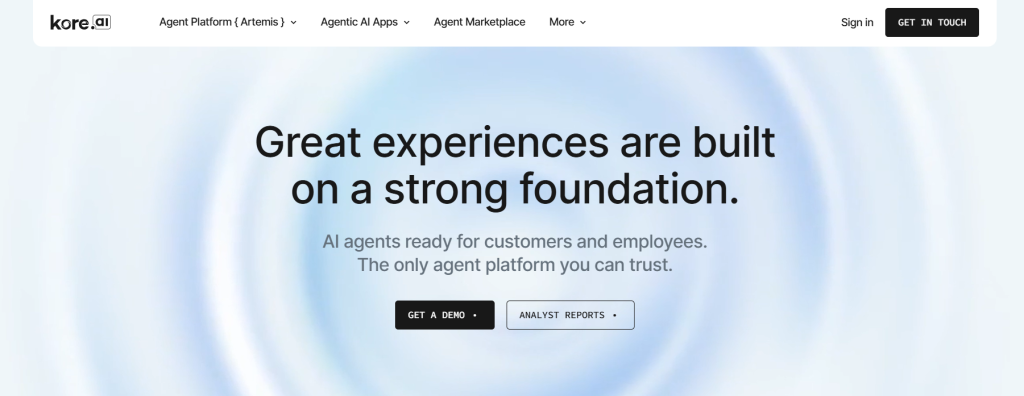
Kore.ai
Kore.ai is an enterprise AI agent platform for building, deploying, and managing customer support and business automation agents. It is widely used for service, banking, healthcare, retail, IT, and HR use cases.
Strengths:
- Strong focus on enterprise customer service automation
- Supports visual and code-based agent building
- Offers pre-built agents, templates, and integrations
- Includes observability, governance, and workflow orchestration
Best for: Enterprises building customer support, service, and industry-specific AI agents. Customer support and enterprise AI teams implementing these systems often go for the SAFe® Advanced Scrum Master Certification for AI-enabled workflow management.
Framework vs Platform vs No-Code Agentic AI Tool
Different types of agentic AI tools fit different team needs. Some offer full developer control, while others focus on speed, automation, and ease of use.
| Type | Best For | Technical Skill | Flexibility | Example Tools |
| Framework | Custom AI agent development | High | Very High | LangGraph, CrewAI, AutoGen |
| Platform | Enterprise AI automation | Medium | High | Salesforce Agentforce, UiPath |
| No-Code Tool | Fast workflow automation | Low | Medium | Gumloop, Copilot Studio |
Understanding workflow data and automation performance is also becoming an important skill for professionals pursuing a Data Analytics Certification.
How to Choose the Best Agentic AI Tool
Choosing the right agentic AI tool depends on your team size, technical skills, use case, security needs, and budget. A simple framework can help teams avoid choosing a tool that is either too complex or too limited.
Technical Skills
If your team has developers, frameworks like LangGraph, CrewAI, or AutoGen offer more control. If your team is non-technical, no-code tools like Gumloop or Copilot Studio are easier to start with.
This shift is also opening new career paths connected to Non-technical jobs in IT, where professionals manage AI workflows without deep programming knowledge.
Workflow Complexity
For simple tasks like content workflows or lead research, no-code tools may be enough. For multi-step orchestration, tool use, memory, and human approvals, developer frameworks or enterprise platforms are a better fit.
Governance and Security
Regulated industries need stronger controls around data, approvals, audit logs, and security. Enterprise platforms like IBM watsonx Orchestrate, Salesforce Agentforce, and UiPath are better suited for these needs.
Infrastructure Fit
Cloud-native teams can choose the most modern AI agent tools. Enterprises with on-premises or hybrid infrastructure should check deployment options, data access rules, and integration support before choosing.
Budget and Pricing
Open-source frameworks can reduce software cost but need developer time. Managed platforms cost more but offer support, governance, integrations, and faster deployment for business teams.
For teams trying to build stronger AI capabilities internally, programs like the Scrum Master Bootcamp with AI can help bridge the technical and operational gap.
Agentic AI Use Cases in 2026
Agentic AI is moving from simple chatbots to systems that can plan, act, and complete multi-step workflows with human oversight.
Customer Support
AI agents can handle support requests, check customer data, act, and escalate only complex cases to humans. For example, Wells Fargo’s virtual assistant Fargo completed over 242 million autonomous customer interactions, showing how agentic AI can scale customer service.
Software Development
In software teams, agentic AI helps write code, review pull requests, debug issues, generate documentation, and manage repetitive engineering tasks. Tools like GitHub Copilot, AutoGen, and LangGraph are commonly used to support developer workflows and multi-step coding tasks.
Its time to upgrade your analytics career with the industry-focused Data Analytics Bootcamp with AI today.
Sales Automation
Sales teams use AI agents to research leads, personalize outreach, update CRM records, send follow-ups, and recommend next-best actions. In education sales, CollegeVine’s Trellis AI recruiter was adopted by 95 partner institutions and supported over 500,000 student conversations.
Agile Workflow Management
Agentic AI can support backlog grooming, sprint planning, user story creation, dependency tracking, and project updates. Instead of only summarizing work, agents can check project status, identify blockers, suggest priorities, and notify the right team members automatically.
Agile teams adopting AI-assisted planning often explore SAFe® Scrum Master (6.0) Certification. This is to understand enterprise-scale AI-enabled Agile execution.
Conclusion
Agentic AI tools are changing how teams automate work, manage workflows, and improve productivity in 2026. But there is no single best tool for everyone. The right choice depends on your team’s technical skills, workflow complexity, infrastructure, governance needs, and budget.
The key is to choose a tool that fits your real business workflow, not just the latest trend. As agentic AI adoption grows, teams that choose the right platform early will have a major advantage in automation, efficiency, and operational scale.
Become job-ready for AI-driven analytics with the Data Analytics Bootcamp with AI. Apply today!
Frequently Asked Questions
1. What is the difference between LangGraph and CrewAI?
LangGraph is mainly used for building complex, stateful AI workflows with detailed orchestration control. CrewAI focuses more on collaboration between multiple AI agents with defined roles and tasks.
2. Can non-developers build AI agents?
Yes. No-code and low-code tools like Microsoft Copilot Studio and Gumloop allow non-developers to build AI agents using visual workflows and prebuilt integrations.
3. Which agentic AI tool is best for enterprises?
Enterprise teams commonly use tools like Salesforce Agentforce, UiPath Agent Platform, IBM watsonx Orchestrate, and Microsoft Copilot Studio because they offer governance, security, and enterprise integrations.
4. What is MCP in agentic AI?
MCP stands for Model Context Protocol. It is a standard that helps AI agents connect with external tools, data sources, and applications in a structured way.
5. What does it cost to deploy an AI agent?
The cost depends on the tool, AI model usage, infrastructure, and workflow complexity. Small no-code AI agents may cost a few hundred dollars per month, while enterprise deployments can cost significantly more.
