 Skip to content
Agile transformation fails when organizations mistake activity for progress. More standups, more sprint boards, and more Agile terminology do not automatically create agility.
We all have worked with teams that looked perfectly Agile from the outside but were internally struggling with slow decisions, leadership bottlenecks, conflicting priorities, and employee burnout. The ceremonies existed, but the mindset did not. That gap is the reason nearly half of Agile transformations fail.
Successful Agile transformation is not about copying Spotify models or implementing SAFe overnight. It is about building leadership alignment, empowering teams, redesigning governance, and focusing relentlessly on customer value.
This blog will show you where organizations fail, what successful enterprises do differently, and how to approach Agile transformation realistically instead of treating it like another management trend.
What is Agile Transformation?
Agile transformation is the process of changing how an organization works, delivers value, and responds to change using Agile principles. It is not just about using Scrum, Jira, or daily standups. A real Agile transformation changes team collaboration, leadership, decision-making, delivery processes, and company culture.
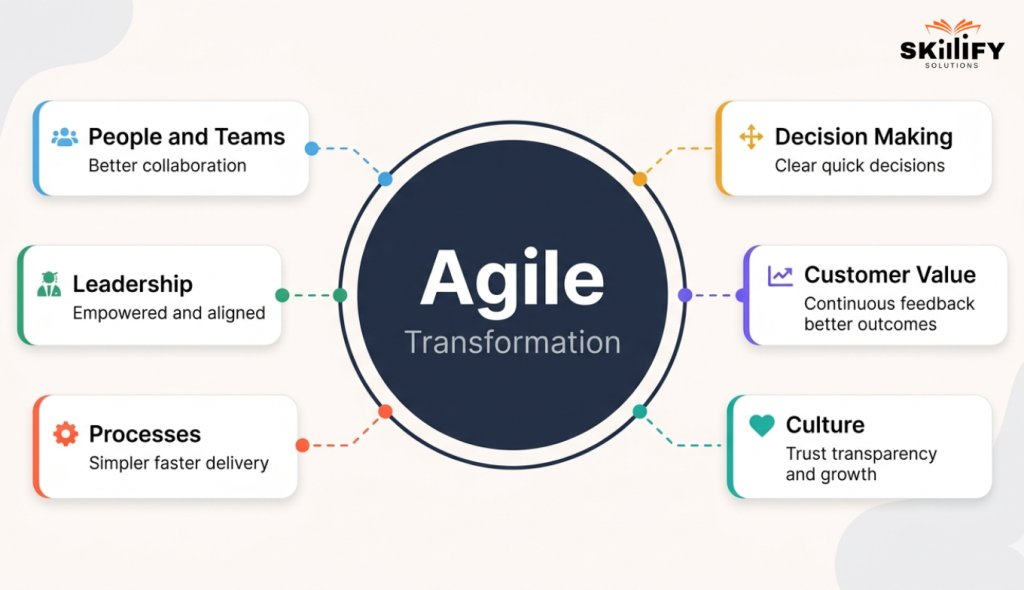
Many organizations fail because they adopt Agile practices at the team level while keeping traditional management structures and rigid workflows unchanged. Successful Agile transformation focuses on both mindset and organizational change.
Agile transformation impacts multiple areas of an organization, including team collaboration, leadership and governance, product delivery processes, customer feedback systems, and continuous improvement of culture. Its goal is to build business agility across departments so organizations can respond faster to market changes and customer needs.
Modern enterprises increasingly adopt Agile Methodology in Project Management to improve delivery flexibility, stakeholder collaboration, and faster response to changing business requirements.
Agile Transformation vs Agile Adoption: Key Differences
Many organizations confuse Agile adoption with Agile transformation, which often leads to failed Agile initiatives.
| Agile Adoption | Agile Transformation |
| Focuses on Agile practices and tools | Focuses on organizational and cultural change |
| Limited to development teams | Involves leadership, teams, and business units |
| Teams do Agile | Organization becomes Agile |
| Measures output and velocity | Measures business value and outcomes |
| Short-term process improvement | Long-term business agility |
Become an enterprise Agile leader with the Leading SAFe Certification program today.
What Successful Agile Transformation Looks Like
A successful Agile transformation creates alignment across teams, programs, and leadership to improve speed, collaboration, and value delivery.
| Level | What Success Looks Like |
| Team Level | Cross-functional teams deliver work in short iterations and continuously improve |
| Program Level | Multiple teams align through Agile Release Trains (ARTs) and shared goals |
| Portfolio Level | Leadership aligns strategy, funding, and governance with business outcomes |
The 4 Stages of Agile Transformation
Most Agile transformations succeed when organizations scale Agile gradually instead of forcing company-wide change at once. The transformation typically moves through four key stages: leadership alignment, pilot launches, enterprise scaling, and continuous improvement.
Stage 1: Inspire Change Through Leadership Alignment
The first stage focuses on creating awareness about why change is needed and securing executive support. Organizations identify business challenges, define transformation goals, and train leadership on Agile principles and mindset.
Strong leadership alignment is critical because most Agile transformations fail without executive commitment. Many enterprises start leadership alignment using programs like Leading SAFe Certification to help executives understand Lean-Agile leadership and Business Agility at scale.
Stage 2: Launch Agile Teams and Pilot ARTs
In this stage, organizations launch pilot Agile teams and initial Agile Release Trains (ARTs) to test Agile practices on a smaller scale. Teams begin working in sprint cycles, participating in Agile ceremonies, and improving collaboration through PI Planning and backlog management.
Stage 3: Scale Agile with SAFe, SPCs, and RTEs
Once pilot teams show positive results, organizations start scaling Agile across departments using frameworks like SAFe. This stage introduces roles such as SPCs and Release Train Engineers (RTEs) to improve coordination, cross-team collaboration, and enterprise-level alignment.
Certifications like SAFe Release Train Engineer (RTE) and SAFe Program Consultant (SPC) from Skillify Solutions are commonly used to prepare transformation leaders for enterprise-level Agile scaling.
Stage 4: Optimize Through Continuous Improvement
The final stage focuses on improving delivery performance, customer value, and organizational adaptability through continuous learning and feedback. Agile becomes part of the company culture, with teams regularly measuring outcomes, optimizing workflows, and driving continuous improvement.
Why Agile Transformations Fail
Many Agile transformations fail because organizations focus on Agile tools and frameworks while ignoring leadership, culture, mindset, and organizational change. Industry studies show that transformation failures are usually caused by people and process issues rather than technology problems.
1. Lack of Leadership Commitment and Executive Buy-In
Insufficient leadership commitment is one of the top reasons Agile transformations fail. According to McKinsey, nearly 63% of failed transformations are linked to weak executive support.
- Leaders support Agile verbally, but continue traditional management styles
- Teams receive mixed directions and priorities
- Decision-making remains slow and hierarchical
Build customer-focused Agile products with the SAFe Agile Product Manager certification now!
2. Treating Agile as a Process Instead of a Mindset
Many organizations treat Agile or SAFe as a checklist of ceremonies instead of a cultural and mindset shift. Building a strong Lean Agile Mindset helps organizations move beyond ceremonies and focus on collaboration, adaptability, customer value, and continuous improvement.
- Teams follow standups and sprint planning mechanically
- Collaboration and leadership behavior remain unchanged
- Focus stays on process compliance instead of adaptability
Teams that invest in practical Agile education programs, such as the Scrum Master Bootcamp, often build a stronger Agile mindset adoption instead of mechanically following ceremonies.
3. Ignoring Organizational Structure and Governance Changes
Agile transformation often fails when companies keep traditional hierarchies and siloed structures.
- Teams lack decision-making autonomy
- Governance and funding models stay rigid
- Cross-functional collaboration becomes difficult
4. Measuring Output Instead of Business Value
Many organizations measure velocity and story points instead of customer value and outcomes.
- Teams focus on completing more tasks
- Customer impact and business goals get ignored
- Productivity is prioritized over innovation and value delivery
5. Resistance to Cultural Change Across Teams
Agile changes how people work, collaborate, and communicate, which often creates resistance.
- Employees fear uncertainty and role changes
- Middle management may resist the loss of control
- Poor communication slows adoption across teams
6. Scaling Agile Without Proper Coaching or Training
- Organizations often scale Agile too quickly without investing in coaching and education.
- Teams adopt Agile terminology without understanding principles
- Agile practices become inconsistent across departments
- Leadership and teams struggle with alignment
Programs like SAFe Advanced Scrum Master (SASM) help Scrum Masters and Agile leaders improve facilitation, coaching, and cross-team collaboration during large-scale transformations.
7. Focusing on Tools Instead of Customer Outcomes
Many companies focus heavily on Agile tools and dashboards while ignoring customer value.
- Tools become the center of transformation efforts
- Customer feedback loops remain weak
- Business outcomes and adaptability are overlooked
Agile Transformation Roadmap: Step-by-Step Approach
Successful Agile transformations usually follow a gradual roadmap instead of forcing Agile across the entire organization at once. The focus should be on leadership alignment, pilot implementation, continuous improvement, and measurable business outcomes.
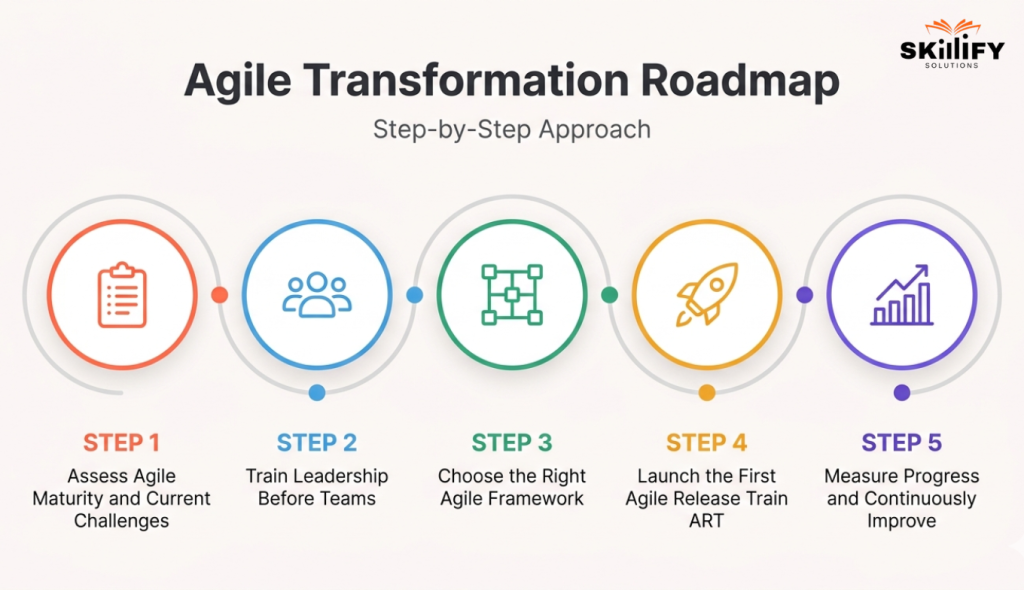
Step 1: Assess Agile Maturity and Current Challenges
The first step is assessing Agile maturity, team structure, workflows, and baseline metrics like delivery speed, customer satisfaction, and release cycles. This helps organizations identify bottlenecks and prioritize improvements.
For example, a healthcare company may discover that slow approvals and siloed teams are delaying product releases.
Become a high-impact Scrum leader with the practical Scrum Master Bootcamp program today!
Step 2: Train Leadership Before Teams
Executive coaching should happen before team-level Agile training because leadership behavior directly impacts the transformation of success. If leaders continue using traditional management styles, Agile teams struggle to adapt.
For example, many organizations fail because leadership still measures teams by deadlines and output instead of adaptability and customer value. Many organizations begin this phase with Leading SAFe Certification training to align executives, managers, and transformation leaders around Agile principles and enterprise agility.
Step 3: Choose the Right Agile Framework
Organizations should choose frameworks based on business size and complexity. SAFe works well for large enterprises, LeSS focuses on simplified large-scale Scrum, while Disciplined Agile offers flexible hybrid approaches.
For example, a global enterprise may choose SAFe for portfolio-level coordination, while a smaller product company may prefer LeSS for simpler scaling.
Step 4: Launch the First Agile Release Train (ART)
Most organizations begin scaling Agile by launching their first Agile Release Train (ART). This includes defining team roles, conducting PI Planning, aligning sprint goals, and setting a clear Definition of Done. These roles are often supported through the SAFe Advanced Scrum Master Certification.
For example, a retail company may first launch an ART for its e-commerce platform before scaling Agile across departments.
Step 5: Measure Progress and Continuously Improve
Agile transformation should be measured continuously using OKRs, flow metrics, customer outcomes, and employee sentiment instead of only velocity or story points.
Teams also improve delivery predictability by adopting modern Agile Estimation Techniques that focus on value, complexity, and sprint planning accuracy instead of unrealistic deadline-based estimation.
For example, a software company may track release frequency, employee engagement, and customer satisfaction to measure real business impact
SAFe vs LeSS vs Disciplined Agile: Which Framework is Right?
Choosing the right Agile framework depends on your organization’s size, structure, complexity, and business goals. While SAFe, LeSS, and Disciplined Agile all help scale Agile practices, each framework follows a different approach to team alignment, governance, and enterprise agility.
| Framework | Best For | Key Focus | Advantages | Challenges |
| SAFe (Scaled Agile Framework) | Large enterprises | Enterprise coordination and governance | Strong alignment, portfolio visibility, and cross-team collaboration | Can feel complex and process-heavy |
| LeSS (Large-Scale Scrum) | Product-focused organizations | Simplicity and Scrum scaling | Lightweight structure and strong team autonomy | Harder to manage at a very large scale |
| Disciplined Agile (DA) | Flexible and hybrid environments | Customized Agile ways of working | Highly adaptable and supports hybrid models | Requires experienced Agile leadership |
Agile Transformation Certifications by Role
Successful Agile transformations require skilled leaders, coaches, Scrum Masters, and change agents who understand Agile frameworks at scale. Certifications help professionals build practical knowledge in Agile leadership, Lean governance, PI Planning, Agile coaching, and enterprise transformation.
Different certifications are designed for different roles within an Agile transformation journey.
| Certification | Best For | Focus Areas | Career Benefit |
| Leading SAFe | Executives and change leaders | Lean-Agile leadership and Business Agility | Helps leaders drive Agile transformation |
| Scrum Master Bootcamp | Scrum Masters, team leads, and Agile beginners | Scrum framework, Agile mindset, team facilitation | Builds strong Agile execution and team collaboration skills |
| SAFe Advanced Scrum Master (SASM) | Scrum masters and team lead | Agile facilitation and team coaching | Improves Agile team execution |
| SAFe LPM | Portfolio managers and senior leadership | Lean governance, portfolio strategy, and funding alignment | Aligns business strategy with value delivery |
| SAFe Agile Product Manager | Product managers and business stakeholders | Customer-centric product strategy and Agile product delivery | Helps teams build value-driven products at scale |
Organizations investing in enterprise transformation often combine role-based learning with industry-recognized programs. Exploring the Top Agile Certifications can help leaders and teams choose the right certification path based on their transformation goals.
Conclusion
Agile transformation is not just about adopting Scrum, SAFe, or running daily standups. It is a long-term shift in how organizations lead teams, deliver value, and respond to change. Many transformations fail because companies focus only on processes and tools while ignoring leadership alignment, culture, governance, and customer outcomes.
Successful organizations approach Agile transformation step by step. They train leaders first, start with pilot teams, measure business value instead of output, and continuously improve through feedback and learning.
Ultimately, Agile transformation works best when organizations stop treating Agile as a project and start treating it as a cultural and business evolution.
Advance your Agile coaching skills through the SAFe Advanced Scrum Master (SASM) training today!
Frequently Asked Questions
1. How long does agile transformation take?
Agile transformation usually takes between 1 and 3 years, depending on the organization’s size, structure, and goals. Smaller companies may adapt faster, while large enterprises often require phased implementation and cultural change over time.
2. What is the role of leadership in agile transformation?
Leadership plays a critical role in Agile transformation by driving vision, removing organizational barriers, and supporting cultural change. Without executive alignment and continuous support, most Agile transformations struggle to succeed.
3. What is the difference between agile transformation and digital transformation?
Agile transformation focuses on improving how teams work, collaborate, and deliver value using Agile principles. Digital transformation focuses on using technology and digital solutions to improve business operations, customer experience, and innovation.
4. Which SAFe certification is best for transformation leaders?
The Leading SAFe and SAFe Advanced Scrum Master Certifications from Skilly Solutions are considered the best certifications for transformation leaders. These certifications focus on Lean-Agile leadership, enterprise transformation, and scaling Agile across organizations.
5. What metrics show agile transformation is working?
Successful Agile transformation is usually measured through faster delivery, improved customer satisfaction, better employee engagement, reduced cycle time, and stronger business outcomes.


