 Skip to content
How you split user stories directly affects sprint success, estimation accuracy, testing effort, and even team morale. A badly split story can block an entire sprint. A well-split story can create faster releases, cleaner feedback loops, and smoother Agile delivery.
I learned this after watching multiple teams repeatedly miss sprint goals even though development capacity looked perfectly fine on paper. The issue was hidden inside oversized stories packed with workflows, validations, dependencies, and edge cases. Once the team started splitting stories properly, sprint predictability improved almost immediately.
This blog is not another generic Agile theory guide. It breaks down 10 proven story splitting techniques with practical examples used by Scrum teams, product owners, and business analysts.
If your stories often feel too big, unclear, or hard to estimate, this blog will completely change how you approach sprint planning.
What is Story Splitting and Why Does it Matter for Agile Teams?
Story splitting is the Agile practice of breaking large user stories into smaller, manageable stories that can be designed, developed, tested, and delivered within a single sprint. Instead of building an entire feature at once, Agile teams divide work into smaller pieces that still provide usable business value.
This helps teams deliver faster, gather feedback earlier, and reduce delivery risk. Well-split stories improve sprint planning, estimation accuracy, collaboration, and release predictability. They also help teams avoid large unfinished stories that carry over multiple sprints.
Story splitting is one of the core practices covered in Agile team facilitation and delivery-focused programs like Certified Scrum Master (CSM) Certification.
In Scrum and other Agile frameworks, story splitting is essential because smaller stories make it easier to maintain continuous delivery and incremental product improvement.
Why some user stories become too large for a sprint
A user’s story usually becomes too large when it contains multiple workflows, business rules, interfaces, or technical dependencies inside a single requirement. These oversized stories are often called epics. They are difficult to estimate, difficult to test, and hard to complete within one sprint.
Large stories also slow down feedback cycles. Instead of delivering value incrementally, teams spend multiple sprints building different technical layers like backend, database, and frontend separately.
This creates dependencies and delays visible progress for stakeholders. Agile teams avoid this by splitting stories into smaller vertical slices that can independently deliver usable functionality.
Improve Agile estimation and backlog management with Certified Scrum Master (CSM) Certification today!
INVEST Criteria
The INVEST model is one of the most widely used frameworks for evaluating whether a user’s story is properly split and ready for development. According to INVEST, a good user story should be:
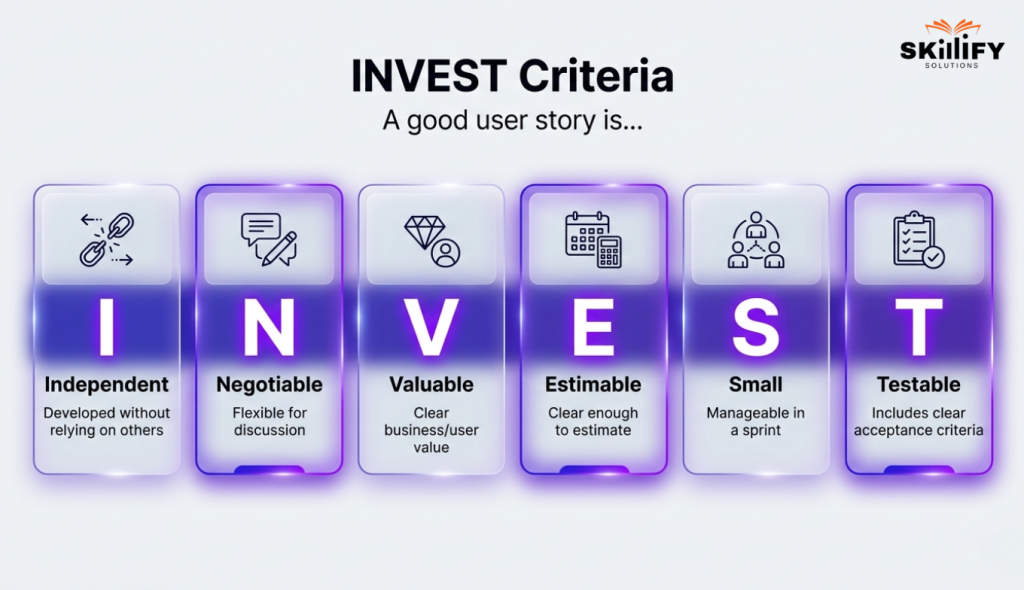
- Independent: It can be developed without relying heavily on another story
- Negotiable: Flexible enough for discussion and refinement
- Valuable: Delivers clear business or user value
- Estimable: Small and clear enough to estimate
- Small: Manageable within a sprint
- Testable: It includes clear acceptance criteria for validation
If a story fails multiple INVEST checks, it is usually a sign that the story is too large or incorrectly split. Agile teams often use INVEST during backlog refinement and sprint planning to validate their story quality before development begins.
The INVEST model is widely used in Agile backlog management workshops and advanced Agile training programs like SAFe POPM Certification.
Vertical slicing vs horizontal splitting in Agile
Vertical slicing delivers a small but complete working feature in a single story, while horizontal splitting separates work by technical layers like frontend, backend, or database. Let’s look at the difference below:
| Aspect | Vertical Slicing | Horizontal Splitting |
| Focus | Customer value | Technical layers |
| Structure | End-to-end functionality | Frontend, backend, database separated |
| Delivery | Working feature delivered early | Partial technical work delivered |
| Testing | Easier end-to-end testing | Testing delayed until integration |
| Feedback | Faster stakeholder feedback | Feedback comes later |
| Dependencies | Fewer team dependencies | Higher cross-team dependencies |
| Agile suitability | Highly recommended in Agile | Less preferred in Agile |
| Example | Login feature with UI, API, and validation | Only the login UI is completed first |
Vertical slicing is a foundational concept in the SAFe Methodology because it helps Agile Release Trains deliver continuous business value across teams and systems.
10 User Story Splitting Techniques with Examples
Story splitting techniques help Agile teams break large user stories into smaller, deliverable stories without losing business value. These story splitting techniques are commonly practiced during real-world sprint planning simulations in Scrum Master Bootcamp with practical lessons.
Below are some of the most widely used story splitting techniques used by Agile teams and business analysts.
1. Split stories by workflow steps
This technique splits a story according to different steps in the user workflow or customer journey. Instead of building the entire process together, teams deliver one stage at a time. This makes stories easier to estimate, test, and complete within a sprint. It also allows stakeholders to review progress incrementally.
For example, an online checkout feature can be divided into separate stories for adding products to the cart, entering a shipping address, selecting a payment method, and confirming the order. Each step becomes an independently deliverable story.
Workflow-based story splitting is especially important for Scrum teams managing iterative product delivery cycles and is frequently discussed in Advanced Scrum Product Owner Certification programs.
2. Split stories by business rules
This approach separates stories based on different business conditions, validation rules, or policies. When a story contains multiple rules, development and testing become difficult. Splitting business rules simplifies implementation and reduces confusion during sprint execution. It also helps teams prioritize the most important rules first.
For example, a loan approval feature may first support salaried employees, while later stories handle self-employed users, different credit score rules, or regional approval policies separately.
3. Split stories by data variations
This technique divides stories according to different data types, formats, or input scenarios supported by the application. Instead of building support for all variations together, teams deliver one format at a time. This reduces complexity and allows faster testing and validation. It is especially useful for systems handling multiple file types or user inputs.
For example, a file upload feature can first support PDF uploads, followed by image uploads, and later Excel or CSV file support in separate stories.
Strengthen Agile planning and product delivery with SAFe Product Owner/Product Manager Certification today!
4. Split stories by happy path first
In this technique, teams first focus on the simplest successful user flow before handling validations, errors, or edge cases. Delivering the happy path early helps teams release usable functionality faster and gather feedback sooner.
Complex scenarios can then be added incrementally through later stories. This approach improves sprint predictability and reduces delivery delays. This incremental delivery approach is widely followed in Agile Software Development to release usable functionality faster and gather early customer feedback.
For example, a login feature may initially allow users to log in with valid credentials only, while later stories add password validation errors, failed login handling, and multi-factor authentication.
5. Split stories by user roles
This technique separates stories according to user roles, permissions, or personas within the system. Different users often require different levels of access and functionality. Splitting by role keeps stories smaller and ensures each role receives focused functionality. It also simplifies testing and acceptance criteria.
Role-based story splitting becomes even more critical in scaled Agile environments where multiple stakeholders and teams collaborate across products, which is a key topic in SAFe Agilist Certification.
For example, a dashboard feature can first provide admin access, followed by manager dashboards and employee dashboards in separate stories.
6. Split stories by interface or platform
Stories can also be divided based on the platform or interface where the functionality will be used. Different platforms may require separate development and testing efforts. Splitting by interface helps teams release features incrementally across channels instead of waiting for all platforms to be completed together. It also improves development planning for cross-platform applications.
For example, a notification feature may first support web notifications, followed by mobile notifications and API-based notifications in later stories.
7. Split stories by performance requirements
This technique focuses on delivering working functionality before investing time in optimization and scalability improvements. Teams first ensure the feature works correctly and later improve speed, reliability, or performance targets through separate stories. This prevents optimization of work from delaying feature delivery. It also helps businesses start using the functionality earlier.
For example, a search feature may initially provide accurate search results, while later stories improve search speed, caching, and scalability for higher traffic loads.
8. Split stories by CRUD operations
CRUD-based splitting works well for systems that manage records and data operations. Instead of combining all operations into one large story, each operation becomes an individual deliverable. This reduces implementation complexity and makes testing more manageable. It also allows teams to prioritize the most important operations first.
For example, an employee management module can have separate stories for creating employee records, viewing profiles, updating details, and deleting records.
9. Split stories by quality improvements
In this approach, teams first release a functional solution and improve quality attributes later through additional stories. This helps deliver business value faster without waiting for perfect UI, advanced optimizations, or enhanced user experience elements. Refinements are added incrementally after the core functionality is stable. It supports faster Agile delivery cycles.
For example, a reporting dashboard may initially provide simple report generation, while later stories add filters, charts, improved UI, and export functionality.
10. Split stories using investigation spikes
A spike story is used when requirements, technical feasibility, or implementation approaches are unclear. Instead of directly starting development, the team first performs research within a limited timeframe. This reduces uncertainty and improves estimation accuracy for future stories.
Spike stories are commonly used for integrations, architecture decisions, or unfamiliar technologies. For example, before integrating a payment gateway, the team may first create a research spike to study API limitations, security requirements, and integration complexity before starting actual development.
Story Splitting Flowchart: How to Choose the Right Technique
A story splitting flowchart helps Agile teams identify the best way to split large user stories into smaller, sprint-ready stories. Instead of randomly dividing work, teams use the flowchart to understand the source of complexity and apply the right splitting technique while still delivering business value.
Many of these decision-making approaches are also used in the SAFe Methodology to manage backlog refinement and feature delivery across large Agile teams.
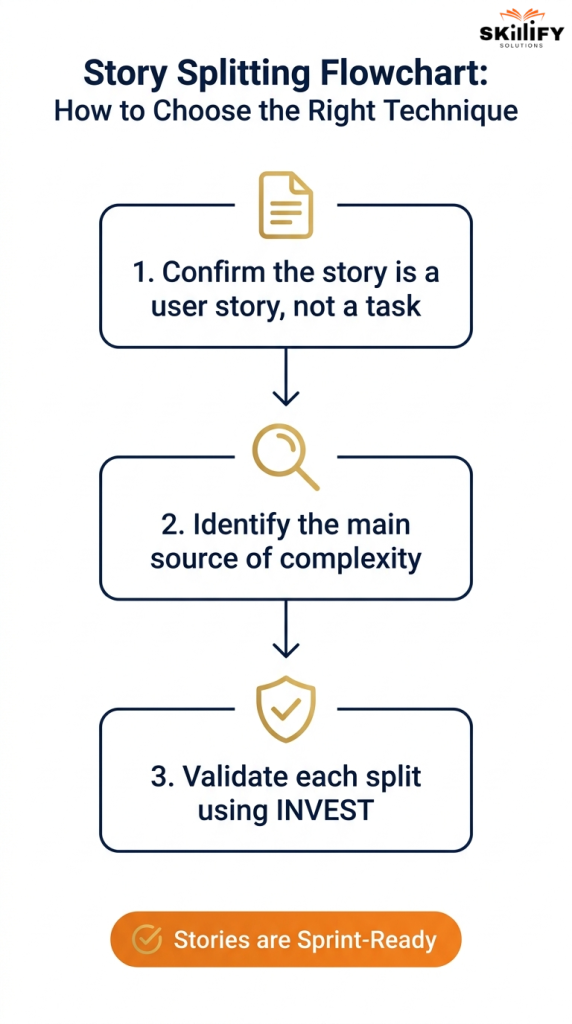
Step 1: Confirm the story is a user story, not a task
The first step is to confirm that the item is a proper user story and not just a technical task. A good user story should focus on customer or business value and should be clear enough for discussion and estimation.
Step 2: Identify the main source of complexity
Next, teams identify what makes the story too large, such as workflow complexity, business rules, user roles, interfaces, or data variations. Based on the complexity, they apply the most suitable story splitting technique.
Improve story splitting and sprint execution through Scrum Master Bootcamp practical training now!
Step 3: Validate each split using INVEST
After splitting the story, teams review the smaller stories using the INVEST criteria. Each story should be independent, valuable, estimable, small enough for a sprint, and testable before moving into development.
Agile coaches, Scrum Masters, and product owners often use similar decision-making frameworks during backlog refinement sessions taught in SAFe Advanced Scrum Master Certification.
How to Practice Story Splitting During Sprint Planning
Story splitting is usually practiced during backlog refinement and sprint planning sessions. Teams review large user stories, identify what makes them complex, and break them into smaller stories that can be completed within a sprint. Product owners, developers, testers, and Scrum Masters collaborate to ensure each split still delivers business value.
Agile teams often use techniques like workflow steps, happy path first, business rules, or CRUD operations during discussions. After splitting, teams validate the stories using the INVEST criteria to ensure they are small, testable, and ready for development. Proper story splitting improves sprint predictability, reduces carry-forward work, and helps teams deliver value incrementally.
Teams looking to improve sprint planning, backlog refinement, and estimation practices often build these practical Agile delivery skills through Professional SaFe Agile Product Management certification.
Common Story Splitting Mistakes in Agile Teams
Many Agile teams struggle with story splitting because they focus only on reducing size instead of delivering meaningful value. Poorly split stories often create dependencies, unclear requirements, and sprint delays.
Common story splitting mistakes include:
- Splitting by technical layers instead of customer value
- Creating tasks instead of user stories
- Making stories too large for one sprint
- Splitting stories without clear acceptance criteria
- Ignoring the INVEST model
- Creating highly dependent stories
- Combining multiple workflows into one story
- Skipping edge cases completely
- Delaying testing until all stories are finished
- Focusing only on size reduction instead of deliverable value
Teams preparing for Agile leadership and certification assessments often practice these backlog refinement approaches during SAFe Exam Preparation sessions and Agile workshops.
Conclusion
Story splitting is one of the most important Agile practices for delivering work consistently within a sprint. Instead of treating large features as single stories, Agile teams break them into smaller, valuable slices that are easier to estimate, develop, test, and release.
Techniques like workflow splitting, happy path first, CRUD operations, business rules, and spikes help teams reduce complexity without losing customer value.
When combined with the INVEST model, proper story splitting improves sprint predictability, faster feedback cycles, and smoother Agile delivery. The better a team becomes at splitting stories, the easier it becomes to maintain continuous delivery and build high-quality products incrementally.
Master Agile workflows and incremental delivery with Leading SAFe Certification courses today!
Frequently Asked Questions
1. Who is responsible for story splitting in an Agile team?
Story splitting is usually a collaborative responsibility shared by the product owner, Scrum Master, developers, testers, and business analysts. Agile teams typically perform story splitting during backlog refinement and sprint planning sessions together.
2. Can story splitting affect sprint velocity and estimation accuracy?
Yes, proper story splitting improves sprint velocity and estimation accuracy because smaller stories are easier to estimate, test, and complete within a sprint. Poorly split stories often lead to carry-forward work and inaccurate sprint planning.
3. How do you know if a user story is small enough?
A user story is considered small enough if it can be completed within a single sprint while still delivering business value. It should also satisfy the INVEST criteria and be easy to estimate and test.
4. What is a spike story in Agile?
A spike story is a time-boxed research or investigation task used when requirements or technical approaches are unclear. Agile teams use spikes to reduce uncertainty before starting actual development work.
5. How does story splitting differ from story decomposition?
Story splitting divides a large user story into smaller stories that still deliver customer value independently. Story decomposition usually breaks work into technical tasks or implementation activities after the story is already define.


