 Skip to content
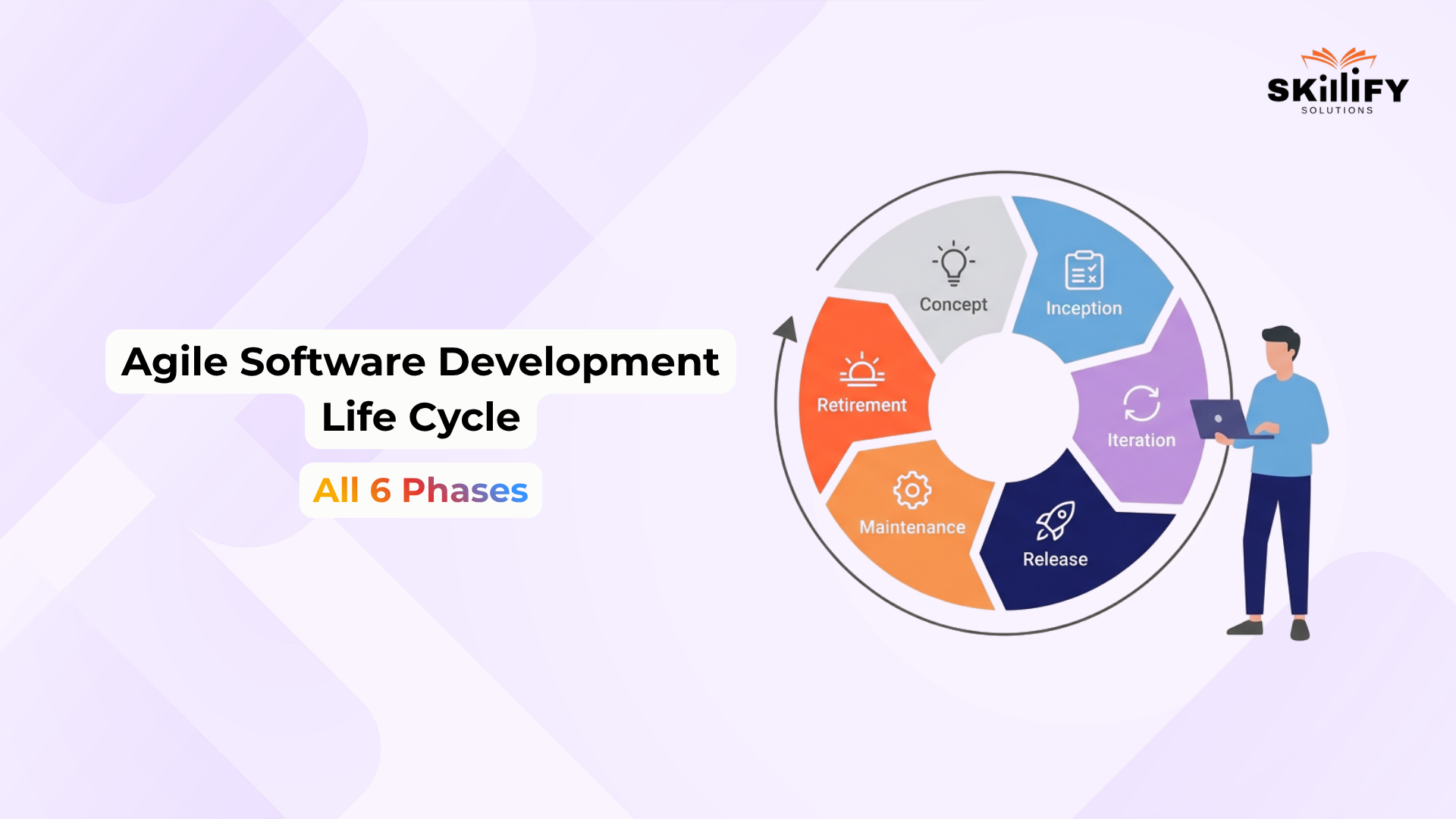
The Agile Software Development Life Cycle is a step-by-step process that helps teams plan, build, test, release, and improve software in short, continuous cycles. Instead of waiting until the end to check whether the product works, Agile teams validate progress throughout the development journey.
This matters because most software delays do not start with coding. They start with unclear goals, weak planning, late testing, poor communication, or feedback that comes too late. Agile SDLC solves this by breaking the project into manageable phases where every stage has a clear purpose.
From defining the product vision to planning sprints, developing features, releasing software, fixing bugs, and finally retiring outdated systems, Agile keeps teams aligned and flexible.
In this blog, we will explain the 6 phases of the Agile Software Development Life Cycle, key activities in each phase, and the tools teams use to deliver better software faster. Read on to know more!
What is the Agile Software Development Life Cycle (SDLC)?
The Agile Software Development Life Cycle (Agile SDLC) is a flexible, iterative approach to software development in which applications are built through small, continuous releases called sprints or iterations. Instead of developing the entire product at once, Agile focuses on delivering working software regularly, collecting feedback quickly, and improving the product throughout the development cycle.
To understand the broader concept behind this approach, you can also read our detailed guide to Agile Software Development, where we explain Agile principles and frameworks, and how teams use them in real projects.
Agile SDLC is designed to help teams adapt to changing business requirements, reduce development risks, improve collaboration, and release software faster. Teams work in short cycles that typically include planning, development, testing, review, and deployment.
Unlike traditional SDLC models such as Waterfall, Agile does not follow a rigid step-by-step process. In Agile, development, testing, and feedback happen continuously throughout the project.
Some of the most used Agile frameworks include Scrum, Kanban, SAFe, and Extreme Programming (XP). You can learn them practically from the SAFe Scrum Master Certification and understand how Agile works across teams, programs, and larger organizations.
Agile SDLC vs Waterfall SDLC: Key Differences
| Aspect | Agile SDLC | Waterfall SDLC |
| Development Approach | Iterative and incremental | Sequential and linear |
| Flexibility | Highly flexible to changes | Difficult to make changes after development starts |
| Delivery Style | Frequent small releases | One final release at the end |
| Customer Involvement | Continuous feedback and collaboration | Limited involvement after requirement gathering |
| Testing | Continuous testing during development | Testing happens after the development phase |
| Planning | Adaptive and sprint-based | Fixed planning at the beginning |
| Risk Management | Risks identified early through iterations | Risks discovered later in the cycle |
| Time to Market | Faster releases | Slower release cycles |
| Documentation | Lightweight and focused | Heavy documentation |
| Best For | Dynamic and fast-changing projects | Stable projects with fixed requirements |
Strengthen product strategy skills with SAFe 6.0 Agile Product Management Certification Training today!
Why Agile SDLC is Iterative Instead of Sequential
Agile SDLC is iterative because software is developed in short cycles where teams continuously build, test, review, and improve the product. This helps teams adapt quickly to changes and user feedback.
The Waterfall model is sequential because each phase follows a fixed order, such as planning, development, testing, and deployment. Changes are difficult once development begins, making it less flexible than Agile.
The 6 Phases of the Agile Software Development Life Cycle
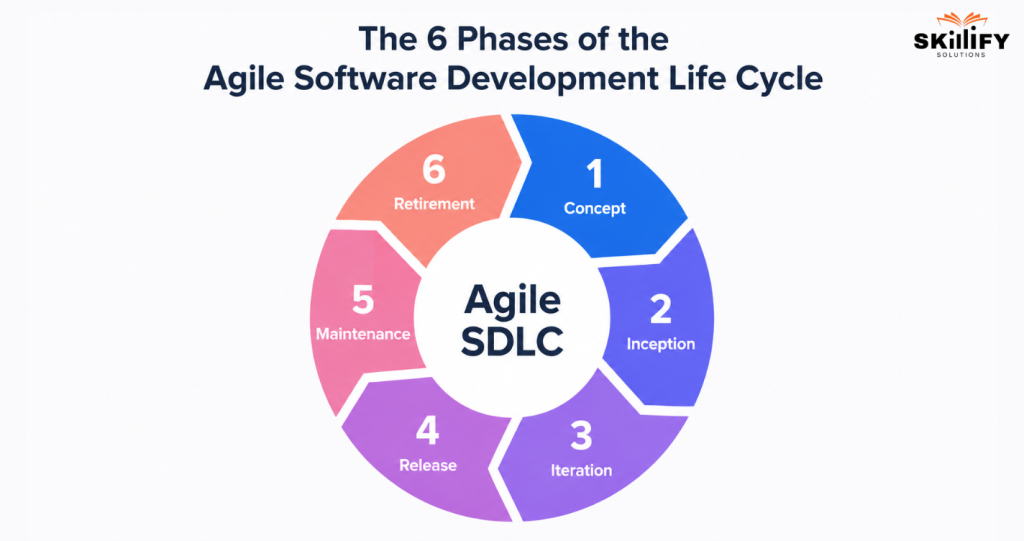
The Agile Software Development Life Cycle consists of six stages that help teams build, test, release, and improve software continuously. Unlike traditional development models, Agile focuses on short sprint cycles, continuous feedback, and iterative improvements.
Phase 1: Concept and Product Vision
The Concept phase is where the idea is evaluated before development begins. Teams define product vision, business goals, target users, estimated timeline, and project feasibility.
The focus at this stage is to validate whether the project is worth building and what business problems it will solve.
Key activities:
- Defining the product vision
- Identifying business goals and KPIs
- Estimating cost and timeline
- Conducting feasibility analysis
- Making the go/no-go decision
Outputs:
- Project charter
- Business case
- Initial feasibility assessment
Phase 2: Inception and Sprint Planning
In the Inception phase, the project moves from idea to execution planning. Teams are assembled, product requirements are discussed, and the initial backlog is created.
User stories, feature priorities, sprint plans, and design mockups are prepared before development starts.
Key activities:
- Building the Agile team
- Creating the product backlog
- Writing user stories
- Planning sprint cycles
- Preparing UI/UX mockups
Outputs:
- Initial product backlog
- Sprint roadmap
- User stories and prototypes
Phase 3: Iteration and Continuous Development
The Iteration phase is the core development stage of Agile SDLC. Teams work in short sprints where development, testing, integration, and feedback happen continuously.
Each sprint delivers a working software increment that is reviewed and improved in the next cycle.
Key activities:
- Sprint planning
- Software development
- Continuous testing
- Daily stand-ups
- Sprint reviews and retrospectives
Common tools:
- GitHub
- Jira
- Jenkins
- Selenium
- Postman
Outputs:
- Working software increment
- Updated backlog
- Sprint feedback and improvements
For developers who want to understand how Agile development works in real projects, a full-stack development bootcamp can be a useful starting point because it focuses on practical software development skills used during the iteration phase.
Phase 4: Release and Deployment
In the Release phase, the tested software is prepared for deployment. Teams conduct final QA checks, fix critical bugs, complete user acceptance testing (UAT), and prepare deployment documentation.
Many Agile teams also perform beta testing or soft launches before full production deployment.
Key activities:
- Final testing and bug fixing
- User Acceptance Testing (UAT)
- Deployment preparation
- Release documentation
- Performance validation
Outputs:
- Production-ready software
- Deployment plan
- UAT approval
Phase 5: Maintenance and Continuous Improvement
After deployment, the software enters the maintenance phase. Teams monitor system performance, fix bugs, improve features, and release updates based on user feedback.
Agile teams continuously improve the product instead of waiting for major release cycles.
Key activities:
- Monitoring application performance
- Fixing bugs and issues
- Releasing feature updates
- Collecting customer feedback
- Optimizing system performance
Common tools:
- Sentry
- Grafana
- Azure Monitor
- New Relic
Outputs:
- Bug fixes
- Product improvements
- Updated backlog items
Start your Agile career journey with a leading Scrum Master Bootcamp with AI today!
Phase 6: Retirement and Product Sunset
The Retirement phase begins when the software is no longer needed or is replaced by a newer system. Teams safely migrate to users, archive important data, and decommission the old application without disrupting operations.
Key activities:
- User migration
- Data archiving
- Infrastructure shutdown
- Compliance handling
- Product decommissioning
Outputs:
- Safe product retirement
- Archived system data
- Successful user transition
Tools Used in Each Agile SDLC Phase
Agile teams use different tools throughout the Software Development Life Cycle to manage projects, collaborate with teams, automate deployments, test applications, and monitor software performance. These tools help teams improve productivity, maintain software quality, and deliver applications faster.
| Tool Category | Tools | Used For | Common Agile SDLC Phases |
| Project Management and Collaboration | Jira, Trello, Confluence, Miro, Slack | Sprint planning, backlog management, documentation, brainstorming, and team communication | Concept, Inception, Iteration |
| Version Control and CI/CD | GitHub, GitLab, Jenkins, Docker, Kubernetes | Source code management, automated builds, CI/CD pipelines, containerized deployment | Iteration, Release |
| Testing and Monitoring | Selenium, Cypress, Postman, SonarQube, Grafana, Sentry | Automated testing, API testing, code quality checks, performance monitoring, error tracking | Iteration, Release, Maintenance |
How Testing Fits into Every Agile SDLC Phase
In Agile SDLC, testing starts early and continues throughout development. Instead of waiting until the end, teams test requirements, user stories, code, performance, and releases at every stage. This helps identify defects faster, reduce rework, and deliver better-quality software.
| Agile SDLC Phase | Testing Focus |
| Concept | Validate goals, risks, and user needs |
| Inception | Review user stories and acceptance criteria |
| Iteration | Run unit, API, integration, and regression tests |
| Release | Perform UAT, final QA, and performance testing |
| Maintenance | Monitor bugs, errors, and system performance |
| Retirement | Test data migration and system shutdown |
Build job-ready development skills with our leading Full Stack Development Bootcamp with AI now!
Shift-Left Testing in Agile Development
Shift-left testing means QA starts from the early planning stage, not after development. Testers help review requirements, define acceptance criteria, and identify risks before coding begins.
This prevents unclear requirements, reduces late-stage bugs, and improves software quality from the first sprint.
Continuous Testing in CI/CD Pipelines
During iteration, automated tests run whenever developers commit code. CI/CD pipelines help teams check builds, catch bugs early, and release stable software faster.
Common tests include unit tests, API tests, integration tests, regression tests, and security checks. If you want to understand how automation improves Agile testing speed, accuracy, and release confidence, read our guide on Agile Test Automation.
Agile SDLC in SAFe (Scaled Agile Framework)
In SAFe, the Agile SDLC is applied at a larger scale through a Program Increment (PI). A PI is a fixed planning cycle, usually 8 to 12 weeks, where multiple Agile teams plan, build, test, integrate, and deliver value together.
Instead of one team working through Agile phases, SAFe helps many teams follow the same rhythm across planning, development, release, feedback, and improvement. Here, Leading SAFe 6.0 Training becomes important because they focus on PI Planning, Agile Release Trains, team alignment, and value delivery at scale.
| Agile SDLC Phase | How It Maps in SAFe |
| Concept | Business goals, product vision, and roadmap are discussed |
| Inception | PI Planning defines features, dependencies, risks, and sprint goals |
| Iteration | Agile teams build and test features during iterations |
| Release | Integrated work is reviewed through System Demo |
| Maintenance | Feedback, defects, and improvements are added to the backlog |
| Retirement | Outdated features or systems are removed based on business need |
How PI Planning Fits into Agile SDLC
PI Planning acts like a combined Concept and Inception phase in SAFe. Teams discuss business priorities, define objectives, plan upcoming iterations, identify dependencies, and align on what needs to be delivered in the Program Increment.
It helps all teams start with a shared vision, clear priorities, and a realistic delivery plan. Product owners and managers involved in prioritization, roadmap planning, and feature delivery can explore SAFe 6.0 Agile Product Management to understand how product strategy connects with Agile execution.
System Demo, Inspect, and Adapt in Agile
The System Demo is like the Release phase because it shows the integrated, working software built during the PI. It helps stakeholders review progress and give feedback.
The Inspect & Adapt event aligns with the Maintenance and improvement phase. Teams review results, identify problems, analyze what went wrong, and decide what should improve in the next PI.
For large Agile teams, PI Planning becomes more effective when value streams are clearly identified. You can learn this concept in detail in our Study on SAFe Value Stream Mapping.
Common Agile SDLC Mistakes and How to Avoid Them
Agile can fail when teams follow the ceremonies but miss the mindset behind them. The goal is not just to run sprints or daily stand-ups, but to build better software through clear priorities, continuous feedback, testing, and improvement.
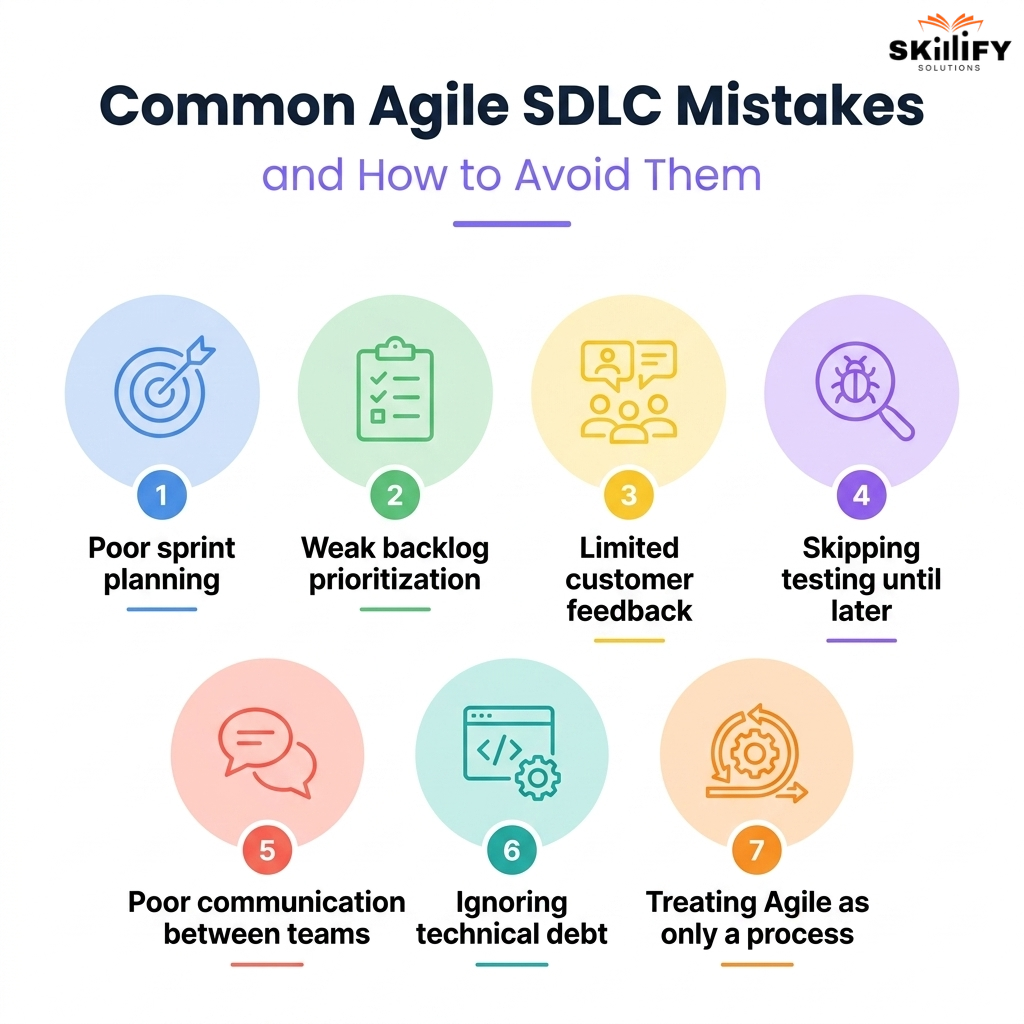
- Poor sprint planning: When sprint goals are unclear, teams lose direction, and deadlines get missed. To avoid this, define a clear sprint goal, break large tasks into smaller stories, and plan based on real team capacity.
- Weak backlog prioritization: If everything looks urgent, teams may spend time on low-value features. Product owners should regularly refine the backlog and prioritize work based on user value, business impact, and technical importance.
- Limited customer feedback: Agile depends on feedback. Without regular input from users or stakeholders, teams may build features that do not solve the real problem. Sprint reviews, user testing, and feedback sessions should be part of the process.
- Skipping testing until later: Delayed testing creates more bugs, rework, and release pressure. Agile teams should test continuously through unit tests, API tests, regression testing, and QA involvement from the early phases.
- Poor communication between teams: Agile needs strong collaboration. If developers, testers, designers, and product owners work in silos, blockers stay hidden. Daily stand-ups, clear ownership, and shared tools help teams stay aligned.
- Ignoring technical debt: Moving fast without refactoring or code reviews can make the product harder to maintain. Teams should include code quality checks, refactoring, and technical improvements in every sprint.
- Treating Agile as only a process: Agile is not just about meetings or tools. It is a mindset based on adaptability, collaboration, customer value, and continuous improvement.
- Teams should focus on outcomes, not just completing sprint tasks. Programs like SAFe Advanced Scrum Master can help professionals improve sprint planning, team communication, backlog discipline, and continuous improvement practices.
Conclusion
The Agile Software Development Life Cycle helps teams build software in a faster, smarter, and more flexible way. Instead of following a fixed step-by-step model, Agile allows teams to plan, develop, test, release, and improve software through continuous cycles.
Each phase, from Concept to Retirement, plays an important role in reducing risk, improving collaboration, and delivering value to users.
With the right tools, clear sprint planning, continuous testing, and regular feedback, Agile teams can build better products with fewer surprises.
The key is not just to follow Agile meetings or processes, but to use Agile as a system for learning, improving, and delivering working software consistently. This makes Agile SDLC a practical approach for modern software development.
Become a stronger Agile leader with SAFe 6.0 Advanced Scrum Master CertificationTraining today!
Frequently Asked Questions
1. What are the phases of the Agile SDLC?
The six phases of the Agile SDLC are Concept, Inception, Iteration, Release, Maintenance, and Retirement. These phases help teams plan, build, test, release, improve, and eventually retire software in a structured way.
2. How is Agile SDLC different from Waterfall?
Agile SDLC is iterative and flexible, while Waterfall is sequential and fixed. In Agile, teams build software in small cycles and take continuous feedback. In Waterfall, each phase is completed one after another, and changes are harder to make later.
3. What tools are used in the Agile development life cycle?
Common tools used in Agile SDLC include Jira, Trello, Confluence, GitHub, GitLab, Jenkins, Docker, Kubernetes, Selenium, Postman, SonarQube, Grafana, and Sentry. These tools help with planning, coding, testing, deployment, and monitoring.
4. What is an iteration in Agile SDLC?
An iteration in Agile SDLC is a short development cycle where teams plan, build, test, and review a small part of the software. Each iteration usually delivers a working software increment that can be improved in the next cycle.
5. How does SAFe fit into the Agile SDLC?
SAFe, or Scaled Agile Framework, helps large organizations apply Agile SDLC across multiple teams. SaFe certifications from Skillify Solutions teach program Increments, PI Planning, System Demos, and Inspect and Adapt sessions practically.
6. Can Agile SDLC be used for non-software projects?
Yes, Agile SDLC can be used for non-software projects. Teams in marketing, product design, operations, education, and business planning use Agile methods to manage work in short cycles, collect feedback, and improve continuously.


