 Skip to content
Key Highlights of SAFe Agile Ceremonies
- Understand SAFe Agile ceremonies and their role at scale.
- Explore the complete SAFe Agile ceremonies list with examples.
- Compare SAFe ceremonies and Scrum events across teams.
- Learn PI Planning SAFe, ART Sync SAFe, and coordination.
- Discover SAFe iteration planning, SAFe system demo, and outcomes.
- Improve delivery using SAFe inspect and adapt and SAFe ART ceremonies.
You can ask any team what slows delivery and the answers are usually familiar. Is it too many meetings, changing priorities, hidden dependencies, and work getting blocked halfway through execution.
Ironically, those are the exact problems SAFe ceremonies are built to solve. The goal isn’t more meetings, it’s better alignment. Each ceremony has a job to do: planning work, syncing teams, validating outcomes, or improving how delivery happens.
When teams understand that shift, ceremonies stop feeling like interruptions and start becoming decision-making moments.
In this blog, we’ll go beyond definitions and break down every SAFe Agile ceremony with timeboxes, attendees, purpose, outputs, and examples. This will help you know how these events work together to keep delivery moving at scale.
What Are SAFe Agile Ceremonies?
SAFe Agile ceremonies are structured, timeboxed events that help teams plan, align, execute, review, and improve work across the enterprise. Unlike standard Agile meetings that mostly operate at team level, SAFe ceremonies connect multiple teams, business stakeholders, and leadership through a shared operating rhythm.
Each ceremony has a defined purpose, participants, cadence, and expected output to maintain predictable delivery at scale.
These ceremonies act as coordination points across the Scaled Agile Framework (SAFe), ensuring work stays aligned with business goals while supporting transparency, faster feedback, and continuous improvement.
Rather than functioning as routine meetings, they create a repeatable cadence that helps organizations deliver value consistently. For organizations adopting SAFe, ceremonies often become a foundational part of larger Agile Transformation efforts by creating alignment across teams and business functions.
Why SAFe ceremonies create alignment and cadence
SAFe uses ceremonies to align teams around shared goals, manage dependencies, and maintain a consistent delivery rhythm. These events create regular checkpoints for planning, collaboration, feedback, and improvement.
SAFe events across Team, Program, Large Solution, and Portfolio levels
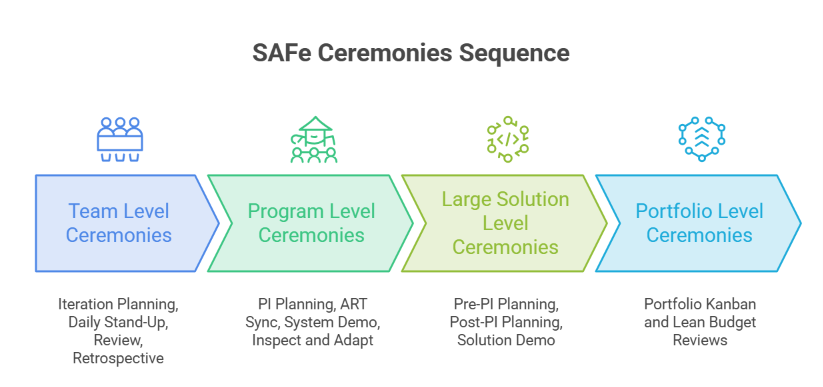
SAFe ceremonies operate across four levels to coordinate work at different scales:
- Team Level: Iteration Planning, Daily Stand-Up, Review, Retrospective
- Program Level: PI Planning, ART Sync, System Demo, Inspect and Adapt
- Large Solution Level: Pre-PI Planning, Post-PI Planning, Solution Demo
- Portfolio Level: Portfolio Kanban and Lean Budget Reviews
Build stronger team facilitation skills with SAFe Scrum Master Certification and learn practical approaches today!
SAFe Agile Ceremonies vs Scrum Events: What Changes at Scale?
SAFe extends Scrum events beyond a single team to align multiple teams, stakeholders, and business objectives at enterprise scale.
| Aspect | Scrum Events | SAFe Agile Ceremonies |
| Scope | Single Agile team | Multiple teams across the enterprise |
| Planning | Sprint Planning | Iteration Planning and PI Planning |
| Coordination | Team-level collaboration | Cross-team and ART coordination |
| Review | Sprint Review | Iteration Review and System Demo |
| Improvement | Sprint Retrospective | Retrospective and Inspect and Adapt |
| Cadence | Sprint cycles | Iteration and Program Increment cycles |
| Participants | Scrum Team | Teams, RTEs, Product Management, Stakeholders |
| Primary Goal | Deliver team outcomes | Deliver aligned business value at scale |
Professionals moving from Scrum to enterprise-scale execution often use SAFe Scrum Master Certification. This is to understand how team ceremonies expand into Program Increment and ART-level coordination.
SAFe Agile Ceremonies
You can refer to this quick-reference table to understand all major SAFe ceremonies. It includes their purpose, timing, participants, and expected outcomes.
| Ceremony | Typical Timebox | Key Attendees | Facilitator | Cadence | Primary Output |
| Iteration Planning | Up to 4 hours | Agile Team | Scrum Master | Every Iteration | Iteration goals and committed backlog |
| Daily Stand-Up | 15 minutes | Agile Team | Scrum Master or Team | Daily | Team alignment and issue visibility |
| Iteration Review | Up to 1 hour | Team, Stakeholders | Scrum Master | End of Iteration | Feedback on completed work |
| Iteration Retrospective | Up to 1.5 hours | Agile Team | Scrum Master | End of Iteration | Improvement actions |
| PI Planning | 2 days | ART members, Business Owners | RTE | Every Program Increment | PI objectives and committed plans |
| ART Sync | 30–60 minutes | RTE, Product Management, Team Representatives | RTE | Weekly | Dependency and risk alignment |
| System Demo | 60 minutes | ART, Stakeholders | RTE / Product Management | Every Iteration | Integrated solution feedback |
| Inspect and Adapt | Half to full day | ART members, Leadership | RTE | End of PI | Improvement backlog and actions |
| Pre-PI Planning | Varies | Solution stakeholders, ART leaders | Solution Train Engineer | Before PI | Cross-ART alignment |
| Post-PI Planning | Varies | Solution stakeholders | Solution Train Engineer | After PI Planning | Consolidated execution plan |
| Solution Demo | 60–90 minutes | Multiple ARTs, Stakeholders | Solution Management | Iteration cadence | End-to-end solution validation |
| Portfolio Kanban and Lean Budget Reviews | Varies | Portfolio Leadership, Epic Owners | LPM | Ongoing or periodic | Portfolio decisions and funding alignment |
Develop the skills to lead cross-team coordination and delivery with Release Train Engineer Certification today!
Team-Level SAFe Ceremonies: The 4 Core Iteration Events
Team-level ceremonies help Agile teams execute work consistently during each iteration while staying connected to Program Increment (PI) goals.
Iteration Planning
Iteration Planning turns PI priorities into short-term execution plans. Teams break features into stories, estimate effort, identify dependencies, and agree on iteration goals before work begins.
Example: A product team plans stories for user login, profile updates, and notifications to support the PI objective of improving customer engagement.
For teams looking to strengthen iteration execution, backlog alignment, and PI participation, SAFe® 6.0 for Teams (SP) Certification provides practical exposure to running iteration events effectively.
Daily Stand-Up
The Daily Stand-Up keeps working by surfacing blockers early and coordinating progress. In SAFe, discussions focus on flow, dependencies, and achieving iteration outcomes, not status reporting.
Example: During stand-up, the testing team flags an API delay, allowing developers to adjust priorities and avoid idle time.
Iteration Review
Iteration Review gives stakeholders visibility into working outcomes and validates whether delivered work meets expectations. Feedback collected here helps shape upcoming iteration priorities.
Example: The team demonstrates a new payment feature and receives stakeholder input before expanding functionality in the next iteration.
Teams often combine iteration planning with proven Agile Estimation Techniques to improve forecasting, manage capacity, and create more realistic commitments.
Iteration Retrospective
Iteration Retrospective focuses on improving how the team works. Teams review what helped delivery, what slowed progress, and commit to specific actions for the next iteration.
Example: The team notices repeated testing bottlenecks and decides to automate part of the testing process in the next iteration.
Program-Level SAFe Ceremonies: The 4 Events That Align Agile Release Trains
Program-level ceremonies keep Agile Release Trains aligned, synchronized, and focused on delivering value throughout the Program Increment.
PI Planning
PI Planning is the core SAFe alignment event where teams define objectives, identify dependencies, and create a shared plan for the upcoming Program Increment.
Example: An e-commerce ART plans the next PI and aligns checkout, payments, and mobile teams to launch one unified checkout experience.
Because PI Planning connects execution with customer outcomes, many organizations strengthen this process through strong Agile Product Management practices.
ART Sync
ART Sync helps teams coordinate progress, resolve dependencies, and maintain delivery alignment across the train.
Example: The API team delays an integration, so teams adjust priorities during ART Sync to avoid blocking release timelines.
System Demo
System Demo showcases integrated work across teams and validates whether delivered features create usable business value.
Example: Multiple teams demonstrate a complete customer onboarding journey working from end to end.
Organizations coordinating architecture decisions across multiple ARTs can extend these practices through SAFe for Architects Certification for better solution alignment and scalable design decisions.
Inspect and Adapt
Inspect and Adapt reviews PI outcomes and identifies actions to improve future delivery.
Example: Teams discover testing delays and decide to introduce automated regression testing in the next PI.
Large Solution and Portfolio SAFe Ceremonies
Large Solution and Portfolio ceremonies help organizations coordinate work beyond a single Agile Release Train (ART). These events improve alignment across teams, value streams, and business strategies to support large-scale delivery and investment decisions.
Pre-PI Planning
Pre-PI Planning happens before PI Planning and prepares multiple ARTs for coordinated execution. Leaders align priorities, review dependencies, identify constraints, and ensure teams enter PI Planning with a shared direction.
Example: Infrastructure, platform, and product teams align technical readiness before committing to a large digital transformation initiative.
Improve release quality, collaboration, and delivery speed with SAFe DevOps Certification Training for modern Agile teams!
Post-PI Planning
Post-PI Planning takes place after PI Planning to consolidate plans across ARTs and solution groups. Teams validate dependencies, adjust commitments, and finalize execution plans to reduce delivery risks.
Example: Two ARTs update delivery milestones after identifying a shared integration requirement that impacts release sequencing.
Since PI Planning sits at the center of SAFe execution, many Agile leaders build this capability through Leading SAFe® 6.0 Agilist Certification. This includes enterprise planning and ART alignment practices.
Solution Demo
Solution Demo demonstrates integrated outcomes created by multiple ARTs working together. Unlike a System Demo, the focus is validating the complete end-to-end solution and gathering stakeholder feedback before broader release of decisions.
Example: A banking solution demonstrates customer onboarding, identity verification, loan processing, and approval in one connected experience.
Portfolio Kanban and Lean Budget Reviews
Portfolio-level ceremonies help leadership evaluate strategic initiatives, prioritize investments, and govern funding continuously rather than through annual planning cycles. Decisions are guided by business outcomes, capacity, and value delivery.
Example: Leadership prioritizes expanding customer self-service capabilities and reallocates funding from lower-impact initiatives. To deepen portfolio governance, investment prioritization, and Lean budgeting practices, readers can explore SAFe® 6.0 Lean Portfolio Management Certification.
5 Common SAFe Ceremony Mistakes That Slow ART Delivery
Even well-designed SAFe ceremonies lose effectiveness when teams focus on process instead of outcomes. These common mistakes often reduce alignment, slow delivery, and create unnecessary friction across the ART.
- PI Planning becomes task-focused: Teams spend too much time assigning tasks instead of aligning business outcomes, dependencies, and PI objectives.
- Daily Stand-Ups turn into status meetings: Updates become manager-facing reports rather than quick team coordination sessions focused on removing blockers.
- ART Sync becomes reporting: Teams share progress but fail to actively resolve dependencies, risks, and cross-team issues.
- System Demos are skipped: Without regular integrated demonstrations; teams miss feedback opportunities and discover issues too late.
- Inspect and Adapt turns into blame sessions: Teams focus on assigning responsibility instead of identifying root causes and defining actionable improvements.
Many ceremony challenges appear during scaling journeys, which is why organizations often address them as part of a broader Agile Transformation roadmap.
Running SAFe Ceremonies in Remote Agile Teams
Remote SAFe ceremonies require stronger facilitation, clear communication, and structured collaboration to maintain alignment across distributed teams.
Remote PI Planning best practices
Successful remote PI Planning depends on preparation and participation. Share objectives early, use digital planning boards, define working agreements, and schedule collaboration sessions with clear outcomes to reduce coordination gaps.
Facilitating virtual ART Sync and System Demos
Keep ART Sync and System Demos short, focused, and interactive. Track dependencies visibly, encourage real-time decision-making, and use live demonstrations to maintain transparency and continuous feedback.
Which SAFe Certification Covers Which Ceremonies?
Different SAFe certifications focus on different ceremony levels based on the role of responsibilities in planning, execution, facilitation, and delivery.
| Certification | Main Ceremony Coverage | Focus Area |
| SAFe Scrum Master (SSM) | Iteration Planning, Daily Stand-Up, Review, Retrospective, PI Planning | Team execution |
| Leading SAFe (SA) | PI Planning, ART Sync, System Demo, Inspect and Adapt | Program and enterprise alignment |
| Release Train Engineer (RTE) | PI Planning, ART Sync, System Demo, Inspect and Adapt, Pre/Post-PI Planning | ART facilitation and coordination |
Conclusion
SAFe Agile ceremonies are more than recurring events on a calendar, they create the alignment, rhythm, and feedback loops needed to deliver value at scale. Each ceremony, whether at the Team, Program, Large Solution, or Portfolio level, plays a specific role in connecting planning, execution, collaboration, and continuous improvement.
When teams understand the purpose behind these events instead of treating them as routine meetings, ceremonies become a powerful way to reduce dependencies, improve visibility, and make delivery more predictable.
The goal is to run the right ones with clear outcomes. Done well, SAFe ceremonies help organizations move faster while staying aligned with business goals.
Improve planning, team alignment, and delivery outcomes with SAFe Certifications and built for modern Agile professionals!
Frequently Asked Questions
1. How many ceremonies are included in SAFe?
SAFe commonly includes 12 core ceremonies across Team, Program, Large Solution, and Portfolio levels.
2. What is the most important ceremony in SAFe?
PI Planning is often considered the most important SAFe ceremony because it aligns teams, objectives, and delivery plans across the Program Increment.
3. How is PI Planning different from Sprint Planning?
PI Planning aligns multiple teams for an entire Program Increment, while Sprint (Iteration) Planning focuses on one team’s work for a single iteration.
4. Who is responsible for facilitating SAFe ceremonies?
Facilitation depends on the ceremony and role, typically including Scrum Masters, Release Train Engineers (RTEs), Solution Train Engineers, and leaders.
5. Can SAFe Agile ceremonies be conducted remotely?
Yes. SAFe ceremonies can be conducted remotely using collaboration tools, digital boards, structured agendas, and virtual facilitation practices.afe-


