 Skip to content
A SAFe System Architect defines the technical vision, guides architecture across the Agile Release Train, and ensures teams build scalable, secure, and reliable systems.
But the real value of this role is not just in creating architecture diagrams. It is in preventing delivery chaos before it begins. In large SAFe environments, multiple Agile teams work on the same system, and one weak technical decision can quickly become a blocker for everyone.
We all have seen teams move fast in the beginning, only to slow down later because integrations, NFRs, or architectural runway were not planned properly.
That is where the System Architect becomes important. They connect business goals with technical execution, support PI Planning, guide enabler work, and help teams make decisions that hold up over time. This blog breaks down what they do, what they own, and how you can become one. Read on to know more!
What is a System Architect in SAFe?
A System Architect in SAFe is the technical leader responsible for defining, guiding, and communicating the architecture of the system being built by an Agile Release Train (ART). In simple terms, this person ensures that multiple Agile teams are not building disconnected pieces but are working toward a single clear technical direction.
The System Architect connects business needs with technical execution. They work closely with Product Management, the Release Train Engineer, Business Owners, and Agile Teams to make sure the solution is scalable, secure, maintainable, and ready for future changes.
The SAFe System Architect does not work like a traditional architect who only creates designs and passes them to teams. The role is more hands-on. They guide architectural decisions, support teams during delivery, manage the architectural runway, and help teams avoid technical problems before they slow down development.
Professionals who want to understand the SAFe structure before moving into architecture roles can begin with the Leading SAFe 6.0 Agilist Certification. It covers the core SAFe mindset, ARTs, and enterprise agility.
Where the System Architect Fits in an Agile Release Train
In SAFe, the System Architect works at the Agile Release Train (ART) level with two other key roles: the Product Manager and the Release Train Engineer (RTE). Together, they align business priorities, delivery execution, and technical direction.
- Product Manager: Decides what to build based on customer needs and business value.
- Release Train Engineer: Coordinates Agile teams, manages dependencies, and keeps the ART moving smoothly.
- System Architect: Defines how the system should be built, so it remains scalable, secure, reliable, and easy to maintain.
The System Architect plays a key role during Agile Transformation. They help multiple Agile teams stay technically aligned while the organization changes how it plans, builds, and delivers value.
System Architect vs Solution Architect vs Enterprise Architect
The terms System Architect, Solution Architect, and Enterprise Architect are often used together, but they do not mean the same thing. The difference mainly comes down to scope.
| Role | Scope | Key Responsibility | Main Goal |
| System Architect | ART or system level | Guides architecture for one system or ART | Build a scalable, reliable system |
| Solution Architect | Large solution level | Aligns architecture across multiple systems or ARTs | Ensure systems work together smoothly |
| Enterprise Architect | Organization level | Defines enterprise-wide technology direction | Align technology with business strategy |
Start leading enterprise Agile confidently with a Leading SAFe 6.0 Agilist Certification today!
Key Responsibilities of a SAFe System Architect
A SAFe System Architect owns the technical direction of the Agile Release Train. Their role is to keep architecture aligned with business goals, support Agile teams, and make sure the system can scale without slowing delivery.
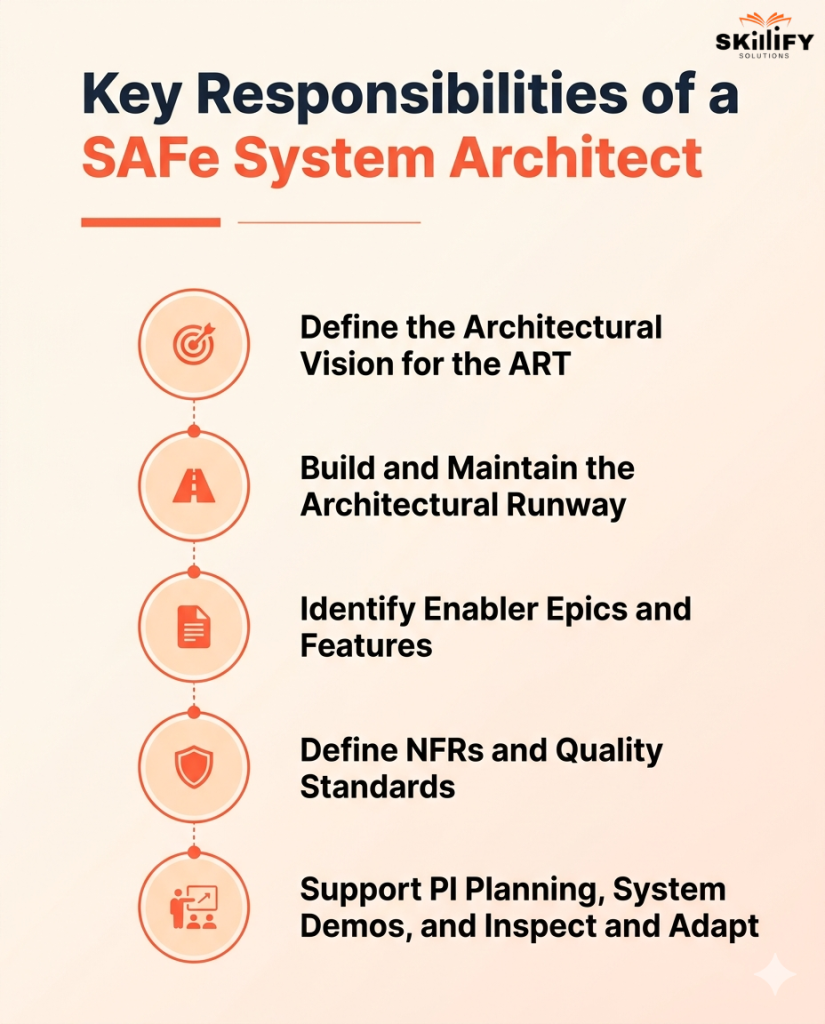
Define the Architectural Vision for the ART
The System Architect defines the architectural vision across the ART, so every Agile team understands the technical direction. This includes key design decisions, system constraints, integration needs, and future scalability requirements.
The goal is to make architecture clear, practical, and easy for teams to apply during delivery.
Build and Maintain the Architectural Runway
The Architectural Runway is the technical foundation that supports upcoming features. The System Architect manages this runway by identifying the infrastructure, design patterns, platforms, APIs, and technical capabilities teams will need in future PIs.
A strong runway prevents delivery of bottlenecks because teams do not have to stop mid-development to fix missing architecture.
Identify Enabler Epics and Feature
The System Architect identifies Enabler Epics and Features that support future business features. These may include architecture improvements, refactoring, infrastructure upgrades, technical exploration, security work, or compliance needs.
By placing them in the Program Kanban, the architect ensures technical work is visible, prioritized, and planned for business work.
Define NFRs and Quality Standards
The System Architect defines non-functional requirements, or NFRs, such as performance, security, reliability, scalability, usability, and compliance. These requirements guide how teams build the system, not just what they build. This helps maintain quality across teams and reduces the risk of technical gaps later.
For professionals who want deeper architecture-specific learning, SAFe 6.0 for Architects Certification Training is the most relevant course because it focuses on the architectural runway.
Support PI Planning, System Demos, and Inspect and Adapt
The System Architect actively participates in PI Planning, System Demos, and Inspect and Adapt as a technical leader. In PI Planning, they explain architectural priorities and dependencies.
In System Demos, they review whether the solution matches the architecture. In Inspect and Adapt, they help identify technical improvements for the next PI.
What Does a SAFe System Architect Do Day to Day?
The SAFe System Architect’s weekly work is a mix of architecture planning, team support, technical decision-making, and ART-level collaboration.
Working with Product Managers, RTEs, and Business Owners
The System Architect works with the Product Manager and RTE to align business goals, delivery flow, and technical direction.
- The Product Manager defines what needs to be built.
- RTE ensures teams are planned, aligned, and unblocked.
- The System Architect defines how the system should be built.
Supporting Team Backlog Refinement
- The System Architect joins backlog refinement to guide technical clarity without controlling every team-level decision.
- Helps teams understand technical dependencies.
- Clarifies NFRs, enablers, and architectural priorities.
- Supports teams in breaking down complex technical work.
- Avoid becoming the final approval point for every decision.
Balancing Team Autonomy with System-Level Architecture
The System Architect balances team-level flexibility with a clear system-level architecture direction.
- Teams can create local design solutions as they build.
- The architect ensures those solutions fit the larger system.
- Intentional architecture gives long-term technical direction.
- This balance helps teams move fast without creating technical debt.
Understand Agile team execution better with SAFe 6.0 for Teams Certification today!
Skills Required for a SAFe System Architect
A SAFe System Architect needs technical expertise, Agile leadership, and strong communication skills to guide teams and align architecture with business goals.
1. Technical Skills
- Designs scalable and reliable systems.
- Guides cloud, API, and integration decisions.
- Supports DevOps pipelines, CI/CD, and automation.
- Helps teams make architecture-ready technical choices.
Since the role requires DevOps pipelines, CI/CD, automation, and release readiness, you can go for a SAFe 6.0 DevOps Practitioner Certification.
2. Agile Leadership and Systems Thinking
- Guides teams without controlling every decision.
- Facilitates technical discussions across the ART.
- Uses systems to manage dependencies and risks.
- Encourage collaboration and continuous improvement.
3. Communication and Stakeholder Management
- Explains architecture in simple business language.
- Connects technical decisions with business outcomes.
- Shares risks, trade-offs, and dependencies clearly.
- Aligns teams, Product Management, RTEs, and leadership.
SAFe System Architect Salary and Job Market in the US
SAFe System Architect salaries in the US vary by experience, location, industry, and technical depth. Since most salary platforms track the broader Systems Architect role, the range below is a practical estimate for SAFe-related roles.
Average SAFe System Architect Salary by Experience
| Experience Level | Average Salary Range |
| Early-level System Architect | $130K–$174K |
| Mid-level System Architect | $137K–$180K |
| Senior SAFe System Architect | $167K–$185K+ |
| Enterprise roles | $180K+ |
Top Industries Hiring SAFe System Architects
SAFe System Architects are commonly hired in industries where large systems, compliance, security, and cross-team coordination are important. The strongest demand usually comes from finance, defense, healthcare, and technology companies.
This is because these industries often run large Agile Release Trains, manage complex platforms, and need architecture that supports scale, reliability, and regulatory requirements.
Become a stronger Agile leader with SAFe Advanced Scrum Master CertificationToday and lead in the future!
How to Become a SAFe System Architect
To become a SAFe System Architect, you need strong technical experience, practical Agile knowledge, and the ability to guide architecture across Agile Release Trains.
Prerequisites: Technical Background and Agile Experience
Before moving into this role, professionals should have:
- Strong experience in software architecture, system design, or enterprise technology.
- Working knowledge of Lean-Agile principles.
- Experience with Agile teams, ARTs, or PI Planning.
- Understanding DevOps, cloud, APIs, integrations, and NFRs.
- Ability to connect technical decisions with business value.
If you are still comparing learning paths, the Top Agile Certifications guide can help them understand which Agile or SAFe certification fits their current role and future goals.
Best SAFe Certifications for System Architects
The right SAFe certification depends on your current experience and career goals. These courses help build SAFe knowledge, architecture skills, and transform leadership capability.
| Certification | Best For | Why it Helps |
| Leading SAFe® Certification Training | Beginners in SAFe roles | Builds a foundation in SAFe, ARTs, PI Planning, and Lean-Agile principles. |
| SAFe® for Architects Certification Training | System, Solution, and Enterprise Architects | Covers architectural runway, enablers, NFRs, and architecture in PI execution. |
| SAFe® DevOps Practitioner Certification Training | Architects, DevOps, and technical leaders | Helps architects understand DevOps pipelines, continuous delivery, built-in quality, and release readiness. |
For professionals who want to strengthen DevOps, CI/CD, built-in quality, and release readiness, the SAFe DevOps Certification guide is a relevant next resource.
Career Path from System Architect to Solution or Enterprise Architect
A common career path starts with a strong technical role such as developer, tech lead, DevOps engineer, or software architect. From there, professionals can move into the SAFe System Architect role, where they guide architecture for one Agile Release Train.
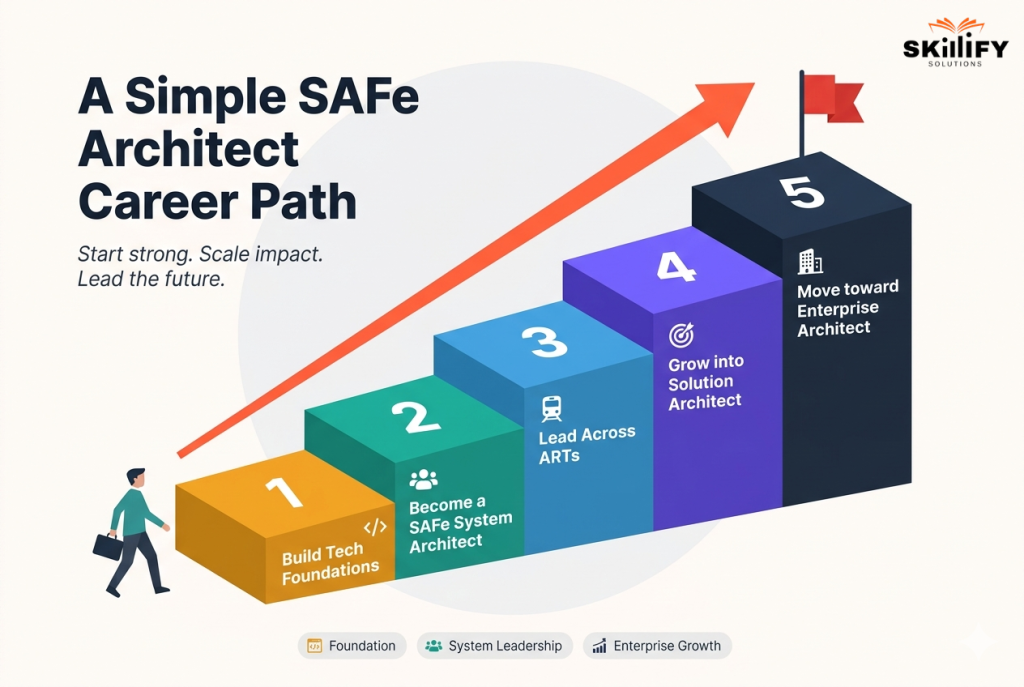
After gaining experience across multiple systems and ARTs, they can grow into a Solution Architect role. With broader business and technology strategy experience, the next step can be Enterprise Architect, where the focus shifts to organization-wide architecture direction, governance, and long-term technology alignment.
As professionals move from System Architect toward Solution Architect or Enterprise Architect roles, SAFe 6.0 for Architects Certification becomes especially useful. It is designed for system, solution, and enterprise architecture responsibilities.
Conclusion
The SAFe System Architect plays an important role in keeping large Agile systems technically strong and delivery-ready. They define the architectural vision, support the architectural runway, guide enabler work, and make sure teams follow important quality standards like security, scalability, performance, and reliability.
In SAFe, this role is not limited to planning architecture. The System Architect actively supports PI Planning, backlog refinement, System Demos, and Inspect and Adapt sessions. They work closely with Product Managers, RTEs, Business Owners, and Agile Teams to connect business goals with technical execution.
For professionals with a strong technical background and Agile experience, this can be a valuable career path toward Solution Architect and Enterprise Architect roles.
Choose your next growth path with our leading SAFe Certifications for Agile professionals today!
Frequently Asked Questions
1. What is the SAFe System Architect role?
A SAFe System Architect defines the technical vision for an Agile Release Train. They guide architecture decisions, support teams, manage the architectural runway, and make sure the system is scalable, secure, and reliable.
2. What is the architectural runway in SAFe?
The architectural runway is the existing technical foundation that supports upcoming features. It includes code, components, infrastructure, APIs, and design patterns that help teams build without major redesign or delay.
3. How does System Architect differ from Solution Architect?
A System Architect works at the ART or system level, while a Solution Architect works across larger solutions, often involving multiple systems or ARTs. In simple terms, the System Architect focuses on one system; the Solution Architect focuses on how multiple systems work together.
4. What certifications does a SAFe System Architect need?
Useful certifications include Leading SAFe, SAFe for Architects, and SAFe DevOps. Leading SAFe builds SAFe basics and SAFe for Architects from Skillify Solutions. It focuses on architecture in SAFe, and SAFe DevOps helps with continuous delivery and release readiness.
5. Is the System Architect a full-time role?
In most large SAFe environments, yes, the System Architect is usually a full-time role because they support ART planning, architecture decisions, enablers, NFRs, PI Planning, and ongoing technical alignment.
6. What is emergent design in SAFe?
Emergent design means the design evolves as Agile teams build and learn. Instead of deciding everything up front, teams improve the design based on feedback, while the architect keeps it aligned with the larger system direction.


