 Skip to content
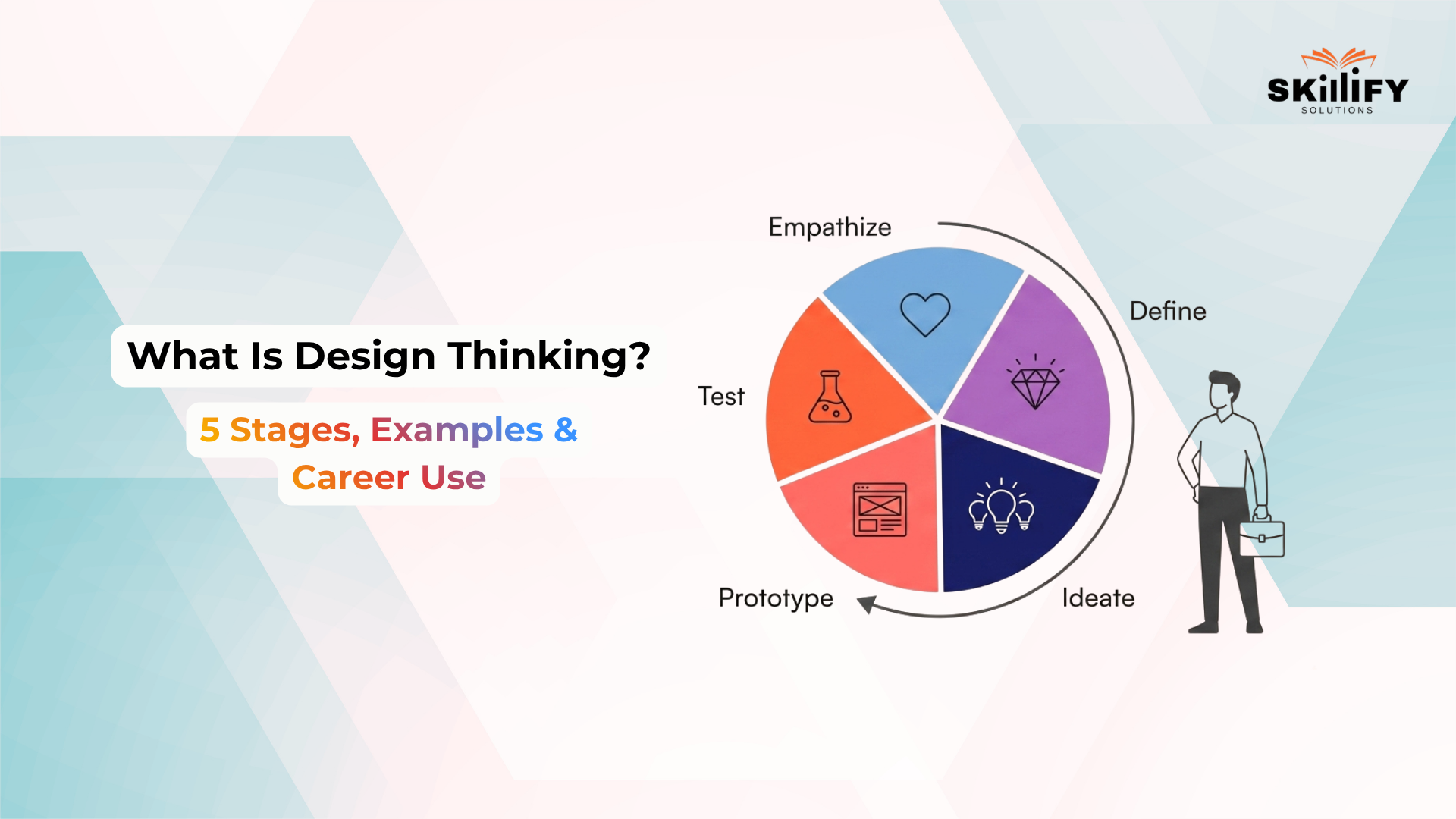
Design thinking is the difference between building what users ask for and discovering what they actually need.
Users may say they want a faster process, a cleaner interface, or more features. But the real problem may be trust, confusion, fear, delay, or lack of clarity. Design thinking helps teams uncover that deeper layer.
It does this through empathy, research, sharp problem framing, broad ideation, quick prototypes, and real user testing. Instead of launching with confidence based only on internal opinions, teams learn early and improve faster.
This is why design thinking is no longer limited to designers. It is now a valuable skill for product managers, UX teams, Agile coaches, business leaders, consultants, and innovation teams.
In this blog, we will explain What is design thinking, its 5 stages, examples, benefits, frameworks, and career impact. Let’s dive into it!
What is Design Thinking?
Design thinking is a human-centered problem-solving approach. It helps teams understand real user needs, define the right problem, create possible solutions, test them quickly, and improve them based on feedback.
The idea is often traced back to Herbert A. Simon, who discussed design as a structured way to solve problems in his 1969 book The Sciences of the Artificial. Later, IDEO made design thinking mainstream by turning it into a practical innovation method used by businesses, product teams, educators, and healthcare teams.
In simple words, design thinking is not just about making something look good. It is about making something useful, usable, and meaningful for the people who need it.
Build customer-focused product skills with SAFe Agile Product Management Certification today.
Why Design Thinking is Not Just for Designers
Design thinking is useful for anyone who solves problems for people. Product managers use it to build better features. Marketers use it to understand customers’ needs. HR teams use it to improve employee experience. Business leaders use it to reduce guesswork before making big decisions.
So, design thinking is not only about design skills. It is about understanding people, testing ideas, and improving solutions before scaling them.
Professionals who want to apply design thinking in product strategy, customer discovery, and roadmap planning can also explore the Product Management with AI Certification.
Design Thinking vs Critical Thinking vs Systems Thinking
Design thinking creates solutions; critical thinking evaluates ideas, and systems thinking looks at the bigger picture. Let’s see the main differences below.
| Approach | Focus | Best For | Key Question |
| Design Thinking | User needs and solutions | Products, services, innovation | What does the user really need? |
| Critical Thinking | Logic, facts, and evidence | Decision-making and analysis | Is this idea valid? |
| Systems Thinking | Connections and impact | Complex business or tech systems | How does this affect the whole system? |
The 5 Stages of the Design Thinking Process
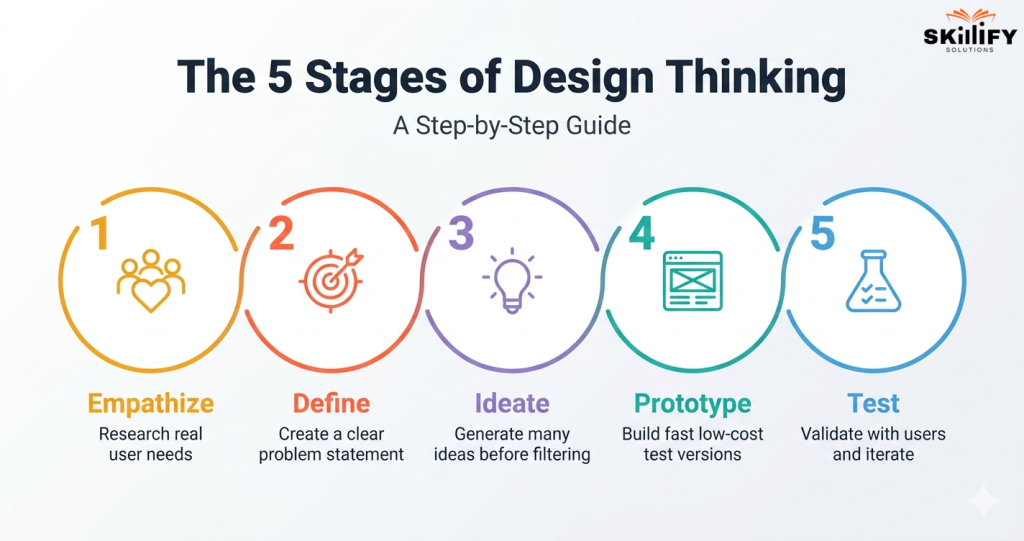
The design thinking process has five key stages: Empathize, Define, Ideate, Prototype, and Test. These stages help teams move from understanding users to building and improving solutions. However, design thinking is not always linear. Teams may go back to earlier stages whenever testing reveals new insights.
Stage 1: Empathize with Real User Needs
The first stage is to understand users deeply. Teams observe users, interview them, study their environment, and learn about their problems, motivations, and behaviors. The goal is to avoid assumptions and discover what users actually need.
Stage 2: Define the Core Problem
In this stage, teams organize research findings and identify core problems. A good problem statement should be user-centered, not company-centered. For example, instead of saying “We need more sales,” the team should define what users are struggling with and why.
This stage is especially important for Product Owners and Product Managers. An AI-Empowered SAFe POPM Certification can help professionals convert customer problems into Features, Stories, priorities, and PI objectives.
Stage 3: Ideate Multiple Solutions
Once the problem is clear, teams brainstorm many possible solutions. At this stage, quantity matters before quality. The aim is to challenge assumptions, explore different angles, and avoid choosing the first obvious idea too early.
During ideation, Design thinking tools like brainstorming, empathy maps, journey maps, and prototypes help teams move from vague ideas to testable solutions.
Stage 4: Prototype Fast and Cheap
A prototype is a simple version of the solution. It can be a sketch, wireframe, mockup, sample flow, or basic model. The goal is not perfection. The goal is to test the idea quickly before investing too much time, money, or development effort.
Stage 5: Test, Learn, and Iterate
In the test stage, real users interact with the prototype and give feedback. Their responses help teams understand what works, what fails, and what needs improvement. Testing often sends teams back to redefine the problem, generate new ideas, or improve the prototype. This is why design thinking is an ongoing loop, not a one-time process.
Since design thinking begins with customer discovery and problem framing, the SAFe Agile Product Management Certification is a strong fit for professionals. It will help them to connect user research, product strategy, and continuous value delivery.
Design Thinking Frameworks Compared
Different teams use different design thinking frameworks, but the goal is the same: understand users, define the right problem, explore ideas, prototype solutions, and test with feedback. The main difference is how each framework structures the journey.
| Framework | Stages | Best For | Main Strength |
| Stanford d.school | Empathize, Define, Ideate, Prototype, Test | Product, UX, Agile, education, innovation teams | Clear step-by-step process |
| IDEO | Inspiration, Ideation, Implementation | Business innovation, service design, social impact | Simple and action-focused |
| Double Diamond | Discover, Define, Develop, Deliver | Strategy, policy, service design, UK/European teams | Strong problem framing |
Stanford d.school 5-Stage Model
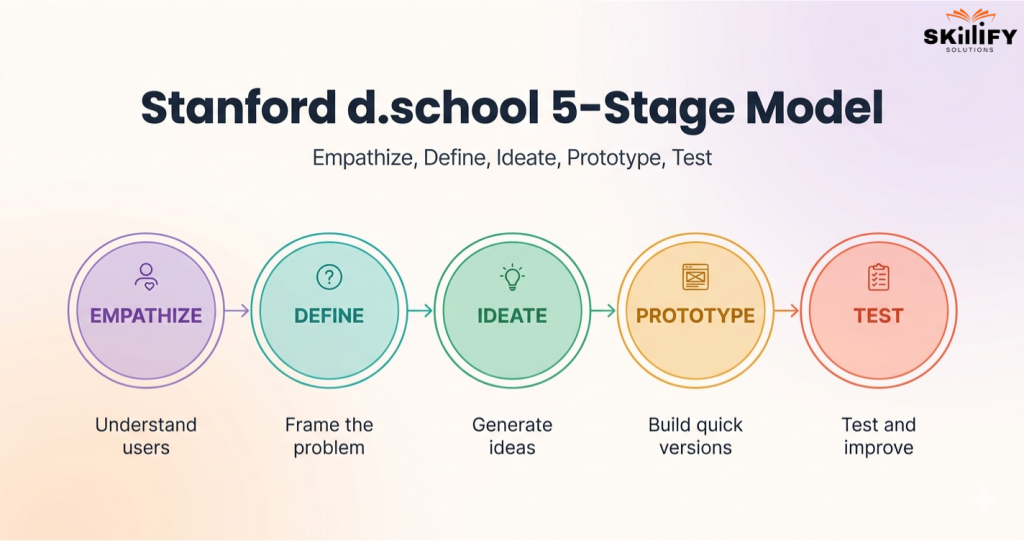
The Stanford d.school model follows five stages: Empathize, Define, Ideate, Prototype, and Test. It is best for teams that need a clear, beginner-friendly process to understand users, frame problems, build quick prototypes, and test solutions.
Start your product career journey with Product Management with AI Certification today and excel in future!
IDEO Model: Inspiration, Ideation, Implementation
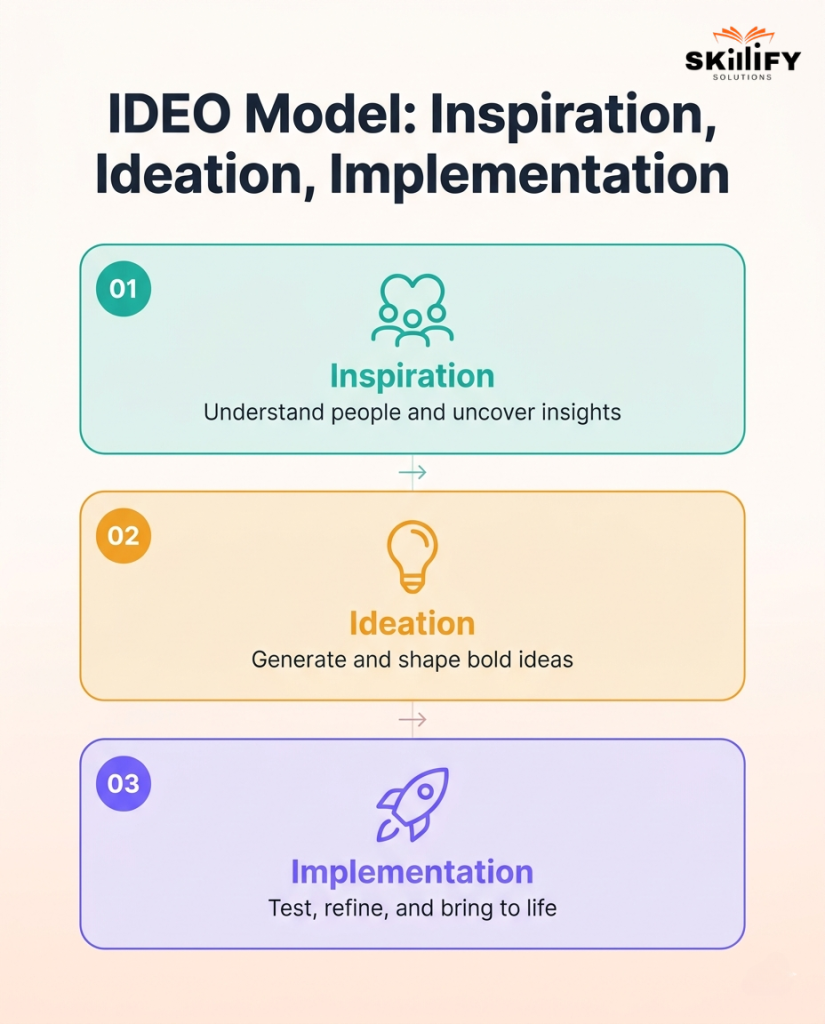
The IDEO model has three broad stages: Inspiration, Ideation, and Implementation. It is useful for business innovation and service design because it keeps the process simple: understand the opportunity, create ideas, and bring the best solution to life.
Double Diamond: Discover, Define, Develop, Deliver
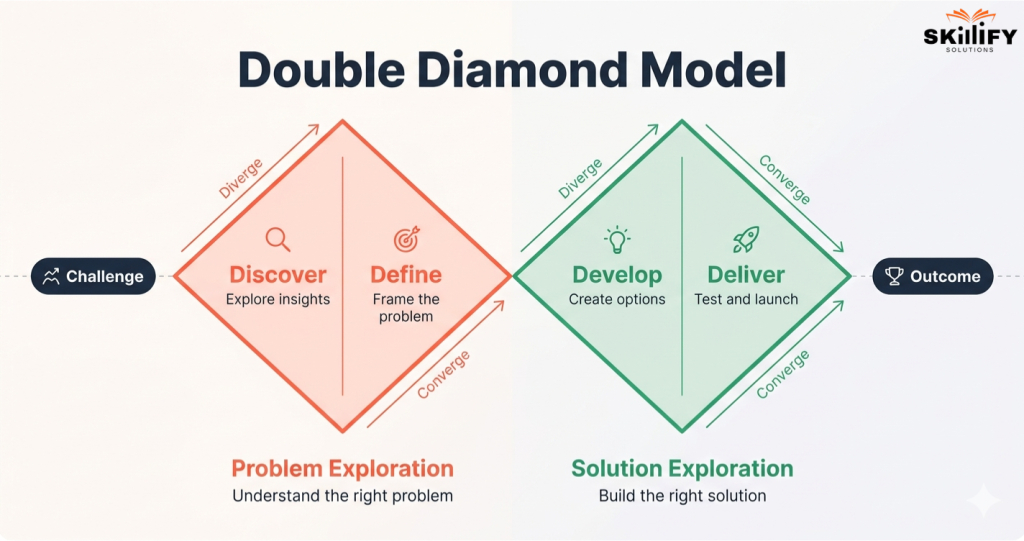
The Double Diamond model has four stages: Discover, Define, Develop, and Deliver. It is often used in strategy and service design because it clearly separates problem discovery from solution development, helping teams avoid solving the wrong problem.
Real-World Design Thinking Examples`
Real companies use design thinking to understand users better, test faster, and solve problems that data alone may not reveal.
Airbnb: Using Empathy to Improve the Customer Experience
In 2009, Airbnb was stuck at around $200 per week in revenue. The founders visited hosts and found that many listings had poor-quality photos. After personally improving photos for 24 New York listings, weekly revenue doubled to around $400.
Key lesson:
- Empathy revealed the trust problem.
- Better photos made listings feel safer.
- A small test created a measurable business impact.
IBM: Scaling Enterprise Design Thinking Across Teams
IBM scaled design thinking across large teams to improve collaboration, reduce rework, and build user outcomes. A Forrester study reported that IBM Design Thinking helped teams get to market 2x faster, reduce design and development time by up to 75%, and move release cycles from 6–8 months to 3-4 months.
Here is the key lesson:
- Cross-functional teams aligned faster.
- Prototypes reduced wasted effort.
- User-centered decisions improved speed.
PillPack: Simplifying the Pharmacy Experience for Patients
PillPack simplified medication management for patients with multiple prescriptions. It organized medicines into easy dose packets, improved refills, and reduced pharmacy friction. Amazon acquired PillPack in 2018 for just under $1 billion.
Key lesson:
- PillPack solves a daily patient pain point.
- Simple packaging improved usability.
- A better healthcare experience created major business value.
Design Thinking in Agile and SAFe
Design thinking and Agile work well together because both focus on customer needs, fast feedback, and continuous improvement. In SAFe, design thinking supports Agile Product Delivery by helping teams build solutions that are desirable, feasible, viable, and sustainable.
How Design Thinking Supports Customer Discovery
The Empathize and Define stages help teams understand users before planning features. In SAFe PI Planning, this supports customer discovery because teams need to know the real problem before deciding what to build.
How Prototyping and Testing Fit Agile Iterations`
The Prototype and Test stages fit naturally into Agile sprints. Teams build small versions of an idea, test them with users, collect feedback, and improve the solution in the next iteration or sprint review.
In enterprise Agile environments, the Leading SAFe 6.0 Certification will help connect design thinking with Lean-Agile principles, Agile Release Trains, and value delivery at scale.
How Product Managers Use Design Thinking for Features and Stories
Product Managers use design thinking to turn user problems into clear Features and Stories. SAFe notes that Agile teams use design thinking techniques to create desirable features, while Product Management defines solutions that meet customer needs.
Design thinking helps Product Managers write better work items by clarifying:
- Who the user is
- What problem do they face
- Why the solution matters
- What outcome should the feature create
Product Managers who use design thinking can also explore Agile Product Management. Here, decisions are driven by customer feedback, data, and continuous learning.
Design Thinking Career Impact
Design thinking is now a useful career skill across product, UX, Agile, business, and innovation roles. Companies value it because it helps professionals understand users, solve the right problems, and build solutions with faster feedback.
Learners who want to grow in Agile, product, or transformation roles can explore leading SAFe Certifications. These will help to strengthen feature prioritization, roadmap thinking, and customer-led decisions.
Jobs That Use Design Thinking Skills
Design thinking skills are useful across roles that involve users, products, services, or business problem-solving. Let’s understand how design thinking helps the role and their average salary range.
| Role | How Design Thinking Helps | Average US Salary |
| UX Designer | Understands user pain points and improves product experience. | $112K/year |
| Product Manager | Converts customer needs into better features and roadmaps. | $194K/year |
| Innovation Consultant | Solves business problems through research, ideation, and prototyping. | $194K/year |
| Agile Coach | Helps teams build with customer feedback and continuous improvement. | $113K/year |
Improve sprint outcomes with AI-Empowered SAFe Scrum Master Certification Today!
Salary Impact of Design Thinking Skills
According to Harvard Business School Online, marketing manager roles that require design thinking skills show a median salary of $133,900, compared to $107,900 for general marketing manager roles. That is a 24% salary increase, showing how design thinking can improve career value.
How Certifications Build Design Thinking Capability
SAFe certifications connect design thinking with Agile execution. They help professionals understand customer needs, define valuable work, prioritize features, and deliver solutions through fast feedback loops.
| Certification | Design Thinking Connection |
| SAFe POPM Certification | Helps Product Owners and Product Managers convert user needs into Features, Stories, priorities, and PI objectives. |
| Leading SAFe Certification | Helps leaders build customer-focused Agile teams that align work with business value and continuous improvement. |
| SAFe Agile Product Management | Supports deeper customer discovery, product strategy, road mapping, and market-driven decision-making. |
Conclusion
It can be concluded that Design thinking is a simple but powerful way to solve problems by understanding people first. Instead of guessing what users need, it helps teams research, define the right problem, create ideas, build quick prototypes, and test with real feedback.
The five stages make the process practical and repeatable. Frameworks like Stanford d.school, IDEO, and Double Diamond give teams different ways to apply the same human-centered approach. Design thinking has helped companies solve real problems and create better experiences.
It is also useful for careers in UX, product management, Agile, innovation, and business strategy. In short, design thinking helps you build solutions that people actually need, not just ideas that look good on paper.
Explore all our leading SAFe® Certifications and build skills for enterprise Agile leadership now!
Frequently Asked Questions
1. How is design thinking different from Agile?
Design thinking helps teams decide what problem to solve by understanding users. Agile helps teams decide how to build and deliver the solution quickly through iterations.
2. Can I learn design thinking without a design background?
Yes. Design thinking is not only for designers. It is a user-centered problem-solving approach that can be used by product managers, marketers, business teams, educators, and leaders.
3. What certifications teach design thinking?
Certifications related to product management, Agile Product Management, SAFe POPM, and Leading SAFe by Skillify Solutions teach design thinking principles. It is through user research, customer discovery, prototyping, feedback, and value delivery.
4. What are the benefits of design thinking?
Design thinking helps teams understand users better, reduce assumptions, test ideas early, improve products or services, and create solutions that are more useful and human-centered.


