 Skip to content
Choosing between CSM and SAFe® in 2026 depends entirely on your current career stage. CSM is your entry point to mastering team-level agility, while SAFe® is the requirement to scale those skills in large, complex enterprises.
I’ve seen candidates delay their careers by picking SAFe® too early, hoping for higher-paying roles, only to struggle to even get shortlisted. And I’ve seen others stay too long with CSM, missing out on growth opportunities in larger, enterprise environments.
The truth is simple: both certifications are powerful, but only when used at the right time and for the right purpose.
Certified Scrum Master (CSM) can help you enter Agile roles faster. However, SAFe® can help you scale into leadership and enterprise-level positions.
But choosing without clarity can cost you time, money, and momentum. In this blog, we’ll break down SAFe® vs CSM based on their cost, salary, hiring demand, and real-world usage. After reading this, you can easily decide what truly aligns with your career goals.
SAFe® vs CSM at a Glance: Key Differences Explained (2026)
If you’re starting your Agile journey or looking to grow in your career, one of the most common questions is: Should you choose SAFe® or CSM? At a basic level, both certifications focus on Agile, but they are designed for very different environments.
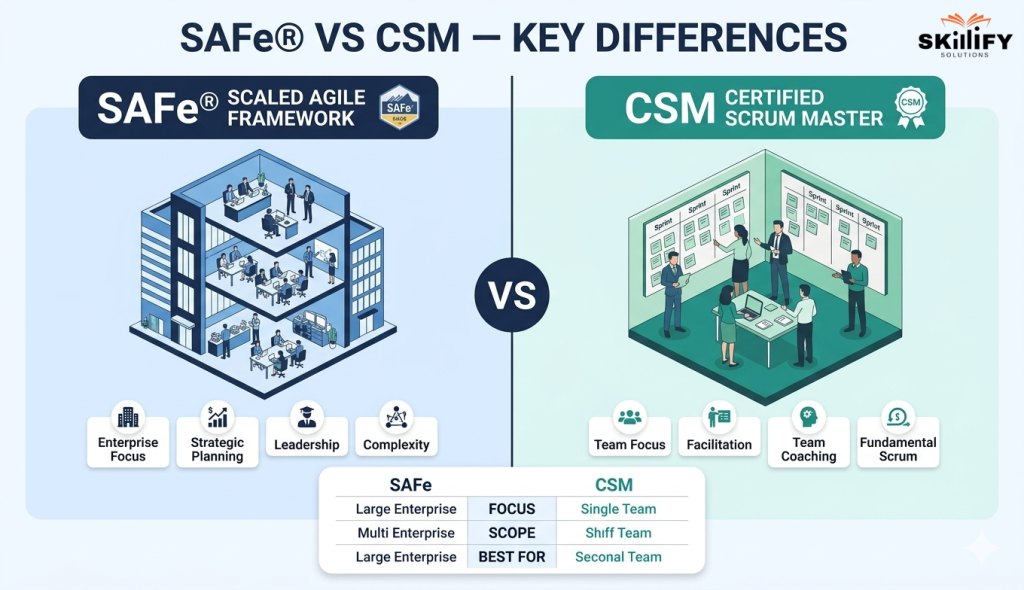
Certified Scrum Master (CSM) is focused on single-team Agile delivery. It teaches you how to run Scrum ceremonies, manage backlogs, and help a small team work efficiently. It is ideal for beginners or those entering Scrum roles.
Scaled Agile Framework (SAFe), on the other hand, is designed for large organizations where multiple teams work together. It focuses on scaling Agile across departments, managing dependencies, and aligning teams with business goals.
Here’s a quick comparison to simplify it:
| Factor | Certified Scrum Master (CSM) | Scaled Agile Framework (SAFe) |
| Best For | Team-level roles like Scrum Master, Agile team member | Enterprise-level roles like Program Manager, Agile Leader |
| Complexity | Simple and beginner-friendly | Complex and suited for experienced professionals |
| Focus Area | Execution within a single team | Coordination across multiple teams |
| Work Scope | Individual Scrum team | Large-scale, multi-team environments |
Build a strong Agile foundation with our industry-focused Scrum Master bootcamp today!
SAFe® vs CSM in Real-World Job Markets
Understanding where each certification is actually used in the real world makes the decision much easier. While both SAFe® and CSM are Agile frameworks, companies use them in very different environments depending on their size, structure, and complexity.
Where CSM is Used: Scrum Team Roles
CSM is most used in small to mid-sized Agile teams where the focus is on delivering work within a single team. These teams follow Scrum practices like sprint planning, daily stand-ups, and retrospectives.
For example, in a product startup or a small tech company, a Scrum Master works closely with 5–10 team members to manage tasks, remove blockers, and ensure smooth delivery.
You’ll typically see CSM in roles like:
- Scrum Master
- Junior Agile Coach
- Product team roles
This is exactly the kind of environment a Scrum Master Bootcamp with AI helps you to make a single team, ensuring smooth sprint execution.
Where SAFe® is Used: Enterprise Agile Environments
SAFe is used in large organizations where multiple teams work together on complex projects. These companies need coordination across teams, departments, and even business units.
If you’re new to the concept, understanding What is SAFe Certification is can help you see how it supports large-scale Agile environments.
For example, in a large enterprise like a bank or a Fortune 500 company, 10–15 Agile teams may work on different parts of the same product. SAFe® helps align all of them through structured planning, like Program Increments (PI).
You’ll typically see SAFe® in roles like:
- SAFe Release Train Engineer (RTE)
- Program Manager
- Enterprise Agile Coach
That’s why professionals working in such environments often opt for SAFe Courses, as they are specifically designed to handle multi-team coordination and large-scale Agile delivery.
Which Certification Gets You Hired Faster?
When it comes to getting hired, the answer is not just SAFe® vs CSM; it depends on your experience level and the type of roles you’re targeting.
In most cases, companies hire based on role fit first and certification second. This means CSM tends to open doors faster for beginners, while SAFe® becomes valuable as you move into larger, enterprise-level roles.
CSM Demand in Entry-Level Scrum Roles
For Scrum Master or Agile team roles, expect basic knowledge of Scrum practices, which CSM directly provides.
| Role Type | Industry | Reason for Demand |
| Junior Scrum Master | Startups, Small Tech | Manages a single team using Scrum practices |
| Agile Team Member | IT Services, Product Teams | Supports daily Agile execution |
| Associate Product Role | SaaS, E-commerce | Works with Scrum teams for feature delivery |
For someone starting, CSM helps you:
- Understand Scrum fundamentals quickly
- Qualify for entry-level roles faster
- Build a strong foundation for Agile careers
In real hiring scenarios, many job descriptions for junior Scrum roles mention CSM as a preferred or required certification. To understand the exact roles, responsibilities, and hiring expectations, you can explore this detailed guide on Scrum Master jobs. This shows the complete breakdown of what companies look for in real-world scenarios.
SAFe® Demand in Enterprise Agile Roles
SAFe is more relevant in large organizations managing multiple Agile teams. These roles usually require some experience, as they involve coordination across teams and business alignment.
| Role Type | Industry | Reason for Demand |
| Release Train Engineer (RTE) | Banking, FinTech, Large Tech | Manages multiple teams and program delivery |
| Program Manager or Agile Lead | IT Services, Consulting | Aligns teams with business goals |
| Enterprise Agile Coach | Large Enterprises, Consulting | Drives Agile transformation |
| Product Manager | SaaS, Tech | Handles cross-team coordination |
| Portfolio Manager | Banking, Government | Manages large-scale programs |
SAFe helps professionals:
- Move into enterprise Agile roles
- Handle cross-team dependencies
- Work in structured Agile environments
Experience vs Certification: What Matters More?
While certifications help you get noticed, experience is what actually gets you hired and promoted. Recruiters use certifications as a filter, but they look for real-world applications during interviews.
For example, a candidate with CSM and project experience will be preferred over someone with only certification. A professional with SAFe® and enterprise experience will stand out for senior roles.
In fact, companies today expect Scrum Masters to go beyond ceremonies and understand performance deeply. This guide on Agile metrics for Scrum Master explains how metrics impact delivery and hiring decisions.
SAFe® vs CSM in the US Job Market
The US Agile job market in 2026 is growing rapidly, but it is also becoming more competitive and skill-driven. Companies are no longer hiring Scrum Masters to run ceremonies; they expect professionals who can improve delivery, manage teams, and drive business outcomes.
CSM vs SAFe® Salary Comparison
CSM is one of the most common entry points into Agile roles in the US. Companies prefer Scrum Masters who can manage individual teams and ensure smooth execution. However, competition is increasing at the entry level as more candidates enter through certifications.
SAFe is more relevant in large enterprises where multiple teams need coordination. It is commonly used in banking, consulting, and large tech companies, where organizations prefer professionals who can scale Agile across teams.
| Certification | Entry-Level Salary | Average Salary | Enterprise Salary |
| Certified Scrum Master | $86K – $99K | $95K – $111K | $113K – $139K |
| SAFe Roles | $76K – $93K | $109K – $124K | $120K – $200K |
As you grow in your career, you may also come across roles like Agile Coach. If you’re unsure how it differs, this comparison of Agile Coach vs Scrum Master explains the responsibilities and career path clearly.
Cost of CSM vs SAFe®: Investment and ROI Breakdown
Choosing between CSM and SAFe® is also about investment vs return. While both certifications require upfront cost, the real question is: how quickly can you recover that cost through job opportunities and salary growth?
Training and Certification Costs
The initial cost varies based on the course provider and level, but CSM is generally more affordable compared to SAFe®. CSM is a low-cost entry option, while SAFe® requires a higher investment due to its complexity and enterprise scope.
| Certification | Training and Exam Cost | Notes |
| CSM | $428.66 | Beginner-friendly, shorter duration |
| SAFe | $300 – $500 | Advanced, enterprise-focused |
Renewal Costs and Long-Term Maintenance
Apart from the initial cost, it’s important to understand the long-term commitment. Both CSM and SAFe® require renewal, which adds to the overall cost over time.
| Certification | Renewal Cycle | Renewal Cost | Notes |
| CSM | Every 2 years | ~$100 | Simple and affordable |
| SAFe | Every year | ~$100 – $150 | More frequent renewal |
ROI Comparison Based on Job Opportunities
The real value of any certification lies in its return on investment (ROI). This depends on how quickly it helps you get a job, increase your salary, or move into better roles.
| Factor | CSM | SAFe |
| Time to get a job | Faster | Slower |
| Initial salary impact | Moderate | High |
| Long-term growth | Steady | Faster in enterprise roles |
| Best for | Beginners | Experienced professionals |
In many cases, a well-structured SAFe 6.0 Scrum Master (SSM) certification can help you recover your investment quickly by helping you land your first role.
Which Certification Should You Choose Based on Your Career Stage?
Choosing between CSM and SAFe® becomes much easier when you look at your current career stage and goals. Both certifications are valuable, but they serve different purposes depending on whether you are starting or looking to grow into higher roles.
Beginners and Career Switchers
If you are new to Agile or switching careers, CSM is usually the best starting point. It focuses on core Scrum concepts and helps you understand how Agile teams work in real projects.
For example, someone moving from a non-technical background into Agile can use CSM to build a strong foundation and qualify for entry-level roles.
CSM is ideal if you:
- Are you starting your Agile career
- Want to become a Scrum Master or team member
- Need a quick entry into the job market
This is where a practical Scrum Master Certification becomes valuable, as it gives you both conceptual clarity and real-world application.
Enterprise Agile Professionals
If you already have experience working in Agile teams, SAFe® becomes more relevant. It focuses on managing multiple teams, aligning with business goals, and handling large-scale projects.
For example, a Scrum Master with a few years of experience can move into roles like Agile Lead or Program Manager with SAFe® knowledge.
SAFe is ideal if you:
- Have Agile or Scrum experience
- Work in large organizations or want to
- Aim for leadership or enterprise roles
Similarly, professionals looking to scale their careers often move toward SAFe®courses to gain exposure to enterprise-level Agile practices.
Salary vs Job Entry: Choosing the Right Path
| Factor | CSM | SAFe |
| Primary Goal | Fast job entry | Higher salary growth |
| Best For | Beginners, career switchers | Experienced professionals |
| Time to Get a Job | Faster | Slower |
| Long-Term Salary Growth | Steady | Faster, higher ceiling |
| Role Scope | Single team | Multiple teams or an enterprise |
| Career Path | Scrum Master to Agile Roles | Agile Lead to Enterprise Roles |
Common Mistakes When Choosing SAFe® vs CSM
Many professionals choose between SAFe® and CSM based on trends, salary expectations, or what others are doing. But the wrong choice can slow down your career instead of accelerating it. The key is to align the certification with your current level and career goals, not just market hype.
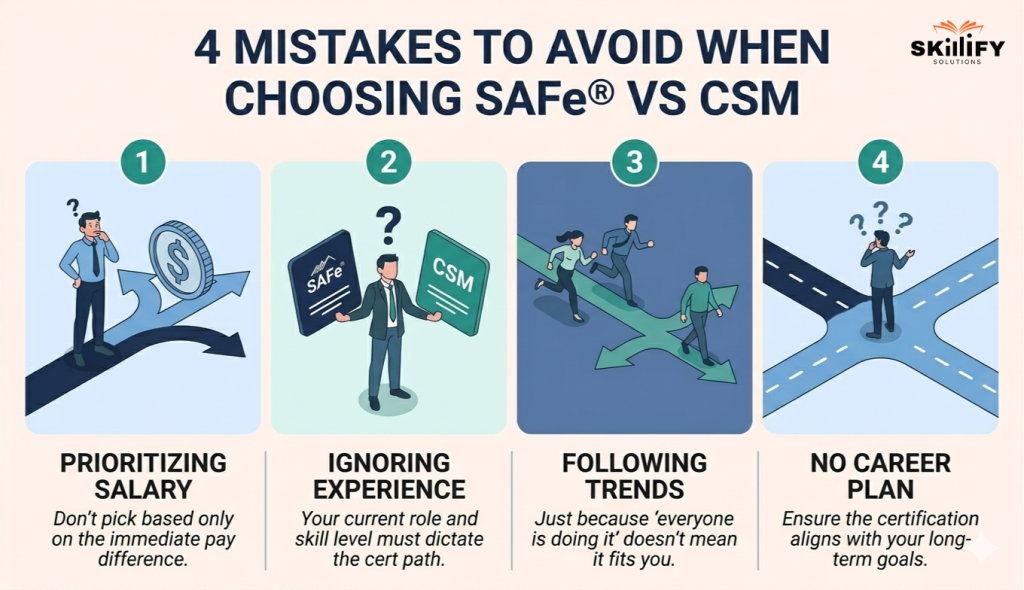
Here are common mistakes when making the decision:
- Choosing based only on salary expectations
- Ignoring your current experience level
- Following market trends blindly
- Not planning your long-term career path
To make the right choice, focus on where you are in your career and where you want to go. If you’re starting, build a strong foundation with CSM.
If you already have experience, then move towards SAFe® for growth. Instead of chasing trends or salaries, align your certification with your skills, target roles, and long-term goals.
Conclusion
By now, the decision should be much clearer. If your goal is to enter Agile roles quickly and build a strong foundation, CSM is the better starting point. It helps you understand core Scrum practices and get into the job market faster.
On the other hand, if you already have experience and are aiming for long-term growth, leadership roles, and higher-paying enterprise opportunities, SAFe® is the next logical step. At the end of the day, it’s about choosing the one that aligns with your current stage and future goals.
Gain enterprise-level Agile expertise with SAFe training designed for experienced professionals!
Frequently Asked Questions
1. Do recruiters prefer SAFe® or CSM on a resume for the same Scrum Master role?
Most recruiters prefer CSM for Scrum Master roles, as it is widely recognized and often used as a basic filter. SAFe® is preferred mainly for enterprise-level or scaled Agile roles, not basic Scrum roles.
2. Can I get a Scrum Master job with only SAFe® certification and no CSM?
Yes, but it is harder without Scrum fundamentals, especially for entry-level roles. SAFe® assumes prior Scrum knowledge, so beginners may struggle in interviews.
3. Is SAFe® overkill for small or mid-sized companies?
In many cases, yes, small teams usually use Scrum, not large-scale frameworks. SAFe® is mainly designed for large organizations with multiple teams.
4. Do employers care more about certification or real Agile experience?
Experience matters more, but certifications are often used as a first-level screening filter. Strong candidates combine both certification and real project experience.
5. Can switching from CSM to SAFe® later improve salary significantly?
Yes, especially when moving into enterprise roles with higher responsibility. SAFe® roles often involve a larger scope, which leads to higher salary potential


