
Scope of Management

Scope of Management: Meaning, Functions, and Importance Explained

Introduction Have you ever wondered what makes a business truly successful? It often comes down to the importance of management and effective management. Management is the art of getting things done through people to achieve organizational goals. Understanding the scope of management is essential for anyone in the business world, as it covers the entire range of tasks and responsibilities that leaders undertake. This guide will explore the fundamental management principles and show you how a clear grasp of its scope can drive success in any organization. For students planning to build careers in leadership or business strategy, exploring top degrees in demand for future careers can also help develop strong foundations in management and organizational thinking. Scope of Management: Meaning and Overview The scope of management refers to the full range of activities and duties that managers handle to meet an organization’s objectives. It provides a complete overview of management, outlining everything from strategic planning to daily operations. Essentially, it defines the boundaries of a manager’s role. This includes overseeing various management areas in business and handling a wide array of management responsibilities related to mass production. The management process is dynamic, adapting to the organization’s size, industry, and specific goals. A clear understanding of this scope ensures that all managerial efforts are aligned and effective. Definition of Scope of Management In simple terms, the comprehensive scope of management statement refers to all the functions, activities, and responsibilities handled by managers to guide their teams and organizations toward success. This scope is dynamic, adapting to changing organizational needs, industry standards, and the external environment. It is grounded in core management principles that bring structure, consistency, and efficiency to the management process. Clearly defining the scope of management ensures everyone understands their roles and contributions. It clarifies authority, sets performance expectations, and aligns managerial actions with strategic goals, serving as a structured framework and roadmap for organizational harmony and effective achievement of the company’s mission. Key Areas Covered in the Scope of Management The scope of financial management encompasses various specialized domains essential for organizational success. Each area requires distinct expertise, yet all are interconnected to ensure smooth business operations. Management’s scope extends from managing finances to marketing products and overseeing people. The scope of financial management maintains the company’s economic health, while human resource management focuses on employee recruitment and development. Together, these areas build a cohesive organization. The main areas included in the scope of management are: Understanding management concepts is especially useful for professionals exploring non-technical jobs in IT, where leadership, coordination, and strategic thinking are key skills required for career growth. Functions of Management Within the Scope Within the broad business management scope, there are five core functions that every manager performs. These functions of management are the essential pillars that support the entire structure of an organization. They provide a logical sequence of activities that managers follow to achieve their objectives. These management responsibilities planning, organizing, staffing, directing, and controlling are universal. Whether you are managing a small team or an entire corporation, these functions are the key to effective leadership and operational excellence. Let’s look at each of these functions in more detail. Planning as a Core Function Planning is the foundational function of management, involving decisions about what needs to be done, how, when, and by whom. It bridges the gap between the current position of the organization and its desired goals. This process includes both strategic and detailed planning, requiring managers to set objectives, forecast future conditions, make decisions, and create actionable steps. Effective planning provides a clear direction for the organization, ensuring resources are used efficiently and every effort is aligned with business goals. Without proper planning, resources may be wasted and activities can become aimless. As the first step in the management process, planning lays the groundwork for all other management functions, making it essential for organizational success. Organizing Resources Effectively Once a plan is in place, the next step is organizing. This function involves arranging and structuring work to accomplish the organization’s goals within a specific time frame. Organizing is all about creating a framework for success, which includes defining roles, grouping tasks, and establishing reporting relationships. It’s a key part of the business management scope. A major component of organizing is resource allocation. This means assigning the necessary resources people, money, and equipment to the right tasks. Effective management practices in organizing, influenced by the type of production, ensure that there is no confusion about who is responsible for what, leading to greater efficiency and productivity, especially in project management. Key activities in the organizing function include: Staffing: Building Winning Teams The staffing function focuses on personnel management by finding the right people for the right jobs, ensuring the organization has the talent it needs to succeed. It covers recruiting, selecting, training, and developing employees. Effective staffing goes beyond filling positions; it creates a positive environment where employees feel valued and motivated. Matching individual skills with organizational needs helps build high-performing teams. Proper staffing improves performance, reduces turnover, and strengthens company culture. Directing for Results Directing involves leading, motivating, and guiding employees to execute tasks efficiently. Managers implement plans through their teams, with leadership style influencing morale and productivity. Clear communication is essential; managers must convey instructions and maintain open dialogue to build trust and respect. Providing constructive feedback helps employees improve and aligns their efforts with organizational goals. Controlling to Achieve Objectives Controlling is the final function of management, involving monitoring performance to ensure goals are met. It provides a framework for accountability by tracking progress, comparing it to standards, and taking corrective action when needed. Effective controlling incorporates activities like quality control, risk management, and performance measurement. Good time management is crucial for timely task completion. Without control, it’s difficult to know if the organization is on track. As a checkpoint, controlling helps managers identify deviations and make adjustments, keeping the organization efficient and focused on objectives. The Scope of Management Across Different Sectors The…
Read More
Non technical jobs in IT and tech

Non-Technical Jobs in IT and Tech: High-Paying Roles (2026)

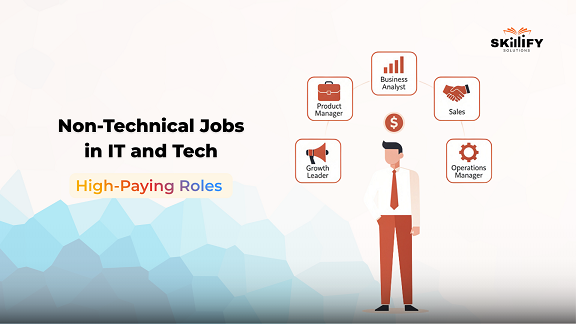
When people hear the word IT career, they immediately think of coding, programming, and complex technical skills. But here’s the truth. Some of the fastest-growing and highest-paying careers today are non-technical jobs in IT. Yes, you read it right.  In 2026, Tech companies are not just hiring developers. They are hiring Product Managers, Growth Leaders, Business Analysts, Sales Experts, and Operations Managers who drive revenue, strategy, and customer experience. The average salary ranges from $50,000–$150,000/year. Companies now pay premium salaries to professionals who can solve business problems without touching code. If you are a fresher or an engineer avoiding coding, or looking for a career switcher, 2026 offers more opportunities than ever. This blog gives you clarity, career direction, and real salary insights and also shows you the best roles for freshers and experienced professionals alike. Scroll down to know more! What Are Non-Technical Jobs in IT and Tech Industry?  Non-technical jobs in IT (Information Technology) are roles that support, grow, and manage tech businesses without coding skills. Instead of building software, these professionals focus on business strategy, sales, marketing, operations, hiring, customer relationships, and execution. In simple terms, they make sure the tech product succeeds in the market.  For example, developers build the product, but non-technical teams help it sell, scale, and sustain.  Here are some common examples of Non-Technical Jobs   Let’s understand the logic of Services vs Product Companies  IT Services companies, like consulting or outsourcing firms, need roles focused on client management, project coordination, delivery, and account growth. However, product companies focus more on product strategy, user research, growth marketing, and customer retention.  Reasons why Demand Is Rising in 2026  Best Non-Technical Jobs in IT Companies with No Coding Requirements  Many IT companies hire non-technical professionals to manage product strategy, operations, hiring, sales, marketing, and customer relationships. For getting hired, you do not need coding skills for these roles.  You will be rewarded for your knowledge and decision-making skills. What you need is business understanding, communication ability, analytical thinking, and leadership potential.  Below are the best non-technical jobs in IT companies in 2026.   1. Product Manager  A Product Manager decides what features should be built, why they matter to customers, and how the product should grow in the market. They work closely with developers and designers but focus mainly on strategy, user needs, and business impact rather than coding.  Core Competencies   Industry Demand   Product Managers have a very high interest in SaaS startups, fintech, edtech, AI companies, and global product-based firms. This is because innovation and customer experience are priorities in these fields.   Salary Range   $159,221 to $226,914 per year  Career Growth   Professionals usually start from Product Manager and progress to Senior Product Manager. If you have a Product Management certificate, the next step can be becoming the Director of Product, which can eventually lead to becoming a Chief Product Officer.   2. Business Analyst  A Business Analyst studies business processes, identifies gaps, and recommends improvements. They translate business needs into structured requirements that technical teams can execute. Their role is essential in ensuring that technology solutions align with business objectives.  Core Competencies  Industry Demand   High demand remains strong in IT services companies, consulting firms, banks, and enterprise technology organizations. In these fields, structured decision-making is important so you can start learning with a Business Analyst Certification and meet the industry standards.  Salary Range   $98047  to $131,558 per year  Career Growth   Professionals often move from Business Analyst to Senior Analyst, then to Lead Analyst or Strategy roles, and can eventually transition into consulting or product leadership.  3. Data Analyst  A Data Analyst interprets business data and converts numbers into actionable insights. They help leadership teams understand trends, performance gaps, and growth opportunities. Heavy programming is not mandatory in many roles, especially at entry and mid-levels.  Core Competencies   Industry Demand   Data Analysts are in strong demand across SaaS, e-commerce, fintech, healthcare tech, and AI-driven organizations where data plays a key role in decision-making. You can study the Data Analyst Job Outlook 2026, to understand how companies are prioritizing data driven decision making and hiring the right talent.  Salary Range   $80,000 to $120,000 per year  Career Growth   Professionals often move from Data Analyst to Senior Analyst, then to Analytics Manager, and eventually to Head of Analytics or Data Strategy roles.  Start Your Tech Career Without Coding Today with our Data Analytics Bootcamp with AI Certifications.  4. Scrum Master  A Scrum Master ensures Agile teams function smoothly and deliver projects efficiently. They remove obstacles, manage workflows, and improve team productivity. Their role focuses on process excellence rather than technical coding.  Core Competencies   Industry Demand   Scrum Masters are highly valued in product companies and IT services firms that follow agile frameworks to deliver faster and more efficiently.  You can also go through the 30 Must-Know Scrum Master Interview Questions and Answers to prepare in a better way.  Salary Range   $74,000 to $143,000 per year  Career Growth   Professionals grow from Scrum Master to Senior Scrum Master. With professional courses like Certified Scrum Master, they can also become an Agile Coach. The final career growth will be Program Management or Delivery Leadership roles.  5. IT Project Manager  An IT Project Manager plans, coordinates, and delivers technology projects within defined timelines and budgets. They manage teams, risks, and stakeholders to ensure successful project execution.  Core Competencies   Industry Demand  IT Project Managers are in steady demand in IT services companies, consulting firms, enterprise tech organizations, and global outsourcing firms.  Salary Range  $42,000 to $111,000 per year  Career Growth   Professionals move from Project Manager to Senior Project Manager, then Program Manager, and eventually into Delivery Head or Operations leadership roles.  6. Technical Recruiter  A Technical Recruiter identifies, evaluates, and hires skilled technology professionals. They understand technical roles but focus mainly on sourcing talent, interviewing, and hiring strategies.  Core Competencies   Industry Demand   Demand for technical recruiters is high in startups, IT services firms, and global technology companies that…

Read More

Top Degrees in Demand for the Future: 2026 & Beyond

Imagine telling your parents that you don’t want to become a doctor, engineer, or Chartered Accountant (CA) and instead, you want to study Artificial Intelligence, Behavioural Psychology, or Renewable Energy. Ten years ago, they would have laughed. But today? These top degrees in demand for the future are getting graduates hired faster than traditional fields.  The degrees that mattered in 2010 aren’t the degrees that will matter in 2026. Hiring is shifting nowadays as industries are reinventing.  And the biggest surprise? The most in-demand degrees for the future come from researching the industry standards. In this blog by Skillify Solutions, we break down the top degrees in demand for the future, backed by real-world examples, salary trends, and industry reports. Let’s dive in!  Understanding Top Degrees in Demand for the Future 2026 Picking top 10 best degrees for the future 2026 feels like betting on your future in a world that is rapidly changing. In the digital transformation era, AI is reshaping jobs, and climate tech is booming like anything. Look at Sundar Pichai, who studied Metallurgical Engineering, a field nowhere close to tech leadership. But his curiosity for product design and strategy led him to Google’s top seat.  Understanding the top future-proof degrees in 2026 can equip you with skills that can match the market demands in the upcoming years. It can also ensure steady jobs and growth to build a rewarding and resilient career.   What Makes a Degree “Future-Proof” in 2026 When you are looking for a future proof degree, you’re not just chasing a job, but building a career that lasts through global shifts and digital waves.  Degrees become future proof when they align with recent trends like AI adoption, green energy pushes, and healthcare advancements.   These fields are expected to grow in Science, Technology, Engineering, and Mathematics (STEM) and healthcare by 2030. Employers look for fresh graduates who can blend tech savvy approaches with human skills like analytical thinking and adaptability. These advancements can keep you ahead even if the recent job roles do not exist in the future market.   5 Key Trends Driving Future Degree Demand  The branching of Artificial Intelligence (AI), automation, and digitalization is reshaping job roles across every sector in 2026. This rapid change points out that the importance of degree and education is being measured by the upcoming opportunities and challenges in the future market.   Here’s the real talk on the five key trends fueling future degree demand, accumulated from the latest job reports.  Explore Skillify’s game-changing bootcamps with 90% placement magic – Join Data Science Bootcamp with AI course today!  Top 15 Degrees in Demand for the Future  If you are worried about the future aspects in this tech Savvy world, there is a study of 15 degrees for the future that you must do. One good news is that 2026 jobs are tilted towards technology, health, and sustainability. The STEM and healthcare roles are about to rapidly increase by 17-30% by 2030.   Below, there are top 15 career paths, roles, salaries, and tips to visualize your future.  1. Computer Science & Artificial Intelligence  Between 2019 and 2029, the U.S. Bureau of Labor Statistics (BLS) anticipates a 13% rise in employment for computer and information technology occupations. The answer to why is that these graduates can mix algorithms with everyday magic. They can fuel self-driving cars and factories 30% quicker. You can see this career path in recommendation systems, voice assistants, self-driving cars, smart home devices, and even in the way businesses operate.  Career opportunities include  Salary Expectations: $120k/ year median salary range while US freshers huge in tech hubs.  Why it’s future-proof: Most industries are replacing manual tasks with automation. But they still need humans with technical skills to guide, train, and optimize these systems.  2. Data Science & Analytics  Data Science can be considered as the engine behind modern decision-making. Every click, purchase, and swipe produces data, and companies need experts who can find patterns, predict trends, and turn information into strategy. All the future proof career options like AI, healthcare, and technology need Data experts to run their business.   Career Opportunities  Salary Expectations:  USA Median can range from $102,938/year. Freshers in Data Science and Analytics can expect $73k – $143k varying with the sector.   Why It’s Future-Proof: Organizations are becoming data dependent. Every industry wants to predict its future, and that makes data professionals irreplaceable.  3. Nursing & Advanced Practice Nursing  With the increasing world’s population, advanced nursing needs rapid rise. Nurse Practitioners (NPs) are becoming the backbone of global health. They can diagnose, prescribe, and manage treatments.   Career Opportunities  Salary Expectations: A nurse practitioner can earn up to $93,969/year and for senior level it can go upto $113k.  Why It’s Future-proof: Healthcare demand is rising, and telehealth is expanding. In this, the NPs are filling essential care gaps across hospitals and clinics.  4. Cybersecurity & Information Security  Cyberattacks are increasing with a rate of 300% year over year. Organizations urgently need defenders who can secure systems, protect data, and prevent breaches for protecting their data.   You’ll learn:  Ethical hacking, digital forensics, penetration testing, threat analysis, network security protocols, firewalls, cryptography, and cloud security defense.  Career Opportunities  Salary Expectations: You can expect $102k/ year on average. The Ethical Hackers often earn more than $123k at senior levels  Why It’s Future-proof: Today, companies digitize everything, so cybersecurity is becoming a non-negotiable requirement.   5. Physician Assistant  PAs diagnose illnesses, prescribe medication, and offer advanced patient care. They are responsible for reducing the pressure on healthcare systems.  You’ll learn:  Clinical diagnostics, surgical assistance, pharmacology, patient management, emergency care, and primary care procedures.  Career Opportunities:  Salary Expectations: Median: $112,902/year Why it’s future-proof: Growing patient demand and physician shortages increase reliance on PAs.  30-40% salary boost awaits with our Data Analytics Bootcamp with AI Course– Join today!  6. Healthcare Administration  Behind every hospital is a team helping it run smoothly. Healthcare administrators manage operations, finances, and patient experience.  You’ll learn:  Healthcare operations, policy, HR management, finance, quality control, telehealth systems, and…

Read More