I have some news that’s going to make your day. Imagine a career where you don’t have to climb the ladder for a decade just to get a decent raise. In the world of Data Analytics, 2026 is looking like a shortcut to the top. Whether you’re a fresh graduate or someone looking to excel in your career, this blog is for you.
We are talking about a field where entry-level roles are earning $68,892 to $81,000 with ease. Industries from Healthcare to E-commerce are adding millions of new roles this year. The good news is you don’t need a PhD to get in, but the right toolkit to enter a job-guaranteed field.
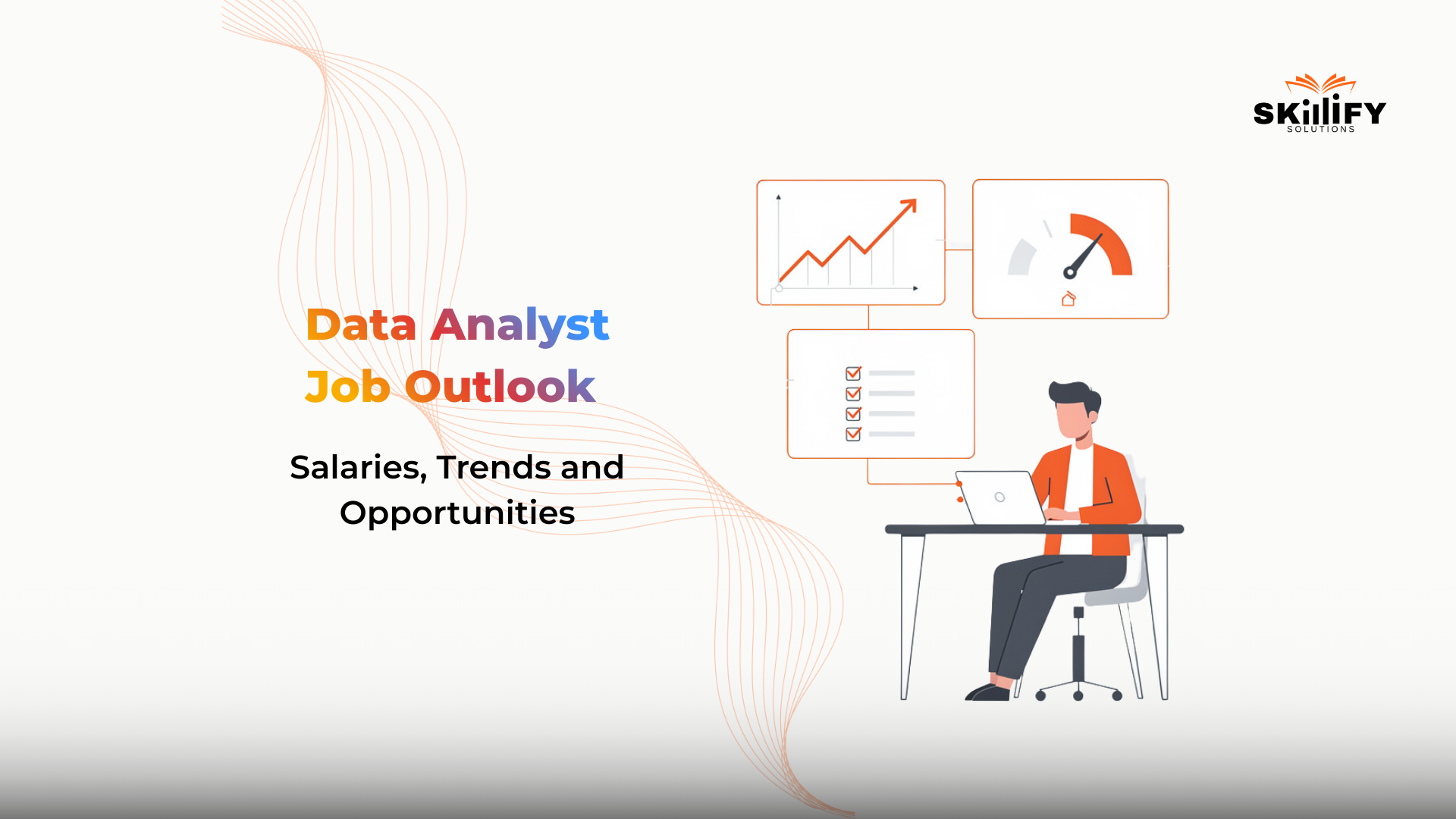
In this blog, we’re looking at the Data Analyst job outlook to secure a six-figure seat in the most lucrative job market. Let’s get into the raw truth of 2026. Read on!
Data Analyst Job Outlook 2026: Market Growth & Demand Analysis
In 2026, the data analyst has moved past data janitors into the era of Insight Architects. To understand the Data Analyst Job Outlook 2026, it is crucial to look at the market. It will not be enough to just study the collection of job openings. This can be the fundamental shift in how businesses handle intelligence.
The Data Analyst of 2026 can be considered a high-level strategist who navigates a landscape defined by AI integration, real-time processing, and cross-industry demand. But are data analysts in demand?
Based on the most recent 2026 market intelligence reports from Fortune Business Insights, here are some insights on the market growth and demand analysis of the Data Analyst career:
A Booming Market Valuation
The global data analytics market is projected to reach $104.39 billion by the end of 2026, growing at a massive annual rate of 21.5%. This is a global necessity as the world generates over 181 zettabytes of data this year.
Massive Opportunity Surge
It is projected to explode to $495.87 billion by 2034, growing at a staggering 21.5% CAGR. Industry forecasts suggest nearly 11.5 million new jobs in data science and analytics will be created by late 2026.
While AI is automating routine tasks, it is simultaneously creating a skills gap. It will drive a hiring surge for analysts who can translate raw numbers into business strategies.
Data Analyst Growth vs. Related Occupations (2026-2034)
If you are choosing a career in data for 2026, you are about to position yourself in the fastest-moving lane of the global economy. While Data Analyst remains the go-to entry point, the landscape is shifting toward specialized roles that command even higher premiums.
If you’re curious about how these roles will stack up by 2034, you can check out Top Degrees in Demand for the Future to get a better understanding. Below we have a table explaining the occupations and their growth rate to make it easy for you to choose the right one.
| Occupation | Growth Rate | New Jobs | Avg. Salary | Entry Requirements |
| Data Analyst | 11% | 5.2 million | $68,892 | Graduation |
| Data Scientist | 16% | 82,500 | $129,294 | Graduation |
| Operations Research Analyst | 21% | 24,100 | $69,331 | Graduation |
| Market Research Analyst | 19% | 941,700 | $73,087 | Graduation |
| Business Intelligence Analyst | 21% | 284,100 | $94,944 | Graduation + Experience |
Industry-Specific Demand & Hiring Trends
- Sectors like Healthcare and Finance are now the leading employers. These industries are hungry for Insight Engineers who can navigate complex, real-time data streams.
- The Supply Chain Management industry is expected to hold a 26.5% market share in 2026. Analysts here are needed to solve the global “logistics puzzle” using real-time data.
- Healthcare is projected to be the fastest-growing vertical. The demand for analysts to handle genomic data and predictive patient outcomes is currently outstripping the supply of qualified talent.
- The Financial Risk and Fraud sector is growing as financial crimes become more sophisticated, requiring analysts who specialise in security-focused data mining.
Data Analyst Salary Outlook: 2026 Compensation Trends
Salary Table by Experience Level
| Experience Level | Average Salary | Salary Range |
| Entry-Level (0-2 years) | $68,892 | $58,477 to $81,189 |
| Mid-Level (2-4 years) | $97,717 | $77,980 to $116,636 |
| Senior (5-7 years) | $104,201 | $83,568 to $123,305 |
| Principal/Lead (8+ years) | $280.5 | $21,000 – $46,200 |
Kickstart your data career – Join our Data Analyst Bootcamp with AI Course Now!
Regional Salary Variations & Cost of Living Impact
When we talk about a paycheck in 2026, where you sit often matters as much as what you know. A high salary in a tech hub looks great on a LinkedIn offer letter. However, the real winner is the analyst who balances that income against the local cost of living (COL).
Below is a conversational breakdown of how geography and expenses are balanced out in the 2026 market.
Big-City Salaries and Their Impact on Net Take-Home Pay
In 2026, major technology hubs continue to have the highest advertised salaries. However, these figures often mask the significant cost burden associated with living in such cities. When housing, transportation, and daily expenses are considered, the apparent advantage of high pay can diminish quickly.
Salary Concentration in Leading Technology Markets
In the United States, San Francisco and New York remain at the top of the compensation spectrum, with salaries typically ranging from $58,477 to $81,189. In India, Bangalore continues to lead, with senior professionals earning between ₹9.3L/yr to ₹10.2L/yr annually.
Cost of Living and the Purchasing Power Gap
A salary in San Francisco may exceed the national average. But the cost of living can be 50% higher or more. Housing costs consume a large share of income. Thus, professionals in cities such as Hyderabad or Austin may retain higher disposable income, despite earning lower nominal salaries.
Remote Work Trends and the Evolution of Location-Based Compensation
By 2026, hybrid and remote work models have matured, but compensation structures have adapted accordingly.
Geographic Differentiation in Pay Structures
Many organisations now apply location-based compensation. The salaries are adjusted according to regional cost levels. Employees who relocate to lower-cost areas may experience salary problems, even when role scope and performance remain unchanged.
Compensation for On-Site Roles
At the same time, physical presence has regained measurable value. Approximately, most technology managers now offer higher compensation for fully on-site roles, with salary increases reaching up to some percentage points compared to fully remote positions. This reflects the continued importance of collaboration, immediacy, and in-person engagement.
Leveraging Salary-to-Cost Arbitrage
Cities such as Salt Lake City in the United States and Pune in India are emerging as strong alternatives. These locations often provide competitive, Tier 1 compensation levels while maintaining significantly lower living costs.
This combination enables higher savings rates, improved financial stability, and sustained career growth without the financial pressure associated with traditional metropolitan hubs.
Educational Requirements & Career Entry Pathways
In 2026, the path to becoming a Data Analyst has become more diverse. The expectations have never been higher. While a degree is still the gold standard, the industry is now prioritising demonstrable skills and portfolio quality over simple credentials.
| Career Level | Proficiency | Core Technical Competencies | Strategic Focus |
| Level 1 | Beginner | Basic SQL, Excel Proficiency, Fundamental Data Visuals | Learn tools and accurate data entry. |
| Level 2 | Intermediate | Advanced SQL, R/Python Scripting, Statistical Analysis | Automate workflows and find trends. |
| Level 3 | Advanced | Predictive Analytics, Data Modelling, Advanced BI Tools | Forecast structured data architecture. |
| Level 4 | Expert | Big Data Tech, Machine Learning Basics, Multi-Dimensional Analysis | Solve complex problems with scalable tech. |
| Level 5 | Leader | Analytics Team Leadership, Company-wide Initiatives | Drive ROI and strategic business decisions. |
Essential Skills for 2026 Job Market Success
To succeed in 2026, you need to move beyond theory and master the tools that allow you to work on a scale. The market is currently good for analysts who can bridge the gap between raw data and AI-driven business strategy.
The Core Four Technical Stack
In 2026, SQL and advanced concepts like window functions and CTEs will be needed. You also need Python for automation, Advanced Excel, and at least one BI tool like Power BI or Tableau. If you don’t have these, your resume will be weak.
- Use AI assistants to generate boilerplate code and accelerate routine development tasks
- Know AI tools to streamline and speed up data cleaning and preparation
- Be familiar with AutoML platforms to build and evaluate models efficiently
- Review and audit AI-generated insights to ensure accuracy and business relevance
Learning Data Analyst Bootcamp with AI will be beneficial as it is designed to mirror a real-world environment, giving you the Core Four stack through project-based learning rather than just lectures.
Data Storytelling & Business Acumen
Hiring managers in 2026 find people who code. However, they struggle to find people who can explain the results. Your ability to translate a complex statistical output into a clear and profitable business recommendation needs to be promoted to senior levels.
- Develop deep domain expertise in a specific industry such as Healthcare, Finance, or Retail
- Understand industry-specific data, metrics, regulations, and business challenges
- Apply analytical tools within real-world domain contexts other than solutions
- Analysts with strong domain knowledge can be up to 3× more valuable than tool-only specialists
AI’s Impact on Data Analyst Careers
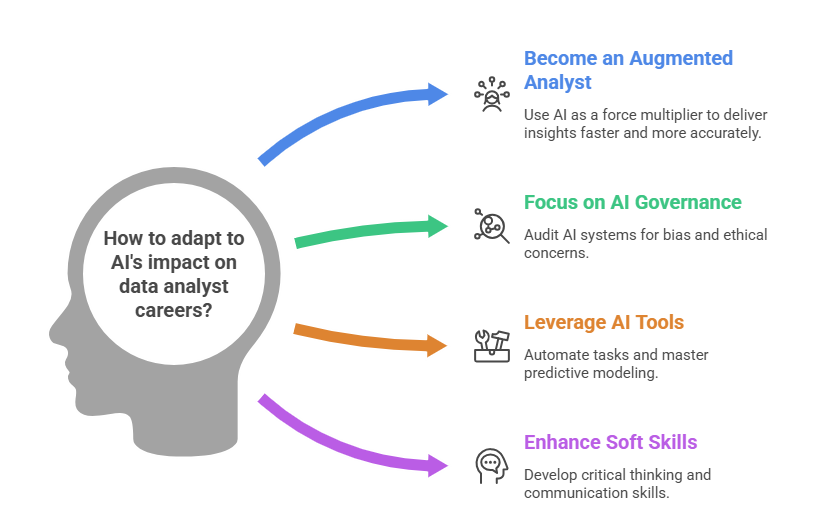
In 2026, AI is a strategic partner for the Data Analyst associate degree job outlook. The skills that once made analysts indispensable are evolving, and new opportunities are emerging for those who can work alongside intelligent systems.
The Rise of the Augmented Analyst
Today, the most valuable analysts are Augmented Analysts. These are professionals who use AI as a force multiplier to deliver insights faster and more accurately.
Analyst’s New Role:
- Verify AI-generated insights for accuracy and relevance
- Translate findings into actionable business strategies
- Shift from data collection to strategic interpretation
Key Takeaways:
- Analysts are decision enablers
- Soft skills like communication and critical thinking have become central to success
The Trust but Verify Mandate
The AI models are increasingly complex; there’s a growing risk of false outputs that appear to be credible.
Emerging Needs in AI Governance:
- Professionals are now required to audit AI systems for bias, ethical concerns, and mathematical errors
- Roles like AI Trust Lead, AI System Trainer, and Data Product Manager are growing rapidly
Key Takeaways
- Understand data observability and governance frameworks
- Learn to validate AI outputs continuously
- Ensure AI insights align with business objectives and compliance standards
Leveraging AI Tools to Boost Your Analyst Career
Data Analysts must treat AI as a partner to excel in their careers. Here are some strategies to stay ahead in the data analytics job market.
- Automate the 80% grind: Use AI copilots such as GitHub Copilot, Tableau Pulse for SQL scripts, dashboards and boilerplate coding.
- Master predictive modelling: Move from descriptive analytics to predictive analytics using AutoML platforms
- Focus on soft skills: Critical thinking, stakeholder communication, and data storytelling remain irreplaceable by machines.
Future Outlook Through 2032: Long-Term Career Viability
According to the U.S. Bureau of Labor Statistics (BLS), demand for data-centric roles is projected to grow by 23% to 35% by 2032. This is faster than the average for all occupations.
- Demand expected to outpace supply, with 11.5 million new data roles by late 2026
- About 108,400 new jobs for data analysts are projected over the next decade.
- Companies using data-driven insights are more likely to be profitable
- Routine SQL queries and dashboard creation are largely handled by AI
- Skills in causal inference and business context interpretation will remain critical
- Become AI Ethics Officer, Model Auditor, or Domain-Specific Strategy Analyst
Get a Data Analyst Bootcamp with AI Course from Skilify Solutions.
Career Advancement & Specialization Opportunities
You can make a future jump from Junior to Leadership within a few years. For example, from Senior to Analytics Manager. However, in 2026, the jump to Senior requires Strategic Decision Support, where you act as a consultant to the C-suite.
By adding Machine Learning and advanced Python to your SQL foundation, you can transition into Data Science, which currently sees a 34% growth rate and average US salaries around $129,000.
High-Value Industry Specialisations
- Healthcare Analyst: Focuses on genomic data and patient outcomes. This sector is growing at 33.4% CAGR.
- Financial Risk Analyst: Specialises in security-focused data mining and fraud detection, as it is growing at 33.6%.
- Supply Chain: Solve ETA puzzles using real-time IoT data. This industry is currently holding a 26.5% market share.
Conclusion
It can be concluded that the Data Analyst Job Outlook 2026 is clear. Analysts who combine technical expertise, strategic thinking, and domain knowledge will lead to the next wave of data-driven decisions. AI may handle the routine, but human judgment and insight remain irreplaceable.
This is an industry that is growing ten times faster than the rest of the US economy. That’s the reality for Data Analytics in 2026, and you just need a well-designed Data Analyst Course to equip you with the skills that matter most. These can be data cleaning, predictive modelling, AI tools, and business storytelling. The future of analytics is here. Best of luck for your future!
Enroll to our Data Analyst Bootcamp with AI Coursetoday and become one of tomorrow’s indispensable data leaders.
Frequently Asked Questions
1. Can you get a data analyst job with an associate degree?
Yes, but it is competitive. While 65% of roles require a Bachelor’s, you can break in with an Associate degree by pairing it with professional certifications and a strong portfolio.
2. What is the job security for data analysts during economic downturns?
Data-driven firms are most likely to stay profitable. During recessions, companies lean on analysts to identify cost-saving efficiencies and protect cash flow. All these make the role of recession resistant.
3. How long does it take to become a job-ready data analyst?
You can expect 6–12 months of focused study. While basics take 3 months, mastering SQL, Python, and BI tools, plus building a real-world portfolio. It typically requires a year of consistent practice.
4. Is a data analyst a good career for career changers in their 30s or 40s?
Yes, the average age of a data analyst is 43. Companies value the domain expertise and soft skills that older professionals bring, which often outweigh pure technical coding speed.
5. What’s the typical work-life balance for data analysts, and does the job outlook include remote opportunities?
Balance is generally good, with 34% of roles offering remote or hybrid options in 2026. While “screen fatigue” is real, flexible schedules and the ability to work from anywhere remain a staple of the profession.