Top Degrees in Demand for the Future: 2026 & Beyond

Imagine telling your parents that you don’t want to become a doctor, engineer, or Chartered Accountant (CA) and instead, you want to study Artificial Intelligence, Behavioural Psychology, or Renewable Energy. Ten years ago, they would have laughed. But today? These top degrees in demand for the future are getting graduates hired faster than traditional fields.  The degrees that mattered in 2010 aren’t the degrees that will matter in 2026. Hiring is shifting nowadays as industries are reinventing.  And the biggest surprise? The most in-demand degrees for the future come from researching the industry standards. In this blog by Skillify Solutions, we break down the top degrees in demand for the future, backed by real-world examples, salary trends, and industry reports. Let’s dive in!  Understanding Top Degrees in Demand for the Future 2026 Picking top 10 best degrees for the future 2026 feels like betting on your future in a world that is rapidly changing. In the digital transformation era, AI is reshaping jobs, and climate tech is booming like anything. Look at Sundar Pichai, who studied Metallurgical Engineering, a field nowhere close to tech leadership. But his curiosity for product design and strategy led him to Google’s top seat.  Understanding the top future-proof degrees in 2026 can equip you with skills that can match the market demands in the upcoming years. It can also ensure steady jobs and growth to build a rewarding and resilient career.   What Makes a Degree “Future-Proof” in 2026 When you are looking for a future proof degree, you’re not just chasing a job, but building a career that lasts through global shifts and digital waves.  Degrees become future proof when they align with recent trends like AI adoption, green energy pushes, and healthcare advancements.   These fields are expected to grow in Science, Technology, Engineering, and Mathematics (STEM) and healthcare by 2030. Employers look for fresh graduates who can blend tech savvy approaches with human skills like analytical thinking and adaptability. These advancements can keep you ahead even if the recent job roles do not exist in the future market.   5 Key Trends Driving Future Degree Demand  The branching of Artificial Intelligence (AI), automation, and digitalization is reshaping job roles across every sector in 2026. This rapid change points out that the importance of degree and education is being measured by the upcoming opportunities and challenges in the future market.   Here’s the real talk on the five key trends fueling future degree demand, accumulated from the latest job reports.  Explore Skillify’s game-changing bootcamps with 90% placement magic – Join Data Science Bootcamp with AI course today!  Top 15 Degrees in Demand for the Future  If you are worried about the future aspects in this tech Savvy world, there is a study of 15 degrees for the future that you must do. One good news is that 2026 jobs are tilted towards technology, health, and sustainability. The STEM and healthcare roles are about to rapidly increase by 17-30% by 2030.   Below, there are top 15 career paths, roles, salaries, and tips to visualize your future.  1. Computer Science & Artificial Intelligence  Between 2019 and 2029, the U.S. Bureau of Labor Statistics (BLS) anticipates a 13% rise in employment for computer and information technology occupations. The answer to why is that these graduates can mix algorithms with everyday magic. They can fuel self-driving cars and factories 30% quicker. You can see this career path in recommendation systems, voice assistants, self-driving cars, smart home devices, and even in the way businesses operate.  Career opportunities include  Salary Expectations: $120k/ year median salary range while US freshers huge in tech hubs.  Why it’s future-proof: Most industries are replacing manual tasks with automation. But they still need humans with technical skills to guide, train, and optimize these systems.  2. Data Science & Analytics  Data Science can be considered as the engine behind modern decision-making. Every click, purchase, and swipe produces data, and companies need experts who can find patterns, predict trends, and turn information into strategy. All the future proof career options like AI, healthcare, and technology need Data experts to run their business.   Career Opportunities  Salary Expectations:  USA Median can range from $102,938/year. Freshers in Data Science and Analytics can expect $73k – $143k varying with the sector.   Why It’s Future-Proof: Organizations are becoming data dependent. Every industry wants to predict its future, and that makes data professionals irreplaceable.  3. Nursing & Advanced Practice Nursing  With the increasing world’s population, advanced nursing needs rapid rise. Nurse Practitioners (NPs) are becoming the backbone of global health. They can diagnose, prescribe, and manage treatments.   Career Opportunities  Salary Expectations: A nurse practitioner can earn up to $93,969/year and for senior level it can go upto $113k.  Why It’s Future-proof: Healthcare demand is rising, and telehealth is expanding. In this, the NPs are filling essential care gaps across hospitals and clinics.  4. Cybersecurity & Information Security  Cyberattacks are increasing with a rate of 300% year over year. Organizations urgently need defenders who can secure systems, protect data, and prevent breaches for protecting their data.   You’ll learn:  Ethical hacking, digital forensics, penetration testing, threat analysis, network security protocols, firewalls, cryptography, and cloud security defense.  Career Opportunities  Salary Expectations: You can expect $102k/ year on average. The Ethical Hackers often earn more than $123k at senior levels  Why It’s Future-proof: Today, companies digitize everything, so cybersecurity is becoming a non-negotiable requirement.   5. Physician Assistant  PAs diagnose illnesses, prescribe medication, and offer advanced patient care. They are responsible for reducing the pressure on healthcare systems.  You’ll learn:  Clinical diagnostics, surgical assistance, pharmacology, patient management, emergency care, and primary care procedures.  Career Opportunities:  Salary Expectations: Median: $112,902/year Why it’s future-proof: Growing patient demand and physician shortages increase reliance on PAs.  30-40% salary boost awaits with our Data Analytics Bootcamp with AI Course– Join today!  6. Healthcare Administration  Behind every hospital is a team helping it run smoothly. Healthcare administrators manage operations, finances, and patient experience.  You’ll learn:  Healthcare operations, policy, HR management, finance, quality control, telehealth systems, and…
Read More
Data engineer vs data science

Data Engineering vs Data Science: Career Guide 2026

Data Engineering and Data Science by the Skillify Solutions are two high-impact careers driving the Artificial Intelligence (AI) and analytics revolution. While one role focuses on crafting the robust infrastructure where data flows, the other specializes in transforming that data into next-generation predictive insights. In the digital era, the value lies not just in the data itself, but in the skilled professionals, the builders and the analysts, who bring it to life. This blog will help you understand Data Engineering vs Data Science, each career guideline so you can decide which side of the data lifecycle best suits your skills and career aspirations. Let’s begin. Data Engineering vs Data Science: Key Differences Explained  It is crucial to understand that both roles work with data but has different purposes. Data Engineers build the systems, while Data Scientists are responsible to analyze the data. Let’s break down Data Science vs Data Engineering in a tabular format to understand how they differ in 2026:  Feature  Data Engineering  Data Science  Objective  Build and manage data pipelines and infrastructure.  Analyze data to extract insights and build predictive models.  Responsibilities  Design architectures, manage ETL/ELT, ensure data quality and scalability.  Clean data, run analysis, create models, and present insights.  Skills & Tools  SQL, Python, Spark, Hadoop, Kafka, Airflow, AWS, Snowflake.  Python, R, TensorFlow, scikit-learn, Tableau, Power BI.  Deliverables  Data pipelines, databases, and optimized infrastructure.  ML models, dashboards, and actionable insights.  Education  Computer Science or Engineering.  Data Science, Statistics, or Mathematics.  Collaboration  Works with data scientists and DevOps teams.  Works with engineers and business teams.  Career Goal  Data Architect / Lead Engineer.  Senior Data Scientist / Head of Analytics.  Trends (2026)  Data mesh, real-time streaming, automation.  Generative AI, AutoML, decision intelligence.  Key Skills and Tools for Data Scientists and Data Engineers In today’s data driven world, both Data Scientists and Data Engineers need a solid technical foundation to excel in their fields. However, the question is Data Science and Data Engineering same. Their usage of tools and technologies will differ depending upon their focus and priorities.  The Data Science and Data Engineering difference depends on whether you want to engineer the data pipeline or analyze the data to decide your career path. Skillify Solutions helps you understand the basic skill sets that are crucial for you to understand Data Science vs Data Engineering:  Unlock your future in data – Register today with Data Science with AI Course and become job-ready in 2026!  Data Engineer Tech Stack  Data Engineers are known as the foundation of any data-controlled organization. They have the responsibility of developing data systems that are scalable and punctual in availing clean data to scientists and analysts.   Here are the key skills and tools that define their role in 2026:   Data Scientist Tool kit   Whereas Data Scientist helps to decode the information provided by engineers into business. Their mandate is to research on trends using forecasting models and report the findings to the stakeholder.   Here are the core skills and tools they must acquire as a basic tool kit:   Roles & Responsibilities of Data Science and Data Engineering Both Data Engineers and Data Scientists are accustomed with data. Whereas their daily tasks look different in terms of approach. Engineers make sure that data flows seamlessly across systems. On the other hand, scientists work with the data to open insights and build predictive models. Let’s note how does their typical day look like for better understanding of Data Science vs Data Engineering Typical Day of a Data Engineer  The day in the life of a Data Engineer is filled with the tasks of guaranteeing the reliability of data, its ability to scale, and probability of access. They are the creators of the design, upkeep, and optimization of the data infrastructure that drives analytics and AI systems.   Their daily task include:   In short: They prepare data in an accessible, accurate and production ready format.   From beginner to pro – Your data career starts here with our Data Engineering course!  Typical Day of a Data Scientist  A Data Scientist is a profession that is centered around exploring, analyzing, and modeling data to provide answers to business inquiries and forecast business results.  Their daily task include:   In short: They transform data into business value and informed decisions.    How They Collaborate?  Despite of the discussion around Data Science vs Data Engineering, it is prevalent that both of them work as a team. One is responsible for building the foundation whereas the other extracts insights. A typical workflow begins when Data Engineers create pipelines to deliver clean data. Data Scientists then use that data for exploration and reporting.  Continuous feedback between both roles ensures that data systems evolve to meet business needs and maintain analytical accuracy.   A Workflow Chart on how Data Engineers and Data Scientists Collaborate  [Raw Data]      ↓   (Data Engineer → ETL, Data Warehouse, Data Lake)     ↓   (Clean Structured Data)     ↓   (Data Scientist → Analysis, Modeling, Visualization)     ↓   [Business Insights & Actions]  +————–+ |   [Raw Data] | (Unstructured Data Sources) +————–+        ↓ (Ingestion Start) +—————————–+ |    DATA ENGINEER (DE)       |  <– RESPONSIBILITY SHIFT –> |—————————–| |  1. ETL/ELT Pipeline Build  | |  2. Data Warehouse / Lake   | |  3. Data Quality & Cleansing| +—————————–+        ↓ (Handoff: Clean Data) +—————————–+ |  [Clean Structured Data]    | +—————————–+        ↓ (Modeling Start) +—————————–+ |    DATA SCIENTIST (DS)      |  <– RESPONSIBILITY SHIFT –> |—————————–| |  1. Feature Engineering     | |  2. Statistical Analysis    | |  3. Model Training & Testing| +—————————–+        ↓ (Deployment Ready Model) +—————————–+ |    DATA ENGINEER (DE)       |  <– DEPLOYMENT RESPONSIBILITY –> |—————————–| |  4. MLOps / Model Serving   | +—————————–+        ↓ (Actionable Output) +—————————–+ | [Business Insights & Actions]| (Strategy & Decision Making) +—————————–+ Data Science vs Data Engineering: Job Opportunities & Salaries Data Science and Data Engineering jobs are reputed to have high-paying salaries, fast career advancement. Both of them has raised their demand all over the…

Read More
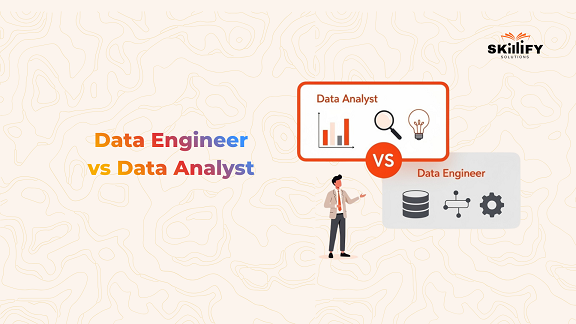
Data engineer vs data analyst

Data Engineer vs Data Analyst in 2026

Data Engineer vs Data Analyst in 2026 depends on whether you prefer Python and Spark or R and statistics. Data generation by global systems is increasing thus, both roles are in high demand. Yet they require fundamentally distinct skill sets and daily approaches to problem-solving. In terms of future opportunity, the Data Engineering role is projected to maintain its high salary premium because their infrastructure expertise directly addresses scaling challenges. While Analysts are the business navigators, Engineers are the builders ensuring the data systems do not crash under load. The Engineer’s focus is system robustness whereas, the Analyst’s focus is strategic modeling and reporting. In this blog, we will cover: Key difference between Data Analyst and Data Engineer Data Engineer vs Data Analyst: Key Differences Aspect Data Engineer Data Analyst Primary Focus Set up systems, move info smoothly, also keep it ready to use when needed ILook at numbers, make charts, get useful info for decisions Core Responsibility Create data setups, build transfer workflows while keeping databases running smoothly Data wrangling, statistical analysis, dashboards, reporting Daily Tasks Setting up flow systems, keeping an eye on info accuracy, handling tech upkeep Cleaning data, then digging into patterns, while building reports plus visual displays Technical Depth High: programming, system design, big data platforms Moderate: SQL, Python/R for analytics, visualization tools Key Tools Python/Java/Scala, SQL, Spark/Hadoop, AWS/Azure, Airflow SQL, Excel, Power BI/Tableau, Python/R Data Stage From messy info to usable details Neat, ready-to-use info to spot trends Data Volume Huge amounts of messy data, sometimes kind of organized, sometimes not Organized data sets, usually cleaned beforehand Collaboration Teams up with analysts, works alongside scientists, delivers practical data they can actually use Teams up with key people, uses info to spark real steps forward Avg US Salary (2026) $5-10 LakhSource $4-9 Lakh Source Entry Barrier More tech skills needed; involves lots of coding Moderate; analytics-focused Career Path Junior Engineer → Senior Engineer → Data Architect / Platform Lead Junior Analyst → Senior Analyst → Analytics Lead / Strategy Best For Loves writing code, also into creating full setups, plus figuring out tech hiccups along the way Loves digging into data – finds joy in spotting patterns. Numbers? They speak volumes when shared right. Teams up with others to get things done What is a Data Analyst? A data analyst checks numbers, then turns them into clear pictures or charts so we get useful answers. For instance: What’s changing? Why does it matter? What happened? What caused it? So what’s probably coming up now? Core Responsibilities: Background: Bachelor’s degree in Stats, Math, or Business Analysis – similar areas work too. Most times, data analysts aren’t expected to know much about databases or how they’re built. Real-World Example / Day-in-the-Life What is a Data Engineer? A Data Engineer sets up systems so information moves smoothly from where it’s gathered to where it’s studied. Instead of just storing data, they keep things running properly over time while improving speed when needed.  Their work guarantees accuracy, so reports and models actually make sense later on. Without messy or broken inputs, teams can trust what they’re working with daily. Data engineering career path is to handle heavy loads of info safely through smart setups others rely on heavily. Key Responsibilities: Technical Focus: Data engineers must know how to code well – languages such as Python, Java, or Scala. On top of that, they should understand how to design data systems and set up solid structures. When it comes to working with large datasets, getting hands-on with cloud services is a must.  Instead of just local setups, modern solutions often rely on platforms built for heavy loads. Besides this, handling workflows smoothly means using tools similar to Apache Airflow. Another key part? Running applications efficiently through containers, powered by Docker or Kubernetes. Data Engineer Example Project Problem-Solving Approach Engineers tackle tough problems tied to systems and structures. Instead, they build data flows, handle massive storage setups, keep operations running smoothly, or fix performance hiccups when things slow down.  Say a data channel crashes during heavy load, someone in this role pins down the issue, gets it working again, then adjusts things so it won’t break under pressure later. Analysts tackle company issues by digging into numbers. Using info from records, they spot patterns that matter. Reports come next, showing what the data means clearly. Instead of just listing facts, they suggest real steps to fix things.  Say sales drop in one area – they might push new ads or tweak pricing to help. Code Complexity Engineers need strong coding skills. They build scripts that run data workflows automatically, keep data transfer tasks running smoothly, while linking different platforms together.  Knowing Python, Java, or Scala matters a lot also hands-on work with tools like Spark and Hadoop counts just as much. Being comfortable with both SQL and NoSQL databases isn’t optional either. Analysts tweak code a bit. Mostly they run SQL to pull data, while leaning on Python or R to dig deeper. Visuals come next, scripts handle that part. Their real job? Turning tidy datasets into clear takeaways instead of crafting the tools behind them. Stakeholder Interaction Engineers usually stick to their own squads, like coders or data folks. They’re focused on keeping systems running smooth instead of guessing how it affects sales or strategy. Not really common. Their main job’s about solid pipelines, not boardroom talk. Stability matters more than storytelling here. Analysts talk closely with company leaders, managers, along with different departments. They turn messy numbers into clear takeaways, using charts or summaries that help shape smart moves. Team Interaction Engineers team up with data scientists, helping keep information correct, easy to reach, plus able to grow when needed. They might fix broken workflows or tweak how data’s set up so analysis runs smoother. Analysts team up with business units, using info to spot trends while guiding decisions alongside leaders. When special data’s needed, they loop in engineers for help shaping or updating files. Error Consequence Engineers…

Read More
Best online data science masters program

Best Online Data Science Masters Programs

Choosing the right Master’s program is the biggest career decision you’ll make this year. The fear of enrolling in a degree that delivers outdated skills or a weak network is valid, and it’s stopping you from moving forward. You don’t need another generic list of Best Online Data Science Masters, you need a reliable, objective selection method. This blog is designed to give you that method. We cut through the university marketing fluff and the aggressive sales pitches to provide a proven, objective selection framework. Whether you’re aiming for a top research role or a fast-track industry position, this blog from Skillify Solutions break down the five critical factors that guarantee your online degree becomes the asset it should be. Best Online Data Science Masters Programs 2026 It is quite challenging to choose the best data science masters online. There are different universities, different costs and different formats. To make your decision easier, we’ve created a clear and updated list of the best data science masters programs online in 2026. Each program in the table below is industry-relevant, and designed for working professionals or aspiring data scientists looking for a flexible path to upgrade their skills. Compare key details like cost, duration, accreditation, GRE requirements, and specializations and find the program that matches your goals.  Best Online Data Science Masters Programs 2026 Program Name & University  Total Cost (USD)  Program Duration  GRE Requirement  Accreditation Status  Graduation Rate  Key Specializations  Data Science, Master of Science, John Hopkins University  $66,670 annually / $33,335 per semester  3 to 4 full time semesters (1.5 to 2 years)  No GRE required  Accredited (JHU Engineering, ranked #13 US News 2026)  Not specified  Data science core areas, machine learning, capstone research, AI applications  Master of Information and Data Science, UC Berkeley School of Information  $69,471 total (27 units, $2,573/unit)  12-32 months  No GRE required  WASC-accredited (#1 ranked MIDS program)  Not specified  ML/Deep Learning, Generative AI/LLMs, NLP, Data Engineering, AI Ethics  Master of Data Science Online, University of California San Diego  Around $83,000 total (18 months full-time)  18 months (5 quarters)  GRE not required  Accredited (UCSD, recognized globally)  Not specified  Data foundations, core DS, electives, 10-week real-world capstone project  Master of Science in Data Science, University of Arizona  ~$34,860 first year / ~$52,290 total (18 months)  18 months  Optional GRE  Accredited (University of Arizona)  Not specified  Data collection/exploration, ML/NLP, data visualization, algorithmic thinking, ethics  MS in Data Science, Eastern University  $9,900 total (30 credits)  10 months (self-paced)  No GRE required  Accredited  Not specified  Python, R, SQL, Tableau, AWS, machine learning, statistics, coding from scratch  MS in Data Science, Tufts University  $53,970 (30 credits,  $1,799/credit)  12-24 months  Not specified  Accredited (Tufts University)  Not specified  Statistics, machine learning, data visualization, optimization  Georgia Institute of Technology – Master of Science in Analytics  ~$10,692 total  1-2 years  Not Required  Accredited  Not specified  Analytics, machine learning, data engineering, visualization  Purdue University – MS in Data Science  ~$14,000 annually  1.5-2 years  Not Required  Accredited, ranked  High graduation rate  Big data, data mining, ML, statistical analysis  MS in Data Science, University of North Dakota  ~$39,240 total (2 years)  2 years  Not specified  Accredited (UND)  Not specified  Big data research, AI, cybersecurity, scientific visualization, autonomous systems  Master of Science in Applied Data Science – Syracuse University (Online)    ~$51,000 total  18 months  Not Required  MSCHE Accredited  Not Publicly Reported  Data Mining, ML, AI, Cyber Analytics, Cloud Data Systems   Online MSc in Data Science – University of London (Goldsmiths)    ~$14,000–$17,000 total   24–60 months (flexible)  No GRE  University of London Accredited  Not Publicly Reported  Data Science Foundations, ML, Advanced Analytics  Master of Science in Data Science – University of Colorado Boulder (Online)  $15,000–$20,000 total  1–3 years (flexible)  No GRE  Higher Learning Commission Accredited  Not Publicly Reported  Statistical ML, NLP, Computer Vision, Big Data Systems  How to Choose the Best Online Data Science Masters Program  With hundreds of options available in the market, it is crucial to focus on accreditation, curriculum depth, Return on Investment (ROI), and flexibility to match your goals. The Skillify Solutions will help you to explore the metrics that are essential before choosing the best online data science masters from top places.   According to the U.S Bureau of Labour Statistics,  34% growth of Data Scientists (2022-2032), and median salaries of the Data Scientist are hitting approximate $112,590 per year. Therefore, choosing the best online data science master programs can help you unlock six-figure careers.   Accreditation and Program Reputation  It is evident that a well-accredited best online masters in data science program increases your chances of employer recognition and smooth transitions into global roles.  Curriculum and Specializations  A strong curriculum teaches not just theory but real-world application. The best online masters in data science balance fundamentals with emerging technologies.  Cost vs. ROI Analysis  A Data Science master’s degree can be considered an investment. Thus, you should evaluate the return by comparing the learning costs with potential outcomes:  Flexibility and Program Format  Online Data Science Masters Admission Requirements  If you are applying for a best online masters data science there are various prerequisites and materials that are commonly required by US universities. When applying for an online Master’s in Data Science program, universities look for a solid academic foundation and applications to evaluate the candidates better. Let us study some of them:   Prerequisites and Background  Application Materials  Career Outcomes and Salary Expectations  Graduates of online Master’s in Data Science programs have strong career opportunities with competitive salaries. These will grow with experience and time thus it is considered as one of the best career options for the youth.  Data science jobs focus on industries like tech, finance, healthcare, and government and offer diverse roles and high demand.  Job Titles and Roles  Online Data Science Master’s graduates can apply for various high-demand roles across tech, finance, healthcare, and consulting. This is clear progression from entry-level candidates to leadership positions.  Job Title  Key Responsibilities  Typical Industries  Data Scientist  Build predictive models, statistical analysis, data visualization    Tech, Finance, Healthcare  Machine Learning Engineer  Deploy ML models, optimize algorithms, productionize AI    Tech,…

Read More
Best data science courses

10 Best Data Science Courses in 2026

From predicting customer behaviour to building AI-powered products, Data Science has become the backbone of modern innovation. Thousands of learners are hunting for the Best Data Science Courses in order to upskill their careers.  The job growth has been projected to be 34% by the US Bureau of Labor Statistics. Therefore, mastering the right skills has become essential. Amid 1000+ courses flooding in the market, how do you pick up the best data science online program with placement that deliver skills, and six-figure salaries? In this blog we will study the 10 Best Data Science Courses in 2026 that deliver results. Read on!  Top 10 Best Data Science Courses in 2026: Detailed Comparison US data science jobs are growing more than 34% with 23K+ openings yearly at $150K+ salaries. Choosing the right course is critical. This comparison table breaks down the 10 Best Data Science Courses by duration, level, features, and ideal learners. Here is the breakdown of each of them with their duration, level, and core features.   Course  Duration  Level  Key Features  Ideal For  Data Science Bootcamp with AI by Skillify Solutions 4 months Beginner Master Python, SQL, Machine Learning, and AI with dedicated career coaching  Perfect for first time learners who want to build a foundation and support business decisions.  IBM Data Science Professional Certificate by Coursera.   4 Months   Beginner   Structured 9–10 course sequence, Python, SQL, visualization, basic ML, cloud tools, job‑ready projects, industry certificate    Newcomers who want an industry-branded, beginner-friendly path into data science with flexible pacing.  Data Science Specialization by Johns Hopkins, Coursera.   6-9 months   Intermediate  R-based, strong statistics focus, EDA, regression, reproducible research, basic ML, GitHub-centric projects.    Learners comfortable with some coding who want rigorous statistical foundations and prefer R.  Applied Data Science with Python by University of Michigan, Coursera 4-6 months   Intermediate  Python libraries (pandas, matplotlib, scikit-learn). Inferential stats, ML, text mining– Social network analysis, hands-on projects    Beginners with basic Python looking for practical data science, ML, and visualization skills.  MicroMasters in Statistics and Data Science by edX, MIT.   9-18 months  Intermediate to Advance  Structured 5-course sequence, probability & statistics, data analysis, machine learning, computation (Python/R theory), mathematical depth  Serious learners seeking rigorous graduate-level theory and academic credentials for master’s pathways.  UC San Diego Data Science MicroMasters by edX, UCSD.   6-9 months   Intermediate  Analyze big data using Python, Jupyter notebooks, and Apache Spark, and mastering concepts in machine learning, probability, and statistics.  Learners wanting scalable big data systems and ML depth beyond single courses.  Professional Certificate in Data Science by edX, Harvard.   4-6 months  Beginner and Intermediate  Learning data wrangling with the tidyverse, data visualization with ggplot2, and implementing machine learning algorithms through case studies.  R enthusiasts seeking structured stats-focused programs from top universities.  Data Scientist Nanodegree by Udacity.  6-12 months  Intermediate   Project-based learning approach, end-to-end data science workflow and practical skills.  Job transitioners valuing hands-on projects, mentorship, and portfolio building.  Data Scientist in Python Certificate Program by DataQuest.  11 months   Beginner and Intermediate   Python stats on large datasets, SQL queries & web scraping, Insightful data visualizations, Automated ML & predictive modeling  Self-directed learners who want interactive coding and portfolio projects.  Career Track 365 Data Science.  6-12+ months  Beginner and Intermediate   Video curriculum Python/R/SQL, Math, stats, ML, AI foundations, Analytics to decision-making skills    Beginners looking for structured video paths with AI/data science career prep.  Python Data Science by FreeCodeCamp   300+ hours  Beginner and Intermediate   Free Python, NumPy, Pandas, MatplotlibJupyter Notebooks, hands-on projectsFull codebase  Beginners looking for free, comprehensive Python data science practice.  Factors to Consider When Choosing the Best Data Science Courses  Beyond the name and popularity of the course, applicants should understand which course will provide value for their time and money. There are some key factors that will help you determine which Data Science Course will be the best fit for you. Let them understand one by one before you make any decisions for your future.   Accreditation and Recognition  Accreditation and recognition can be considered as the signal strength of how the employer will take your course. Here are some key points to check accreditation and recognition:  Who stands behind the course  Type of credential  How to use this  If you are aiming for roles in large multinational companies, then go for university or industry-accredited credentials. On the other hand, if you already have a strong degree and just need skills, online program recognition certifications can also help.   Curriculum Relevance and Depth  A certificate will be useless if the data science syllabus is outdated, and you get to learn nothing. Here are the areas you should focus on while looking at the syllabus depth and relevancy.  Core building blocks  Depth and Breadth   Industry Alignment  How to use this  You can create a checklist of skills required for your Data Scientist target role from job descriptions, then see how many things are aligned with the course.   Tip: Avoid courses that only offer basic Excel or BI skills as “Data Science.”  Flexibility and Learning Format  It is important to note that even the best institute for data science certification is useless if it does not fit your life and learning style. Here are some crucial dimensions to consider:  Schedule:  Time Demand  Format  How to use this  It can prove helpful if you write down your real weekly hours and preferred style if you are choosing self-paced learning mode.  Immediately rule out any course whose time or format clashes with your reality for real-time results.   Support and Career Services  Finally, this is to understand how much help you get during and after the best online courses for data science for beginners. These are the types of support you can look out for:   Academic and Learning Support:   Discussion forums, teaching assistants, or mentors to answer technical questions. Code reviews or feedback on projects.   Career support  Resume and LinkedIn reviews. Mock interviews, career coaching, and job search strategy sessions. Employer partnerships or job boards.   Community: Active learner or alumni community (Slack/Discord/LinkedIn) for networking and peer support.  How to use this Minimal career…

Read More