Imagine walking into your SAFe exam prep already knowing how the questions will feel, what they’re really testing, and exactly how to approach them with confidence. Feels good, right? That’s what the right preparation does. It removes your confusion and replaces it with clarity.
In 2026, SAFe® certification will become a strong advantage as more companies scale Agile across teams and projects. But here’s the real game changer. It is not about how much you study, it’s about how well you understand and apply the concepts in real situations.
In this blog, I’ll walk you through a simple, practical way to prepare. You will learn what actually matters, what you can skip, and how to stay consistent. You’ll also know how to use SAFe® exam practice questions smartly, so you build confidence, improve accuracy, and walk into your exam feeling ready to clear it on your first attempt. Let’s start reading!
What is SAFe Certification? Key Concepts Explained
SAFe® Certification is a globally recognized credential that demonstrates you understand how to apply Agile at the enterprise level. It is based on the Scaled Agile Framework (SAFe®). It is a structured system that helps companies manage multiple teams, improve collaboration, and deliver projects faster.
In simple terms, SAFe® is scaling Agile across the entire organization. Many companies struggle when Agile moves beyond one team. SAFe® solves this by giving clear roles, workflows, and processes to align everyone.
When you earn a SAFe® Certification, you’re proving that you can:
- Work in large Agile environments
- Align teams with business goals
- Improve delivery speed and quality
- Apply Lean, Agile, and DevOps practices together
Most SAFe® certifications require you to attend an official training session and then pass an exam. Once you clear it, you get a certification badge that validates your expertise. If you’re preparing seriously, one thing you’ll notice is that practicing questions plays a huge role.
Solving SAFe® practice questions helps you understand real exam patterns, improve accuracy, and boost confidence before the final test.
Most professionals begin with Leading SAFe® to understand the framework, and then move to role-based certifications like SAFe® Scrum Master (SSM) or SAFe® POPM, depending on their career path.
Types of SAFe® Certifications
1. Beginner Level
SAFe® Agilist and SAFe® for Teams (SP) are perfect if you’re new to SAFe®. These certifications help you understand the basics of Agile, how SAFe® works, and how multiple teams collaborate at scale. This level builds a strong foundation before moving to advanced roles.
2. Intermediate Level
SAFe® Scrum Master (SSM) and SAFe® Product Owner/Product Manager (POPM) focus on specific job roles. Providers like Skillify Solutions offer these certifications that help you learn how to manage teams, plan sprints, and deliver real business value. At this stage, practicing SAFe® exam practice questions becomes very important because the exam is more scenario-based.
Master team facilitation skills with SAFe Scrum Master certification today!
3. Advanced Level
Certifications like SAFe® Advanced Scrum Master (SASM), SAFe® DevOps Practitioner, and SAFe® Architect / Lean Portfolio Management are designed for professionals who want to lead teams and drive Agile transformation. You’ll learn strategy, scaling, and how to manage Agile at an enterprise level.
4. Expert Level
SAFe® Program Consultant (SPC) is the highest-level certification. It allows you to train others, implement SAFe® across organizations, and lead large-scale Agile transformations as an expert.
Why SAFe Certification is Important in 2026
In 2026, companies are no longer working with just one team. They are managing multiple teams, projects, and locations at the same time. This is where knowing What is SAFe Certification is becomes important. It helps professionals understand how to scale Agile across large organizations and deliver results faster.
- High demand: Companies prefer SAFe® certified professionals to manage large Agile teams effectively.
- Better career growth: Certification opens doors to higher-paying roles and faster career progression.
- Enterprise skills: You learn how to handle Agile across multiple teams and complex projects.
- Leadership development: SAFe® builds strong decision-making and team management skills.
- Faster delivery: Helps improve productivity by aligning teams and reducing delays.
- Global recognition: SAFe® certification is widely accepted across industries and countries.
SAFe® Exam Pattern: Format, Duration, and Passing Score
The SAFe® Certification Exam is designed to test how well you can apply Agile in real business scenarios. Unlike basic certifications, SAFe® exams focus heavily on decision-making, roles, and real-world situations.
1. Exam Format and Structure
Most SAFe® certification exams follow a similar format:
- Question Type: Multiple-choice questions with single or multiple correct answers
- Exam Mode: Online, web-based
- Number of Questions: Typically, 40-60 questions
- Time Duration: 90-120 minutes, depending on certification
- Language: English
The SAFe® exam is designed to evaluate how well you understand and apply key concepts in real-world scenarios. It focuses on core areas such as Lean-Agile principles and mindset, SAFe® roles like Scrum Master, Product Owner, and Release Train Engineer, as well as Program Increment (PI) planning and Agile Release Trains (ARTs). You’ll also be tested on DevOps practices and continuous delivery to ensure you can connect development with faster business outcomes.
Lead enterprise transformation with Lean Portfolio Management SAFe certification!
2. Passing Score and Difficulty
The passing score varies slightly depending on the certification, but generally falls between 73% to 80% for most SAFe® exams. Higher-level certifications may have stricter evaluations. The format of the exam may seem straightforward.
However, the difficulty comes from close answer choices, real-world scenarios instead of direct questions, and application-based thinking. This is why many candidates struggle without proper preparation.
Why Practice Questions Are Critical
One of the biggest mistakes candidates make is only reading theory. In reality, SAFe® exams are heavily based on practical scenarios. Practicing regularly helps you understand the exam pattern and question style, improve your speed and accuracy, and identify weak areas early in your preparation.
It also builds confidence before the actual exam, making you more comfortable with scenario-based questions. In fact, top performers usually complete multiple mock tests before attempting the final SAFe® certification exam.
SAFe® Certification Exam Comparison
| Certification | Questions | Duration | Passing Score | Difficulty |
| SAFe® Agilist (SA) | 45 | 90 mins | 80% | Moderate |
| SAFe® Scrum Master (SSM) | 45 | 90 mins | 77% | Moderate |
| SAFe® POPM | 45 | 90 mins | 80% | Moderate |
| SAFe® 6.0 for Teams | 60 | 120 mins | 77% | High |
| SAFe® DevOps Practitioner | 45 | 90 mins | 77% | Moderate |
| SAFe® Agile Product Management | 60 | 120 mins | 77% | Very High |
How to Prepare for SAFe® Certification: Step-by-Step Study Plan
Preparing for the SAFe® certification is about understanding how Agile works in real-world scenarios. A structured study plan helps you stay consistent, cover all important topics, and improve your chances of passing on the first attempt.
Experts recommend combining official learning, revision, and practice questions to build a strong concept of clarity and confidence.
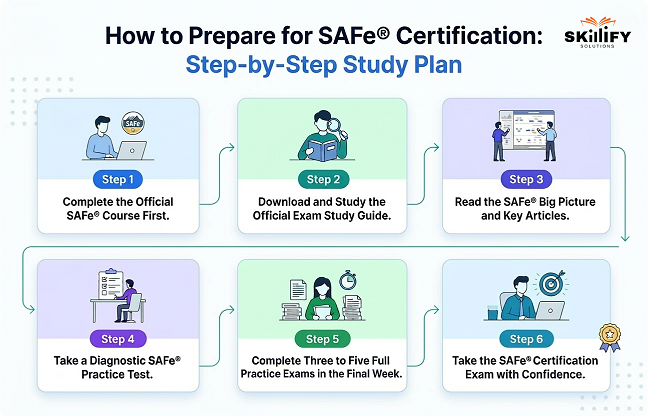
Step 1: Complete the Official SAFe® Course First
The first and most important step is to complete an official SAFe® training course. This gives you a clear understanding of the framework, roles, and workflows. Most certifications require training before the exam, and it builds your foundation for everything else.
If you want to explore the right path based on your role, you can go through the Leading SAFe®, SAFe® Scrum Master, or SAFe® POPM courses from Skilllify Solutions. These courses guide you through the exam, pattern, passing marks, and study guide to prepare in a better way.
Step 2: Download and Study the Official Exam Study Guide
After training, go through the official SAFe® exam study guide carefully. It covers all the key topics, concepts, and areas where questions are asked. Treat this as your primary preparation resource.
You can start studying from the important questions before an exam instead of reading the entire textbook.
Step 3: Read the SAFe®Big Picture and Key Articles
The SAFe® Big Picture is one of the most important tools for understanding how everything connects. Reviewing it regularly helps you understand roles, events, and workflows clearly, which is critical for scenario-based questions.
It’s like a company org chart. When you understand who reports to whom and how workflows work, everything becomes clearer.
Step 4: Take a Diagnostic SAFe® Practice Test
Before deep preparation, take a practice test to understand your current level. This helps you identify weak areas and gives you a clear direction on what to focus on next.
For example, taking a mock driving test before your actual license test, you see where you’re making mistakes.
Step 5: Review and Revisit Weak Areas Systematically
Once you know your weak areas, revise those topics thoroughly. Focus more on concepts like PI Planning, ARTs, and SAFe® roles, as these are commonly tested in exams.
Suppose you’re weak in math and you don’t study everything again. You can just try to focus on the chapters you struggle with.
Step 6: Complete Three to Five Full Practice Exams in the Final Week
In the final week, take multiple full-length mock tests. This helps improve your speed, accuracy, and confidence. Regular practice also prepares you for the scenario-based nature of SAFe® exam questions.
For example, doing multiple full rehearsals before a big presentation or match, you perform better because you’ve already practiced.
SAFe® Exam Tips from Experts with 10+ Years Experience
Clearing the SAFe® exam is less about memorizing concepts and more about thinking like an Agile practitioner. Professionals with 10+ years of experience follow a few proven strategies that significantly improve success rates.
1. Focus on “Why.”
Experts do understand why a concept exists. Instead of memorizing PI Planning steps, understand why teams align before execution. This helps you answer scenario-based questions easily.
2. Eliminate Wrong Options First
Most questions have similar-looking answers. The fastest way is to eliminate clearly wrong options first. If two options don’t follow Agile principles, like command-and-control decisions, you can instantly remove them.
3. Think from a SAFe® Mindset
Always choose answers that align with Lean-Agile values like collaboration, decentralization, and continuous improvement. If confused, pick up the option that promotes teamwork over hierarchy.
4. Practice Scenario-Based Questions Daily
Experts spend more time on SAFe® exam practice questions than on theory. Instead of reading Scrum roles, solve questions where you decide what a Scrum Master should do in a situation.
5. Don’t Overthink the Questions
Many candidates fail because they overanalyze simple questions. SAFe® exams usually test straightforward concepts. You can go with the most practical and Agile-aligned answer.
6. Manage Time Smartly During the Exam
Time management is key, especially in longer exams. Don’t spend too much time on one question; mark it and come back later.
7. Revise the SAFe® Big Picture Before the Exam
Experts always review the SAFe®Big Picture just before the test. This helps you quickly recall roles, flows, and processes during the exam. You can go through the SAFe® Big Picture guide to learn the levels, competencies, and layers of SAFe® in a better way.
8. Take Mock Tests in Real Exam Conditions
Simulate the actual exam environment while practicing. Set a timer, avoid distractions, and complete the test in one sitting to build confidence.
SAFe® and Agile Trends in 2026 and 2027
In 2026-2027, Agile is evolving from a team-level approach to a full business strategy. Over 70% of enterprises are expected to adopt Agile at scale, with SAFe® remaining one of the most widely used frameworks. Organizations are now focusing more on business outcomes rather than just processes, with companies reporting up to 30-50% faster delivery cycles after adopting SAFe®.
At the same time, AI integration in Agile is increasing, helping teams improve planning, forecasting, and decision-making.
Another major shift is the rise of DevOps and continuous delivery, with over 80% of Agile teams adopting CI/CD practices to release faster and more frequently.
Companies are also becoming more customer-centric, using real-time feedback to improve products. To stay competitive, it’s important to build practical knowledge and regularly practice SAFe® exam practice questions, as exams are increasingly aligned with real-world trends.
Conclusion
By now, you have a clear path in front of you. Take it step by step, stay consistent, and keep learning with the right mindset. Every hour you invest in preparation moves you closer to success. Small, focused efforts every day will build strong confidence over time.
Remember, it’s about progress. Focus on understanding concepts and reinforcing them with SAFe® exam practice questions. This combination will help you handle real exam scenarios with ease.
Stay calm, trust your preparation, and believe in yourself. When you walk into the exam with clarity and confidence, success becomes a natural outcome, and your certification will follow. Best of luck!
Become an Agile leader with advanced SAFe certifications and structured learning!
Frequently Asked Questions
1. How many questions are on the SAFe® exam?
Most SAFe® exams typically have 45 multiple-choice questions. These questions are scenario-based and test how well you apply concepts rather than just recall them.
2. What is the passing score for the SAFe® Agilist exam?
The passing score is usually around 77%-80%. This means you need about 35 correct answers out of 45. Since questions are scenario-based, strong concept clarity is important to consistently choose the correct answers
3. How long does it take to prepare for a SAFe® certification?
We can here say, once u take the in-class training from us, you should be ready within days or weeks. In general, when you take the class, you have to take the exam within 30 days
4. Are SAFe® practice tests worth it?
Yes, SAFe® practice tests are highly valuable as they help you understand the exam pattern and improve accuracy. They also prepare you for scenario-based questions, making you more confident for the actual exam.