 Skip to content
Before you enroll in a Data Science Bootcamp, there’s one question that matters more than cost, duration, or brand name:
What exactly will you learn?
In 2026, the Data Science Bootcamp Curriculum will not be restricted to just Python and dashboards anymore. It’s AI deployment, real-time data pipelines, cloud systems, and working with Large Language Models. There is a lot more to learn.
A serious bootcamp curriculum should reflect today’s industry, and that’s what you get while reading this blog. So here we will study what a serious 2026 Data Science Bootcamp Curriculum really includes. Let’s unpack it week by week.
Data Science Bootcamp Curriculum: What’s Included in 2026
| Bootcamp | Cost Range | Duration | Core Modules | Tools and Languages | Career Support |
| Skiilify Solutions Data Science Bootcamp with AI | $659.77 | ~4 Months | Python, SQL, Machine Learning, Generative AI, LLMs, MLOps, Capstone Projects | Python, SQL, Pandas, Scikit-learn, TensorFlow, AWS, Git | Installments |
| Springboard Data Science Career Track | ~$9,900 | ~6 Months | Data Wrangling, ML, Statistics, AI Applications | Python, SQL, Tableau, ML Libraries | Instalments, Financing |
| Flatiron School | ~$9,900 | 45 Weeks | Data Analysis, ML, Deep Learning, Capstone | Python, SQL, Tableau, ML Libraries | Financing Options |
| Le Wagon Data Science and AI | ~$14,000 | 2 Months | Data Analysis, ML, Deep Learning, Capstone | Python, SQL, Pandas, TensorFlow | Upfront / Financing |
| 4Geeks Academy Data Science and Machine learning | ~$9,899 | 3–6 Months | Data Analysis, ML Fundamentals | Python, SQL, ML frameworks | Financing Available |
| General Assembly Data Science Bootcamp | $16,450 | 12 Weeks | Python, Data Modeling, ML Basics | Python, SQL, Pandas | Financing Options |
| Data Science Dojo Bootcamp | ~$3,999+ | ~16 Weeks | Data Analytics, ML, Visualization | Python, SQL, Tableau | Upfront |
| Techpro SMU AI and Data Science Bootcamp | $9,900 | 15 Weeks | Data Analysis, ML, AI Intro | Python, R, Azure | Installments |
| Nashville Software School Data Science Bootcamp | $13,125 | 9 Months | AI, ML, Data Engineering Basics | Python, SQL, Cloud basics | Financing |
| Tripleten Data Science Bootcamp | ~$9,700 | 9 Months | Data Analytics, Python, ML | Python, SQL | Installments |
Core Skills You’ll Learn in a Data Science Bootcamp
A modern Data Science Bootcamp in 2026 is built around practical, job-ready skills rather than academic theory. Top-ranked university guides and industry reports consistently highlight that employers prioritize programming, data handling, visualization, and applied machine learning over credentials.
The goal of a Data Science Bootcamp is simple. It is to teach you how to work with real data, build models, and communicate insights in a production environment.
Below are the core technical foundations most reputable bootcamps focus on:
1. Python for Data Science and SQL Fundamentals
Python remains the dominant language in data science because of its simplicity and powerful ecosystem. Bootcamps train you to use Python for solving real business problems through structured workflows.
You typically learn:
- Data manipulation using Pandas and NumPy
- Writing reusable scripts and functions
- Working with APIs and structured datasets
- Using Jupyter Notebooks for experimentation
- Version control basics with Git
Alongside Python, Structured Query Language (SQL) is treated as a non-negotiable skill. Nearly every data-driven organization stores information in relational databases, and the ability to extract clean datasets efficiently is critical.
Explore the AI Bootcamp Everyone Is Talking About
Core SQL skills include:
- Writing SELECT, JOIN, GROUP BY, and aggregation queries
- Filtering and transforming large datasets
- Query optimization basics
- Working with real-world business databases
Together, Python and SQL form the operational backbone of any data role. Without them, advanced modeling isn’t possible.
Data Visualization and Intro to Machine Learning
Once data can be extracted and cleaned, the next step is turning it into insight. Data visualization helps you interpret patterns and communicate findings clearly to non-technical stakeholders.
Bootcamps typically cover:
- Exploratory Data Analysis (EDA)
- Visualization using Matplotlib and Seaborn
- Dashboard tools like Tableau or Power BI
- Choosing the right chart for the right question
Visualization builds analytical thinking. It helps identify trends, anomalies, and relationships before modeling even begins.
From there, learners transition into introductory machine learning, the foundation of predictive analytics. Rather than diving straight into complex AI systems, most programs start with core supervised and unsupervised techniques.
You learn:
- Regression and classification models
- Clustering techniques
- Model evaluation metrics like accuracy, precision, and recall
- Overfitting vs underfitting concepts
- Basic feature engineering
These modules prepare students to move beyond descriptive analysis into prediction and automation. These skills help to drive higher salary outcomes. If you want to see how a structured, AI-focused curriculum is designed step-by-step, you can explore a complete example of a modern Data Science Bootcamp.
Explore the Data Science Bootcamp with AIand advance your Data Visualisation skills!
Sample Data Science Course Syllabus: Week-by-Week Breakdown
A well-structured data science bootcamp builds skills in clear modules. Programs like Data Science Bootcamp with AI by Skillify Solutions follow a practical progression in which each module builds on the previous one, ensuring learners progress from beginner to job-ready.
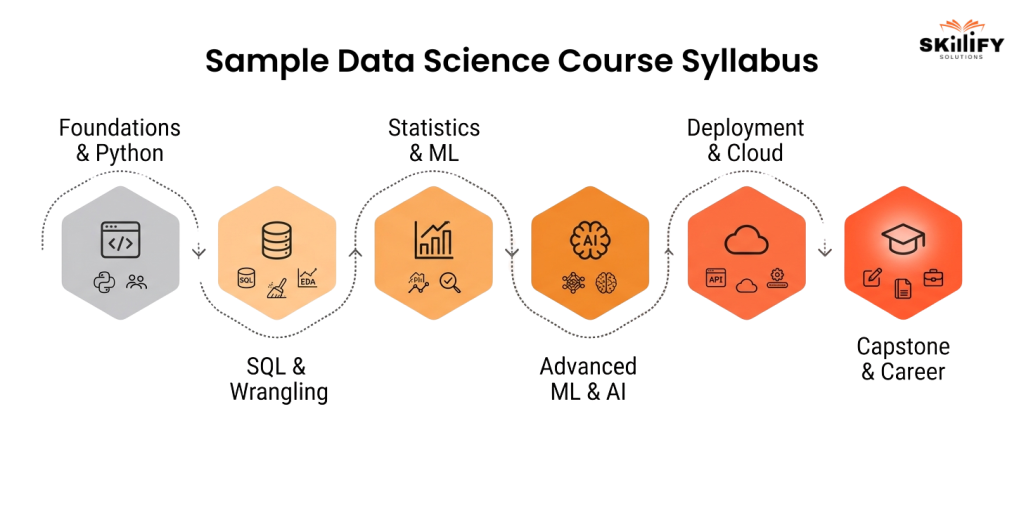
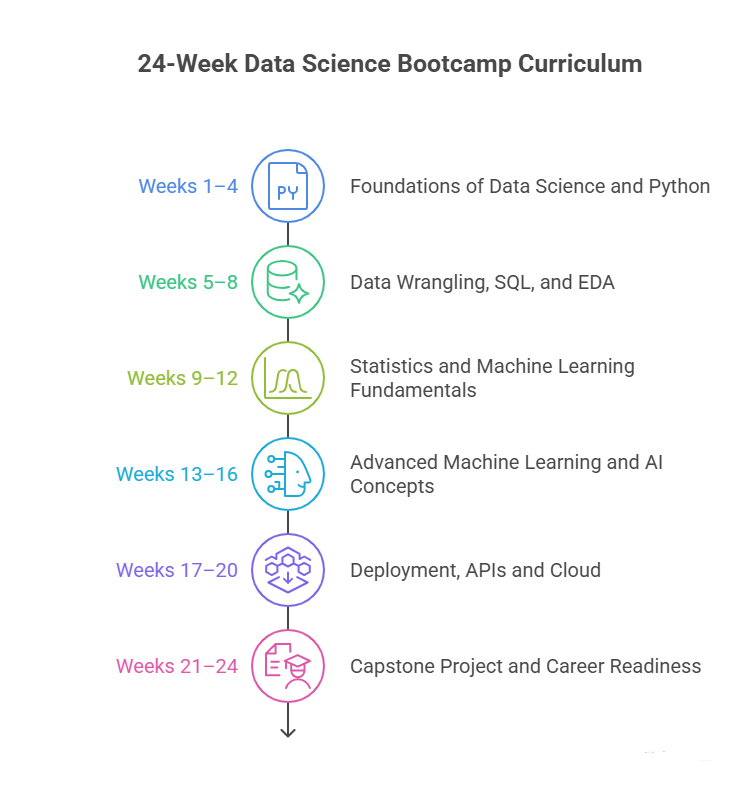
Here’s how a 24-week curriculum can be broken into modules:
Module 1: Foundations of Data Science and Python (Weeks 1–4)
This module builds the base for everything that follows. You start with Python, the most widely used language in data science, and understand how real-world data workflows operate.
What you’ll learn:
- Python basics like variables, loops, and functions
- Data structures like lists, dictionaries, and sets
- Introduction to NumPy and Pandas
- Jupyter Notebook workflows
- Git and GitHub fundamentals
Expected Outcomes: You will be able to write basic Python programs and work with structured data using libraries like Pandas and NumPy. You’ll understand how real-world data workflows operate and prepare datasets for analysis.
Module 2: Data Wrangling, SQL, and EDA (Weeks 5–8)
This is where raw data becomes useful. In line with major Data Science Bootcamp programs, this module focuses heavily on real-world data handling.
What you’ll learn:
- SQL queries (SELECT, JOIN, GROUP BY)
- Data extraction from databases
- Data cleaning and preprocessing
- Handling missing values
- Exploratory Data Analysis (EDA)
- Visualization using Matplotlib and Seaborn
Expected Outcomes: You will be able to extract data from databases, clean it, and perform exploratory analysis. You’ll confidently turn raw data into meaningful insights using SQL and visualization tools.
Module 3: Statistics and Machine Learning Fundamentals (Weeks 9–12)
This module introduces analytical thinking and predictive modeling, core to any data science role.
What you’ll learn:
- Descriptive and inferential statistics
- Hypothesis testing
- Regression and classification models
- Model evaluation, like accuracy, precision, and recall
- Overfitting vs underfitting
Expected Outcomes: You will understand core statistical concepts and build basic machine learning models. You’ll be able to evaluate model performance and interpret the results to inform decision-making.
Module 4: Advanced Machine Learning and AI Concepts (Weeks 13–16)
As seen in modern bootcamps like Skillify Solutions, this stage focuses on improving model performance and introducing AI concepts.
What you’ll learn:
- Feature engineering and selection
- Cross-validation techniques
- Hyperparameter tuning
- Introduction to deep learning
- Neural networks basics (TensorFlow/PyTorch)
Expected Outcomes: You will improve model accuracy using advanced techniques like feature engineering and tuning. You’ll gain a working understanding of deep learning and how AI models handle complex data.
Module 5: Deployment, APIs and Cloud (Weeks 17–20)
This is where most beginners struggle, but it’s what companies actually look for. This module emphasizes job-ready deployment skills in this phase.
What you’ll learn:
- Model deployment basics
- API creation using Flask or FastAPI
- Model serialization
- Real-time data handling
- Cloud basics (AWS/GCP)
Expected Outcomes: You will be able to deploy machine learning models using APIs and cloud platforms. You’ll understand how to take a model from development to a real-world production environment.
Module 6: Capstone Project and Career Readiness (Weeks 21–24)
The final module focuses on outcomes, turning your learning into a portfolio and preparing for jobs.
What you’ll learn:
- End-to-end project
- Business problem-solving using data
- Dashboarding and reporting
- Resume and LinkedIn optimization
- Mock interviews and job preparation
Expected Outcomes: You will build a complete end-to-end data science project showcasing your skills. You’ll be prepared for interviews with a strong portfolio, resume, and practical problem-solving ability.
Start Your Data Science BootcampWith Confidence and land with a job in months!
Choosing the Right Bootcamp: Key Factors to Consider
Picking the right Data Science Bootcamp in 2026 is challenging. It depends on IT support and real career outcomes. According to industry guides like Ironhack’s bootcamp advice and hiring insights, the strongest programs help you build job-ready skills and land relevant roles quickly.
Here are the key factors to consider before you enroll:
1. Curriculum That Matches Industry Need: Look for programs that teach Python, SQL, machine learning, statistics, and deployment, with real business case studies. The best science bootcamps should reflect what employers actually hire for.
2. Hands-On Learning and Projects: The best bootcamps emphasize project-based learning, where you build real applications you can showcase in your portfolio. Employers focus on what you can do, not just what you know.
3. Instructor Quality and Mentorship: Experienced instructors and 1:1 mentorship help you learn faster and avoid common pitfalls. Programs with structured support, like live sessions, office hours, and code reviews, tend to have better completion and placement rates.
4. Career Services and Placement Support: Look for bootcamps that offer resume and LinkedIn reviews. Also look for mock interviews, hiring partner networks, and job search guidance. These elements shorten your time to employment and improve salary outcomes.
5. Flexible Format and Completion Rate: Choose a format like full-time, part-time, self-paced, or online that you can realistically finish. Bootcamps with higher completion rates generally have better outcomes.
6. Cost vs Value (ROI): Consider how quickly you can recover your investment based on expected starting salaries and job support. Check if the Data Science Bootcamp Cost and ROI are worth it, and the right value comes from outcomes.
7. Transparent Outcomes and Alumni Feedback: Programs that publish clear graduation rates, salary ranges, and graduate testimonials give you confidence. If outcome data is missing, dig deeper before committing.
Conclusion
It can be concluded that the real difference between learning data science and becoming a data scientist lies in the curriculum. A well-designed program takes you from writing simple scripts to building intelligent systems that create measurable business impact.
In 2026, that journey must include AI integration, deployment, and strategic thinking. If the program you’re considering doesn’t prepare you to build, deploy, and communicate impact, it’s incomplete.
Choose a Data Science Bootcamp curriculum that aligns with where the industry is headed.
Frequently Asked Questions
1. Are advanced data science courses included in bootcamps or separate?
Most bootcamps cover foundational to intermediate machine learning. Advanced topics like deep learning, NLP, or AI research are often offered as separate specializations or add-on modules. Some premium bootcamps include advanced tracks, but university-level depth is usually separate.
2. How does a data science course syllabus differ from a university degree?
Bootcamp syllabus focus on practical, job-ready skills like Python, SQL, ML, and deployment in a few months. University degrees include deeper theory, mathematics, and research over 2–4 years. Bootcamps prioritize speed and employability, while degrees emphasize academic depth.
3.Can I customize my data science bootcamp curriculum based on my goals?
Some bootcamps allow elective modules or specialization tracks like ML, AI, or data engineering. However, most follow a structured core curriculum. Customization usually happens through capstone projects aligned with your career goals.
4. What is the typical data science bootcamp curriculum like?
A typical bootcamp covers Python, SQL, data wrangling, visualization, statistics, machine learning, and basic deployment. Many 2026 programs also include cloud tools, MLOps, and AI concepts, ending with a real-world capstone project for portfolio building.


