 Skip to content
Key Highlights of Agentic AI vs AI Agents
- Understand agentic AI vs AI agents in simple terms.
- Learn the difference between agentic AI and AI agents.
- Compare autonomy, memory, and decision-making capabilities.
- Know when to use AI agents vs agentic AI.
- Explore agentic AI orchestration in enterprise workflows.
- See what is agentic AI compared to AI agents.
Agentic AI and AI agents are not the same and confusing them can lead to the wrong technology decisions. Over the past year, I’ve noticed these terms used interchangeably in product demos, webinars, and even enterprise discussions.
The reality is much simpler: AI agents execute tasks, while agentic AI plans, reasons, adapts, and orchestrates entire workflows to achieve a goal. That distinction matters more than ever in 2026, as businesses move beyond chatbots and automation toward autonomous AI systems.
If you’re evaluating AI tools, building enterprise solutions, or simply trying to understand the next wave of AI, knowing where one ends and the other begins is essential.
This blog breaks down the differences in plain English, with practical examples, enterprise use cases, and insights that actually help you decide which approach fits your needs. Read on to know more!
Agentic AI vs AI Agents: Key Differences
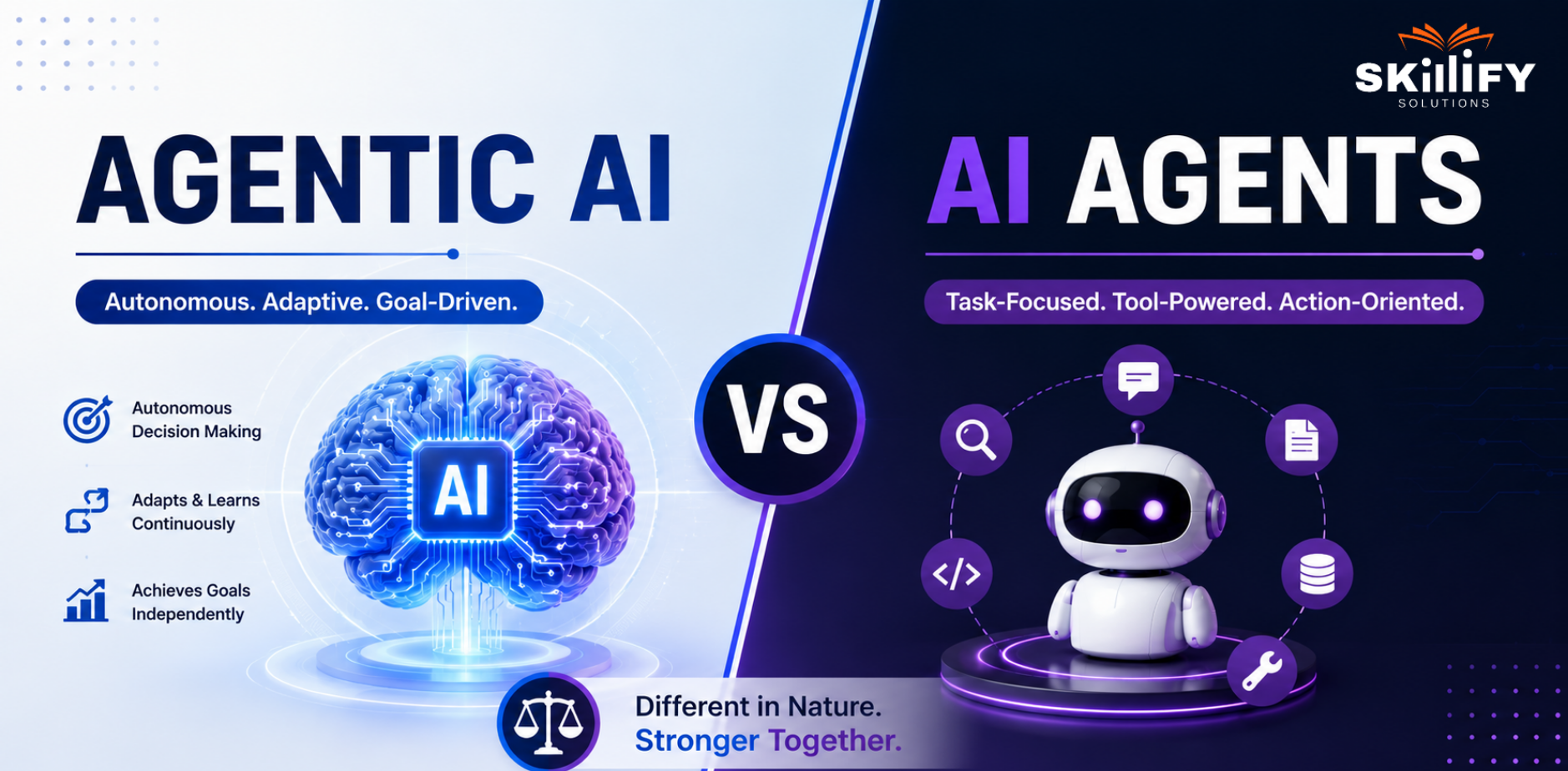
AI agents and agentic AI both automate tasks, but they differ in capability and autonomy. AI agents perform specific tasks based on predefined goals, while agentic AI can plan, reason, adapt, and coordinate multiple actions to achieve broader objectives.
| Feature | AI Agents | Agentic AI |
| Autonomy | Limited | High |
| Scope | Single-task execution | End-to-end workflows |
| Decision-Making | Rule-based | Planning and reasoning |
| Memory | Task-specific context | Long-term contextual memory |
| Adaptability | Limited | Dynamic and adaptive |
| Collaboration | Usually single agent | Multi-agent orchestration |
| Use Cases | Support, scheduling, automation | Enterprise planning, research, workflow orchestration |
| Best For | Repetitive tasks | Complex, goal-driven processes |
Master AI-powered Agile leadership with our Leading SAFe (6.0) course and lead enterprise AI transformation confidently!
What is an AI Agent?
An AI agent follows a simple decision-making cycle. It observes its environment, analyzes available data, decides the best action, and executes it. Depending on the task, it may use large language models (LLMs), APIs, databases, or business applications to complete its work.
How AI agents work:
- Receive a task or user request
- Gather relevant information
- Process data using AI models
- Execute the required action
- Return the result or repeat the process if needed
Professionals building AI-powered product workflows can also benefit from the SAFe POPM course to learn how AI enhances product planning and backlog management.
What AI Agents Can Do and Cannot do
AI agents are designed to automate specific, goal-oriented tasks. They perform best in structured workflows with clear rules and defined outcomes.
| AI Agents Can | AI Agents Cannot |
| Automate repetitive tasks | Plan long-term strategies independently |
| Answer customer queries | Handle complex, open-ended goals |
| Retrieve and summarize information | Adapt to unfamiliar situations without guidance |
| Trigger workflows across applications | Coordinate multiple agents autonomously |
| Schedule tasks and send notifications | Replace human judgment in critical decisions |
Check out our Best AI Project Ideas for Students to apply AI agents and agentic AI in real-world projects.
What is Agentic AI?
Agentic AI refers to AI systems that can independently plan, reason, adapt, and execute multiple actions to achieve broader goals. Instead of simply completing assigned tasks, agentic AI continuously evaluates progress, adjusts its approach, and coordinates activities as conditions change.
Unlike traditional AI agents, agentic AI focuses on achieving outcomes rather than completing individual tasks.
It combines reasoning, planning, memory, and autonomous decision-making to solve complex problems with minimal human guidance. Explore the top Agentic AI Tools used to build intelligent, autonomous AI systems.
How Agentic AI Plans, Reasons, and Adapts
Agentic AI breaks large objectives into smaller tasks, evaluates different approaches, learns outcomes, and modifies its plan when new information becomes available.
Core capabilities include:
- Goal-based planning
- Context-aware reasoning
- Long-term memory
- Dynamic decision-making
- Continuous adaptation
To understand how AI-driven planning fits into Agile teams, explore the SAFe Scrum Master (6.0) course, which covers AI-enabled Scrum practices.
Multi-Agent Orchestration
In many enterprise environments, agentic AI coordinates multiple specialized AI agents, with each agent handling a specific responsibility while working toward a shared objective.
Example workflow:
- One agent gathers data
- Another analyzes information
- A third generates recommendations
- A coordinating agent manages the entire workflow and adjusts plans when needed
When to Use AI Agents vs Agentic AI
The right choice depends on the complexity of your business process. AI agents are best for task automation, while agentic AI is better suited for workflows that require planning, reasoning, and coordination.
| Use AI Agents For | Use Agentic AI For |
| Customer support | Enterprise workflow orchestration |
| Scheduling and reminders | Strategic planning |
| Data entry and retrieval | Software development lifecycle automation |
| Report generation | Research and analysis |
| Routine workflow automation | Complex, multi-step business processes |
Scale enterprise AI delivery by enrolling in the SAFe DevOps 6.0 course and streamline development with modern DevOps practices!
Combining AI Agents and Agentic AI in Enterprises
Many organizations use both technologies together for maximum efficiency. AI agents automate individual operational tasks. Agentic AI coordinates multiple agents, manages dependencies, and drives end-to-end business workflows.
Enterprise architects responsible for AI-enabled systems can deepen their expertise through the SAFe for Architects (6.0) course, which focuses on architecture at scale.
Agentic AI in Enterprise and Agile (SAFe)
In SAFe environments, AI agents and agentic AI improve Agile delivery by automating routine work and supporting large-scale coordination. Together, they help teams deliver faster while improving planning and collaboration.
AI Agents for Sprint and Delivery Automation
AI agents reduce manual effort by handling repetitive Agile tasks. Here are the common uses.
- Sprint planning support
- Backlog refinement
- User story creation
- Test case generation
- Sprint reporting
To understand how AI fits into modern software delivery, read our guide on Agile Software Development and its core principles.
Agentic AI for Cross-Team Planning
Agentic AI helps manage complex planning across Agile Release Trains (ARTs) by analyzing dependencies, risks, and priorities.
It can:
- Coordinate multiple teams
- Identify feature dependencies
- Optimize PI Planning
- Adapt plans as priorities change
Impact on Scrum Masters and RTEs
Rather than replacing Agile leaders, agentic AI enhances their decision-making. Benefits for Scrum Masters and RTEs:
- Less administrative work
- Better visibility into risks and dependencies
- Faster planning and reporting
- More time for coaching and strategic leadership
For experienced Agile leaders managing large Agile Release Trains, the SAFe Advanced Scrum Master 6.0 course builds advanced facilitation and leadership skills.
Risks and Governance in Agentic AI
As agentic AI becomes more autonomous, organizations need strong governance to ensure security, compliance, and responsible decision-making.
System-Level Risks of Agentic AI
Because agentic AI can make independent decisions across multiple systems, errors or incorrect actions can have a wider business impact if left unchecked.
Security and Access Control
Agentic AI often interacts with enterprise applications and sensitive data. Role-based access, authentication, and continuous monitoring are essential to prevent unauthorized actions.
Human-in-the-Loop Oversight
Human oversight remains critical for reviewing high-impact decisions, validating AI outputs, and ensuring accountability, especially in regulated or business-critical workflows.
If you’re implementing intelligent delivery pipelines, the SAFe DevOps 6.0 course explains how to streamline development and deployment using modern DevOps practices.
Conclusion
Agentic AI and AI agents are both transforming how businesses use artificial intelligence, but they are built for different purposes. AI agents are best for automating specific, repetitive tasks, while agentic AI can plan, reason, and manage complex workflows.
Many organizations use both together to improve productivity and decision-making. As AI adoption grows in 2026. Understanding their differences will help you choose the right solution for your business and prepare for more intelligent, efficient automation.
Lead high-performing Agile teams by earning the SAFe Advanced Scrum Master 6.0 certification today!
Frequently Asked Questions
1. Can AI agents become agentic AI?
No. AI agents and agentic AI are different concepts. An AI agent can be part of an agentic AI system, but it does not become agentic AI on its own.
2. Is agentic AI better than AI agents?
Not always. AI agents are better for simple, repetitive tasks, while agentic AI is better for complex workflows that require planning and reasoning.
3. Where is agentic AI used in enterprises?
Agentic AI is used in software development, customer service, supply chain management, healthcare, financial services, and enterprise workflow automation.
4. What is an example of an agentic AI system?
An AI-powered project management system that plans tasks, assigns work, monitors progress, and adjusts schedules automatically is an example of agentic AI.
5. Is agentic AI risky?
Yes. Because it makes autonomous decisions, agentic AI can introduce security, compliance, and operational risks without proper governance and human oversight


