 Skip to content
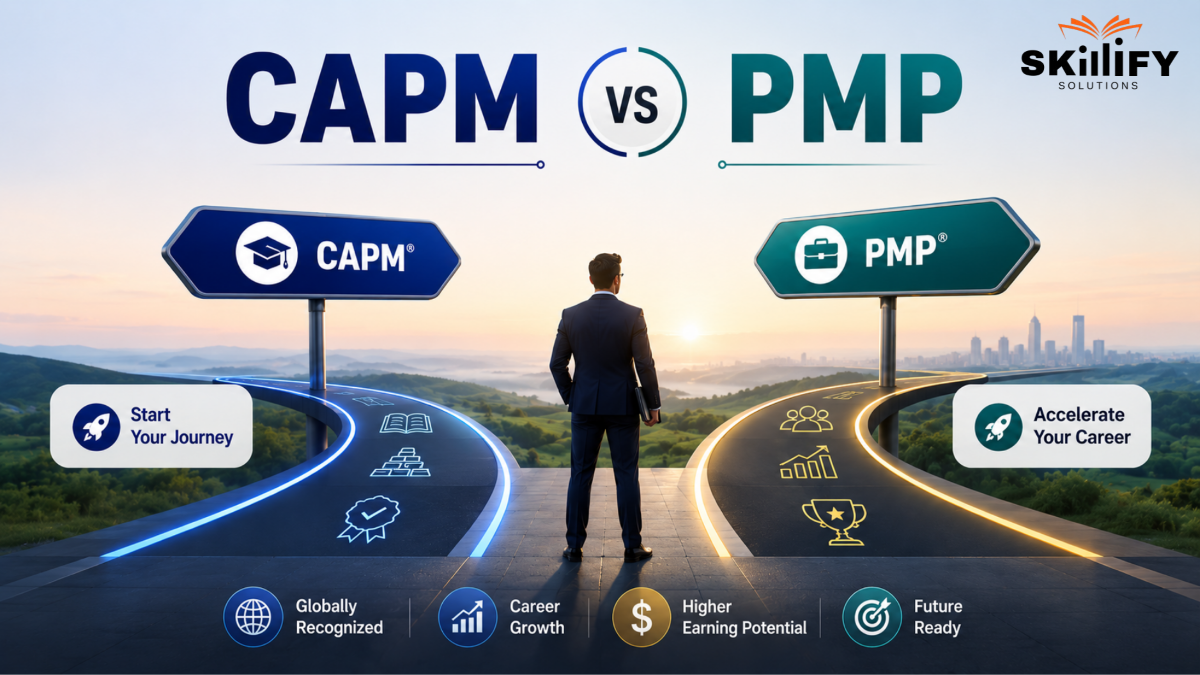
Key Highlights of CAPM vs PMP
- Compare CAPM vs PMP to choose the right certification.
- Understand CAPM certification requirements for beginners.
- Learn the latest PMP certification requirements for 2026.
- Compare PMP certification cost and long-term ROI.
- Explore PMP vs CAPM salary and career growth.
- Find the best certification for your career stage.
When people start exploring project management certifications, the first question is almost always the same: Should I choose CAPM or PMP? It sounds like a simple comparison, but the answer depends entirely on where you are in your career.
Over the years, I’ve noticed that many professionals focus on salaries, exam difficulty, or popularity before asking the most important question, which certification am I actually ready for? That’s exactly why so many people end up taking the longer route.
CAPM and PMP are both valuable, but they’re built for different professionals with different levels of experience. In this blog, we’ll break down every major difference, from eligibility and exam format to costs, salary potential, and career growth, so you can make a confident decision without second-guessing yourself.
CAPM vs PMP: Which Certification Should You Choose?
The right certification depends on your experience and career goals. Both CAPM and PMP are offered by PMI, but they are designed for different career stages.
You can definitely choose CAPM if you’re new to project management, a student, a recent graduate, or changing careers. It helps you build foundational project management knowledge.
However, the right choice for you will be PMP if you already have project management experience and meet PMI’s eligibility requirements. It validates your ability to lead projects and opens doors to senior roles with higher salaries.
If you’re still exploring your options, our guide on Project Management Certifications compares the top credentials to help you choose the best certification for your career goals.
What is CAPM Certification?
The Certified associate in project management (CAPM) is an entry-level certification offered by the Project Management Institute (PMI). It validates your understanding of project management fundamentals, including predictive, Agile, and business analysis concepts.
CAPM is ideal for students, recent graduates, career changers, and professionals starting a project management career. It demonstrates your readiness to contribute to project teams, even without prior project leadership experience.
As you build foundational project management knowledge with CAPM, the Scrum Master Bootcamp is another great option to strengthen your Agile fundamentals and improve job readiness.
CAPM Eligibility Requirements (2026)
- High school diploma, associate degree, or equivalent.
- 23 hours of project management education.
- No project management experience is required.
Advance beyond traditional project management with the Leading SAFe® 6.0 and develop enterprise Agile leadership skills employers value!
What is PMP Certification?
The Project Management Professional (PMP) is PMI’s flagship certification for experienced project professionals. It validates your ability to lead projects, manage teams, and deliver successful outcomes using predictive, Agile, and hybrid approaches.
PMP is recognized globally and is widely preferred for project manager and leadership roles across industries. Experienced professionals pursuing PMP can also benefit from the Leading SAFe 6.0 course to strengthen enterprise Agile leadership skills.
PMP Eligibility Requirements (2026)
- Bachelor’s degree and 36 months of project experience
- High school diploma or associate degree
- 60 months of project experience
- 35 hours of PM education or CAPM
Since PMP emphasizes predictive, Agile, and hybrid approaches, it’s also worth understanding Agile Methodology in Project Management and how Agile practices are applied across modern projects.
CAPM vs PMP: Complete Comparison
| Factor | CAPM | PMP |
| Certification Purpose | Entry-level project management certification | Advanced certification for project leaders |
| Ideal Candidate | Students, graduates, career changers | Experienced project managers |
| Experience Requirement | Not required | 36-60 months of project experience |
| Education Requirement | High school diploma + 23 hours PM education | Degree + 35 hours PM education (or CAPM) |
| Exam Format | 150 questions, 3 hours | 180 questions, 230 minutes |
| Exam Difficulty | Moderate | High |
| Preparation Time | 1-2 months | 2-4 months |
| Exam Cost | Lower | Higher |
| Renewal Requirements | 15 PDUs every 3 years | 60 PDUs every 3 years |
| Career Impact | Entry-level PM roles | Senior PM and leadership roles |
| Salary Potential | Moderate | High |
CAPM vs PMP Eligibility
Your eligibility depends on your education and project management experience. CAPM has no experience requirement, making it ideal for beginners. PMP requires verified project management experience and is designed for professionals who already lead projects.
Can You Skip CAPM and Go Straight to PMP?
Yes. If you already meet PMP eligibility requirements, you can apply directly for the PMP exam. Earning CAPM first is not mandatory. However, if you don’t yet qualify for PMP, CAPM is a great way to build project management knowledge and strengthen your resume before pursuing PMP.
CAPM vs PMP Exam Difficulty
Both exams are challenging, but PMP is significantly harder because it tests real-world project leadership and decision-making, while CAPM focuses on project management concepts and terminology.
CAPM Exam Difficulty
CAPM is a moderate-level exam. It tests your understanding of project management fundamentals, Agile, predictive approaches, and business analysis. No prior project management experience is required.
PMP Exam Difficulty
PMP is an advanced level exam. It evaluates your ability to lead projects, manage teams, solve complex scenarios, and apply predictive, Agile, and hybrid practices in real-world situations.
Is CAPM Harder Than PMP?
No. PMP is more difficult than CAPM because it requires project management experience and includes scenario-based questions that assess practical decision-making. CAPM is designed as an entry-level certification.
If you’re preparing for leadership-focused project management roles, combining PMP preparation with the Leading SAFe 6.0 can provide practical knowledge of Agile transformations.
CAPM vs PMP Cost Comparison
CAPM has a lower upfront cost, making it a cost-effective choice for beginners. PMP requires a higher investment but typically delivers stronger long-term career growth and salary potential.
| Cost Component | CAPM Path | PMP Path |
| Training | 23-hour PM course | 35-hour PM course |
| Exam | Lower exam fee | Higher exam fee |
| Renewal | 15 PDUs every 3 years | 60 PDUs every 3 years |
| Total Investment | Lower | Higher, but better ROI |
Looking to lead Agile transformations? Enroll in AI-Empowered Leading SAFe 6.0 and build practical enterprise-scale Agile expertise today.
CAPM vs PMP Salary Comparison
Both certifications can improve your earning potential, but PMP generally delivers a higher return on investment due to its global recognition and demand for experienced project managers.
| Certification | Typical Annual Salary (US) | Career Level |
| CAPM | $83,000-$122,000 | Entry-level Project Management |
| PMP | $121,000-$170,000+ | Mid to Senior Project Management |
Does PMP Offer Better Salary Growth?
Yes. PMP generally offers greater salary growth than CAPM, as it validates proven project leadership experience and is widely preferred by employers for higher-level positions.
Besides certification, industry demand also influences your earning potential. Explore the latest Project Manager Job Market to understand hiring trends, salaries, and future career opportunities.
CAPM vs PMP: Which Fits Your Career Stage?
The best certification is the one that matches your current experience. Whether you’re just starting out or already managing projects, choosing the right certification can help you progress faster and maximize your career opportunities.
Students and Recent Graduates
Start with CAPM. It helps you build a strong foundation in project management and demonstrates your commitment to employers.
Even if you don’t have professional project experience. It’s an excellent way to stand out for entry-level roles. If you’re a student or just starting your career, you can also explore Best AI Project Ideas for Students.
Career Changers
If you’re transitioning from another field, CAPM is the ideal choice. It validates your project management knowledge and helps bridge the experience gap, making it easier to move into project coordinator or junior project manager roles.
Professionals aiming for Agile leadership roles can explore SAFe Scrum Master 6.0 to develop Scrum facilitation and Agile team leadership skills.
Developers and Technical Professionals
Your choice depends on your responsibilities. If you’re moving into project management for the first time, CAPM is a great starting point.
If you already lead technical projects, coordinate teams, or manage deliveries, PMP will better showcase your leadership skills.
Experienced Project Managers
If project management is already part of your job, PMP is a clear choice. It validates your experience, strengthens your professional credibility, and prepares you for senior project management and leadership opportunities.
Future Agile Leaders
If your goal is to lead Agile or hybrid projects, PMP offers greater value. It covers Agile, predictive, and hybrid approaches.
It makes it well-suited for leadership roles such as Project Manager, Program Manager, or Agile Delivery Lead.
If you’re planning to transition into product-focused leadership roles, read our Agile Product Management guide to understand how Agile principles are applied to product strategy and delivery.
Should You Get CAPM Before PMP?
Not necessarily. If you already meet PMP eligibility requirements, you can apply for PMP directly. However, if you’re new to project management or don’t yet have enough experience, CAPM is a smart first step. It helps you build foundational knowledge and prepares you for the PMP journey.
Does CAPM Help You Earn PMP Later?
Yes. CAPM provides a solid understanding of PMI’s project management concepts, making PMP preparation easier. It also fulfills the 35-hour project management education requirement for PMP, so you won’t need to complete a separate training course before applying.
Once you’ve chosen between CAPM and PMP, consider expanding your skills with the Scrum Master Bootcamp to stay competitive in today’s Agile-driven project management landscape.
Conclusion
If you’re new to project management or transitioning into the field, CAPM is a great way to build foundational knowledge and strengthen your resume. If you already have project management experience and meet PMI’s requirements, PMP is the better choice for advancing into leadership roles and increasing your earning potential.
Both certifications are valuable, but they serve different career stages. Before making your decision, evaluate your current qualifications, long-term goals, and the roles you want to pursue.
Selecting the right certification at the right time will help you maximize your investment and accelerate your project management career with confidence.
Build job-ready Agile and project management skills with the Scrum Master Bootcamp and accelerate your career with hands-on practical learning.
Frequently Asked Questions
1.Is CAPM harder than PMP?
No. PMP is more difficult because it requires project management experience and includes scenario-based questions, while CAPM focuses on project management fundamentals.
2.Can I skip CAPM and directly take PMP?
Yes. If you meet PMI’s PMP eligibility requirements, you can apply for the PMP exam without earning CAPM first.
3.Does CAPM count toward PMP experience?
No. CAPM does not count as project management experience. However, it can satisfy the 35-hour project management education requirement for PMP.
4.Is CAPM worth it after graduation?
Yes. CAPM is a valuable certification for recent graduates. It validates your project management knowledge and can improve your chances of securing entry-level project roles.
5.Is PMP better than CAPM?
It depends on your experience. PMP is better for experienced project managers, while CAPM is ideal for beginners entering the field.
6.How long does it take to move from CAPM to PMP?
There is no fixed timeline. Most professionals earn PMP after gaining the required 36-60 months of project management experience, depending on their education level.


