 Skip to content
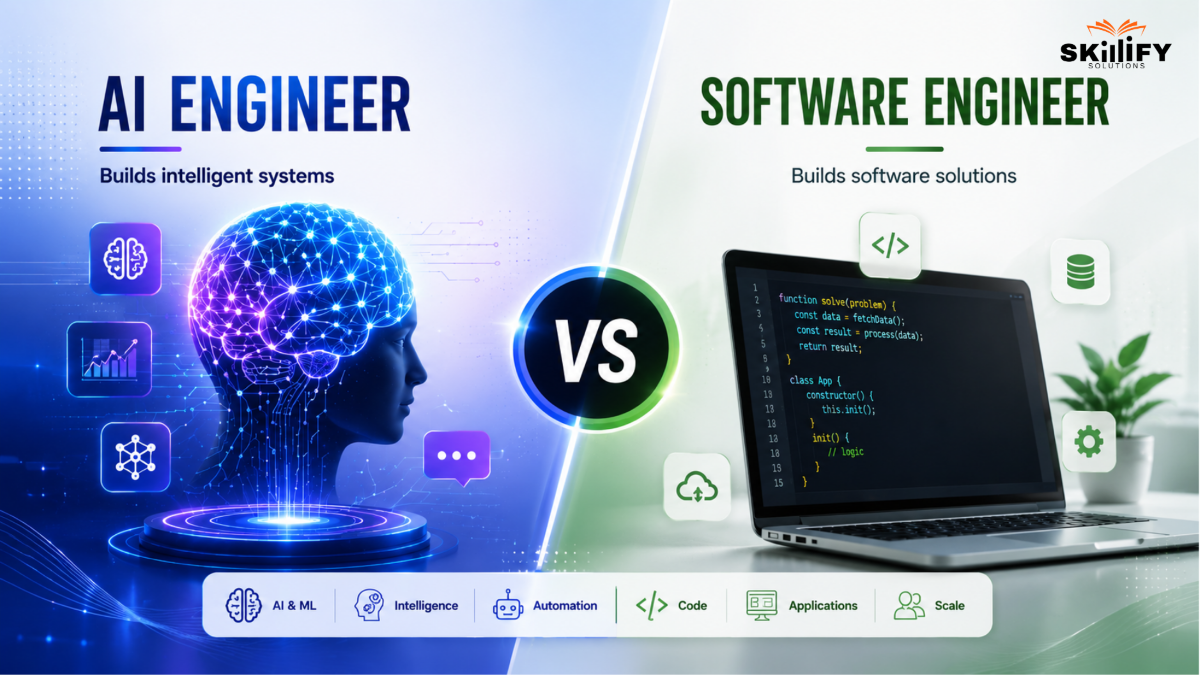
Key Highlights of AI Engineer vs Software Engineer
- Compare AI engineer vs software engineer roles, skills, and responsibilities.
- Explore AI engineer vs software engineer salary ranges in 2026.
- Understand the difference between an AI engineer and software engineer.
- Evaluate AI engineering vs software engineering career opportunities in 2026.
- Learn can a software engineer become an AI engineer.
- Discover essential AI skills for transitioning from software engineering.
Software engineering used to mean writing code that followed clearly defined rules. AI engineering adds a different layer: building systems whose outputs can change depending on data, prompts, models, and context.
That single difference changes how engineers build, test, deploy, and monitor applications. A modern AI engineer may spend part of the day integrating an LLM, designing a RAG pipeline, evaluating model responses, or monitoring AI costs and hallucinations.
A software engineer may be designing APIs, optimizing databases, building distributed systems, or improving application reliability. Yet these roles are far from separate. AI engineering is built on software engineering foundations. So which path makes more sense for you in 2026?
This blog cuts through the overlapping job titles and compares the two careers by salary, skills, responsibilities, career outlook, and transition opportunities. It is for professionals deciding whether AI is their next career move.
What Does a Software Engineer Do?
A software engineer designs, develops, tests, deploys, and maintains software applications and systems. Their work focuses on building reliable, scalable, secure, and efficient solutions.
Key responsibilities include:
- Writing and testing code
- Designing software architecture and APIs
- Managing databases and cloud infrastructure
- Debugging and optimizing applications
- Using version control and CI/CD
- Maintaining and scaling production systems
For professionals looking to strengthen these core development skills, the Full Stack Development Bootcamp offers practical training across modern software development.
What Does an AI Engineer Do?
An AI engineer builds and deploys AI-powered applications using machine learning models, LLMs, APIs, and AI frameworks. The role combines software engineering with AI-specific development and evaluation.
Key responsibilities include:
- Integrating AI and LLM APIs
- Building RAG applications and AI agents
- Working with embeddings and vector databases
- Designing and testing AI workflows
- Evaluating model performance and accuracy
- Deploying and monitoring AI systems
Those building a foundation in AI and machine learning can explore the Data Science Bootcamp with AI, which covers Python, machine learning, and AI through practical projects.
AI Engineer vs Software Engineer Salary in 2026
AI engineers can command higher salaries because of specialized skills in AI, machine learning, LLMs, and model deployment. Actual pay varies by experience, location, specialization, and employer.
| Experience | Software Engineer | AI Engineer |
| Entry Level | $83K–$95K | $90K–$100K |
| Mid Level | $132K–$154K | $115K–$135K |
| Senior Level | $250K+ | $300K+ |
AI expertise can also lead to some of the industry’s highest-paying roles. See Highest Paying AI Jobs to explore lucrative career options and their required skills.
AI Engineer vs Software Engineer: Key Differences
Role and Responsibilities
Software engineers build and maintain software systems, while AI engineers develop applications that integrate AI models, machine learning, and LLM technologies.
Technical Skills
Software engineers typically need programming, system design, databases, APIs, testing, and cloud skills. AI engineers additionally need machine learning, Python, LLMs, embeddings, RAG, and AI evaluation.
Tools and Technologies
Software engineers commonly use Git, Docker, Kubernetes, cloud platforms, databases, and CI/CD tools. AI engineers also work with LLM APIs, vector databases, AI frameworks, model platforms, and agentic AI tools.
Education and Entry Requirements
A computer science or related degree can provide a strong foundation for both roles. Software engineering emphasizes programming and systems, while AI engineering requires additional knowledge of machine learning and AI technologies.
If you are choosing between these fields, Artificial Intelligence vs Computer Science breaks down their curriculum, skills, and career opportunities.
Problem-Solving Approach
Software engineers generally build deterministic systems with predictable outputs. AI engineers work with probabilistic systems where model evaluation, prompt design, data quality, and output validation are critical.
Career Growth
Software engineers can progress into senior, staff, principal, architect, or engineering management roles. AI engineers can advance into senior AI, ML engineering, AI architecture, AI leadership, or specialized AI roles.
If you want to strengthen your data and AI foundation alongside software skills, the Data Science Bootcamp with AI can provide a structured learning path.
AI Engineer Skills vs Software Engineer Skills
Both roles share a strong software engineering foundation, including programming, APIs, databases, cloud platforms, testing, and deployment. AI engineers build on these fundamentals with specialized AI skills.
Skills Both Roles Need
Software engineering skills remain essential for AI engineering because AI applications still need scalable architecture, reliable APIs, secure data handling, testing, and production deployment.
| Shared Skill | Software Engineer | AI Engineer |
| Programming | ✓ | ✓ |
| APIs | ✓ | ✓ |
| Databases | ✓ | ✓ |
| Git/Version Control | ✓ | ✓ |
| Cloud Platforms | ✓ | ✓ |
| Testing | ✓ | ✓ |
| System Design | ✓ | ✓ |
| Deployment | ✓ | ✓ |
Combine business expertise with AI capabilities through the Business Analytics Bootcamp with AI and unlock smarter career opportunities.
AI Skills Software Engineers Need
Software engineers moving into AI do not need to start from scratch. They can extend their existing development skills with technologies used to build, integrate, evaluate, and monitor modern AI applications.
| AI Skill | Why It Matters |
| LLM APIs | Integrate AI models into applications |
| Prompt Engineering | Improve model responses and reliability |
| Embeddings | Enable semantic search and retrieval |
| Vector Databases | Store and retrieve embeddings efficiently |
| RAG | Connect AI models with relevant data |
| AI Evaluation | Measure AI quality and accuracy |
| AI Agents | Build autonomous, task-oriented AI systems |
| Model Monitoring | Track performance, cost, and failures |
For a structured transition into AI-focused development, the Data Science Bootcamp with AI covers Python, machine learning, AI, and hands-on projects.
AI Engineer vs Software Engineer: Job Demand and Career Outlook
AI engineering is growing rapidly as companies add generative AI, machine learning, and LLM-powered features to existing products. Software engineering remains equally important because AI systems still require strong application development, infrastructure, APIs, security, and deployment.
Are AI Engineering Jobs Growing Faster?
AI engineering demand is increasing as organizations move from AI experimentation to production applications. Skills in LLMs, RAG, AI agents, machine learning, and model deployment are becoming increasingly valuable.
- Generative AI and LLM applications are creating new engineering roles.
- Companies need engineers who can integrate AI into existing software.
- AI engineers often combine software development with specialized AI expertise.
- Demand varies by industry, location, experience, and specialization.
Will AI Replace Software Engineers?
AI is more likely to change software engineering than eliminate it. AI coding tools can automate repetitive development tasks, but engineers are still needed for architecture, requirements, security, testing, system design, and production decisions.
The role is shifting toward building with AI rather than competing against it.
Which Career Has Better Long-Term Potential?
Both careers offer strong long-term potential. AI engineering may provide faster-growing opportunities, while software engineering offers a broader range of roles across industries.
Choose AI engineering if you enjoy AI systems, models, automation, and emerging technologies. Choose software engineering if you prefer broader application development and system architecture.
How to Transition from Software Engineer to AI Engineer
Software engineers already have many of the foundations needed for AI engineering. The transition is mainly about adding AI-specific knowledge and demonstrating that you can build and deploy practical AI applications.
Can a Software Engineer Become an AI Engineer?
Yes. Software engineering experience in programming, APIs, databases, cloud, testing, and deployment provides a strong foundation for AI engineering.
Focus on learning how AI systems are integrated, evaluated, deployed, and monitored, rather than trying to master every area of AI.
What Skills Should You Learn First?
Start with skills that directly build on your existing development experience:
- Python for AI development
- LLM APIs and AI frameworks
- Prompt engineering
- Embeddings and vector databases
- RAG architecture
- AI agents
- Model evaluation
- AI deployment and monitoring
A structured Data Analytics Bootcamp with AI can help professionals build these foundations through guided learning and practical projects
3-6 Month AI Engineering Roadmap
A focused roadmap can help you move from software development to practical AI engineering without learning everything at once.
| Timeline | Focus |
| Month 1 | Python, LLM fundamentals, APIs, prompting |
| Month 2 | Embeddings, vector databases, RAG |
| Month 3 | Build and deploy an AI application |
| Months 4–5 | AI agents, evaluation, monitoring |
| Month 6 | Portfolio, resume, interview preparation |
Ready to move beyond coding? Explore Product Management with AI Bootcamp and lead AI-powered products with confidence.
Portfolio Projects for AI Engineering Jobs
Build projects that demonstrate both your existing software engineering abilities and your new AI skills.
- RAG-based document assistant
- AI customer-support agent
- Multi-agent workflow
- AI-powered recommendation system
- LLM application with evaluation and monitoring
You can also use AI tools to refine project descriptions and applications; see How to Use Claude for Job Search.
How to Present Software Experience on an AI Resume
Do not hide your software engineering background. Position it as the foundation for your AI transition and highlight projects where you applied AI technologies.
- Emphasize Python, APIs, cloud, databases, and system design.
- Add LLM, RAG, vector database, and AI-agent experience.
- Quantify performance, scalability, cost, or efficiency improvements.
- Link to relevant AI projects and GitHub repositories.
- Use AI engineering keywords throughout your skills and experience sections.
A Product Management Bootcamp can be useful for readers interested in combining technical, AI, and product skills.
AI Engineer vs Software Engineer: Which Career is Right for You?
The right career depends on your current skills, experience, and interest in AI. Use the following guide to identify the better fit.
If You Are a Fresh Computer Science Graduate
Start with software engineering fundamentals, then build AI skills. This gives you broader career options while preparing for AI engineering roles.
If You Are an Experienced Software Engineer
AI engineering can be a natural next step. Build your existing programming, APIs, cloud, and system design skills by adding LLMs, RAG, AI agents, and model evaluation.
If You Are a Non-Technical Professional
Software engineering usually requires a stronger technical foundation. Start with programming and computer science basics before moving into AI engineering.
If you are still deciding which academic path can support a future technology career, explore Top Degrees in Demand for the Future before choosing your specialization.
If You Are Coming from Data Science or Analytics
AI engineering can be a strong transition. Your experience with data, Python, statistics, and machine learning can provide a useful foundation for building and deploying AI applications.
Data Analytics Bootcamp directly matches the reader’s existing career background and transition path.
Conclusion
AI engineering and software engineering are no longer completely separate career paths. Both require strong programming, system design, cloud, APIs, testing, and deployment skills, but AI engineering adds expertise in LLMs, RAG, AI agents, embeddings, and model evaluation.
AI roles may offer strong salary potential and growing demand, while software engineering continues to provide broader opportunities across industries. For fresh graduates, building solid software fundamentals before specializing in AI can create more flexibility.
Ultimately, the better career depends on your interests, strengths, and goals. In 2026, combining strong software engineering fundamentals with practical AI skills may offer the most adaptable career path.
Master modern software development with the Full Stack Development Bootcamp and build job-ready skills for today’s technology careers.
Frequently Asked Questions
1.Is an AI engineer the same as a software engineer?
No. AI engineers build AI-powered systems using technologies such as machine learning and LLMs, while software engineers build and maintain broader software applications and systems.
2. Do AI engineers make more than software engineers?
AI engineers can earn higher salaries because of specialized AI skills, but pay depends on experience, location, industry, and employer.
3.Can a software engineer become an AI engineer without going back to school?
Yes. Software engineers can transition through self-learning, certifications, practical AI projects, and hands-on experience with LLMs, RAG, AI agents, and machine learning.
4.What programming languages do AI engineers use vs software engineers?
Both commonly use Python, Java, C++, and JavaScript. AI engineers rely heavily on Python for machine learning and AI development, while software engineers use languages based on their application and technology stack.
5.Is AI engineering replacing software engineering jobs?
Not completely. AI is automating some development tasks, but software engineers remain essential for system design, architecture, security, testing, integration, and maintaining production applications.


