 Skip to content
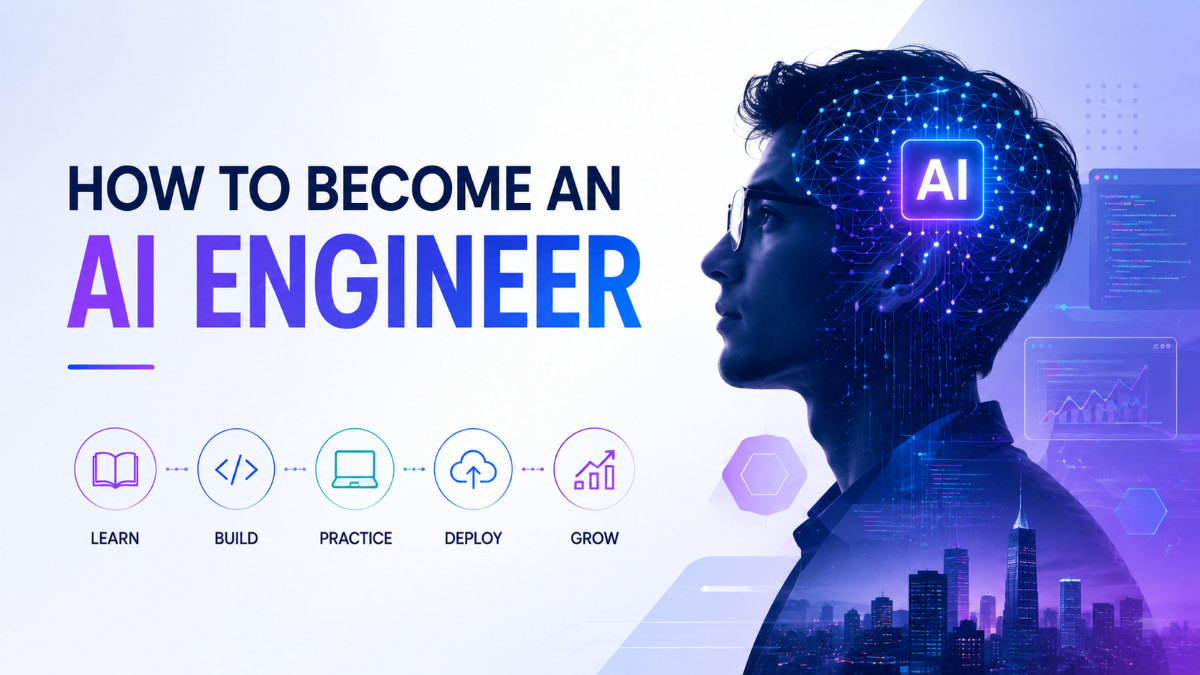
Key Highlights: How to Become an AI Engineer?
- Learn how to become an AI engineer in 2026.
- Follow the AI engineer roadmap 2026 step by step.
- Explore steps to become an AI engineer.
- Master AI engineer skills required 2026.
- Build an AI engineer learning path without a degree.
- Prepare for AI engineering jobs with practical projects.
The fastest way to become an AI engineer in 2026 is to learn the right things in the right order. Start with Python and software engineering. Add machine learning fundamentals.
Then move into LLM applications, RAG, vector databases, AI agents, deployment, and evaluation. Each layer builds on the previous one and skipping the foundation usually creates problems when projects become more complex.
What makes AI engineering different today is the focus on shipping AI, not simply understanding it. Companies need engineers who can turn models into useful products, connect them to business data, deploy them, and measure whether they actually work.
This blog maps that journey across 36 weeks, including portfolio projects and practical career advice for getting your first AI engineering role. Read on to know more!
How to Become an AI Engineer in 2026
To become an AI engineer in 2026, start with Python and software engineering fundamentals, then learn machine learning, LLMs, RAG, AI agents, deployment, and evaluation. The focus is increasingly on building and shipping practical AI applications rather than training large models from scratch.
A typical path includes learning Python and APIs, understanding ML fundamentals, building LLM-powered applications, working with embeddings and vector databases, developing AI agents, and deploying AI systems using cloud and MLOps tools.
If you’re also considering traditional software development, comparing an AI Engineer vs Software Engineer can help you understand how the roles differ and which path fits your goals.
What Does an AI Engineer Do?
An AI engineer combines software engineering and artificial intelligence to build, integrate, deploy, and maintain AI-powered applications. Their work can involve LLM APIs, RAG pipelines, AI agents, databases, APIs, cloud platforms, and AI evaluation.
In 2026, the role increasingly involves building production-ready generative AI and agentic AI systems that can retrieve information, use tools, interact with external applications, and complete multi-step workflows.
What AI Engineers Build
AI engineers build applications such as LLM chatbots, AI assistants, RAG-based knowledge systems, research tools, recommendation systems, document-processing applications, AI-powered APIs, and autonomous agents.
These applications typically combine existing AI models with software, data, APIs, and business workflows.
AI Engineer vs ML Engineer
If your goal is to build AI products with existing models, focus on software engineering, LLMs, RAG, agents, APIs, and deployment. For model development, go deeper into machine learning, deep learning, mathematics, and MLOps.
| Area | AI Engineer | ML Engineer |
| Focus | AI-powered applications | ML models and systems |
| Core skills | Python, LLMs, RAG, agents, APIs | Python, ML, deep learning, MLOps |
| Typical work | Build and integrate AI features | Train, optimize, and deploy models |
| Tools | LLM APIs, vector databases, AI frameworks | PyTorch, TensorFlow, MLflow |
| Best suited for | Building AI products | Developing ML systems |
Strengthen your data and AI expertise with Data Analytics Bootcamp and prepare for modern technology-driven career opportunities.
AI Engineer Skills Required in 2026
AI engineers need a mix of software engineering, machine learning, generative AI, agent development, and production skills. The focus is increasingly on building reliable AI applications that work in real-world environments.
Python, Software Engineering and ML Basics
Python, Git, APIs, databases, data structures, and software engineering form the foundation. Learn ML basics, statistics, model evaluation, and essential deep learning concepts.
Tip: Learn fundamentals by building small projects instead of studying theory for months. A Data Science Bootcamp with AI can help you build these skills through hands-on learning
LLMs, RAG and Generative AI
Learn about LLM APIs, prompt engineering, embeddings, structured outputs, and context management. RAG requires understanding chunking, embedding, retrieval, semantic search, and vector databases.
Tip: Build a document-based chatbot to learn RAG practically.
AI Agents and Tool Use
Learn how agents use tools, APIs, external data, memory, and workflows to complete multi-step tasks. Familiarity with agent frameworks and MCP is increasingly valuable.
Tip: Start with one useful agent before moving to complex multi-agent systems. Learn How to Build Agentic AI Using Python and turn these concepts into a working AI application.
Deployment, MLOps and AI Evaluation
Learn Docker, APIs, cloud platforms, CI/CD, monitoring, logging, and basic MLOps. AI evaluation helps measure quality, accuracy, reliability, latency, cost, and safety.
Tip: Include testing and evaluation in every AI project you build.
AI Engineer Roadmap: Step-by-Step
A practical 36-week roadmap can take you from programming fundamentals to building, deploying, and evaluating production-ready AI applications.
| Phase | Timeline | What to Learn | What to Build |
| 1. Python and Programming | Weeks 1–6 | Python, Git, APIs, databases, data structures, software engineering | Small Python applications |
| 2. Machine Learning | Weeks 7–12 | ML fundamentals, statistics, model evaluation, basic deep learning | Simple ML projects |
| 3. LLM Applications | Weeks 13–18 | LLM APIs, prompting, structured outputs, context, function calling | Chatbot or AI assistant |
| 4. RAG and Vector Databases | Weeks 19–24 | Embeddings, chunking, retrieval, semantic search, vector databases | RAG knowledge-base application |
| 5. AI Agents and Workflows | Weeks 25–30 | Tool calling, agents, memory, workflows, MCP | Multi-step AI agent |
| 6. Deployment and Monitoring | Weeks 31–36 | Docker, APIs, cloud, CI/CD, monitoring, evaluation | Production-ready AI application |
Full Stack Development Bootcamp is relevant to the software development, APIs, and application-building foundation AI engineers need.
AI Engineer Portfolio: 5 Projects to Build
A strong portfolio should show that you can build, deploy, and evaluate practical AI applications, not just experiment with AI tools.
1. LLM Chatbot
Build a chatbot using Python and an LLM API. Demonstrate prompting, API integration, conversation handling, and basic backend development.
2. RAG Application
Create a document-based question-answering system using embeddings and a vector database. This demonstrates retrieval, chunking, semantic search, and LLM integration.
3. AI Research Agent
Build an agent that can search for information, use tools, and complete multi-step research tasks. This demonstrates tool calling, agent workflows, and automation.
4. Production AI API
Turn an AI application into a deployable API using FastAPI and Docker. Add authentication, error handling, logging, and cloud deployment to demonstrate production skills.
5. AI Evaluation System
Build a system that evaluates AI outputs for accuracy, relevance, latency, cost, and reliability. This demonstrates an understanding of testing and monitoring AI applications.
Explore Best AI Project Ideas for Students for more practical ideas you can adapt to your skill level and portfolio goals.
How to Become an AI Engineer Based on Your Background
You do not need to follow the same AI engineering path as everyone else. Your existing technical skills can shorten the learning curve and help you focus on the gaps that matter most.
For Software Engineers
You already have a strong foundation in programming, APIs, databases, and software development. Focus on machine learning basics, LLMs, RAG, AI agents, and AI-specific evaluation and deployment practices.
For Data Scientists and Data Analysts
Your experience with Python, statistics, data analysis, and machine learning gives you a useful starting point. Strengthen your software engineering skills, then learn LLMs, RAG, agents, APIs, and production deployment.
The Business Analytics Bootcamp with AI can help you connect analytics skills with AI-driven business applications.
For Computer Science Graduates
Your programming, algorithms, databases, and computer science fundamentals provide a strong base. Build practical skills in machine learning, generative AI, LLM applications, RAG, agents, and cloud deployment.
For Non-Technical Professionals
Start with programming and basic computer science concepts before moving into machine learning and generative AI. Build your skills progressively through Python, APIs, LLM applications, RAG, and deployment.
Product Management with AI Bootcamp can be a reasonable entry point for professionals interested in AI without a deep technical background.
How to Get Your First AI Engineering Job
Getting your first AI engineering role requires more than completing courses. Employers want evidence that you can build practical AI systems, solve problems, and take projects from development to deployment.
Build a Production-Ready AI Portfolio
Build 2–3 practical projects using LLMs, RAG, agents, APIs, or cloud deployment. Add GitHub code, documentation, and live demos where possible.
The Full Stack Development Bootcamp can help you strengthen coding, APIs, databases, and deployment skills needed to build production-ready AI applications.
Create an AI Engineer Resume
Highlight Python, LLMs, RAG, AI agents, cloud, APIs, and relevant frameworks based on the job description. Quantify project outcomes wherever possible and place your strongest AI projects where recruiters can see them quickly.
Prepare for AI Engineer Interviews
Prepare for Python, software engineering, ML fundamentals, LLMs, RAG, vector databases, AI agents, system design, and deployment questions. Be ready to explain your portfolio projects and the technical decisions behind them.
Practice with these Artificial Intelligence Interview Questions to test your understanding of AI concepts and real-world applications.
Consider AI Certifications and Training
Certifications and structured training can help organize your learning, especially if you are transitioning from another field. Choose programs that include hands-on projects and current AI engineering technologies rather than focusing only on theory.
Conclusion
Becoming an AI engineer in 2026 requires strong programming skills and practical AI knowledge. Start with Python and ML fundamentals, then learn LLMs, RAG, AI agents, deployment, and evaluation.
Follow the 36-week roadmap to build these skills step by step. Work on real projects to strengthen your portfolio and demonstrate practical experience. Your learning path can also vary based on your current background and technical skills.
Finally, prepare an AI-focused resume, practice interviews, and consider structured training to fill skill gaps. With consistent learning and hands-on practice, you can build the skills needed to start and grow your AI engineering career.
Develop AI-focused product skills with Product Management Bootcamp and learn to turn emerging technologies into valuable solutions.
Frequently Asked Questions
1.Do I need a degree to become an AI engineer in 2026?
Not necessarily. A degree can help, but strong technical skills, practical projects, and a good portfolio can also demonstrate your ability.
2.How long does it take to become an AI engineer from scratch?
It depends on your background and study time. A focused learner can build foundational skills in around 6–12 months with consistent practice.
3.What programming language do AI engineers use most?
Python is the most common choice because of its extensive AI, ML, data, and development ecosystem.
4.Can a software engineer become an AI engineer in under 6 months?
Yes. Experienced software engineers can move faster because they already understand programming, APIs, databases, and software development. They should focus on ML, LLMs, RAG, agents, and AI deployment.
5.What is the difference between an AI engineer and an ML engineer?
AI engineers primarily build AI-powered applications, while ML engineers focus more on developing, optimizing, deploying, and maintaining machine learning systems.
6.Which AI certifications help when applying for AI engineer roles?
Certifications such as AWS Certified Machine Learning Engineer, associate can validate production ML skills. AWS also offers the foundational AWS Certified AI Practitioner for broader AI knowledge.


