Author: Nupur Shah

  • Best AI for Python Coding: Top 7 Tools Compared

    Best AI for Python Coding: Top 7 Tools Compared

    What if you could cut debugging time in half, refactor entire modules in seconds, and ship features before your coffee gets cold? That’s the promise behind today’s AI coding assistants, but only if you choose the best AI for Python coding for your workflow. 

    With dozens of new tools launching every month, it’s easy to get distracted by hype instead of real performance. In this blog, we compare the top 7 AI tools for Python coding in 2026, including GitHub Copilot, Cursor, Windsurf, Bito, and others. It is based on real-world developer friction points like Python-specific intelligence, repository-wide reasoning, agentic capabilities, workflow integration, and security. 

    Whether you’re building a FastAPI backend, cleaning messy Pandas datasets, refactoring legacy code, or deploying AWS Lambda scripts, you’ll discover which AI assistant actually improves code quality and which ones just autocomplete faster. Let’s find the AI pair programmer that works the way you do.

    How We Evaluated the Best AI for Python Coding

    It has been observed that a new AI coding tool launches almost every week. Between these findings, identifying the top seven AI tools is quite difficult. We evaluated each tool against real-world developer friction points and industry standards. This ranking is built on four core pillars:

    1. Python-specific Intelligence and logic

    Python is more about readability and library mastery. We sought tools that not only guess code but also understand Pythonic conventions (PEP 8). We prioritised tools that excel in:

    • Library Awareness: Accurate suggestions for popular frameworks like FastAPI, Django, Pandas, and NumPy.
    • Debugging Prowess: The ability to trace logic errors in complex Python scripts, not just fix missing colons.

    2. Workflow Integration or the FlowTest

    As noted by experts at n8n and Greptile, an AI is only useful if it doesn’t break your concentration. We tested how these tools live inside your IDE, like VS Code, PyCharm, and others.

    • Latency: Does the autocomplete feel instant?
    • Context Window: Can the AI “read” your entire repository to understand how a function in utils.py affects your main.py?

    3. Agentic Capabilities (The 2026 Standard)

    Modern coding has moved beyond simple autocomplete. We evaluated Agentic features and tools that can take a natural language prompt like “Add a JWT authentication layer to my existing routes “. This will help to execute changes across multiple files autonomously.

    4. Security and Privacy

    Security is non-negotiable in enterprise environments. Following the lead of AnalytixLabs, we assessed:

    • Data Privacy: Consider if the tool offers Zero-Data Retention or local LLM support.  
    • Code Quality: See if the AI introduces issues or does it proactively suggests security patches.  

    Top 7 AI Tools for Python Coding in 2026

     Here are the list of some Best Free AI for Python Coding along with their use cases and superpowers: 

    Tool NameBest ForPython SuperpowerPricing
    CursorComplex ProjectsRepository-wide reasoning for Django or FastAPIFree$20 – $200 Per Month
    GitHub CopilotThe StandardMassive library support, such as Pandas, NumPy, and others.Free$4 – $21 Per Month 
    WindsurfAgentic FlowCascade mode for multi-file refactoring$15 – $30 Per Month 
    Bito AICode ReviewsDeep PR analysis and security scanning$12 – $20 Per Month 
    TabninePrivacy and AirgapLocal model execution $59 Per Month 
    Sourcegraph CodyLarge CodebasesNavigating Big Code across many repos$49 Per Month 
    Amazon Q DevAWS Cloud-FirstOptimizing Boto3 and Lambda functionsFree 

    Best AI for Python Coding by Use Case

    Choosing the best free AI for Python Coding in 2026 is about matching the tool’s personality to your specific Python workload.

    1. Rapid Web Development like FastAPI, Django, Flask

    • Top Pick: Cursor
    • The Scenario: If you are building a new feature that requires touching a database model, an API endpoint, and a frontend component.
    • Use Cases: Cursor’s Composer mode is an agentic architect. It can see your entire project structure and refactor logic across multiple files simultaneously. If you say, “Add a JWT auth layer to all routes,” it writes the logic, updates the configuration, and installs the dependencies in one go.
    • How it works: It scans your imports, updates your middleware and adds the logic to your route decorators. It even suggests the pip install commands for missing libraries.
    • Key Strength: Context-aware multi-file editing that understands Python framework conventions.

    2. Data Science and ML like Pandas, PyTorch, Jupyter

    • Top Pick: GitHub Copilot or Google Gemini Code Assist
    • Scenario: You are cleaning a messy dataset or fine-tuning a neural network in a notebook environment.
    • Use Cases: Copilot has the world’s largest training set for numerical Python. It excels at suggesting complex Pandas transformations and Matplotlib visualisations. If you’re a Google Cloud user or Gemini Code Assist offers deep integration with BigQuery and TensorFlow pipelines.
    • How it works: It offers high-accuracy, line-by-line suggestions that feel like predictive text but for data science logic.
    • Key Strength: High accuracy for mathematical logic and library-specific snippets. It knows your GitHub Issues, your Pull Requests, and even your CI/CD pipelines. It can draft a PR summary or explain why a GitHub Action failed in your Python environment.

    3. Enterprise Legacy Code and Refactoring

    • Top Pick: Sourcegraph Cody
    • The Scenario: You have inherited a massive, 10-year-old Python repository with zero documentation knowledge.
    • Use Cases: Cody is built on top of a powerful code-search engine. It searches your entire company’s private codebase to find where a specific legacy function is defined and how it interacts with other services.
    • How it works: It uses RAG (Retrieval-Augmented Generation) to index your entire company’s private codebase. It’s better than any other tool at explaining why a piece of old code exists across thousands of files.
    • Key Strength: Superior at explaining How does this old module work? across thousands of files.

    4. Cloud-Native & DevOps like AWS Lambda, Boto3, IaC

    • Top Pick: Amazon Q Developer
    • The Scenario: You’re writing Python scripts to automate AWS infrastructure or deploying serverless Lambda functions.
    • Use Cases: This is the specialist for the Boto3 library. It can troubleshoot AWS console errors in real-time and even suggest the correct IAM policies for your Python scripts to prevent security leaks.
    • How it works: It’s integrated directly into the AWS console and your IDE, acting as a bridge between your Python code and your cloud infrastructure.
    • Key Strength: Optimised for AWS-specific configurations and security best practices.

    5. Autonomous Agent Tasks like Greenfield Projects

    • Top Pick: Windsurf 
    • Scenario: You want to give a high-level goal and let the AI do the heavy lifting while you grab a coffee.
    • Use Cases: These tools use “Flow” technology. They can run your terminal, read the error output, search the web for a fix, and apply the correction without you ever leaving your chair.

    How the Tool Work

    • Windsurf: It features Cascade Flow, which allows the AI to see your terminal. If the Python script you wrote has a bug, it sees the error, searches the web for the fix, and applies the correction.
    • Key Strength: High-autonomy agents that manage entire workflows, not just line-by-line code.

    How to Choose the Right AI for Your Python Projects
    Best AI for Python Coding Projects

    You can compare choosing an AI tool for Python with choosing a lab partner. Some are good at quick calculations, and others excel at explaining the bigger picture. The key is to find the Best AI for Python coding that matches how you work and what you actually need.  

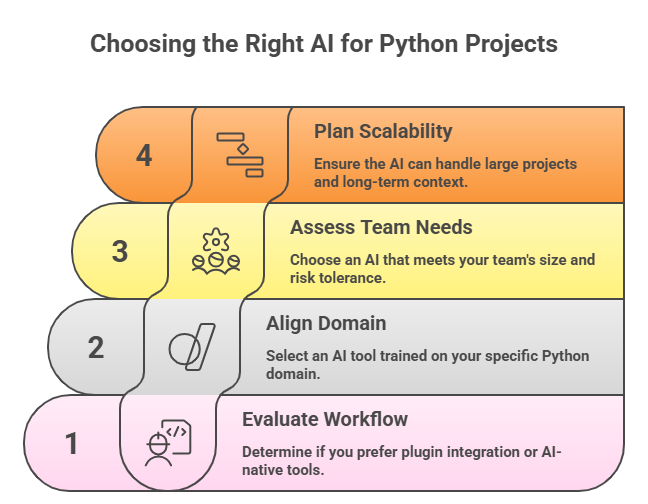
    Below, we have discussed a practical step-by-step guide to pick the best free AI for Python Coding your Python projects. These are based on recent benchmarks and developer feedback from platforms like n8n, Greptile, and Daily.dev.  

    Let’s study them to gain a broader idea:

    Step 1: Evaluate Your Development Workflow

    Before comparing tools, take a moment to think about your workflow. Do you want an AI that blends quietly into your setup, or are you open to a more AI-driven way of working?

    • The Workflow Integrator or Plugin Style: If you already love your editor, like VS Code, PyCharm, or similar and don’t want to change it, plugin-style tools are ideal. Solutions like GitHub Copilot and Tabnine integrate directly into your development environment. It offers smart, context-aware suggestions that speed up coding without disrupting your flow.
    • The AI-first Pioneer or Native Style: If you’re willing to rebuild your tooling for a productivity boost, then AI-native editors such as Cursor or Windsurf are good options.

    These tools are designed around AI from the ground up and allow them to understand broader project contexts.  

    Step 2: Align the Tool with Your Python Domain

    Python is a huge world. Different AI tools have spent their time studying different parts of it.  

    If you are buildingTry this toolReason to Choose
    Data Science and MLGitHub CopilotIt has been trained on more Pandas and NumPy code than others.
    Web Apps (Django/FastAPI)CursorThe Composer mode handles the back-and-forth between models, routes, and schemas.
    Cloud-Native or AWSAmazon Q DeveloperIt knows the Boto3 library inside out and can help with serverless Lambda setup.
    Legacy or Complex CodebaseSourcegraph CodyIt’s a master at indexing huge, messy folders and explaining what’s actually happening.

    Step 3: Assess Team Requirements and Governance

    The right AI tool depends heavily on team size and risk tolerance.

    For Solo Founders and Startups: You need Velocity. Tools like Windsurf act like junior developers. They can handle tasks like writing unit tests while you focus on the big ideas.

    • For Mid-sized Teams: You need Consistency. Look for tools that let you share carousels. This ensures the AI follows your team’s specific Python style guide, so everyone’s code looks the same.
    • For Big Enterprises: You need Safety. Go with Tabnine or GitHub Copilot Enterprise. They offer Zero-Data Retention. This means they don’t use your private code to train their public models and can even run enatirely on your own private servers.

    Step 4: Plan for Scalability and Long-Term Context

    Python projects are growing fast. If your AI only sees 500 lines of code, it will eventually get confused and suggest things that break your imports.

    • For Big Projects: You need an AI with a high Context IQ, like Sourcegraph Cody or Claude Code. They use a process called “RAG” to “read” your distant files before they suggest a change.
    • For Small Projects: Here, speed is the king. Windsurf’s lightning-fast response time is perfect for jumping between small and independent scripts.

    Maximising Productivity with AI Python Tools

    To truly maximise your productivity in 2026, you shouldn’t just use AI to write more code; you should use it to eliminate the work you hate doing. While AI can generate code up to 40% faster, the real “pro” move is using it to collapse the time spent on debugging, testing, and documentation.

    1. Adopt the Agentic Mindset

    One of the most common productivity mistakes is using AI only for single-line suggestions or autocomplete. In 2026, high-performing teams are moving forward and adopting agentic workflows.

    Instead of asking the AI to write a function, you can describe an entire feature. With tools like Windsurf or Claude Code, you can prompt:

    “Create a new API endpoint in routes.py, define the Pydantic model in schemas.py, and generate a migration script.”

    This approach turns the AI into an execution partner. You start focusing on architecture and intent while the AI handles cross-file boilerplate and setup work. With a Data Science Bootcamp with AI, you can learn how to write prompts that command these agents to build entire scrapers and bots in minutes.

    2. Audit Your Code with Dual-model Logic

    A hidden productivity drain in 2026 is trust. Recent data shows that AI-generated pull requests often sit in review much longer because developers are cautious about correctness.

    After generating code with one model, run it through a second one. For example, if you used GPT-4o to generate the code, ask Claude 3.7 or other review engine:

    “Identify logical errors, security risks, edge cases, or off-by-one mistakes in this code.”

    This dual-model approach catches hallucinations early, before they ever reach a human reviewer. The result is faster approvals, higher confidence, and a reputation for clean, reliable Python code.

    3. Automate the Verification Bottleneck

    Senior Python developers often spend up to 50% of their time writing unit tests and docstrings. This is a massive drain on creativity; however, it is where AI has a 96% success rate.  

    Use a Test-Driven Prompting approach and feed your logic to the AI and command it to:

    “Write five Pytest cases, including edge cases for null inputs, large datasets, and boundary conditions.”

    Tools like Bito AI or PyCharm AI can even auto-generate your code and inline documentation by analysing your actual call flows.

    4. Leverage Index-aware Context

    AI productivity dies when the model suggests a function you’ve already written in another file. To avoid this, you must ensure your tool, whether it’s Cursor or Sourcegraph, has fully indexed your local repository. When prompting, use specific “Mentions” or file references:  

    This ensures the AI stops guessing and starts following your team’s specific “dialect” of Python; it dramatically reduces the time you spend fixing its “generic” mistakes.

    Conclusion

    At the end of the day, the best AI for Python coding is the one that quietly makes your day easier. Maybe that means fewer bugs slipping into production. Maybe it’s faster to pull requests. Or maybe it’s finally not having the test coverage and documentation.

    The smartest developers in 2026 aren’t trying to replace themselves with AI. They’re using tools to handle the boring parts, double-check their work, and keep projects moving without burning out.

    Python will keep evolving. AI tools will keep getting better. Your job is simple. You have to just pick the assistant who works the way you do. We believe your time is valuable, so we train you to focus on high-stakes strategy while the algorithms do the heavy lifting.

    Frequently Asked Questions

    1. Can AI tools help debug Python code automatically?

    Yes. AI tools can spot syntax errors, logical issues, and edge cases quickly. Platforms review code contextually, suggest fixes, and even explain why bugs happen. They also save hours of manual debugging.

    2. Which AI tool is best for learning Python as a complete beginner?

    Beginner-friendly AI tools explain code in plain language and suggest improvements step by step. Skillify Solutions is great for learning because it helps you understand why code works, not just what to type.

    3. Will AI replace Python developers in 2026?

    No. AI won’t replace developers, but it will replace repetitive tasks. Python developers who use AI tools will be more productive, while creativity, architecture, and decision-making remain in human skills.

    4. Can AI tools refactor legacy Python code?

    Absolutely, AI can analyse large, messy codebases and suggest cleaner, modern structures. Tools help refactor legacy Python safely by understanding dependencies and existing patterns.
  • Cognos vs Power BI: Which BI Tool Should Choose in 2026?

    Cognos vs Power BI: Which BI Tool Should Choose in 2026?

    Imagine a library where every book is leather-bound, perfectly indexed, and guarded by a master librarian. That’s Cognos. Now, imagine a high-speed digital newsroom where headlines update every second and anyone can grab a microphone. That’s Power BI. One offers the security of a fortress, the other the agility. The question isn’t which tool is better, it’s whether your data needs a vault or a megaphone to help you win this year.

    At Skillify Solutions, we don’t just compare tools but try to help you build a data-driven culture. This blog is your roadmap to answer your question on which tool is better. Let’s break down the Cognos vs Power BI clash and see which champion deserves a spot in your tech stack. Want to know more? Read on! 

    Cognos vs Power BI: Quick Comparison Table 

    Choosing the right Business Intelligence (BI) tool between Power BI vs Cognos in 2026 starts here. Power BI is the go-to for modern and fast-moving teams. On the other hand, IBM Cognos comes with a heavy-duty engine for massive and regulated organizations. 

    Below is a quick and up-to-date comparison table of Cognos vs Power BI:   

    Feature IBM Cognos Analytics Microsoft Power BI 
    Best For Large, high-governance enterprises like Banks, Government, and Healthcare.  Startups to Enterprises already using Microsoft 365. 
    Starting Price $11.25 USD   $14.00 USD 
    Ideal Users IT Professionals and Advanced Data Architects. Business Analysts and non-tech users  
    Learning Curve Steep  Gentle  
    Deployment Flexible: Hybrid, On-Premises, or Cloud. Cloud-native, best in Azure 
    Reporting Strength Essential for formal PDFs and financial statements. Best for clicking, filtering, and “playing” with data. 
    AI Features IBM Watson Integration AI Copilot 
    Data Connectors Robust for traditional databases Massive library (300+) 
    Main Advantage Rock-solid security and massive scalability for billions of rows. Speed of setup, low cost, and seamless connection to Excel/Teams. 
    Main Drawback Dated and complex. Performance can dip with extremely massive datasets 

    Feature Comparison: Cognos Analytics vs Power BI Capabilities 

    Choosing from Cognos vs Power BI is a big decision for any team. At Skillify Solutions, our students learn that the best tool is the one your team will enjoy using every day. Let’s compare the features to get a better understanding:  

    Data Visualization and Dashboard Design 

    IBM Cognos Analytics: You can imagine yourself as an architect building a skyscraper. Everything needs to be precise and down to the millimeter. Cognos is famous for its Pixel-Perfect reporting. If you need a formal 50-page financial report where every table and logo must stay in the exact spot when printed as a PDF, Cognos can be beneficial for you.  

    In 2026, it added Interactive Brushing, which means clicking a bar in a chart highlights related data across your other charts instantly. But the overall vibe remains professional and structured. 

    Best for: Large-scale and formal reporting as looking professional and staying consistent are non-negotiable there.  

    Microsoft Power BI: Now, imagine you’re playing a video game where you can move anything, change colors, and explore the world. Power BI is built for Interactive Discovery. It is very fast at making dashboards that feel “alive.” You can drag and drop visuals.  

    With the latest 2026 updates, you get some bubble charts and layouts that react instantly. It’s less about a static PDF and more about a screen you can play around with to find answers. 

    Best for: Fast-moving teams who need to see real-time trends and want to “click around” to understand their business. 

    AI and Advanced Analytics Features 

    IBM Cognos Analytics: Cognos depends heavily on IBM Watson. It is one of the smartest AI brains in history. It has an AI Assistant where you can type questions in plain English, like “Why did my sales drop in January?” and it will explain the “why” behind the trend.  

    This tool is excellent at forecasting by using complex math to predict where your business will be in six months with its techniques.  

    Best for: Identifying hidden patterns and getting automated explanations for complex business changes. 

    Microsoft Power BI: Power BI uses Microsoft Copilot. In 2026, it carries a dedicated data assistant sitting. You can literally say, “Create a report page for last week’s marketing ROI (Return on Investment) and Copilot will build the entire page from charts in seconds.  

    This low-code AI approach makes Power BI so popular with non-technical managers. 

    Best for: Speed. It’s for the person who wants the AI to build the reports for them. 

    Data Integration and Connectivity 

    IBM Cognos Analytics: Cognos is like a master key. It is legendary for connecting to Enterprise Data Warehouses such as Oracle, SAP, or IBM’s own DB2. It can handle billions of rows of data without error as it processes that data on a powerful server.  

    In 2026, it has even added connectivity to modern cloud systems and shows that it’s ready to play nicely with the new digital world.  

    Best for: Connecting Big Data and stable corporate systems that have been around for years.  

    Microsoft Power BI: Power BI is the social butterfly. It has over 300 connectors and can link to almost anything from an Excel sheet on your desktop to a Facebook ad account. It is because it lives in the Microsoft Fabric ecosystem.  

    It can be considered the easiest tool in the world if your company already uses Excel and SharePoint. It feels like a natural part of your office toolkit.  

    Best for: Businesses that use the Microsoft ecosystem and need to pull data from many different modern web apps. 

    Cognos vs Power BI Pricing: Plans, Tiers, and Value 

    Here is the comparison table to study the Plans, Tiers, and Value IBM Cognos vs Power BI.  

    Plan Type IBM Cognos Microsoft Power BI 
    Free Tier Freemium Plan  
    Basic Plan $11.25 USD   $14.00 USD 
    Enterprise $44.90 USD $24.00 USD 
    Capacity-based Variable  Variable 

    Microsoft Power BI: It is all about affordability and scale. It is often included in Microsoft 365 E5 licenses, and many businesses find they already own the basic version. It’s the best value for companies that want to get everyone on the team using data without a massive upfront cost. 

    IBM Cognos: While the entry price is competitive, the real value lies in its Enterprise level. It is built for heavy-duty reporting where data security and pixel-perfect accuracy are worth the premium. It is considered an investment in stability and centralized control. 

    Cognos vs Power BI: Use Cases by Industry and Team Size  

    Some businesses in 2026 need heavy-duty security. Whereas others need the speed of a startup. 

    Here is how Power BI vs Cognos fits into different business operations: 

    Use Cases of IBM Cognos   

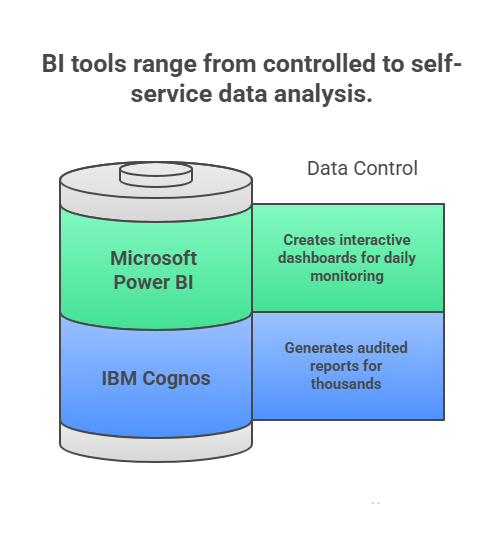
    Cognos is considered the go-to for structured excellence of the team. It is primarily used when a company needs data that is highly controlled and audited.  

    It is perfect for generating massive batches of reports that need to be sent to thousands of people simultaneously called Report Bursting.  

    Industry: Financial Services, Healthcare, Government, and Large-Scale Manufacturing. 

    Team Size: Large Enterprises with centralized IT departments and dedicated Data Architects. 

    Cognos is Best For: 

    • Generating perfect financial statements and legal documents. 
    • Distributing reports to thousands of users with high security. 
    • Handling massive data volumes from traditional, complex databases. 
    • Maintaining strict data governance and audit trails for compliance. 

    Use Cases of Microsoft Power BI   

    Power BI is used by teams that want to plug in their data and start seeing insights in minutes. It is the gold standard for “Self-Service BI,” where anyone in the company from HR to Sales can build their own dashboard to track daily performance. 

    Industry: Retail, E-commerce, Digital Marketing, Tech Startups, and Education. 

    Team Size: Small to Large Businesses that value decentralized, fast-paced decision making. 

    Power BI is Best For: 

    • Create interactive dashboards for daily monitoring. 
    • Connecting to modern web apps like Facebook Ads, Shopify, and Google Analytics. 
    • Sharing live data insights easily through Microsoft Teams and Excel. 
    • Low-cost entry for teams that need professional-grade AI tools. 
    Cognos vs Power BI

    Cognos vs Power BI: How to Choose the Right BI Tool in 2026 

    When it comes to picking the right tool from IBM Cognos vs Power BI, the “best” choice is the one that fits your team’s current skills and your company’s future goals. 

    Choose IBM Cognos Analytics if:   

    If your priority is precision and control, Cognos can be your solution. 

    • You work in Banks or Hospitals where data rules are very strict. 
    • You want IT experts to control all the numbers so nobody can change them by mistake. 
    • Your office already uses IBM systems and wants to stay with that family. 
    • You need to keep your data on private, physical servers for extra safety. 
    • You need formal PDF reports that look the same every single month.  

    Choose Microsoft Power BI if:   

    If your priority is speed and accessibility, Power BI is your modern engine. 

    • Your team already uses Excel, Teams, and Word every day. 
    • You want regular staff, not just tech experts, to create their own charts. 
    • You need a low-cost option that is easy on the wallet. 
    • You want to see live results today; not wait weeks for a report to be built. 
    • Your team is comfortable with Excel and wants a tool that feels similar. 

    Conclusion 

    The Cognos vs Power BI debate is not about which BI tool is superior, it’s about which one aligns with how your organization works in 2026.

    If your business depends on strict governance, audit-ready reporting, and pixel-perfect financial documents, IBM Cognos remains a powerful and reliable choice. If your teams need speed, self-service analytics, AI-assisted reporting, and seamless integration with Microsoft tools, Power BI clearly leads the way.

    Ultimately, the real advantage does not come from the platform alone, but from how confidently your team can use it to make decisions. The right BI tool, combined with the right skills, is what turns data into real business impact.

    At Skillify Solutions, we help professionals and teams master both Cognos and Power BI through practical, hands-on training so they can choose the right tool and actually use it to its full potential.

    Frequently Asked Questions  

    1. Is Cognos better than Power BI for large enterprises? 

    Power BI vs Cognos depends upon the daily needs of the businesses. Cognos is a powerhouse for massive companies that need strict IT control and formal, printed reports. However, Power BI is faster and easier for all employees to use daily.

    2. Can Power BI replace IBM Cognos Analytics? 

    Yes, but the style changes. Cognos is built for static PDF reports, while Power BI is made for interactive and clickable screens. In Skillify Solutions you can study both to make the right choice for your future. 

    3. Which BI tool has better AI capabilities: Cognos or Power BI? 

    It is a tie for this Power BI vs Cognos as Cognos uses IBM Watson to explain why data changed. Power BI uses Copilot to let you build entire reports just by typing a sentence.

    4. Can businesses transfer reports from Cognos to Power BI without data loss?

    Your data stays safe, but you must rebuild the reports. Since they use different languages, you can’t just copy-paste them.  You must clean up old data and build fresh, better-looking dashboards.


  • AI Engineer vs ML Engineer: Salary, Skills & Which Role Fits You Best

    AI Engineer vs ML Engineer: Salary, Skills & Which Role Fits You Best

    Some engineers live for the ‘Launch‘ button, however others live for the ‘Train‘ button. While they both work with intelligence, one builds the house and the other masters the bricks. This is the true divide between AI vs ML engineering.

    In 2026, the new tech world is divided into two specialties. AI Engineering is the new frontier for Full Stack creators. However,ML Engineering remains the preference for math lovers who live for algorithmic efficiency and MLOps. Both paths lead to the most influential roles in tech, but they require vastly different toolkits. 

    At Skillify Solutions, we’re here to help you navigate this crossroads with this blog on AI Engineer vs ML Engineer. We ensure you don’t just learn to code but learn to lead in the specific field that fits you. Ready to find your seat in the intelligence revolution? 

    Let’s break down which path is yours!

    AI Engineer vs ML Engineer: Salary, Skills & Career Path Comparison 

    In 2026, the tech world is no longer just talking about data. It talks about agents, automation, and real-time intelligence. While AI and ML are often used, their career paths have differences that are significant. 

    Let’s break down  

    Category AI Engineer ML Engineer 
    Core Focus They build an end-to-end intelligent system that mimics human thinking and reasoning.  Design and optimize algorithms that learn from data and make predictions.  
    Responsibilities Develop chatbots and integrate AI into existing software. Model training and build data pipelines. 
    Skills NLP, Deep Learning, Robotics, Computer Vision, Software Architecture. Statistical Modeling, Linear Algebra, Feature Engineering, Big Data Processing. 
    Tools TensorFlow, PyTorch, OpenAI API, LangChain, OpenCV, ROS. Scikit-Learn, Keras, Hadoop, Spark, MLflow, Databricks. 
    Salary (USA) $87k – 1lakh $87k – $167k  
    Employers Tech Giants like Google, Meta, Robotics firms, Healthcare and Smart Device makers. Fintech, E-commerce like Amazon, Netflix, Ad-tech and SaaS platforms. 
    Career Path AI Architect, Chief AI Officer, Robotics Specialist. Senior ML Engineer, Data Scientist, MLOps Lead. 
    Best Fit Aspirants who enjoy problem-solving and building smart user-facing products. Professionals who love math, statistics, and want to learn data patterns.   
    Certifications Microsoft Azure AI Engineer, IBM AI Professional. Google Professional ML Engineer, AWS ML Specialty. 
    Projects Voice Assistants, Self-driving car logic, GenAI apps. Recommendation engines, Fraud detection, Demand forecasting. 

    What Does an AI Engineer Do? 

    The job of an AI Engineer is to take human-like intelligence such as speech, vision, or reasoning. Then they weave it into a functional product. In 2026, this role is heavily focused on Agentic workflows and Generative AI integration. 

    Let’s study the core responsibilities and the tools that are essential:  

    Core Responsibilities of an AI Engineer 

    An AI Engineer must take an active approach to build intelligent systems: 

    1. Integrate Systems: Wire Large Language Models (LLMs) like GPT-4 or Claude into existing applications using robust APIs. 
    2. Develop Agents: Build AI Agents that autonomously execute tasks like booking travel or filing taxes. 
    3. Engineer Prompts & RAG: Design advanced prompt strategies and Retrieval-Augmented Generation (RAG) systems so the AI securely accesses and uses your company’s private data. 
    4. Deploy Ethics & Guardrails: Implement active safety layers and monitoring to prevent hallucinations and ensure data privacy. 

    Common Tools & Frameworks 

    1. Orchestration: LangChain, LlamaIndex, Haystack. 
    2. Models/APIs: OpenAI, Anthropic, Hugging Face. 
    3. Vector Databases: Pinecone, Weaviate, Milvus 
    4. Vision/Speech: OpenCV, Whisper, ElevenLabs. 

    AI Engineer Salary by Region 

    Let’s study ML Engineer VS AI Engineer based on their Salary: 

    Region Entry-Level (0-2 Years) Mid-Senior (5+ Years) Market Trend 
    USA $87k – 1lakh  $227k+ Rising  
    UK  £31k – £83k £93k+ Stable  
    India ₹17.1- ₹18.9 Lakhs ₹18.9 Lakhs+ Explosive  

    What Does an ML Engineer Do? 

    An ML Engineer is the specialist who builds the brain of the AI. They focus on the math, data, and training needed to make a model smarter and more accurate. To understand it better, if the AI Engineer builds the car, the ML Engineer is the specialist who designs the high-performance engine. They mainly focus on math, training, and the raw performance of models. 

    Let’s study the core responsibilities and the tools that are essential: 

    Core Responsibilities of an ML Engineer 

    1. Train & Tune Models: Take raw data and train custom models from scratch or fine-tune existing ones for specific tasks. 
    2. Engineer Data Pipelines: Build and maintain the “pipes” that clean and move massive datasets into the model. 
    3. Manage MLOps: Oversee the model lifecycle, deploying, monitoring for “drift,” and retraining as needed. 
    4. Optimize Performance: Ensure models run fast and remain cost-effective in cloud environments. 

    Tools & Libraries Used 

    1. Frameworks: PyTorch (the 2026 industry favorite), TensorFlow, JAX. 
    2. Data Processing: Apache Spark, Databricks, SQL. 
    3. Monitoring: MLflow, Weights & Biases, Kubeflow. 

    ML Engineer Salary by Region 

    Below we will study ML Engineer VS AI Engineer based on their Salary:

    Region Entry-Level (0-2 Years) Mid-Senior (5+ Years) Market Trend 
    USA $87k – $167k $205k+ Strong
    UK  £27k – £61k £140k+ Stable  
    India ₹8.3- ₹9.2 LPA ₹23.8 LPA+ Rising 

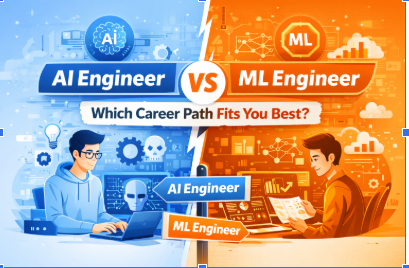
    AI Engineer vs ML Engineer: Which Career Path Fits You Best? 

    AI Engineer vs ML Engineer

    Based on Educational Background 

    The AI Engineer Path 

    1. Best for: Computer Science graduates or Software Engineers. 
    2. The Logic: If you’re comfortable with Full-Stack development and APIs, you will find AI Engineering aligning. 
    3. Key Skill: You need to be a Master of System Architecture. 

    The ML Engineer Path 

    1. Best for: Statistics, Mathematics, or Physics majors. 
    2. The Logic: If you enjoy working with algorithms and ML Engineer Path is for you.  
    3. Key Skill: You need a deep comfort level with Linear Algebra and Calculus. 

    Based on Career Goals 

    You can choose AI Engineering if your passion lies in building functional and user-facing products. You might aim to create an autonomous coding assistant or a smart application. 

    Your daily satisfaction comes from seeing people interact with your smart features. In this role, you actively prioritize user experience and seamless functionality over the complex math of the model architecture. 

    Choose ML Engineering if you prefer solving foundational data puzzles and optimizing the engine itself. You might focus on reducing AI bias or making models 10x smaller for mobile devices. This path is for those who prioritize scalability and mathematical optimization above all else. 

    Based on Industry Preference 

    Let’s study AI Engineer vs ML Engineer  based on their industry preference: 

    IndustryAI Engineering FocusML Engineering Focus
    SaaS & CreativeBuild GenAI tools for designers and writers.Optimize massive recommendation engines.
    Finance & CXAutomate real-time customer support agents.Engineer millisecond-fast fraud detection.
    Health & RoboticsDesign vision for drones and home bots.Train high-accuracy like tumor detection models.

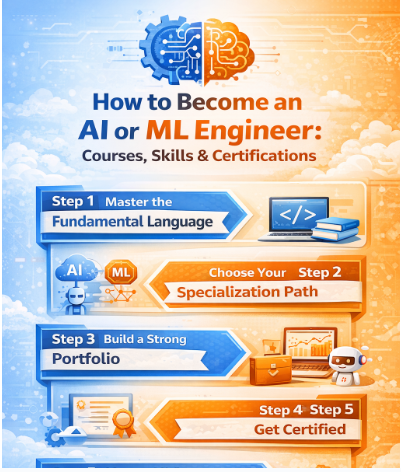
    How to Become an AI or ML Engineer: Courses, Skills & Certifications 

    You need a tactical roadmap to Start your career in the AI or ML fields in 2026. At Skillify Solutions, we’ve mapped out the most direct route to help you focus on the high-impact skills the industry demands. 

    Here is your step-by-step path on how to Become an AI or ML Engineer:  

    AI Engineer vs ML Engineer

    Step 1: Master the Fundamental Language  

    Start with Advanced Python, SQL for data retrieval, and the basics of Git for version control. You can try our Python for Data Science and AI course to master the syntax. Try libraries like NumPy and Pandas that serve as your foundation. 

    Step 2: Choose Your Specialization Path   

    First you have to decide whether you want to be an architect or an engine specialist. For AI Engineers, focus on API integration, Prompt Engineering, and Vector Databases. For ML Engineers, learn about Statistics, Calculus, and Linear Algebra. 

    Explore the Skillify Solutions AI & Machine Learning Bootcamp, which offers specialized tracks for both career paths, ensuring you don’t waste time on irrelevant modules. 

    Step 3: Build a Strong Portfolio  

    Recruiters care more about your practical experience than what’s on your degree in 2026. You need projects that solve real-world problems. Build a Retrieval-Augmented Generation (RAG) chatbot that can read a company’s entire legal database.  

    For ML, you have to develop a predictive model that identifies potential equipment failure in a manufacturing plant using sensor data. 

    Step 4: Get Certified  

    Certifications prove that you know how to use the cloud infrastructure that powers AI. Here are the Top 2026 Certifications: 

    1. Microsoft Certified: Azure AI Engineer Associate. 
    2. AWS Certified: Machine Learning, Specialty. 
    3. Google Professional Machine Learning Engineer. 

    Pro Tip: At Skillify Solutions, we align our curriculum with these global certifications, providing you with mock exams and prep material to ensure you pass on your first attempt. 

    Step 5: Master MLOps and Deployment   

    Learn Docker, Kubernetes, and MLflow. You need to understand how to deploy your AI agents or ML models so they can handle thousands of users. 

    Ready to claim your spot in the AI revolution? Explore all Skillify Solutions Courses here and take the first step toward your new career today. 

    Conclusion 

    In 2026, the market rewards specialists who don’t just know the theory. They can deliver results that drive business value.  If you are trying to choose between an AI Engineer vs ML Engineer career path in 2026, the most important step is to understand which one matches your strengths and career goals.  

    The choice you make today will define your future in the global tech economy. At Skillify Solutions, we provide specialized training, real-world projects, and expert mentorship to help you master a discipline.  Start your journey today and lead the future of technology. 

    Frequency Asked Questions

    1. What’s the difference between AI and ML engineering in startups vs big tech?

    In startups, an AI Engineer often handles everything from prompt design to deployment. In big tech, roles are specialized. ML Engineers focus on massive scale and reliability. Whereas AI Engineers build specific product features

    2. Is AI engineering harder than ML engineering? 

    It is not harder, just different. ML Engineering is math-intensive and requires deep knowledge of statistics and algorithms. AI Engineering focuses on system architecture and product integration

    3. Can an ML engineer transition into an AI role? 

    Definitely. Since Machine Learning is a subset of AI, ML engineers already have foundational logic. To switch, you’ll just need to master Generative AI tools like LLMs and RAG systems. At Skillify Solutions, our bridge courses help you learn quickly by adding the latest 2026 AI skills to your existing ML toolkit.

    4. What’s the future of AI engineer vs ML engineer roles?

    In the future, AI Engineers will build autonomous agents that do work, while ML Engineers will create specialized models that power them. Join our courses at Skillify Solutions to master your skills for this evolving landscape. 

  • Top Degrees in Demand for the Future: 2026 & Beyond

    Top Degrees in Demand for the Future: 2026 & Beyond

    Imagine telling your parents that you don’t want to become a doctor, engineer, or Chartered Accountant (CA) and instead, you want to study Artificial Intelligence, Behavioural Psychology, or Renewable Energy. Ten years ago, they would have laughed. But today? These top degrees in demand for the future are getting graduates hired faster than traditional fields. 

    The degrees that mattered in 2010 aren’t the degrees that will matter in 2026. Hiring is shifting nowadays as industries are reinventing.  And the biggest surprise? The most in-demand degrees for the future come from researching the industry standards. In this blog by Skillify Solutions, we break down the top degrees in demand for the future, backed by real-world examples, salary trends, and industry reports. Let’s dive in! 

    Understanding Top Degrees in Demand for the Future 2026

    Picking top 10 best degrees for the future 2026 feels like betting on your future in a world that is rapidly changing. In the digital transformation era, AI is reshaping jobs, and climate tech is booming like anything. Look at Sundar Pichai, who studied Metallurgical Engineering, a field nowhere close to tech leadership. But his curiosity for product design and strategy led him to Google’s top seat. 

    Understanding the top future-proof degrees in 2026 can equip you with skills that can match the market demands in the upcoming years. It can also ensure steady jobs and growth to build a rewarding and resilient career.  

    What Makes a Degree “Future-Proof” in 2026

    When you are looking for a future proof degree, you’re not just chasing a job, but building a career that lasts through global shifts and digital waves.  Degrees become future proof when they align with recent trends like AI adoption, green energy pushes, and healthcare advancements.  

    These fields are expected to grow in Science, Technology, Engineering, and Mathematics (STEM) and healthcare by 2030. Employers look for fresh graduates who can blend tech savvy approaches with human skills like analytical thinking and adaptability. These advancements can keep you ahead even if the recent job roles do not exist in the future market.  

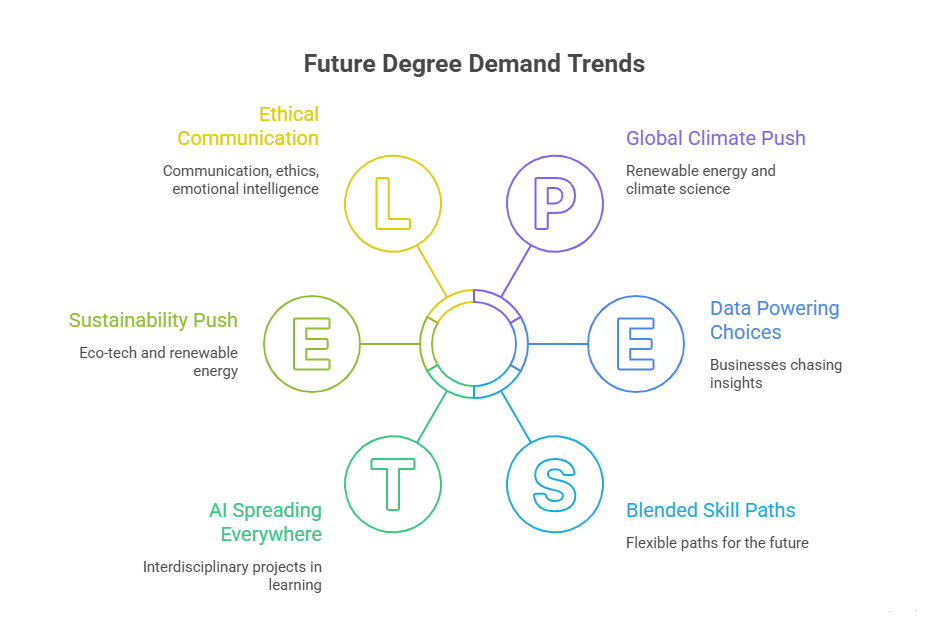
    5 Key Trends Driving Future Degree Demand 

    The branching of Artificial Intelligence (AI), automation, and digitalization is reshaping job roles across every sector in 2026. This rapid change points out that the importance of degree and education is being measured by the upcoming opportunities and challenges in the future market.  

    Here’s the real talk on the five key trends fueling future degree demand, accumulated from the latest job reports. 

    1. AI Spreading Everywhere: Previously, AI was only used by coders but now, it’s weaving into education, art, business, and healthcare. It boosts interdisciplinary projects in learning outcomes and problem-solving. Imagine using AI tools to blend creative writing with data analysis, this way you can master in any field.  
    2. Data Powering Choices: Every field today or in the future will require data intelligence from journalism to psychology. You can assume that Python and SQL are turning raw information into smart calls. These approaches are a must-have as businesses in 2026 chase insights.  
    3. Sustainability and Climate Push: Renewable energy and climate science are growing at a faster pace with thousands of roles in solar, wind, and eco-tech. It is fueled by global pushes for a cooler planet where it can be considered as a future proof career option.  
    4. Blended Skill Paths: One of the common problems for most fresh graduates is that they go for multiple skill paths and try to explore them. Like they will try business plus computer science to beat competition and create flexible paths for the future.  
    5. Learning Soft Skills: Communication, ethics, and emotional intelligence are considered gold in this digital era. Employers want humans who can connect, not just code for driving the need for human intelligence.  
    top degrees in demand for the future

    Explore Skillify’s game-changing bootcamps with 90% placement magic – Join Data Science Bootcamp with AI course today! 

    Top 15 Degrees in Demand for the Future 

    If you are worried about the future aspects in this tech Savvy world, there is a study of 15 degrees for the future that you must do. One good news is that 2026 jobs are tilted towards technology, health, and sustainability. The STEM and healthcare roles are about to rapidly increase by 17-30% by 2030.  

    Below, there are top 15 career paths, roles, salaries, and tips to visualize your future. 

    1. Computer Science & Artificial Intelligence 

    Between 2019 and 2029, the U.S. Bureau of Labor Statistics (BLS) anticipates a 13% rise in employment for computer and information technology occupations. The answer to why is that these graduates can mix algorithms with everyday magic. They can fuel self-driving cars and factories 30% quicker. You can see this career path in recommendation systems, voice assistants, self-driving cars, smart home devices, and even in the way businesses operate. 

    Career opportunities include 

    • Software Developer or Full-Stack Engineer 
    • AI or ML Engineer 
    • Robotics Programmer or Automation Engineer 
    • Big Data or Backend Systems Developer 
    • Cloud or DevOps Engineer 

    Salary Expectations: $120k/ year median salary range while US freshers huge in tech hubs. 

    Why it’s future-proof: Most industries are replacing manual tasks with automation. But they still need humans with technical skills to guide, train, and optimize these systems. 

    2. Data Science & Analytics 

    Data Science can be considered as the engine behind modern decision-making. Every click, purchase, and swipe produces data, and companies need experts who can find patterns, predict trends, and turn information into strategy. All the future proof career options like AI, healthcare, and technology need Data experts to run their business.  

    Career Opportunities 

    • Data Analyst 
    • Data Scientist 
    • Machine Learning Engineer 
    • Data Engineer 
    • Business Intelligence Analyst 
    • Quantitative Analyst 

    Salary ExpectationsUSA Median can range from $102,938/year. Freshers in Data Science and Analytics can expect $73k – $143k varying with the sector.  

    Why It’s Future-Proof: Organizations are becoming data dependent. Every industry wants to predict its future, and that makes data professionals irreplaceable. 

    3. Nursing & Advanced Practice Nursing 

    With the increasing world’s population, advanced nursing needs rapid rise. Nurse Practitioners (NPs) are becoming the backbone of global health. They can diagnose, prescribe, and manage treatments.  

    Career Opportunities 

    • Registered Nurse (RN) 
    • Nurse Practitioner (NP) 
    • Clinical Nurse Specialist 
    • Acute Care Nurse 
    • Pediatric Nurse Practitioner 
    • Telehealth Nursing Specialist 

    Salary Expectations: A nurse practitioner can earn up to $93,969/year and for senior level it can go upto $113k. 

    Why It’s Future-proof: Healthcare demand is rising, and telehealth is expanding. In this, the NPs are filling essential care gaps across hospitals and clinics. 

    4. Cybersecurity & Information Security 

    Cyberattacks are increasing with a rate of 300% year over year. Organizations urgently need defenders who can secure systems, protect data, and prevent breaches for protecting their data.  

    You’ll learn: 

    Ethical hacking, digital forensics, penetration testing, threat analysis, network security protocols, firewalls, cryptography, and cloud security defense. 

    Career Opportunities 

    • Cybersecurity Analyst 
    • Ethical Hacker / Pen Tester 
    • Information Security Manager 
    • Cloud Security Specialist 
    • Cyber Forensics Investigator 

    Salary Expectations: You can expect $102k/ year on average. The Ethical Hackers often earn more than $123k at senior levels 

    Why It’s Future-proof: Today, companies digitize everything, so cybersecurity is becoming a non-negotiable requirement.  

    5. Physician Assistant 

    PAs diagnose illnesses, prescribe medication, and offer advanced patient care. They are responsible for reducing the pressure on healthcare systems. 

    You’ll learn: 

    Clinical diagnostics, surgical assistance, pharmacology, patient management, emergency care, and primary care procedures. 

    Career Opportunities: 

    • Surgical PA 
    • Emergency Medicine PA 
    • Primary Care PA 
    • Orthopedic PA 
    • Pediatric PA 

    Salary Expectations: Median: $112,902/year

    Why it’s future-proof: Growing patient demand and physician shortages increase reliance on PAs. 

    30-40% salary boost awaits with our Data Analytics Bootcamp with AI Course– Join today! 

    6. Healthcare Administration 

    Behind every hospital is a team helping it run smoothly. Healthcare administrators manage operations, finances, and patient experience. 

    You’ll learn: 

    Healthcare operations, policy, HR management, finance, quality control, telehealth systems, and healthcare leadership. 

    Career Opportunities: 

    • Hospital Administrator 
    • Healthcare Operations Manager 
    • Clinical Coordinator 
    • Medical Office Manager 
    • Health Services Manager 

    Salary Expectations: Median: $86k/ year

    Why it’s future-proof: Healthcare is expanding and needs skilled leaders to manage large, complex systems. 

    7. Biomedical Engineering 

    Biomedical engineers design life-saving technologies from prosthetics to surgical robots. 

    You’ll learn: 

    Biomechanics, biomaterials, imaging systems, medical device design, electronics, tissue engineering, and regulatory standards. 

    Career Opportunities: 

    • Medical Device Engineer 
    • Clinical Engineer 
    • Biomechanics Engineer 
    • Surgical Robotics Engineer 
    • Medical Imaging Engineer 

    Salary Expectations: Median: $81,127/year

    Why it’s future-proof: Medical technology is expanding rapidly, so industries require engineers who understand both medicine and innovation. 

    8. Financial Technology (FinTech) 

    FinTech is transforming how we pay, invest, borrow, and save. This field blends finance + coding + cryptography. 

    You’ll learn: 

    Blockchain fundamentals, smart contracts, financial modelling, risk analytics, fraud detection, Python, and cybersecurity for banking. 

    Career Opportunities: 

    • Blockchain Developer 
    • Algorithmic Trading Engineer 
    • Fraud Detection Engineer 
    • FinTech Software Architect 
    • Crypto Analyst 

    Salary Expectations: Median: $114k/ year

    Why it’s future-proof: Money is becoming digital and financial institutions are evolving into tech companies. 

    9. Renewable Energy Engineering 

    As countries transition to sustainability, green energy engineers are in high demand. 

    You’ll learn: Solar & wind systems, energy storage, smart grids, electrical systems, sustainability modelling, and environmental impact analysis. 

    Career Opportunities: 

    • Solar Energy Engineer 
    • Wind Turbine Systems Engineer 
    • Smart Grid Engineer 
    • Energy Storage Engineer 
    • Sustainability Consultant 

    Salary Expectations: Median: $90,000/year

    Why it’s future-proof: Climate goals, green policies, and renewable energy investments guarantee long-term growth. 

    10. Physical Therapy (DPT) 

    Physical therapists help people recover movement, strength, and independence after injuries or surgeries. 

    You’ll learn: Human anatomy, rehabilitation techniques, movement science, therapeutic exercise, neuromuscular therapy, and clinical assessment. 

    Career Opportunities: 

    • Orthopedic PT 
    • Sports Rehab Therapist 
    • Pediatric PT 
    • Neurological PT 
    • Home Health PT 

    Salary Expectations: Median: $79k/ year

    Why it’s future-proof: An aging population + lifestyle injuries = permanent demand for rehabilitation specialists. 

    11. Systems & Business Analytics 

    This degree blends business and technology, helping companies make faster, smarter, and more efficient decisions. 

    You’ll learn: 

    Systems modelling, analytics tools, SQL, dashboarding, business strategy, automation workflows, and process optimization. 

    Career Opportunities: 

    • Business Analyst 
    • Systems Analyst 
    • Operations Analyst 
    • Digital Transformation Specialist 
    • BI Analyst 

    Salary Expectations: Median $82k/ year

    Why it’s future-proof: Businesses rely on data and automation and need analysts to guide strategy. 

    12. Information Technology Management 

    IT managers keep digital infrastructure running from cybersecurity to cloud systems. 

    You’ll learn: 

    Network management, cybersecurity basics, cloud computing, IT project management, enterprise software, and digital governance. 

    Career Opportunities: 

    • IT Manager 
    • Network Architect 
    • Systems Administrator 
    • Cybersecurity Manager 
    • Cloud Infrastructure Manager 

    Salary Expectations: Median: $98k/ year

    Why it’s future-proof: Every organization needs strong digital foundations, making IT leadership essential. 

    13. Occupational Therapy 

    OTs help people rebuild physical and cognitive skills needed for daily life. 

    You’ll learn: Therapeutic techniques, motor skills training, cognitive rehab, sensory integration, mental health support, and patient-centered care. 

    Career Opportunities: 

    • Occupational Therapist 
    • Pediatric OT 
    • Geriatric OT 
    • Hand Therapist 
    • Rehab Consultant 

    Salary Expectations: Median: $96,864

    Why it’s future-proof: Demand for rehabilitation and independent-living support continues to grow. 

    14. Supply Chain & Logistics 

    Supply chains keep the world moving from warehouses to global shipping networks. 

    You’ll learn: Logistics management, procurement, operations planning, inventory control, analytics, and supply chain technologies (ERP, WMS). 

    Career Opportunities: 

    • Supply Chain Manager 
    • Logistics Coordinator 
    • Procurement Specialist 
    • Demand Planning Analyst 
    • Global Operations Manager 

    Salary Expectations: Median: $81k/ year

    Why it’s future-proof: E-commerce and global trade rely on efficient, tech-enabled supply chains. 

    15. Mental Health Counseling 

    Mental health professionals are critical as awareness and emotional health needs rise. 

    You’ll learn: Psychotherapy techniques, counseling skills, mental health assessment, crisis intervention, behavioral therapy, and ethics. 

    Career Opportunities: 

    • Mental Health Counselor 
    • Clinical Psychotherapist 
    • School Counselor 
    • Trauma Specialist 
    • Behavioral Health Consultant 

    Salary Expectations: Median: $53,139

    Why it’s future-proof: Mental health services are expanding across schools, workplaces, hospitals, and communities. 

    How to Choose Your Future-Proof Degree: 5-Step Framework 

    Choosing a degree used to be simple previously as poaching a good job offer with a degree and skills was pretty easy. Pick a degree that is safe and in demand, get a job, and stay in that field for decades. But today, industries are evolving faster than your university syllabuses. Most of the job roles appear and disappear within years and students often find themselves asking the same question: How to Choose Your Future-Proof Degree? The answer to this question is choosing the right degree.
    Then, you’ll learn how to turn that degree into a job-ready portfolio with this 5-stage career-building roadmap. 

    Step 1: Assess Your Core Interests and Strengths 

    Candidates nowadays are chasing certificates like Pokémon cards, which is a big no when it comes to selecting your future proof career. You must choose one real-world skill and learn it thoroughly. Whether it’s coding or creative writing, it is crucial to understand your core strengths and talent.  

    Many students do this wrong as they aim to learn six tools at 20% depth instead of one tool at 80%. This is to understand that the world hires creators, not collectors who have a bunch of incomplete skills.  

    Ask yourself: 

    • What subjects excite me enough to study for three or four years? 
    • What skills feel interesting – analytical thinking, creativity, empathy, problem-solving? 
    • When do I feel most engaged or curious? 

    Step 2: Analyze Market Demand and Job Growth 

    It is important to understand that a degree can only be considered future proof if it leads the market for a decade. If a field shows consistent demand across multiple reports, there are several chances that they are going to grow.   

    What to research: 

    • Industry trends like AI, cybersecurity, healthcare, green energy, fintech 
    • Hiring patterns in LinkedIn job insights 
    • BLS growth forecasts 
    • Skill reports like Google and others  

    Step 3: Calculate ROI and Career Potential 

    A degree is an investment, so compare what you will spend and what you can earn and grow in future. The best degree is the one that keeps creating opportunities long after you graduate and helps you get Return on Investment (ROI). You can also equip you with transferable skills like data, coding, analysis, and healthcare expertise.  

    Things you should consider 

    • Tuition and living costs 
    • Time to complete 
    • Starting salary 
    • Upward mobility 
    • Skill versatility 

    Step 4: Evaluate Program Quality and Reputation 

    It is evident that choosing the right discipline is half the battle won for you.  Choosing the right program is the other half to choose top degrees in demand for the future in the world. You can explore opportunities like updated curriculum, industry projects, internship opportunities and university–industry partnerships 

    Ask these questions: 

    • Are they teaching what companies use? 
    • Do graduates from this program get hired into good roles? 

    Step 5: Plan for Flexibility and Lifelong Learning 

    Now, this is the final and the most important step when you are just hoping that someone will hire you. Employers love candidates who do not entertain guesswork, so you should take care of projects and visibility. As a perfect candidate, you have to negotiate your strength along with the proof of capability.  

    Things that are needed 

    • Real projects 
    • Public proof 
    • Demonstrated consistency 
    • Confidence with your work 

    Conclusion 

    Choosing the right degree today is less about “what everyone studies” and more about what the future needs. The key to figuring out top business degrees in demand for the future is choosing that opens doors, sparks curiosity, and stays relevant long after 2026. 

    This blog by the Skillify Solutions concludes the top degrees along with expectations and average salary. The jobs of tomorrow won’t wait, and your future self will thank you for choosing a path that challenges you, excites you, and prepares you to grow in a world that’s changing faster than ever.

    Frequently Asked Questions 

    1. Which fields offer the best opportunities for remote work among the top degrees in demand for the future? 

    The top 10 best degrees for the future 2030 can be CS/AI, Data Science by Skillify Solutions, Cybersecurity, FinTech, IT Management, Business Analytics shine for remote work. Code from home, analyze data anywhere; secure systems virtually acquire more than 40%. Healthcare admin & counseling offer hybrid flexibility. 

    2. Which top degrees in demand for the future have the highest global career opportunities?

    The most heated question is which degree has the highest demand in the future? Degrees like CS, AI, Cybersecurity, FinTech, Renewable Energy, and Biomedical Engineering open doors globally.  These top degrees in demand for the future 2026 across oceans and cultures are in high demand.

    3. What soft skills complement the top degrees in demand for the future to stay competitive? 

    The top business degrees in demand for the future will need clear communication, curiosity, problem-solving, and the ability to adapt fast. Being a team player and knowing how to solve tricky puzzles can help you get hired and promoted.

    4. Can certifications enhance the value of the top degrees in demand for the future? 

    Yes. Certifications like AWS cloud, CompTIA Security+, or PMP from the Skillify Solutions can help you chase the top ten degrees in demand for the future. They can boost your pay, open doors quicker, and prove your skills beyond a degree.

    5. Which top degrees in demand for the future offer the highest ROI in terms of salary vs tuition?

    Computer Science and AI often lead when it comes to return on Investment (ROI) from the top degrees in demand for the future in the world. Data Science from Skillify Solutions, Cybersecurity, and Nursing also pack great ROI punches.