Author: Nupur Shah

  • SAFe® vs CSM 2026: Full Comparison of Cost, Salary, and Hiring

    SAFe® vs CSM 2026: Full Comparison of Cost, Salary, and Hiring

    Choosing between CSM and SAFe® in 2026 depends entirely on your current career stage. CSM is your entry point to mastering team-level agility, while SAFe® is the requirement to scale those skills in large, complex enterprises.

    I’ve seen candidates delay their careers by picking SAFe® too early, hoping for higher-paying roles, only to struggle to even get shortlisted. And I’ve seen others stay too long with CSM, missing out on growth opportunities in larger, enterprise environments.  

    The truth is simple: both certifications are powerful, but only when used at the right time and for the right purpose. 

    Certified Scrum Master (CSM) can help you enter Agile roles faster. However, SAFe® can help you scale into leadership and enterprise-level positions. 

    But choosing without clarity can cost you time, money, and momentum. In this blog, we’ll break down SAFe® vs CSM based on their cost, salary, hiring demand, and real-world usage. After reading this, you can easily decide what truly aligns with your career goals. 

    SAFe® vs CSM at a Glance: Key Differences Explained (2026) 

    If you’re starting your Agile journey or looking to grow in your career, one of the most common questions is: Should you choose SAFe® or CSM? At a basic level, both certifications focus on Agile, but they are designed for very different environments. 

    Certified Scrum Master (CSM) is focused on single-team Agile delivery. It teaches you how to run Scrum ceremonies, manage backlogs, and help a small team work efficiently. It is ideal for beginners or those entering Scrum roles. 

    Scaled Agile Framework (SAFe), on the other hand, is designed for large organizations where multiple teams work together. It focuses on scaling Agile across departments, managing dependencies, and aligning teams with business goals. 

    Here’s a quick comparison to simplify it: 

    Factor Certified Scrum Master (CSM) Scaled Agile Framework (SAFe) 
    Best For Team-level roles like Scrum Master, Agile team member                          Enterprise-level roles like Program Manager, Agile Leader
    Complexity Simple and beginner-friendly Complex and suited for experienced professionals 
    Focus Area Execution within a single team                 Coordination across multiple teams 
    Work Scope  Individual Scrum team  Large-scale, multi-team environments 

    Build a strong Agile foundation with our industry-focused Scrum Master bootcamp today!

    SAFe® vs CSM in Real-World Job Markets 

    Understanding where each certification is actually used in the real world makes the decision much easier. While both SAFe® and CSM are Agile frameworks, companies use them in very different environments depending on their size, structure, and complexity. 
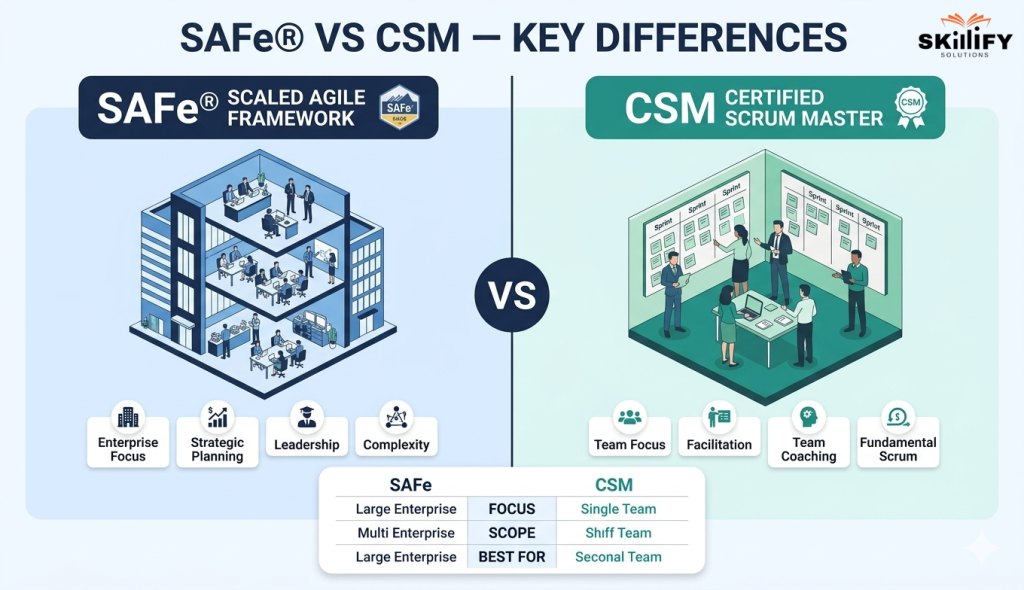
    Key differences

    Where CSM is Used: Scrum Team Roles 

    CSM is most used in small to mid-sized Agile teams where the focus is on delivering work within a single team. These teams follow Scrum practices like sprint planning, daily stand-ups, and retrospectives. 

    For example, in a product startup or a small tech company, a Scrum Master works closely with 5–10 team members to manage tasks, remove blockers, and ensure smooth delivery. 

    You’ll typically see CSM in roles like: 

    • Scrum Master  
    • Junior Agile Coach  
    • Product team roles 

    This is exactly the kind of environment a Scrum Master Bootcamp with AI helps you to make a single team, ensuring smooth sprint execution.

    Where SAFe® is Used: Enterprise Agile Environments 

    SAFe is used in large organizations where multiple teams work together on complex projects. These companies need coordination across teams, departments, and even business units.

    If you’re new to the concept, understanding What is SAFe Certification is can help you see how it supports large-scale Agile environments. 

    For example, in a large enterprise like a bank or a Fortune 500 company, 10–15 Agile teams may work on different parts of the same product. SAFe® helps align all of them through structured planning, like Program Increments (PI). 

    You’ll typically see SAFe® in roles like: 

    That’s why professionals working in such environments often opt for SAFe Courses, as they are specifically designed to handle multi-team coordination and large-scale Agile delivery.

    Which Certification Gets You Hired Faster?

    When it comes to getting hired, the answer is not just SAFe® vs CSM; it depends on your experience level and the type of roles you’re targeting. 

    In most cases, companies hire based on role fit first and certification second. This means CSM tends to open doors faster for beginners, while SAFe® becomes valuable as you move into larger, enterprise-level roles. 

    CSM Demand in Entry-Level Scrum Roles 

    For Scrum Master or Agile team roles, expect basic knowledge of Scrum practices, which CSM directly provides. 

    Role Type Industry Reason for Demand 
    Junior Scrum Master Startups, Small Tech Manages a single team using Scrum practices 
    Agile Team Member IT Services, Product Teams Supports daily Agile execution 
    Associate Product Role SaaS, E-commerce Works with Scrum teams for feature delivery 

    For someone starting, CSM helps you: 

    • Understand Scrum fundamentals quickly  
    • Qualify for entry-level roles faster  
    • Build a strong foundation for Agile careers  

    In real hiring scenarios, many job descriptions for junior Scrum roles mention CSM as a preferred or required certification. To understand the exact roles, responsibilities, and hiring expectations, you can explore this detailed guide on Scrum Master jobs. This shows the complete breakdown of what companies look for in real-world scenarios.

    SAFe® Demand in Enterprise Agile Roles 

    SAFe is more relevant in large organizations managing multiple Agile teams. These roles usually require some experience, as they involve coordination across teams and business alignment. 

    Role Type Industry Reason for Demand 
    Release Train Engineer (RTE) Banking, FinTech, Large Tech Manages multiple teams and program delivery 
    Program Manager or Agile Lead IT Services, Consulting Aligns teams with business goals 
    Enterprise Agile Coach Large Enterprises, Consulting Drives Agile transformation 
    Product ManagerSaaS, Tech Handles cross-team coordination 
    Portfolio Manager Banking, Government Manages large-scale programs 

    SAFe helps professionals: 

    • Move into enterprise Agile roles  
    • Handle cross-team dependencies  
    • Work in structured Agile environments 

    Experience vs Certification: What Matters More? 

    While certifications help you get noticed, experience is what actually gets you hired and promoted. Recruiters use certifications as a filter, but they look for real-world applications during interviews. 

    For example, a candidate with CSM and project experience will be preferred over someone with only certification. A professional with SAFe® and enterprise experience will stand out for senior roles. 

    In fact, companies today expect Scrum Masters to go beyond ceremonies and understand performance deeply. This guide on Agile metrics for Scrum Master explains how metrics impact delivery and hiring decisions.

    SAFe® vs CSM in the US Job Market  

    The US Agile job market in 2026 is growing rapidly, but it is also becoming more competitive and skill-driven. Companies are no longer hiring Scrum Masters to run ceremonies; they expect professionals who can improve delivery, manage teams, and drive business outcomes. 

    CSM vs SAFe® Salary Comparison 

    CSM is one of the most common entry points into Agile roles in the US. Companies prefer Scrum Masters who can manage individual teams and ensure smooth execution. However, competition is increasing at the entry level as more candidates enter through certifications. 

    SAFe is more relevant in large enterprises where multiple teams need coordination. It is commonly used in banking, consulting, and large tech companies, where organizations prefer professionals who can scale Agile across teams. 

    Certification Entry-Level Salary Average Salary Enterprise Salary 
    Certified Scrum Master $86K – $99K $95K – $111K $113K – $139K 
    SAFe Roles$76K – $93K $109K – $124K $120K – $200K 

    As you grow in your career, you may also come across roles like Agile Coach. If you’re unsure how it differs, this comparison of Agile Coach vs Scrum Master explains the responsibilities and career path clearly.

    Cost of CSM vs SAFe®: Investment and ROI Breakdown 

    Choosing between CSM and SAFe® is also about investment vs return. While both certifications require upfront cost, the real question is: how quickly can you recover that cost through job opportunities and salary growth? 

    Training and Certification Costs 

    The initial cost varies based on the course provider and level, but CSM is generally more affordable compared to SAFe®. CSM is a low-cost entry option, while SAFe® requires a higher investment due to its complexity and enterprise scope. 

    Certification Training and Exam Cost Notes 
    CSM $428.66Beginner-friendly, shorter duration 
    SAFe $300 – $500Advanced, enterprise-focused 

    Renewal Costs and Long-Term Maintenance 

    Apart from the initial cost, it’s important to understand the long-term commitment. Both CSM and SAFe® require renewal, which adds to the overall cost over time. 

    Certification Renewal Cycle Renewal Cost Notes 
    CSM Every 2 years ~$100 Simple and affordable 
    SAFe Every year ~$100 – $150 More frequent renewal 

    ROI Comparison Based on Job Opportunities 

    The real value of any certification lies in its return on investment (ROI). This depends on how quickly it helps you get a job, increase your salary, or move into better roles. 

    Factor CSM SAFe 
    Time to get a job Faster Slower 
    Initial salary impact Moderate High 
    Long-term growth Steady Faster in enterprise roles 
    Best for Beginners Experienced professionals 

    In many cases, a well-structured SAFe 6.0 Scrum Master (SSM) certification can help you recover your investment quickly by helping you land your first role.

    Which Certification Should You Choose Based on Your Career Stage? 

    Choosing between CSM and SAFe® becomes much easier when you look at your current career stage and goals. Both certifications are valuable, but they serve different purposes depending on whether you are starting or looking to grow into higher roles. 

    Beginners and Career Switchers

    If you are new to Agile or switching careers, CSM is usually the best starting point. It focuses on core Scrum concepts and helps you understand how Agile teams work in real projects. 

    For example, someone moving from a non-technical background into Agile can use CSM to build a strong foundation and qualify for entry-level roles. 

    CSM is ideal if you: 

    • Are you starting your Agile career  
    • Want to become a Scrum Master or team member  
    • Need a quick entry into the job market 

     This is where a practical Scrum Master Certification becomes valuable, as it gives you both conceptual clarity and real-world application.

    Enterprise Agile Professionals

    If you already have experience working in Agile teams, SAFe® becomes more relevant. It focuses on managing multiple teams, aligning with business goals, and handling large-scale projects. 

    For example, a Scrum Master with a few years of experience can move into roles like Agile Lead or Program Manager with SAFe® knowledge. 

    SAFe is ideal if you: 

    • Have Agile or Scrum experience  
    • Work in large organizations or want to  
    • Aim for leadership or enterprise roles 

    Similarly, professionals looking to scale their careers often move toward SAFe®courses to gain exposure to enterprise-level Agile practices.

    Salary vs Job Entry: Choosing the Right Path 

    Factor CSM SAFe
    Primary Goal Fast job entry Higher salary growth 
    Best For Beginners, career switchers Experienced professionals 
    Time to Get a Job Faster Slower 
    Long-Term Salary Growth Steady Faster, higher ceiling 
    Role Scope Single team Multiple teams or an enterprise 
    Career Path Scrum Master to Agile Roles Agile Lead to Enterprise Roles 

    Common Mistakes When Choosing SAFe® vs CSM 

    Many professionals choose between SAFe® and CSM based on trends, salary expectations, or what others are doing. But the wrong choice can slow down your career instead of accelerating it. The key is to align the certification with your current level and career goals, not just market hype. 
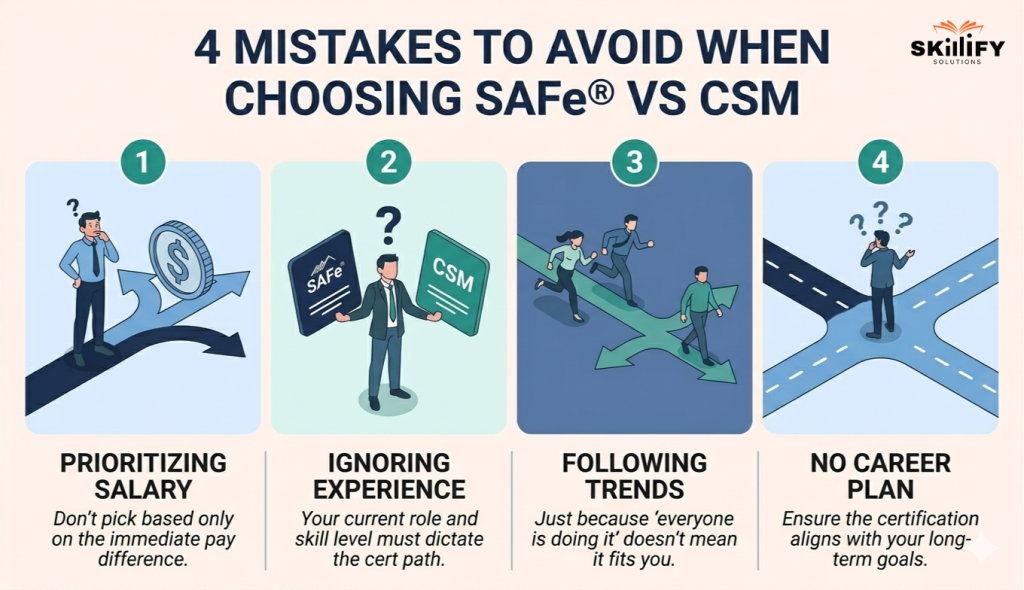
    safe vs csm

    Here are common mistakes when making the decision:  

    • Choosing based only on salary expectations  
    • Ignoring your current experience level  
    • Following market trends blindly  
    • Not planning your long-term career path 

    To make the right choice, focus on where you are in your career and where you want to go. If you’re starting, build a strong foundation with CSM. 

    If you already have experience, then move towards SAFe® for growth. Instead of chasing trends or salaries, align your certification with your skills, target roles, and long-term goals. 

    Conclusion 

    By now, the decision should be much clearer. If your goal is to enter Agile roles quickly and build a strong foundation, CSM is the better starting point. It helps you understand core Scrum practices and get into the job market faster.  

    On the other hand, if you already have experience and are aiming for long-term growth, leadership roles, and higher-paying enterprise opportunities, SAFe® is the next logical step. At the end of the day, it’s about choosing the one that aligns with your current stage and future goals. 

    Gain enterprise-level Agile expertise with SAFe training designed for experienced professionals!

    Frequently Asked Questions

     1. Do recruiters prefer SAFe® or CSM on a resume for the same Scrum Master role?

    Most recruiters prefer CSM for Scrum Master roles, as it is widely recognized and often used as a basic filter. SAFe® is preferred mainly for enterprise-level or scaled Agile roles, not basic Scrum roles.

    2. Can I get a Scrum Master job with only SAFe® certification and no CSM?

    Yes, but it is harder without Scrum fundamentals, especially for entry-level roles. SAFe® assumes prior Scrum knowledge, so beginners may struggle in interviews.

    3. Is SAFe® overkill for small or mid-sized companies?

    In many cases, yes, small teams usually use Scrum, not large-scale frameworks. SAFe® is mainly designed for large organizations with multiple teams.

    4. Do employers care more about certification or real Agile experience?

    Experience matters more, but certifications are often used as a first-level screening filter. Strong candidates combine both certification and real project experience.

    5. Can switching from CSM to SAFe® later improve salary significantly?

    Yes, especially when moving into enterprise roles with higher responsibility. SAFe® roles often involve a larger scope, which leads to higher salary potential
  • Best Project Management Tools in 2026: AI, Free vs Paid and Career Guide

    Best Project Management Tools in 2026: AI, Free vs Paid and Career Guide

    Introduction

    Project Management in 2026 is not what it used to be. Today, your tool can auto-create tasks, predict delays, and even summarize your entire project in seconds. 

    Sounds perfect, right? Yet somehow deadlines still slip, quick updates turn into 30-message threads, and someone still says, Wait, who’s doing this? Relatable? 

    I’ve seen teams jump from Trello to Asana to ClickUp in 3 months, thinking the next tool will fix everything. It doesn’t. Because the problem lies in choosing the wrong fit for how your team actually works.

    That’s exactly what this blog will fix. You’ll find the best Project Management Tools, real comparisons, AI insights, and what employers actually expect you to know, so you can make smarter decisions. 

    By the end, you will know which one actually works for your use case, your team, and your growth stage. Read on to know more!

    What Are Project Management Tools?  

    Project Management Tools are software platforms designed to help individuals and teams plan, organize, and manage their work efficiently. Instead of relying on scattered emails, spreadsheets, or manual tracking, these tools bring everything into one centralized system. Here, tasks, timelines, and communication are managed in one place.  

    In simple terms, they act as a control center for projects. They allow managers to assign tasks, track progress, manage deadlines, and ensure that teams stay aligned. Most modern tools are cloud-based, meaning teams can access them from anywhere and collaborate in real time.  

    They work by breaking a project into smaller tasks, assigning those tasks to team members, setting deadlines, and continuously tracking progress through dashboards or visual boards. This structured approach helps businesses avoid delays, reduce confusion, and improve overall productivity. 

    If you’re new to project management, starting with a structured learning path like a Scrum Master Bootcamp can help you understand how these tools are actually used in real projects.

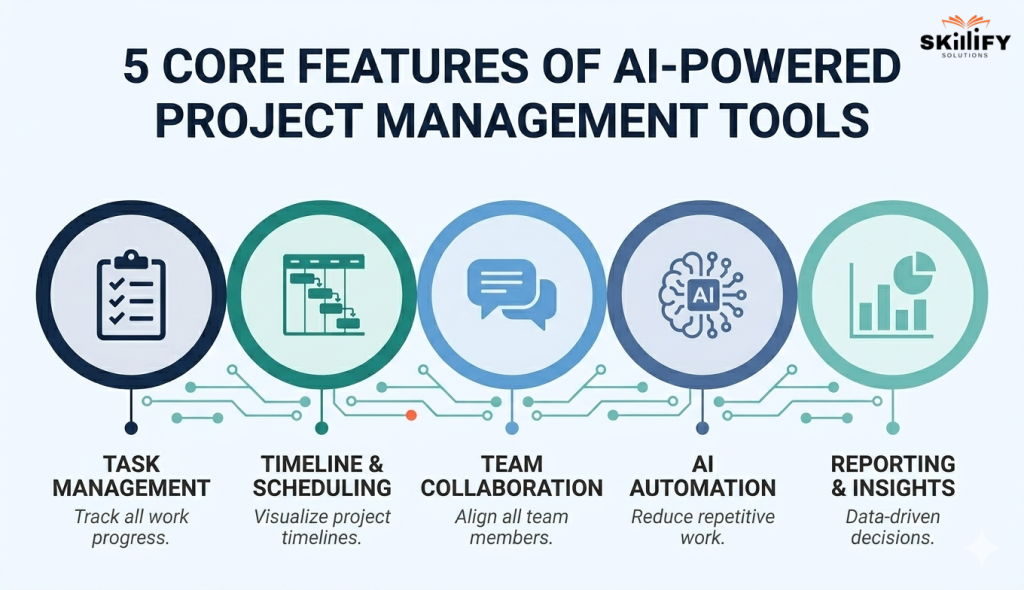
    Key Features of Project Management Software  

    A good project management tool is defined by how well it simplifies execution. While features can vary across platforms, the following are the must-have capabilities: 

    project management tools
    1. Task Management: Create, assign, prioritize, and track tasks with clear ownership and status updates.  
    2. Timelines and Scheduling: Visualize deadlines, dependencies, and project progress using calendars or Gantt charts.  
    3. Team Collaboration: Enable real-time communication through comments, file sharing, and notifications.  
    4. Reporting and Insights: Track performance with dashboards and reports to identify delays, risks, and productivity gaps. 

    Start with Scrum Master Bootcamp and learn how real teams manage projects effectively!

    10 Best Project Management Tools in 2026 

    Some tools are built for simple task tracking, while others focus on enterprise-level automation, Agile workflows, or cross-functional collaboration. 

    Based on industry comparisons and expert reviews, tools rank according to their feature depth, scalability, and usability. Below is a master comparison table to help you quickly evaluate the best tools in 2026: 

    Tool Name Best For Free Plan Paid Price Key Feature Agile Compatible 
    ClickUp All-in-one teams and startupsYes $7/user/month Tasks, docs, goals, and chat in one platformYes 
    Asana Mid to large teams Yes   $10.99/user/month Workflows, goals, and automation trackingYes 
    Trello Simple task management Yes $5/user/month Kanban boards for visual workflows Yes 
    Notion Documentation and lightweight PM Yes $8/user/month Notes, databases, and tasks in one workspaceNo 
    Monday.com Small to mid-sized businesses Yes$9/user/month Visual dashboards and workflow automationYes 
    Wrike Enterprise collaboration Yes $9.80/user/month Advanced reporting and real-time analytics Yes 
    Jira Development and Agile teams Yes $7.75/user/month Sprint planning and  backlog managementYes 
    Smartsheet Spreadsheet-style PM No$9/user/month   Excel-like interface with automation Yes 
    Zoho Projects Budget-friendly teams Yes $4/user/month Time tracking and task automationYes 
    Teamwork Client or project delivery teams Yes $10/user/month Client collaboration and  time tracking Yes 

    These tools are skills employers actively look for. In fact, the Project Manager Job Market today specifically mentions tools like Jira, Asana, or Agile workflows. 

    AI Project Management Tools in 2026: How AI Is Transforming Workflows 

    Artificial Intelligence is transforming project management from a manual tracking system into an intelligent decision-making system. Instead of just organizing tasks, modern tools now act like digital assistants. They tend to help teams plan faster, predict risks, and automate repetitive work. 

    This reduces manual effort and allows project managers to focus more on strategy, problem-solving, and team coordination rather than day-to-day execution. 

    Key AI Features in Modern PM Tools 

    Modern AI-powered project management tools go beyond basic automation. They actively assist teams with: 

    • Auto-Scheduling and Planning 
    • Risk Detection and Alerts 
    • Task Summarization and Insights 
    • Workflow Automation 
    • Smart Recommendation 

    Best AI-Powered Project Management Tools 

    Some of the leading tools integrating AI into project workflows include: 

    1. ClickUp Brain: This tool offers AI-powered writing, task creation, and workflow automation inside a single workspace  
    2. Asana AI: It focuses on smart task prioritization, goal tracking, and automated updates  
    3. Notion AI: It helps summarize documents, extract action items, and manage knowledge + tasks together  
    4. Wrike AI: This tool provides advanced analytics, risk prediction, and real-time performance insights 

    Do You Need AI Project Management Skills in 2026? 

    Yes, learning AI-enabled project management tools is becoming essential. Companies now expect project managers to use AI to automate tasks, analyze data, and make faster decisions. It helps you save time, improve project outcomes, and focus more on strategy instead of manual work.  

    Simply put, knowing AI tools can give you a strong advantage in your career and keep you relevant in the evolving job market. Programs like Product Owner Certification help you understand how to use AI in real project environments.

    Free vs Paid Project Management Tools: Which One Should You Choose? 

    Free project management tools are often the starting point for individuals and small teams. These are easy to adopt, cost nothing, and cover basic needs like task tracking and collaboration. But as projects grow complex, teams often hit limitations that slow them down.  

    Paid tools, on the other hand, are built for scalability, automation, and deeper control. They offer advanced features like reporting, integrations, and resource planning, along with better support and regular updates. 

    Factor Free Tools Paid Tools 
    Feature Access Basic features like ask tracking, boards, and simple collaborationAdvanced features like automation, reporting, integrations, and AI
    User Limits Limited Scalable for teams of any size 
    Storage Restricted storage capacity Higher or unlimited storage 
    Reporting and Insights Basic or limited analytics Advanced dashboards and real-time insights 
    Best For Individuals, freelancers, small teamsGrowing teams, businesses, and enterprise use 
    When to Upgrade When limits block productivity Needed for scale, control, and efficiency 

    What Free Plans of Top Tools Actually Offer 

    Most top tools offer generous free plans, but with clear limitations: 

    1. Trello: Kanban boards, task cards, basic automation, and limited boards  
    2. Asana: Unlimited tasks/projects, but limited automation, reporting, and AI features  
    3. ClickUp: Multiple views like list, board, calendar,  basic docs, and limited advanced features  
    4. Notion: Notes and task tracking, basic collaboration, limited team workflows 

    Most free project management tools come with a few common limitations that can impact growing teams. They often have user caps and restricted storage, which means you can only add a limited number of team members and files. In addition, automation and integration. 

    In addition, they are usually limited, making it harder to connect with other tools or streamline workflows. Finally, reporting and analytics features are basic or minimal, which restricts visibility into project performance and makes data-driven decision-making more difficult. 

    Learn how top teams work with our Product Management Bootcamp and build practical skills!

    When Free Tools Are Enough  

    A free project management plan is enough when your needs are simple and structured. If you are a solo user, freelancer, or part of a small team of 1–5 members, free tools can easily handle task tracking, basic collaboration, and day-to-day project organization. 

    It also works well for student projects or when you’re just starting out and learning how project management tools work. If your projects don’t require advanced reporting, automation, or integrations, a free plan can be a practical and cost-effective choice. 

    5 Signs You Need a Paid Project Management Tool 

    You should consider upgrading when: 

    • Your team size exceeds the free user limit  
    • You need advanced reporting or performance insights  
    • Workflows require automation or integration 
    • Projects involve complex timelines, dependencies, or resource planning  
    • You need reliable customer support and scalability 

    Today, employers expect real-world application. This is why many professionals get training from SAFe® Certification with hands-on tool experience.

    Project Management Tools for Career Growth in 2026 

    In most job descriptions, companies are not just looking for certifications like PMP or Scrum Master. They also need hands-on experience with tools that execute those methodologies in real work environments. 

    When you are exploring roles, it’s also important to understand how different career paths compare. For example, the difference between Scrum Master and Project Manager  roles goes beyond responsibilities; it also impacts salary and growth.

    Most In-Demand Project Management Tools in Job Descriptions 

    In 2026, certain tools consistently appear across job listings for roles like Project Manager, Product Manager, and Scrum Master: 

    Jira 

    Jira is a project management tool designed primarily for Agile and Scrum-based teams, widely used in software development. It helps teams plan, track, and release work in structured sprints. 

    jira

    It offers strong features like backlog management, sprint planning, and issue tracking. This makes it highly effective for managing complex projects with clear workflows and continuous delivery. 

    Asana 

    Asana is a flexible project management tool used by teams to organize, track, and manage their work in one place. It is popular across industries for managing both simple and complex workflows. 

    asana

    It provides easy task management, workflow automation, and goal tracking. Its clean interface and collaboration features make it ideal for cross-functional teams.

    monday

    ClickUp 

    ClickUp is an all-in-one project management platform that combines tasks, documents, goals, and dashboards. It is designed to replace multiple tools with a single unified system. 

    Clickup

    Its biggest advantage is flexibility and customization, allowing teams to tailor workflows as per their needs. It also offers multiple views like lists, boards, and calendars. 

    Trello 

    Trello is a simple and visual project management tool based on Kanban boards. It helps teams organize tasks using cards and lists. 

    Trello

    It is easy to use and quick to set up, making it ideal for small teams and beginners. Its visual layout makes tracking progress very intuitive. 

    Ready for leadership roles? Start with our Lean Portfolio Management course to scale projects confidently.

    Monday.com 

    Monday.com is a work operating system that helps teams manage projects, workflows, and daily operations. It is widely used for both project tracking and business processes. 

    monday

    It offers high customization, automation, and visual dashboards. This makes it useful for teams that need flexibility and real-time visibility. 

    Wrike 

    Wrike is a powerful project management tool built for teams that need advanced collaboration and reporting. It is commonly used by large organizations and enterprises. 

    wrike

    It provides detailed analytics, real-time reporting, and strong workload management. This helps teams handle complex projects efficiently and on a large scale. 

    If you’re starting, learning tools like Jira or Agile workflows through a Scrum Master bootcamp can give you a strong foundation and make it easier to transition into real job roles.

    Best Tools for Certifications  

    Different project management certifications align with specific tools based on their methodology and use cases. 

    Certification Tools Key Use 
    Scrum Master Jira, Trello, ClickUp Sprint planning, backlog, Agile workflows 
    SAFe® Jira, Wrike, Monday.com Multi-team coordination, enterprise Agile 
    PMP Microsoft Project, Smartsheet, Asana Planning, timelines, reporting 

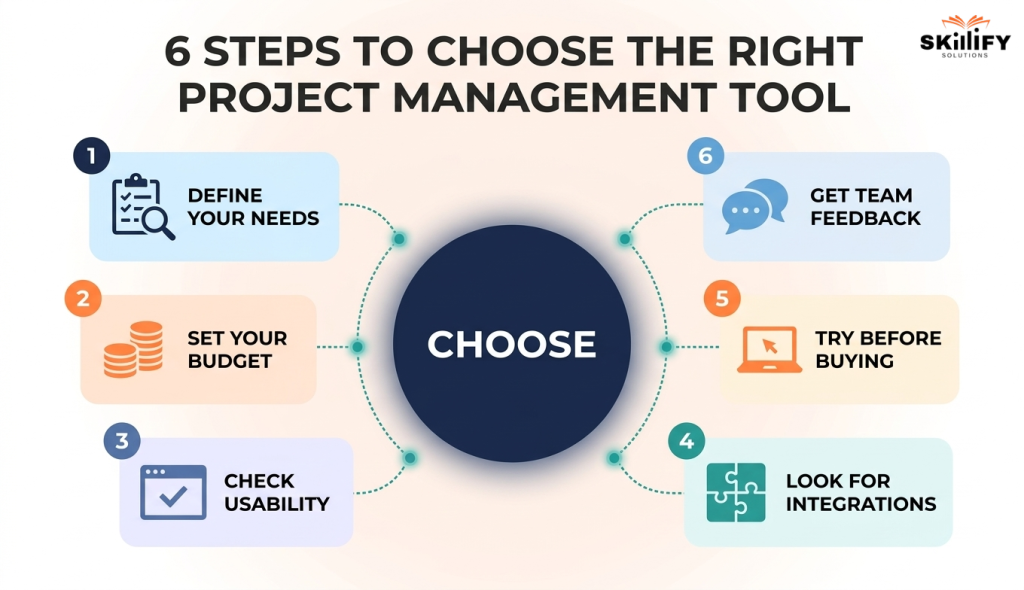
    How to Choose the Right Project Management Tool  

    Choosing the right project management tool is about finding the best fit for your team’s workflow, not just the most feature-rich option. 

    best project management tools

    Step 1: Define your needs and understand your team size, project type, and must-have features. List your non-negotiables first, like task tracking, timelines, and reporting. Don’t get distracted by extra features you won’t use.

    Step 2: Set a budget and plan for current costs and future scaling. Check pricing per user and how it increases as your team grows. Hidden costs often come from upgrades and add-ons. 

    Step 3: Check usability to ensure the tool is simple and easy to adopt. If your team needs too much training, adoption will fail. Choose something intuitive from day one.

    Step 4: Look for integrations that should connect with your existing tools. Make sure it works with tools like Slack, Google Drive, or your CRM to avoid manual work.

    Step 5: Try before buying with real projects using free trials. Don’t just explore features, run a small live project to see how it performs in real scenarios.

    Step 6: Get team feedback and choose what your team is comfortable using. Ask daily users, not just managers. If they don’t like it, they won’t use it.  

    Step 7: Think long-term and pick a tool that can grow with your needs. Choose something scalable, so you don’t have to switch tools again in 6 months.

    The demand for project management professionals is also growing rapidly, especially in Agile and tech-driven roles. Understanding What Hiring Managers Want in Agile Roles can help you choose the right tools and skills to focus on.

    Conclusion 

    Project management today is less about tracking tasks and more about working smarter. The right tool can bring clarity, improve collaboration, and help your team stay on track without constant follow-ups.

    But the best choice depends on your situation, your team size, your projects, and how you prefer to work. There’s no one-size-fits-all answer.

    Start simple, test what works, and grow from there. Don’t chase features, focus on usability and consistency.

    At the end of the day, a good project management tool should reduce your effort, not add to it. Choose the one that helps your team work better, not harder.

    Upgrade your career with the AI-Empowered Scrum Master courseand stay ahead of industry trends!

    Frequently Asked Questions

    1. What is the easiest project management tool for a complete beginner?

    Tools like Trello and Asana are considered the easiest for beginners. They have simple interfaces, visual boards, and require little to no training to get started.

    2.Do I need project management tools if I work alone on small projects?

    Not necessarily, but they can help you stay organized. Even for solo work, tools can improve task tracking, planning, and time management.

    3. What is the difference between project management tools and project management software?

    There is no major difference; both terms are used interchangeably. They refer to platforms that help plan, track, and manage projects efficiently.

    4. Which project management tool should I learn to get hired as a project manager in the US?

    Jira, Asana, and ClickUp are among the most in-demand tools. Learning at least one of these can improve your chances of getting hired.

    5. Can project management tools help with Agile or Scrum workflows?

    Yes, many tools like Jira, ClickUp, and Trello are designed to support Agile and Scrum methods, including sprint planning, backlog management, and team collaboration.

  • Agile Metrics for Scrum Master: Reporting to Non-Technical Stakeholders (2026)

    Agile Metrics for Scrum Master: Reporting to Non-Technical Stakeholders (2026)

    Introduction

    In one of my early Agile projects, everything looked perfect on paper. Velocity was stable. Burndown charts looked clean. Reports were always on track. But delivery was still getting delayed.

    That’s when it hit me. Metrics can look right and still be completely wrong. And honestly, this is where most Scrum Masters get stuck. Most Scrum Masters fall into this trap. We track numbers because we’re supposed to, not because we truly understand what they’re trying to tell us.

    Agile metrics are not about dashboards. They are about decisions. They give signals that quietly tell you where work is stuck, what’s slowing your team down, and what needs to change next.

    Once you start seeing them this way, everything shifts. In this blog, we’ll break down the Agile Metrics for Scrum Master that actually matter, how to present them to stakeholders without confusion, and how to use them to create real impact.

    Agile Metrics Every Scrum Master Should Track Internally 2026 Guide  

    As a Scrum Master, your role goes beyond running stand-ups and sprint reviews. You are responsible for understanding how your team works, where delays happen, and how delivery can improve. This is where Agile metrics become important.  

    These metrics are not meant for reporting to management, but for internal improvement. They help you identify bottlenecks, improve planning, and make your team more predictable over time. 

    This is exactly the shift most professionals learn when they go deeper into structured frameworks like SAFe® Scrum Master training.

    Velocity Trends (3-Sprint Average) 

    Velocity shows how much work your team completes in a sprint, usually measured in story points. Instead of looking at a single sprint, it is always better to track a 3-sprint average. This helps remove fluctuations and gives a more stable picture of team performance. 

    For example, if your team completed 20, 30, and 25 story points in the last three sprints, the average velocity is 25. This number helps in planning future sprints more realistically. 

    agile metrics for scrum master

    Velocity is useful for: 

    • Planning how much work to take in upcoming sprints  
    • Understanding if the team is stable or inconsistent  
    • Improving predictability over time  

    Cycle Time vs Lead Time 

    These metrics help you understand how fast work moves through your system. Cycle time measures the time from start to completion, while lead time covers the full journey from request to delivery. 

    For example, if a task is created on Monday, started on Wednesday, and finished on Friday, the lead time is 5 days and the cycle time is 3 days. 

    You can use it to: 

    • Identify delays before work starts  
    • Improve delivery speed  
    • Reduce waiting time 

    If you look at real Scrum Master jobs, you’ll notice that companies don’t just expect reporting; they expect you to understand what the numbers actually mean.

    Throughput, Flow Efficiency, and Sprint Burndown 

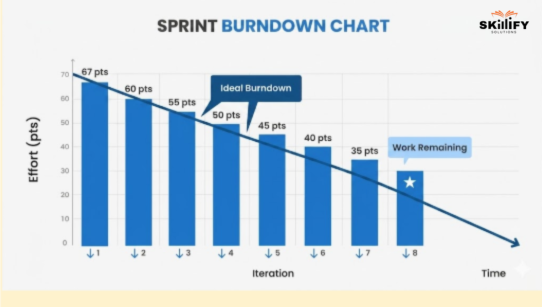
    These metrics show how smoothly work is progressing within a sprint. Throughput tracks how many tasks are completed, flow efficiency shows how much time is spent actively working, and sprint burndown tracks remaining work daily. For example, if most work is completed at the end of the sprint, it indicates delays or poor planning. 

    sprint burndown

    Use them to: 

    • Spot bottlenecks early  
    • Improve workflow efficiency  
    • Avoid a last-minute rush 

    Good Cycle Time Benchmarks 

    Cycle time varies based on team size, work type, and complexity. There is no single “perfect” number, but shorter and consistent cycle times usually indicate a healthy and efficient team. The goal is not just to reduce cycle time, but to keep it stable and predictable. 

    For example, if most of your tasks are completed within 2–4 days, your system is likely to flow well. But if some tasks take 2 days and others take 10 days, it shows inconsistency and possible bottlenecks. 

    Use benchmarks to: 

    • Identify what is “normal” for your team  
    • Spot tasks that are taking unusually long  
    • Improve consistency, not just speed 

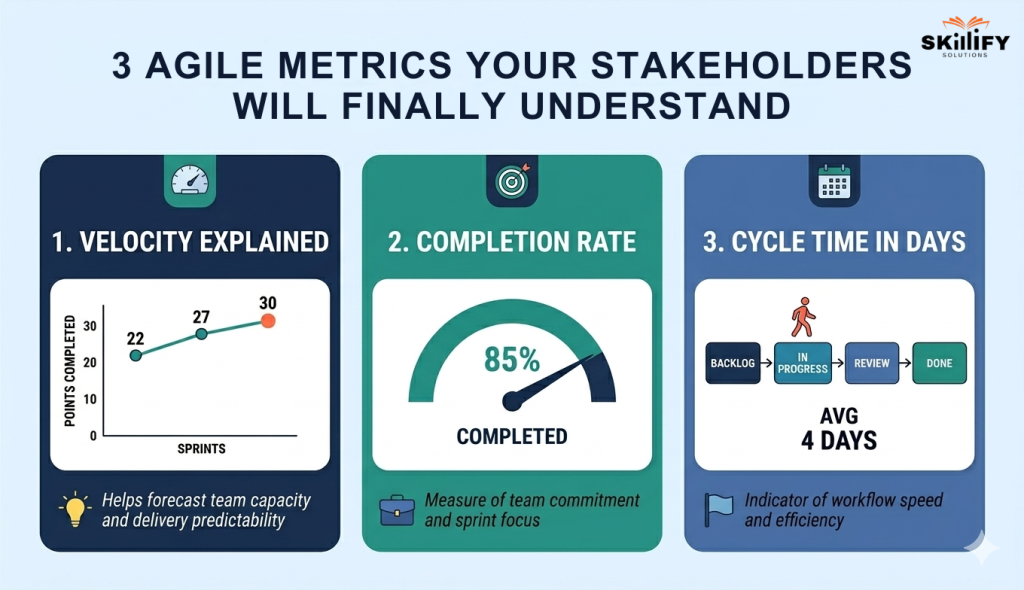
    The 3 Agile Metrics Non-Technical Stakeholders Actually Understand  

    Not every Agile metric makes sense to business stakeholders. Leaders want simple answers to questions like: Are we on track? Are we delivering fast? Can we trust timelines? These three metrics help communicate clearly without confusion. 

    Agile metrics

    Explaining Velocity Simply 

    Velocity shows how much work a team completes in each sprint. Instead of explaining story points in detail, you can present them as a trend. 

    For example, if a team consistently delivers around 25 points in every sprint, it means work is stable and predictable. This helps stakeholders understand progress without getting technical details. 

    In fact, concepts like velocity planning and sprint predictability are core parts of mostScrum Master courses, as they directly impact delivery performance. 

    Sprint Goal Completion Rate 

    This metric shows how often the team achieves the goal they committed to in a sprint. If the team completes their sprint goal 8 out of 10 times, the completion rate is 80%. This is easy for stakeholders to understand because it directly reflects reliability and commitment. 

    Cycle Time in Days 

    Cycle time in days shows how long it takes to complete a task once work starts. For example, if most tasks are completed within 3–4 days, it indicates fast delivery. This metric is simple and business-friendly because it directly answers how quickly the team delivers value. 

    Become a job-ready Scrum Master with hands-on SAFe 6.0 Scrum Master (SSM) training designed for beginners and career switchers!

    How Scrum Masters Should Present Agile Metrics to Non-Technical Stakeholders  

    Presenting Agile metrics is not about showing more data, but about making it easy to understand. Stakeholders need clear insights that help them make decisions. As a Scrum Master, your goal is to simplify the message and focus on what actually matters for the business.

    The 5-Minute Metrics Summary 

    A good metrics summary should be quick and focused. Instead of showing multiple dashboards, present one simple view with key numbers. 

    For example, you can say: 

    • We are delivering around 25 story points per sprint 
    • We completed 80% of the sprint goals this month.
    • Our average delivery time is 3–4 days per task.

    This gives stakeholders a clear picture in under 5 minutes without confusion.

    Explaining a Drop in Velocity 

    When velocity drops, stakeholders may assume something is wrong. Instead of just showing numbers, always explain the reason. 

    For example: 

    • Velocity dropped from 25 to 18 because 2 team members were on leave.
    • We had urgent production issues, which took priority.

    This makes it clear that the drop is understood and temporary, which builds trust. 

    Presenting Flow Efficiency Clearly 

    Flow efficiency can sound complex, so explain it using real situations. 

    For example: 

    • A task took 10 days to complete, but only 4 days were actual work.
    • The remaining time was spent waiting for approvals or dependencies.

    This helps stakeholders clearly see where delays are happening and what needs improvement, without using technical jargon. This is exactly the kind of practical understanding most professionals develop when they go deeper into a structured Scrum Master Course.

    Agile Metrics That Matter in High-Paying Scrum Master Roles (2026 Trends)  

    In 2026, Scrum Master interviews go beyond basic definitions. Companies expect you to explain metrics, interpret trends, and show how you used them to solve real problems. Metrics like velocity, cycle time, lead time, and burndown are commonly discussed, but what matters is how you apply them in real scenarios. 

    Metrics Asked in Senior Interviews 

    In interviews, you are often asked how you use metrics, not just what they mean. Questions are scenario-based and focus on decision-making. This is exactly What Hiring Managers Want in Agile Roles. They check the ability to interpret metrics and use them to solve real delivery problems.

    For example, real interview-style questions include: 

    1. What metrics do you track and why?
    1. Cycle time is increasing, so how will you fix it?
    2. How do you use velocity to improve planning?

    Here are some common metrics expected in answers: 

    1. Velocity for planning and predictability  
    2. Cycle time and Lead time to identify delays and improve flow  
    3. Burndown charts to track sprint progress  

    The key is to show that you use metrics to identify problems and drive improvement, not to track performance. This is where structured learning through a Scrum Master Course helps, as it prepares you to apply these metrics in real interview scenarios.

    Scrum Master Salary Insights by Industry 

    Scrum Master salaries in the US are significantly higher due to strong Agile adoption and demand for delivery-focused roles. On average, Scrum Masters earn around $120K–$126K per year, with top performers crossing $200K+ 

    Industry Type Salary RangeInsight 
    Product or SaaS$120K – $200KHigh demand for fast delivery and Agile maturity 
    IT Services or  Consulting $100K – $140K Stable roles with structured Agile processes 
    Banking or  Finance$110K – $160K High accountability and regulatory complexity 
    Healthcare or  non-Tech $95K – $130K Slower Agile adoption, moderate demand 
    Startups$90K – $140K Lower base but high ownership and growth 

    As you grow in your career, your role can expand beyond Scrum Master responsibilities. Understanding the difference between an Agile Coach vs Scrum Master helps you see how metrics evolve at higher levels.

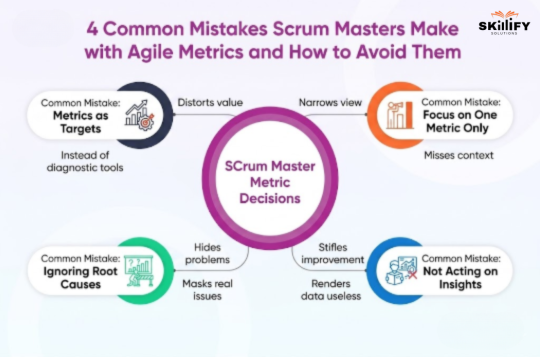
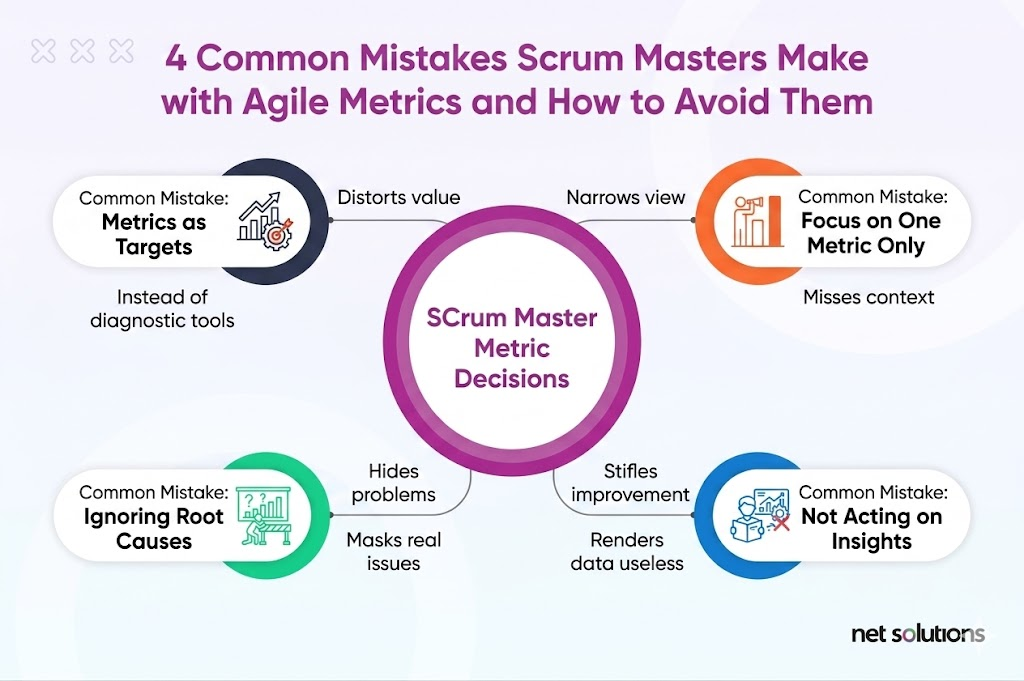
    4 Common Mistakes Scrum Masters Make with Agile Metrics and How to Avoid Them 

    Agile metrics are powerful, but using them the wrong way can do more harm than good. Many Scrum Masters focus too much on numbers instead of outcomes. The goal of metrics is to improve flow and delivery, not to control or pressure the team. 

    image 18 Agile Metrics for Scrum Master: Reporting to Non-Technical Stakeholders (2026)

    1. Using Metrics as Performance Targets 

    One of the most common mistakes is treating metrics like velocity as a target instead of a guide. This often leads teams to inflate estimates or focus on numbers instead of value. 

    For example, a team increases story points from 25 to 40 without real improvement  

    You can avoid this by: 

    • Using metrics for planning, not performance evaluation  
    • Focusing on outcomes like delivery, quality, not numbers  

    2. Focusing on One Metric Only 

    Relying only on velocity or burndown gives an incomplete picture. Metrics should be used together to understand the full system. 

    For example, velocity is stable, but cycle time is increasing, which leads to hidden delays. 

    Avoid this by: 

    • Combining metrics like cycle time, throughput, and flow efficiency  
    • Looking at trends, not single numbers  

    3. Ignoring Root Causes Behind Metrics 

    Many Scrum Masters report numbers but don’t investigate why they are changing. Metrics without context can mislead stakeholders. 

    For example, velocity drops and the actual reason is team members on leave or urgent bugs  

    Avoid this by: 

    • Always explaining the “why” behind metrics  
    • Using retrospectives to identify root causes  

    Many of these challenges appear when teams scale, which is why advanced programs like a SAFe® Advanced Scrum Master course focus on solving real-world bottlenecks across teams.

    4. Not Acting on Metrics Insights 

    Tracking metrics without taking action is a common mistake. Metrics should lead to improvement, not just reporting. 

    For example, flow efficiency shows a high waiting time, but no process changes are made  

    Avoid this by: 

    • Turning insights into action items  
    • Continuously improving workflows and removing bottlenecks 

    Conclusion 

    It can be concluded that the Agile metrics are tools to understand how your team works and where improvements are needed. When used correctly, they help you make better decisions, improve delivery speed, and build trust with stakeholders. 

    The key is to keep things simple, focus on the right metrics, and always look beyond the numbers to understand the story behind them. 

    As a Scrum Master, your real value lies in how you use these insights to drive continuous improvement. Start small, stay consistent, and let your metrics guide meaningful change.

    Kickstart your career with a Scrum Master bootcamp that prepares you for real interviews!

    Frequently Asked Questions

    1. Should a Scrum Master be judged on team velocity?

    No. Velocity is a team metric, not a performance metric. It should be used for planning, not judging a Scrum Master or team.

    2. What metrics should a Scrum Master include in a sprint review?

    Keep it simple and business-focused:
    Sprint goal completion
    Delivered features or value
    Cycle time (delivery speed)
    Key blockers or risks

    3. How do you explain agile metrics to a project sponsor?

    Use simple language and outcomes. For example: “We are delivering features in 3–4 days and achieving 80% of our sprint goals.”

    4. What is a healthy velocity trend for a new Scrum team?

    A healthy trend is stable and gradually improving over time. Big fluctuations are normal initially, but they should stabilize after a few sprints.

    5. What agile metrics are measured in SAFe® programs?

    Common SAFe® metrics include PI predictability, Velocity, Lead time & cycle time, Flow efficiency, and Defect rates

  • SAFe DevOps Certification in 2026: Cost, Exam Details, Salary, and Career Scope

    SAFe DevOps Certification in 2026: Cost, Exam Details, Salary, and Career Scope

    Here’s the truth no one tells you about SAFe DevOps Certification. It’s not about which one is best.
    It’s about which one actually changes your role, your salary, and your day-to-day work. 

    If you’ve ever worked in a team where releases get delayed, bugs keep coming back, and everyone is blaming everyone else. You’ve already seen why DevOps matters.  

    Now the real question is: Does a certification like SAFe® DevOps actually fix that? Or is it just another line on your resume? 

    From what I’ve seen, the answer depends entirely on how you use it. SAFe® DevOps doesn’t teach you tools. It teaches you something more valuable. You will learn how teams, systems, and processes actually come together to deliver software without chaos.  

    Depending upon all of these factors, your salary and career scope widen. And that’s exactly what most professionals miss.  

    In this guide, we’ll go beyond the surface and delve into SAFe DevOps Certification. We will note the cost, exam, salary, and whether this certification can move your career forward in 2026. Let’s dive in! 

    What is SAFe DevOps Certification: Key Concepts and Skills You Will Learn  

    SAFe® DevOps Certification is a globally recognized certification designed to help organizations deliver software faster, with better quality. It helps to improve collaboration between development and operations teams using the Scaled Agile Framework (SAFe®). If you’re new to SAFe®, you can first understand the basics in our detailed guide on What is SAFe Certification.

    In simple terms, this certification teaches you how to remove delays between teams, automate processes, and create a smooth system where ideas are quickly turned into working products. 

    Let’s see what you will learn: 

    • How to improve collaboration between development, testing, and operations teams  
    • Ways to automate testing, integration, and deployment processes  
    • How to reduce errors, rework, and delays in software delivery  
    • Understanding the complete journey from idea to product release  
    • Practical DevOps strategies used by large enterprises  

    Understanding the Continuous Delivery Pipeline  

    The Continuous Delivery Pipeline is the core concept of SAFe® DevOps. It explains how an idea moves step-by-step until it becomes a product used by customers. 

    It is divided into four simple stages: 

    1. Continuous Exploration (CE): Understanding what customers need and planning what to build  
    2. Continuous Integration (CI): Developers write code and regularly combine their work  
    3. Continuous Deployment (CD): The code is tested and deployed automatically  
    4. Release on Demand (RoD): The product is released whenever the business is ready  

    Take the next step toward mastering DevOps at scale with our SAFe 6.0 SM Certification today!

    Who Should Take SAFe® DevOps Certification and Who Should Avoid It 

    SAFe® DevOps Certification is best suited for developers, testers, DevOps engineers, and Agile professionals who work in environments using the Scaled Agile Framework (SAFe®). It is valuable for those who want to understand how large organizations improve collaboration and deliver software faster. 

    It may not be suitable for beginners with no IT background or for those looking for deep technical training in tools like AWS or Kubernetes. This certification focuses more on processes and workflow rather than hands-on tool expertise. 

    If you’re early in your SAFe® journey, certifications like Leading SAFe might be a better starting point before moving into SAFe® DevOps.

    SAFe DevOps Certification Cost in 2026  

    The cost of SAFe® DevOps Certification in 2026 mainly depends on the training provider, location, and learning format. This usually includes training, study materials, and the first exam attempt. 

    Cost Component Price Details 
    Training Cost ~$795 – $1,200 Instructor-led SAFe® DevOps training with real-world workshops and exercises 
    Exam Fee Included First exam attempt included with the training program 
    Retake Fee ~$50 Applicable if you don’t clear the exam on the first attempt 
    Renewal Fee $195/year Annual renewal required to maintain certification 

    SAFe® DevOps Exam Details: Pattern, Duration, and Passing Criteria  

    The SAFe® DevOps Certification exam is designed to test your understanding of DevOps practices within the Scaled Agile Framework (SAFe®). Here’s a quick overview of the exam format: 

    Exam Component Details 
    Number of Questions 45 Multiple Choice Questions
    Duration 90 minutes 
    Passing Score 74 – 80%
    Mode Online and web-based exam 
    Access First attempt included with training, valid for 30 days after course completion

    The exam focuses more on practical understanding of workflows and concepts rather than deep technical coding knowledge. Having a structured preparation plan is important; a dedicated SAFe Exam Preparation strategy can help you cover all key topics efficiently.

    What to Expect on the SAFe® DevOps Exam Day  

    On the exam day, you will take the test online through the official SAFe® platform. The exam is not heavily proctored, but it is time-bound, so managing time is important. 

    Here are some of the questions you can expect: 

    • Scenario-based questions focused on real-world DevOps situations  
    • Questions testing your understanding of the Continuous Delivery Pipeline  
    • Some direct concept-based questions from the training material  
    • A moderate difficulty level that requires clarity of concepts  

    Important Topics to Focus on for Exam Preparation  

    To pass the exam, you should focus on the most important concepts covered in the course: 

    1. The Continuous Delivery Pipeline 
    2. DevOps culture and collaboration across teams  
    3. Automation in testing, integration, and deployment  
    4. Lean-Agile principles and their role in DevOps  
    5. Identifying and removing bottlenecks in delivery  
    6. Metrics and ways to improve delivery performance  

    Tip: Most questions are directly based on the training content and framework concepts, so revising the course material and understanding real-world applications is the best way to prepare. 

    SAFe DevOps vs AWS vs CKA vs Google DevOps: Which Certification Is Better?  

    Choosing the right SaFe DevOps Certification depends on your career goals, current roles, and the type of skills you want to build. The SAFe® DevOps certification focuses on process, collaboration, and enterprise-level delivery. While certifications like AWS, CKA, and Google DevOps are more tool-specific and technical. 

     If you are working in large organizations using Agile frameworks, SAFe® is highly relevant. On the other hand, if you want hands-on expertise in cloud, containers, or infrastructure, other certifications may be a better fit. 

    Certification Focus Area Best For Technical Depth Industry Use Case 
    SAFe 6.0 DevOps Practitioner (SDP) CertificationDevOps processes, collaboration, enterprise Agile Agile teams, managers, DevOps professionals in large organizations Medium Scaling DevOps across enterprises 
    AWS DevOps     Cloud infrastructure, CI/CD on AWS Cloud engineers, DevOps engineers High Cloud-based application deployment 
    Certified Kubernetes Administrator (CKA) Kubernetes, container orchestration System admins and DevOps engineers Very HighManaging containerized applications 
    Google DevOps (Professional DevOps Engineer)     GCP tools, monitoring, and reliability Cloud and SRE professionals High Site reliability and cloud operations 

    SAFe DevOps Certification Salary in the US (2026) and Career Opportunities  

    DevOps roles in the US continue to be among the highest-paying in tech, and certifications like SAFe® DevOps can further strengthen your profile, especially in enterprise environments. 

    In 2026, the average salary for a DevOps engineer depends on experience, skills, and location. Below is a simple salary breakdown: 

    Experience Level Average Salary 
    Entry-Level (0–2 years) $82,000 – $101,000 
    Mid-Level (3–6 years) $110,000 – $134,000 
    Senior-Level (7+ years) $140,000 – $150,000+ 

    With SAFe® DevOps certification, you are not limited to just one role. It opens doors to multiple career paths, especially in companies using Agile at scale. 

    Common job roles include: 

    • DevOps Engineer  
    • Release Train Engineer (RTE)  
    • Site Reliability Engineer (SRE)  
    • Agile Coach or Scrum Master  
    • Cloud and Infrastructure Engineer  

    The demand for DevOps professionals is growing rapidly, with many organizations adopting DevOps practices to improve speed and efficiency. In fact, a large percentage of companies are actively investing in DevOps adoption, increasing job opportunities across industries. 

    Ready to scale your career? Start with AI-Empowered SAFe 6.0 POPM Certification today!

    Is SAFe® DevOps Certification Worth It in 2026? ROI and Career Impact

    In 2026, DevOps certifications continue to deliver strong career value, especially when aligned with your role and industry needs. Studies show that certified professionals can earn higher salaries compared to non-certified peers, and certifications often act as a resume filter for recruiters, improving job opportunities and reducing job search time.  

    ROI Factor Impact 
    Salary Growth 18% – 30% increase 
    Job Opportunities Higher shortlisting chances 
    Career Growth Access to senior roles 
    Cost Recovery 3–6 months 
    Long-Term Value Strong for enterprise roles 

    In real-world roles, understanding both processes and the tools supporting them is what creates real impact. Our Scaled Agile Framework Tools guide covers this practical side in detail.

    Who Should Invest in SAFe® DevOps Certification  

    This certification is worth it if you are working in or targeting enterprise Agile environments. It is especially valuable for professionals involved in delivery processes. For example, DevOps engineers, Scrum Masters, release managers, and Agile coaches. 

    It also makes sense if you want to move into leadership or transformation roles, where understanding DevOps workflows, collaboration, and scaling practices is critical. 

    SAFe Certifications from Skillify Solutions help validate your skills, improve credibility, and act as a strong signal during hiring and promotions. 

    Who Should Consider Other DevOps Certifications Instead  

    If your goal is to build hands-on technical expertise in tools like AWS, Kubernetes, or cloud infrastructure, SAFe® DevOps may not be the best choice. Certifications like AWS DevOps or CKA offer more direct ROI in terms of technical skill and salary growth. 

    Also, certifications alone are not enough, without practical experience or projects; their impact is limited. Experts suggest that certifications work best when combined with real-world skills, as employers value practical capability over just credentials. 

    Conclusion 

    From the above discussion, it can be concluded that there is no one best certification for your career. The one that fits your path is the best. SAFe® DevOps is valuable for understanding systems, improving workflows, and growing within enterprise environments.  

    But it works best when it matches your role and goals. If you are looking for technical depth, other options may suit you better. If you want to grow how work gets delivered at scale, this is a strong choice. 

    Take a step back, evaluate your direction, and make a decision that supports your long-term growth, not just a short-term trend. 

    Learn how top companies deliver software and be part of it with our SAFe 6.0 for Teams (SP) Certification now!

    Frequently Asked Questions

    1. Is there a prerequisite to attend the SAFe DevOps certification course?

    No strict prerequisite is required, but having basic knowledge of Agile, DevOps, or software delivery is helpful.

    2. How long is the SAFe DevOps exam, and how many questions does it have?

    The exam is 90 minutes long and consists of 45 multiple-choice questions.

    3. Can non-technical professionals benefit from SAFe® DevOps certification?

    Yes, but mainly those involved in Agile teams or delivery processes. Purely non-technical roles may find limited value.

    4. Does SAFe® DevOps certification count toward PMI PDUs?

    Yes, it can provide PDUs that count toward maintaining PMI certifications.

    5. Can I take the SAFe® DevOps certification if I already hold Leading SAFe®?

    Yes, you can. There is no restriction, and it can complement your existing SAFe® knowledge.

  • SAFe® Lean-Agile Principles: All 10 Explained with Real Examples and Exam Tips

    SAFe® Lean-Agile Principles: All 10 Explained with Real Examples and Exam Tips

    In every Agile transformation we have seen, one pattern is clear. Teams adopt frameworks, tools, and ceremonies, but still struggle with alignment and delivery. 

    Do you know what the missing piece is? Its principles. SAFe Lean Agile Principles aid the difference between teams that deliver and teams that struggle. They guide how you prioritize, how you handle uncertainty, and how decisions are made across large organizations. 

    And here’s the truth: most exam questions and real-world challenges are based on these principles, not definitions. If you truly understand them, everything else in SAFe® becomes easier. 

    In this blog, we will simplify all 10 SAFe® Lean-Agile Principles with real examples and clear exam tips, so you don’t just read them; you actually get them. Let’s get started! 

    What Are SAFe Lean-Agile Principles and Why Do They Matter? 

    SAFe® Lean-Agile Principles are the core thinking framework behind the Scaled Agile Framework (SAFe). They guide how organizations make decisions, prioritize work, and deliver value on a scale. 

    Unlike processes or checklists, these principles focus on how teams and leaders should think while building products. They combine three powerful ideas: Lean, Agile, and Systems Thinking. These are to help organizations move faster without losing alignment. 

    In real-world scenarios, especially in large companies where multiple teams are involved, things often slow down because of dependencies, approvals, and unclear priorities. This is exactly where SAFe® principles step in.  

    Master SAFe® principles with structured training and real-world application with our SAFe 6.0 Agile Product Management Certification now!

    SAFe® Principles vs Agile Manifesto 

    At first glance, SAFe® principles and the Agile Manifesto may look similar, but they serve very different purposes. 

    The Agile Manifesto was designed for small, independent teams, focusing on flexibility, collaboration, and delivering working software quickly. SAFe® principles, on the other hand, are built for large organizations where multiple teams must work together in a structured yet flexible way. 

    Aspect Agile Manifesto SAFe® Lean-Agile Principles 
    Focus Team-level agility Enterprise-level agility 
    Purpose Improve team collaboration and delivery Guide decision-making across teams and business units 
    Scope Small teams Large organizations with multiple teams 
    Nature Values and philosophy Actionable principles for execution 
    Decision-making Mostly team-driven Business + technical alignment 

    Which SAFe® Certifications Cover These Principles 

    If you are preparing for a SAFe certification, understanding these principles deeply is critical because most exam questions are scenario-based. Instead of asking “what is a principle,” they test whether you can apply it in real situations. 

    Certification Focus Area How Principles Are Used 
    AI-empowered SAFe POPM Product ownership and value delivery Prioritization, customer value, and economic decisions 
    Leading SAFe  Enterprise-level agility             Understanding the full framework and decision-making 
    SAFe Advanced Scrum Master  Team facilitation Applying principles in daily Agile practices 
    SAFe 6.0 for Teams (SP)Program-level execution                         Managing multiple teams and alignment 

    This is exactly why most professionals prefer guided SAFe® training from platforms like Skillify Solutions. They structure their SAFe courses around real-world use cases and exam-focused scenarios, making it easier to understand how these principles work in practice.

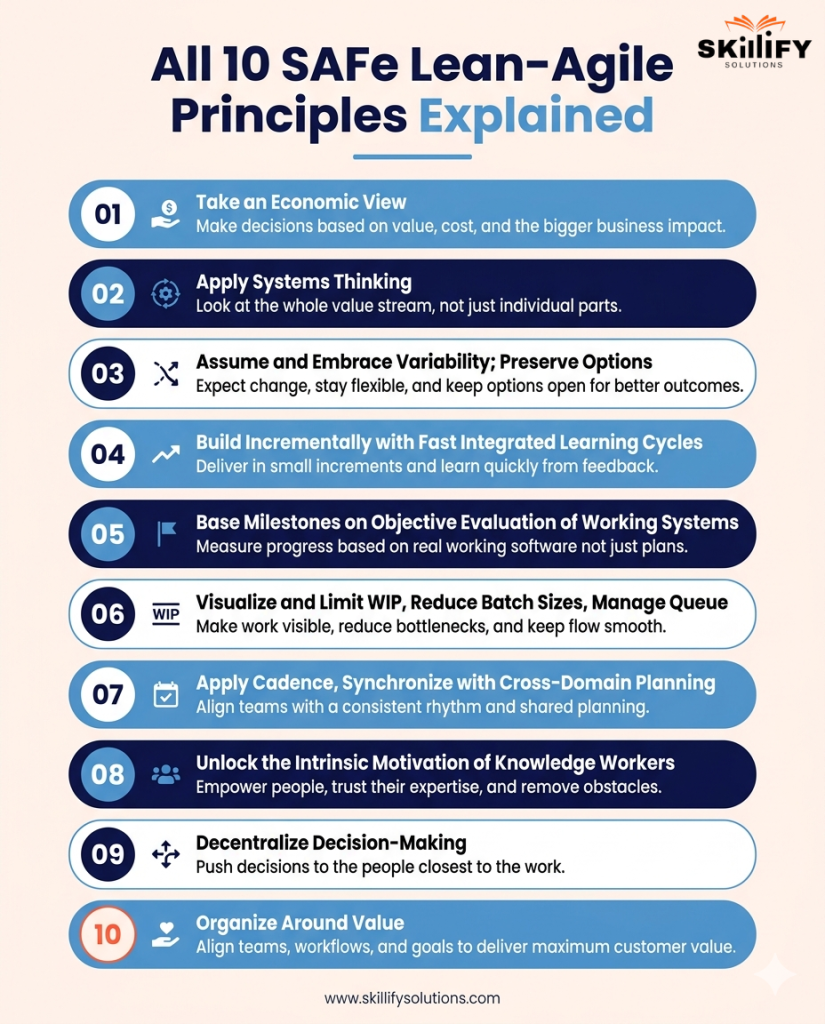
    All 10 SAFe® Lean-Agile Principles Explained  

    Untitled design 61 SAFe® Lean-Agile Principles: All 10 Explained with Real Examples and Exam Tips

    Principle 1: Take an Economic View 

    Concept: This principle focuses on making decisions based on economic impact. Every choice should consider cost, value, risk, and especially the cost of delay. The goal is to maximize business outcomes, not just complete tasks. 

    Practical Example: A team has two tasks: fixing a payment bug affecting customers or building a new feature. Even if the feature is exciting, fixing the bug first makes more economic sense because it directly impacts revenue and customer trust. 

    Exam tip: In prioritization questions, always choose options that maximize value and reduce delay, not just minimize effort. 

    Principle 2: Apply Systems Thinking 

    Concept: Organizations operate as interconnected systems. Improving one part alone is not enough; teams must optimize the entire value stream to improve overall delivery and performance. 

    Practical Example: Even if development is fast, slow testing delays releases. Improving testing flow increases overall system efficiency. 

    Exam Tip: Choose answers that improve the end-to-end system, not just individual team performance. 

    Principle 3: Assume Variability, Preserve Options 

    Concept: Uncertainty is natural in product development. Teams should avoid early decisions and instead keep multiple options open until sufficient information is available. 

    Practical Example: A team explores multiple design approaches before selecting one based on real user feedback. 

    Exam Tip: Select options that delay commitment and allow flexibility, rather than locking decisions too early. 

    Strengthen Scrum Master skills with a focused SAFe 6.0 Advanced Scrum Master Certification today and get hired!

    Principle 4: Build Incrementally with Fast Learning Cycles 

    Concept: Work should be delivered in small increments with continuous feedback. This reduces risk and allows teams to learn and improve quickly. 

    Practical Example: A team releases a basic version of a feature early and improves it based on user feedback. 

    Exam Tip: Look for answers that emphasize small releases, quick feedback, and continuous learning. 

    Principle 5: Base Milestones on Working Systems 

    Concept: Progress should be measured by working systems, not by documentation or plans. Real value is delivered only when solutions are functional and usable. 

    Practical Example: A feature is considered complete only after it is tested and working, not just coded or documented. 

    Exam Tip: Choose answers that prioritize working outcomes over reports or theoretical completion. 

    Principle 6: Limit WIP, Reduce Batch Sizes, Manage Queues 

    Concept: Too much work in progress slows delivery. Limiting WIP and working in smaller batches improves flow, reduces errors, and speeds up completion. 

    Practical Example: A team focuses on finishing a few tasks completely instead of starting many tasks at once. 

    Exam Tip: Select options that promote focus, smaller batches, and smooth workflow, not multitasking. 

    Principle 7: Apply Cadence and Synchronize Planning 

    Concept: Cadence provides a regular work rhythm, while synchronization aligns teams. Together, they improve predictability and coordination across teams. 

    Practical Example: Teams plan together during Program Increment planning, ensuring alignment and early identification of dependencies. 

    Exam Tip: Choose answers that emphasize regular cycles, alignment, and coordinated planning. 

    Principle 8: Unlock Team Motivation 

    Concept: People perform best when they are internally motivated. Providing autonomy, purpose, and ownership leads to higher productivity and better outcomes. 

    Practical Example: Teams are given the freedom to decide how to complete tasks, increasing engagement and accountability. 

    Exam Tip: Avoid micromanagement-based answers. Prefer those that support team empowerment and trust. 

    Principle 9: Decentralize Decision-Making 

    Concept: Decisions should be made by those closest to the work, except for critical strategic decisions. This improves speed and reduces delays. 

    Practical Example: A developer resolves a minor issue without waiting for approvals, avoiding unnecessary delays. 

    Exam Tip: Choose answers where frequent decisions are decentralized, but major decisions remain centralized. 

    Principle 10: Organize Around Value 

    Concept: Teams should be structured around delivering value rather than functions. This ensures faster delivery and better accountability. 

    Practical Example: A cross-functional team handles a feature from development to deployment instead of splitting work across departments. 

    Exam Tip: Select answers that focus on end-to-end value delivery, not siloed team structures. The SAFe 6.0 for Teams (SP) Certification will help you analyze real scenarios and excel in exams. 

    Real-World Application of SAFe® Principles 

    SAFe® principles guide how different roles in an organization make decisions, collaborate, and deliver value in real-world scenarios.  

    For Scrum Masters and Agile Teams 

    Scrum Masters and Agile teams apply SAFe® principles in daily execution. Their focus is on improving flow, reducing bottlenecks, and delivering work incrementally. 

    For example, limiting WIP helps teams finish tasks faster, while incremental delivery ensures continuous feedback. Scrum Masters enable this by removing blockers, improving collaboration, and keeping the team aligned with value delivery. 

    For Product Owners and Product Managers 

    Product Owners and Product Managers use SAFe® principles to make better prioritization and product decisions. Their role is to ensure teams work on what delivers the highest value. 

    Using an economic view, they balance cost, value, and urgency. At the same time, preserving options helps them avoid early decisions and adapt based on feedback. 

    For RTEs and Program Leaders 

    RTEs and program leaders apply SAFe® principles at a system level. They focus on aligning multiple teams, managing dependencies, and ensuring smooth execution. 

    Using systems thinking and cadence, they coordinate planning, maintain alignment, and ensure the entire value stream operates efficiently. These principles are a core part of the overall SAFe Methodology, and guide how teams and organizations operate at scale.

    SAFe® House of Lean  

    Just like a house needs a strong base, SAFe® relies on Lean thinking to ensure sustainable and scalable Agile practices. 

    The Four Pillars of Lean Thinking 

    The House of Lean stands on four key pillars that guide decision-making and execution across teams. 

    1. Respect for People and Culture: Empowering individuals, building trust, and encouraging collaboration  
    2. Flow: Ensuring smooth and continuous delivery of value without delays  
    3. Innovation: Creating space for learning, experimentation, and improvement  
    4. Relentless Improvement: Continuously improving processes, systems, and outcomes 

    To understand how these principles fit into the larger framework, it helps to explore the SAFe Big Picture, which shows how all roles, events, and principles connect.

    The Role of Leadership in SAFe® 

    Leadership forms the base of the House of Lean, which means everything depends on it. Leaders are not just decision-makers; they are responsible for creating an environment where teams can perform at their best. In SAFe®, leaders: 

    • Support teams instead of controlling them  
    • Encourage innovation and learning  
    • Drive alignment between business goals and execution 

    Upgrade your Agile career with industry-relevant SAFe 6.0 Agile Product Management Certification today!

    Common Mistakes Teams Make with SAFe® Principles 

    Even when organizations adopt SAFe®, many teams struggle because they focus on processes instead of principles. These mistakes reduce the effectiveness of SAFe® and limit real business outcomes. 

    Treating SAFe® as Just a Process 

    One of the most common mistakes is treating SAFe® as a checklist of ceremonies and roles instead of a mindset. Teams follow rituals like PI planning and stand-ups, but fail to understand the principles behind them. 

    This leads to mechanical execution without real improvement. SAFe® works best when teams focus on why they are doing something, not just how. This is why focused SAFe Exam Preparation is important, as most questions test your understanding of how these principles work in real scenarios.

    Ignoring the Flow and Cost of Delay 

    Many teams focus only on completing tasks without considering flow efficiency or business impact. They take on too much work or delay high-value tasks, which slows down delivery and reduces value. 

    Ignoring the cost of delay means missing opportunities where faster decisions could have created better outcomes. 

    Misusing Decentralized Decision-Making 

    Decentralization is often misunderstood. Some teams either make every decision without alignment or depend too much on leadership for small decisions. 

    The right approach is balanced; teams should make frequent, local decisions, while critical and strategic decisions remain centralized.

    If you’ve ever gone through certifications like SAFe 6.0 Advanced Scrum Master Certification, you’ll notice one thing. Most questions are not about definitions, but about applying these principles in real situations.

    Certifications, Roles, and Salary Trends in 2026 

    SAFe® certifications are directly linked to specific roles and salary potential. Here’s a clear mapping to help you understand the career impact: 

    Certification Typical Role Average Salary (US) 
    Leading SAFe®Agile Coach or SAFe® Agilist $96,000 – $113,000
    SAFe® Scrum Master Scrum Master $95,000 – $111,000 
    SAFe® POPM Product Owner or Product Manager $75,000 – $150,000 
    SAFe® for TeamsRelease Train Engineer or Program Leader $91,000 – $101,000 

    These roles are in high demand because companies are looking for professionals who can apply SAFe® principles to align teams, improve delivery speed, and drive business outcomes at scale. 

    Conclusion 

    It can be concluded from the above discussion that understanding SAFe® Lean-Agile Principles is the first step toward working effectively in a scaled Agile environment. These principles go beyond theory. They help you handle real challenges like prioritization, delays, and team alignment. 

    If you focus only on processes, things may work for a while. But when you understand the principles behind them, you can adapt, improve, and deliver better results consistently. 

    Whether for exams or real work, keep these principles in mind while making decisions. Over time, they become natural, and that’s when you truly start working the SAFe® way. 

    Gain real SAFe® expertise with practical learning and guided AI-Empowered SAFe 6.0 POPM Certification today!

    Frequently Asked Questions

    1.  Who originally developed the SAFe Lean Agile principles?

    The SAFe® Lean-Agile principles were developed by Dean Leffingwell, the creator of the Scaled Agile Framework (SAFe®), based on Lean, Agile, and product development practices.

    2. Are the SAFe® Lean Agile principles the same across all SAFe® configurations?

    Yes, the 10 SAFe Lean-Agile principles remain the same across all SAFe® configurations. They are the foundation of the entire framework.

    3. How are SAFe® Lean Agile principles different from SAFe® core values?

    SAFe® principles guide decision-making, while SAFe® core values define behavior and culture within teams and organizations.

    4. How much weight do SAFe® Lean Agile principles carry on the Leading SAFe® exam?

    SAFe® principles carry significant weight in the exam, as many questions are scenario-based and test how you apply these principles in real situations.

    5. What is the difference between the Lean Agile mindset and the Lean Agile principles in SAFe?

    The Lean-Agile mindset is the overall way of thinking, while the principles are specific guidelines used to apply that mindset in practice.

  • Scrum Master vs Project Manager Salary (2026): Roles, Pay, and Career Comparison

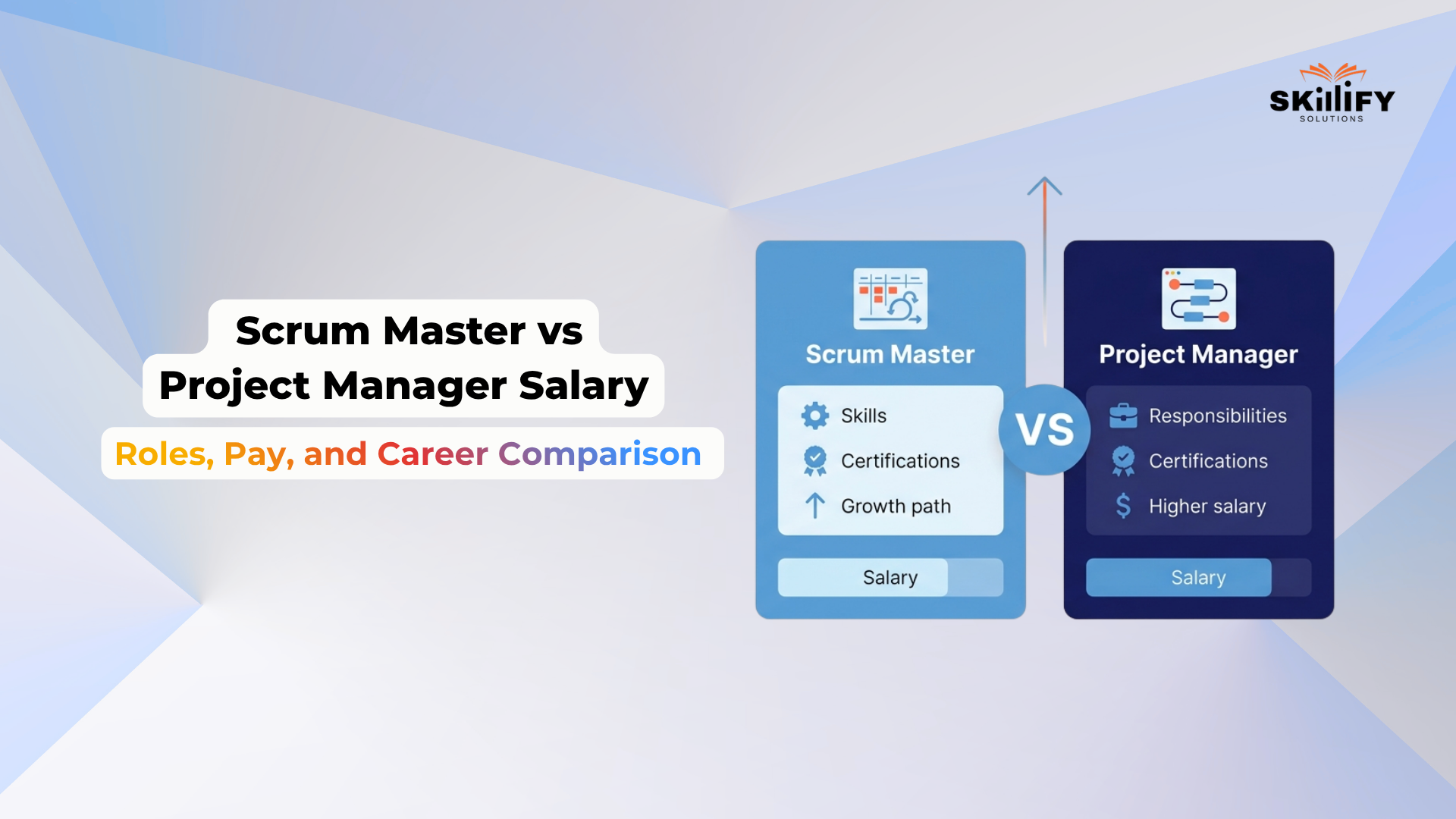
    Scrum Master vs Project Manager Salary (2026): Roles, Pay, and Career Comparison

    As we all know, Agile roles continue to grow rapidly across industries. One of the most common career questions right now is “Should I become a Scrum Master or stay a Project Manager?” 

    On one side, you have Scrum Masters with flexible roles, strong demand in tech, and often a faster entry into high-paying opportunities. On the other hand, Project Managers with structured careers, broader industry scope, and a clear path into leadership roles. 

    But here’s where most people get it wrong. I’ve seen professionals jump into Scrum thinking it’s an easy shortcut to better pay. At the same time, I’ve seen experienced Project Managers who adapted to Agile become incredibly valuable and future-proof in their careers. Please note, this isn’t just a role comparison; it’s about salary and future opportunities.  

    In this blog, we’ll break down Scrum Master vs Project Manager Salary, responsibilities, career growth, certifications, and future demand. In simple terms, you can make a decision based on what fits your skills, goals, and working style. 

    What Does a Scrum Master Do?  

    A Scrum Master helps teams work better, faster, and without confusion. They don’t manage people like bosses. Instead, they guide the team using Agile principles. Their main job is to remove blockers, improve team communication, and make sure work is completed smoothly within timelines. 

    They run daily stand-ups, sprint planning meetings, and reviews. But more importantly, they act like coaches. Scrum masters help the team stay focused, solve problems quickly, and continuously improve how they work.  

    For example, imagine a development team is stuck due to unclear requirements, the Scrum Master gets clarity and helps the team move forward quickly. 

    Many professionals start with a structured learning path like a Scrum Master Bootcamp to build practical Agile understanding and real-world application. 

    What Does a Project Manager Do? 

    A Project Manager is responsible for planning, executing, and completing projects on time and within budget. They handle timelines, resources, budgets, and stakeholder communication. Unlike Scrum Masters, they take more control and make key decisions to ensure the project meets business goals. 

    Even in 2026, Project Management is still a strong career. It gains ground in industries like construction, healthcare, finance, and IT. While Agile roles are growing fast, Project Managers remain important wherever structured planning and execution are required.  

    You can think of it as if building an office; the Project Manager handles budget, timeline, and vendors to ensure everything is completed on time. A SAFe® 6.0 for Teams (SP) Certification can help you excel in meeting deadlines, handling team and get hired easily. 

    Scrum Master vs Project Manager Salary Comparison (2026) 

    Both Scrum Masters and Project Managers are high-paying roles, but their salaries depend on experience, industry, and certifications. Scrum Masters often earn more in Agile-driven tech companies, while Project Managers have broader opportunities across industries. 

    Here’s a quick side-by-side comparison to help you understand how Scrum Master and Project Manager salaries differ across key factors in 2026.  

    Factor Scrum Master Project Manager 
    Avg US Salary $95,000 – $111,000 $92,000 – $117,000 
    Entry Salary $86,000 – $99,000 $62,000 – $76,000 
    Senior-level salary $92,000 – $108,000$117,000 – $136,000
    Global Avg $60,000 – $90,000 $55,000 – $85,000 
    Key Certification SAFe 6.0 Advanced Scrum Master CertificationPMP (Project Management Professional) 
    Career Ceiling Agile Coach, RTE, Delivery Head Senior PM, Program Manager, Director 

    Scrum Master vs Project Manager Salary by Top US Cities 

    Both Scrum Masters and Project Managers earn strong salaries in the US, but the numbers vary based on experience, location, and role responsibilities. Location plays a big role in salary. Tech hubs and high-cost cities typically offer higher compensation. 

    City Scrum MasterProject Manager
    San Francisco, CA $95k – $116k$118k – $150k
    New York, NY $101k – $118k$104k – $162k
    Seattle, WA $105k – $123k$76k – $163k
    Austin, TX $94k – $110k$100k – $161k
    Chicago, IL                                   $98k – $115k$100k – $153k

    Who Earns More: Scrum Master or Project Manager? 

    In most cases, Scrum Masters tend to earn slightly more than Project Managers. It is noticed in tech companies that follow Agile practices. This is because Scrum Masters play a key role in improving team efficiency and delivery speed, which directly impacts business outcomes. 

    However, the gap is not huge. Experienced Project Managers, especially those managing large budgets or multiple projects, can earn just as much or even more than Scrum Masters. 

    In short, both roles pay well. However, your earning potential depends more on experience, certifications, and industry than the title alone. As you grow in this path, understanding the difference between an Agile Coach vs Scrum Master can help you decide your next career move.
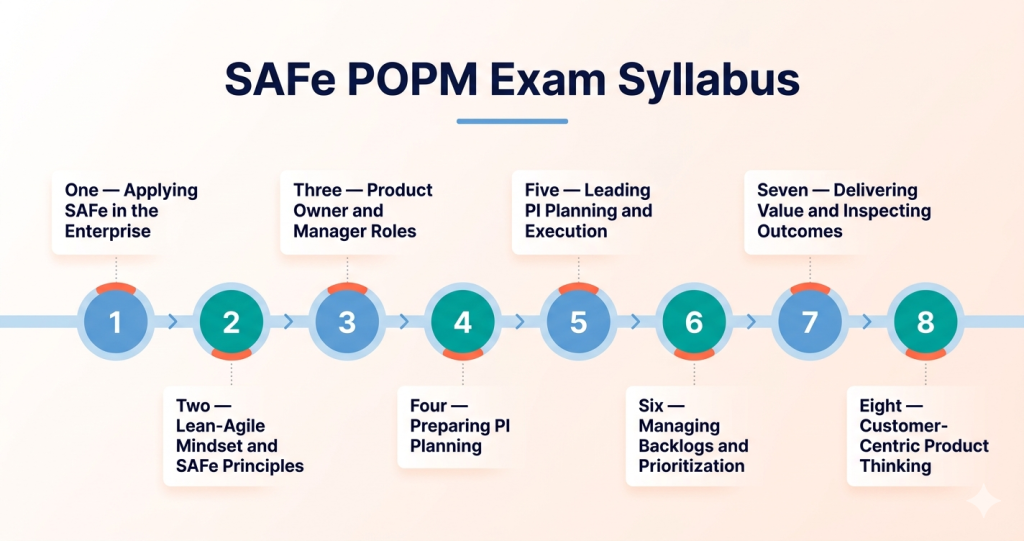
    Build real Agile skills with our industry-focused Scrum Master bootcamp and get hired!

    Scrum Master vs Project Manager: Career Growth Path with 5-Year Outlook 

    Both Scrum Masters and Project Managers offer strong career growth, but the paths are different. Scrum Masters typically grow within Agile and tech environments, moving into coaching and leadership roles. Project Managers, on the other hand, have a broader range of opportunities across industries and can move into senior management positions. 

    Over 5 years, both roles can lead to high-paying leadership positions if supported by the right experience and certifications. 

    Scrum Master Career Path 

    A Scrum Master can grow quickly in Agile environments, especially in tech companies. In the first 1–2 years, they work as a CSM, managing one or two teams, and focusing on Agile practices.  

    image 10 Scrum Master vs Project Manager Salary (2026): Roles, Pay, and Career Comparison

    By years 3–4, they move into Senior Scrum Master or Agile Coach roles, handling multiple teams and improving processes. After 5+ years, they transition into roles like RTE or Delivery Lead, managing large-scale Agile programs. 

    Project Manager Career Path 

    Project Managers follow a structured and stable growth path. In the first 1–2 years, they manage small to mid-size projects, focusing on execution and coordination. By years 3–4, they become Senior PMs, handling larger teams and budgets.  

    image 9 Scrum Master vs Project Manager Salary (2026): Roles, Pay, and Career Comparison

    After 5+ years, they move into Program Manager or Director roles, overseeing multiple projects and driving strategic decisions. To get a clearer picture of growth and opportunities, you can also explore how the Project Manager job market is evolving across industries in 2026.

    Emerging Role: Delivery Manager 

    A Delivery Manager combines the strengths of both roles, Agile execution and project ownership. Their focus is to manage multiple teams, like Scrum Master, and own delivery timelines and outcomes like a Project Manager. The delivery manager works closely with business and technical stakeholders 

    CSM vs PMP Certification: Salary, Cost, and ROI in 2026

    Both CSM (Certified Scrum Master) and PMP (Project Management Professional) are highly valued certifications, but they serve different career paths. CSM is ideal for Agile roles with faster entry, while PMP is suited for structured project management with higher responsibility. 

    Here’s a clear comparison to help you understand cost, effort, and return on investment: 

    Factor Certified Scrum Master        Project Management Professional
    Best For Agile roles like Scrum Master, Agile Coach, etc.Project Managers across industries 
    Cost $300 – $800 $500 – $1,200 
    Duration 2–5 days 2–6 months 
    Eligibility No strict requirements 3–5 years of project experience required 
    Difficulty Level Easy to moderate Moderate to high 
    Average Salary $95K–$110K $90k – $115k
    Global Recognition Good Very high
    ROIHigh High 

    This is where advanced certifications like SAFe (Scaled Agile Framework) become highly valuable, especially for professionals aiming to manage multiple Agile teams at scale. 

    Scrum Master vs Project Manager: Which Career is Right for You?  

    Choosing between a Scrum Master and a Project Manager really comes down to how you like to work and what kind of role excites you more. Both careers are rewarding, but the day-to-day experience is quite different. 

    If you enjoy helping teams improve, working in flexible environments, and guiding rather than controlling, a Scrum Master could be a great fit. If you prefer structured planning, decision-making, and taking ownership of timelines and budgets, Project Management might suit you better. 

    Let’s quickly jot down a few self-assessment questions to help you decide: 

    1. Do you enjoy coaching people more than managing them?  
    2. Are you comfortable working in changing, fast-moving environments?  
    3. Do you like planning timelines, budgets, and handling stakeholders?  
    4. Do you see yourself working beyond tech (like construction, healthcare, etc.)?  
    5. Do you prefer flexibility in work or control over execution?  
    6. Are you open to investing time in certifications like CSM, PMP, or both? 

    If you’re exploring opportunities, it’s also useful to understand the current demand and openings in the Scrum Master job market to see how companies are hiring and what roles are available.

    How to Transition from Project Manager to Scrum Master (Step-by-Step Guide) 

    Moving from Project Manager to Scrum Master is a natural shift for many professionals. You already know how to manage work, coordinate people, and keep delivery on track. The main difference is that a Scrum Master focuses less on control and more on coaching, collaboration, and Agile team support. 

    Scrum Master vs Project Manager Salary

    Here’s a simple step-by-step path to make that transition smoother: 

    1. Learn the basics of Agile and Scrum: Start by understanding Scrum roles, sprint planning, stand-ups, retrospectives, and backlog management.  
    2. Shift your mindset from managing to facilitating: As a Project Manager, you may be used to directing work. As a Scrum Master, your role is to guide the team, remove blockers, and help them improve.  
    3. Get a Scrum certification: A Scrum Master Bootcamp can help validate your skills and make your profile stronger for Agile roles.  
    4. Highlight transferable skills: Your experience in stakeholder communication, risk handling, planning, and team coordination is still valuable. You just need to position it in an Agile context.  
    5. Gain hands-on Scrum exposure: Try working with Agile teams, shadowing Scrum ceremonies, or taking internal Agile responsibilities in your current role.  
    6. Update your resume and LinkedIn profile: Use Agile keywords, mention Scrum-related work, and show how you helped teams deliver better outcomes. 

    Scale your Agile career with industry-recognized SAFe certification training today!

    Is AI Replacing Scrum Masters and Project Managers in 2026? 

    The simple answer to this is no; AI is not replacing these roles. But it is changing them fast. 

    AI is mainly taking over repetitive tasks like reporting, scheduling, and data tracking. In fact, a large portion of routine project work is expected to be automated, allowing professionals to focus on more strategic and human aspects.  

    For Scrum Masters, AI can automate things like stand-up summaries, backlog updates, and performance insights. But real jobs like coaching teams, resolving conflicts, and improving collaboration still need human judgment.  

    For Project Managers, AI helps with better planning, risk prediction, and decision-making. Instead of replacing them, it actually makes them more powerful by giving data-driven insights.  

    It also helps to know what hiring managers actually look for. Understanding What Hiring Managers want in Agile roles can give you a strong edge during interviews.

    Conclusion 

    In the end, both Scrum Master and Project Manager roles offer strong career growth, competitive salaries, and long-term opportunities. The right choice depends on your working style and career goals. 

    If you enjoy guiding teams, adapting to change, and working in Agile environments, a Scrum Master is a great fit. If you prefer structured planning, ownership, and leading projects end-to-end, Project Management is the way to go. 

    There is no wrong choice here, only what suits you better. Focus on building the right skills, gaining experience, and continuously learning, and you can succeed and grow in either path.

    Master Scrum concepts with our Scrum Master Bootcamp training and unlock high-paying Agile career opportunities!

    Frequently Asked Questions

    1. Do you need a computer science degree to become a Scrum Master?

    No, a CS degree is not required. Agile knowledge and communication skills matter more.

    2. Is CSM or PMP better for career growth in the US?

    CSM is ideal for Agile roles, while PMP suits traditional project management. Both offer strong career growth depending on your path.

    3. How long does it take to become a Scrum Master from scratch?

    It usually takes 2–6 months. You need basic Scrum knowledge and a certification like CSM.

    4. Can a Project Manager become an Agile Coach?

    Yes, many Project Managers transition into Agile Coach roles. Agile experience and certifications help accelerate the shift.

  • SAFe® RTE Certification 2026: Cost, Exam, Salary, and ROI Guide

    SAFe® RTE Certification 2026: Cost, Exam, Salary, and ROI Guide

    At some point in your Agile career, doing your job well stops being enough. You’re no longer just managing a team; suddenly, you’re expected to align multiple teams, handle dependencies, unblock delivery, and keep everything moving at scale.

    And that’s where most professionals hit a wall. I’ve seen experienced Scrum Masters and Agile leads struggle here, not because they lack skills, but because they lack a system to manage complexity.

    That’s exactly where SAFe RTE Certification comes in. But here’s the real question: Is it actually worth spending $2,000+, investing your time, and stepping into a much bigger responsibility in 2026?

    In this blog, we’ll cut through the noise and break down the reality. We will discuss the cost, salary, demand, ROI, and whether SAFe® RTE Certification truly helps you move into leadership roles at scale.

    What is SAFe® RTE Certification?  

    SAFe® RTE (Release Train Engineer) Certification is designed for professionals who want to lead Agile execution at scale. It focuses on managing multiple Agile teams working together within an Agile Release Train (ART). It ensures alignment, smooth delivery, and continuous improvement. 

    In simple terms, while roles like Product Owner focus on what to build, an RTE focuses on how everything comes together. It is a leadership role that sits at the center of execution, coordination, and delivery across teams. 

    This certification is not entry-level. It is best suited for professionals who already have experience in Agile environments and want to move into program-level leadership roles. 

    If you’re new to SAFe®, starting with programs like Leading SAFe can help you understand the framework before moving into advanced roles like RTE. 

    image 7 SAFe® RTE Certification 2026: Cost, Exam, Salary, and ROI Guide

    What a Release Train Engineer Does in an Agile Release Train 

    A Release Train Engineer acts as a servant leader and facilitator for the Agile Release Train. Their role is to ensure that multiple teams are aligned, dependencies are managed, and delivery stays on track. 

    In real-world scenarios, an RTE: 

    • Facilitates Program Increment (PI) Planning  
    • Helps teams identify and resolve risks (ROAM process)  
    • Coordinates across teams to remove blockers  
    • Ensures smooth communication between stakeholders and teams  

    Think of an RTE as the person who keeps the entire system running efficiently. Instead of focusing on one team, they ensure that all teams move in the same direction. If you’re new to SAFe®, you have to first understand the basics in this guide on What Is SAFe Certification.

    Who Should Choose RTE vs SPC Certification 

    Choosing between RTE and SPC depends on your career direction. SAFe® RTE is ideal if you want to stay close to execution and manage delivery across multiple teams. It is suited for professionals who enjoy coordination, facilitation, and driving outcomes. 

    On the other hand, SPC (SAFe® Program Consultant) is more focused on training, coaching, and leading Agile transformations at an organizational level.

    If you’re still building your Agile foundation, guides like SAFe POPM Certification can be a better starting point before moving into RTE.

    SAFe® RTE Certification Cost in the US  

    The cost of SAFe RTE certification is significantly higher than most Agile certifications because it is a program-level leadership role. In most cases, you don’t pay separately for the exam; the certification is bundled with the training. 

    Training Cost by Provider  

    The biggest portion of your investment is the training program, which is mandatory before taking the exam. The cost varies depending on the provider, trainer experience, and course features. 

    Provider Type Cost Range (US) What’s Included 
    Standard Training Providers$1000 – $1500Training + exam + study material 
    Mid-Tier Programs $1,500 – $2,500 Instructor-led training + practice tests 
    Premium Providers like Skillify Solutions$300 – $600Advanced coaching, exam support, and real-world case studies 

    Most programs include: 

    • 3-day instructor-led training  
    • First exam attempt  
    • Official study materials  
    • 1-year SAFe® community access 

    Start your SAFe® journey with practical, real-world Scrum Master Bootcamp training today!

    Renewal Fees, Retake Costs, and Hidden Expenses 

    Apart from training, there are a few additional costs that many people overlook. The renewal is mandatory to keep your certification active and maintain access to SAFe® resources and community. 

    Component Cost 
    Exam Attempt (1st) Included in training 
    Exam Retake ~$50 
    Renewal Fee (Annual) ~$295 
    Certification Validity 1 year 

    SAFe® RTE Exam Format, Pass Rate, and Difficulty Level 

    The SAFe® RTE exam is designed to test your ability to handle real-world Agile execution at scale. Unlike basic certifications, it focuses on scenario-based questions where you need to apply concepts, not just recall them. 

    Overall, the exam is considered advanced level, especially for professionals without hands-on experience in Agile environments. 

    Exam Pattern, Duration, and Passing Score 

    Here’s a quick breakdown of the exam format: 

    Parameter Details 
    Total Questions 60 (Multiple Choice) 
    Exam Duration 120 minutes 
    Passing Score 74 – 80%
    Mode Online, web-based 
    Access After completing training 

    The questions are mostly scenario-driven, testing how you would handle situations like team alignment, PI Planning, and dependency management. 

    Most Tested Topics and Common Mistakes 

    The exam focuses heavily on practical execution areas within SAFe®. 

    The most tested topics include: 

    • Program Increment (PI) Planning and facilitation  
    • Managing risks using the ROAM framework  
    • Cross-team coordination and dependency management  
    • Coaching Agile teams and improving flow  

    Here are some of the most common mistakes candidates make: 

    • Relying too much on theory instead of understanding scenarios  
    • Not fully understanding the RTE’s role vs Scrum Master  
    • Ignoring practical aspects like facilitation and communication  
    • Skipping mock tests and real-world examples 

    Master execution at scale with industry-relevant SAFe certification coursesand avoid making mistakes!

    SAFe® RTE Salary in the US  

    SAFe® RTE is one of the highest-paying roles in the SAFe® ecosystem because it operates at a program and leadership level. Unlike roles focused on a single team, RTEs manage execution across multiple teams, which directly impacts business outcomes, and that’s why the compensation is significantly higher. 

    Salary by Industry  

    Salary varies significantly based on the industry you work in, especially in sectors that rely heavily on large-scale Agile execution. 

    Industry Average Salary (US) 
    Financial Services ~$170K – $188K 
    Technology / Software ~$135K – $150K 
    Healthcare / Pharma ~$140K – $165K 
    Telecommunications ~$150K+ 
    Energy & Utilities ~$180K+ 

    Insight: Industries like finance and energy pay more because they operate complex systems with multiple teams, where RTEs play a critical role in coordination and delivery. 

    If you’re already in Agile roles, structured programs like SAFe RTE Certification Training can help you transition into leadership roles faster.

    Top US Companies Hiring SAFe® RTE Professionals 

    The demand for SAFe® RTE professionals is highest in large enterprises and consulting firms that run Agile at scale. 

    image 8 SAFe® RTE Certification 2026: Cost, Exam, Salary, and ROI Guide

    Top hiring companies include: 

    • Cisco  
    • Mastercard  
    • Capital One  
    • Bank of America  
    • AT&T  

    These companies actively hire RTEs because they manage multiple Agile teams, large-scale product systems, and enterprise-level delivery pipelines. To understand how SAFe® RTE works in practice, you can explore these Scaled Agile Framework tools used across teams and programs.

    Is SAFe® RTE Certification Worth It in 2026?  

    SAFe RTE certification is worth it in 2026 for experienced Agile professionals aiming to move into program-level leadership roles. 

    With a $2,000+ investment leading to $130K–$170K+ salary potential, the ROI is strong, but only if you’re working in scaled Agile environments where these skills are applied. 

    When the $2,000+ Investment Makes Sense 

    The investment makes sense when you are already in roles like Scrum Master, Agile Coach, or Program Manager and want to step into a larger leadership position. 

    It is especially valuable if: 

    • You are working in enterprises using SAFe® or planning to move into one  
    • You are managing or coordinating multiple Agile teams  
    • You want to move from team-level execution to program-level leadership  
    • Your organization supports or sponsors certification  

    In these cases, the certification acts as a strong signal of capability and can accelerate your transition into higher-paying roles. 

    Since the investment is $2,000+, choosing the right training provider becomes critical. Programs like Skillify Solutions include real-world case studies and coaching support, which tend to deliver better outcomes.

    When You Should Consider Alternatives 

    SAFe® RTE may not be the right choice if you are early on your Agile journey or still working at a team level. 

    You should consider alternatives if: 

    • You are new to Agile or Scrum  
    • You have not worked in multi-team environments  
    • You are more interested in product roles (PO/PM) rather than execution leadership  
    • You want a lower-cost, entry-level certification  

    In such cases, starting with foundational certifications and gaining experience will give you better long-term value. 

    How to Pass the SAFe® RTE Exam (30-Day Study Plan) 

    The SAFe® RTE exam is about understanding how Agile works at scale and applying it in real scenarios. A structured 30-day plan can help working professionals prepare effectively without overwhelming their schedule. 

    Week-by-Week Plan for Working Professionals 

    Week Focus Area What to Cover 
    Week 1 SAFe® Fundamentals Lean-Agile principles, SAFe® framework, ART structure 
    Week 2 RTE Role and Responsibilities PI Planning, facilitation, coaching teams, ROAM risks 
    Week 3 Execution and Flow Dependency management, metrics, and continuous delivery 
    Week 4 Revision and Practice Mock tests, weak areas, scenario-based questions 

    If you’re preparing for the exam, this SAFe Exam Prep guide can help you understand key topics and avoid common mistakes. These steps can improve your chances of clearing the exam.

    Common Mistakes That Lead to Failure 

    Many candidates struggle not because the exam is difficult, but because of how they prepare for it. 

    Some common mistakes include: 

    • Focusing only on theory instead of real-world scenarios  
    • Not clearly understanding the RTE role vs Scrum Master  
    • Skipping practice tests and mock exams  
    • Underestimating the importance of PI Planning and facilitation 

    Many of these mistakes happen due to a lack of guided preparation. Following a structured SAFe training program helps you focus on practical application rather than just theory.

    SAFe® RTE vs SPC Certification: Which One Should You Choose? 

    Choosing between SAFe® RTE and SPC depends on the kind of role you want to play in an Agile environment. 

    SAFe® RTE (Release Train Engineer) is focused on execution and coordination at scale. It is ideal for professionals who want to manage multiple Agile teams, facilitate Program Increment (PI) Planning, and ensure smooth delivery across an Agile Release Train. 

    SPC (SAFe® Program Consultant), on the other hand, is more about coaching, training, and driving SAFe® adoption across an organization. It is suited for those who want to work as Agile coaches or consultants helping companies implement SAFe®. 

    Factor SAFe® RTE SPC 
    Focus Execution and delivery at scale Coaching and transformation 
    Role Type Program-level leader Consultant or Trainer 
    Best For Scrum Masters, Program Managers Agile Coaches, Consultants 
    Involvement Daily execution with teams Organizational strategy and training 
    Difficulty Advanced Advanced 

    Conclusion 

    At the end of the day, SAFe® RTE is about taking on bigger responsibility, not just earning a certification. It gives you a structured way to manage complexity, align multiple teams, and drive execution at scale. It helps with something many professionals struggle with in real work environments.

    The investment is high, but so are the returns in terms of salary and career growth. However, the certification only makes sense if you are already working in or planning to move into a scaled Agile environment. If your role demands it, SAFe® RTE is a strong career move. If not, it’s better to focus on gaining the right experience first. 

    Build product, Agile, and leadership skills with structured SAFe programs today!

    Frequently Asked Questions

    1. Can I take the SAFe® RTE certification exam without attending the 3-day training?

    No, you cannot take the SAFe® RTE exam directly. Completing the official 3-day instructor-led training is mandatory, as it provides access to the exam and covers all required concepts and frameworks.

    2. Is the SAFe RTE exam open-book or closed-book?

    The SAFe® RTE exam is a closed-book, web-based exam. You are not allowed to refer to any external material, so a strong understanding of concepts and real-world applications is essential to pass.

    3. How many PDUs and SEUs does SAFe® RTE training earn?

    SAFe RTE training typically provides 15–24 PDUs (Professional Development Units) and SEUs (Scrum Education Units). The exact number may vary depending on the training provider and program structure.

    4. Can an experienced Scrum Master skip Leading SAFe® and go directly for RTE?

    Yes, experienced Scrum Masters can go directly for RTE certification. However, having prior knowledge of SAFe® or scaled Agile environments is highly recommended to better understand advanced concepts and responsibilities

    5. Does SAFe® RTE certification qualify me to train others in SAFe®?

    No, SAFe® RTE certification does not allow you to train others. To become an official SAFe® trainer, you need a higher-level certification like SPC (SAFe® Program Consultant), which focuses on coaching and implementation.

  • Is SAFe POPM Certification Worth It in 2026? Salary, ROI, and Honest

    Is SAFe POPM Certification Worth It in 2026? Salary, ROI, and Honest

    Here’s a simple question most people don’t ask before doing a certification: Will this actually change my role or just my resume?

    Because that’s the real difference between spending money and making an investment. I’ve seen professionals stack certifications one after another, hoping something will “click.” But their day-to-day work doesn’t change. Same tasks. Same responsibilities. Same ceiling.

    Then I’ve also seen the opposite: one right certification, applied well, and suddenly they’re part of product discussions, not just execution. That’s where SAFe® POPM comes in.

    It’s often marketed as a high-value Agile certification. But the real value is what the certification enables. The ability to decide what gets built, prioritize work, and align multiple teams around outcomes.

    And in today’s companies, that’s where the real growth is. So in this blog, let’s cut through the noise. We’ll break down the actual ROI, cost vs salary, demand in the US market, and real drawbacks to clear a clear understanding on Is SAFe POPM Certification Worth It. Learn more!

    Key Highlights 

    • High ROI certification with strong demand in product roles  
    • Average salary is ~$120K–$140K after certification  
    • Helps shift from execution roles to product decision-making  
    • Best suited for Agile environments with multiple teams  
    • Cost recovery is possible within 1–2 months with a salary hike 
    • Builds real product thinking skills  
    • Works best with structured training and practical application  

    Is SAFe® POPM Certification Worth It in 2026?  

    Yes, SAFe® POPM certification is worth it in 2026, but only if you’re aiming for product or Agile roles where decision-making matters. Here’s the simple reality. Companies are no longer looking for people who just execute tasks.  

    They want professionals who can prioritize work, align teams, and deliver business value to their business. These are some things most professionals struggle with in real jobs. 

    That’s exactly what SAFe® POPM trains you for. From a number perspective, the ROI is strong. The average SAFe® POPM professional earns around $128K annually, with job demand growing at 20%+ in Agile-driven organizations.  

    But here’s the honest part. The certification alone won’t change your career. Its value comes from how well you apply it. SAFe® is widely used in large organizations with almost 20,000+ companies globally. That is why it creates real opportunities only if you plan to work in such environments. 

    If you’re planning to take this seriously, structured programs like the AI-Empowered SAFe POPM Certification can help you understand concepts faster and apply them in real-world scenarios.

    What SAFe® POPM Certification Means to Hiring Managers 

    For hiring managers, SAFe® POPM certification is a signal that you can operate in complex, real-world product environments. It tells them that you understand how to work across teams, prioritize effectively, and connect business goals with execution. 

    In many organizations, especially those adopting scaled Agile, this certification reduces the risk of hiring someone who only understands theory but cannot handle product-level responsibilities. If you’re new to this, you can first understand the basics in this guide on What is SAFe Certification.

    image 5 Is SAFe POPM Certification Worth It in 2026? Salary, ROI, and Honest

    Skills, Responsibilities, and Credibility 

    When a candidate has SAFe® POPM certification, hiring managers typically associate it with a specific set of capabilities. It signals that you can: 

    • Manage and prioritize product backlogs based on business value  
    • Work closely with stakeholders and Agile teams  
    • Participate in Program Increment (PI) Planning and execution  
    • Think in terms of outcomes, not just tasks  

    More importantly, it shows that you understand how products are built in environments where multiple teams are involved. This adds a level of credibility, especially in roles like Product Owner and Product Manager. 

    Master Agile at scale with structured SAFe 6.0 Advanced Scrum Master Certificationand learn more!

    Demand for SAFe® POPM Professionals in the Job Market  

    The demand for SAFe® POPM-certified professionals has been steadily increasing, particularly in industries like technology, finance, healthcare, and enterprise IT. Companies in the US are actively looking for professionals who can: 

    • Handle product ownership across multiple teams  
    • Align product delivery with business strategy  
    • Drive execution in Agile environments at scale  

    With more organizations moving towards scaled Agile frameworks, this demand is expected to grow further in 2026. You can explore the complete breakdown in this detailed SAFe POPM Certification guide.

    SAFe POPM Cost vs Salary: ROI Breakdown (2026)  

    When you compare the cost of SAFe POPM certification with the salary it unlocks, the ROI is clearly in favor of the investment. Most professionals recover the cost quickly, often within the first few months of switching roles or getting a salary hike. 

    Average Salary of SAFe® POPM Professionals 

    To understand the earning potential, here’s a breakdown of average SAFe® POPM salaries in the US across different experience levels: 

    Role Level Salary Range (US) Average 
    Entry-Level $90K – $100K ~$112K 
    Mid-Level $120K~$130K 
    Senior-Level Up to $150K+ ~$145K 

    How Quickly You Can Recover Your Certification Investment  

    Now let’s look at how the certification cost compares to salary and how quickly you can recover your investment: 

    Factor Value 
    Certification Cost  $383.16
    Average Salary ~$111K – $135K 
    Monthly Salary  $7K – $9K 
    Typical Salary Increase 10% – 20% 
    Recovery Time 1–2 months 

    Career Growth After SAFe® POPM Certification  

    SAFe® POPM certification plays a strong role in accelerating career growth, especially for professionals moving from execution roles to product-focused roles. It helps you shift from “doing tasks” to owning product decisions, which is where real career progression happens. 

    With companies increasingly adopting scaled Agile, certified professionals are often preferred for roles that involve cross-team coordination, backlog ownership, and business alignment. 

    This creates a clear path toward higher responsibility and better compensation. If you’re preparing for the exam, this SAFe Exam Prep guide can help you avoid common mistakes.

    Salary Growth Before vs After Certification  

    One of the biggest advantages of SAFe® POPM is the noticeable salary jump after certification. 

    Category Average Salary (US) 
    Non-certified Product Owner 95K 
    SAFe® POPM Certified Professional ~$135K 
    Lead roles~$130K – $190K 

    Top Companies Hiring SAFe® POPM Professionals in the US  

    The demand for SAFe® POPM professionals is strong across industries that operate at scale and rely heavily on Agile frameworks. These organizations need professionals who can manage products across multiple teams and align execution with business goals. 

     Is SAFe POPM Certification Worth It

    Common hiring sectors are:  

    1. Technology: Product-led companies need strong Product Owners and Managers to handle feature prioritization, roadmap planning, and continuous delivery.  
    2. Banking and Financial Services: Large banks and fintech companies use SAFe® to manage complex systems, regulatory requirements, and multiple teams working on the same product.  
    3. Healthcare and Insurance: With digital transformation increasing, these industries require structured Agile execution to handle large-scale product development.  
    4. Enterprise IT and Consulting: These firms implement SAFe® for clients, creating consistent demand for certified professionals who can work in scaled Agile environments. 

    Examples of companies hiring similar roles are Accenture, Deloitte, JPMorgan Chase, Wells Fargo, and Intel. These companies prefer professionals who can manage products across teams, align with business strategy, and drive execution; all core skills covered in SAFe® POPM. 

    Advance your career with SAFe 6.0 for Teams Certification aligned to industry demand and get hired now!

    Real Drawbacks of SAFe POPM Certification  

    While SAFe® POPM has strong career benefits, it’s important to understand the limitations as well. First, the certification alone does not guarantee a job or salary hike.  

    Hiring managers still look for real experience in product roles. If you don’t apply the concepts in your work, the value remains limited. 

    Second, SAFe® is more relevant for companies working on scale. If you are in a small startup or a non-Agile environment, the direct application may be lower. 

    Third, the cost can feel high for beginners. Without proper guidance, many candidates also struggle with the exam if they rely only on theory. This is why understanding common mistakes, like poor concept clarity or lack of practice, becomes important. 

    SAFe® POPM vs CSPO vs PSM: Cost, Salary, and Career Comparison  

    Choosing the right certification depends on your career stage and goals. Each certification serves a different purpose. 

    Certification Cost Salary Potential Focus Area Best For 
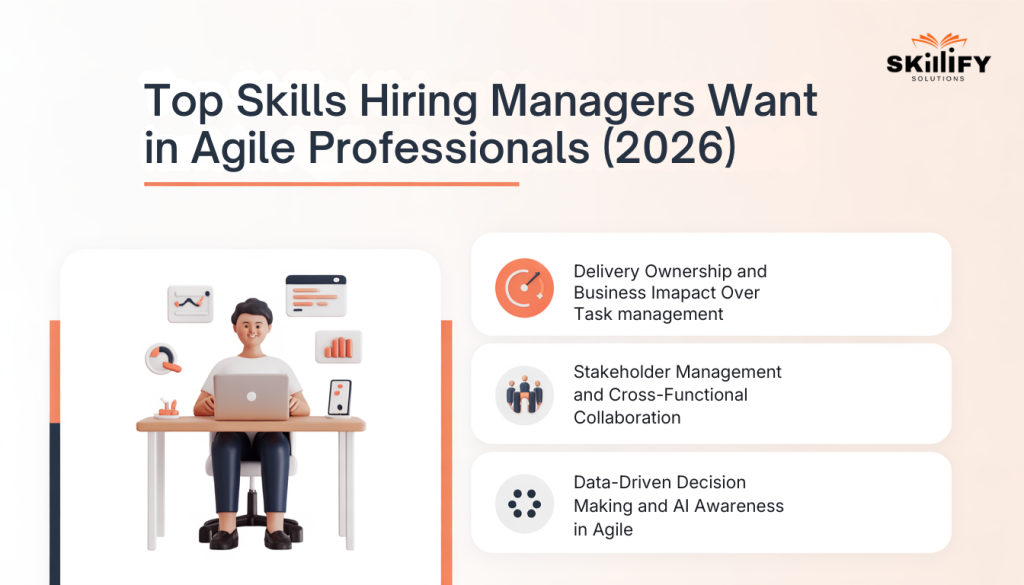
    SAFe POPM $383.16$95K – $111K Product management at scale Product Owners, PMs 
    SAFe 6.0 Advanced Scrum Master $383.16 $111K – $128K Scrum fundamentals Scrum professionals
    SAFe 6.0 SM $383.16$89K – $106K Scrum masteryBeginners 

    SAFe® POPM stands out when you want to work in large organizations with multiple teams. CSPO is better for getting started, while PSM is more focused on Scrum concepts and exam-based validation. 

    If your goal is to move into product roles or scale your current responsibilities, SAFe® POPM offers a more practical and career-aligned path. 

    5 Questions to Ask Before Choosing SAFe® POPM Certification  

    Before investing in the certification, it’s important to evaluate whether it aligns with your career goals. Here are the five questions you can ask yourself: 

    1. Do I want to move into product or decision-making roles?  
    2. Am I working (or planning to work) in an Agile environment at scale?  
    3. Can I apply these concepts in my current or next role?  
    4. Am I ready to invest time in understanding concepts, not just passing the exam?  
    5. Do I have the right training or guidance to prepare effectively?  

    These questions help you avoid common mistakes and ensure that the certification delivers real value, not just a credential. If your answer to most of these is “yes,” then investing in a structured program like the SAFe POPM Certification can help you get there faster.

    Conclusion 

    At the end of the day, SAFe® POPM is not about passing an exam. It’s about understanding how work turns into products, and how products create business impact. 

    If you’re already in Agile or planning to move into product roles, this certification gives you a structured way to think and operate at scale.

    The numbers are salary, demand, and ROI, and all support the decision. The only real question is whether you’re ready to move from execution to ownership. Because that’s the shift SAFe® POPM is designed for. 

    Learn how scaled Agile works with practical, guided SAFe certification coursesby Skillify Solutions today!

    Frequently Asked Questions

    1. Does SAFe POPM certification actually help you get shortlisted in ATS systems?

    Yes. SAFe® POPM is a recognized keyword in Agile/product roles, which can improve ATS visibility and shortlisting chances.

    2. Is SAFe POPM certification valuable without real Agile or SAFe® experience?

    It helps, but its real value comes when combined with practical experience. Without application, the impact is limited.

    3. Does SAFe® POPM certification expire if not renewed, and does it affect job prospects?

    Yes. The certification is valid for 1 year and must be renewed annually to stay active. An active certification helps maintain credibility in the job market.

    4. Can SAFe® POPM certification help you switch from Scrum Master or Business Analyst roles?

    Yes. It is commonly used to transition into Product Owner or Product Manager roles, especially in Agile environments.

  • SAFe® POPM Certification 2026: Complete Beginner’s Guide (Cost, Syllabus, Exam, and Career Benefits)

    SAFe® POPM Certification 2026: Complete Beginner’s Guide (Cost, Syllabus, Exam, and Career Benefits)

    A few years ago, Agile meant daily standups and sprint boards. Today, it means managing multiple teams, aligning business goals, and still delivering on time. That shift is exactly where most people get stuck. 

    I’ve seen smart professionals struggle not because they lack skills, but because they don’t understand how product decisions work at scale. Work keeps moving; tasks get completed, but the bigger question: Are we building the right thing?  Often remains unanswered. 

    That’s where SAFe® POPM starts making sense. It’s not just another certification you add to your resume. It’s a structured way to understand how real companies plan, prioritize, and deliver products when multiple teams and stakeholders are involved. 

    In this blog, I’ll break down everything you need to know. What is SAFe POPM Certification, who it’s for, cost, syllabus, exam format, how to clear it, and most importantly, whether it’s worth your time in 2026. 

    If you’re serious about moving into product roles or growing in Agile environments, this blog will give you a clear, practical understanding. Read on to learn more! 

    SAFe POPM Certification: Key Highlights 

    If you’re exploring a career in Agile product roles, SAFe® POPM is one of the most practical certifications to start with. It focuses on how real businesses manage products on scale. Here’s a quick snapshot of what you need to know: 

    • Globally recognized certification by Scaled Agile Inc.  
    • Focuses on Product Owner and Product Manager roles in Agile at scale  
    • 2-day training of 16 hours and certification exam  
    • Typically includes 1 free exam attempt with training  
    • The exam includes 45 MCQs for 90 minutes  
    • The passing score is approximately 80% 
    • Cost ranges from $500 – $1,499  
    • Covers PI Planning, backlog management, and value delivery  
    • High demand for product, Agile, and enterprise tech roles  
    • Common roles include Product Owner, Product Manager, Agile PM  

    Start your SAFe® journey with structured, practical, real-world focused Leading SAFe Certification today!

    What is SAFe® POPM Certification? 

    SAFe® POPM (Product Owner/Product Manager) Certification is designed to help professionals manage products in a scaled Agile environment. It focuses on how to prioritize work, align with business goals, and deliver continuous value through Agile teams.  

    In simple terms, it teaches you how to connect what the business wants with what the team builds. Unlike basic Scrum certifications, SAFe® POPM goes beyond a single team. It prepares you to work across multiple teams, stakeholders, and timelines. 

    This is how most modern companies operate today. If you’re new to SAFe®, you can first understand the basics in this guide on What is SAFe Certification.

    How SAFe® POPM Fits into the SAFe® Framework 

    Within the SAFe® framework, POPM plays a critical role in execution. It sits between business strategy and development teams, ensuring that the right features are built at the right time. 

    You are involved in key activities like: 

    • Managing and prioritizing the product backlog  
    • Participating in Program Increment (PI) Planning  
    • Collaborating with multiple Agile teams  

    This makes the role highly impactful, as it directly influences both delivery and business outcomes. To understand how teams actually operate, you can explore these Scaled Agile Framework tools used in real environments.

    SAFe® POPM vs CSPO vs SAFe® Agilist: Key Differences Explained 

    CSPO focuses on Scrum at a team level. It is useful if you are just starting in Agile. SAFe® Agilist, on the other hand, is more about leading Agile transformations at an organizational level. 

    SAFe® POPM sits in the middle. It is ideal for professionals who want to work closely with products, manage priorities, and drive execution across teams, not just within one team or at a high leadership level. 

    Certification Focus Area Best For 
    AI-Empowered SAFe 6.0 POPM CertificationProduct management in scaled Agile Product Owners, PMs 
    CSPO Scrum fundamentals Beginners 
    SAFe Agilist Enterprise Agile transformation Leaders, managers 

    Who Should Get SAFe POPM Certified? 

    This certification is best suited for professionals involved in product decisions or seeking to move into product-focused roles. It is especially useful in organizations where multiple teams work together to deliver a single product. 

    Roles That Benefit Most (Product Owners, PMs, Agile Teams) 

    You will benefit the most if you are working as or transitioning into: 

    • Product Owner  
    • Product Manager  
    • Business Analyst  
    • Project Manager moving to Agile  
    • An agile team member involved in delivery  

    These roles require clarity in prioritization, stakeholder alignment, and execution, all of which POPM covers. 

    Eligibility, Prerequisites, and Experience Required 

    There are no strict prerequisites for SAFe POPM Certification, which makes it accessible to a wide range of professionals. However, having a basic understanding of Agile or Scrum can make the learning process smoother. 

    Even if you are new, the structured training format helps you quickly get up to speed. If you’re considering it seriously, a guided program like this can simplify your preparation: 

    SAFe® POPM Certification Cost in 2026  

    The cost of SAFe® POPM certification usually includes both training and exams. Pricing varies based on the training provider, but here’s a quick snapshot to help you understand the typical range: 

    Component US Global 
    Training and Certification $381.26$500 – $1,499 
    Exam Attempt (1st) Included Included 
    Retake Fee ~$50 ~$50 
    Renewal ~$195 $100 – $295 
    Eligibility Basic Agile knowledge neededSame 
    Experience level                 1-3 years in a Product or Agile role Approximately 3 years in an Agile role

    SAFe® POPM Syllabus 2026: Topics & Modules Explained 

    The SAFe® POPM syllabus is designed to give you a practical understanding of how product management works in a scaled Agile environment. Instead of focusing only on theory, it teaches you how to prioritize, plan, and deliver value across multiple teams. 

    what-is-safe-popm-certification

    Key Modules Simplified (SAFe® Principles, PI Planning, Execution) 

    The syllabus is broadly divided into a few core areas that define how products are built in SAFe®: 

    1. Applying SAFe® in the Enterprise: Understand how SAFe® works at an organizational level, including Lean-Agile principles and how teams align with business strategy. 
    2. Lean-Agile Mindset and SAFe® Principles: Focus on the core principles that drive decision-making, prioritization, and continuous improvement in Agile environments. 
    3. Understanding Product Owner and Product Manager Roles: Learn the difference between PO and PM responsibilities, stakeholder collaboration, and ownership of product outcomes. 
    4. Preparing Program Increment (PI) Planning: Understand how work is planned in cycles, how teams align, and how priorities are set before execution begins. 
    5. Leading PI Planning and Execution: Dive into how PI Planning is conducted, how teams commit to work, and how execution is tracked across iterations. 
    6. Managing Backlogs and Prioritization: Learn how to break down features into user stories, prioritize based on value, and continuously refine the backlog. 
    7. Delivering Value and Inspecting Outcomes: Understand how teams deliver value, measure progress, and improve through feedback loops. 
    8. Customer-Centric Product Thinking: Focus on identifying customer needs, defining value, and aligning product decisions with business outcomes.

    Upgrade your career with structured AI-Empowered SAFe 6.0 POPM Certification today!

    What You Actually Need to Study to Pass 

    To clear the exam, you don’t need to memorize everything. The focus should be on understanding how concepts work in real-world scenarios. You should primarily focus on: 

    • SAFe® principles and core values  
    • Roles and responsibilities (PO vs PM)  
    • PI Planning flow and events  
    • Backlog prioritization techniques  
    • Key SAFe® events and terminology  

    Most candidates find preparation easier when they follow a structured learning path. If you’re preparing seriously, the AI-Empowered SAFe POPM Certification helps you focus only on what matters for both the exam and real-world use: 

    SAFe® POPM Exam Format, Questions, and Passing Score 

    The SAFe® POPM exam is designed to test your practical understanding of product management in a scaled Agile environment. It focuses more on concepts, scenarios, and decision-making rather than deep theoretical knowledge. 

    Exam Structure, Duration & Passing Criteria 

    The exam follows a straightforward multiple-choice format and is typically taken online after completing the training. The questions are mostly scenario-based, testing how well you understand roles, prioritization, and SAFe® events like PI Planning. 

    Parameter Details 
    Total Questions 45 (Multiple Choice) 
    Exam Duration 90 minutes 
    Passing Score 74% (approx. 33 correct answers) 
    Mode Online, web-based exam 
    Access Unlocked after completing training 

    Retake Policy and Difficulty Level (Beginner to Intermediate) 

    The first exam attempt is usually included in your training program. If you don’t pass the first try, you can retake the exam by paying an additional fee (around $50). 

    In terms of difficulty, the exam is considered beginner to intermediate. It is not very technical, but it requires clarity on concepts and how they are applied in real situations. 

    Most candidates find the exam manageable if they: 

    • Understand key SAFe® concepts clearly  
    • Focus on roles and responsibilities  
    • Go through practice questions 

    How to Pass the SAFe® POPM Exam on First Attempt 

    Passing the SAFe® POPM exam on the first attempt is more about clarity than hard preparation. The exam focuses on how well you understand concepts and apply them in real scenarios, not how much you memorize. 

    3–5 Day Study Plan for Beginners 

    If you follow a structured approach and focus on the right topics, 3–5 days of focused preparation are usually enough. 

    Day Focus Area What to Cover 
    Day 1 SAFe® Basics SAFe® principles, Lean-Agile mindset, framework overview 
    Day 2 Roles and Responsibilities Product Owner vs Product Manager, stakeholder collaboration, backlog ownership 
    Day 3 PI Planning and Events Program Increment (PI) Planning, SAFe® events, team alignment 
    Day 4 Backlog and Value Delivery Prioritization techniques, user stories, value delivery concepts 
    Day 5 Revision and Mock Tests Practice tests, weak areas, and quick revision of key concepts 

    Best Mock Tests, Practice Questions & Study Resources 

    The most effective way to prepare is to combine official material with practice questions. The exam is scenario-based, so practicing helps you understand how questions are framed. 

    You can rely on the official SAFe learning material provided during training. Practice exams and mock tests are helpful. Get notes and summaries from your training sessions. Most importantly, following a structured training program ensures you don’t waste time on unnecessary topics. 

    If you want guided preparation aligned with the exam, you can explore  

    Career Benefits of SAFe® POPM Certification in 2026 

    SAFe® POPM certification directly impacts your career by positioning you in high-demand product roles. As more companies adopt Agile at scale, the need for professionals who can connect business goals with execution is growing rapidly. Many organizations, especially in tech, banking, and enterprise IT, actively prefer SAFe® certified professionals for product roles. 

    Job Roles, Demand, and Salary Range in 2026

    After earning SAFe® POPM certification, professionals typically move into roles involving product ownership and strategic execution. 

    Role Average US Salary Average Global Salary Demand Level 
    Product Owner $111 – $135K $120K – $180KHigh 
    Product Manager $77K – $160K $90K – $150KVery High 
    Agile Project Manager $91K – $115K $95K – $140KHigh 
    Business Analyst (Agile) $85K – $106K $70K – $120KModerate to High 

    Many professionals evaluate ROI before choosing it. That is why this guide on Is SAFe POPM Certification Worth It covers that in detail. 

    How to Get SAFe® POPM Certified in 2026 

    Getting SAFe® POPM certified is quite structured. Unlike some certifications, where you can register directly for an exam, SAFe® requires you to complete an authorized training program first. The typical flow is simple: 

    1. Enroll in a SAFe POPM training Program  
    2. Attend the 2-day session  
    3. Get access to study material and the exam portal  
    4. Attempt the certification exam 

    What to Expect from the 2-Day POPM Training 

    The 2-day training is designed to be practical and application-focused. Instead of just covering theory, it helps you understand how product decisions are made in a scaled Agile setup. 

    You’ll learn how to manage backlogs, prioritize features, and work closely with Agile teams during Program Increment (PI) Planning. There is also a strong focus on customer-centric thinking and delivering value continuously. 

    Most programs include instructor-led sessions, real-world examples, and guidance around the exam. By the end of the training, you are not just prepared for the certification but also more confident about handling product responsibilities in real work environments. 

    What to Do After POPM: Next Certifications and Career Path 

    Once you complete SAFe® POPM, the next step depends on your career direction. If you want to go deeper into product and Agile, try SAFe® Advanced Scrum Master (SASM) and SAFe® Agile Product Management (APM).  

    However, if you are moving towards leadership roles, SAFe® Agilist (SA) or SAFe Lean Portfolio Management (LPM) will work well. If you’re planning to take this certification, the AI-Empowered SAFe® POPM Certification Training offers a structured way to understand concepts, prepare for the exam, and apply them in real-world scenarios. 

    Conclusion 

    At some point in your career, doing tasks well is not enough. You need to understand what to build, why it matters, and how it fits into the bigger picture. That’s exactly what SAFe® POPM helps you achieve.

    It gives you clarity, structure, and a way to operate in complex product environments. Whether you’re transitioning into product roles or scaling your current responsibilities, this certification can open the right doors.  

    The key is to approach it with the right mindset, not just to pass the exam, but to understand how products are built in real-world scenarios. If you’re planning to grow in Agile environments or move into product management, SAFe® POPM is a strong step forward.  

    Learn, apply, and grow with industry-aligned SAFe 6.0 SM Certification and learn how teams are actually built!

    Frequently Asked Questions

    1. How long does it take to get SAFe® POPM certified?

    You can get certified within 3-7 days. The training is usually 2 days, followed by exam preparation and the certification test.

    2. Can a non-technical professional get SAFe® POPM certified?

    Yes. SAFe® POPM is not technical. It is designed for product, business, and management roles, so non-technical professionals can easily take it.

    3. What is the difference between SAFe® POPM and CSPO?

    SAFe POPM focuses on product management at scale (multiple teams), while CSPO focuses on Scrum at a single team level.

    4. What happens after I pass the SAFe® POPM exam?

    You receive your official certification from Scaled Agile Inc., get a digital badge, and access to the SAFe® community for 1 year.

  • What Hiring Managers Look for in Agile Roles (2026): Real Hiring Insights & Trends

    What Hiring Managers Look for in Agile Roles (2026): Real Hiring Insights & Trends

    A few months ago, during a hiring discussion, one thing became very clear. Most Agile candidates sound the same. Same certifications. Same tools. Same answers. 

    But only a few stand out in this role in 2026. Did you know that the hiring managers today are not impressed by what you know? However, they care more about what you have done.  

    Agile in 2026 has changed. It’s no longer about following frameworks perfectly. It’s about driving outcomes, handling complexity, and showing real impact.  

    Running ceremonies, updating Jira, following Scrum, that’s expected. It doesn’t make you stand out anymore. What matters now is delivery, ownership, and results. 

    If you’re wondering why you’re not getting shortlisted or why others are getting ahead, this blog will give you a clear answer. In this blog, we will break down what hiring managers want in agile roles in 2026 and how you can align yourself before it’s too late. 

    Agile Hiring Trends in 2026 

    Agile hiring in 2026 has shifted from process execution to business impact. Companies are no longer hiring people just to run stand-ups or follow frameworks. They want professionals who can deliver outcomes, improve speed, and show measurable results. 

    Across the US and global markets, Agile is now being used beyond IT. It has its place in marketing, operations, finance, and even HR teams. That means hiring managers are looking for multi-skilled, business-aware professionals, not just framework experts. 

    How Agile Roles Are Evolving Across Industries 

    In 2026, Agile is becoming a core operating model across industries. You’ll now find Agile roles in: 

    • Manufacturing for process optimization, workforce planning
    • Healthcare for faster service delivery, system improvements
    • Finance, as in compliance and speed balance
    • HR includes people ops, hiring workflows, and others

    Here are the key shifts happening: 

    • Agile is merging with DevOps, OKRs, and data systems  
    • Remote work has made communication and alignment skills critical  
    • Visibility of work, like tracking, reporting, and outcomes, is now expected 

    Demand Shift: From Process-Focused to Outcome-Driven Hiring 

    This is the biggest change in Agile hiring. Companies no longer care how perfectly you follow Agile frameworks or how many ceremonies you run. What truly matters is the results you’ve delivered using Agile. 

    Earlier, hiring managers focused heavily on Scrum knowledge, certifications, and how well candidates followed Agile rituals. Today, that’s just the baseline, not the differentiator. 

    Let’s see the new hiring focus: 

    • What did you improve? 
    • What impact did your work have?  
    • Can you own outcomes, not just tasks? 

    This is exactly why many professionals are now moving toward practical, outcome-driven training programs like Scrum Master Bootcamp, which focus on real execution, not just theory.

    Top Skills Hiring Managers Want in Agile Professionals (2026) 

    In 2026, Agile hiring is focused on one thing: impact over activity. It’s no longer enough to manage boards or run ceremonies. Hiring managers want professionals who can own delivery, align teams, and use data to improve outcomes. 

    what hiring managers want in agile roles

    Delivery Ownership and Business Impact Over Task Management 

    Today, Agile professionals are expected to take end-to-end ownership of delivery. It’s about ensuring work actually gets completed on time and creates value for the business. 

    Earlier, roles were centered around sprint management and process adherence. Now, hiring managers are looking for people who can connect Agile work to real outcomes like faster delivery, cost savings, or improved efficiency. 

    Stakeholder Management and Cross-Functional Collaboration 

    Agile today operates across teams, not within them. That’s why stakeholder management has become a core requirement. 

    Professionals are expected to work with multiple functions, like product, tech, and business, and ensure everyone is aligned. Most delays now come from miscommunication and dependency issues, not execution. 

    Data-Driven Decision Making and AI Awareness in Agile 

    Agile in 2026 is becoming more data-driven and AI-supported. Decisions are expected to be backed by metrics, not assumptions. 

    Hiring managers now look for professionals who can read data, identify bottlenecks, and improve performance. Basic awareness of AI tools is also becoming important as teams increasingly rely on automation for planning and execution. 

    Learn from the SAFe® 6.0 Agile Product Management Certificationand upgrade your Agile career with skills that truly matter in 2026!

    Role-Based Expectations: Scrum Masters, Project Managers & Agile Coaches 

    In 2026, Agile roles may sound similar. But hiring managers clearly differentiate them based on scope, ownership, and business impact. It’s no longer about titles; it’s about what you drive and how far your impact goes. 

    What Hiring Managers Expect from Each Agile Role 

    Each role now comes with sharper expectations tied to delivery and business value. 

    Scrum Masters are expected to go beyond running ceremonies and actively improve team performance and delivery consistency. They are seen as enablers who remove blockers and ensure predictable execution. 

    Project Managers are expected to own delivery end-to-end, manage timelines, risks, and stakeholder expectations, while ensuring projects contribute to business goals. 

    Agile Coaches are expected to operate at a higher level. It drives Agile maturity across teams and aligns Agile practices with organizational strategy. If you’re aiming for these roles, it’s important to train based on role expectations. If you’re confused about which role fits you better, understanding the difference between Agile Coach vs Scrum Master can help you choose the right career path.

    Key Differences in Responsibilities and Impact Areas 

    The key difference between these roles lies in how wide and how deep their impact is. 

    • Scrum Masters focus on team-level efficiency and consistency  
    • Project Managers focus on project-level delivery and results  
    • Agile Coaches focus on organization-level alignment and transformation 

    As you move from Scrum Master to PM to Agile Coach, the expectation shifts from: 

    Execution → Ownership → Strategic influence 

    Essential Agile Tools and Technologies in Demand 

    In 2026, Agile tools are central to execution, visibility, and decision-making. Hiring managers expect professionals to be comfortable with tools because they directly impact delivery speed, collaboration, and reporting. 

    It’s not about knowing every feature, but about using tools to drive outcomes, not just updating status. 

    Core Tools: Jira, Azure DevOps, and Agile Tracking Platforms 

    Tools like Jira and Azure DevOps are now standard across most Agile teams. They help manage workflows, track progress, and create visibility across projects. But what really matters is how effectively you use them to drive outcomes. 

    Area What They Expect What Stands Out Tools Commonly Used 
    Task Management Updating tickets and managing boards Structuring workflows for efficiency Jira, Azure DevOps 
    Reporting Basic dashboards Using data to identify delays and improve delivery Jira dashboards, Power BI 
    Collaboration Assigning tasks Driving alignment across teams using tools Slack, Microsoft Teams 
    Execution Tracking progress Ensuring predictable and timely delivery Azure DevOps, Jira 

    Why Tool Expertise Matters More Than Ever in 2026 

    With distributed teams and faster delivery expectations, tools have become the single source of truth for Agile execution. Hiring managers rely on them to understand performance, identify bottlenecks, and ensure accountability. 

    Why is tool expertise critical today? 

    • Improves visibility across teams and stakeholders  
    • Enables faster, data-driven decisions  
    • Helps identify and fix delivery gaps early  
    • Supports automation and AI-driven insights 

    Programs likeSAFe® 6.0 Agile Product Management Certification can help bridge the gap between role theory and real execution.

    Why Agile Candidates Get Rejected in Interviews 

    In 2026, most Agile interview rejections come down to one core issue. It can be a lack of real, demonstrated impact. Many candidates know the theory, have certifications, and understand frameworks, but struggle to show how they’ve improved delivery or solved business problems. 

    Lack of Real-World Experience and Measurable Results 

    One of the biggest reasons candidates get rejected is the inability to show measurable outcomes from their work. Saying you manage sprints or handled ceremonies is no longer enough. 

    Interviewers expect clear examples of impact and improvement, how your work changed something in the team or business. 

    What candidates often say: 

    • I handled daily stand-ups and sprint planning
    • I managed the backlog and coordinated with teams
    • What hiring managers want to hear: 
    • Improved sprint completion rate from 65% to 90%
    • Reduced delivery delays by 30% through better planning
    • Resolved cross-team blockers to speed up releases.

    Over-Reliance on Certifications Without Practical Application 

    Certifications still matter, but only as a starting point, not proof of capability. Many candidates rely heavily on certifications without demonstrating how they’ve applied that knowledge in real scenarios. Hiring managers now see certifications as validation of knowledge, not validation of skill 

    The problem arises when candidates: 

    • Talk only about frameworks and theory  
    • Cannot explain the real challenges they’ve handled  
    • Fail to connect certification learning with actual outcomes  

    What works better: 

    • Showing how you applied Agile principles in real projects  
    • Explaining decisions, trade-offs, and results  
    • Demonstrating learning through execution, not just exams 

    Transform your Agile career with practical, job-ready skills that matter with our SAFe® 6.0 Scrum MasterTraining!

    Agile Certifications vs Real Skills: What Hiring Managers Value More 

    In 2026, Agile certifications still hold value, but they are no longer enough to get you hired. Hiring managers see certifications as proof that you understand concepts, not proof that you can deliver results. 

    What really differentiates candidates today is how well they apply those concepts in real-world situations. The focus has clearly shifted toward execution, problem-solving, and measurable impact. 

    Most hiring managers now evaluate candidates based on: 

    • How they handled real delivery challenges  
    • What improvements did they drive in teams or projects  
    • Whether they can connect Agile practices to business outcomes 
    Aspect Certifications Real Skills 
    Focus Theory and frameworks Execution and outcomes 
    Validation Exams and knowledge Real-world impact 
    Interview Value Entry-level credibility Decision-making factor 
    Differentiation Common among candidates Rare and high value 

    A candidate with multiple certifications, but no clear examples of impact, will often lose to someone with fewer certifications, but strong execution stories and measurable results. 

    How to Align Your Profile with Agile Hiring Expectations 

    In 2026, aligning your profile with Agile hiring expectations is about one thing: showing clear, measurable impact. It’s not enough to list responsibilities or tools. Your profile should reflect what you improved, delivered, and influenced. 

    Building a Results-Driven Agile Resume 

    A strong Agile resume today focuses on outcomes, not activities. Instead of listing tasks, you need to highlight results backed by numbers or clear improvements. 

    Keep your resume simple, but outcome-focused. Every role should answer: what changed because of you? 

    Weak Resume Statements Strong Resume Statements 
    Managed sprint planning and stand-ups Improved sprint delivery rate from 70% to 90% 
    Coordinated with cross-functional teams Reduced cross-team delays by aligning stakeholders 
    Worked on backlog management Increased team velocity by optimizing backlog prioritization 

    What makes a resume stand out: 

    • Measurable impact like %, time saved, efficiency gained 
    • Clear ownership of delivery or improvements  
    • Real examples of problem-solving 

    Demonstrating Real Impact in Interviews 

    Hiring managers in 2026 want to see how you’ve applied them in real situations and what results you created. The best way to answer is by keeping a simple flow:  

    Problem → Action → Result.  

    Instead of explaining processes or listing ceremonies, focus on the decisions you made and the outcomes you achieved. 

    For example, saying that you had delays due to dependency issues, so you realigned teams and reduced delays by 25%, or our sprint commitments were inconsistent, so I improved planning and increased delivery predictability, clearly shows impact.  

    On the other hand, statements like I followed Scrum practices and conducted ceremonies don’t demonstrate real value. Many professionals improve this gap through guided learning and mock interviews offered inSAFe® 6.0 Scrum Master training,  designed specifically for hiring success

    Agile Salary Trends and Job Demand in 2026 

    Agile roles continue to see strong demand and competitive salaries in 2026, driven by digital transformation and the need for faster, outcome-driven execution. Companies are investing in Agile talent not just for process adoption, but for improving delivery speed, efficiency, and business performance. 

    Region Average Salary Top Range 
    US $100K–$115K $135K+ 
    India ₹8–₹23 LPA ₹40–₹50 LPA 
    UK £40K–£64K £79K+ 

    Demand for Agile professionals remains consistently high as companies expand Agile beyond IT into operations, marketing, and business functions. The role is about helping organizations adapt quickly and deliver value continuously. 

    Hiring trends show a clear preference for professionals who can work across teams, handle complexity, and drive outcomes. Companies are also moving toward skill-based hiring, where real impact matters more than years of experience or certifications. 

    Key demand drivers: 

    • Need for faster product and service delivery  
    • Growth of cross-functional and remote teams  
    • Increasing focus on measurable business outcomes 

    If you’re specifically exploring opportunities in this space, understanding current trends in Scrum Master jobs can give you better clarity on demand and expectations.

    How Skillify Helps You Get Hired in Agile Roles 

    Skillify Solutions is designed not just to teach Agile concepts, but to make you job-ready with real, measurable skills. In a market where hiring managers prioritize execution over theory, Skillify focuses on helping you build practical experience, confidence, and interview readiness. 

    Unlike traditional courses that end with certification, Skillify serves as a comprehensive career accelerator, covering everything from learning to placement. 

    What makes Skillify different: 

    • Hands-on learning with real projects so you can show actual impact  
    • 1:1 mentorship from industry experts to guide your career decisions  
    • Resume optimization and interview preparation tailored to Agile roles  
    • Globally recognized certifications, including SAFe®, that add credibility  
    • Placement support and career coaching until you land a role  

    Skillify reports that learners see 30-40% average salary growth and strong placement outcomes, highlighting its focus on results, not just learning. This shift also aligns with broader hiring trends, where companies are prioritizing skills over traditional qualifications, similar to what we see in top degrees in demand for the future.

    Conclusion 

    If there’s one thing to take away from this, it’s simple. Agile roles have evolved, and so should you. Hiring managers are no longer impressed by processes or titles. They want to see what you’ve delivered and how you’ve made a difference. 

    The gap between average and high-impact candidates is only growing. The good part? You can bridge it by focusing on real skills, ownership, and outcomes. Start thinking beyond frameworks, and start proving your value. Remember, in 2026, it’s not about knowing Agile, it’s about making Agile work.

    Get job-ready with Agile skills that actually drive business impact with  Scrum Master Bootcamp today!

    Frequently Asked Questions

    1. Do hiring managers still value Agile certifications in the AI era?

    Yes, Certifications like Scrum Master Bootcamp show you understand Agile, but hiring managers now focus more on how you apply it in real work.

    2. How can I stand out in Agile interviews when everyone has certifications?

    By showing real results and impact. Talk about what you improved, problems you solved, and outcomes you delivered, not just processes you followed.

    3. What skills will be most future-proof in Agile careers?

    Skills like delivery ownership, stakeholder management, and data-driven decision-making will stay relevant. Also, basic AI awareness and adaptability will be important going forward.