 Skip to content
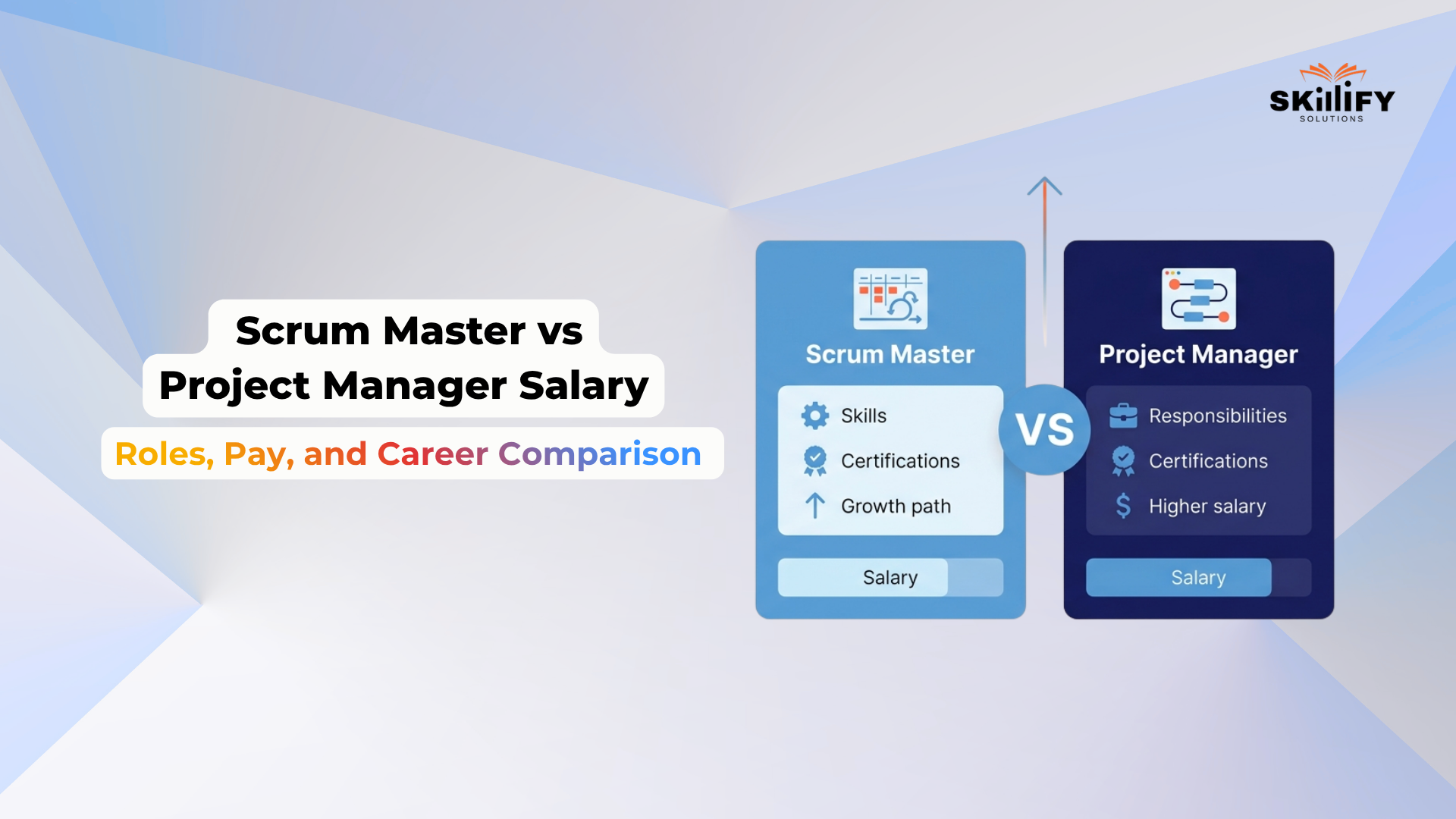
As we all know, Agile roles continue to grow rapidly across industries. One of the most common career questions right now is “Should I become a Scrum Master or stay a Project Manager?”
On one side, you have Scrum Masters with flexible roles, strong demand in tech, and often a faster entry into high-paying opportunities. On the other hand, Project Managers with structured careers, broader industry scope, and a clear path into leadership roles.
But here’s where most people get it wrong. I’ve seen professionals jump into Scrum thinking it’s an easy shortcut to better pay. At the same time, I’ve seen experienced Project Managers who adapted to Agile become incredibly valuable and future-proof in their careers. Please note, this isn’t just a role comparison; it’s about salary and future opportunities.
In this blog, we’ll break down Scrum Master vs Project Manager Salary, responsibilities, career growth, certifications, and future demand. In simple terms, you can make a decision based on what fits your skills, goals, and working style.
What Does a Scrum Master Do?
A Scrum Master helps teams work better, faster, and without confusion. They don’t manage people like bosses. Instead, they guide the team using Agile principles. Their main job is to remove blockers, improve team communication, and make sure work is completed smoothly within timelines.
They run daily stand-ups, sprint planning meetings, and reviews. But more importantly, they act like coaches. Scrum masters help the team stay focused, solve problems quickly, and continuously improve how they work.
For example, imagine a development team is stuck due to unclear requirements, the Scrum Master gets clarity and helps the team move forward quickly.
Many professionals start with a structured learning path like a Scrum Master Bootcamp to build practical Agile understanding and real-world application.
What Does a Project Manager Do?
A Project Manager is responsible for planning, executing, and completing projects on time and within budget. They handle timelines, resources, budgets, and stakeholder communication. Unlike Scrum Masters, they take more control and make key decisions to ensure the project meets business goals.
Even in 2026, Project Management is still a strong career. It gains ground in industries like construction, healthcare, finance, and IT. While Agile roles are growing fast, Project Managers remain important wherever structured planning and execution are required.
You can think of it as if building an office; the Project Manager handles budget, timeline, and vendors to ensure everything is completed on time. A SAFe® 6.0 for Teams (SP) Certification can help you excel in meeting deadlines, handling team and get hired easily.
Scrum Master vs Project Manager Salary Comparison (2026)
Both Scrum Masters and Project Managers are high-paying roles, but their salaries depend on experience, industry, and certifications. Scrum Masters often earn more in Agile-driven tech companies, while Project Managers have broader opportunities across industries.
Here’s a quick side-by-side comparison to help you understand how Scrum Master and Project Manager salaries differ across key factors in 2026.
| Factor | Scrum Master | Project Manager |
| Avg US Salary | $95,000 – $111,000 | $92,000 – $117,000 |
| Entry Salary | $86,000 – $99,000 | $62,000 – $76,000 |
| Senior-level salary | $92,000 – $108,000 | $117,000 – $136,000 |
| Global Avg | $60,000 – $90,000 | $55,000 – $85,000 |
| Key Certification | SAFe 6.0 Advanced Scrum Master Certification | PMP (Project Management Professional) |
| Career Ceiling | Agile Coach, RTE, Delivery Head | Senior PM, Program Manager, Director |
Scrum Master vs Project Manager Salary by Top US Cities
Both Scrum Masters and Project Managers earn strong salaries in the US, but the numbers vary based on experience, location, and role responsibilities. Location plays a big role in salary. Tech hubs and high-cost cities typically offer higher compensation.
| City | Scrum Master | Project Manager |
| San Francisco, CA | $95k – $116k | $118k – $150k |
| New York, NY | $101k – $118k | $104k – $162k |
| Seattle, WA | $105k – $123k | $76k – $163k |
| Austin, TX | $94k – $110k | $100k – $161k |
| Chicago, IL | $98k – $115k | $100k – $153k |
Who Earns More: Scrum Master or Project Manager?
In most cases, Scrum Masters tend to earn slightly more than Project Managers. It is noticed in tech companies that follow Agile practices. This is because Scrum Masters play a key role in improving team efficiency and delivery speed, which directly impacts business outcomes.
However, the gap is not huge. Experienced Project Managers, especially those managing large budgets or multiple projects, can earn just as much or even more than Scrum Masters.
In short, both roles pay well. However, your earning potential depends more on experience, certifications, and industry than the title alone. As you grow in this path, understanding the difference between an Agile Coach vs Scrum Master can help you decide your next career move.
Build real Agile skills with our industry-focused Scrum Master bootcamp and get hired!
Scrum Master vs Project Manager: Career Growth Path with 5-Year Outlook
Both Scrum Masters and Project Managers offer strong career growth, but the paths are different. Scrum Masters typically grow within Agile and tech environments, moving into coaching and leadership roles. Project Managers, on the other hand, have a broader range of opportunities across industries and can move into senior management positions.
Over 5 years, both roles can lead to high-paying leadership positions if supported by the right experience and certifications.
Scrum Master Career Path
A Scrum Master can grow quickly in Agile environments, especially in tech companies. In the first 1–2 years, they work as a CSM, managing one or two teams, and focusing on Agile practices.
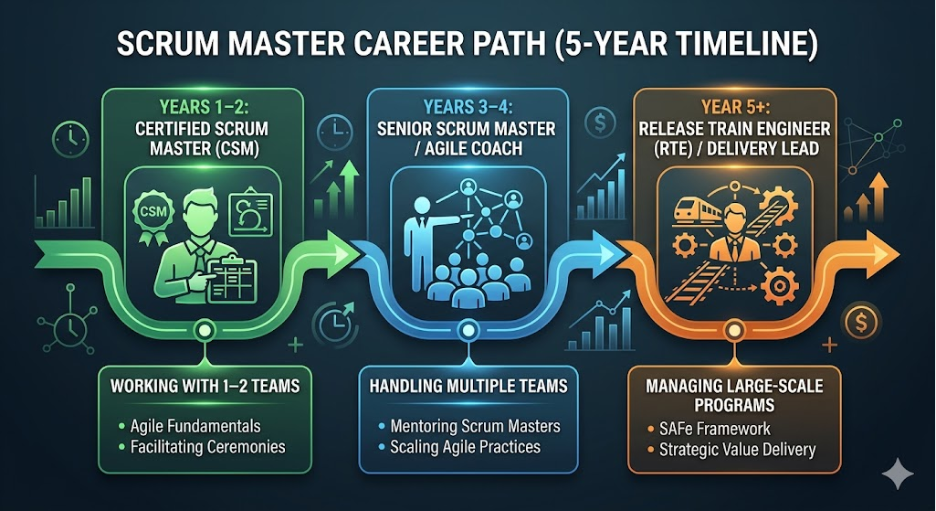
By years 3–4, they move into Senior Scrum Master or Agile Coach roles, handling multiple teams and improving processes. After 5+ years, they transition into roles like RTE or Delivery Lead, managing large-scale Agile programs.
Project Manager Career Path
Project Managers follow a structured and stable growth path. In the first 1–2 years, they manage small to mid-size projects, focusing on execution and coordination. By years 3–4, they become Senior PMs, handling larger teams and budgets.
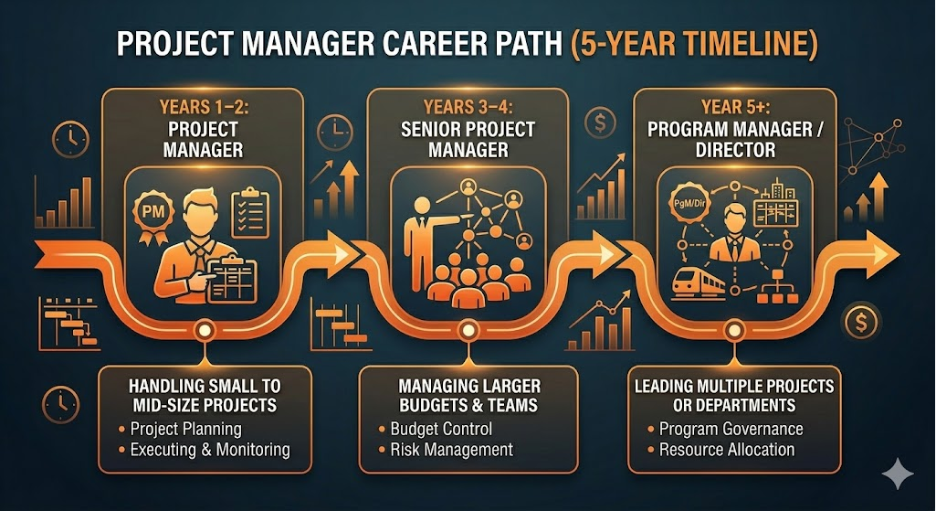
After 5+ years, they move into Program Manager or Director roles, overseeing multiple projects and driving strategic decisions. To get a clearer picture of growth and opportunities, you can also explore how the Project Manager job market is evolving across industries in 2026.
Emerging Role: Delivery Manager
A Delivery Manager combines the strengths of both roles, Agile execution and project ownership. Their focus is to manage multiple teams, like Scrum Master, and own delivery timelines and outcomes like a Project Manager. The delivery manager works closely with business and technical stakeholders
CSM vs PMP Certification: Salary, Cost, and ROI in 2026
Both CSM (Certified Scrum Master) and PMP (Project Management Professional) are highly valued certifications, but they serve different career paths. CSM is ideal for Agile roles with faster entry, while PMP is suited for structured project management with higher responsibility.
Here’s a clear comparison to help you understand cost, effort, and return on investment:
| Factor | Certified Scrum Master | Project Management Professional |
| Best For | Agile roles like Scrum Master, Agile Coach, etc. | Project Managers across industries |
| Cost | $300 – $800 | $500 – $1,200 |
| Duration | 2–5 days | 2–6 months |
| Eligibility | No strict requirements | 3–5 years of project experience required |
| Difficulty Level | Easy to moderate | Moderate to high |
| Average Salary | $95K–$110K | $90k – $115k |
| Global Recognition | Good | Very high |
| ROI | High | High |
This is where advanced certifications like SAFe (Scaled Agile Framework) become highly valuable, especially for professionals aiming to manage multiple Agile teams at scale.
Scrum Master vs Project Manager: Which Career is Right for You?
Choosing between a Scrum Master and a Project Manager really comes down to how you like to work and what kind of role excites you more. Both careers are rewarding, but the day-to-day experience is quite different.
If you enjoy helping teams improve, working in flexible environments, and guiding rather than controlling, a Scrum Master could be a great fit. If you prefer structured planning, decision-making, and taking ownership of timelines and budgets, Project Management might suit you better.
Let’s quickly jot down a few self-assessment questions to help you decide:
- Do you enjoy coaching people more than managing them?
- Are you comfortable working in changing, fast-moving environments?
- Do you like planning timelines, budgets, and handling stakeholders?
- Do you see yourself working beyond tech (like construction, healthcare, etc.)?
- Do you prefer flexibility in work or control over execution?
- Are you open to investing time in certifications like CSM, PMP, or both?
If you’re exploring opportunities, it’s also useful to understand the current demand and openings in the Scrum Master job market to see how companies are hiring and what roles are available.
How to Transition from Project Manager to Scrum Master (Step-by-Step Guide)
Moving from Project Manager to Scrum Master is a natural shift for many professionals. You already know how to manage work, coordinate people, and keep delivery on track. The main difference is that a Scrum Master focuses less on control and more on coaching, collaboration, and Agile team support.
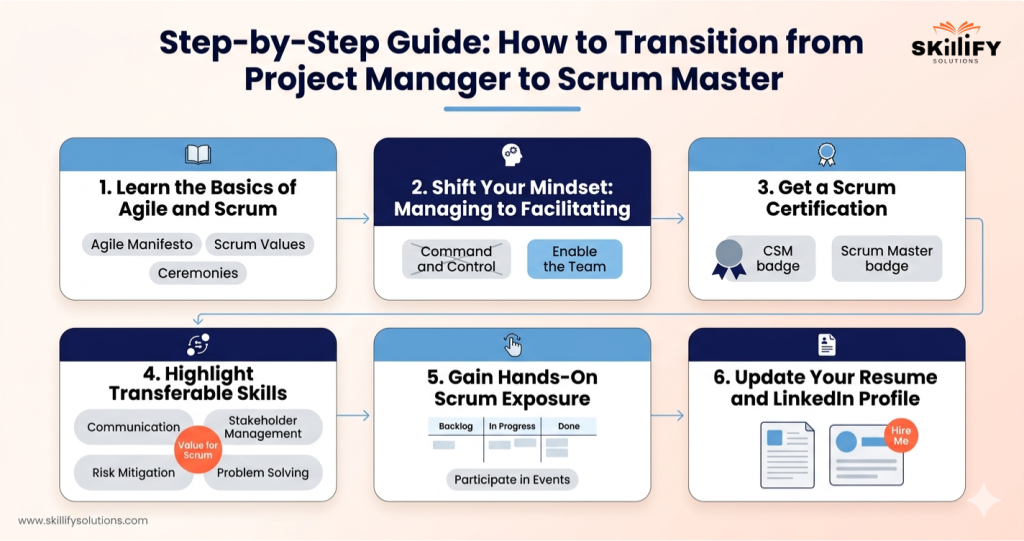
Here’s a simple step-by-step path to make that transition smoother:
- Learn the basics of Agile and Scrum: Start by understanding Scrum roles, sprint planning, stand-ups, retrospectives, and backlog management.
- Shift your mindset from managing to facilitating: As a Project Manager, you may be used to directing work. As a Scrum Master, your role is to guide the team, remove blockers, and help them improve.
- Get a Scrum certification: A Scrum Master Bootcamp can help validate your skills and make your profile stronger for Agile roles.
- Highlight transferable skills: Your experience in stakeholder communication, risk handling, planning, and team coordination is still valuable. You just need to position it in an Agile context.
- Gain hands-on Scrum exposure: Try working with Agile teams, shadowing Scrum ceremonies, or taking internal Agile responsibilities in your current role.
- Update your resume and LinkedIn profile: Use Agile keywords, mention Scrum-related work, and show how you helped teams deliver better outcomes.
Scale your Agile career with industry-recognized SAFe certification training today!
Is AI Replacing Scrum Masters and Project Managers in 2026?
The simple answer to this is no; AI is not replacing these roles. But it is changing them fast.
AI is mainly taking over repetitive tasks like reporting, scheduling, and data tracking. In fact, a large portion of routine project work is expected to be automated, allowing professionals to focus on more strategic and human aspects.
For Scrum Masters, AI can automate things like stand-up summaries, backlog updates, and performance insights. But real jobs like coaching teams, resolving conflicts, and improving collaboration still need human judgment.
For Project Managers, AI helps with better planning, risk prediction, and decision-making. Instead of replacing them, it actually makes them more powerful by giving data-driven insights.
It also helps to know what hiring managers actually look for. Understanding What Hiring Managers want in Agile roles can give you a strong edge during interviews.
Conclusion
In the end, both Scrum Master and Project Manager roles offer strong career growth, competitive salaries, and long-term opportunities. The right choice depends on your working style and career goals.
If you enjoy guiding teams, adapting to change, and working in Agile environments, a Scrum Master is a great fit. If you prefer structured planning, ownership, and leading projects end-to-end, Project Management is the way to go.
There is no wrong choice here, only what suits you better. Focus on building the right skills, gaining experience, and continuously learning, and you can succeed and grow in either path.
Master Scrum concepts with our Scrum Master Bootcamp training and unlock high-paying Agile career opportunities!
Frequently Asked Questions
1. Do you need a computer science degree to become a Scrum Master?
No, a CS degree is not required. Agile knowledge and communication skills matter more.
2. Is CSM or PMP better for career growth in the US?
CSM is ideal for Agile roles, while PMP suits traditional project management. Both offer strong career growth depending on your path.
3. How long does it take to become a Scrum Master from scratch?
It usually takes 2–6 months. You need basic Scrum knowledge and a certification like CSM.
4. Can a Project Manager become an Agile Coach?
Yes, many Project Managers transition into Agile Coach roles. Agile experience and certifications help accelerate the shift.


