 Skip to content
The SAFe Big Picture is not just a diagram; it’s a structured view of how enterprise Agile operates, showing how teams, roles, planning, and delivery are connected. When used correctly, it becomes a powerful tool for alignment, decision-making, and execution at scale.
The SAFe Big Picture shows how strategy, teams, planning, and delivery connect within a single system. And if you’re working with multiple teams or trying to scale Agile, understanding this is not optional.
This blog is designed to help you decode it simply and practically. From next time, you don’t just recognize the framework, but actually know how to navigate and use it effectively. If you’re new to SAFe® or want to understand it more deeply, a structured SAFe certification course can help you learn how this Big Picture works in real-world scenarios.
What is the SAFe Big Picture?
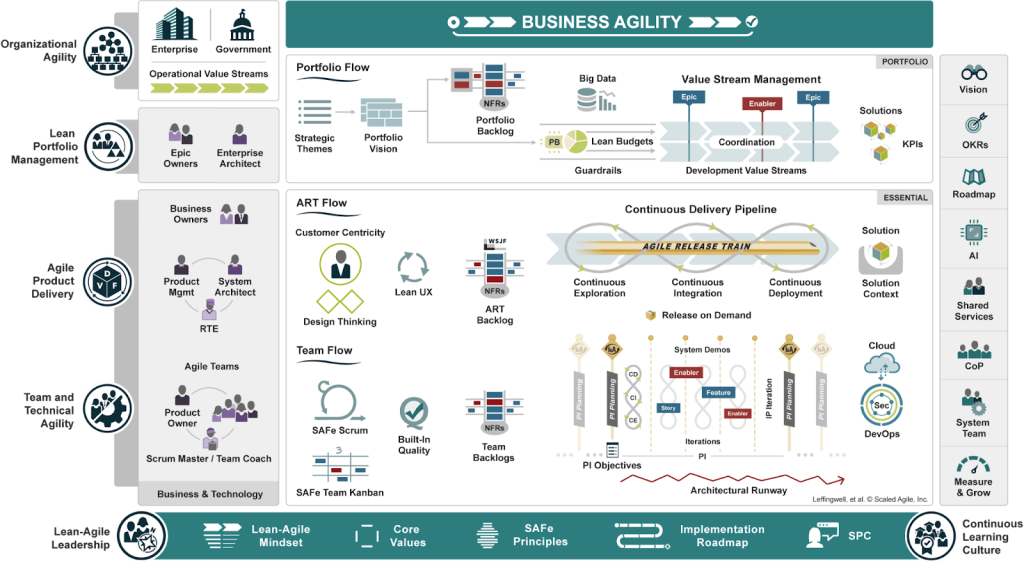
The SAFe® Big Picture is a visual representation of the Scaled Agile Framework. It is designed to show how Agile works across an entire organization. Instead of reading long documentation, teams can use this diagram to understand how different roles, processes, and levels connect in one system.
It acts like a map of the SAFe® framework, bringing together all key elements, such as teams, programs, portfolios, and supporting practices, into a single, structured view. This makes it easier for organizations to see how work flows from strategy to execution.
Purpose of the SAFe Big Picture
- Provides a clear overview of the entire framework
- Shows how different levels and roles are connected
- Helps teams understand where they fit in the system
- Acts as a reference guide for implementation and training
Why Enterprises Rely on it
- Simplifies complex Agile structures into a single visual model
- Improves alignment across multiple teams and departments
- Helps leaders and teams make better, faster decisions
- Serves as a practical guide during Agile transformation
Gain hands-on SAFe knowledge with expert-led Leading SAFe Certification today!
SAFe Configurations Explained
SAFe offers four configurations to help organizations adopt Agile based on their size, complexity, and business needs. Instead of forcing every company to follow the same setup, SAFe® allows organizations to start small and gradually expand as their operations grow.
This means a company with a few teams can use a simpler setup, while large enterprises with multiple products and departments can adopt a more advanced configuration. In simple terms, SAFe® provides a flexible, step-by-step approach to scaling Agile, so organizations can choose what works best for them without unnecessary complexity.
| Configuration | Best For | Levels Shown | Key Components | Recommended When | Complexity Level |
| Essential SAFe | Small to mid-scale teams | Team + Program | Agile Release Train (ART), Teams | Starting SAFe adoption or managing a few teams | Low |
| Large SolutionSAFe | Complex solutions with many teams | Team + Program + Large Solution | Solution Train, multiple ARTs | Building large systems in telecom, aerospace | Medium |
| Portfolio SAFe | Enterprise-level strategy alignment | Team + Program + Portfolio | Lean Portfolio Management, Value Streams | Aligning business strategy with execution | Medium–High |
| Full SAFe | Large enterprises with full adoption | All 4 levels | All components (ART, Portfolio, Solution) | Managing multiple portfolios and complex solutions | High |
How to Choose the Right Configuration
- Start with Essential SAFe®: When beginning Agile at scale
- Move to Large Solution: When multiple teams/products need coordination
- Use Portfolio SAFe®: When strategy and funding need alignment
- Adopt Full SAFe®: When the entire organization is Agile
Key Components of the SAFe Big Picture Explained
The SAFe® Big Picture is made up of several key components that work together to create a complete system for scaling Agile. These components define how teams, roles, processes, and strategy connect across the organization.
The Foundation Layer
The Foundation Layer forms the base of the SAFe® Big Picture and represents the core mindset behind the framework. It includes elements like SAFe® core values, Lean-Agile principles, and leadership approach, which guide how teams and organizations work together at scale.
These elements are not shown for detailed learning here, but as a reference layer that supports all other components in the Big Picture.
For a deeper understanding, refer to our guide on SAFe Methodology Explained: Principles, Values, and Competencies. Many professionals start with a basic SAFe Certification to understand how this Big Picture translates into real roles and responsibilities.
The Spanning Palette: Cross-Cutting Tools and Roles
The Spanning Palette is one of the most important parts of the SAFe Big Picture because it includes the elements that do not belong to just one level. Instead, they support and connect the entire system. While the Team, Program, Large Solution, and Portfolio levels show where work happens, the Spanning Palette shows what helps all those levels stay aligned.
In simple terms, this section includes the shared roles, events, and artifacts that make large-scale Agile work smoothly. These elements help organizations reduce silos, improve coordination, and maintain consistency across teams.
Cross-cutting roles in the Spanning Palette
These roles support alignment across multiple teams or levels. They are not limited to a single team, which is why they appear in the Spanning Palette.
Architect
Architects help define the overall technical direction of the solution. They ensure that teams build in a way that supports scalability, integration, and long-term quality.
In large organizations, architects are important because teams cannot make isolated technical decisions without affecting the bigger system. These roles and practices are typically covered in role-based SAFe for Architects (6.0) Certification, designed for execution and coordination at scale.
Release Train Engineer (RTE)
The RTE is often described as the chief facilitator for the Agile Release Train. This role helps teams stay aligned, remove blockers, support planning, and keep execution on track. In practice, the RTE plays a major coordination role across teams.
Product Management
Product Management is responsible for defining and prioritizing the work that delivers value to customers and the business. This role connects customer needs, market direction, and business priorities with the teams that build the solution.
These competencies are often developed through the advanced SAFe 6.0 Agile Product Manager certificate, focused on leadership and enterprise agility.
System Architect or Engineer
This role supports the technical side of large solution delivery. It works closely with teams, architects, and engineering leaders to maintain a strong technical foundation while enabling continuous delivery.
Business Owners
Business Owners provide strategic guidance, align priorities, and ensure that delivery outcomes support business objectives. They are especially important during planning and prioritization events.
Shared Services
These are supporting specialists who may not sit within one Agile team but are still needed across the system. This can include compliance, security, UX, legal, finance, or infrastructure support. For a deeper understanding, refer to our guide on SAFe methodology, including principles, values, and competencies.
Cross-Cutting Events
These events align teams and improve execution:
- PI Planning: Aligns all teams on goals, priorities, and dependencies
- System Demo: Shows integrated progress across teams
- Inspect and Adapt: Reviews performance and drives improvements
- Sync Meetings: Maintain ongoing coordination
Cross-Cutting Artifacts
These provide shared visibility and direction:
- Program Backlog: Prioritized work across teams
- PI Objectives: Clear goals for each cycle
- Roadmaps: Future direction and planning
- Metrics: Track performance and delivery
- Architectural Guidance: Maintain system quality
These artifacts are usually managed using SAFe tools that provide visibility, tracking, and real-time updates across teams. Read on to our guide on Scaled Agile Framework Tools to get a better understanding.
The Four Levels of SAFe
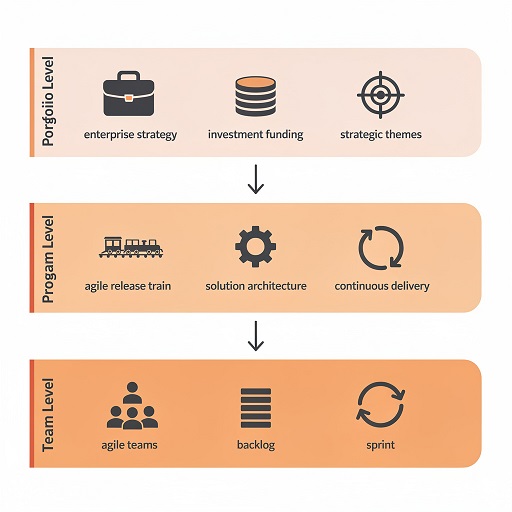
The Main Body is the central part of the Big Picture, where the four SAFe® levels are visually organized. It shows how work flows from strategy at the top to execution at the team level.
Each level has its own roles, responsibilities, and outputs, but they are all connected to ensure alignment and smooth delivery.
| Layer | Key Roles | Key Artifacts | Main Goal |
| Team Level | Scrum Master, Team Members | User Stories, Iterations | Deliver working features |
| Program Level | Product Manager, RTE | Program Backlog, PI Plans | Align multiple teams |
| Large Solution Level | Solution Manager, Architects | Solution Backlog | Manage complex, multi-team systems |
| Portfolio Level | Executives, Portfolio Managers | Strategic Themes, Budgets | Align strategy with execution |
The Core Competencies: How Business Agility is Represented in SAFe
Core competencies are shown in the Big Picture to represent how organizations achieve business agility at scale. Instead of focusing on individual tasks, they highlight the key capability areas needed for success.
These competencies are positioned as a supporting layer across the framework, helping organizations measure and improve performance.
They include areas like:
- Leadership and culture
- Team execution and delivery
- Product and solution management
- Portfolio alignment and strategy
These competencies are explained in detail in the SAFe methodology, which forms the foundation of the framework. You can read about it and gain a better and clearer understanding of how it is related to the big picture.
How to Read and Navigate the SAFe Big Picture
The SAFe® Big Picture may look complex at first, but it is designed to be navigated step by step. Instead of trying to understand everything at once, you can read it as a flow from strategy to execution.
The best way to approach it is to start from the top and move downward, understanding how each layer connects and contributes to value delivery. If you’re exploring how SAFe works in real-world roles, you can also read our guide on What is SAFe® certification, its levels, and career paths.
How to Use the Interactive Model: Step-by-Step
Follow this simple approach to navigate the SAFe Big Picture effectively:
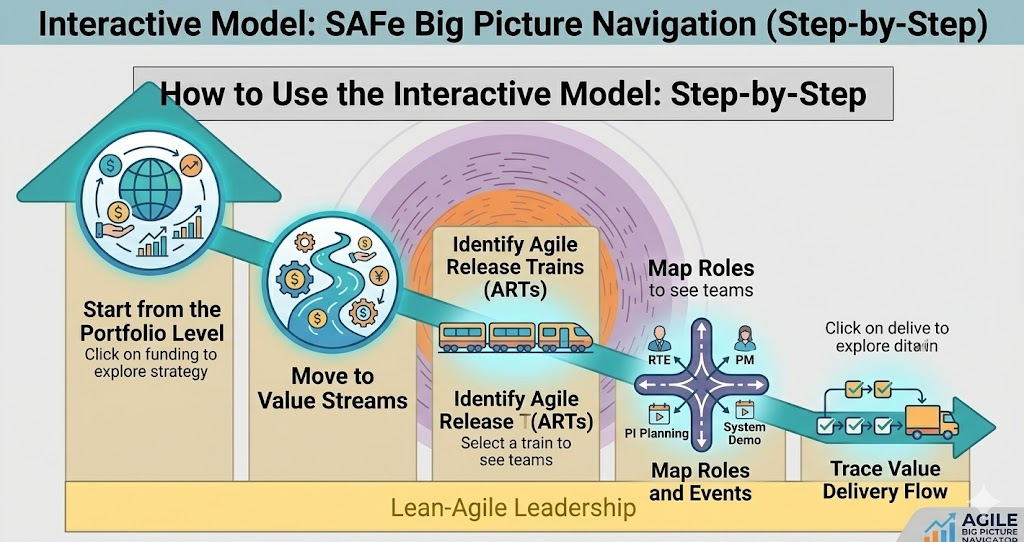
Start from the Portfolio Level
Begin at the top, where strategy, funding, and business goals are defined. This gives you the big-picture view of what the organization is trying to achieve.
Move to Value Streams
Identify how work is organized around value streams. This shows how strategy is broken down into actionable areas of work.
Identify Agile Release Trains (ARTs)
Look at how multiple teams are grouped into ARTs to deliver value together. This is where coordination across teams happens.
Map Roles and Events
Understand who is involved in roles like RTE, Product Management, and how alignment happens. It includes events like PI Planning and System Demo.
Trace Value Delivery Flow
Follow how work moves from strategy, planning, execution, to delivery. It ensures that everything is connected.
Start learning SAFe 6.0 Lean Portfolio Manager (LPM) certification and apply the Big Picture with confidence
SAFe Big Picture vs. Other Agile Scaling Frameworks
Different frameworks exist to scale Agile, but they vary in terms of structure, flexibility, and complexity. The SAFe® Big Picture stands out because it provides a complete visual model of how Agile works across an enterprise.
| Factor | SAFe | Scrum@Scale | LeSS | Spotify Model |
| Visual Model | Yes | Limited | Minimal | No formal model |
| Best Team Size | 50–150+ | 20–100 | 10–50 | Flexible |
| Configuration Options | Multiple | Moderate | Limited | No fixed structure |
| Learning Curve | High | Medium | Medium | Low |
| Certification Available | Yes | Yes | Yes | No formal certification |
Who Should Use the SAFe Big Picture
The SAFe Big Picture is most useful for organizations and professionals who need to understand, implement, or manage Agile at scale. It acts as a reference guide to aligning teams, roles, and processes across the enterprise.
- Enterprises
Large organizations with multiple teams can use the Big Picture to visualize how strategy connects to execution. It helps leadership ensure that all teams are aligned and working toward common goals.
- Agile Transformation Teams
Teams responsible for implementing SAFe can use it as a roadmap for adoption. It helps them understand where to start, how to scale, and how different components fit together.
- Consultants
Agile coaches and consultants use the Big Picture to explain SAFe clearly to stakeholders. It acts as a communication tool to simplify complex concepts and guide organizations through transformation.
The SAFe Big Picture is useful for enterprises, Agile transformation teams, and consultants who need to understand and implement Agile at scale. Enterprises use it when managing multiple teams and aligning strategy with execution, especially in complex projects.
Agile transformation teams rely on it during the initial setup and rollout of SAFe® to define structure, roles, and processes. Consultants use it when explaining the framework, conducting workshops, or guiding adoption.
Conclusion
The SAFe Big Picture may seem complex at first, but once you understand how to read it, it becomes a powerful tool for navigating Agile at scale. It brings together strategy, teams, roles, and delivery into one clear system, helping organizations stay aligned and efficient.
More importantly, it is something you can use, decode, and then understand. Whether you’re leading teams, driving transformation, or simply trying to understand how large-scale Agile works, the Big Picture provides the clarity needed to move forward with confidence.
The blog concludes that mastering the SAFe Big Picture means moving from understanding Agile concepts to actually applying them across the organization.
Learning SAFe often comes with hands-on training and real-world application. You can go through the SAFe courses by Skillify Solutions, mainly focused on leadership and enterprise agility.
Frequently Asked Questions
1. Is the SAFe Big Picture free to access?
Yes, the SAFe® Big Picture is free to access on the official Scaled Agile website and can be viewed as an interactive model.
2. How often does Scaled Agile update the Big Picture?
Scaled Agile updates the Big Picture whenever a new SAFe® version is released (e.g., SAFe® 6.0), based on industry changes and feedback.
3. Do I need SAFe certification to understand the Big Picture?
No, certification is not required. However, training or certification helps in understanding it more deeply and practically.
4. Which configuration should my company start with?
Most companies start with Essential SAFe®,as it is the simplest and forms the foundation for scaling further.
5. Can the SAFe Big Picture be downloaded as a poster?
Yes, the SAFe® Big Picture is available as a downloadable poster in multiple languages from the official website.
6. How is the SAFe Big Picture different from a SAFe implementation roadmap?
The Big Picture is a visual representation of the framework, while the implementation roadmap is a step-by-step guide to adopting SAFe® in an organization.


