 Skip to content
Key Highlights of Technical Debt in SAFe
- Understand technical debt in SAFe and its impact on Agile delivery.
- Learn how to manage technical debt in Agile effectively.
- Discover SAFe Enabler Stories for technical debt remediation.
- Explore SAFe Built-In Quality to prevent future technical debt.
- Measure technical debt remediation in Agile using key delivery metrics.
- Apply PI Planning and WSJF to reduce technical debt continuously.
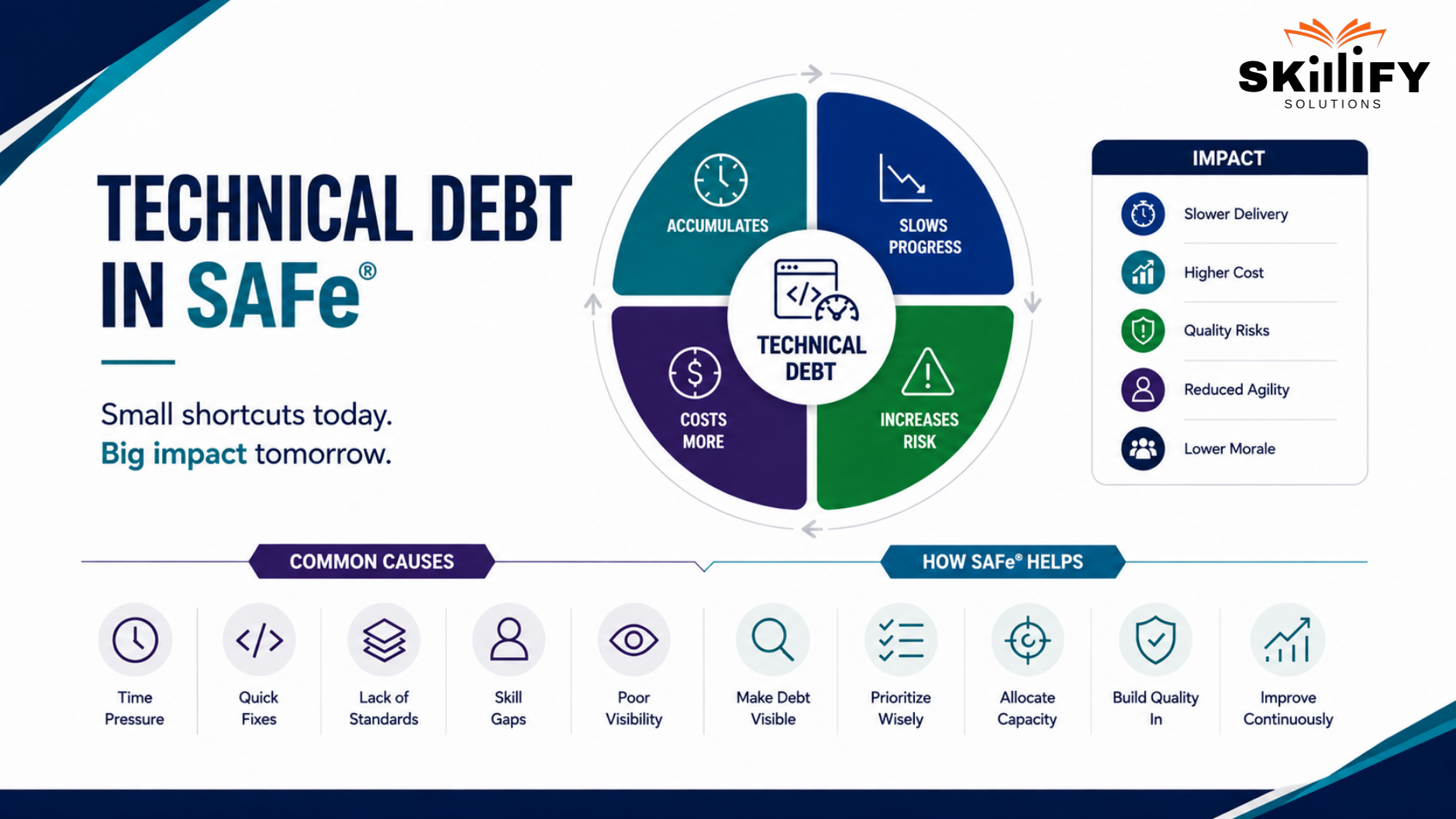
Technical debt in SAFe is the hidden reason many Agile Release Trains (ARTs) slow down over time. It’s in every shortcut, delayed refactoring, outdated architecture, or skipped automation that makes future delivery harder.
But there is good news. SAFe doesn’t expect teams to stop building features to fix it. Instead, it provides practical mechanisms like Built-In Quality, Enabler Stories, WSJF, and PI Planning to manage technical debt continuously.
I’ve seen teams wonder why every Program Increment feels more difficult than the last, even though they keep adding talented engineers. The problem usually is the technical debt silently accumulating behind every release.
In this blog, you’ll learn how technical debt builds across PIs, how SAFe Enablers help reduce it, and the strategies successful organizations use to maintain delivery speed without compromising quality.
What is Technical Debt in SAFe?
Technical debt in SAFe is the accumulated cost of technical shortcuts, deferred improvements, and outdated implementations that slow future development. Like financial debt, it grows over time if left unaddressed.
In a SAFe environment, technical debt affects multiple Agile teams and Agile Release Trains (ARTs), making delivery less predictable and increasing maintenance effort.
SAFe addresses technical debt through Built-In Quality, Enabler Stories, regular refactoring, and prioritization during PI Planning to maintain long-term delivery speed. It includes technical decisions that reduce system maintainability and agility, such as:
- Legacy code and outdated architecture
- Incomplete test automation
- Infrastructure limitations
- Deferred refactoring
- Security and compliance gaps
If you’re new to enterprise Agile, the Leading SAFe Certification provides a solid understanding of how technical debt is managed across Agile Release Trains (ARTs).
Why Technical Debt Grows at Scale
As organizations scale Agile, technical debt spreads across multiple teams, shared systems, and release trains, making it harder to resolve.
Common reasons include:
- Shared codebases and dependencies
- Feature-first delivery pressure
- Legacy systems
- Hidden technical work
- Delayed refactoring
Advance your Agile leadership skills with the SAFe Scrum Master (SSM) Certification and reduce technical debt effectively!
How Technical Debt Slows Agile Release Trains
Technical debt directly affects ART performance by reducing delivery speed and product quality.
Its impact includes:
- Slower feature delivery
- More defects and rework
- Longer testing cycles
- Increased unplanned work
- Lower PI Objective achievement
- Reduced deployment frequency
The SAFe Scrum Master (SSM) Certification helps professionals learn how to manage Enabler Stories, team backlogs, and technical improvements within an ART.
How Technical Debt Accumulates Across Program Increments
Technical debt accumulates gradually across Program Increments (PIs). Teams often take shortcuts to meet delivery goals, postpone refactoring, or delay infrastructure improvements.
While these decisions may speed up short-term delivery, they increase the effort required in future PIs and reduce overall development efficiency.
Early PL Cycles
During the early PIs, technical debt is rarely obvious because teams can still deliver features at a steady pace. Quick fixes, temporary workarounds, and deferred improvements usually have little immediate impact, making the debt easy to ignore.
Later PL Cycles
As technical debt grows, its effects become harder to overlook. Teams spend more time fixing defects, maintaining legacy code, and resolving integration issues. This reduces the capacity available for delivering new business value and makes PI commitments more difficult to achieve.
Signs Technical Debt Is Impacting Delivery
Growing technical debt often shows up as slower releases, declining team velocity, and increasing unplanned work. Teams may also experience more production defects, longer testing cycles, and lower PI Objective achievement.
Recognizing these signs early helps Agile Release Trains (ARTs) prioritize technical debt before it significantly impacts delivery.
How Built-In Quality Prevents Technical Debt
Built-In Quality helps prevent technical debt by integrating quality into every stage of development. Instead of fixing issues later, SAFe promotes practices that reduce defects, improve maintainability, and support continuous delivery.
Built-In Quality and Technical Debt Prevention
Built-In Quality reduces technical debt through:
- Continuous integration
- Automated testing
- Coding standards
- Peer reviews
- Regular refactoring
A key component of Built-In Quality is automation. Organizations investing in Agile Test Automation often reduce defects earlier in the development cycle and prevent technical debt from accumulating.
Why Built-In Quality Doesn’t Eliminate Existing Debt
Built-In Quality prevents new technical debt but cannot remove existing debt. Legacy code, outdated architecture, and deferred improvements require Enabler Stories, planned refactoring, and dedicated capacity during PI Planning.
Professionals responsible for backlog prioritization can deepen their understanding of WSJF and backlog management through the SAFe POPM Certification.
How SAFe Enablers Reduce Technical Debt
SAFe uses Enablers to address technical work that supports future business value. Unlike feature stories, Enablers focus on improving architecture, infrastructure, security, and technical knowledge. By planning Enablers in the backlog, teams can reduce technical debt without disrupting feature delivery.
Architecture Enablers for Code and Design Debt
Architecture Enablers improve the system’s structure and maintainability by addressing design issues and legacy code.
Example: Refactoring a monolithic application into microservices or replacing duplicated code with reusable components.
Infrastructure Enablers for Development Environments
Infrastructure Enablers strengthen the development environment, making software easier to build, test, and deploy.
Example: Setting up automated CI/CD pipelines, upgrading build servers, or improving test automation.
Compliance Enablers for Security and Regulatory Debt
Compliance Enablers help teams meet security, legal, and regulatory requirements before they become costly issues.
Example: Implementing data encryption, fixing security vulnerabilities, or updating systems to comply with GDPR or HIPAA requirements.
Exploration Enablers to Prevent Future Debt
Exploration Enablers reduce future technical debt by validating technical approaches before implementation.
Example: Building a proof of concept (PoC) for a new framework or evaluating a cloud migration strategy before committing to development.
These are essential capabilities during Enterprise Digital Transformation initiatives where organizations adopt new technologies and operating models.
Writing SAFe Enabler Stories for Technical Debt
A SAFe Enabler Story captures technical work that improves the system without directly delivering a user-facing feature. It makes technical debt visible in the backlog, allowing teams to prioritize and address it during Program Increments (PIs).
Elements of an Effective Enabler Story
A good Enabler Story should include:
- The technical problem or debt
- The improvement required
- Clear acceptance criteria
- Expected technical or business benefit
Example Technical Debt Enabler Story
Story: Refactor the payment module to remove duplicated code and improve maintainability.
Acceptance Criteria:
- Duplicate code removed
- All automated tests pass
- No impact on existing functionality
Prioritizing Technical Debt with WSJF
SAFe prioritizes technical debt using Weighted Shortest Job First (WSJF). Teams evaluate the business value, urgency, risk reduction, and job size to decide which Enabler Stories should be implemented first.
The SAFe Release Train Engineer (RTE) Certification explores planning techniques that improve ART execution and delivery predictability.
Capacity Allocation for Technical Debt in SAFe
SAFe does not prescribe a fixed percentage for technical debt. Teams should allocate capacity based on the amount of existing debt, delivery goals, and product health. Capacity can be adjusted during PI Planning as technical debt changes.
Capacity Allocation for New ARTs
New Agile Release Trains (ARTs) typically have low technical debt. Most capacity is dedicated to feature development, with a smaller portion reserved for refactoring, automation, and architectural improvements.
Capacity Allocation for Mature ARTs
Mature ARTs often require more capacity for technical debt because of legacy code, shared systems, and growing maintenance needs. Regular Enabler Stories help prevent debt from accumulating further.
Adjusting Capacity When Technical Debt Increases
If technical debt starts slowing releases, increasing defects, or reducing PI Objective achievement, teams should temporarily allocate more capacity to technical improvements. Reducing debt early helps restore delivery speed and long-term productivity.
Learn to prioritize Enabler Stories and maximize business value with the SAFe POPM Certification today!
How to Measure Technical Debt Reduction in SAFe
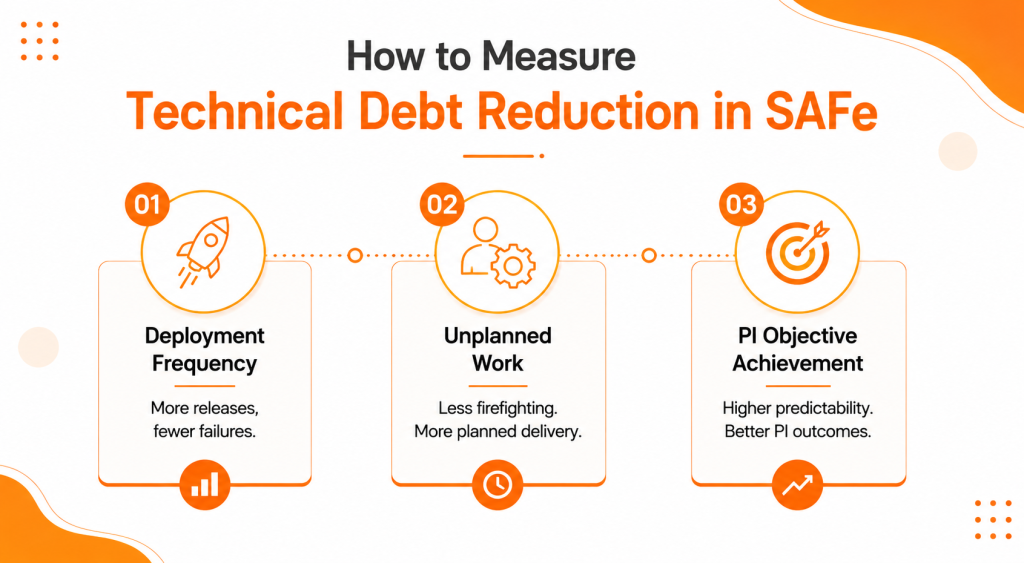
Reducing technical debt should produce measurable improvements in delivery performance. Instead of tracking debt alone, monitor engineering and PI outcomes to see whether technical investments are delivering value.
Deployment Frequency and Release Performance
Frequent, stable deployments indicate healthier systems and lower technical debt. If releases become faster with fewer failures after refactoring, your technical debt reduction efforts are working.
Tip: Compare deployment frequency across multiple PIs to identify long-term improvements.
Unplanned Work Caused by Technical Debt
Track how much team capacity is spent fixing defects, production issues, and emergency maintenance. A steady decline in unplanned work shows that technical debt is being effectively managed.
Tip: Review sprint retrospectives to identify recurring technical issues before they grow.
PI Objective Achievement Trends
Consistently meeting PI Objectives is a strong indicator that technical debt is no longer slowing delivery. Higher predictability means teams are spending more time on planned value rather than unexpected fixes.
Tip: Compare planned versus achieved PI Objectives for every Program Increment to spot improvement trends.
Best Practices for Managing Technical Debt During PI Planning
Here are a few simple practices you can follow during PI Planning. This helps teams maintain delivery speed while improving system quality.
Make Technical Debt Visible
Document technical debt as Enabler Stories instead of leaving it as informal technical work. Visible backlog items are easier to estimate, prioritize, and track.
Teams that successfully balance technical improvements with feature delivery typically follow strong Agile Software Development practices.
Balance Features and Enablers
Reserve part of the team’s capacity for refactoring, automation, and infrastructure improvements. This prevents technical debt from growing while delivering new features.
Align Technical Debt with Business Value
Connect technical improvements to outcomes such as faster releases, improved reliability, or lower operational risk. When technical debt supports business goals, it is easier to justify and prioritize.
The SAFe Advanced Scrum Master (SASM) Certification equips Scrum Masters with advanced facilitation and coaching skills for handling complex Agile delivery challenges.
Conclusion
Technical debt is inevitable in any growing software product, but letting it accumulate is a choice. In SAFe, managing technical debt is an ongoing effort that combines Built-in Quality, Enabler Stories, WSJF prioritization, and thoughtful PI Planning to keep Agile Release Trains delivering value consistently.
By making technical debt visible, allocating capacity for technical improvements, and measuring progress through delivery metrics, teams can prevent small issues from becoming major delivery bottlenecks.
Organizations improve code quality, accelerate releases, reduce rework, and create a more sustainable development process that supports both business goals and long-term agility.
Build practical SAFe implementation skills through our SAFe Certifications and deliver faster with higher product quality!
Frequently Asked Questions
1. What is the difference between technical debt and bugs in SAFe?
Technical debt is the result of technical shortcuts or deferred improvements, while bugs are defects that cause incorrect system behavior. Technical debt often leads to more bugs over time.
2. Should technical debt enablers go into the Team Backlog or Program Backlog?
It depends on the scope. Team-specific technical debt goes into the Team Backlog, while debt affecting multiple teams or the Agile Release Train belongs in the Program Backlog.
3. How does SAFe handle technical debt during PI Planning?
SAFe manages technical debt by prioritizing Enabler Stories, allocating team capacity, and balancing technical improvements with feature delivery during PI Planning.
4. Can technical debt become an Epic in SAFe?
Yes. Large technical debt initiatives that span multiple teams or value streams can be managed as an Enabler Epic.
5.How do you measure technical debt reduction?
Track metrics such as deployment frequency, defect rates, unplanned work, lead time, and PI Objective achievement to measure technical debt reduction.
6. What capacity should teams allocate for technical debt?
SAFe does not recommend a fixed percentage. Teams should allocate capacity based on the level of technical debt and adjust it during PI Planning as needed.


