 Skip to content
Data is everywhere today. But I will ask you a real question. Are you just looking at data, or actually using it to make decisions?
This is where the gap between Business Intelligence and Data Science becomes important.
I’ve seen businesses track hundreds of metrics on dashboards. It can be sales, attendance, revenue, churn and others. However, they still struggle to answer simple questions like why growth is slowing or what to do next.
At the same time, I’ve seen teams use the same data to forecast demand, optimize pricing, reduce costs, and stay ahead of competitors. Here is the difference.
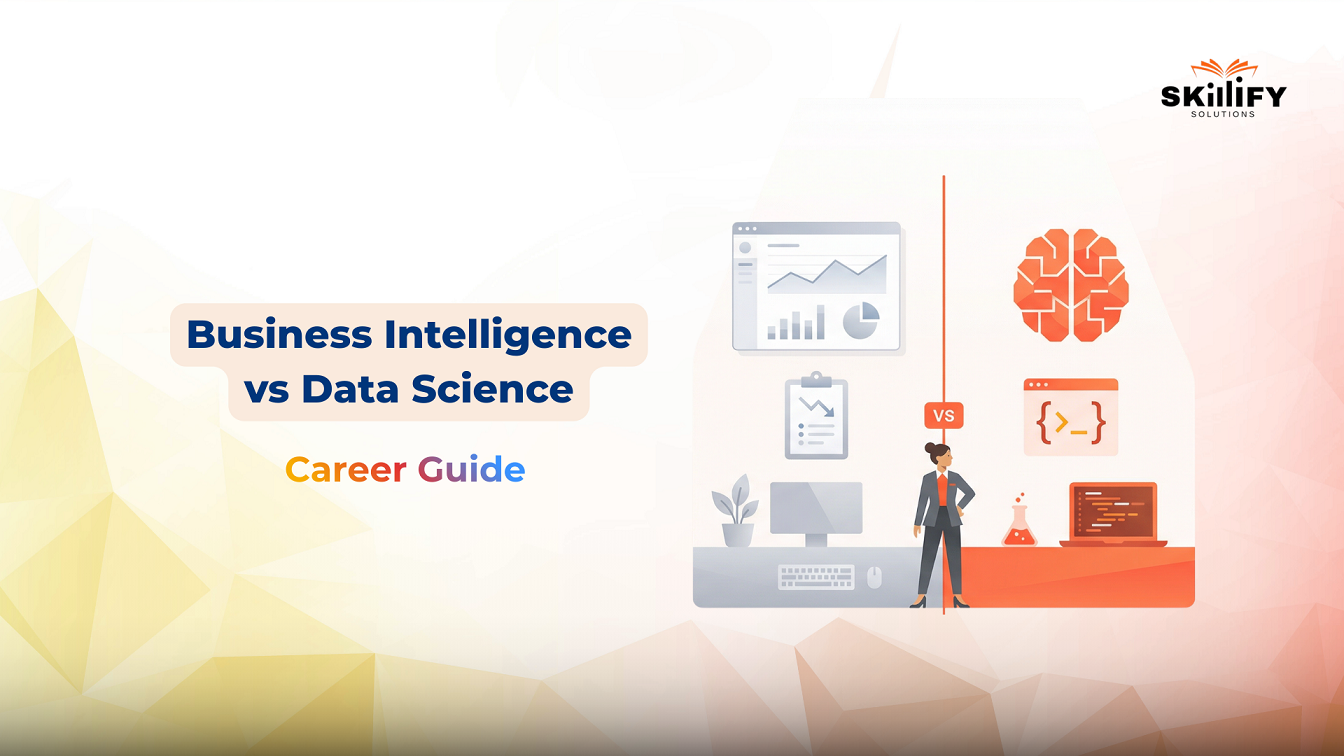
Business Intelligence helps you understand what has already happened through reports and dashboards. Data Science goes deeper and helps you predict what will happen next using models and algorithms.
In this blog, we’ll break down Business Intelligence vs Data Science in the simplest way possible. We will study what they mean, how they differ, real-world use cases, and which path makes the most sense for you in 2026. Read on to know more!
Business Intelligence vs Data Science: A Detailed Comparison
Businesses today generate a huge amounts of data every day. However, raw data alone does not create value. Companies need the right methods and technologies to turn data into meaningful insights that support decision-making. This is where Business Intelligence (BI) and Data Science play an important role.
While both fields work with data, their goals, techniques, and outcomes are different. Business Intelligence focuses on understanding what has already happened in the business.
However, Data Science focuses on predicting what could happen in the future using advanced analytics and machine learning. The table below explains the core differences between Business Intelligence and Data Science in a simple and structured way.
| Criteria | Business Intelligence | Data Science |
| Primary Focus | Analyzes past business data for reporting and decisions | Finds patterns and predicts future outcomes |
| Time Orientation | Focuses on past and present data | Focuses on future predictions |
| Key Questions | What happened? Why did it happen? | What will happen next? What should we do? |
| Data Types | Structured data from databases and business systems | Structured and unstructured data like text, images, and logs |
| Data Volume | Medium to large datasets | Very large and complex datasets |
| Technical Complexity | Moderate technical skills | High technical skills and programming |
| Methods Used | Reporting, dashboards, and data visualization | Machine learning, statistics, and AI models |
| Tools | Power BI, Tableau, Excel, Looker | Python, R, TensorFlow, Spark |
| Deliverables | Reports, dashboards, KPI tracking | Predictive models and automated insights |
| Implementation Time | Faster to implement | Takes longer due to model building |
| Flexibility | Structured and predefined reports | Flexible and experimental analysis |
| Business Value | Tracks business performance | Predicts trends and supports strategy |
Key Differences Between Business Intelligence and Data Science
The key difference between Business Intelligence and Data Science starts with their focus and how they will help you perform your daily work. Business Intelligence focuses more on data interpretation, reporting, and visualization, while Data Science requires advanced analytical skills, programming knowledge, and statistical modeling to build predictive systems.
Below are the core areas where these two fields differ.
Skills and Technical Requirements
Business Intelligence professionals typically focus on analyzing business data and presenting insights in a clear and understandable format. Their work involves creating dashboards, generating reports, and helping management make data-driven decisions.
Key skills for Business Intelligence roles include:
- Data visualization and dashboard creation
- SQL and database management
- Business analysis and Key Performance Index (KPI) tracking
- Reporting and data interpretation
- Knowledge of BI tools such as Power BI or Tableau
Data Science roles require a strong technical and analytical background. Data scientists work with large datasets, build predictive models, and use machine learning algorithms to discover patterns in data.
Key skills for Data Science roles include:
- Programming languages such as Python or R
- Statistics and probability
- Machine learning and predictive modeling
- Data cleaning and preprocessing
- Big data technologies and algorithms
In simple terms, BI professionals focus more on business insights, while data scientists focus more on advanced analytics and predictive modeling. If you’re starting from scratch, learning all these skills on your own can feel overwhelming.
This is where structured learning paths like a Data Science Bootcamp help you move faster with guided projects, mentorship, and industry-relevant tools.
Tools and Technologies Comparison
Another major difference between Business Intelligence and Data Science lies in the tools and technologies used.
Business Intelligence tools are mainly designed to analyze historical data and present it visually through dashboards and reports. These tools help business teams quickly understand trends and performance metrics.
Common Business Intelligence tools include:
- Microsoft Power BI
- Tableau
- QlikView and Qlik Sense
- Looker
- Microsoft Excel
Data Science tools are more programming-focused and used for complex data analysis and machine learning.
Common Data Science tools include:
- Python
- R programming language
- Jupyter Notebook
- TensorFlow and PyTorch
- Apache Spark
While BI tools prioritize ease of use and visualization, Data Science tools focus on advanced computation and model development.
Data Processing Methodologies
The way data is processed is also different in Business Intelligence and Data Science.
Business Intelligence generally works with structured and well-organized data stored in databases or data warehouses. BI systems use methods such as Extract, Transform, Load (ETL) to clean and organize data before generating reports and dashboards. A structured Business Analyst Bootcamp can help you define gaps and analyze the trends along with individual growth.
However, Data Science often deals with large and complex datasets, including unstructured data such as text, images, and logs. Data scientists use advanced techniques like data mining, machine learning algorithms, and statistical modeling to analyze and extract insights.
In BI workflows, the focus is on descriptive analytics, which explains what happened in the past. In Data Science workflows, the focus shifts toward predictive and prescriptive analytics. This helps businesses anticipate future outcomes and optimize decisions.
Together, Business Intelligence and Data Science complement each other, allowing organizations to understand past performance while also predicting future opportunities.
Master Data science with practical learning with our Data Science Bootcamp with AI course today!
Business Intelligence vs Data Science Salary and Career Growth
Business Intelligence roles are often focused on reporting, dashboard creation, and performance monitoring, while Data Science roles focus on predictive modeling, machine learning, and advanced analytics.
Because Data Science requires deeper technical expertise, salaries in this field are often slightly higher. You can check out Data Science Bootcamp Salary according to the current industry standards to get a better understanding. However, BI roles also offer excellent growth opportunities, especially for professionals who understand both business operations and data analysis.
The table below gives a general overview of salary ranges and career growth for common roles in these fields.
| Role | Entry-Level | Mid-Level (3–5 yrs) | Senior (8+ yrs) | Growth Rate |
| BI Analyst | $58k – $81k | $60k – $109k | $91k – $113k | High demand in organisations |
| BI Developer | $67k – $91k | $90k – $109k | $92k – $134k | Growing demand due to cloud BI platforms |
| Data Scientist | $63k – $74k | $73k – $103k | $107k – $138k | High demand |
| ML Engineer | $87k | $87k – $125k | $107k – $139k | Fastest-growing tech careers |
Industry Applications and Real-World Use Cases
Both Business Intelligence and Data Science are widely used across industries to improve decision-making, optimize operations, and drive innovation. While Business Intelligence helps organizations monitor performance and understand past trends, Data Science helps them predict future outcomes and uncover deeper insights from complex data.
Companies often use both approaches together to build a strong data-driven strategy. Below are some common industry applications for Business Intelligence and Data Science.
Business Intelligence Applications by Industry
Business Intelligence is commonly used to analyze business performance, generate reports, and visualize key metrics. BI tools help managers and executives quickly understand what is happening within their organizations.
1. Retail and E-commerce
Retail companies use BI dashboards to track sales performance, inventory levels, customer purchases, and product demand. This helps businesses manage stock efficiently and identify best-selling products.
2. Finance and Banking
Banks and financial institutions rely on BI tools to monitor transactions, track financial performance, detect unusual patterns, and generate regulatory reports. BI also helps analyze customer behavior and service performance.
3. Healthcare
Hospitals and healthcare organizations use Business Intelligence to analyze patient data, hospital resource usage, treatment outcomes, and operational efficiency. BI dashboards help administrators improve healthcare management.
4. Manufacturing
Manufacturers use BI systems to monitor production metrics, supply chain performance, equipment utilization, and operational efficiency. This helps companies reduce downtime and improve productivity.
5. Marketing and Sales
BI tools help businesses analyze campaign performance, customer acquisition data, sales trends, and regional performance. Marketing teams use these insights to optimize strategies and improve ROI.
Gain practical Business skills and accelerate your career growth today with our Business Analyst Bootcamp today!
Data Science Applications by Industry
Data Science goes beyond reporting and focuses on advanced analytics, predictive modeling, and automation. Organizations use data science techniques to discover patterns, forecast trends, and build intelligent systems.
1. E-commerce and Online Platforms
Companies use data science to build recommendation systems that suggest products to customers based on browsing and purchase behavior. Platforms like Amazon and Netflix rely heavily on predictive algorithms.
2. Finance and Fraud Detection
Data science models analyze large volumes of financial transactions to detect fraud, predict credit risk, and automate investment decisions. Machine learning algorithms can identify suspicious activities in real time.
3. Healthcare and Medical Research
Data science is used to predict disease risks, analyze medical images, and support drug discovery. Machine learning models can help doctors detect health conditions earlier and improve treatment outcomes.
4. Transportation and Logistics
Logistics companies use predictive analytics to optimize delivery routes, forecast demand, and reduce operational costs. Data science also supports autonomous vehicles and intelligent transportation systems.
5. Marketing and Customer Analytics
Businesses use data science to analyze customer behavior, predict churn, personalize marketing campaigns, and optimize pricing strategies. This allows companies to create more targeted and effective marketing efforts.
Business Intelligence or Data Science: How to Choose the Right Career Path
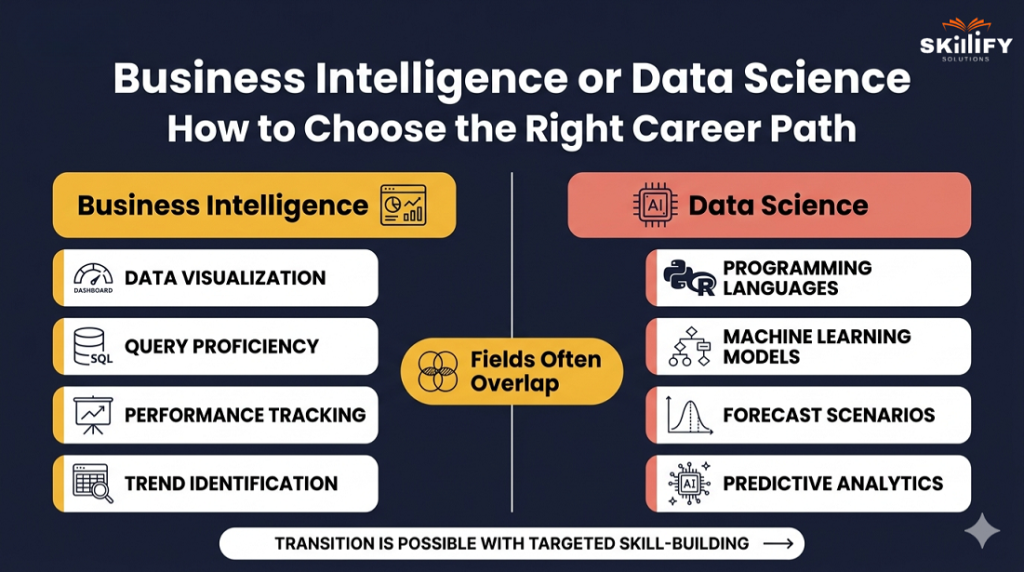
If you enjoy working closely with business teams, creating dashboards, and turning data into clear visual insights, Business Intelligence may be the right path for you. BI professionals focus on analyzing historical data, building reports, and helping organizations track performance through metrics and dashboards. This role is ideal for people who enjoy data interpretation, business strategy, and communication.
On the other hand, Data Science is better suited for individuals who enjoy deep technical work, programming, and solving complex analytical problems. Data scientists work with large datasets, build machine learning models, and develop algorithms that help predict future trends.
If you are interested in statistics, artificial intelligence, and advanced analytics, Data Science can be a highly rewarding career path.
Here are a few simple factors to consider when choosing between the two fields:
Choose Business Intelligence if you:
- Enjoy working with dashboards and data visualization
- Prefer solving business problems using data insights
- Like working closely with management and decision-makers
- Have skills in SQL, reporting tools, and analytics platforms
Choose Data Science if you:
- Enjoy programming and building predictive models
- Are interested in machine learning and artificial intelligence
- Like working with complex datasets and statistical analysis
- Have strong skills in Python, R, mathematics, or algorithms
It is also important to note that the two fields often overlap. Many professionals begin their careers in Business Intelligence or Data Analytics and later move into Data Science as they develop stronger technical skills. Here studying the Data Analyst vs Data Scientist Salary can help you take better career decisions and choose the best one.
Conclusion
From the above blog, we understood that Business Intelligence and Data Science are not competitors but complements.
Business Intelligence helps you understand your business clearly by showing what has happened and why. Data Science takes it a step further by helping you predict what will happen next and what actions to take.
In today’s data-driven world, companies that succeed are not the ones with the most data, but the ones that use it effectively. That’s why many organizations combine both, using BI for day-to-day decisions and Data Science for long-term strategy. That is why, platforms like Skillify Solutions offer structured bootcamps designed to help beginners become job-ready with real-world projects.
It is suggested to go for Business Intelligence if you enjoy analysis and storytelling with data. Choose Data Science if you enjoy programming, models, and solving complex problems. The key is to start, learn, and build real-world skills.
Upgrade your career with high demand business skills today with an on-demand Business Analyst Bootcamp now!
Frequently Asked Questions
1. Can business intelligence and data science work together in organizations?
Yes, both work together. Business Intelligence analyzes past data, while Data Science predicts future trends. Together, they help businesses make better decisions.
2. Which is easier to learn: business intelligence vs data science?
Business Intelligence is generally easier to learn. It requires less programming and focuses more on tools like Excel and dashboards. Data Science is more complex and needs coding and statistics.
3. Do I need a degree for business intelligence or data science careers?
Not always. Many people enter these fields through online courses, bootcamps, and practical projects. Skills and experience matter more than a degree.
4. Is business intelligence being replaced by data science?
No, Business Intelligence is not being replaced. Both are used together. BI helps understand past performance, while Data Science helps predict the future.


