Author: Murali Mohan Narayanabhatla

  • SAFe DevOps vs AWS DevOps Certification: Which Builds a Better DevOps Career in 2026?

    SAFe DevOps vs AWS DevOps Certification: Which Builds a Better DevOps Career in 2026?

    Key Highlights of SAFe DevOps vs AWS DevOps

    • Compare SAFe DevOps vs AWS DevOps certification paths.
    • Learn which DevOps certification is best for you.
    • Explore SAFe® DevOps certification and career benefits.
    • Understand the AWS DevOps Professional exam requirements.
    • Compare DevOps salary and AWS DevOps engineer salary trends.
    • Discover CI/CD pipeline AWS skills and enterprise DevOps practices. 

    The biggest surprise about SAFe® DevOps and AWS DevOps is that they are often compared by people who may eventually benefit from both. 

    One teaches how to improve the flow of value across large enterprises. The other teaches how to build and automate the technology that delivers that value. 

    Through conversations with Agile coaches, DevOps engineers, and cloud architects, I’ve noticed that professionals who understand both business delivery and technical implementation often advance into leadership roles faster. 

    But every career journey needs a starting point. Should you begin with SAFe® DevOps or AWS DevOps? The answer depends on your current role, technical background, and long-term ambitions. 

    This blog breaks down SAFe DevOps vs AWS DevOps, compares both certifications in a practical, career-focused way, so you can make a confident decision based on your future goals. Dive in!

    SAFe DevOps vs AWS DevOps: Beginner-Friendly Overview 

    SAFe® DevOps is an enterprise-focused framework that helps organizations improve collaboration, streamline workflows, and accelerate software delivery using DevOps principles at scale. 

    AWS DevOps is a cloud-focused approach that uses AWS services to automate infrastructure, CI/CD pipelines, monitoring, and application deployments. 

    Simply put, SAFe® DevOps focuses on enterprise transformation, while AWS DevOps focuses on cloud-based DevOps implementation and automation. 

    If you’re planning to pursue the certification, the SAFe DevOps Practitioner (SDP) Certification provides hands-on exposure to value stream mapping. You can also learn continuous Delivery Pipelines, DevSecOps, and the CALMR approach used in enterprise-scale DevOps transformations.

    SAFe® DevOps vs AWS DevOps: Key Differences 

    While both certifications support DevOps practices, they serve different purposes. SAFe® DevOps focuses on improving software delivery across large Agile enterprises, whereas AWS DevOps focuses on implementing and automating DevOps workflows using AWS cloud services. 

    Factor SAFe® DevOps Practitioner AWS Certified DevOps Engineer – Professional 
    Primary Focus Enterprise DevOps transformation and continuous delivery Cloud-based DevOps automation on AWS 
    Key Skills CALMR, Value Streams, Continuous Delivery Pipeline, DevSecOps IaC, CI/CD, Monitoring, Security, Deployment Automation 
    Target Audience Scrum Masters, RTEs, Agile Coaches, Release Managers DevOps Engineers, Cloud Engineers, SREs 
    Technical Depth Moderate High 
    Exam Difficulty Beginner to Intermediate Advanced 
    Prerequisites Basic Agile or SAFe® knowledge recommended Strong AWS and DevOps experience recommended 
    Career Focus Enterprise Agile and DevOps leadership Cloud operations and DevOps engineering 
    Average Salary (2026) $113,000–$130,000 $126,000–$140,000+ 

    Build high-demand Agile delivery skills through our leading SAFe DevOps Practitioner Certification today!

    What You Learn in SAFe® DevOps and AWS DevOps Certification 

    Both certifications strengthen DevOps capabilities, but their learning outcomes differ significantly. SAFe DevOps Certification focuses on improving the flow of value across enterprise teams, while AWS DevOps develops technical expertise for automating and managing cloud environments. 

    SAFe® DevOps Practitioner 

    SAFe® DevOps teaches organizations how to improve software delivery through the Continuous Delivery Pipeline and the CALMR approach. 
    SAFe DevOps Practitioner 

    Key learning areas: 

    • CALMR (Culture, Automation, Lean Flow, Measurement, Recovery)  
    • Value Stream Mapping and Flow Optimization  
    • Continuous Delivery Pipeline  
    • DevSecOps practices  
    • Cross-team collaboration and delivery improvement

    Professionals exploring this path often start by learning more about SAFe DevOps Certification, including its curriculum, exam structure, and career benefits, before pursuing training.

    AWS DevOps Professional 

    AWS DevOps Professional focuses on implementing and automating DevOps practices using AWS services. 
    AWS DevOps Professional 

    Key learning areas: 

    • Infrastructure as Code (IaC)  
    • CI/CD pipeline automation  
    • Monitoring and logging  
    • Deployment and release automation  
    • Security, compliance, and incident management 

    Shared DevOps Skills Across SAFe® and AWS Certifications 

    Although their focus differs, both certifications cover essential DevOps concepts, including: 

    • CI/CD practices  
    • Automation  
    • DevSecOps principles  
    • Monitoring and measurement  
    • Faster and more reliable software delivery  

    The main difference is that SAFe® DevOps focuses on enterprise delivery transformation, while AWS DevOps focuses on technical cloud implementation and automation. 

    Which Certification Matches Your Career Path? 

    Your ideal certification depends on whether your role is focused on enterprise transformation, cloud engineering, or a combination of both. 

    Certification Roles Why It Fits 
    SAFe® DevOps Scrum Masters, RTEs, Agile Coaches, Enterprise Team Leads Focuses on delivery flow, collaboration, DevSecOps, and enterprise transformation 
    AWS DevOps Cloud Engineers, SREs, DevOps Engineers Builds expertise in IaC, CI/CD, monitoring, automation, and cloud operations 
    SAFe® DevOps and AWS DevOps     Technical Leaders, Enterprise Cloud Professionals, DevOps Managers Combines enterprise DevOps strategy with hands-on cloud automation skills 

    If you’re evaluating multiple Agile credentials alongside DevOps certifications, our guide to Top Agile Certifications can help you compare the most valuable options for career growth.

    Best for Agile and Enterprise Roles 

    SAFe® DevOps is ideal for professionals leading Agile transformation and improving software delivery across large organizations. If you’re working closely with teams, improving delivery flow, or driving Agile transformation in an organization, SAFe® DevOps is a strong fit for you. 

    If your goal is to lead Agile transformation initiatives, the Leading SAFe Certification can complement SAFe® DevOps. This is achieved by building enterprise agility, Lean-Agile leadership, and transformation management skills.

    Best for Cloud and DevOps Roles 

    AWS DevOps is best for professionals responsible for cloud infrastructure, deployment automation, and operational reliability. If your day-to-day work involves AWS, automation, CI/CD pipelines, or managing system reliability, AWS DevOps will suit your skill path better. 

    Hybrid Career Path 

    Many organizations need professionals who understand both enterprise DevOps strategy and cloud implementation. Combining both certifications can create a well-rounded DevOps skill set. 

    If you’re unsure or want to grow in both directions, combining both can help you balance enterprise-level thinking with strong hands-on cloud DevOps skills. 

    Before choosing a certification path, it’s worth exploring What is SAFe Certification. This will help you to understand how different SAFe® credentials support enterprise transformation and Agile leadership roles.

    SAFe DevOps vs AWS DevOps Salary Comparison (2026) 

    Salary varies based on experience, location, and company demand. This comparison focuses only on overlapping roles where both SAFe® DevOps and AWS DevOps skills can apply. 

    Role SAFe® DevOps AWS DevOps
        Enterprise DevOps or Agile Lead $134K – $149K $1560K – $170K 
    DevOps Engineer $110K – $150K $130K – $180K 
    Cloud or Platform Engineer $105K – $145K $110K – $160K 
    Technical Lead$120K – $155K $135K – $175K 

    Advance your Agile career with industry-recognized Leading SAFe® Certification today and get ready for the future!

    Which is Better for Beginners: SAFe® DevOps or AWS DevOps 

    For beginners, the better choice depends on your background and career direction. 

    SAFe® DevOps is easier to start with if you are from a non-technical or Agile background. It focuses on DevOps concepts like collaboration, flow, and enterprise delivery rather than deep technical implementation. 

    For beginners entering enterprise Agile environments, the SAFe DevOps Practitioner (SDP) Certification offers a structured introduction to DevOps culture. It includes value streams and continuous delivery without requiring deep cloud engineering expertise.

    AWS DevOps is better if you already have some technical knowledge or want to build a strong cloud engineering career. It requires understanding AWS services, CI/CD, automation, and infrastructure concepts, which can be more challenging for complete beginners. 

    Which Certification Should You Get First? 

    The right starting point depends on whether you want to build a strong foundation in Agile enterprise delivery or directly enter cloud and DevOps engineering roles. 

    Start with SAFe® DevOps for Agile Enterprise Environments 

    If you are new to DevOps or working in Agile teams, SAFe DevOps Certification  is a good starting point because it focuses on flow, collaboration, and enterprise-level delivery rather than deep technical tools. 

    • Best for beginners from Agile, management, or coordination backgrounds  
    • Helps you understand DevOps culture, value streams, and delivery pipelines  
    • Easier entry point with less technical complexity  
    • Ideal for roles in enterprise Agile transformation 

    Start with AWS DevOps for Cloud and Infrastructure Roles 

    If you already have technical experience or want to work directly with cloud systems, AWS DevOps is a better first step because it focuses on hands-on implementation. 

    • Best for learners with basic cloud or Linux knowledge  
    • Focuses on CI/CD, automation, and AWS services  
    • Builds strong technical DevOps engineering skills  
    • Ideal for cloud engineer and DevOps engineer roles 

    If certification exams feel overwhelming, reviewing a dedicated SAFe Exam Preparation guide can help you understand the exam format, study strategy, and key concepts to focus on.

    Real-World Applications of SAFe® DevOps and AWS DevOps 

    SAFe® DevOps and AWS DevOps are widely used in real organizations, but in different environments. Let’s understand with real-life scenarios to relate better.  

    Enterprise DevOps Transformation with SAFe® 

    SAFe® DevOps is used in large enterprises and Fortune 500 companies with 50–5000+ employees and 10–50+ Agile teams working in parallel. 

    It helps coordinate complex delivery systems and can improve release efficiency by 20%–50%. It reduces lead time by up to 30%–40% through better flow, collaboration, and pipeline optimization. 

    Cloud-Native DevOps on AWS 

    AWS DevOps is widely used in startups and cloud-native companies with 5–100 engineers. High-performing teams can achieve 10–200+ deployments per day. 

    They can reduce deployment time from hours to minutes, and scale applications from thousands to millions of users using CI/CD automation, infrastructure as code, and cloud-native services. 

    Exploring Agentic AI Tools can help professionals understand how autonomous AI systems are increasingly supporting monitoring, incident response, and workflow automation in DevOps environments.

    Organizations Using SAFe® and AWS Together 

    Many large enterprises in banking, telecom, and SaaS use both frameworks together, often operating with 100–1000+ engineers across multiple cloud environments. SAFe® DevOps manages enterprise coordination across 10–100+ teams. 

    However, AWS DevOps supports automated cloud delivery pipelines handling millions of transactions per day, combining strategic alignment with high-scale technical execution. 

    As organizations scale Agile and cloud adoption simultaneously, professionals often start with the Leading SAFe Certification to bridge enterprise strategy and modern delivery execution.

    Conclusion 

    SAFe DevOps vs AWS DevOps serve different career goals. SAFe® DevOps is best for Agile professionals and leaders focused on enterprise transformation, collaboration, and delivery improvement. 

    AWS DevOps is ideal for engineers seeking expertise in cloud automation, CI/CD, infrastructure as code, and cloud operations. The right choice depends on your role, technical background, and career aspirations. 

    If you’re focused on enterprise Agile environments, start with SAFe® DevOps. If you’re pursuing a cloud or DevOps engineering career, AWS DevOps is the stronger option. For long-term growth and versatility, earning both certifications can help you combine strategic DevOps knowledge with hands-on technical expertise.

    Enhance collaboration and delivery flow using our leading SAFe DevOps Practitioner Certification today!

    Frequently Asked Questions

    1. Is SAFe® DevOps useful outside large enterprises?

    Yes. SAFe® DevOps by Skillify Solutions is designed for large organizations; its principles of collaboration, flow, and continuous delivery can benefit teams of any size.

    2. Can AWS DevOps certification help Scrum Masters move into technical roles?

    Yes, but it requires learning cloud, automation, and infrastructure concepts. The certification can support a transition into more technical positions.

    3. Which certification is harder for non-engineers to pass?

    AWS DevOps is generally harder because it requires hands-on knowledge of AWS services, automation, and cloud operations.

    4. Do companies pay more for process-focused or tool-focused DevOps skills?

    Tool-focused DevOps skills often command higher salaries, especially in cloud and engineering roles. However, leadership roles with process expertise are also highly valued.

    5. Is SAFe® DevOps respected by cloud engineering teams?

    Yes, particularly in organizations using SAFe®. It is valued for improving delivery flow and cross-team collaboration, though it is not a technical cloud certification.

    6. Which certification ages better over a 5-year career?

    Both remain valuable. SAFe® DevOps by Skillify Solutions supports leadership and transformation careers, while AWS DevOps stays relevant as cloud adoption continues to grow.

  • Kanban vs Scrum: Which Agile Framework Fits the Way Your Team Works?

    Kanban vs Scrum: Which Agile Framework Fits the Way Your Team Works?

    If your team works on planned product releases, Scrum will probably serve you better. If your days are filled with unexpected requests, support tickets, and constantly shifting priorities, Kanban may be the smarter choice.

    The challenge is that most Agile discussions make both frameworks sound interchangeable. They aren’t. While Scrum and Kanban share the same Agile goal of delivering value faster, they take very different approaches to planning, managing, and completing work.

    Over the years, I’ve seen product teams thrive with Scrum’s structured sprint cycles and clear delivery goals. I’ve also seen operations and support teams achieve better results with Kanban’s flexible, continuous workflow. In many cases, teams struggled not because Agile failed, but because they adopted a framework that didn’t match the way they actually worked.

    That’s why choosing between Kanban and Scrum comes down to understanding your team’s workflow, priorities, and delivery needs. In this blog, we’ll break down Kanban vs Scrum, where each framework performs best, and how to determine which one is the right fit for your team. Read on to know more!

    Key Takeaways of Kanban vs Scrum

    • Kanban vs Scrum is about which fits your team’s work style. 
    • Scrum focuses on structured sprints and predictable delivery.
    • Kanban focuses on continuous workflow and flexibility.
    • The Kanban methodology improves visibility and helps teams identify workflow bottlenecks early.
    • The Scrum framework provides clear roles, planning cycles, and accountability.
    • Teams can combine both approaches through Scrum to balance flexibility and structure.

    Kanban vs Scrum at a Glance 

    Kanban and Scrum are two popular Agile frameworks that help teams manage and deliver work efficiently. While both aim to improve collaboration, transparency, and productivity, they take different approaches to organizing and tracking work. 

    Kanban is a visual workflow management method that focuses on continuous delivery and limiting work in progress (WIP) to improve flow.  

    Scrum is an Agile framework that organizes work into fixed-length sprints, supported by defined roles, events, and planning cycles. 

    Factor Kanban Scrum 
    Workflow Continuous flow Fixed sprints 
    Planning Continuous Sprint-based 
    Roles No required roles Defined Scrum roles 
    Ceremonies Optional Required 
    WIP Limits Yes No 
    Scope Changes Anytime Limited during the sprint 
    Metrics Throughput, Cycle Time, Lead Time Velocity, Burndown 
    Delivery Continuous End of sprint 
    Flexibility High Moderate 
    Best For Support, operations, maintenance Product development 
    Predictability Lower Higher 

    If you’re preparing for structured Agile roles, the SAFe Certifications are often a strong starting point to understand how frameworks like Scrum and Kanban scale in enterprises.

    Why Scrum Creates Predictability 

    Scrum is designed to bring structure and predictability to Agile teams. By working in fixed-length sprints, teams know what they are expected to deliver and when. This makes planning and progress tracking easier. 

    However, the same structure that creates predictability can also introduce friction when priorities change frequently. Much of this structure is guided by the responsibilities of a Scrum Master. It is useful to understand What is a Scrum Master is and how the role supports Agile teams.

    The Three Scrum Roles and Their Purpose 

    Scrum defines three specific roles to ensure accountability and clear ownership: 

    • Product Owner: Prioritizes work and manages the product backlog.  
    • Scrum Master: Facilitates the Scrum process and removes obstacles.  
    • Development Team: Delivers the work committed to during the sprint. 

    Become a confident Agile leader with our globally valued Scrum Master Certification today!

    The Five Scrum Ceremonies and Their Time Cost 

    Scrum relies on regular meetings, often called ceremonies, to keep work organized and transparent. 

    Scrum Ceremonies
    • Sprint Planning: Defines the work for the upcoming sprint.  
    • Daily Scrum: Short daily check-in meeting.  
    • Sprint Review: Demonstrates completed work to stakeholders.  
    • Sprint Retrospective: Reviews what went well and what can be improved.  
    • The Sprint: The time-boxed period in which the work is completed. 

    How Fixed Sprint Scope Improves Focus 

    In Scrum, the sprint scope is fixed once a sprint starts. This helps teams focus on committed work without constant changes or interruptions. 

    As a result, priorities remain clear, productivity improves, and delivery becomes more predictable. The trade-off is that urgent new requests often have to wait until the next sprint. 

    For professionals aiming to build deeper expertise, the Scrum Master Certification helps strengthen understanding of sprint planning, roles, and delivery accountability in real projects.

    Where Scrum Works Best and Where it Struggles 

    Scrum works best for: 

    • Product development teams  
    • Projects with clear roadmaps  
    • Teams that value structured planning and predictable releases  

    Common Agile Metrics for Scrum Master roles include velocity, burndown charts, cycle time, and team throughput.

    Scrum can struggle with: 

    • Support and maintenance teams  
    • Environments with constantly changing priorities  
    • Work that requires immediate response to incoming requests 

    Why Kanban Feels Faster 

    Kanban is built around continuous workflow rather than fixed sprint cycles. Teams can start, prioritize, and complete work as capacity becomes available, which often makes delivery feel faster and more responsive. 

    However, maintaining a smooth flow requires discipline and clear work management practices. 

    How Kanban Boards and WIP Limits Improve Flow 

    Kanban uses visual boards to show the status of work in real time. Tasks move through different stages, making bottlenecks easy to identify. 

    Work-in-progress (WIP) limits prevent teams from taking on too much work at once. This encourages focus, reduces multitasking, and helps tasks move through the workflow more efficiently. 

    Strengthen Agile delivery capabilities with our industry-aligned SAFe DevOps Certification today!

    Why Kanban Has No Required Roles or Ceremonies 

    Unlike Scrum, Kanban does not require specific roles such as Scrum Master or Product Owner. It also has no mandatory ceremonies or sprint meetings. 

    This lightweight structure gives teams more flexibility and reduces process overhead. Teams can adopt only practices that add value to their workflow. 

    Kanban Metrics 

    Kanban measures workflow efficiency using three key metrics that help teams improve delivery speed and identify bottlenecks:

    Kanban vs Scrum
    • Lead Time: Total time from work request to final delivery.
    • Cycle Time: Time taken to complete a task after work begins.
    • Work-in-Progress (WIP): The number of tasks being worked on at a given time.
    • Throughput: The amount of work completed within a specific period.

    Teams looking to specialize in flow-based systems often explore the SaFe DevOps Certification. Here, you can better understand continuous delivery and operational efficiency principles that align closely with Kanban thinking.

    Where Kanban Outperforms Scrum 

    Kanban works particularly well for: 

    • Support and maintenance teams  
    • IT operations teams  
    • Service desks and help desks  
    • Teams handling unpredictable workloads  

    When priorities change frequently and work arrives continuously, Kanban often provides greater flexibility than Scrum. 

    Which Framework Fits Your Team? 

    The best framework depends on the type of work your team handles. Scrum is ideal for planned product development, while Kanban works better for teams dealing with a constant flow of incoming work. Some teams combine both approaches through Scrum. 

    Choose Scrum for Roadmap-Driven Product Development 

    Scrum is a good fit when work can be planned and delivered in stages. Fixed sprints help teams stay aligned with product goals and release schedules. 

    Scrum works especially well when combined with structured upskilling paths like the Scrum Master Certification. It prepares you for real-world sprint-based execution roles.

    Example: A software company building a new mobile app can use Scrum to plan features, complete them in two-week sprints, and release updates on a predictable schedule. 

    Choose Kanban for Support and Operational Work 

    Kanban works best when priorities change frequently and new tasks arrive unexpectedly. Teams can add and complete work continuously without waiting for the next sprint. 

    Example: An IT support team handling service requests and urgent incidents can use Kanban to manage work as it arrives throughout the day. 

    Teams managing complex product roadmaps often rely on modern Project Management Tools to organize backlogs, track sprint progress, and improve visibility across stakeholders.

    Why Scrumban is the Practical Middle Ground 

    Scrumban combines Scrum’s planning structure with Kanban’s flexibility. Teams can use sprint planning while managing work through a continuous flow system. 

    Example: A product team that follows a roadmap but also handles frequent customer requests may use Scrumban to balance planned development with unexpected work. 

    If you’re exploring multiple Agile pathways, the Top Agile Certifications can help you compare roles, frameworks, and career paths before committing to Scrum or Kanban specialization.

    How Scrum and Kanban Work in SAFe 

    Scaled Agile Framework (SAFe) allows teams to use either Scrum or Kanban, depending on the type of work they handle. Both frameworks support Agile Release Trains (ARTs), but they manage planning, execution, and delivery differently. 

    Why SAFe Supports Both Frameworks 

    SAFe gives teams the flexibility to choose the framework that aligns with their work patterns while still contributing to larger business goals. 

    Scrum in SAFe Kanban in SAFe 
    Uses iterations and sprint planning Uses continuous workflow 
    Best for planned product development Best for operational and service-based work 
    Focuses on predictable delivery Focuses on flow efficiency 
    Works well with PI Planning and team commitments Helps manage incoming work and bottlenecks 

    For enterprise-level scaling and transformation, the SAFe DevOps Certification helps professionals understand how flow, automation, and Agile principles integrate at scale.

    Which Framework Works Better for Agile Release Trains? 

    In most Agile Release Trains, Scrum is commonly used for feature delivery because it aligns well with iteration planning and Program Increment (PI) objectives. 

    Kanban is often used by operations, platforms, and service teams that need continuous delivery and faster response to changing priorities. 

    Scenario Better Fit 
    Feature development with planned releases Scrum 
    Continuous support and operations work Kanban 
    Mixed development and support workloads Scrumban or Hybrid Approach 

    Conclusion 

    Scrum provides structure, predictable delivery, and clear roles, making it a strong choice for product development teams working toward planned releases. Kanban focuses on continuous flow, flexibility, and fast response times, making it ideal for support, operations, and service-based teams.

    The right choice depends on how your team plans, prioritizes, and delivers work. If your work is roadmap-driven, Scrum may be the better fit. If priorities change frequently, Kanban can offer greater flexibility. 

    And for teams that need a balance of both, Scrumban provides a practical middle ground. Ultimately, the best framework is the one that aligns with your team’s workflow and goals.

    Build job-ready Agile skills faster with our leading SAFe Certification Course today, and gain practical experience!

    Frequently Asked Questions

    1. Why are experienced Agile teams moving away from pure Scrum?

    Some teams find Scrum too structured for fast-changing environments. They move toward Kanban or Scrumban to gain more flexibility and reduce meeting overhead.

    2. Is Kanban better for AI and DevOps teams with unpredictable workloads?

    Yes. Kanban is often a better fit for AI and DevOps teams because it allows continuous work management and adapts quickly to changing priorities and incoming requests.

    3. What are the highest hidden costs of Scrum ceremonies?

    The highest costs are time spent in planning, reviews, retrospectives, and daily meetings. If not managed well, these ceremonies can reduce the time available for actual delivery.

    4. Why do some teams fail after switching from Scrum to Kanban?

    Teams often fail because they remove Scrum’s structure without adopting Kanban discipline, such as managing workflow, limiting WIP, and tracking flow metrics.

    5. Can Kanban work for product teams with fixed deadlines?

    Yes. Kanban can support fixed deadlines, but teams must carefully manage priorities, capacity, and workflow to ensure work is completed on time.

    6. What do Agile coaches recommend for hybrid remote teams in 2026?

    Many Agile coaches recommend a flexible approach, often using Scrumban, which combines Scrum’s planning structure with Kanban’s workflow flexibility for distributed teams.

  • SAFe Certification Renewal Cost: Renewal Fees, Steps, and Expiry Details

    SAFe Certification Renewal Cost: Renewal Fees, Steps, and Expiry Details

    Key Highlights

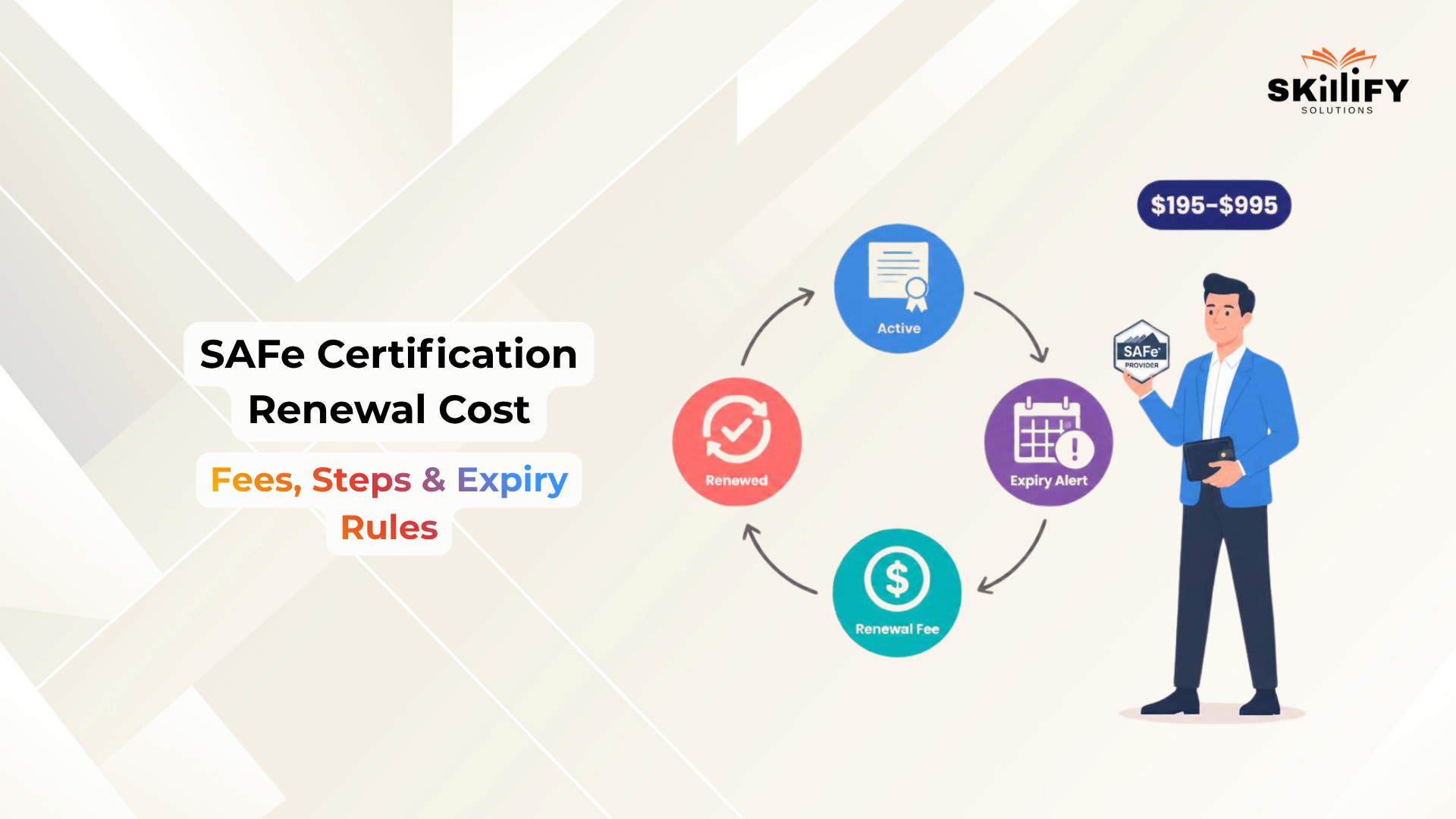
    • SAFe certification renewal cost ranges from $195 to $995.
    • Learn how to renew SAFe certification 2026 through SAFe Studio.
    • SAFe Agilist renewal fee usually falls under the foundational tier.
    • Renewal tiers are $195, $295, and $995 based on certification level.
    • You can usually renew expired SAFe certification without re-exam.

    SAFe certification renewal takes only a few minutes, but the decision behind it is bigger than a quick payment. Most SAFe certifications stay active for 1 year, and once that period ends, your credential can move from active to expired if you do not renew it.

    The renewal usually costs between $195 and $995 per year, depending on your certification tier. If you hold multiple SAFe certifications, you usually do not pay separately for each one. You pay only the highest applicable tier once.

    This matters because renewal affects more than your certificate date. It decides whether your credential stays active, whether your digital badge looks updated, and whether you continue getting access to SAFe Studio learning resources.

    For Agile professionals, this can matter during interviews, promotions, client projects, or internal role changes.

    In this blog, we will break down the SAFe Certification Renewal Cost, renewal tiers, step-by-step renewal process, expiry rules, and whether paying the renewal fee is actually worth it. You can take it as a clear guide to help you renew smartly and keep your SAFe credential active. Dive in!

    How SAFe Certification Renewal Works  

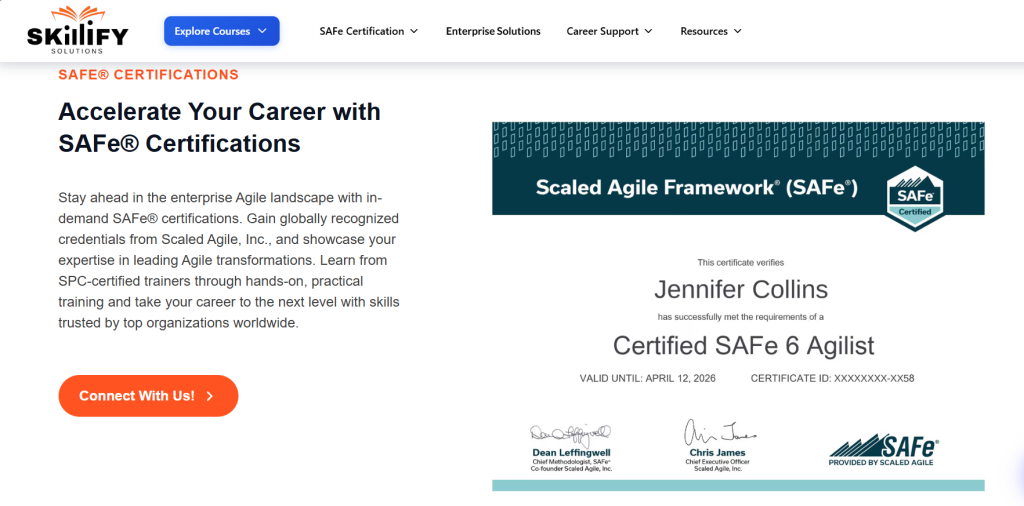
    SAFe certification renewal is the process of keeping your SAFe credential active after its validity period ends. Most SAFe certifications are valid for 1 year, so professionals need to renew them annually to continue showing an active certification status. 

    The renewal process is simple. You do not need to take the full course again or retake the certification exam. You mainly need to log in to your SAFe account, check your certification status, renew your membership, and complete the renewal payment before the expiry date. 

    For professionals planning their SAFe learning journey, Skillify Solutions offers SAFe® certification courses with online exam mode and course durations starting from 16 hours.  

    image SAFe Certification Renewal Cost: Renewal Fees, Steps, and Expiry Details

    SAFe certifications are valid for 1 year  

    SAFe certifications are valid for 1 year from the date you earn them. Renewal keeps your credential active for the next year. 

    • Validity period is 12 months  
    • Renewal is required every year  
    • Active status remains visible to employers  
    • Helps keep your SAFe knowledge current  
    • Gives continued access to SAFe Studio resources 

    For team members working inside Agile Release Trains, the SAFe® 6.0 for Teams Certification helps build a practical understanding of PI Planning, iteration execution, and team collaboration.

    No exam retake is required for renewal 

    Renewal is simpler than first-time certification. You do not need to attend the course again or retake the exam. 

    • No exam retake needed  
    • No repeat training required  
    • Renewal is done through SAFe Studio  
    • You only need to pay the renewal fee  
    • Your certification validity gets extended 

    Enroll in Leading SAFe 6.0 Certification and build the confidence to lead enterprise Agile transformations today!

    How auto-renewal works in SAFe Studio  

    SAFe Studio may allow auto-renewal through saved billing settings. It is useful, but you should check it before the renewal date. 

    • Log in to SAFe Studio  
    • Go to subscription or membership settings  
    • Check if autorenewal is turned on  
    • Turn it off if you want manual renewal  
    • Renew manually before expiry to avoid inactive status 

    Renewal is also useful because the SAFe Methodology keeps evolving, and professionals need to stay updated with the latest framework practices.

    SAFe Certification Renewal Cost in 2026  

    SAFe renewal cost depends on your certification tier. If you have multiple SAFe certifications, you only need to pay the most applicable tier once. 

    Tier Annual fee Certifications covered Benefits Best for 
    Foundational $195/year SA, SSM, POPM, SP, SDP Keeps certification active Team members, Scrum Masters, Product Owners 
    Advanced $295/year RTE, SASM, LPM, and similar certifications Maintains advanced credential validity RTEs, senior Scrum Masters, portfolio leaders 
    Expert $995/year SPC, ASPC, SPCT Keeps expert-level certification active SAFe consultants, coaches, transformation leaders 
    Multiple certifications Highest tier once All active SAFe certifications One renewal covers lower tiers, too Professionals with multiple SAFe credentials 

    Product Owners and Product Managers holding the SAFe POPM Certification should also check which renewal tier applies to their credential.

    How to Renew Your SAFe Certification  

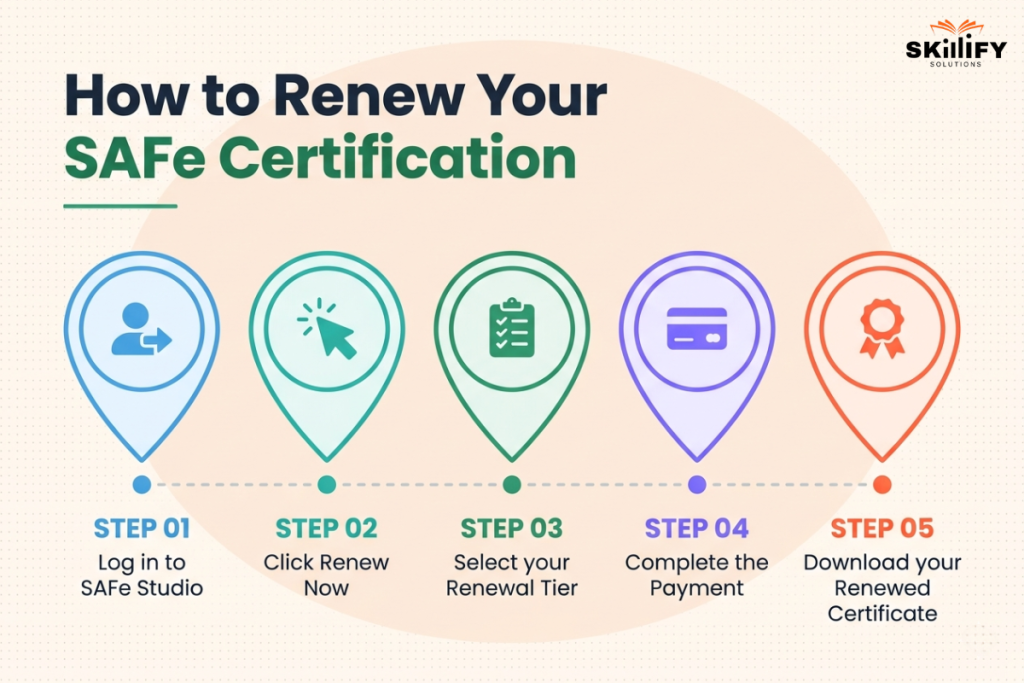
    Renewing your SAFe certification is a simple online process. You only need to log in, check your certification status, select renewal, pay the fee, and confirm the updated validity. Let’s understand the step-by-step approach.  

    Untitled 1200 x 800 px 4 SAFe Certification Renewal Cost: Renewal Fees, Steps, and Expiry Details

    Step 1: Log in to SAFe Studio  

    Start by signing into your Scaled Agile account. This is where you can view your active and expired SAFe certifications. 

    • Go to SAFe Studio  
    • Open your certification dashboard  
    • Check your active or expired certifications  
    • Confirm the certification you want to renew 

    Step 2: Click Renew Now 

    Once your renewal window is open, SAFe Studio will show the renewal option. You can usually find it on the home page or inside subscription details. 

    • Click “Renew Now”  
    • Or go to subscription details  
    • Select the certification due for renewal  
    • Review your current expiry date 

    Step 3: Select your Renewal Tier  

    Your renewal fee depends on your certification tier. Select the right tier, review the fee, and complete the payment online. 

    • Review your renewal fee  
    • Select the correct tier  
    • Add billing details  
    • Complete payment online  
    • Check the confirmation message 

    For DevOps leads and professionals focused on continuous delivery, automation, and faster value flow, Skillify Solutions also offers the SAFe® 6.0 DevOps Certification.

    Step 4: Complete the Payment  

    After successful payment, your certification validity should be updated. You can download the renewed certificate from your certification section. 

    • Go to “My Certs”  
    • Open the renewed certification  
    • Download the updated certificate  
    • Check the new expiry date 

    Step 5: Download your Renewed Certificate  

    After renewal, update your public professional profiles. This helps recruiters, employers, and clients see that your SAFe certification is still active. 

    • Update LinkedIn certificate expiry year  
    • Refresh your digital badge if needed  
    • Add the renewed credential to your resume  
    • Keep proof of renewal for employer records 

    If you are renewing your SAFe Agilist credential, it also helps to understand the full Leading SAFe Certification Cost, including training, exam, and renewal planning.

    What you get after SAFe Renewal  

    Renewing your SAFe certification is not only about extending the expiry date. It also helps you keep your credentials active, continue learning, and show employers or clients that your SAFe knowledge is still current. 

    Active Certification for Another Year  

    After renewal, your SAFe certification stays active for another year. This means your credential remains valid and visible, which is useful when you are applying for jobs, working on Agile projects, or showing proof of your SAFe knowledge to your organization. 

    Continued access to SAFe Studio Learning Resources  

    Renewal also gives you continued access to SAFe Studio learning resources. These resources help you refresh key concepts, understand framework updates, and stay connected with the latest SAFe practices instead of relying only on what you learned during your first training. 

    Updated Certificate and Digital Badge  

    Once the renewal is complete, your certificate and digital badge will be updated with the new validity period. You can download the renewed certificate, update your LinkedIn profile, and add the latest expiry year to your resume or professional portfolio. 

    Access to SAFe Community and Learning Updates  

    You also continue getting access to SAFe community features and learning updates. This can help you stay aware of new SAFe changes, events, resources, and discussions that are useful for Agile professionals who want to keep growing in their role. 

    Build strategic Agile leadership skills with SAFe 6.0 Lean Portfolio Management Certification today!

    What Happens if Your SAFe Certification Expires 

    If your SAFe Certification expires, it no longer shows an active credential. You may still have the knowledge, but your official certification status will not remain valid until you renew it. 

    Your Certification Becomes Inactive  

    Your certification status may show as expired in your SAFe profile or digital badge. This can matter if employers, recruiters, or clients verify your credentials during hiring or project selection. 

    You Lose Access to SAFe Learning Resources 

    Once your certification or membership expires, your access to SAFe Studio learning resources may become limited. This means you may miss updated content, framework changes, and learning materials. 

    Can you Renew an Expired Certification Without an Exam? 

    In many cases, you can renew an expired SAFe certification without retaking the exam. You need to log in to SAFe Studio, check your renewal option, and complete the required payment. 

    A New SAFe Course does not Renew Old Certifications  

    Taking a new SAFe course does not always renew your previous certification. If you want to keep an old credential active, you must renew that specific certification through your SAFe account. 

    Is SAFe Certification Renewal Worth It?  

    Paying the SAFe renewal fee is worth it if you actively work in Agile, Scrum, product management, portfolio management, or enterprise transformation roles. An active SAFe certification shows that your credential is still valid, and your knowledge is updated with the latest SAFe practices. 

    Renewal makes more sense if your job role, employer, client work, or career plan requires SAFe knowledge. It is also useful if you want to show an active certificate on LinkedIn, your resume, or during interviews. 

    Skipping renewal may make sense if you are no longer working in Agile, do not use SAFe in your current role, or do not need the certificate for career growth. In that case, you can avoid the yearly fee. 

    Many professionals keep their SAFe certifications active because it improves credibility, supports career opportunities, and gives continued access to SAFe Studio resources, updates, and community learning. 

    Conclusion 

    It can be concluded that SAFe certification renewal is a simple but important step if you want to keep your credential active. The SAFe Certification needs yearly renewal, and the cost depends on your certification tier: Foundational, Advanced, or Expert. Renewal also helps you keep access to SAFe Studio resources, learning updates, digital badges, and community benefits.

    The process is easy: log in to SAFe Studio, choose your renewal option, pay the fee, and download your renewed certificate. If your certification expires, it may show as inactive, but you can usually renew it without retaking the exam.

    If SAFe is important for your job, career growth, client work, or Agile role, paying the renewal fee is usually worth it.

    Become a stronger Agile leader with SAFe Scrum Master Certification and support high-performing Scrum teams!

    Frequntly Asked Questions

    1.Do I need to retake the exam to renew?

    No. You do not need to retake the SAFe exam to renew your certification. You can renew it through SAFe Studio by paying the applicable renewal fee.

    2.What is the difference between SAFe renewal tiers?

    SAFe renewal tiers are based on the certification level. Foundational is usually for SA, SSM, POPM, SP, and SDP; Advanced is for RTE, SASM, LPM, and similar certifications; Expert is for SPC, ASPC, and SPCT.

    3.Can I renew an expired SAFe certification?

    Yes. Scaled Agile says you can renew an expired certification from SAFe Studio, and there are no late fees or exam retakes required.

    4.How do I renew my SAFe Agilist on SAFe Studio?

    Log in to SAFe Studio, open your certification dashboard, click “Renew” or “Renew Now,” pay the renewal fee, and download the updated certificate.

  • Leading SAFe Certification Cost in 2026: Training Fee, Exam Cost, Renewal, and Hidden Charges

    Leading SAFe Certification Cost in 2026: Training Fee, Exam Cost, Renewal, and Hidden Charges

    Key Highlights

    • Leading SAFe certification cost includes training, exam, study materials, and SAFe Studio access.
    • The SAFe Agilist certification cost for the 2026 exam attempt is usually included in the course fee.
    • Extra Leading SAFe exam fee and costs may include retakes and renewal fees.
    • The leading SAFe training fee in the USA depends on the trainer, support, and batch type.
    • Check the SAFe certification cost and ROI before enrolling for Agile, Scrum, RTE, and Product roles.

    The Leading SAFe Certification Cost in 2026 includes the course cost, exam access, study resources, SAFe Studio membership, and potential future charges such as retakes or renewals. So, if you are comparing providers only by looking at the lowest price on the page, you may miss the real cost behind the certification.

    This is where many learners make the wrong call. They see a discounted course fee and enroll quickly. Later, they start asking the important questions: Is the exam included? Will I get official study material? What happens if I fail? Do I need to pay again next year? 

    These details decide whether the course is truly affordable or only looks affordable at first. This blog breaks it down clearly. You will understand the Leading SAFe certification cost, the training fee, exam cost, hidden charges, provider differences, 3-year cost view, and ROI based on US Agile salary potential.

    By the end, you will know whether Leading SAFe is just another certification expense or a smart career investment. Read on to make the smartest career choice!

    How Much Does Leading SAFe Certification Cost in 2026? 

    Leading SAFe certification cost in 2026 usually depends on the training provider, country, course format, and what is included in the package. Most authorized courses include the training fee, first exam attempt, official study material, and one-year SAFe Studio access. 

    Leading SAFe Training and Exam Cost in the US 

    In the US, the Leading SAFe certification cost usually ranges between $545 and $1,500, depending on the training provider and course format. Some providers show a lower range of around $545 to $910, while broader cost guides mention prices going up to $1,500 for premium instructor-led programs.  

    For learners comparing different Agile paths, Leading SAFe® Certification is usually the foundation-level choice and may suit specific career goals.

    The fee usually covers: 

    • 2 days of instructor-led Leading SAFe training  
    • Official SAFe course materials  
    • First SAFe Agilist exam attempt  
    • One-year SAFe Studio or SAFe Community Platform access  
    • Exam preparation support, depending on the provider 

    Does the course fee include the exam? 

    Yes, in most authorized Leading SAFe training programs, the first SAFe Agilist exam attempt is included in the course fee. This means learners usually do not have to pay separately for the exam after completing the training. 

    Leading SaFe Course by Skillify Solutions clearly mentions that the certification exam fee is included, and there are no hidden exam charges.  

    Why Leading SAFe Prices Vary by Provider 

    Factor Why It Changes the Price 
    Training format Online, classroom, weekday, and weekend batches may have different fees. 
    Trainer expertise Experienced SAFe trainers or SPCs may charge higher fees. 
    Exam inclusion Some providers include the exam fee, while others may charge it separately. 
    Study material Official workbooks, mock tests, and prep resources can affect pricing. 
    Batch size Smaller or corporate batches may cost more than regular public batches. 
    Location US-based training is usually costlier than India-based training. 
    Support offered Mentor support, recordings, career guidance, or doubt sessions can add value. 
    Provider credibility Authorized and well-reviewed providers may charge higher fees. 

    Build sharper product leadership skills with our SAFe Agile Product Management Certification today!

    What is Included in the Leading SAFe Training Fee? 

    The Leading SAFe training fee usually covers the complete learning and certification package, including live training, official SAFe resources, exam access, and SAFe Studio membership. 

    For professionals who want to move deeper into Scrum responsibilities, SAFe® Scrum Master (6.0) Certification is relevant. It can help build stronger skills in team facilitation, Agile execution, and Scrum practices at scale.

    image 68 Leading SAFe Certification Cost in 2026: Training Fee, Exam Cost, Renewal, and Hidden Charges

    16 Hours of Live Instructor-Led SAFe Training 

    The course includes 16 hours of live instructor-led SAFe training, delivered through flexible weekday and weekend batches. 

    Included Details 
    Training duration 16 hours 
    Format Live online training 
    Batch options Weekday and weekend batches 
    Credits earned 16 PDUs and 16 SEUs 
    Learning style Case studies, exercises, and SAFe simulations 

    During training, learners are also introduced to practical SAFe execution concepts. To explore the digital side of PI Planning, dependencies, and Agile coordination, read Scaled Agile Framework Tools.

    Official SAFe Workbook and Course Materials 

    Skillify Solutions includes official SAFe learning resources along with team toolkits, templates, and learning paths. These materials help learners understand SAFe concepts, revise after class, and apply the framework in real enterprise Agile environments. 

    First SAFe Agilist Exam Attempt 

    The certification exam fee is included, with no additional exam charges. This means learners get access to the first SAFe Agilist exam attempt as part of the training package. 

    Exam Component Included? 
    SAFe Agilist exam fee Yes 
    First exam attempt Yes 
    Hidden exam charges No 
    Exam prep support Yes 

    One-Year SAFe Studio Membership 

    The course includes a 1-year SAFe Community or SAFe Studio membership, giving learners access to the global SAFe ecosystem, updated resources, webinars, tools, templates, and learning support even after the training is completed. 

    Improve release speed and delivery flow with our leading SAFe DevOps Practitioner Certification Training now!

    Hidden Costs Before You Enroll  

    The Leading SAFe course is an all-inclusive certification package with the exam fee included SAFe Studio access, mentor support, mock tests, and live online training. Still, learners should check possible extra costs like retakes, renewals, internet setup, and preparation time before enrolling. 

    Hidden Cost Estimated US Cost 
    Exam retake fees $50 per retake 
    Annual renewal charges $195 per year 
    Travel and internet expenses $0 travel cost for our live online training; internet cost depends on learner setup 
    Time investment 16 hours live training + extra exam preparation time 

    To avoid retake costs, preparation matters. The SAFe Exam Preparation blog gives practical guidance on how to study, revise, practice, and improve your chances of clearing the exam on the first attempt. 

    Leading SAFe Certification Cost Over 3 Years 

    The total 3-year Leading SAFe certification cost includes the initial training fee, exam access, and annual renewal charges after the first year. Let’s see how it is distributed.  

    Total Cost If You Pass on the First Attempt 

    If you pass the exam on the first attempt, your listed cost remains approximately $427. This includes live instructor-led training, the first certification exam attempt, SAFe Studio access, study resources, mock tests, and mentor support. 

    Total Cost with Exam Retakes 

    If you don’t pass the first attempt, each retake typically costs around $50. You can take multiple retakes, but there may be a waiting period between attempts.  

    How to Save on Leading SAFe Certification Cost 

    You can lower the overall Leading SAFe certification cost by using available discounts, employer support, group enrollment options, and flexible payment plans.  

    Ask Your Employer for Sponsorship 

    Many companies invest in SAFe certification because it helps employees contribute better to Agile teams, PI Planning, Agile Release Trains, and enterprise transformation work. 

    Before enrolling, check with: 

    • Your manager  
    • HR or L&D team  
    • Training and development department  
    • Project or delivery leadership  

    You can explain that the certification is relevant for Agile roles, Scrum Masters, Product Owners, Project Managers, Agile Coaches, and team leads working in scaled Agile environments. 

    Look for Group Discounts 

    If more than one person from your team wants to take the course, ask for group pricing. Training providers often offer better pricing for team enrollments because multiple learners join the same batch. 

    This works well for: 

    • Agile teams  
    • Project teams  
    • Product teams  
    • Scrum Masters and Product Owners  
    • Corporate training batches  

    Group enrollment can help reduce the per-person cost and also make it easier for teams to learn SAFe concepts together. 

    Use Early-Bird Registration Offers 

    Early registration can help you save money when a discounted batch price is available. The Leading SAFe course by Skillify Solutions is currently offered at approximately $427, discounted from around $542. 

    Check Reimbursement Programs 

    Some companies reimburse certification expenses after you complete the course or pass the exam. This can reduce your personal cost significantly. 

    Check whether your company offers: 

    • Learning and development reimbursement  
    • Certification reimbursement  
    • Professional development allowance  
    • Project-based training support  
    • Post-certification fee claims 

    Move from project execution to portfolio strategy with SAFe Lean Portfolio Management Certification today!

    Is Leading SAFe Certification Worth the Cost? 

    Yes. If you are targeting enterprise Agile roles in the US, the certification cost is small compared to the salary potential. 

    For a broader career comparison, read Top Agile Certifications in 2026 to see how Leading SAFe compares with other Agile certifications in terms of role fit, cost, salary potential, and career growth.

    Based on the course fee of approximately $427, even a small salary improvement can recover the investment quickly. 

    Role Approx. US Salary Range Course Cost ROI View 
    Scrum Master $118,000–$128,000/year ~$427 Low cost compared to salary potential 
    Product Owner $111,000–$135,000/year ~$427 Useful for Agile product roles 
    Release Train Engineer $109,000–$125,000/year ~$427 Strong ROI for SAFe-specific roles 
    Agile Coach $113,000–$130,000/year ~$427 High value for leadership roles 
    Program Manager $140,000–$176,000/year ~$427 Helps in scaled Agile delivery roles 

    A Simple ROI View: If certification helps you get even a 1% salary increase on a $100,000 role, that equals $1,000, which is more than the course cost. 

    For senior professionals aiming at portfolio-level decision-making, SAFe® Lean Portfolio Management (6.0) Certification can be a strong next step. It connects Agile execution with strategy, funding, governance, and enterprise outcomes.

    Mistakes to Avoid When Choosing a SAFe Course 

    Many learners compare only the course fee, but the real value depends on what is included, who is teaching, and whether the provider offers proper exam support. 

    Leading SAFe certification cost

    1. Choosing Only by Lowest Price 

    Choosing the cheapest course may save money upfront, but it can reduce learning quality. Check whether the fee includes live training, exam fee, SAFe Studio access, study materials, mock tests, and mentor support. 

    A good way to avoid choosing the wrong course is to first understand the certification path clearly. The What is SAFe Certification guide explains different SAFe credentials, levels, and role-based options.

    2. Ignoring Renewal and Retake Fees 

    The first exam attempt may be included, but retakes and future renewals may cost extra. Always confirm these charges before enrolling, so there are no surprises later. 

    3. Skipping Instructor Quality Checks 

    A good SAFe trainer should explain real-world Agile implementation, PI Planning, ARTs, Lean-Agile leadership, and enterprise transformation clearly. Check trainer experience, reviews, and support quality before booking. 

    For professionals working in delivery, release, automation, or continuous flow, the SAFe 6.0 DevOps Practitioner (SDP) Certification can be useful. You can understand how DevOps practices support faster and more reliable value delivery in SAFe environments.

    Conclusion 

    By now, we have understood that the Leading SAFe certification cost in 2026 is not just about the training fee. The real cost depends on what is included in the course, such as the exam fee, study materials, SAFe Studio access, mock tests, and mentor support. 

    Learners should also check possible extra costs like retakes, renewals, and preparation time before enrolling. The best approach is to compare providers by value, not just price. A course that includes live training, exam support, official resources, and practical guidance can offer better long-term benefits.

    For professionals targeting Scrum Master, Product Owner, Agile Coach, RTE, or enterprise Agile roles, Leading SAFe can be a strong career investment when chosen carefully. 

    Strengthen continuous delivery and DevOps thinking with SAFe DevOps Practitioner Certification Training today!

    Frequently Asked Questions

    1. Is the SAFe exam included in the training fee?

    Yes. For the authorized Leading SAFe course by Skillify Solutions, the first SAFe Agilist exam attempt is included in the training fee. 

    2. What happens if I fail the SAFe exam?

    If you fail the exam, you can retake it. The retake fee is usually around $50 per attempt for most SAFe exams. Multiple attempts are allowed, but waiting periods may apply between repeated attempts.

    3. How much is the SAFe renewal fee?

    Renewal charges can vary by certification and provider information, but many cost references mention around $100–$195 per year for SAFe Agilist renewal. 

    4. Can I get Leading SAFe for free?

    Usually, Leading SAFe is not free because it is an instructor-led certification course with official exam access. However, you may reduce your personal cost if your employer sponsors it, reimburses it, or includes it under a learning and development budget.

    5. Does my employer have to pay for my SAFe certification?

    No, your employer does not have to pay for your certification. But many companies support SAFe training if it helps your role in Agile teams, PI Planning, transformation projects, or leadership development. 

  • SAFe System Architect Role: What They Do, What They Own, and How to Become One

    SAFe System Architect Role: What They Do, What They Own, and How to Become One

    A SAFe System Architect defines the technical vision, guides architecture across the Agile Release Train, and ensures teams build scalable, secure, and reliable systems.

    But the real value of this role is not just in creating architecture diagrams. It is in preventing delivery chaos before it begins. In large SAFe environments, multiple Agile teams work on the same system, and one weak technical decision can quickly become a blocker for everyone.

    We all have seen teams move fast in the beginning, only to slow down later because integrations, NFRs, or architectural runway were not planned properly. 

    That is where the System Architect becomes important. They connect business goals with technical execution, support PI Planning, guide enabler work, and help teams make decisions that hold up over time. This blog breaks down what they do, what they own, and how you can become one. Read on to know more!

    What is a System Architect in SAFe? 

    A System Architect in SAFe is the technical leader responsible for defining, guiding, and communicating the architecture of the system being built by an Agile Release Train (ART). In simple terms, this person ensures that multiple Agile teams are not building disconnected pieces but are working toward a single clear technical direction. 

    The System Architect connects business needs with technical execution. They work closely with Product Management, the Release Train Engineer, Business Owners, and Agile Teams to make sure the solution is scalable, secure, maintainable, and ready for future changes. 

    The SAFe System Architect does not work like a traditional architect who only creates designs and passes them to teams. The role is more hands-on. They guide architectural decisions, support teams during delivery, manage the architectural runway, and help teams avoid technical problems before they slow down development. 

    Professionals who want to understand the SAFe structure before moving into architecture roles can begin with the Leading SAFe 6.0 Agilist Certification. It covers the core SAFe mindset, ARTs, and enterprise agility.

    Where the System Architect Fits in an Agile Release Train 

    In SAFe, the System Architect works at the Agile Release Train (ART) level with two other key roles: the Product Manager and the Release Train Engineer (RTE). Together, they align business priorities, delivery execution, and technical direction. 

    • Product Manager: Decides what to build based on customer needs and business value.  
    • Release Train Engineer: Coordinates Agile teams, manages dependencies, and keeps the ART moving smoothly.  
    • System Architect: Defines how the system should be built, so it remains scalable, secure, reliable, and easy to maintain. 

    The System Architect plays a key role during Agile Transformation. They help multiple Agile teams stay technically aligned while the organization changes how it plans, builds, and delivers value.

    System Architect vs Solution Architect vs Enterprise Architect 

    The terms System Architect, Solution Architect, and Enterprise Architect are often used together, but they do not mean the same thing. The difference mainly comes down to scope. 

    Role Scope Key Responsibility Main Goal 
    System Architect ART or system level Guides architecture for one system or ART Build a scalable, reliable system 
    Solution Architect Large solution level Aligns architecture across multiple systems or ARTs Ensure systems work together smoothly 
    Enterprise Architect Organization level Defines enterprise-wide technology direction Align technology with business strategy 

    Start leading enterprise Agile confidently with a Leading SAFe 6.0 Agilist Certification today!

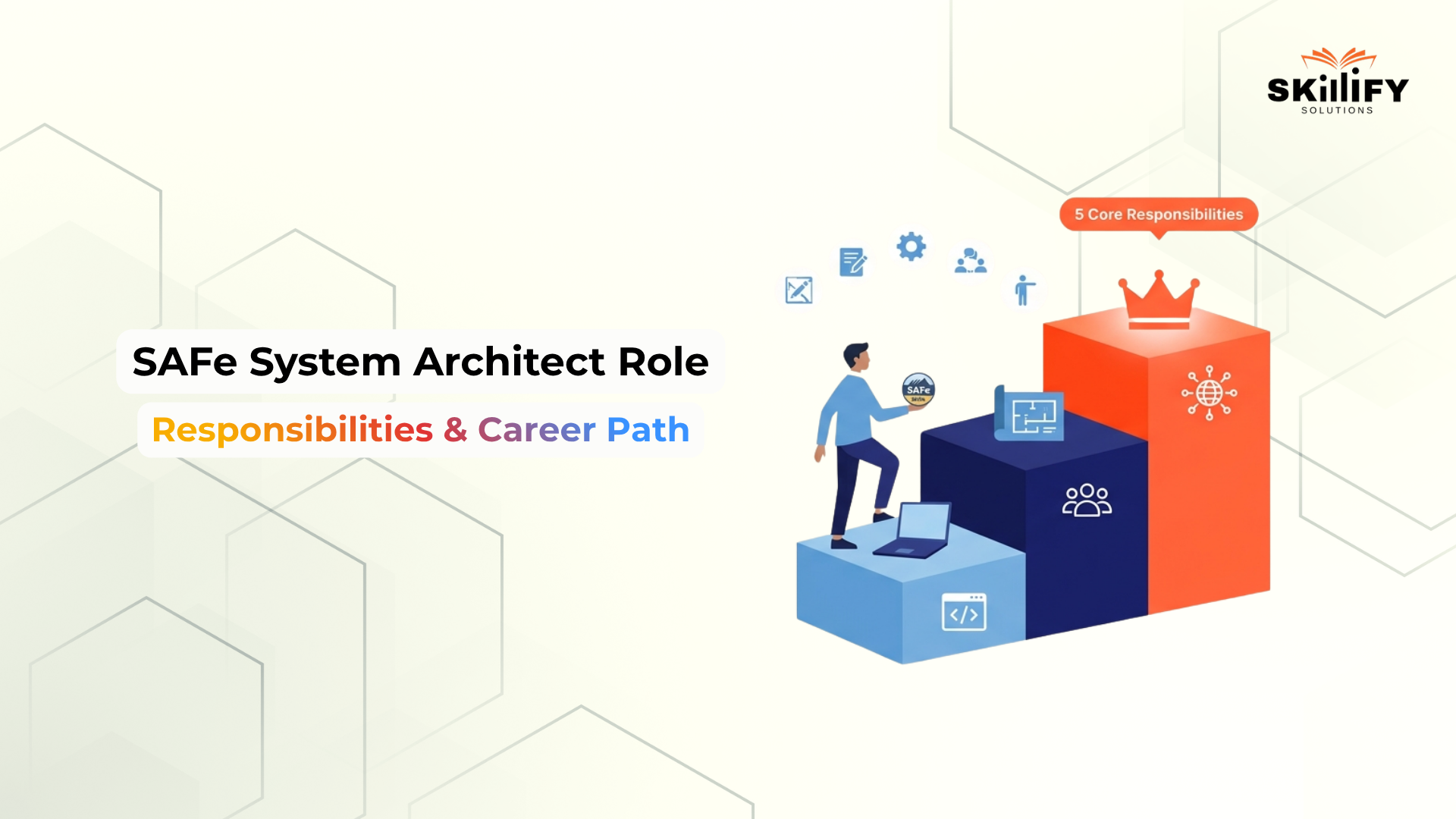
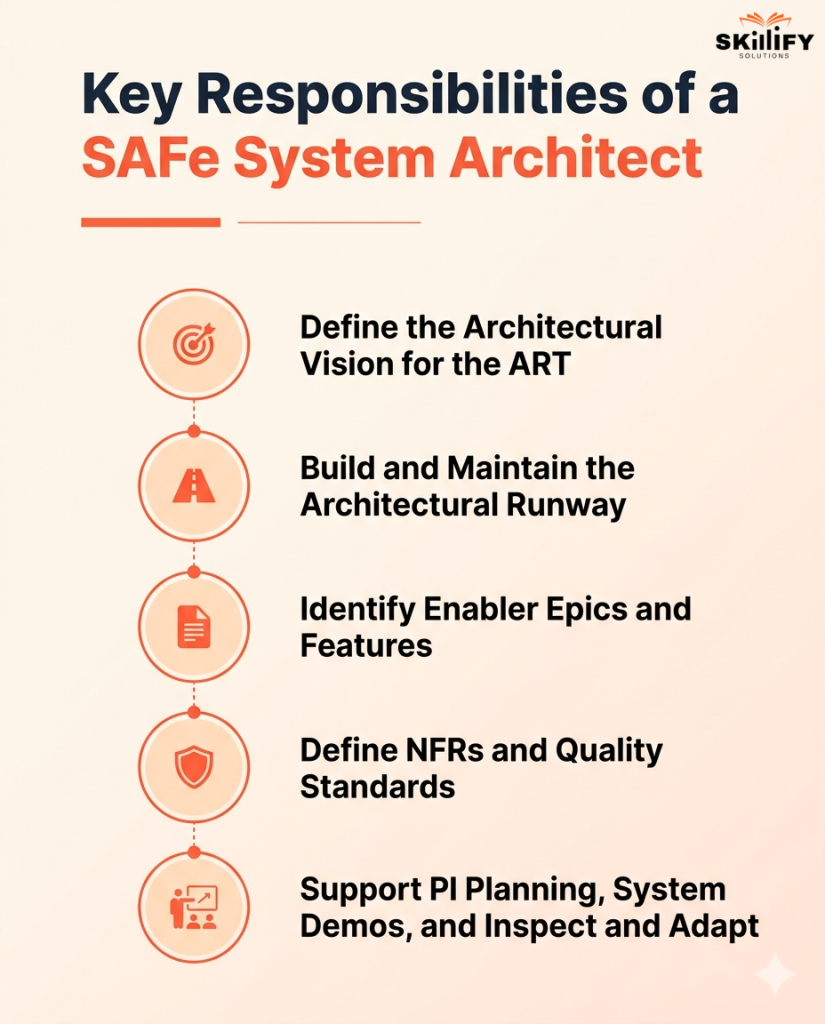
    Key Responsibilities of a SAFe System Architect 

    A SAFe System Architect owns the technical direction of the Agile Release Train. Their role is to keep architecture aligned with business goals, support Agile teams, and make sure the system can scale without slowing delivery. 

    SAFe system architect role

    Define the Architectural Vision for the ART 

    The System Architect defines the architectural vision across the ART, so every Agile team understands the technical direction. This includes key design decisions, system constraints, integration needs, and future scalability requirements.  

    The goal is to make architecture clear, practical, and easy for teams to apply during delivery. 

    Build and Maintain the Architectural Runway 

    The Architectural Runway is the technical foundation that supports upcoming features. The System Architect manages this runway by identifying the infrastructure, design patterns, platforms, APIs, and technical capabilities teams will need in future PIs.  

    A strong runway prevents delivery of bottlenecks because teams do not have to stop mid-development to fix missing architecture. 

    Identify Enabler Epics and Feature 

    The System Architect identifies Enabler Epics and Features that support future business features. These may include architecture improvements, refactoring, infrastructure upgrades, technical exploration, security work, or compliance needs.  

    By placing them in the Program Kanban, the architect ensures technical work is visible, prioritized, and planned for business work. 

    Define NFRs and Quality Standards 

    The System Architect defines non-functional requirements, or NFRs, such as performance, security, reliability, scalability, usability, and compliance. These requirements guide how teams build the system, not just what they build. This helps maintain quality across teams and reduces the risk of technical gaps later. 

    For professionals who want deeper architecture-specific learning, SAFe 6.0 for Architects Certification Training is the most relevant course because it focuses on the architectural runway.

    Support PI Planning, System Demos, and Inspect and Adapt 

    The System Architect actively participates in PI Planning, System Demos, and Inspect and Adapt as a technical leader. In PI Planning, they explain architectural priorities and dependencies.  

    In System Demos, they review whether the solution matches the architecture. In Inspect and Adapt, they help identify technical improvements for the next PI. 

    What Does a SAFe System Architect Do Day to Day? 

    The SAFe System Architect’s weekly work is a mix of architecture planning, team support, technical decision-making, and ART-level collaboration. 

    Working with Product Managers, RTEs, and Business Owners 

    The System Architect works with the Product Manager and RTE to align business goals, delivery flow, and technical direction. 

    • The Product Manager defines what needs to be built.  
    • RTE ensures teams are planned, aligned, and unblocked.  
    • The System Architect defines how the system should be built.  

    Supporting Team Backlog Refinement 

    • The System Architect joins backlog refinement to guide technical clarity without controlling every team-level decision. 
    • Helps teams understand technical dependencies.  
    • Clarifies NFRs, enablers, and architectural priorities.  
    • Supports teams in breaking down complex technical work.  
    • Avoid becoming the final approval point for every decision. 

    Balancing Team Autonomy with System-Level Architecture 

    The System Architect balances team-level flexibility with a clear system-level architecture direction. 

    • Teams can create local design solutions as they build.  
    • The architect ensures those solutions fit the larger system.  
    • Intentional architecture gives long-term technical direction.  
    • This balance helps teams move fast without creating technical debt. 

    Understand Agile team execution better with SAFe 6.0 for Teams Certification today!

    Skills Required for a SAFe System Architect 

    A SAFe System Architect needs technical expertise, Agile leadership, and strong communication skills to guide teams and align architecture with business goals. 

    1. Technical Skills 

    • Designs scalable and reliable systems.  
    • Guides cloud, API, and integration decisions.  
    • Supports DevOps pipelines, CI/CD, and automation.  
    • Helps teams make architecture-ready technical choices. 

    Since the role requires DevOps pipelines, CI/CD, automation, and release readiness, you can go for a SAFe 6.0 DevOps Practitioner Certification.

    2. Agile Leadership and Systems Thinking 

    • Guides teams without controlling every decision.  
    • Facilitates technical discussions across the ART.  
    • Uses systems to manage dependencies and risks.  
    • Encourage collaboration and continuous improvement. 

    3. Communication and Stakeholder Management 

    • Explains architecture in simple business language.  
    • Connects technical decisions with business outcomes.  
    • Shares risks, trade-offs, and dependencies clearly.  
    • Aligns teams, Product Management, RTEs, and leadership. 

    SAFe System Architect Salary and Job Market in the US 

    SAFe System Architect salaries in the US vary by experience, location, industry, and technical depth. Since most salary platforms track the broader Systems Architect role, the range below is a practical estimate for SAFe-related roles. 

    Average SAFe System Architect Salary by Experience 

    Experience Level Average Salary Range 
    Early-level System Architect $130K–$174K 
    Mid-level System Architect $137K–$180K 
    Senior SAFe System Architect $167K–$185K+ 
    Enterprise roles $180K+ 

    Top Industries Hiring SAFe System Architects 

    SAFe System Architects are commonly hired in industries where large systems, compliance, security, and cross-team coordination are important. The strongest demand usually comes from finance, defense, healthcare, and technology companies.  

    This is because these industries often run large Agile Release Trains, manage complex platforms, and need architecture that supports scale, reliability, and regulatory requirements. 

    Become a stronger Agile leader with SAFe Advanced Scrum Master CertificationToday and lead in the future!

    How to Become a SAFe System Architect 

    To become a SAFe System Architect, you need strong technical experience, practical Agile knowledge, and the ability to guide architecture across Agile Release Trains. 

    Prerequisites: Technical Background and Agile Experience 

    Before moving into this role, professionals should have: 

    • Strong experience in software architecture, system design, or enterprise technology.  
    • Working knowledge of Lean-Agile principles.  
    • Experience with Agile teams, ARTs, or PI Planning.  
    • Understanding DevOps, cloud, APIs, integrations, and NFRs.  
    • Ability to connect technical decisions with business value. 

    If you are still comparing learning paths, the Top Agile Certifications guide can help them understand which Agile or SAFe certification fits their current role and future goals.

    Best SAFe Certifications for System Architects 

    The right SAFe certification depends on your current experience and career goals. These courses help build SAFe knowledge, architecture skills, and transform leadership capability. 

    Certification  Best For Why it Helps 
    Leading SAFe® Certification Training Beginners in SAFe roles Builds a foundation in SAFe, ARTs, PI Planning, and Lean-Agile principles. 
    SAFe® for Architects Certification Training System, Solution, and Enterprise Architects Covers architectural runway, enablers, NFRs, and architecture in PI execution. 
    SAFe® DevOps Practitioner Certification Training       Architects, DevOps, and technical leadersHelps architects understand DevOps pipelines, continuous delivery, built-in quality, and release readiness.   

    For professionals who want to strengthen DevOps, CI/CD, built-in quality, and release readiness, the SAFe DevOps Certification guide is a relevant next resource.

    Career Path from System Architect to Solution or Enterprise Architect 

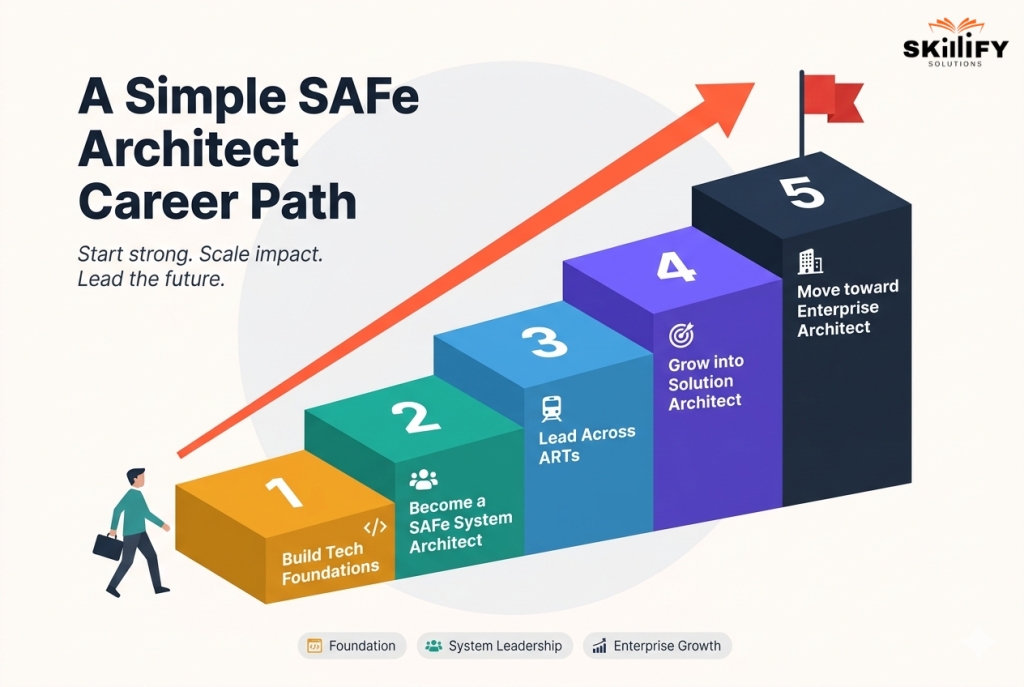
    A common career path starts with a strong technical role such as developer, tech lead, DevOps engineer, or software architect. From there, professionals can move into the SAFe System Architect role, where they guide architecture for one Agile Release Train. 

    Simple SAFe architect Career path

    After gaining experience across multiple systems and ARTs, they can grow into a Solution Architect role. With broader business and technology strategy experience, the next step can be Enterprise Architect, where the focus shifts to organization-wide architecture direction, governance, and long-term technology alignment. 

    As professionals move from System Architect toward Solution Architect or Enterprise Architect roles, SAFe 6.0 for Architects Certification becomes especially useful. It is designed for system, solution, and enterprise architecture responsibilities.

    Conclusion 

     The SAFe System Architect plays an important role in keeping large Agile systems technically strong and delivery-ready. They define the architectural vision, support the architectural runway, guide enabler work, and make sure teams follow important quality standards like security, scalability, performance, and reliability.

    In SAFe, this role is not limited to planning architecture. The System Architect actively supports PI Planning, backlog refinement, System Demos, and Inspect and Adapt sessions. They work closely with Product Managers, RTEs, Business Owners, and Agile Teams to connect business goals with technical execution.

    For professionals with a strong technical background and Agile experience, this can be a valuable career path toward Solution Architect and Enterprise Architect roles.

    Choose your next growth path with our leading  SAFe Certifications for Agile professionals today!

    Frequently Asked Questions

    1. What is the SAFe System Architect role?

    A SAFe System Architect defines the technical vision for an Agile Release Train. They guide architecture decisions, support teams, manage the architectural runway, and make sure the system is scalable, secure, and reliable.

    2. What is the architectural runway in SAFe?

    The architectural runway is the existing technical foundation that supports upcoming features. It includes code, components, infrastructure, APIs, and design patterns that help teams build without major redesign or delay.

    3. How does System Architect differ from Solution Architect?

    A System Architect works at the ART or system level, while a Solution Architect works across larger solutions, often involving multiple systems or ARTs. In simple terms, the System Architect focuses on one system; the Solution Architect focuses on how multiple systems work together.

    4. What certifications does a SAFe System Architect need?

    Useful certifications include Leading SAFe, SAFe for Architects, and SAFe DevOps. Leading SAFe builds SAFe basics and SAFe for Architects from Skillify Solutions. It focuses on architecture in SAFe, and SAFe DevOps helps with continuous delivery and release readiness.

    5. Is the System Architect a full-time role?

    In most large SAFe environments, yes, the System Architect is usually a full-time role because they support ART planning, architecture decisions, enablers, NFRs, PI Planning, and ongoing technical alignment.

    6. What is emergent design in SAFe?

    Emergent design means the design evolves as Agile teams build and learn. Instead of deciding everything up front, teams improve the design based on feedback, while the architect keeps it aligned with the larger system direction.

  • Agile Software Development Life Cycle: 6 Phases, Key Activities, and Tools for Each

    Agile Software Development Life Cycle: 6 Phases, Key Activities, and Tools for Each

    The Agile Software Development Life Cycle is a step-by-step process that helps teams plan, build, test, release, and improve software in short, continuous cycles. Instead of waiting until the end to check whether the product works, Agile teams validate progress throughout the development journey.

    This matters because most software delays do not start with coding. They start with unclear goals, weak planning, late testing, poor communication, or feedback that comes too late. Agile SDLC solves this by breaking the project into manageable phases where every stage has a clear purpose.

    From defining the product vision to planning sprints, developing features, releasing software, fixing bugs, and finally retiring outdated systems, Agile keeps teams aligned and flexible. 

    In this blog, we will explain the 6 phases of the Agile Software Development Life Cycle, key activities in each phase, and the tools teams use to deliver better software faster. Read on to know more!

    What is the Agile Software Development Life Cycle (SDLC)?  

    The Agile Software Development Life Cycle (Agile SDLC) is a flexible, iterative approach to software development in which applications are built through small, continuous releases called sprints or iterations. Instead of developing the entire product at once, Agile focuses on delivering working software regularly, collecting feedback quickly, and improving the product throughout the development cycle. 

    To understand the broader concept behind this approach, you can also read our detailed guide to Agile Software Development, where we explain Agile principles and frameworks, and how teams use them in real projects.

    Agile SDLC is designed to help teams adapt to changing business requirements, reduce development risks, improve collaboration, and release software faster. Teams work in short cycles that typically include planning, development, testing, review, and deployment. 

    Unlike traditional SDLC models such as Waterfall, Agile does not follow a rigid step-by-step process. In Agile, development, testing, and feedback happen continuously throughout the project. 

    Some of the most used Agile frameworks include Scrum, Kanban, SAFe, and Extreme Programming (XP). You can learn them practically from the SAFe Scrum Master Certification and understand how Agile works across teams, programs, and larger organizations.

    Agile SDLC vs Waterfall SDLC: Key Differences  

    Aspect Agile SDLC Waterfall SDLC 
    Development Approach Iterative and incremental Sequential and linear 
    Flexibility Highly flexible to changes Difficult to make changes after development starts 
    Delivery Style Frequent small releases One final release at the end 
    Customer Involvement Continuous feedback and collaboration Limited involvement after requirement gathering 
    Testing Continuous testing during development Testing happens after the development phase 
    Planning Adaptive and sprint-based Fixed planning at the beginning 
    Risk Management Risks identified early through iterations Risks discovered later in the cycle 
    Time to Market Faster releases Slower release cycles 
    Documentation Lightweight and focused Heavy documentation 
    Best For Dynamic and fast-changing projects Stable projects with fixed requirements 

    Strengthen product strategy skills with SAFe 6.0 Agile Product Management Certification Training today!

    Why Agile SDLC is Iterative Instead of Sequential  

    Agile SDLC is iterative because software is developed in short cycles where teams continuously build, test, review, and improve the product. This helps teams adapt quickly to changes and user feedback. 

    The Waterfall model is sequential because each phase follows a fixed order, such as planning, development, testing, and deployment. Changes are difficult once development begins, making it less flexible than Agile. 

    The 6 Phases of the Agile Software Development Life Cycle  

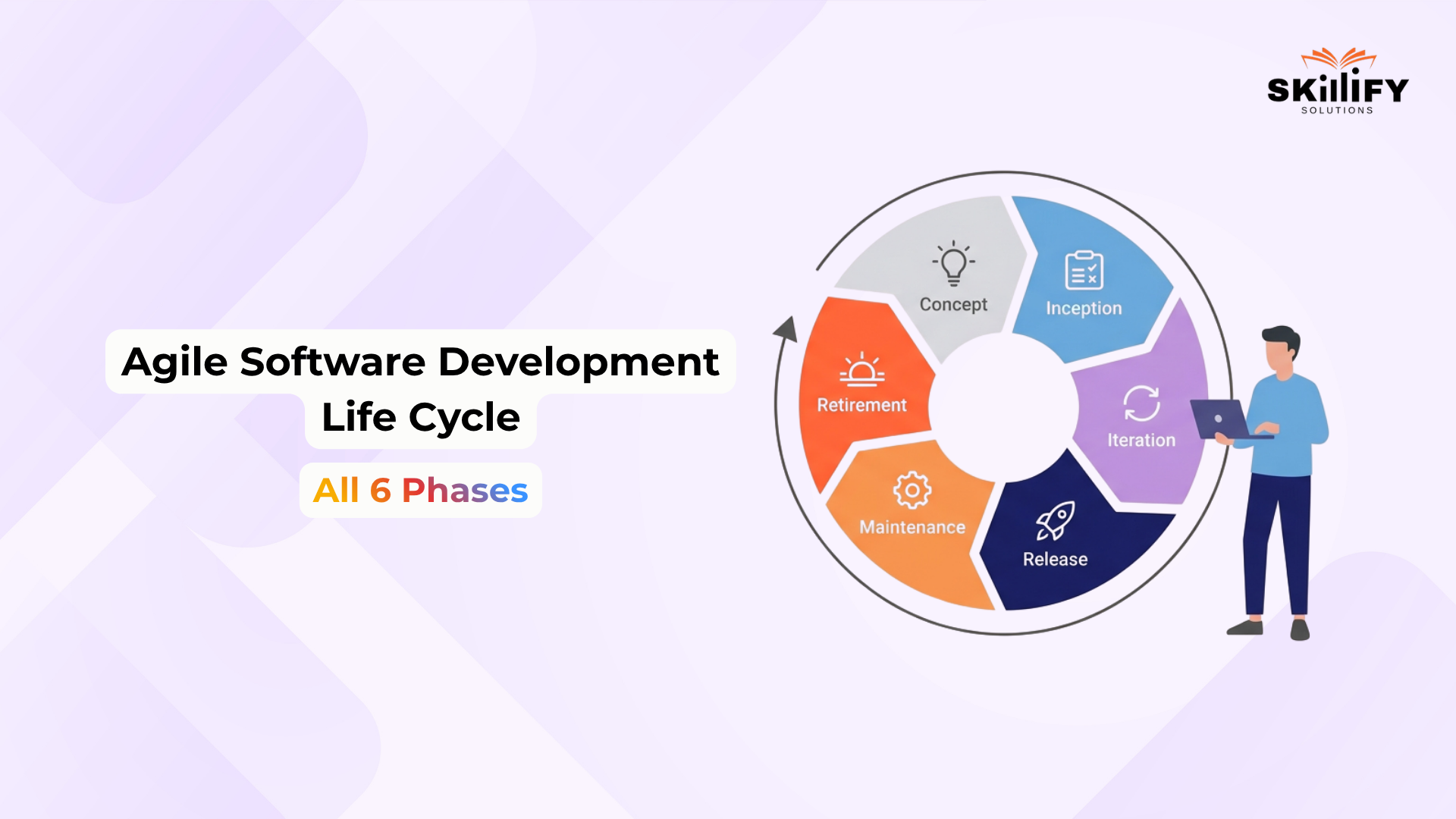
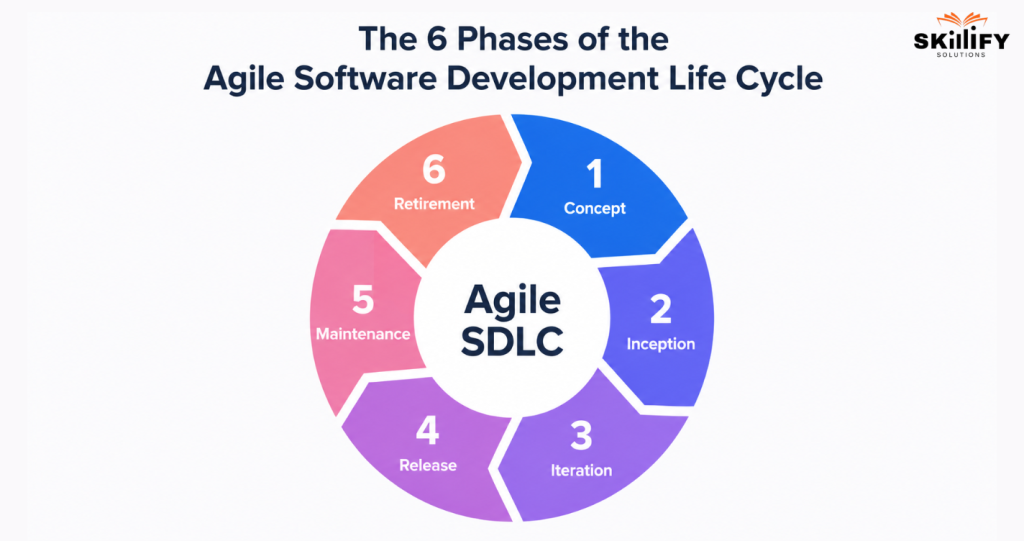
    The Agile Software Development Life Cycle consists of six stages that help teams build, test, release, and improve software continuously. Unlike traditional development models, Agile focuses on short sprint cycles, continuous feedback, and iterative improvements. 

    agile software development life cycle

    Phase 1: Concept and Product Vision  

    The Concept phase is where the idea is evaluated before development begins. Teams define product vision, business goals, target users, estimated timeline, and project feasibility. 

    The focus at this stage is to validate whether the project is worth building and what business problems it will solve. 

    Key activities: 

    • Defining the product vision  
    • Identifying business goals and KPIs  
    • Estimating cost and timeline  
    • Conducting feasibility analysis  
    • Making the go/no-go decision  

    Outputs: 

    • Project charter  
    • Business case  
    • Initial feasibility assessment 

    Phase 2: Inception and Sprint Planning  

    In the Inception phase, the project moves from idea to execution planning. Teams are assembled, product requirements are discussed, and the initial backlog is created. 

    User stories, feature priorities, sprint plans, and design mockups are prepared before development starts.  

    Key activities: 

    • Building the Agile team  
    • Creating the product backlog  
    • Writing user stories  
    • Planning sprint cycles  
    • Preparing UI/UX mockups  

    Outputs: 

    • Initial product backlog  
    • Sprint roadmap  
    • User stories and prototypes 

    Phase 3: Iteration and Continuous Development  

    The Iteration phase is the core development stage of Agile SDLC. Teams work in short sprints where development, testing, integration, and feedback happen continuously. 

    Each sprint delivers a working software increment that is reviewed and improved in the next cycle.  

    Key activities: 

    • Sprint planning  
    • Software development  
    • Continuous testing  
    • Daily stand-ups  
    • Sprint reviews and retrospectives  

    Common tools: 

    • GitHub  
    • Jira  
    • Jenkins  
    • Selenium  
    • Postman  

    Outputs: 

    • Working software increment  
    • Updated backlog  
    • Sprint feedback and improvements 

    For developers who want to understand how Agile development works in real projects, a full-stack development bootcamp can be a useful starting point because it focuses on practical software development skills used during the iteration phase.

    Phase 4: Release and Deployment  

    In the Release phase, the tested software is prepared for deployment. Teams conduct final QA checks, fix critical bugs, complete user acceptance testing (UAT), and prepare deployment documentation.  

    Many Agile teams also perform beta testing or soft launches before full production deployment. 

    Key activities: 

    • Final testing and bug fixing  
    • User Acceptance Testing (UAT)  
    • Deployment preparation  
    • Release documentation  
    • Performance validation  

    Outputs: 

    • Production-ready software  
    • Deployment plan  
    • UAT approval 

    Phase 5: Maintenance and Continuous Improvement  

    After deployment, the software enters the maintenance phase. Teams monitor system performance, fix bugs, improve features, and release updates based on user feedback.  

    Agile teams continuously improve the product instead of waiting for major release cycles. 

    Key activities: 

    • Monitoring application performance  
    • Fixing bugs and issues  
    • Releasing feature updates  
    • Collecting customer feedback  
    • Optimizing system performance  

    Common tools: 

    • Sentry  
    • Grafana  
    • Azure Monitor  
    • New Relic  

    Outputs: 

    • Bug fixes  
    • Product improvements  
    • Updated backlog items 

    Start your Agile career journey with a leading Scrum Master Bootcamp with AI today!

    Phase 6: Retirement and Product Sunset  

    The Retirement phase begins when the software is no longer needed or is replaced by a newer system. Teams safely migrate to users, archive important data, and decommission the old application without disrupting operations.  

    Key activities: 

    • User migration  
    • Data archiving  
    • Infrastructure shutdown  
    • Compliance handling  
    • Product decommissioning  

    Outputs: 

    • Safe product retirement  
    • Archived system data  
    • Successful user transition 

    Tools Used in Each Agile SDLC Phase

    Agile teams use different tools throughout the Software Development Life Cycle to manage projects, collaborate with teams, automate deployments, test applications, and monitor software performance. These tools help teams improve productivity, maintain software quality, and deliver applications faster. 

    Tool Category Tools Used For Common Agile SDLC Phases 
    Project Management and Collaboration Jira, Trello, Confluence, Miro, Slack Sprint planning, backlog management, documentation, brainstorming, and team communication Concept, Inception, Iteration 
    Version Control and CI/CD GitHub, GitLab, Jenkins, Docker, Kubernetes Source code management, automated builds, CI/CD pipelines, containerized deployment Iteration, Release 
    Testing and Monitoring Selenium, Cypress, Postman, SonarQube, Grafana, Sentry Automated testing, API testing, code quality checks, performance monitoring, error tracking Iteration, Release, Maintenance 

    How Testing Fits into Every Agile SDLC Phase  

    In Agile SDLC, testing starts early and continues throughout development. Instead of waiting until the end, teams test requirements, user stories, code, performance, and releases at every stage. This helps identify defects faster, reduce rework, and deliver better-quality software. 

    Agile SDLC Phase Testing Focus 
    Concept Validate goals, risks, and user needs 
    Inception Review user stories and acceptance criteria 
    Iteration Run unit, API, integration, and regression tests 
    Release Perform UAT, final QA, and performance testing 
    Maintenance Monitor bugs, errors, and system performance 
    Retirement Test data migration and system shutdown 

    Build job-ready development skills with our leading Full Stack Development Bootcamp with AI now!

    Shift-Left Testing in Agile Development  

    Shift-left testing means QA starts from the early planning stage, not after development. Testers help review requirements, define acceptance criteria, and identify risks before coding begins. 

    This prevents unclear requirements, reduces late-stage bugs, and improves software quality from the first sprint. 

    Continuous Testing in CI/CD Pipelines  

    During iteration, automated tests run whenever developers commit code. CI/CD pipelines help teams check builds, catch bugs early, and release stable software faster. 

    Common tests include unit tests, API tests, integration tests, regression tests, and security checks. If you want to understand how automation improves Agile testing speed, accuracy, and release confidence, read our guide on Agile Test Automation.

    Agile SDLC in SAFe (Scaled Agile Framework)  

    In SAFe, the Agile SDLC is applied at a larger scale through a Program Increment (PI). A PI is a fixed planning cycle, usually 8 to 12 weeks, where multiple Agile teams plan, build, test, integrate, and deliver value together. 

    Instead of one team working through Agile phases, SAFe helps many teams follow the same rhythm across planning, development, release, feedback, and improvement. Here, Leading SAFe 6.0 Training becomes important because they focus on PI Planning, Agile Release Trains, team alignment, and value delivery at scale.

    Agile SDLC Phase How It Maps in SAFe 
    Concept Business goals, product vision, and roadmap are discussed 
    Inception PI Planning defines features, dependencies, risks, and sprint goals 
    Iteration Agile teams build and test features during iterations 
    Release Integrated work is reviewed through System Demo 
    Maintenance Feedback, defects, and improvements are added to the backlog 
    Retirement Outdated features or systems are removed based on business need 

    How PI Planning Fits into Agile SDLC  

    PI Planning acts like a combined Concept and Inception phase in SAFe. Teams discuss business priorities, define objectives, plan upcoming iterations, identify dependencies, and align on what needs to be delivered in the Program Increment. 

    It helps all teams start with a shared vision, clear priorities, and a realistic delivery plan. Product owners and managers involved in prioritization, roadmap planning, and feature delivery can explore SAFe 6.0 Agile Product Management to understand how product strategy connects with Agile execution.

    System Demo, Inspect, and Adapt in Agile 

    The System Demo is like the Release phase because it shows the integrated, working software built during the PI. It helps stakeholders review progress and give feedback. 

    The Inspect & Adapt event aligns with the Maintenance and improvement phase. Teams review results, identify problems, analyze what went wrong, and decide what should improve in the next PI. 

    For large Agile teams, PI Planning becomes more effective when value streams are clearly identified. You can learn this concept in detail in our Study on SAFe Value Stream Mapping.

    Common Agile SDLC Mistakes and How to Avoid Them  

    Agile can fail when teams follow the ceremonies but miss the mindset behind them. The goal is not just to run sprints or daily stand-ups, but to build better software through clear priorities, continuous feedback, testing, and improvement. 

    agile software development life cycle
    • Poor sprint planning: When sprint goals are unclear, teams lose direction, and deadlines get missed. To avoid this, define a clear sprint goal, break large tasks into smaller stories, and plan based on real team capacity.  
    • Weak backlog prioritization: If everything looks urgent, teams may spend time on low-value features. Product owners should regularly refine the backlog and prioritize work based on user value, business impact, and technical importance.  
    • Limited customer feedback: Agile depends on feedback. Without regular input from users or stakeholders, teams may build features that do not solve the real problem. Sprint reviews, user testing, and feedback sessions should be part of the process.  
    • Skipping testing until later: Delayed testing creates more bugs, rework, and release pressure. Agile teams should test continuously through unit tests, API tests, regression testing, and QA involvement from the early phases.  
    • Poor communication between teams: Agile needs strong collaboration. If developers, testers, designers, and product owners work in silos, blockers stay hidden. Daily stand-ups, clear ownership, and shared tools help teams stay aligned.  
    • Ignoring technical debt: Moving fast without refactoring or code reviews can make the product harder to maintain. Teams should include code quality checks, refactoring, and technical improvements in every sprint.  
    • Treating Agile as only a process: Agile is not just about meetings or tools. It is a mindset based on adaptability, collaboration, customer value, and continuous improvement. 
    • Teams should focus on outcomes, not just completing sprint tasks. Programs like SAFe Advanced Scrum Master can help professionals improve sprint planning, team communication, backlog discipline, and continuous improvement practices.

    Conclusion 

     The Agile Software Development Life Cycle helps teams build software in a faster, smarter, and more flexible way. Instead of following a fixed step-by-step model, Agile allows teams to plan, develop, test, release, and improve software through continuous cycles. 

    Each phase, from Concept to Retirement, plays an important role in reducing risk, improving collaboration, and delivering value to users.

    With the right tools, clear sprint planning, continuous testing, and regular feedback, Agile teams can build better products with fewer surprises. 

    The key is not just to follow Agile meetings or processes, but to use Agile as a system for learning, improving, and delivering working software consistently. This makes Agile SDLC a practical approach for modern software development.

    Become a stronger Agile leader with SAFe 6.0 Advanced Scrum Master CertificationTraining today!

    Frequently Asked Questions

    1. What are the phases of the Agile SDLC?

    The six phases of the Agile SDLC are Concept, Inception, Iteration, Release, Maintenance, and Retirement. These phases help teams plan, build, test, release, improve, and eventually retire software in a structured way.

    2. How is Agile SDLC different from Waterfall?

    Agile SDLC is iterative and flexible, while Waterfall is sequential and fixed. In Agile, teams build software in small cycles and take continuous feedback. In Waterfall, each phase is completed one after another, and changes are harder to make later.

    3. What tools are used in the Agile development life cycle?

    Common tools used in Agile SDLC include Jira, Trello, Confluence, GitHub, GitLab, Jenkins, Docker, Kubernetes, Selenium, Postman, SonarQube, Grafana, and Sentry. These tools help with planning, coding, testing, deployment, and monitoring.

    4. What is an iteration in Agile SDLC?

    An iteration in Agile SDLC is a short development cycle where teams plan, build, test, and review a small part of the software. Each iteration usually delivers a working software increment that can be improved in the next cycle.

    5. How does SAFe fit into the Agile SDLC?

    SAFe, or Scaled Agile Framework, helps large organizations apply Agile SDLC across multiple teams. SaFe certifications from Skillify Solutions teach program Increments, PI Planning, System Demos, and Inspect and Adapt sessions practically. 

    6. Can Agile SDLC be used for non-software projects?

    Yes, Agile SDLC can be used for non-software projects. Teams in marketing, product design, operations, education, and business planning use Agile methods to manage work in short cycles, collect feedback, and improve continuously.

  • Agile Transformation: Why 47% of Organizations Fail and How to Succeed

    Agile Transformation: Why 47% of Organizations Fail and How to Succeed

    Agile transformation fails when organizations mistake activity for progress. More standups, more sprint boards, and more Agile terminology do not automatically create agility.

    We all have worked with teams that looked perfectly Agile from the outside but were internally struggling with slow decisions, leadership bottlenecks, conflicting priorities, and employee burnout. The ceremonies existed, but the mindset did not. That gap is the reason nearly half of Agile transformations fail.

    Successful Agile transformation is not about copying Spotify models or implementing SAFe overnight. It is about building leadership alignment, empowering teams, redesigning governance, and focusing relentlessly on customer value. 

    This blog will show you where organizations fail, what successful enterprises do differently, and how to approach Agile transformation realistically instead of treating it like another management trend.

    What is Agile Transformation? 

    Agile transformation is the process of changing how an organization works, delivers value, and responds to change using Agile principles. It is not just about using Scrum, Jira, or daily standups. A real Agile transformation changes team collaboration, leadership, decision-making, delivery processes, and company culture. 

    ewrf 1 Agile Transformation: Why 47% of Organizations Fail and How to Succeed

    Many organizations fail because they adopt Agile practices at the team level while keeping traditional management structures and rigid workflows unchanged. Successful Agile transformation focuses on both mindset and organizational change. 

    Agile transformation impacts multiple areas of an organization, including team collaboration, leadership and governance, product delivery processes, customer feedback systems, and continuous improvement of culture. Its goal is to build business agility across departments so organizations can respond faster to market changes and customer needs. 

    Modern enterprises increasingly adopt Agile Methodology in Project Management to improve delivery flexibility, stakeholder collaboration, and faster response to changing business requirements.

    Agile Transformation vs Agile Adoption: Key Differences 

    Many organizations confuse Agile adoption with Agile transformation, which often leads to failed Agile initiatives. 

    Agile Adoption Agile Transformation 
    Focuses on Agile practices and tools Focuses on organizational and cultural change 
    Limited to development teams Involves leadership, teams, and business units 
    Teams do AgileOrganization becomes Agile
    Measures output and velocity Measures business value and outcomes 
    Short-term process improvement Long-term business agility 

    Become an enterprise Agile leader with the Leading SAFe Certification program today.

    What Successful Agile Transformation Looks Like 

    A successful Agile transformation creates alignment across teams, programs, and leadership to improve speed, collaboration, and value delivery. 

    Level What Success Looks Like 
    Team Level Cross-functional teams deliver work in short iterations and continuously improve 
    Program Level Multiple teams align through Agile Release Trains (ARTs) and shared goals 
    Portfolio Level Leadership aligns strategy, funding, and governance with business outcomes 

    The 4 Stages of Agile Transformation 

    Most Agile transformations succeed when organizations scale Agile gradually instead of forcing company-wide change at once. The transformation typically moves through four key stages: leadership alignment, pilot launches, enterprise scaling, and continuous improvement. 

    Stage 1: Inspire Change Through Leadership Alignment 

    The first stage focuses on creating awareness about why change is needed and securing executive support. Organizations identify business challenges, define transformation goals, and train leadership on Agile principles and mindset.  

    Strong leadership alignment is critical because most Agile transformations fail without executive commitment. Many enterprises start leadership alignment using programs like Leading SAFe Certification to help executives understand Lean-Agile leadership and Business Agility at scale.

    Stage 2: Launch Agile Teams and Pilot ARTs 

    In this stage, organizations launch pilot Agile teams and initial Agile Release Trains (ARTs) to test Agile practices on a smaller scale. Teams begin working in sprint cycles, participating in Agile ceremonies, and improving collaboration through PI Planning and backlog management. 

    Stage 3: Scale Agile with SAFe, SPCs, and RTEs 

    Once pilot teams show positive results, organizations start scaling Agile across departments using frameworks like SAFe. This stage introduces roles such as SPCs and Release Train Engineers (RTEs) to improve coordination, cross-team collaboration, and enterprise-level alignment. 

    Certifications like SAFe Release Train Engineer (RTE) and SAFe Program Consultant (SPC) from Skillify Solutions are commonly used to prepare transformation leaders for enterprise-level Agile scaling.

    Stage 4: Optimize Through Continuous Improvement 

    The final stage focuses on improving delivery performance, customer value, and organizational adaptability through continuous learning and feedback. Agile becomes part of the company culture, with teams regularly measuring outcomes, optimizing workflows, and driving continuous improvement. 

    Why Agile Transformations Fail 

    Many Agile transformations fail because organizations focus on Agile tools and frameworks while ignoring leadership, culture, mindset, and organizational change. Industry studies show that transformation failures are usually caused by people and process issues rather than technology problems. 

    1. Lack of Leadership Commitment and Executive Buy-In 

    Insufficient leadership commitment is one of the top reasons Agile transformations fail. According to McKinsey, nearly 63% of failed transformations are linked to weak executive support. 

    • Leaders support Agile verbally, but continue traditional management styles  
    • Teams receive mixed directions and priorities  
    • Decision-making remains slow and hierarchical 

    Build customer-focused Agile products with the SAFe Agile Product Manager certification now!

    2. Treating Agile as a Process Instead of a Mindset 

    Many organizations treat Agile or SAFe as a checklist of ceremonies instead of a cultural and mindset shift. Building a strong Lean Agile Mindset helps organizations move beyond ceremonies and focus on collaboration, adaptability, customer value, and continuous improvement.

    • Teams follow standups and sprint planning mechanically  
    • Collaboration and leadership behavior remain unchanged  
    • Focus stays on process compliance instead of adaptability 

    Teams that invest in practical Agile education programs, such as the Scrum Master Bootcamp, often build a stronger Agile mindset adoption instead of mechanically following ceremonies.

    3. Ignoring Organizational Structure and Governance Changes 

    Agile transformation often fails when companies keep traditional hierarchies and siloed structures. 

    • Teams lack decision-making autonomy  
    • Governance and funding models stay rigid  
    • Cross-functional collaboration becomes difficult 

    4. Measuring Output Instead of Business Value 

    Many organizations measure velocity and story points instead of customer value and outcomes. 

    • Teams focus on completing more tasks  
    • Customer impact and business goals get ignored  
    • Productivity is prioritized over innovation and value delivery 

    5. Resistance to Cultural Change Across Teams 

    Agile changes how people work, collaborate, and communicate, which often creates resistance. 

    • Employees fear uncertainty and role changes  
    • Middle management may resist the loss of control  
    • Poor communication slows adoption across teams 

    6. Scaling Agile Without Proper Coaching or Training 

    • Organizations often scale Agile too quickly without investing in coaching and education. 
    • Teams adopt Agile terminology without understanding principles  
    • Agile practices become inconsistent across departments  
    • Leadership and teams struggle with alignment 

    Programs like SAFe Advanced Scrum Master (SASM) help Scrum Masters and Agile leaders improve facilitation, coaching, and cross-team collaboration during large-scale transformations.

    7. Focusing on Tools Instead of Customer Outcomes 

    Many companies focus heavily on Agile tools and dashboards while ignoring customer value. 

    • Tools become the center of transformation efforts  
    • Customer feedback loops remain weak  
    • Business outcomes and adaptability are overlooked 

    Agile Transformation Roadmap: Step-by-Step Approach 

    Successful Agile transformations usually follow a gradual roadmap instead of forcing Agile across the entire organization at once. The focus should be on leadership alignment, pilot implementation, continuous improvement, and measurable business outcomes. 

    asff Agile Transformation: Why 47% of Organizations Fail and How to Succeed

    Step 1: Assess Agile Maturity and Current Challenges 

    The first step is assessing Agile maturity, team structure, workflows, and baseline metrics like delivery speed, customer satisfaction, and release cycles. This helps organizations identify bottlenecks and prioritize improvements. 

    For example, a healthcare company may discover that slow approvals and siloed teams are delaying product releases. 

    Become a high-impact Scrum leader with the practical Scrum Master Bootcamp program today!

    Step 2: Train Leadership Before Teams 

    Executive coaching should happen before team-level Agile training because leadership behavior directly impacts the transformation of success. If leaders continue using traditional management styles, Agile teams struggle to adapt. 

    For example, many organizations fail because leadership still measures teams by deadlines and output instead of adaptability and customer value. Many organizations begin this phase with Leading SAFe Certification training to align executives, managers, and transformation leaders around Agile principles and enterprise agility.

    Step 3: Choose the Right Agile Framework 

    Organizations should choose frameworks based on business size and complexity. SAFe works well for large enterprises, LeSS focuses on simplified large-scale Scrum, while Disciplined Agile offers flexible hybrid approaches. 

    For example, a global enterprise may choose SAFe for portfolio-level coordination, while a smaller product company may prefer LeSS for simpler scaling. 

    Step 4: Launch the First Agile Release Train (ART) 

    Most organizations begin scaling Agile by launching their first Agile Release Train (ART). This includes defining team roles, conducting PI Planning, aligning sprint goals, and setting a clear Definition of Done. These roles are often supported through the SAFe Advanced Scrum Master Certification.

    For example, a retail company may first launch an ART for its e-commerce platform before scaling Agile across departments. 

    Step 5: Measure Progress and Continuously Improve 

    Agile transformation should be measured continuously using OKRs, flow metrics, customer outcomes, and employee sentiment instead of only velocity or story points. 

    Teams also improve delivery predictability by adopting modern Agile Estimation Techniques that focus on value, complexity, and sprint planning accuracy instead of unrealistic deadline-based estimation.

    For example, a software company may track release frequency, employee engagement, and customer satisfaction to measure real business impact

    SAFe vs LeSS vs Disciplined Agile: Which Framework is Right? 

    Choosing the right Agile framework depends on your organization’s size, structure, complexity, and business goals. While SAFe, LeSS, and Disciplined Agile all help scale Agile practices, each framework follows a different approach to team alignment, governance, and enterprise agility. 

    Framework Best For Key Focus Advantages Challenges 
    SAFe (Scaled Agile Framework) Large enterprises Enterprise coordination and governance Strong alignment, portfolio visibility, and cross-team collaboration Can feel complex and process-heavy 
    LeSS (Large-Scale Scrum) Product-focused organizations Simplicity and Scrum scaling Lightweight structure and strong team autonomy Harder to manage at a very large scale 
    Disciplined Agile (DA) Flexible and hybrid environments Customized Agile ways of working Highly adaptable and supports hybrid models Requires experienced Agile leadership 

    Agile Transformation Certifications by Role 

    Successful Agile transformations require skilled leaders, coaches, Scrum Masters, and change agents who understand Agile frameworks at scale. Certifications help professionals build practical knowledge in Agile leadership, Lean governance, PI Planning, Agile coaching, and enterprise transformation. 

    Different certifications are designed for different roles within an Agile transformation journey. 

    Certification Best For Focus Areas Career Benefit 
    Leading SAFe Executives and change leaders Lean-Agile leadership and Business Agility Helps leaders drive Agile transformation 
    Scrum Master BootcampScrum Masters, team leads, and Agile beginnersScrum framework, Agile mindset, team facilitationBuilds strong Agile execution and team collaboration skills
    SAFe Advanced Scrum Master (SASM) Scrum masters and team lead Agile facilitation and team coaching Improves Agile team execution 
    SAFe LPM Portfolio managers and senior leadership Lean governance, portfolio strategy, and funding alignmentAligns business strategy with value delivery 
    SAFe Agile Product ManagerProduct managers and business stakeholdersCustomer-centric product strategy and Agile product deliveryHelps teams build value-driven products at scale 

    Organizations investing in enterprise transformation often combine role-based learning with industry-recognized programs. Exploring the Top Agile Certifications can help leaders and teams choose the right certification path based on their transformation goals.

    Conclusion 

    Agile transformation is not just about adopting Scrum, SAFe, or running daily standups. It is a long-term shift in how organizations lead teams, deliver value, and respond to change. Many transformations fail because companies focus only on processes and tools while ignoring leadership alignment, culture, governance, and customer outcomes.

    Successful organizations approach Agile transformation step by step. They train leaders first, start with pilot teams, measure business value instead of output, and continuously improve through feedback and learning. 

    Ultimately, Agile transformation works best when organizations stop treating Agile as a project and start treating it as a cultural and business evolution.

    Advance your Agile coaching skills through the SAFe Advanced Scrum Master (SASM) training today!

    Frequently Asked Questions

    1. How long does agile transformation take?

    Agile transformation usually takes between 1 and 3 years, depending on the organization’s size, structure, and goals. Smaller companies may adapt faster, while large enterprises often require phased implementation and cultural change over time.

    2. What is the role of leadership in agile transformation?

    Leadership plays a critical role in Agile transformation by driving vision, removing organizational barriers, and supporting cultural change. Without executive alignment and continuous support, most Agile transformations struggle to succeed.

    3. What is the difference between agile transformation and digital transformation?

    Agile transformation focuses on improving how teams work, collaborate, and deliver value using Agile principles. Digital transformation focuses on using technology and digital solutions to improve business operations, customer experience, and innovation.

    4. Which SAFe certification is best for transformation leaders?

    The Leading SAFe and SAFe Advanced Scrum Master Certifications from Skilly Solutions are considered the best certifications for transformation leaders. These certifications focus on Lean-Agile leadership, enterprise transformation, and scaling Agile across organizations.

    5. What metrics show agile transformation is working?

    Successful Agile transformation is usually measured through faster delivery, improved customer satisfaction, better employee engagement, reduced cycle time, and stronger business outcomes.

  • How to Split User Stories: 10 Agile Techniques with Examples

    How to Split User Stories: 10 Agile Techniques with Examples

    How you split user stories directly affects sprint success, estimation accuracy, testing effort, and even team morale. A badly split story can block an entire sprint. A well-split story can create faster releases, cleaner feedback loops, and smoother Agile delivery.

    I learned this after watching multiple teams repeatedly miss sprint goals even though development capacity looked perfectly fine on paper. The issue was hidden inside oversized stories packed with workflows, validations, dependencies, and edge cases. Once the team started splitting stories properly, sprint predictability improved almost immediately.

    This blog is not another generic Agile theory guide. It breaks down 10 proven story splitting techniques with practical examples used by Scrum teams, product owners, and business analysts. 

    If your stories often feel too big, unclear, or hard to estimate, this blog will completely change how you approach sprint planning.

    What is Story Splitting and Why Does it Matter for Agile Teams? 

    Story splitting is the Agile practice of breaking large user stories into smaller, manageable stories that can be designed, developed, tested, and delivered within a single sprint. Instead of building an entire feature at once, Agile teams divide work into smaller pieces that still provide usable business value.

    This helps teams deliver faster, gather feedback earlier, and reduce delivery risk. Well-split stories improve sprint planning, estimation accuracy, collaboration, and release predictability. They also help teams avoid large unfinished stories that carry over multiple sprints.  

    Story splitting is one of the core practices covered in Agile team facilitation and delivery-focused programs like Certified Scrum Master (CSM) Certification. 

    In Scrum and other Agile frameworks, story splitting is essential because smaller stories make it easier to maintain continuous delivery and incremental product improvement.

    Why some user stories become too large for a sprint 

    A user’s story usually becomes too large when it contains multiple workflows, business rules, interfaces, or technical dependencies inside a single requirement. These oversized stories are often called epics. They are difficult to estimate, difficult to test, and hard to complete within one sprint. 

    Large stories also slow down feedback cycles. Instead of delivering value incrementally, teams spend multiple sprints building different technical layers like backend, database, and frontend separately.  

    This creates dependencies and delays visible progress for stakeholders. Agile teams avoid this by splitting stories into smaller vertical slices that can independently deliver usable functionality. 

    Improve Agile estimation and backlog management with Certified Scrum Master (CSM) Certification today!

    INVEST Criteria

    The INVEST model is one of the most widely used frameworks for evaluating whether a user’s story is properly split and ready for development. According to INVEST, a good user story should be: 

    story splitting
    • Independent: It can be developed without relying heavily on another story  
    • Negotiable: Flexible enough for discussion and refinement  
    • Valuable: Delivers clear business or user value  
    • Estimable: Small and clear enough to estimate  
    • Small: Manageable within a sprint  
    • Testable: It includes clear acceptance criteria for validation  

    If a story fails multiple INVEST checks, it is usually a sign that the story is too large or incorrectly split. Agile teams often use INVEST during backlog refinement and sprint planning to validate their story quality before development begins. 

    The INVEST model is widely used in Agile backlog management workshops and advanced Agile training programs like SAFe POPM Certification.

    Vertical slicing vs horizontal splitting in Agile 

    Vertical slicing delivers a small but complete working feature in a single story, while horizontal splitting separates work by technical layers like frontend, backend, or database. Let’s look at the difference below: 

    Aspect Vertical Slicing Horizontal Splitting 
    Focus Customer value Technical layers 
    Structure End-to-end functionality Frontend, backend, database separated 
    Delivery Working feature delivered early Partial technical work delivered 
    Testing Easier end-to-end testing Testing delayed until integration 
    Feedback Faster stakeholder feedback Feedback comes later 
    Dependencies Fewer team dependencies Higher cross-team dependencies 
    Agile suitability Highly recommended in Agile Less preferred in Agile 
    Example Login feature with UI, API, and validation Only the login UI is completed first 

    Vertical slicing is a foundational concept in the SAFe Methodology because it helps Agile Release Trains deliver continuous business value across teams and systems.

    10 User Story Splitting Techniques with Examples 

    Story splitting techniques help Agile teams break large user stories into smaller, deliverable stories without losing business value. These story splitting techniques are commonly practiced during real-world sprint planning simulations in Scrum Master Bootcamp with practical lessons. 

    Below are some of the most widely used story splitting techniques used by Agile teams and business analysts. 

    1. Split stories by workflow steps 

    This technique splits a story according to different steps in the user workflow or customer journey. Instead of building the entire process together, teams deliver one stage at a time. This makes stories easier to estimate, test, and complete within a sprint. It also allows stakeholders to review progress incrementally. 

    For example, an online checkout feature can be divided into separate stories for adding products to the cart, entering a shipping address, selecting a payment method, and confirming the order. Each step becomes an independently deliverable story. 

    Workflow-based story splitting is especially important for Scrum teams managing iterative product delivery cycles and is frequently discussed in Advanced Scrum Product Owner Certification programs.

    2. Split stories by business rules 

    This approach separates stories based on different business conditions, validation rules, or policies. When a story contains multiple rules, development and testing become difficult. Splitting business rules simplifies implementation and reduces confusion during sprint execution. It also helps teams prioritize the most important rules first. 

    For example, a loan approval feature may first support salaried employees, while later stories handle self-employed users, different credit score rules, or regional approval policies separately. 

    3. Split stories by data variations 

    This technique divides stories according to different data types, formats, or input scenarios supported by the application. Instead of building support for all variations together, teams deliver one format at a time. This reduces complexity and allows faster testing and validation. It is especially useful for systems handling multiple file types or user inputs. 

    For example, a file upload feature can first support PDF uploads, followed by image uploads, and later Excel or CSV file support in separate stories. 

    Strengthen Agile planning and product delivery with SAFe Product Owner/Product Manager Certification today!

    4. Split stories by happy path first 

    In this technique, teams first focus on the simplest successful user flow before handling validations, errors, or edge cases. Delivering the happy path early helps teams release usable functionality faster and gather feedback sooner. 

    Complex scenarios can then be added incrementally through later stories. This approach improves sprint predictability and reduces delivery delays. This incremental delivery approach is widely followed in Agile Software Development to release usable functionality faster and gather early customer feedback.

    For example, a login feature may initially allow users to log in with valid credentials only, while later stories add password validation errors, failed login handling, and multi-factor authentication. 

    5. Split stories by user roles 

    This technique separates stories according to user roles, permissions, or personas within the system. Different users often require different levels of access and functionality. Splitting by role keeps stories smaller and ensures each role receives focused functionality. It also simplifies testing and acceptance criteria. 

    Role-based story splitting becomes even more critical in scaled Agile environments where multiple stakeholders and teams collaborate across products, which is a key topic in SAFe Agilist Certification.

    For example, a dashboard feature can first provide admin access, followed by manager dashboards and employee dashboards in separate stories. 

    6. Split stories by interface or platform 

    Stories can also be divided based on the platform or interface where the functionality will be used. Different platforms may require separate development and testing efforts. Splitting by interface helps teams release features incrementally across channels instead of waiting for all platforms to be completed together. It also improves development planning for cross-platform applications. 

    For example, a notification feature may first support web notifications, followed by mobile notifications and API-based notifications in later stories. 

    7. Split stories by performance requirements 

    This technique focuses on delivering working functionality before investing time in optimization and scalability improvements. Teams first ensure the feature works correctly and later improve speed, reliability, or performance targets through separate stories. This prevents optimization of work from delaying feature delivery. It also helps businesses start using the functionality earlier. 

    For example, a search feature may initially provide accurate search results, while later stories improve search speed, caching, and scalability for higher traffic loads. 

    8. Split stories by CRUD operations 

    CRUD-based splitting works well for systems that manage records and data operations. Instead of combining all operations into one large story, each operation becomes an individual deliverable. This reduces implementation complexity and makes testing more manageable. It also allows teams to prioritize the most important operations first. 

    For example, an employee management module can have separate stories for creating employee records, viewing profiles, updating details, and deleting records. 

    9. Split stories by quality improvements 

    In this approach, teams first release a functional solution and improve quality attributes later through additional stories. This helps deliver business value faster without waiting for perfect UI, advanced optimizations, or enhanced user experience elements. Refinements are added incrementally after the core functionality is stable. It supports faster Agile delivery cycles. 

    For example, a reporting dashboard may initially provide simple report generation, while later stories add filters, charts, improved UI, and export functionality. 

    10. Split stories using investigation spikes 

    A spike story is used when requirements, technical feasibility, or implementation approaches are unclear. Instead of directly starting development, the team first performs research within a limited timeframe. This reduces uncertainty and improves estimation accuracy for future stories.  

    Spike stories are commonly used for integrations, architecture decisions, or unfamiliar technologies. For example, before integrating a payment gateway, the team may first create a research spike to study API limitations, security requirements, and integration complexity before starting actual development. 

    Story Splitting Flowchart: How to Choose the Right Technique 

    A story splitting flowchart helps Agile teams identify the best way to split large user stories into smaller, sprint-ready stories. Instead of randomly dividing work, teams use the flowchart to understand the source of complexity and apply the right splitting technique while still delivering business value. 

    Many of these decision-making approaches are also used in the SAFe Methodology to manage backlog refinement and feature delivery across large Agile teams.

    story splitting

    Step 1: Confirm the story is a user story, not a task 

    The first step is to confirm that the item is a proper user story and not just a technical task. A good user story should focus on customer or business value and should be clear enough for discussion and estimation. 

    Step 2: Identify the main source of complexity 

    Next, teams identify what makes the story too large, such as workflow complexity, business rules, user roles, interfaces, or data variations. Based on the complexity, they apply the most suitable story splitting technique. 

    Improve story splitting and sprint execution through Scrum Master Bootcamp practical training now!

    Step 3: Validate each split using INVEST 

    After splitting the story, teams review the smaller stories using the INVEST criteria. Each story should be independent, valuable, estimable, small enough for a sprint, and testable before moving into development. 

    Agile coaches, Scrum Masters, and product owners often use similar decision-making frameworks during backlog refinement sessions taught in SAFe Advanced Scrum Master Certification.

    How to Practice Story Splitting During Sprint Planning 

    Story splitting is usually practiced during backlog refinement and sprint planning sessions. Teams review large user stories, identify what makes them complex, and break them into smaller stories that can be completed within a sprint. Product owners, developers, testers, and Scrum Masters collaborate to ensure each split still delivers business value. 

    Agile teams often use techniques like workflow steps, happy path first, business rules, or CRUD operations during discussions. After splitting, teams validate the stories using the INVEST criteria to ensure they are small, testable, and ready for development. Proper story splitting improves sprint predictability, reduces carry-forward work, and helps teams deliver value incrementally. 

    Teams looking to improve sprint planning, backlog refinement, and estimation practices often build these practical Agile delivery skills through Professional SaFe Agile Product Management certification. 

    Common Story Splitting Mistakes in Agile Teams 

    Many Agile teams struggle with story splitting because they focus only on reducing size instead of delivering meaningful value. Poorly split stories often create dependencies, unclear requirements, and sprint delays. 

    Common story splitting mistakes include: 

    1. Splitting by technical layers instead of customer value  
    2. Creating tasks instead of user stories  
    3. Making stories too large for one sprint  
    4. Splitting stories without clear acceptance criteria  
    5. Ignoring the INVEST model  
    6. Creating highly dependent stories  
    7. Combining multiple workflows into one story  
    8. Skipping edge cases completely  
    9. Delaying testing until all stories are finished  
    10. Focusing only on size reduction instead of deliverable value 

    Teams preparing for Agile leadership and certification assessments often practice these backlog refinement approaches during SAFe Exam Preparation sessions and Agile workshops.

    Conclusion  

    Story splitting is one of the most important Agile practices for delivering work consistently within a sprint. Instead of treating large features as single stories, Agile teams break them into smaller, valuable slices that are easier to estimate, develop, test, and release. 

    Techniques like workflow splitting, happy path first, CRUD operations, business rules, and spikes help teams reduce complexity without losing customer value.

    When combined with the INVEST model, proper story splitting improves sprint predictability, faster feedback cycles, and smoother Agile delivery. The better a team becomes at splitting stories, the easier it becomes to maintain continuous delivery and build high-quality products incrementally.

    Master Agile workflows and incremental delivery with Leading SAFe Certification courses today!

    Frequently Asked Questions

    1. Who is responsible for story splitting in an Agile team?

    Story splitting is usually a collaborative responsibility shared by the product owner, Scrum Master, developers, testers, and business analysts. Agile teams typically perform story splitting during backlog refinement and sprint planning sessions together.

    2. Can story splitting affect sprint velocity and estimation accuracy?

    Yes, proper story splitting improves sprint velocity and estimation accuracy because smaller stories are easier to estimate, test, and complete within a sprint. Poorly split stories often lead to carry-forward work and inaccurate sprint planning.

    3. How do you know if a user story is small enough?

    A user story is considered small enough if it can be completed within a single sprint while still delivering business value. It should also satisfy the INVEST criteria and be easy to estimate and test.

    4. What is a spike story in Agile?

    A spike story is a time-boxed research or investigation task used when requirements or technical approaches are unclear. Agile teams use spikes to reduce uncertainty before starting actual development work.

    5. How does story splitting differ from story decomposition?

    Story splitting divides a large user story into smaller stories that still deliver customer value independently. Story decomposition usually breaks work into technical tasks or implementation activities after the story is already define.

  • What is the Test Pyramid in Agile: The 3-Layer Testing Model Explained

    What is the Test Pyramid in Agile: The 3-Layer Testing Model Explained

    The Test Pyramid in Agile is one of the simplest yet most misunderstood concepts in software testing. Most teams know about unit tests, integration tests, and UI tests, but very few know how to balance them correctly.

    We all learned this the hard way while working with automation-heavy Agile projects where hundreds of UI tests looked impressive on dashboards but failed constantly in CI/CD pipelines. Releases slowed down, debugging became painful, and teams lost trust in automation itself.

    That’s where the Test Pyramid changes everything. It gives Agile teams a practical structure for building faster, stable, and scalable test automation without drowning in maintenance effort.

    In this blog, you’ll learn how the 3-layer testing model works, why the 70/20/10 rule matters, common anti-patterns that silently break Agile projects, and how modern teams are adapting the pyramid for 2026 software development. Read on!

    What is the Agile Testing Pyramid? 

    The Test Pyramid in Agile is a software testing strategy that helps teams create faster, stable, and cost-effective automated test suites. Agile expert Mike Cohn introduced the concept in his 2009 book Succeeding with Agile. 

    He created the Test Pyramid to solve a common problem in software testing that teams were relying too heavily on slow and expensive UI tests while ignoring faster unit tests. 

    It explains how different types of automated tests should be distributed across an application to improve software quality while maintaining fast delivery cycles. The model divides testing into three layers: 

    • Unit tests  
    • Integration tests  
    • UI or end-to-end tests  

    The idea is simple: teams should have faster and lower-cost tests at the bottom and fewer slow tests at the top. This approach improves software quality while keeping testing efficient in Agile projects. 

    The Test Pyramid is widely used in Agile and CI/CD environments because it supports continuous testing, faster releases, and early bug detection.  Professionals often start with the Scrum Master Bootcamp with AI  to build practical Agile execution and testing knowledge.

    Why the Pyramid Shape Matters in Agile Testing 

    The pyramid shape represents the balance between test speed, cost, and reliability. Tests at the bottom are faster and cheaper, while tests at the top are slower and more expensive to maintain. 

    Why this structure works: 

    • Unit tests run quickly and catch bugs early  
    • Integration tests verify APIs and service communication  
    • UI tests validate critical user journeys  
    • Fewer UI tests reduce maintenance effort  
    • Faster feedback improves Agile sprint delivery  

    If teams rely too much on end-to-end testing, test execution becomes slow and unstable. The Test Pyramid prevents this by encouraging more low-level automated tests and fewer complex UI tests. 

    This structure helps Agile teams deliver stable software faster with better feedback loops throughout the development cycle. This balanced testing approach is one of the key foundations of successful Agile Software Development, where quick feedback loops and rapid releases are critical for product stability.

    The 3 Layers of the Agile Test Pyramid 

    The Agile Test Pyramid is divided into three layers based on test speed, complexity, and maintenance cost. This structure helps Agile teams achieve better automation efficiency, faster feedback loops, and stable software releases. 

    Large enterprises implementing layered Agile testing strategies commonly use the Leading SAFe 6.0 Certification to standardise Agile delivery and testing practices across teams. Let’s find out each of the layers with details:  

    Layers of the Agile Test Pyramid

    Unit Tests: The Foundation  

    Unit tests form the foundation of the Test Pyramid and usually make up nearly 70% of the entire test suite. These tests check small pieces of code, such as functions, methods, or classes, in isolation. Since they run very quickly and are easy to maintain, they help developers detect bugs early in the development cycle. 

    Tools like JUnit, PyTest, and NUnit are commonly used for unit testing. A simple example is testing whether a login function correctly validates a username and password. 

    Many Agile teams also combine testing strategies with proper Agile Estimation Techniques to better plan sprint workloads, automation effort, and testing timelines.

    Integration Tests: Middle Layer 

    Integration or service tests usually make up around 20% of the Test Pyramid. These tests verify whether different modules, APIs, services, or databases work correctly together. They are slower than unit tests, but are important for validating communication between different application components. 

    Tools such as Postman and RestAssured are widely used for integration testing. An example would be testing whether a payment API correctly sends and receives data from the database. 

    Build scalable Agile testing and leadership skills through Leading SAFe 6.0 Agilist Certification today!

    UI or End-to-end Tests: The Apex  

    UI or end-to-end tests sit at the top of the Test Pyramid and generally make up only 10% of the test suite. These tests simulate real user actions and validate complete business workflows from start to finish. Since they require a full application environment, they are slower, more expensive, and harder to maintain. 

    These tests are usually reserved for critical user flows such as login, checkout, or payment processing. A common example is testing the entire checkout process of an e-commerce application to ensure all system components work together correctly. 

    The 70/20/10 Rule: How to Apply the Right Ratio to Your Agile Team 

    The 70/20/10 rule is a common guideline used in the Agile Test Pyramid. It suggests that around 70% of tests should be unit tests, 20% should be integration or service tests, and 10% should be UI or end-to-end tests. 

    This structure helps Agile teams maintain faster feedback loops, lower testing costs, and stable CI/CD pipelines. Since unit tests are fast and easy to maintain, they form the largest part of the testing suite, while slower UI tests are kept limited to critical workflows. 

    Why There is no Universal ratio, and How to Calibrate Yours 

    The 70/20/10 ratio is not fixed for every project. Different applications require different testing strategies based on complexity, architecture, and business needs. 

    For example, microservice applications may require more integration tests, while UI-heavy applications may need additional end-to-end testing. The main goal is to maintain fast, reliable, and balanced test automation. 

    Teams can calibrate the ratio by monitoring: 

    • Test execution speed  
    • Maintenance effort  
    • Flaky test frequency  
    • CI/CD pipeline performance  
    • Release stability  
    • Signs Your Pyramid Ratio Is Off and How 

    Understanding how to balance testing, sprint planning, and Agile collaboration becomes easier through programs like SAFe 6.0 Advanced Scrum Master, focused on practical Agile team workflows.

    Signs Your Pyramid Ratio Is Off and How to Rebalance it 

    An unbalanced Test Pyramid can slow down releases and increase maintenance effort. One common issue is having too many UI tests and too few unit tests, which makes automation slower and more unstable. 

    Another issue is missing integration tests, where APIs and services fail even when unit tests pass successfully. 

    Teams can rebalance the pyramid by: 

    • Increasing unit test coverage  
    • Reducing unnecessary UI tests  
    • Adding more API and integration tests  
    • Removing flaky automation tests  
    • Running fast tests earlier in CI/CD pipelines 

    Monitoring flaky tests, release stability, and automation speed is an important part of using Agile Metrics for Scrum Master to improve sprint delivery and team efficiency.

    Common Test Pyramid Anti-Patterns to Avoid 

    Test Pyramid anti-patterns happen when Agile teams create an unbalanced testing strategy. This usually leads to slow test execution, unstable automation, higher maintenance costs, and delayed releases.  

    The Ice Cream Cone Anti-Pattern 

    The Ice Cream Cone anti-pattern occurs when teams rely heavily on UI or end-to-end tests while having very few unit tests and integration tests. This creates slow, fragile, and difficult-to-maintain test suites.  

    Ice Cream Cone Anti-Pattern

    Since UI tests require full application environments, they take longer to run and often fail due to small UI changes, timing issues, or environment instability. As the application grows, release cycles become slower, and debugging becomes more difficult.  

    Teams can avoid this anti-pattern by increasing unit test coverage, reducing unnecessary UI tests, and testing business logic at lower levels of the pyramid. 

    Strengthen Agile product delivery and roadmap planning with SAFe Agile Product Management Certification now!

    The Hourglass Anti-Pattern 

    The Hourglass anti-pattern appears when teams have many unit tests and many end-to-end tests, but very few integration tests in the middle layer. In this situation, APIs, services, and modules are not tested properly together.  

    This often causes end-to-end tests to fail because integration issues are detected too late in the testing cycle. Missing integration tests also make debugging slower and reduce confidence in the automation suite. 

    Teams can rebalance the pyramid by adding more API and service-level tests that validate communication between system components earlier in the CI/CD pipeline. 

    Flaky Automated Tests and Their Impact 

    Flaky tests are automated tests that sometimes pass and sometimes fail without any code changes. These unreliable tests reduce trust in automation and waste developer time during debugging.  

    Flaky tests are commonly caused by timing issues, unstable environments, shared test data, network dependency, or poor test isolation. In Agile and CI/CD environments, flaky automation can slow deployments and create false failure alerts. 

    Teams can reduce flaky tests by improving test stability, isolating test environments, removing duplicate automation, and keeping tests independent from each other. The Test Pyramid also aligns strongly with SAFe Lean Agile Principles, where continuous improvement, fast feedback, and built-in quality are core Agile delivery principles.

    How to Build a Test Pyramid for an Agile Project 

    Building a Test Pyramid early in an Agile project helps teams create faster feedback loops, stable automation, and reliable CI/CD pipelines. The main goal is to maintain more fast-running tests at the lower levels and fewer slow tests at the top layer. 

    Steps to Build a Test Pyramid 

    1. Build strong unit test coverage for core business logic before adding higher testing layers.  
    2. Add integration tests to validate APIs, databases, and service communication between modules.  
    3. Keep UI and end-to-end tests limited to critical user journeys and business workflows.  
    4. Automate testing early to support continuous testing and faster Agile sprint delivery.  
    5. Configure CI/CD pipelines to run unit tests first for faster developer feedback loops.  
    6. Remove duplicate and flaky tests regularly to improve automation stability and reliability.  
    7. Monitor test execution time to maintain a balanced and efficient Test Pyramid structure.  
    8. Use shift-left testing to detect defects earlier and reduce production-level software issues. 

    Teams scaling Agile testing across multiple teams often adopt frameworks covered in the SAFe 6.0 for Teams (SP) Certification to improve collaboration, automation, and sprint execution.

    Test Pyramid in Agile Sprints and CI/CD Pipelines 

    The Test Pyramid helps Agile teams run faster, stable, and efficient testing during sprint cycles and CI/CD pipelines. Different testing layers run at different stages based on speed and complexity. This structure improves continuous testing, faster feedback, and release stability. 

    When Each Test Layer Runs in Agile Sprints 

    Unit tests run first during development because they are fast and help developers catch bugs immediately after code changes. 

    Integration and service tests run after unit testing to verify communication between APIs, databases, and application modules. UI or end-to-end tests run later in the sprint cycle or before deployment because they are slower and validate critical user workflows. 

    Shift-Left Testing and Faster Feedback Loops 

    Shift-left testing means identifying defects earlier in the development process instead of waiting until the final testing stage. 

    The Test Pyramid supports shift-left testing by focusing more on fast unit tests and integration tests. This helps Agile teams reduce debugging effort, improve CI/CD speed, and release stable software more frequently. 

    Become industry-ready in Agile, Scrum, and modern delivery workflows with Scrum Master Bootcamp with AI today!

    Is the Test Pyramid Still Relevant in 2026 

    Yes, the Test Pyramid is still relevant in 2026, but modern Agile teams no longer follow it as a strict rule. The core idea of maintaining more fast-running tests and fewer slow UI tests is still widely used in Agile, DevOps, and CI/CD environments. 

    However, modern software architectures like microservices, cloud-native applications, and AI-driven systems have changed how teams approach testing. Today, teams focus more on risk-based testing, API testing, contract testing, and continuous quality engineering instead of relying only on the traditional pyramid structure. 

    The Test Pyramid is now treated more as a testing guideline than a fixed framework. Agile teams adapt the ratio based on application complexity, release frequency, and business requirements. 

    Modern Alternatives to the Test Pyramid 

    Continuous testing strategies are now a major part of advanced Agile Test Automation approaches used in modern CI/CD pipelines. Several modern testing models have evolved from the traditional Test Pyramid to better support modern software development practices. 

    Here are the modern alternatives to the Test Pyramid 

    • Testing Trophy  
    • Honeycomb Testing Model  
    • Risk-Based Testing  
    • Continuous Testing  
    • Contract Testing for Microservices 

    Test Pyramid in SAFe: How it Scales Across Agile Release Trains 

    In the Scaled Agile Framework (SaFe), the Test Pyramid helps multiple Agile teams maintain faster, stable, and scalable test automation across Agile Release Trains (ARTs). 

    Unit tests validate individual components during development; integration tests verify communication between systems and services, and UI tests are limited to critical business workflows. 

    This approach helps SAFe teams improve CI/CD pipeline efficiency, detect defects earlier during Program Increments (PIs), reduce slow and expensive UI testing, maintain faster feedback across teams, and deliver stable software consistently at scale. 

    Many enterprise Agile teams use leading SAFe Training to manage Agile Release Trains (ARTs), improve cross-team coordination, and scale testing practices effectively.

    Conclusion 

    It can be concluded that the Test Pyramid remains one of the most effective testing strategies for Agile teams because it creates a balance between speed, quality, and automation stability. 

    By focusing more on unit tests, maintaining a healthy integration layer, and limiting UI tests to critical workflows, teams can achieve faster feedback loops and more reliable CI/CD pipelines.

    Throughout this blog, we explored the three layers of the Test Pyramid, the 70/20/10 rule, common anti-patterns, CI/CD implementation, SAFe scaling, and modern testing alternatives used in 2026. A balanced testing strategy ultimately helps Agile teams release software faster with greater confidence and fewer production issues.

    Improve enterprise Agile execution and continuous delivery with SAFe 6.0 Advanced Scrum Master certification today!

    Frequently Asked Questions

    1. Who created the testing pyramid?

    Agile expert Mike Cohn created the testing pyramid in his 2009 book Succeeding with Agile. He introduced the model to help teams build faster and more balanced automated testing strategies.

    2. Does Playwright change the traditional test pyramid?

    Playwright does not replace the traditional Test Pyramid, but it improves UI and end-to-end testing speed and reliability. This allows modern teams to run more E2E tests without significantly slowing down CI/CD pipelines.

    3. What is the ice cream cone anti-pattern?

    The Ice Cream Cone anti-pattern occurs when teams rely mostly on UI or end-to-end tests while ignoring unit tests. This creates slow, expensive, and difficult-to-maintain automation suites.

    4. Why do some teams replace the test pyramid with the test trophy?

    Some teams prefer the Testing Trophy because it focuses more on integration testing rather than large numbers of unit tests. It is commonly used in modern frontend and JavaScript-heavy applications.

    5. What is the difference between the test pyramid and shift-left testing?

    The Test Pyramid is a framework that organises different testing layers, while shift-left testing is the practice of testing earlier in the development lifecycle. Both approaches help teams detect defects faster and improve software quality.

  • Release Train Engineer Salary in 2026: What US RTEs Earn by State, Experience, and Certification

    Release Train Engineer Salary in 2026: What US RTEs Earn by State, Experience, and Certification

    Release Train Engineer salaries in 2026 typically range between $109K and $125K+, but the top 20% earn well above $200K. This salary gap is driven by scale, complexity, and visibility. 

    The moment you move from supporting a single team to aligning multiple teams, managing dependencies, and owning program-level outcomes, your value changes significantly. 

    You’re no longer just enabling delivery; you’re responsible for ensuring it happens across the organization, and that’s where compensation starts to rise sharply.

    But salary isn’t just about experience. It’s influenced by where you work, the industry you’re in, and whether you have the right SAFe® Certifications. 

    I’ve seen professionals accelerate into higher salary brackets simply by positioning themselves in the right environments and upgrading their skill set at the right time.

    This blog goes beyond averages. It breaks down the Release Train Engineer salary and where they earn the most. You will also learn how experience and location impact pay, and which certifications actually move the needle, so you can plan your career with clarity. 

    Key Highlights 

    • Average RTE salary in 2026 is $109K–$125K+  
    • Senior RTEs earn $180K–$220K+  
    • Top states pay 15–25% higher  
    • SAFe® certification adds a 10–20% boost  
    • Finance and tech offer the highest pay and bonuses 

    What is a Release Train Engineer (RTE)? 

    A Release Train Engineer (RTE) is a servant leader and Agile coach. They ensure multiple Agile teams work together smoothly to deliver value within a Scaled Agile Framework (SAFe) environment.  These roles are deeply rooted in SAFe Lean Agile principles, which define how teams collaborate at scale.

    Release Train Engineer

    They act as the Scrum Master of multiple teams. The main role is to align teams, manage dependencies, remove blockers, and drive execution across the entire Agile Release Train (ART). 

    To understand how SAFe® works in real-world setups, many professionals start with formal SAFe® Training Programs.

    What is the Average Release Train Engineer Salary in 2026? 

    The average Release Train Engineer (RTE) salary in the US in 2026 typically ranges between $109,000 and $125,000 per year. Most RTEs fall within a broader salary band of $115,000 to $185,000 annually.  

    However, highly experienced professionals working in top tech companies or high-demand regions can earn $200,000 or more. Overall, salary levels are influenced by factors such as experience, industry, location, and SAFe certification from Skillify Solutions.

    Overall, compensation varies significantly based on experience, location, industry, and certifications, but across the US, RTE remains one of the highest-paying roles in the Agile and SAFe® ecosystem. 

     Upgrade your Agile skills with industry-recognized SAFe certification programs today!

    RTE Salary by Experience Level 

    Release Train Engineer (RTE) salaries increase significantly with experience. The role demands deeper expertise in scaling Agile, managing cross-team dependencies, and driving enterprise delivery.  

    From entry-level roles to senior leadership positions, compensation increases rapidly with responsibility, impact, and the size of Agile Release Trains managed. 

    Many professionals compare this move in detail when evaluating the Release Train Engineer vs Scrum Master roles.

    Entry-Level RTE Salary 

    At the entry level, Release Train Engineers typically earn around $104,000 to $125,000 per year in the US. 

    Fresh RTEs often transition from roles like Scrum Master or Project Manager after completing a Scrum Master bootcamp. Salaries start slightly lower but grow quickly as they gain hands-on experience managing Agile Release Trains (ARTs). 

    Mid-Level RTE Salary 

    With a few years of experience, salaries see a strong jump. Mid-level RTEs usually earn between $130,000 and $150,000+ annually. 

    They handle larger programs, cross-team coordination, and enterprise-level delivery. This stage is where most professionals invest in advanced SAFe certifications and see fast salary acceleration due to the high demand for experienced SAFe® leaders.  

    Senior RTE Salary 

    Senior and Principal RTEs command some of the highest salaries in Agile roles, typically earning $130K+, with top performers crossing $200,000 or more in high-paying industries. 

    At this level, compensation increases significantly due to leadership responsibilities, strategic impact, and ownership of large-scale Agile transformations. 

    RTE Salary by Location: Top US States and Cities 

    RTE salaries in the US vary significantly by state, city, and cost of living, with tech hubs and high-demand regions offering the highest compensation. Location can create a 15–25% difference in pay, especially between mid-tier cities and top tech metros. 

    Highest Paying States for RTEs 

    Salaries in top states can go 20–30% above the national average, depending on demand and company presence. New York and California lead due to tech and finance demand. Texas and Illinois offer strong pay with a lower cost of living. 

    State Average Annual Salary Hourly Rate 
    West Virginia $107k~$52/hr 
    California $120, 000 ~$58/hr 
    New York ~$125,000 ~$61/hr 
    Arizona ~$106,700 ~$51/hr 
    North Carolina ~$103,238 ~$50/hr 

    Remote RTE Roles: How Location Affects Pay 

    Even in remote roles, companies often adjust salaries based on employee location and cost of living, though top firms are moving toward location-agnostic pay bands. 

    Work Type Salary Range Impact on Pay 
    Fully Remote (US-based) $120,000 – $160,000 Slightly lower than the top cities 
    Remote (Company HQ in Tech Hub) $140,000 – $180,000 Competitive with metro salaries 
    Hybrid (Major City) $150,000 – $200,000+ Highest compensation potential 
    Offshore or Low-cost regions $90,000 – $130,000 Lower due to geo-adjustment 

    This is why many professionals invest time in learning What is SAFe Certification and the pathways before moving into RTE roles.

    Release Train Engineer Salary by Industry

    RTE salaries vary significantly by industry, as different sectors place different levels of value on Agile at scale. Industries with high digital transformation, compliance complexity, and large programs tend to offer higher compensation. 

     1. Financial Services  

    Financial services consistently offer the highest salaries for RTEs due to large-scale Agile adoption and complex program structures. 

    Why it pays more: 

    • Large enterprise Agile transformations  
    • High regulatory and compliance requirements  
    • Critical systems with zero downtime tolerance  

    Salary Range: $160,000 – $200,000

    Examples: 

    • Bank of America  
    • JPMorgan Chase 

    Advance your Release Train Engineer career with a practical Certified SAFe 6.0 Scrum Master today!

    2. Healthcare, Defense, and Government  

    These sectors offer stable, mid-range salaries with strong long-term job security and consistent demand. 

    Why are salaries moderate? 

    • Budget-controlled environments  
    • Slower Agile adoption compared to tech/finance  
    • Focus on stability over speed  

    Salary Range: $130,000 – $160,000 annually  

    Key benefits: 

    • High job stability  
    • Long-term contracts  
    • Predictable work structure 


    3. Tech and Product Companies 

    Tech and product companies offer a high salary ceiling, especially when stock options and bonuses are included.

    Why it stands out: 

    • Fast-paced Agile environments  
    • High demand for scaling teams quickly  
    • Strong focus on delivery and innovation  

    Salary Structure: Base Salary: $140,000 – $180,000  

    Total Compensation: $180,000 – $220,000 

    How SAFe RTE Certification Affects Your Salary

    SAFe Certification plays a significant role in increasing an RTE’s earning potential, as most enterprises prefer certified professionals to lead Agile Release Trains (ARTs). It not only improves credibility but also directly impacts salary offers, especially in large-scale Agile environments. 

     
    Certified vs non-certified RTEs: Salary Difference 

    Certified RTEs consistently earn more than non-certified professionals due to higher trust and validation of SAFe® expertise. 

    Type Average Salary Range Impact 
    Non-Certified RTE $110K – $125K Limited opportunities in large enterprises 
    SAFe® Certified RTE $113K – $130KHigher demand and faster growth 
    Senior Certified RTE $122K – $140K+ Preferred for enterprise programs 

    Top Certifications for RTE Roles 

    Hiring managers typically look for a combination of SAFe® Certifications to ensure strong Agile leadership capabilities. The most in-demand include the SAFe® Release Train Engineer (RTE) certification. 

    It is considered the core requirement for the role, the Leading SAFe Certification, which builds a solid foundation in SAFe® principles. 

    The Advanced SAFe certification from Skillify Solutions is an advanced credential that signals expertise in driving enterprise Agile transformations and often commands higher compensation. 

    Certification Role Value Salary Impact 
    SAFe® RTE Core role requirement High 
    Leading SAFe® Foundational knowledge Medium 
    Advanced Scrum MasterEnterprise transformation expert Very High 

     
    RTE Certification ROI 

    Mostly, the investment is usually recovered within the first few months of employment or salary hike, making it one of the fastest payback certifications in the Agile ecosystem. 

    Beyond salary, it also improves job opportunities, credibility, and chances of landing enterprise-level roles, further increasing long-term career value. 

    Certification Cost Salary Increase Annual Gain Break-Even Time 
    $800 – $1,000 +$10,000 $10K/year ~1–2 months 
    $1,000 – $1,200 +$20,000 $20K/year <1 month 
    $1,200 – $1,500 +$30,000+ $30K+/year Immediate 

    Step into leadership roles by mastering the SAFe POPM Certification with guided training and get ROI in the early years!

    RTE Salary vs Scrum Master, Agile Coach, and SP: How RTEs Compare to Other SAFe® Roles 

    Release Train Engineers (RTEs) sit at a program-level leadership position, which directly reflects in their compensation. Compared to other SAFe® roles, RTEs typically earn more than Scrum Masters but may be slightly below top-tier Agile Coaches or SPCs, depending on experience and scope. 

    Role Average Salary (US) Level Key Responsibility 
    Scrum Master $111K – $128K Team-level Manages a single Agile team 
    Release Train Engineer (RTE) $109K – $125K Program-level Leads multiple teams (ART) 
    Agile Coach $113K – $130KEnterprise-level Drives Agile transformation 
    SPC (SAFe® Program Consultant)  $151kStrategic level Implements SAFe® across org 

    RTE is a high-paying mid-to-senior leadership role, positioned between execution and strategy. This makes it one of the most balanced and in-demand roles in the SAFe® ecosystem. Most professionals start with a Scrum Master certification before moving into RTE roles.

    How to Negotiate Your RTE Salary: Data-Backed Strategies for 2026 

    Negotiating your RTE salary in 2026 requires a data-first and strategic approach, as companies now expect candidates to justify their ask with market benchmarks and impact. The best time to negotiate is after receiving an offer, when your leverage is highest. 
    Successful candidates focus not just on salary, but on the total compensation and business value they bring.

    Handling Offers Below Your Target Salary 

    When an offer is lower than expected, respond in a calm, data-backed, and value-driven way. Start by acknowledging the offer, reinforcing your interest in the role, and then present a counter based on market data and your impact. 

    For example, you can say that you are excited about this role. Based on market benchmarks and my experience, you were expecting something closer to $160K–$170K. Is there flexibility? Keep in mind that having a recognized SAFe Certification can strengthen your negotiation position significantly. Anchor slightly higher than your target, support your ask with data and outcomes, and maintain a collaborative tone rather than a confrontational one. 

    Non-Salary Levers: Remote Work, Bonuses, Certification Support 

    If base salary is fixed, strong candidates negotiate the total compensation package, not just pay. 

    • Remote flexibility: Ask for fully remote or fewer office days. It improves work-life balance and reduces costs  
    • Joining bonus: Request a one-time signing bonus, an immediate financial gain  
    • Performance bonus: Negotiate 10–20% variable pay to boost the total compensation  
    • Stock or ESOPs: Ask for equity and  long-term wealth upside  
    • Certification reimbursement: Get SAFe® certification costs covered and lower personal investment  
    • Extra leaves: Negotiate additional PTO and a better lifestyle and flexibility 

    Conclusion 

    Release Train Engineer and Scrum Master are both important roles, but they operate at different levels. Scrum Masters focus on improving team performance, while RTEs ensure multiple teams work together to deliver business outcomes. This difference in scope directly impacts responsibilities, salary, and career growth.

    If you are early in your Agile journey, starting as a Scrum Master helps you build a strong foundation. But if your goal is to move into leadership roles, handle complex delivery, and earn higher compensation, transitioning into an RTE role is the next logical step.

    Ultimately, the right choice depends on your career goals. Choose Scrum Master for team-level depth, and RTE for scale and leadership.

    Master SAFe® and Agile frameworks with our Leading SAFe Certificationto unlock high-paying leadership roles faster!

    Frequently Asked Questions

    1. What is the average RTE salary in the US (2026)?

    The average RTE salary in 2026 is around $130K–$180K+ per year. Top roles in high-demand areas can go beyond $200K.

    2. Does RTE certification increase salary?

    Yes, SAFe® RTE certification can increase salary by 10–20%. These certifications from Skillify Solutions can also improve job opportunities and credibility.

    3. What is the highest-paid RTE role?

    Senior or Principal RTE roles in tech and finance can earn $200K–$220K+. Compensation may include bonuses and stock.

    4. Is RTE a good career in 2026?

    Yes, RTE is a high-demand and high-paying Agile role. It offers strong career growth and leadership opportunities.

    5. How long does it take to become an RTE?

    It typically takes 2–4 years of Agile experience, often starting with a Scrum Master course from Skillify Solutions. Exposure to SAFe® helps accelerate the transition.

    6. What is the salary of a senior RTE?

    Senior RTEs usually earn between $170K–$200K+. Pay depends on experience, location, and company size.